



Consumer fraud is often described as a compliance issue, a consumer protection problem, or a law enforcement priority. Those descriptions are accurate, but they can make the problem sound abstract. Several government agencies, as well as nonprofits, in the United States educate, inform, and track consumer fraud, including the Federal Trade Commission (“FTC”), which maintains a Consumer Sentinel Network, a database of fraud reports made directly to the FTC as well as reports made to law enforcement agencies and the Better Business Bureau. This secure data is made available to law enforcement. An aggregated data file called the Consumer Sentinel Network Data Book (“Consumer Sentinel”) is published yearly containing fraud reports by type, state, consumer, etc., making the harm more concrete: consumers reported more than $12.5 billion in fraud losses in 2024 (the most recent year for which a data book has been released), and the Consumer Sentinel Network received 6.5 million reports across fraud, identity theft, and other consumer protection categories.[1] The data is especially useful for business lawyers because it shows where consumer-facing representations, digital contact methods, and payment pathways meet measurable financial harm.
This article uses the FTC’s public Consumer Sentinel data files to look at deceptive marketing and consumer fraud through a business-law lens.[2] The central point is simple: deceptive marketing is not limited to false advertising copy. In a digital marketplace, the consumer’s path to loss can begin with a social media message, website, app, phone call, email, text, or online advertisement. The legal risk is not only whether the first statement was misleading but also whether the full consumer pathway predictably moved people from contact to payment.
The Complaint Categories Show the Breadth of Consumer-Facing Risk
As shown in figure 1 below, the largest Consumer Sentinel report category is credit bureaus and information furnishers, with more than 1.35 million reports. Identity theft follows with more than 1.13 million reports, and imposter scams account for 845,806 reports. Online shopping and negative reviews, banks and lenders, debt collection, auto-related complaints, internet services, business and job opportunities, and credit cards round out the top ten categories. Those categories are not all “marketing” in the narrow advertising-law sense. But many involve the same basic commercial problem: consumers receive information, form trust, act on a representation, and sometimes suffer financial harm. The data shows that consumer protection risk appears across credit reporting, identity misuse, online purchasing, financial services, debt collection, job opportunities, and consumer credit.
Figure 1. Top 10 Consumer Sentinel Report Categories by Number of Reports, 2024
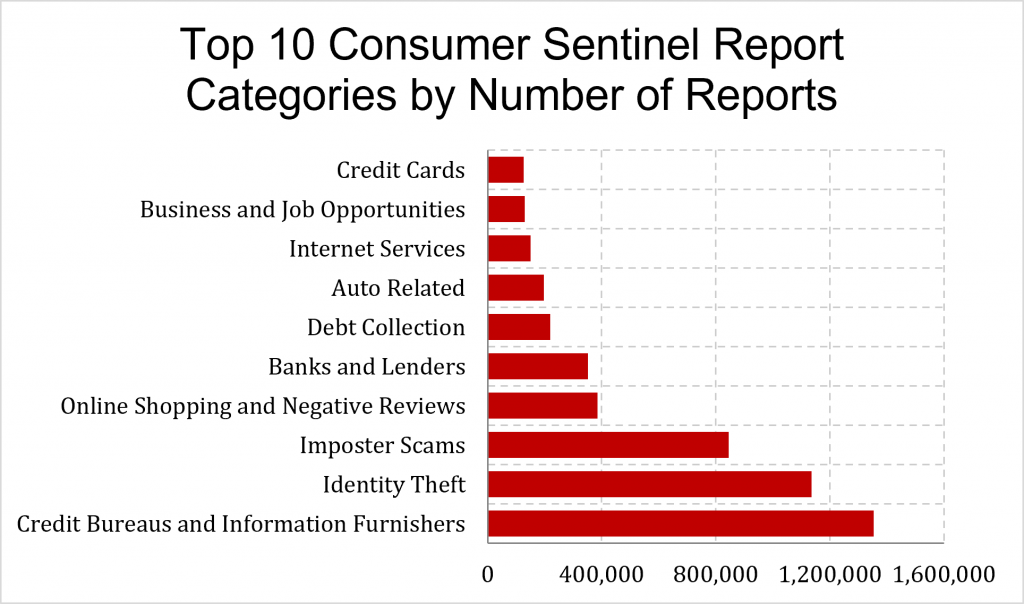
Credit bureaus and information furnishers, identity theft, and imposter scams were the top categories of Consumer Sentinel fraud reports in 2024.
The legal hook is familiar. Section 5 of the FTC Act declares unfair or deceptive acts or practices in or affecting commerce unlawful.[3] The FTC’s deception framework focuses on whether a representation, omission, or practice is likely to mislead consumers acting reasonably under the circumstances and whether it is material.[4] Consumer Sentinel data does not prove that every report is unlawful, but it helps identify areas where consumer-facing practices generate enough friction or harm to deserve legal attention.
Payment Method Is Where the Loss Becomes Real
As shown in figure 2 below, in 2024, bank transfers or payments accounted for approximately $2.089 billion in reported losses, the largest payment category in the dataset. Cryptocurrency followed at approximately $1.417 billion. Payment apps and services accounted for approximately $391 million; cash, $308 million; wire transfers, $287 million; credit cards, $275 million; checks, $225 million; gift cards or reload cards, $212 million; debit cards, $180 million; and money orders, $51 million.
Figure 2. Reported Consumer Fraud Losses by Payment Method, 2024
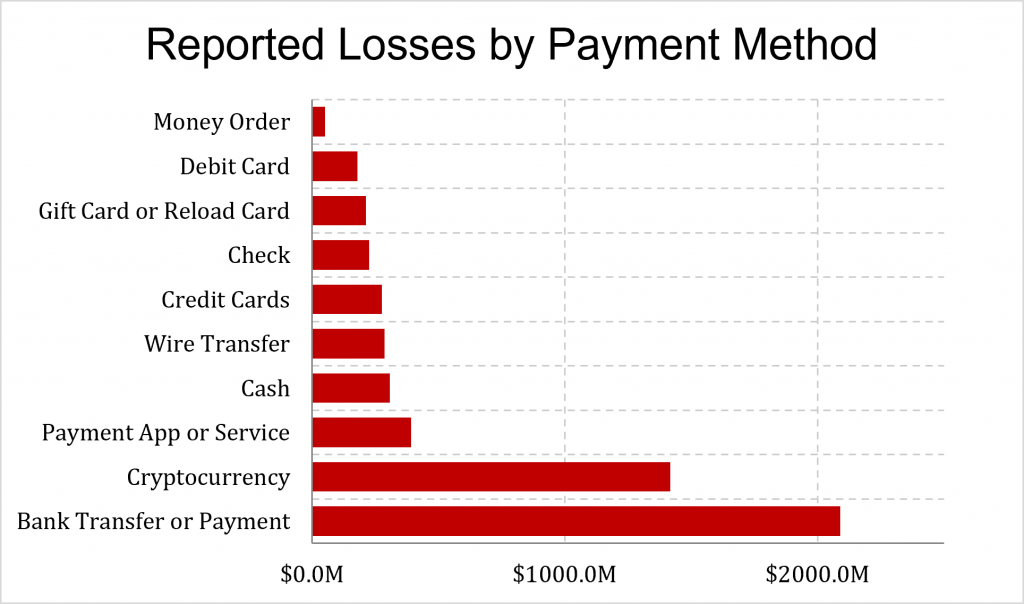
Bank transfers or payments and cryptocurrency were the payment methods for the vast majority of consumer fraud losses in 2024 Consumer Sentinel data.
This ranking should matter to lawyers advising companies, platforms, financial institutions, fintech providers, and payment intermediaries. Consumer protection analysis often begins with the front end of the transaction: what was said, what was omitted, and whether the overall impression was misleading. The payment data shows that the back end of the transaction is just as important. Once money moves through a bank transfer, cryptocurrency transfer, wire transfer, payment app, or similar mechanism, recovery can be difficult.
The FTC has separately reported that consumers in 2024 lost more money to scams paid through bank transfers or cryptocurrency than through all other payment methods combined.[5] If a consumer-facing pathway uses urgency, impersonation, scarcity, or fear to move a person toward a hard-to-reverse payment method, the risk is not merely reputational; it becomes a financial-harm problem with legal consequences.
The Marketing Channel Is Often the Entry Point
The contact-method chart, shown in figure 3, brings the marketing side into focus. Social media was associated with approximately $1.858 billion in reported losses, the highest amount among the listed contact methods. Websites or apps accounted for approximately $976 million; phone calls, $948 million; emails, $502 million; text messages, $470 million; online ads or pop-ups, $246 million; and mail, $90 million. The “other” category accounted for approximately $1.072 billion.
Deceptive marketing is nearly as old as marketing itself. The familiar image of the traveling snake-oil salesman reflects a long-standing form of commercial opportunism: taking advantage of limited information, consumer trust, urgency, or the difficulty of verifying a claim before a purchase is made. The basic strategy has not disappeared, but the delivery methods have changed. What once occurred through personal demonstrations, printed advertisements, or door-to-door sales can now be carried out through social media, websites, apps, text messages, and other digital channels.
From a marketing perspective, opportunism helps explain how legitimate tools of persuasion can be redirected toward deception. Scarcity, social proof, authority, personalization, and urgency can help consumers evaluate legitimate products, but they can also be used to discourage careful review or accelerate payment before a claim can be verified. Digital platforms increase the potential scale of that conduct by allowing a deceptive message to reach large numbers of consumers quickly, at relatively low cost, and with increasingly precise targeting.
Figure 3. Reported Consumer Fraud Losses by Contact Method, 2024
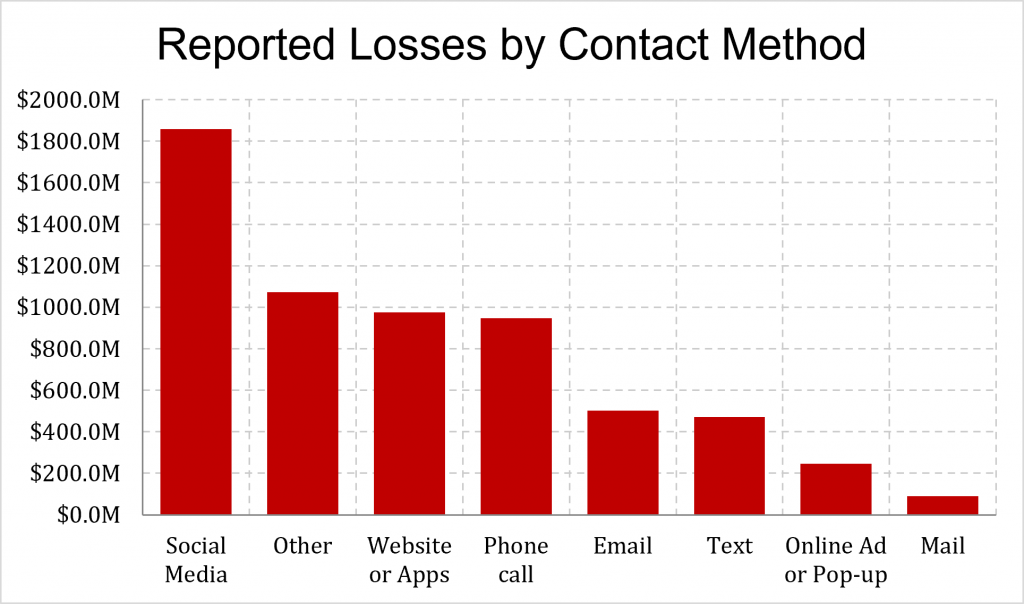
Social media was the contact method for almost $1.86 billion in consumer fraud losses in 2024, the highest amount of any contact method by far.
These numbers show that modern consumer fraud often begins in ordinary marketing environments. Cialdini’s Principles of Influence[6] describe several methods of influence widely used in the marketing environment, including reciprocity, social proof, and scarcity, that, while not necessarily illegal, do capitalize on consumers’ use of heuristics or mental shortcuts, resulting in purchasing decisions less than beneficial.
Other theories in the areas of cognition, decision-making, psychology, and sociology also help explain why consumers engage in faulty decision-making and fall prey to fraudulent activities. Social media, apps, websites, emails, texts, and online ads are not merely communication tools; they are consumer access points. A deceptive message on social media may not look like a traditional advertisement. A fake website may mimic a legitimate business. A text message may imply urgency. A phone call may create fear. Each channel can move a consumer closer to a financial decision.
That point aligns with the FTC’s concern over digital “dark patterns,” which the agency has described as design practices that can trick or manipulate consumers into buying products or services or giving up personal information.[7] Consumer Sentinel data does not measure dark patterns directly, but it supports the same broader concern: digital design, contact channels, and consumer decision-making cannot be separated from the legal analysis of deception.
The Harm Is Not Limited to One Age Group
The age data shown in figure 4 complicates the simple narrative that consumer fraud is only a problem for one demographic group. Reported losses were highest among consumers ages sixty to sixty-nine, at approximately $1.18 billion. Consumers ages fifty to fifty-nine reported approximately $1.006 billion in losses, followed by ages forty to forty-nine, approximately $971 million; ages seventy to seventy-nine, approximately $887 million; ages thirty to thirty-nine, approximately $810 million; ages twenty to twenty-nine, approximately $430 million; ages eighty and over, approximately $319 million; and ages nineteen and under, approximately $55 million.
Figure 4. Reported Consumer Fraud Losses by Age Group, 2024
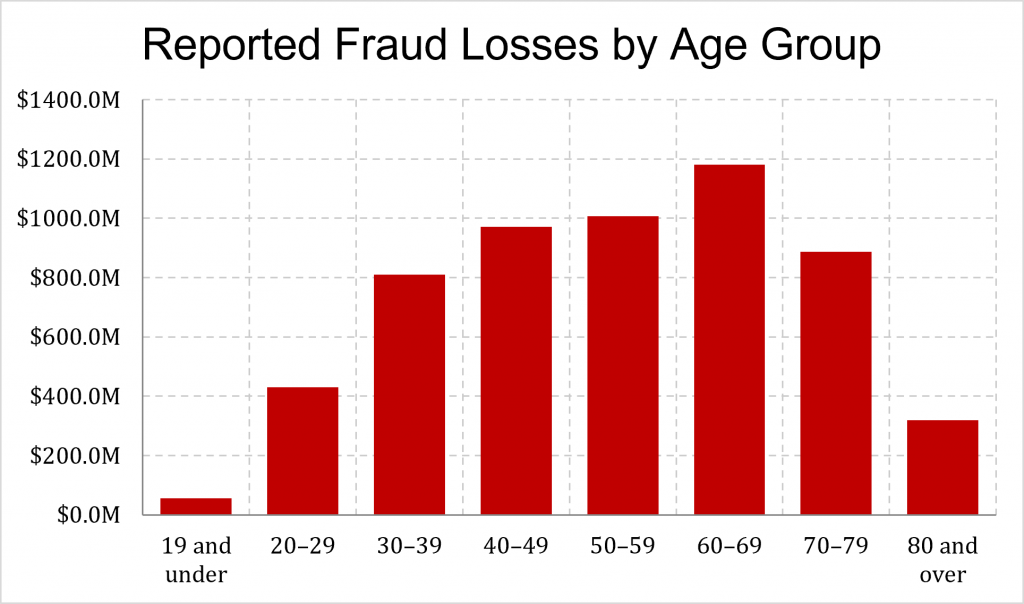
Consumer fraud is a problem for all age groups, with consumers in age groups 30–39 to 70–79 all reporting over $800 million in losses in 2024.
The chart does not prove why loss levels differ by age group. It may reflect differences in assets, savings, reporting behavior, channel exposure, scam type, or willingness to engage with certain communications. Still, the pattern is useful. It suggests that consumer education and compliance controls should not be generic. The warning needed for a twenty-five-year-old using payment apps and social media may not be the same warning needed for a sixty-five-year-old responding to a bank message, investment offer, technical support contact, or government imposter communication.
Geography Can Help Target Enforcement and Compliance
The state chart, shown in figure 5 below, shows the largest reported fraud losses in California, Texas, Florida, New York, Arizona, Illinois, New Jersey, Washington, Virginia, and Georgia. California alone accounted for approximately $1.679 billion in reported fraud losses. Texas reported approximately $898 million; Florida, approximately $866 million; and New York, approximately $534 million.
Figure 5. Top 10 States by Total Reported Consumer Fraud Losses, 2024
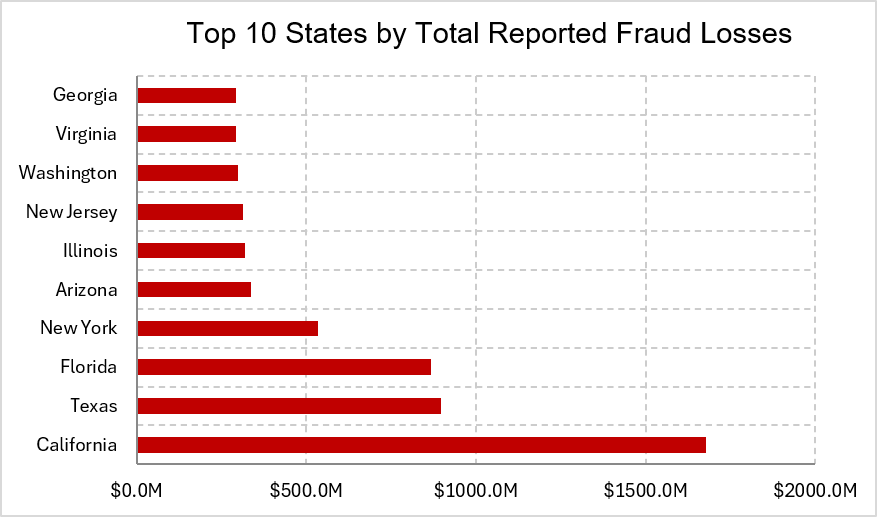
California, Texas, and Florida, the states with the largest populations, were the states with the most total reported consumer fraud losses in 2024.
Large states will naturally show large aggregate losses, so Table 1 below details per capita total fraud losses for each of the top ten aggregate state losses. State attorneys general, consumer protection offices, financial institutions, and national companies can use geographic data to decide where education, monitoring, and enforcement resources may be most needed. For corporate counsel, geographic concentration can be an issue-spotting tool. If a product, campaign, platform feature, or payment pathway generates disproportionate complaints or losses in a state, that pattern should trigger review.
Table 1: Per Capita Reported Fraud Losses in States with Largest Aggregate Losses, 2024
State | 2024 Population[8] | 2024 Total Fraud Loss | Per Capita Fraud Loss |
Arizona | 7,582,384 | $336,716,502 | $44.41 |
California | 39,431,263 | $1,678,703,608 | $42.57 |
Washington | 7,958,180 | $297,200,858 | $37.35 |
Florida | 23,372,215 | $866,069,909 | $37.06 |
Virginia | 8,811,195 | $293,690,299 | $33.33 |
New Jersey | 9,500,851 | $314,439,857 | $33.10 |
Texas | 31,290,831 | $897,890,888 | $28.70 |
New York | 19,867,248 | $533,979,898 | $26.88 |
Georgia | 11,180,878 | $291,260,795 | $26.05 |
Illinois | 12,710,158 | $318,113,996 | $25.03 |
A Practical Framework for Business Lawyers
Consumer Sentinel data supports a simple framework for evaluating deceptive marketing and consumer fraud risk. First, ask how the consumer was reached. Second, ask what representation or impression was created. Third, ask how payment was requested or processed. Fourth, ask which consumers appear most exposed. Fifth, ask where the losses are concentrated. Those questions move the analysis from isolated advertising review to a broader review of the consumer journey.
This approach is useful because a social media message, website, app screen, text, phone call, or online ad may be only one part of the transaction. The more important question may be whether the full pathway creates foreseeable financial harm. That pathway can include the claim, the timing, the call to action, the payment method, the consumer segment, and the post-payment recovery process.
For corporate counsel, the lesson is operational. Advertising review, user-experience review, payment-risk review, complaint monitoring, and fraud prevention should not be separate silos. If the same consumer journey creates marketing conversion, payment movement, and complaint risk, it should be reviewed as one legal and business process. Consumer Sentinel data gives lawyers a way to explain that point to boards and executives in concrete terms: risk can be measured in reports, dollars, channels, payment methods, age groups, and states.
Conclusion
The most useful insight from the 2024 Consumer Sentinel data is not simply that consumer fraud exists—it is that the harm can be mapped in a way that business lawyers understand. The contact method shows how the consumer enters the funnel. The payment method shows how the loss occurs. The age and state data show who and where the harm affects. The report categories show the parts of the marketplace where consumer trust is breaking down.
That makes deceptive marketing a business law problem as much as a consumer protection problem. It involves legal representations, platform design, payment systems, compliance controls, customer trust, and measurable financial loss. The data does not establish liability in any individual case, but it does provide an early warning system. Public complaint data can help lawyers and businesses see where consumer-facing conduct is most likely to produce financial harm—and where compliance attention should go before the next enforcement action, lawsuit, or reputational crisis.
Fed. Trade Comm’n, Consumer Sentinel Network Data Book 2024 (2025). The FTC states that the 2024 data book is based on unverified reports filed by consumers, not a consumer survey. ↑
Id. data files (CSV files). The figures in this article are based on author analysis of the public data files. ↑
15 U.S.C. § 45(a)(1). ↑
Fed. Trade Comm’n, Policy Statement on Deception, appended to Cliffdale Assocs., Inc., 103 F.T.C. 110, 174–84 (1984). ↑
Press Release, Fed. Trade Comm’n, New FTC Data Show a Big Jump in Reported Losses to Fraud to $12.5 Billion in 2024 (Mar. 10, 2025). ↑
Robert B. Cialdini, Influence: The Psychology of Persuasion (rev. ed., Harper Bus. 2006). ↑
Fed. Trade Comm’n, Bringing Dark Patterns to Light (Sept. 2022). ↑
Annual Estimates of the Resident Population for the United States, Regions, States, District of Columbia, and Puerto Rico: April 1, 2020 to July 1, 2024 (NST-EST2024-POP), in Vintage 2024 National and State Population Estimates, U.S. Census Bureau (Dec. 2024). ↑