



At the recent Tokyo Business and Rule of Law Forum, Alejandro Ponce, Executive Director of the World Justice Project (“WJP”), issued a stark warning: “A weak rule of law is a direct business problem. When everyone—including government—is not held accountable to clear, equally applied rules, the private sector loses the confidence required for long-term planning.”
The data confirms instability is accelerating. According to the WJP Rule of Law Index® 2025, 68% of countries saw their scores decline this year—a significant jump from 57% in 2024. While building stable institutions is a slow, iterative process, the current trend shows that dismantling them occurs much more swiftly.
As lawyers, who ourselves have taken a solemn oath to defend the Constitution and the rule of law, we must heed the warning that the erosion of judicial independence and civil justice represents a critical threat to the democratic and economic stability we are sworn to protect.
A rise in authoritarianism is driving the rule of law recession
An expansion of authoritarian trends—namely, a reduction in civic space and weakening checks and balances—has been the primary force behind this downturn, with deep declines in factors measuring Constraints on Government Powers, Open Government, and Fundamental Rights.
The critical pillars of government accountability have eroded in most countries:
- Legislative and judicial oversight are losing their ability to check executive power, declining in 61% of countries.
- Independent auditing of government actions fell in 61% of countries.
- Fundamental freedoms, specifically expression, assembly, and participation, have shrunk in nearly 75% of nations, stifling the public debate necessary for a healthy democracy.
Judicial independence, the last line of defense against executive overreach, is weakening
The Index shows that judiciaries are losing ground to executive overreach, with rising political interference across justice systems. Indicators measuring whether the judiciary limits executive power and whether civil and criminal justice are free from improper government influence declined in 61%, 67%, and 62% of countries, respectively.
For the business community, the decline of civil justice in 68% of countries is particularly concerning. This weakening is reflected in longer court delays, less effective mediation, and increased government interference in legal outcomes.
Rule of law in the U.S. continues to decline
Rule of law in the United States continued to decline for the third consecutive year, falling in seven of the eight factors measured. Indeed, in the latest report, the United States was one of the ten countries with the largest declines in rule of law. This decline was driven specifically by weakening fundamental rights and a lack of effective constraints on government powers, as well as the perception that government officials are not sanctioned for misconduct. The U.S. currently ranks twenty-seventh out of the 143 countries and jurisdictions surveyed.
In the latest World Justice Project report, the United States was one of the 10 countries with the largest decline in rule of law.
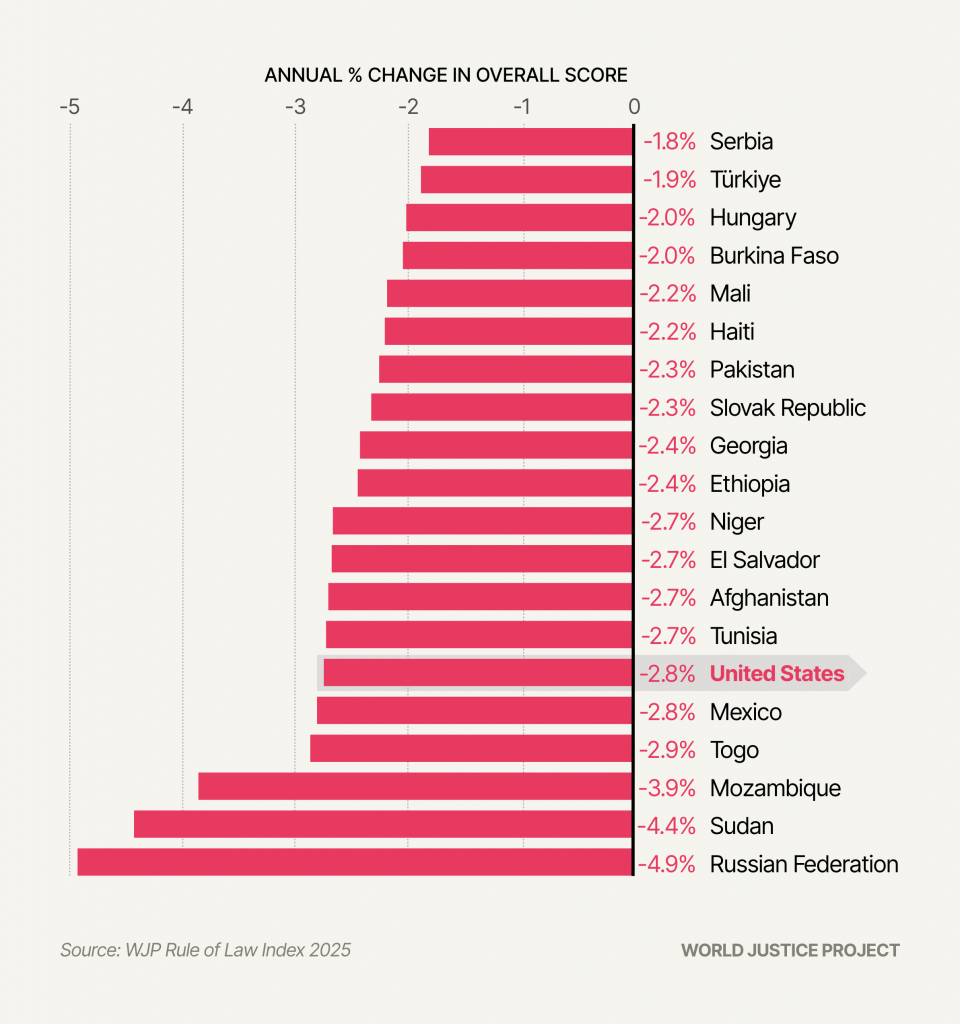
U.S. rule of law saw the sixth largest decline of the 143 countries assessed, behind only the Russian Federation, Sudan, Mozambique, Togo, and Mexico. Source: © World Justice Project, WJP Rule of Law Index 2025.
Seven of eight rule of law factors declined in the United States from 2024 to 2025.
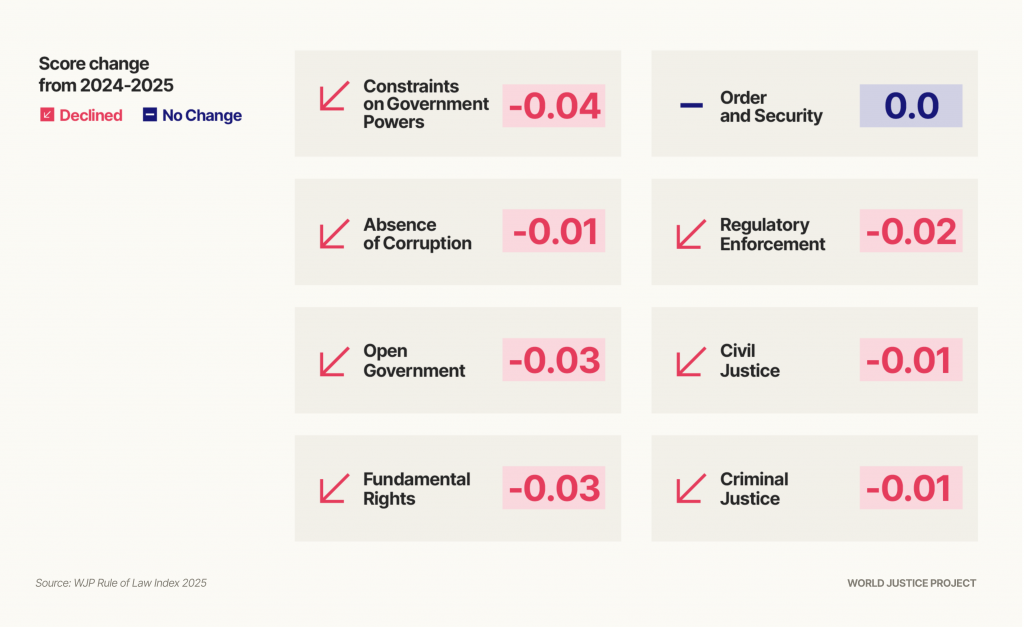
U.S. scores for seven of the eight rule of law factors dropped by between 0.01 and 0.04; only Order and Security showed no change. Source: © World Justice Project, WJP Rule of Law Index 2025.
The continuing decline in the U.S. rule of law score was driven specifically by weakening fundamental rights and a lack of effective constraints on government powers.
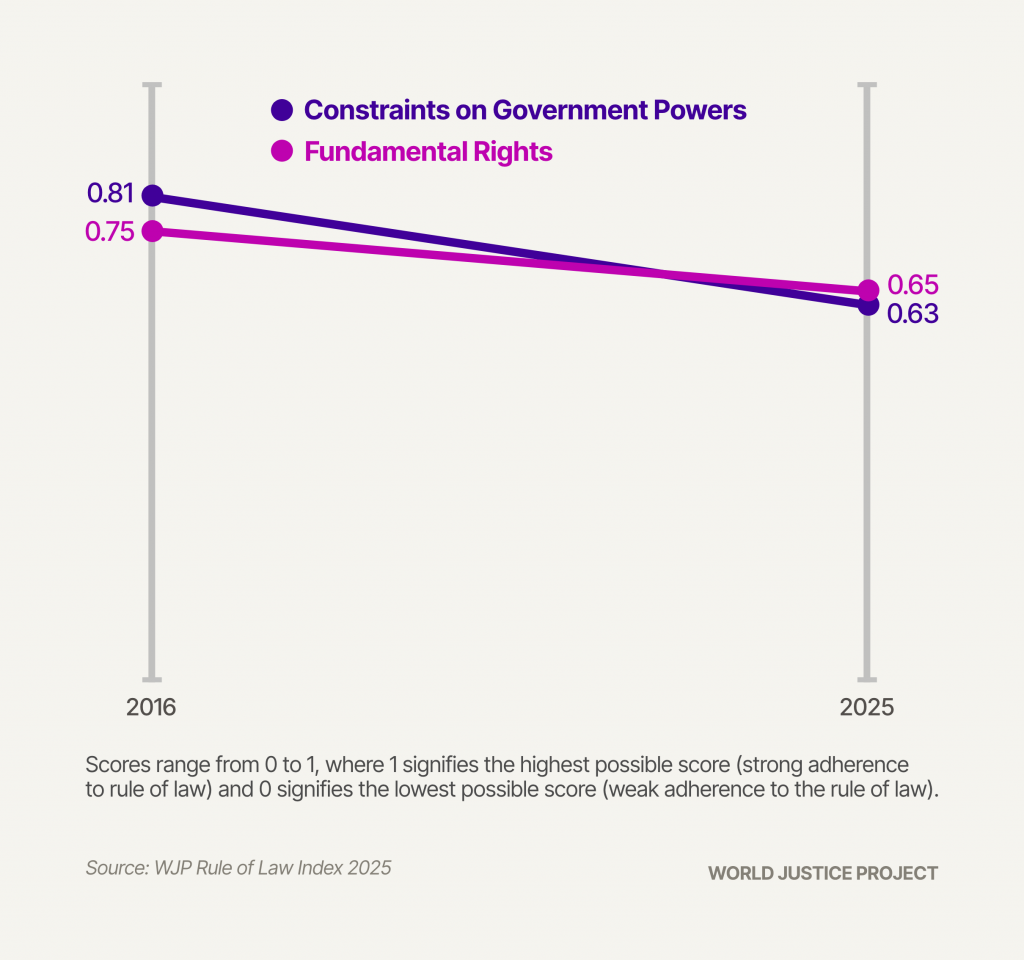
From 2016 to 2015, U.S. scores for fundamental rights and constraints on government powers dropped from 0.75 to 0.65 and 0.81 to 0.63, respectively. Source: © World Justice Project, WJP Rule of Law Index 2025.
The U.S. score for the subfactor “Government officials are sanctioned for misconduct” continued to decline.
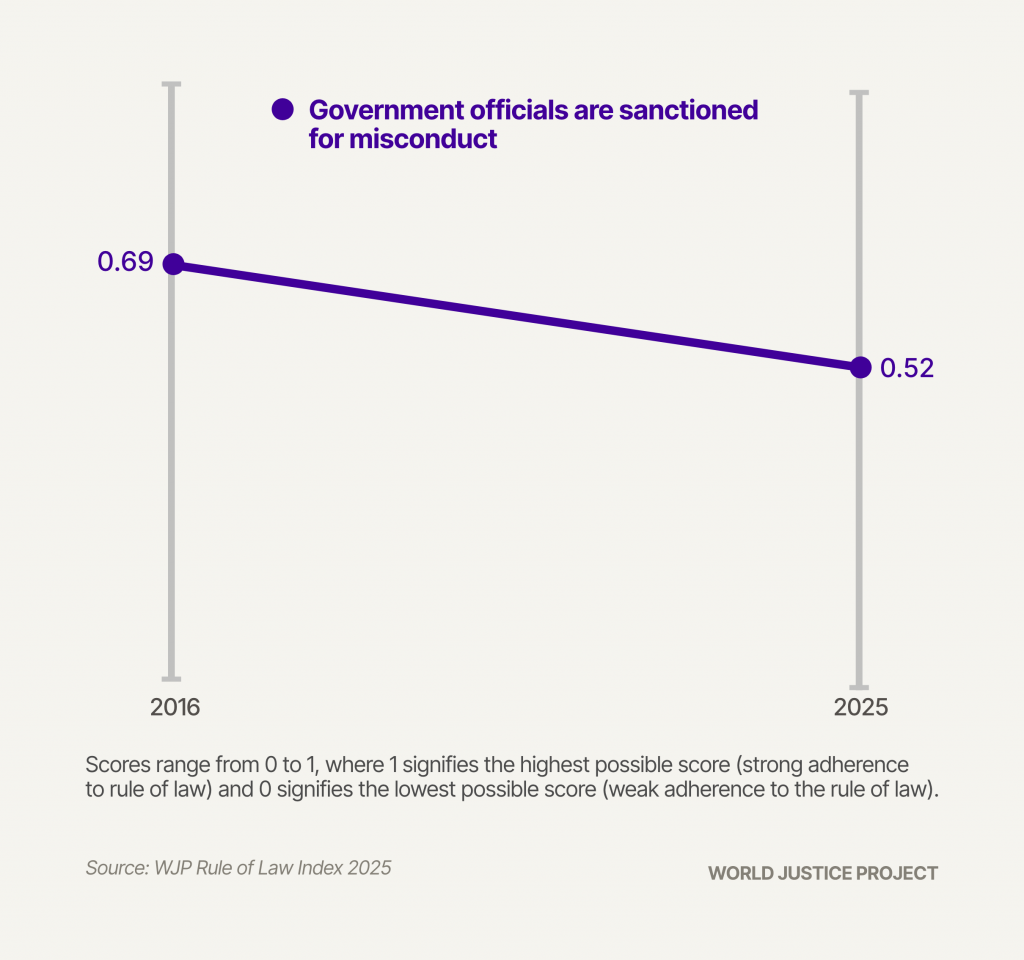
The United States scored 0.52 for the subfactor Government Officials Are Sanctioned for Misconduct, down from 0.69 in 2016. Source: © World Justice Project, WJP Rule of Law Index 2025.
WJP Rule of Law Index 2025: Key Findings Summary
The WJP Rule of Law Index provides data on eight factors: Constraints on Government Powers, Absence of Corruption, Open Government, Fundamental Rights, Order and Security, Regulatory Enforcement, Civil Justice, and Criminal Justice. Scores range from 0 to 1, where 1 signifies the highest possible adherence to the rule of law. This year, the Index covers 143 countries and jurisdictions.
- Top-Ranked Countries: Denmark (1), Norway (2), Finland (3), Sweden (4), New Zealand (5).
- Bottom-Ranked Countries: Venezuela (143), Afghanistan (142), Cambodia (141), Haiti (140), Nicaragua (139).
- Top Decliners: The most significant decliners include the Russian Federation (-4.9%), Sudan (-4.4%), and Mozambique (-3.9%).
- Top Improvers: Countries with the largest improvements include the Dominican Republic (2.1%), Senegal (1.6%), and Sierra Leone (1.4%).
Explore the full rankings and findings of the 2025 WJP Rule of Law Index at the World Justice Project website.
“These findings and data are important for both businesses and business lawyers,” said John H. Stout, of counsel at Fredrikson & Byron P.A. and co-chair of the American Bar Association Business Law Section’s Rule of Law Working Group. “This information is critical to both as they give legal advice and make business decisions about whether to increase or decrease their investment in a particular country.”
About the World Justice Project:
The World Justice Project (WJP) is an independent, nonpartisan, multidisciplinary organization working to create knowledge, build awareness, and stimulate action to advance the rule of law worldwide.
This article is part of a series on the rule of law and its importance for business lawyers created by the American Bar Association Business Law Section’s Rule of Law Working Group. Read more articles in the series.

