When negotiating mergers or acquisitions, deal lawyers will often support their position by asserting that it is in accord with the “market” based on published deal points studies. However, as many of these lawyers intuit based on their experience, terms vary across the market based on a number of factors including deal size, a factor that no previously published study has examined or accounted for. This article confirms that intuition by surveying the middle market at deal sizes from several million to several billion dollars and showing, for the first time, that highly negotiated deal points tend to become more seller favorable as transaction value increases. This conclusion is based on a review of five terms (liability cap, liability basket amount and type, sellers’ catch all representations, the “no undisclosed liabilities” representation, and closing conditions) across 849 deals from 2007 to 2015, a sample larger than that used in any previously published deal points study of mergers and acquisitions.
When negotiating mergers or acquisitions, many deal lawyers try to gauge what a “market” position is for a given deal point by looking at published deal points studies.1 Often these studies are cited in negotiations by one of the parties to show that the position that party is advocating is in line with the market and thus fair. Seasoned practitioners know from experience that the other party will frequently reject the study data on grounds that it is not representative of the market segment their deal inhabits. This objection is reasonable; deal points studies provide a good baseline for understanding the market as a whole, but thus far they have not investigated how terms vary across market segments. Our study addresses one facet of that issue, perhaps the most significant one, by showing how transaction size affects highly negotiated deal points.2 By publishing, for the first time, data to show what market is at each transaction size, we hope to facilitate settlement of these contentious points and contribute to transactional efficiency.3
This study analyzes data collected from 849 merger or acquisition deals spanning nine years, from 2007 to 2015, on which SRS Acquiom served as the shareholders’ representative for a privately held target company’s shareholders.4 Through its shareholders’ representative service, SRS Acquiom is engaged when there is a large number of shareholders that would prefer to use the services of a third party to manage postclosing administration and dispute matters. In this set of 849 deals, the average number of shareholders of the private company target was 169 and the median number of shareholders was 90.5
This sample is larger than that used in any previously published study of M&A deal points and ensured that each of the six transactionsize buckets we examined contained a significant number of deals such that random outliers would not unduly skew the results. The sample reflects deals with purchase prices ranging from $1 million to $3.2 billion with a mean deal size of $149.3 million and a median of $74.5 million. This distribution focuses on deals that are sometimes referred to as the “middle market” ($10 million to $1 billion), but it also includes smaller deals under $10 million. The middle market can be further subdivided into the “lower” ($10 million to $250 million), “core” ($250 million to $500 million), and “upper” ($500 million to $1 billion) segments.6
In discussing the effect of transaction size on deal points with other deal professionals, we noted that many who have worked in multiple segments have observed that what market is varies by segment. This study demonstrates for the first time that this anecdotally observed variation of terms across deal sizes is a real phenomenon and quantifies that variation for the following negotiated terms: (I) liability caps, (II) liability basket amount and type, (III) seller’s catch-all representations and warranties, (IV) the “no undisclosed liabilities” representation, and (V) closing conditions. Our analysis shows that, in general, those highly negotiated deal points tend to become more seller favorable as deal size increases. We briefly explain each of these deal points and our findings on how transaction size affects them in the parts that follow.
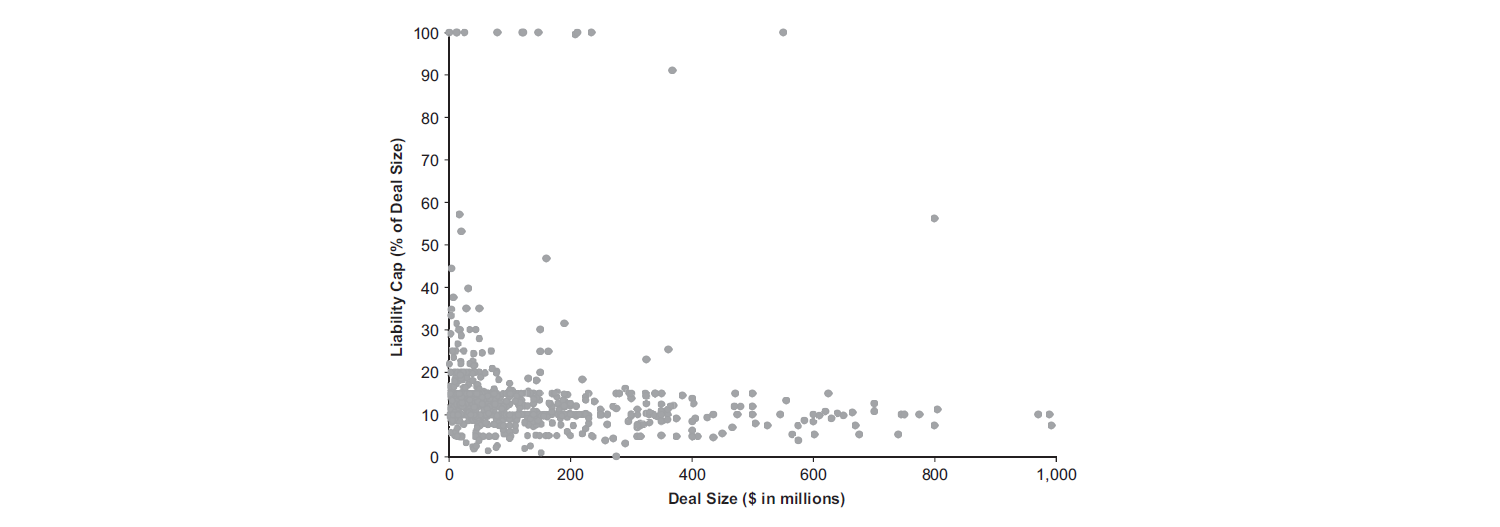
Figure 1-A Liability Cap as a Percent of Deal Size, Versus Deal Size (Raw Data)
I. LIABILITY CAPS
Liability caps establish an upper limit on the amount of the seller’s indemnification obligations. Generally, liability caps apply to most of the seller’s representations, but they usually do not apply to covenants and representations defined by the parties to the transaction as “fundamental.”7 The seller, of course, prefers liability caps that are lower relative to the total transaction price, while the buyer prefers liability caps that are higher.
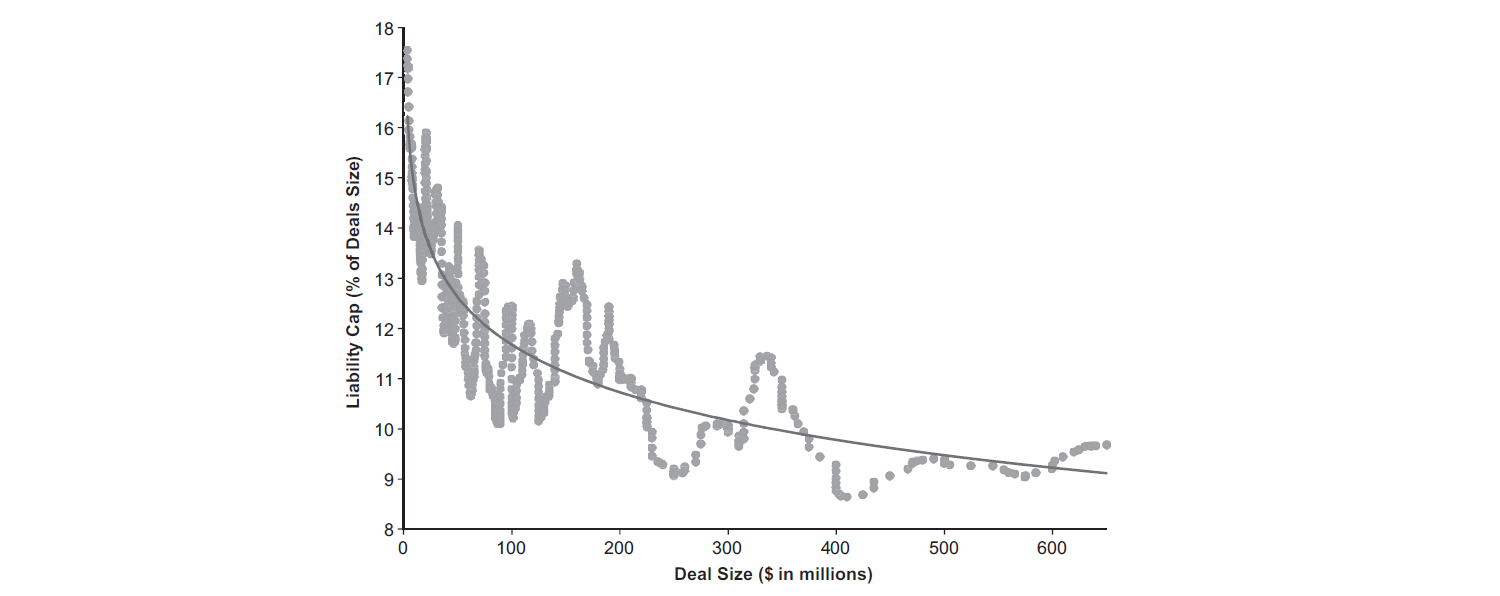
Across all deals in the sample, the mean liability cap was 14.2 percent of the transaction price. However, when looking at the relationship between liability caps and transaction size, we found that for smaller deals, buyers were able to obtain higher liability cap percentages; 74.7 percent of deals with liability caps of 20 percent or above occurred at deal sizes below the $74.5 million median of our sample (see Figure 1-A, above). To take a closer look at this nonlinear relationship, we fit an exponential decay to a mathematically smoothed set of the liability cap percentage data and found that as deals increase in size, liability caps as a percentage of the transaction size become smaller and more seller favorable (see Figure 1-B, below). This indicates that many buyers of smaller deals have the leverage to require sellers to bear more risk on a percentage basis.
Figure 1-B Liability Cap as a Percent of Deal Size, Versus Deal Size (Smoothed Data)8
II. LIABILITY BASKET AMOUNT AND TYPE
Liability baskets establish the minimum threshold amount of the seller’s indemnification obligation below which the seller will not be liable. Like liability caps, liability baskets generally apply to most of the seller’s representations, but they usually do not apply to covenants or to fundamental representations.9 The average threshold amount of a liability basket in our study was 0.83 percent of the transaction size, decreasing slightly as the purchase price increased. A decrease in the basket amount as a percentage of deal size as deals increase in transaction size reflects a benefit for buyers, who benefit from a lower threshold (as a percentage of deal size) in bringing indemnification claims. However, basket amounts in absolute dollars still increase as deal size increases. Therefore, although a buyer’s relative position appears to be more favorable as deals become larger, the increase in the nominal basket amount still favors sellers in absolute terms. Moreover, as explained below, as transaction size increases, sellers are able to negotiate more favorable types of baskets.
In general, there are three basic types of baskets. “Deductible” baskets, which are the most seller friendly, result in liability to the seller only for damages in excess of the threshold amount. Thus, if the basket is set at $1 million and there are $1.1 million of damages, only $100,000 is recoverable against the seller. First dollar or “tipping” baskets are more buyer friendly because they result in liability to the seller for all damages once the threshold amount has been reached. For the same example, because the $1.1 million in damages is greater than the basket amount of $1 million, all $1.1 million in damages would be recoverable with a tipping basket. A third common approach is a combination or “partial tipping” basket. Under a combination basket, the seller is liable for all damages in excess of a threshold amount plus a percentage of the damages below that threshold. For example, if we again assume $1.1 million in damages but this time with a $1 million basket amount with a 50 percent tip, then the seller would be liable for $600,000 of the $1.1 million in damages (equal to the $100,000 above the threshold plus 50 percent of the amount below the $1 million threshold). Finally, in a small subset of deals, there is no liability basket, meaning that the seller is liable for all damages from the first dollar of indemnified claims, which is the most buyer-friendly alternative.
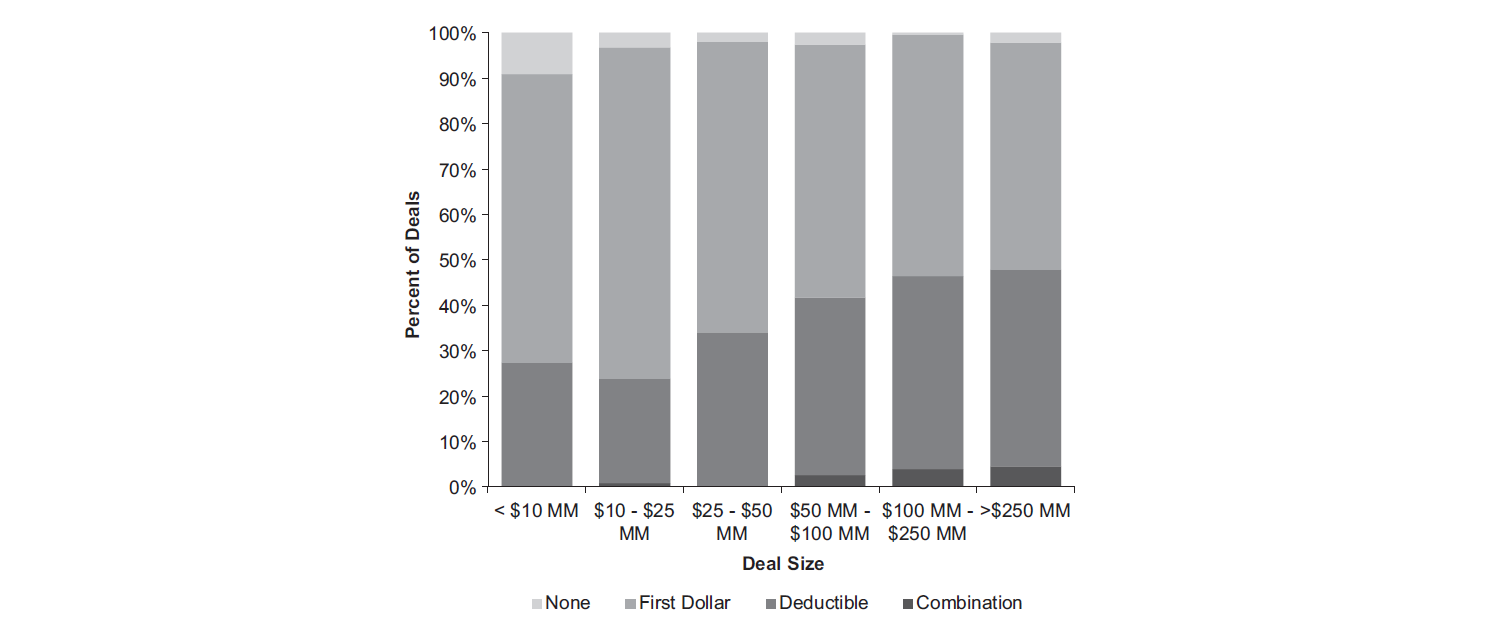
Figure 2, below, highlights the prevalence of each type of basket at various deal sizes. We note that for deals having a purchase price of less than $10 million, deals with no basket or first dollar baskets make up 72.7 percent of the deals, while deals with deductible baskets make up only 27.3 percent. As the deal size increases, so too does the prevalence of deductible or combination baskets; 47.8 percent of deals having a purchase price greater than $250 million contain deductible or combination baskets, while only 52.2 percent contain first dollar or deductible baskets. The data reflects that as deal size increases, sellers are generally able to negotiate better liability basket terms.10
Figure 2 Basket Type, Segmented by Deal Size
III. SELLER’S CATCH-ALL REPRESENTATIONS
Seller’s “catch-all” representations serve to fill in any gaps that are left by more specific representations. One common formulation, the “10b-5” representation, mirrors the Securities Exchange Act of 1934 rule of the same name, but without the scienter requirement:
No representation or warranty or other statement made by Seller in this Agreement, the Disclosure Letter, any supplement to the Disclosure Letter, the certificates delivered pursuant to Section 2.7(a) or otherwise in connection with the Contemplated Transactions contains any untrue statement or omits to state a material fact necessary to make any of them, in light of the circumstances in which it was made, not misleading.
In another formulation, the “full disclosure” representation, the seller represents that all material facts of which it has knowledge have been disclosed:
Seller does not have Knowledge of any fact that has specific application to Seller (other than general economic or industry conditions) and that may materially adversely affect the assets, business, prospects, financial condition or results of operations of Seller that has not been set forth in this Agreement or the Disclosure Letter.
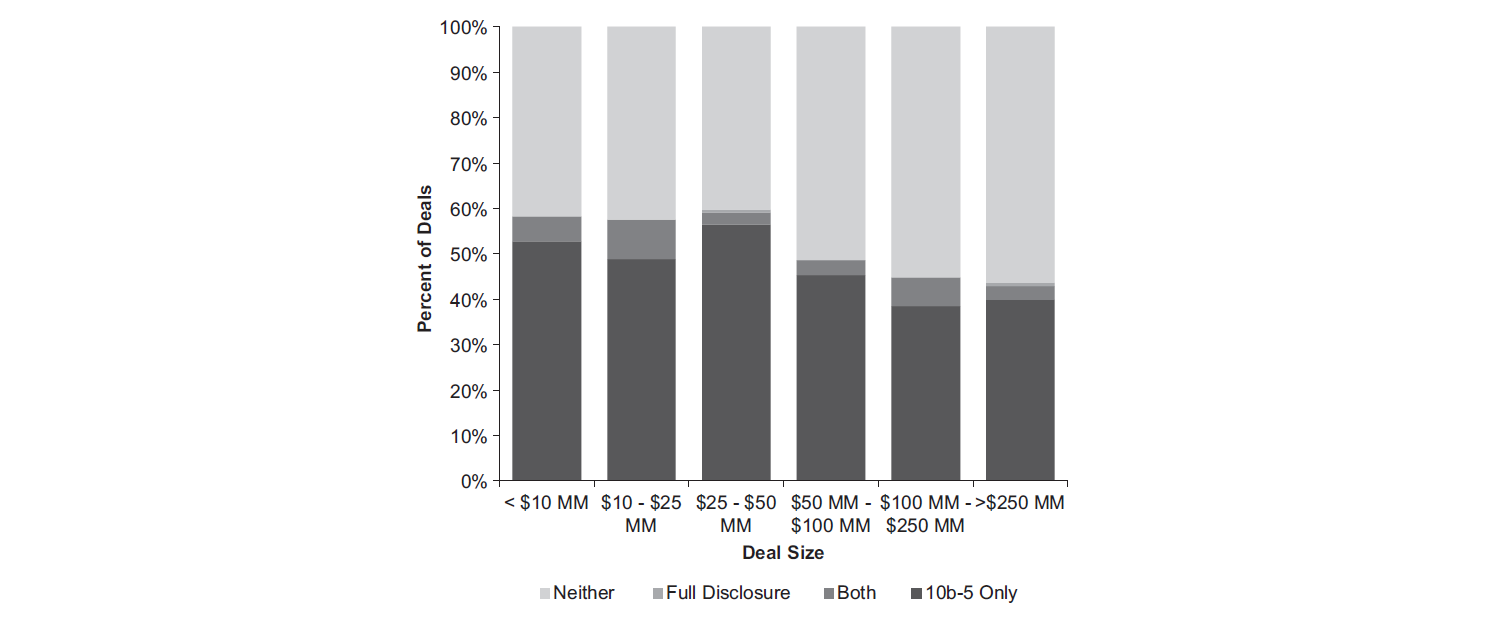
Figure 3 Seller’s Catch-All Representations, Segmented by Deal Size
Buyers prefer to include catch-all representations because they provide a more fulsome basis for indemnification protection than do the seller’s specific representations. Conversely, sellers object to these representations because they greatly expand the potential scope of sellers’ exposure to indemnification claims.
As noted in Figure 3 above, we found that for transactions having a purchase price of less than $10 million, buyers were successful in obtaining catch-all representations in 58.2 percent of the deals in our sample. However, as the deal size increases beyond $50 million, their prevalence decreases. For deals having a purchase price greater than $250 million, only 43.6 percent of deals contain catch-all representations.11
IV. “NO UNDISCLOSED LIABILITIES” REPRESENTATION
A “no undisclosed liabilities” representation is another type of catch-all representation, designed to protect the buyer against liabilities related to the business that have not been otherwise disclosed to the buyer. Buyers prefer a blanket representation from sellers, whereas sellers prefer to omit, or at least qualify, the representation. A buyer-friendly formulation of a no undisclosed liabilities representation is as follows:
Seller has no liability except for liabilities reflected or reserved against in the Balance Sheet or the Interim Balance Sheet and current liabilities incurred in Seller’s ordinary course of business since the date of the Interim Balance Sheet.
A seller-friendly formulation would limit the representation to liabilities required to be disclosed on a balance sheet prepared in accordance with GAAP, include a Material Adverse Effect qualifier, or both:
Seller has no liability of the nature required to be disclosed in a balance sheet prepared in accordance with GAAP [or which could not reasonably be expected to have, individually or in the aggregate, a Material Adverse Effect], except for liabilities reflected or reserved against in the Balance Sheet or the Interim Balance Sheet and current liabilities incurred in Seller’s ordinary course of business since the date of the Interim Balance Sheet.
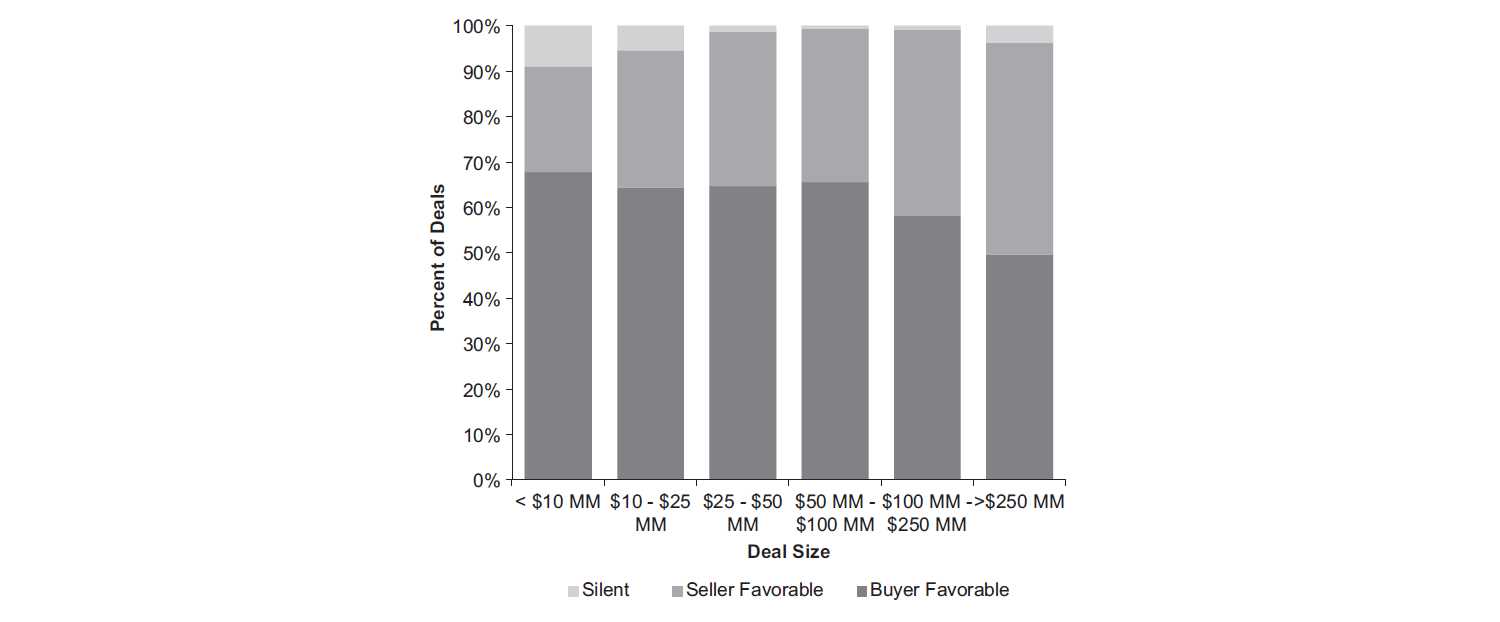
As noted in Figure 4 below, we found that the buyer-friendly formulation is most prevalent in smaller deal sizes, with 68 percent of deals having a purchase price under $10 million containing a blanket no undisclosed liabilities representation. As the deal size increases, the buyer-friendly formulation is generally less prevalent, with less than 50 percent of deals above $250 million including the formulation. Therefore, as deal size increases, sellers are increasingly able to qualify the undisclosed liabilities representation.12
V. CLOSING CONDITIONS
Prior to closing, the seller must demonstrate that certain conditions are met in order for the buyer to be obligated to close. One critical and customary closing condition is the “bring-down” of the seller’s representations. Our study reveals that there is considerable variation as to the precise standard that the seller must meet to satisfy this condition. Buyers prefer sellers to demonstrate that their representations are accurate “in all respects” as of the closing. This means that even an immaterial inaccuracy at closing in a representation that was entirely true at signing would allow the buyer not to close the transaction. An example of this formulation follows:
Figure 4 “No Undisclosed Liabilities” Representation, Segmented by Deal Size
Each of the representations and warranties made by Seller in this Agreement shall have been accurate in all respects as of the Closing Date as if made on the Closing Date.
Somewhat less buyer friendly, but still requiring the seller to bear more of the risk of changes between signing and closing, is a bring-down requiring representations to be accurate “in all material respects”; this means that only material inaccuracies in individual representations as of the closing date would allow the buyer not to close the transaction. For example:
Each of the representations and warranties made by Seller in this Agreement shall have been accurate in all material respects as of the Closing Date as if made on the Closing Date.
The most seller-friendly form of the condition, which provides the seller with the highest degree of certainty of closing, is a bring-down requiring representations to be true except for inaccuracies in the representations that would not have a “Material Adverse Effect” (as defined in the purchase agreement and commonly referred to as an “MAE”) on the business. For example:
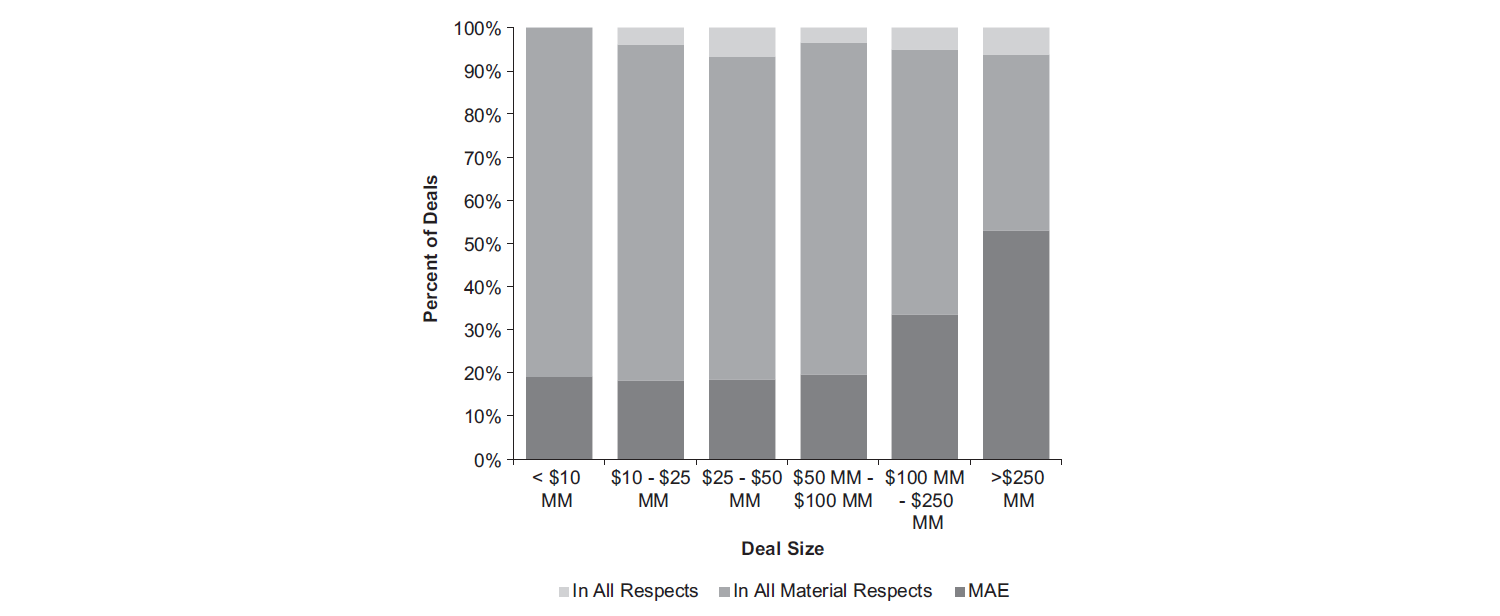
Figure 5 Closing Conditions, Segmented by Deal Size
Each of the representations and warranties made by Seller in this Agreement shall be accurate in all respects as of the Closing Date as if made on the Closing Date, except for inaccuracies of representations or warranties the circumstances giving rise to which, individually or in the aggregate, do not have and could not reasonably be expected to have a Material Adverse Effect.
As noted in Figure 5 above, only 18.4 percent of deals having a purchase price of less than $100 million have the seller-friendly Material Adverse Effect formulation. However, as purchase prices increase beyond $100 million, we found increasingly more seller-favorable formulations of the closing condition. For deals with purchase prices greater than $250 million, fully 53.1 percent of deals have the seller-favorable Material Adverse Effect formulation.13
VI. COMPARISON WITH THE 2013 AND 2015 ABA DEAL POINTS STUDIES
This is the first study to look at the prevalence of buyer- or seller-favorable deal points based on the sizes of transactions. Prior studies have tried to determine what “market” is for a given deal point by looking at the prevalence of various formulations in the study’s total sample but have not broken the sample down by transaction size.14 As a result, it is impossible to validate our results through a direct comparison with prior studies. However, by comparing the aggregate prevalence of different formulations of deal points across our entire sample with the aggregate prevalence found in prior studies, we can understand whether our sample yields similar conclusions as to what market is overall.
The most commonly cited deal points studies are the 2014 SRS Study and the 2013 and 2015 ABA Studies. The former is drawn from a subset of the data used here, and a comparison would thus not be helpful, but the ABA Studies are drawn from an entirely different sample. While the SRS Acquiom data used here come from deals in which the target company had a large number of shareholders that required the service of a shareholders’ representative, the ABA Studies look at publicly available deals that involved private targets being acquired by public companies. Despite these differences, in comparing the aggregate prevalence of the various deal point formulations seen in our study to those reported in the ABA Studies, we found that our results are consistent with those seen in the ABA Studies.
The 2013 and 2015 ABA Studies review 136 and 117 publicly available deals completed in 2012 and 2014, respectively, that involved private targets acquired by public companies through traditional merger or acquisition transactions. Compared to our sample, the ABA Studies’ samples skew toward larger deals. The value of the transactions in the 2013 ABA Study ranged from $17.2 million to $4.7 billion in purchase price (versus $1 million to $3.2 billion in this study), with mean and median deal sizes of $305 million and $150 million, respectively (versus $149 million and $74.5 million, respectively, in this study). Similarly, the value of the transactions in the 2015 ABA Study ranged from $50 million to $500 million in purchase price, with mean and median deal sizes of $186 million and $130.5 million, respectively.
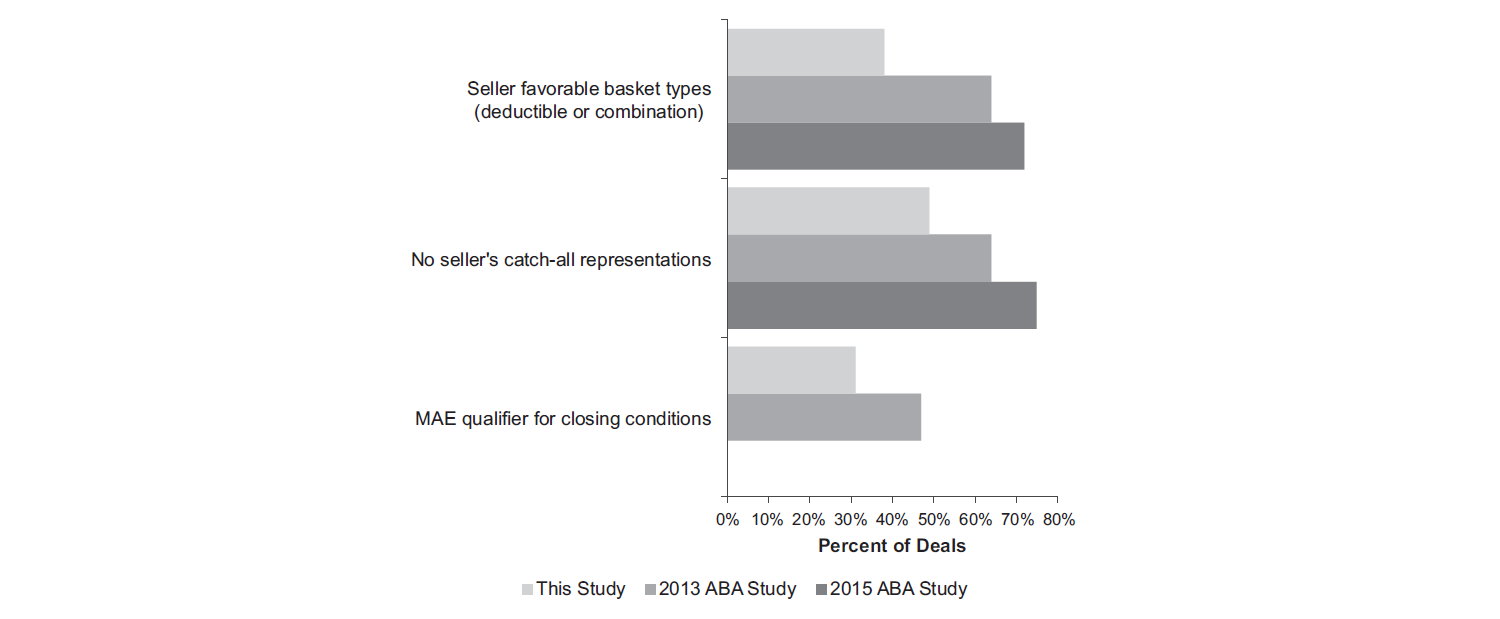
Figure 6, below, demonstrates that the deals of the ABA Studies’ samples (with their larger mean and median transaction sizes) were, on average, more seller friendly than the deals of this study with respect to liability basket type, seller’s catch-all representations, and warranties and closing condition terms.15 This is consistent with this study’s finding that the market for highly negotiated terms is more seller friendly at larger transaction sizes. Additionally, when looking at the median liability cap as a percent of deal size, the larger deals of the ABA Studies had a more seller-friendly 10.0 percent median (in both the 2013 and 2015 ABA Studies), compared with an 11.3 percent median in this study.
Figure 6 Comparison of the Percent of Deals with Seller-Friendly Terms
VII. CONCLUSION
Based on the SRS Acquiom sample, we conclude that, overall, as deals increase in transaction value, the parties become increasingly likely to settle on seller-favorable formulations of the hotly contested deal points we investigated, including liability caps, liability baskets, sellers’ catch-all representations and warranties, the “no undisclosed liabilities” representation, and closing conditions. Examining these points individually reveals that there are some instances in which deal terms do not become more seller favorable with each increase in transaction size; rather, some minor deviations in the overall trend occur.16 It is clear, however, that with respect to all of the studied points, transactions with purchase prices of less than $10 million contain, on average, more buyer-friendly terms than transactions with purchase prices above $250 million.
The reasons that legal deal terms become increasingly seller friendly as deal size increases are beyond the scope of this study. There are many possible contributing factors, and it seems likely that multiple factors play a role. Future researchers who wish to take on this question may want to start their investigations by considering the simplest explanation: a relatively weaker market for smaller businesses causes sellers of these businesses to accept more onerous legal terms just as they, on average, accept purchase prices based on lower multiples of earnings as compared to sellers of larger businesses.17 If in fact market forces are the primary contributing factor, we would expect that, within an industry, the multiples of earnings would increase as deal points become more seller favorable. Likewise, we would expect that other markers of a robust market, such as a greater number of bidders participating in an auction process,18 would correlate positively with incidence of seller-friendly deal terms.
While this study cannot explain what causes heavily negotiated deal terms to become more seller friendly as deal size increases, the trend documented here should help all parties to understand the market better and to avoid the breakdowns in negotiations that often occur when each side thinks the other is making an unreasonable or “non-market” request.
__________________
* Eric Rauch is a partner in the mergers and acquisitions practice group at Dorsey & Whitney, LLP. Brian Burke is an associate in the mergers and acquisitions practice group at Dorsey & Whitney, LLP. The authors are indebted to SRS Acquiom for offering the use of its database of M&A deals for this article, without which this study would not have been possible. Glenn Kramer of SRS Acquiom deserves special acknowledgement for his contribution to the statistical analysis included below. The authors would also like to thank John Marsalek and Bryn R. Vaaler for their thoughtful comments on earlier versions of this article. The views and opinions expressed in this article are solely those of the authors and not those of Dorsey & Whitney or of SRS Acquiom.
2. In this study, “transaction size” or “deal size” means the purchase price for the transaction, not including any earn-out consideration.
3. See Ronald J. Gilson, Value Creation by Business Lawyers: Legal Skills and Asset Pricing, 94 YALE L.J. 239 (1984) (describing the role of the business lawyer as that of a transaction cost engineer, designing efficient mechanisms to allow parties to effect transactions).
4. The set analyzed here comprises all of the merger or acquisition deals in which SRS Acquiom served as a shareholder representative from 2007 through 2015, but it excludes certain deals not considered to be traditional merger or acquisition transactions. For example, the sample does not take into account ongoing transactions with no closing date or previously completed transactions in which SRS Acquiom was engaged to take over as the successor to a different initial shareholder representative.
5. For a comparison of this sample with studies that arrived at their sample by other means, see infra Part VI.
7. Although which representations are defined as fundamental varies by deal, one form of a pro-buyer private merger agreement offered by Practical Law Company identifies the following representations as a starting point: organization and qualification, due authority, capitalization, environmental matters, employee benefits, and broker fees. See Merger Agreement (Private Company, Pro-Buyer), PRACTICAL L., http://us.practicallaw.com/5-538-9385 (last accessed Apr. 4, 2016). In the 2014 SRS Study, representations that were identified as fundamental and carved out from liability caps more than 10% of the time included due authority (carved out 84% of the time), capitalization (78%), taxes (72%), ownership of shares (66%), due organization (62%), broker or finder fees (42%), intellectual property (31%), no conflicts (23%), employee benefits and ERISA (16%), and title to and sufficiency of assets (15%). Covenant breaches were also carved out of the liability cap 29% of the time. 2014 SRS Study, supra note 1, at 67.
8. For the smoothed data set, we ordered the deals by transaction size and convolved that with a fifteen-deal-wide triangle filter. We then fit an exponential decay to the resulting data set, obtaining the following equation of fit: Liability Cap Percent = 19.32 * exp(–0.11 * ln(Deal Size in $ Millions)). This model resulted in a residual standard of error of 0.883 on 757 degrees of freedom.
9. In the 2014 SRS Study, the following representations were carved out from the liability basket more than 10% of the time: due authority (carved out 74% of the time), capitalization (68%), taxes (64%), due organization (60%), ownership of shares (56%), broker or finder fees (42%), no conflicts (22%), intellectual property (19%), employee benefits or ERISA (17%), and title to or sufficiency of assets (14%). Covenant breaches were also carved out of the liability basket 65% of the time. 2014 SRS Study, supra note 1, at 62.
10. To determine whether the observed relationship between transaction size and basket type was meaningful, we grouped the basket types into “seller favorable” (deductible basket or partially deductible basket) and “buyer favorable” (no basket or tipping basket) and ran a Tukey honest significant difference test on the mean transaction sizes at a 95% family-wise confidence level. This test resulted in a p-value of 0.047, strongly suggesting that the data points to a relationship between transaction size and whether the basket type is buyer or seller favorable.
11. To determine whether the observed relationship between transaction size and catch-all representations was meaningful, we grouped the catch-all representations into “buyer favorable” (full disclosure, 10b-5, or both catch-all representations) and “seller favorable” (no catch-all representations) and ran a Tukey honest significant difference test on the mean transaction sizes at a 95% family-wise confidence level. This test resulted in a p-value of 0.037, strongly suggesting that the data points to a relationship between transaction size and whether a catch-all representation is included.
12. To determine whether the observed relationship between transaction size and no undisclosed liabilities representations was meaningful, we grouped the no undisclosed liabilities representations into “buyer favorable” (unqualified no undisclosed liabilities representation) and “seller favorable” (qualified no undisclosed liabilities representation or agreement silent on undisclosed liabilities) and ran a Tukey honest significant difference test on the mean transaction sizes at a 95% family-wise confidence level. This test resulted in a p-value of 0.024, strongly suggesting that the data points to a relationship between transaction size and whether the no undisclosed liabilities representation is buyer or seller favorable. Note also, however, that 8.9% of deals less than $10 million and 3.7% of deals between $10 and 25 million omit the undisclosed liabilities representation entirely, which is the most seller-favorable permutation. This is more frequent than in larger deals in our deal sample. While we cannot be certain of the reason for the apparent anomaly, it may be due to the buyer’s having addressed undisclosed liabilities through other catch-all representations.
13. To determine whether the observed relationship between transaction size and closing condition standard was meaningful, we grouped the closing condition standards into “buyer favorable” (bring-down in all respects or in all material respects) and “seller favorable” (bring-down qualified by Material Adverse Effect formulation) and ran a Tukey honest significant difference test on the mean transaction sizes at a 95% family-wise confidence level. This test resulted in a p-value of 0, reflecting a complete separation of the groups at the 95% confidence interval and indicating a very strong relationship between buyer- or seller-favorable formulations of closing condition standards and transaction size.
15. Note that the 2013 and 2015 ABA Studies’ categorization of the no undisclosed liabilities representation data and the 2015 ABA Study’s categorization of the closing conditions data differ from that used in our sample such that a comparison of results on those terms was not possible.
16. See, for example, Figure 2, which demonstrates that while the percentage of deals with deductible baskets generally increases as transaction size does, this percentage actually dips from 27% of deals under $10 million to only 23% of deals in the $10–25 million bucket before increasing to 34% of deals in the $25–50 million bucket.
18. This is especially the case because, in such processes, bidders often submit proposed revisions to the seller’s form of agreement. This allows the seller to select among bidders offering comparable valuations and choose the one that will accept the most seller-friendly legal terms.
Many companies believe that they are beyond the reach of the Fair Credit Reporting Act (FCRA) because they do not engage in typical “credit” reporting; however, such beliefs are enormously mistaken. Rather, the FCRA regulates a sprawling spectrum of products and industries ranging from insurance to retail to energy. The FCRA further governs all those involved in the consumer report chain of custody – furnishers, consumer reporting agencies (CRAs), and users of consumer information. Indeed, it is difficult to imagine an employer or a consumer-facing business that is not subject to the FCRA’s strict, technical requirements. Given the innumerable number of products offered by the plethora of specialty CRAs in the marketplace today, users may even unknowingly purchase a regulated consumer report. The bottom line is that the FCRA is likely regulating your client’s business, even if you do not think it is, and with regulation comes risk – both monetary and reputational. Besides the ever-expanding FCRA class-action arena, federal regulatory enforcement has become just as prominent, with the Consumer Financial Protection Bureau (CFPB) and Federal Trade Commission (FTC) taking the lead in prosecuting FCRA violators. Counsel must take notice of this ever-increasingly prominent statute and advise their clients accordingly.
This article explores the broad scope and expansive reach of the FCRA. Part I describes the various individuals and entities that fall within the FCRA’s reach. Part II illustrates the potentially staggering damages that may result from an FCRA violation. Part III then explores some of the common claims that typically are asserted against employers and CRAs. Part IV explains the emerging scrutiny on furnishers of consumer information.
I. The FCRA’s Expansive Reach
Although its name insinuates a limited scope, the FCRA governs more than just traditional credit reports. Rather, the FCRA focuses on any information that can be broadly defined as a “consumer report.” A “consumer report” means “any written, oral, or other communication of any information by a consumer reporting agency bearing on a consumer’s credit worthiness, credit standing, credit capacity, character, general reputation, personal characteristics, or mode of living which is used or expected to be used or collected in whole or in part for the purpose of serving as a factor in establishing the consumer’s eligibility” for credit, insurance, or employment purposes. A “consumer reporting agency,” in turn, is defined as “any person which, for monetary fees, dues, or on a cooperative nonprofit basis, regularly engages in whole or in part in the practice of assembling or evaluating consumer credit information or other information on consumers for the purpose of furnishing consumer reports to third parties.” Thus, the FCRA clearly reaches beyond the spectrum of credit reporting – it extends to criminal and civil records, civil lawsuits, reference checks, and other information obtained by a CRA.
The FCRA additionally imposes requirements on entities beyond typical CRAs. In addition to its clear control over the “Big Three” CRAs – Experian, Equifax, and Trans Union – and the burgeoning industry of specialty CRAs, the FCRA also regulates users and furnishers of consumer information, each of which is subject to a unique set of obligations.
First, the FCRA requires CRAs to use “reasonable procedures” to protect “the confidentiality, accuracy, relevancy, and proper utilization” of consumer credit information contained in consumer reports. Accordingly, CRAs are prohibited from furnishing consumer reports to persons who lack a permissible purpose, such as using a consumer report to determine employment or credit eligibility. These types of entities are further required to maintain reasonable procedures to ensure the maximum possible accuracy of consumer information in consumer reports and to ensure that such information is provided to only proper users.
Second, users of consumer information, such as employers, must first have a permissible purpose under the FCRA to obtain a consumer report. Users are also required to notify consumers when “adverse” actions are taken based at least in part on information contained in a consumer report.
Finally, furnishers have specific responsibilities to establish and maintain reasonable written policies and procedures designed to implement the FCRA requirements and to ensure that the information furnishers report to CRAs is accurate. Furnishers also have specific reinvestigation obligations in the context of consumer disputes that are submitted either directly or indirectly to the furnisher.
Each of these three entities clearly faces a different set of technical requirements under the FCRA and, as demonstrated below, potentially may be subject to enormous monetary damages for failure to comply.
II. Potential Damages under the FCRA
The FCRA provides for a range of potential remedies, including actual, statutory, and punitive damages as well as reasonable attorney fees. Specifically, the availability of statutory damages under the FCRA makes the statute attractive to plaintiffs who otherwise cannot prove an injury-in-fact and leads to potential enormous exposure for defendants.
The FCRA provides for statutory damages in the amount of $100 to $1,000, but plaintiffs must first prove a willful violation. Based on an analysis of the statutory construction of the term “willfully” in the FCRA, the U.S. Supreme Court in Safeco Insurance Co. of America v. Burr, 551 U.S. 47 (2007), defined “willful” to include reckless disregard of a statutory duty. The court then defined “reckless” as an “action entailing an unjustifiably high risk of harm that is either known or so obvious that it should be known,” and further explained that, “[i]t is this risk of harm, objectively assessed that is the essence of recklessness at common law.” The court summarized its holding as follows: “[A] company subject to FCRA does not act in reckless disregard of it unless the action is not only a violation under a reasonable reading of the statute’s terms, but shows that the company ran a risk of violating the law substantially greater than the risk associated with a reading that was merely careless.” The court’s ruling thus raised the bar for a plaintiff to prove reckless disregard because evidence of a defendant’s subjective bad faith is no longer determinative; rather, courts will apply an objective lens when considering a defendant’s actions.
Although many class-action plaintiff claims hinge on this statutory damages clause, the future of such damages remains questionable after the U.S. Supreme Court’s decision in Spokeo, Inc. v. Robins, 194 L. Ed. 2d 635 (2016). In Spokeo, Robins sued the “people search engine” for alleged violations of the FCRA. Specifically, Robins alleged that Spokeo published inaccurate (though not harmful per se) information about him, including that Robins had a graduate degree and was married and had children. At issue on appeal was the fact that Robins’s complaint alleged only statutory violations and no physical injury in fact. Spokeo argued that this statutory violation alone was insufficient to confer Article III standing because it did not meet the “irreducible constitutional minimum” to establish standing, which requires a plaintiff to have suffered an injury in fact by sustaining an “actual or imminent” harm that is “concrete and particularized.”
The district court originally dismissed the case, holding that Robins failed to allege any injury-in-fact and, therefore, did not have Article III standing. The Ninth Circuit reversed, holding that the alleged violation of Robins’s statutory rights alone is sufficient to satisfy Article III’s injury-in-fact requirement, regardless of whether the plaintiff can show a separate actual injury. On May 16, 2016, the U.S. Supreme Court issued its much-anticipated decision, vacating and remanding the decision of the Ninth Circuit.
Justice Alito delivered the 6–2 decision, with the majority holding that the Ninth Circuit’s injury-in-fact analysis was “incomplete” because it “focused on the second characteristic (particularity), but it overlooked the first (concreteness).” According to the court, “a ‘concrete’ injury must be ‘de facto’; that is, it must actually exist.” Through its analysis, the court indicated that a technical violation is not enough to create particularized, concrete harm. The court specifically determined that: “Congress’ role in identifying and elevating intangible harms does not mean that a plaintiff automatically satisfies the injury-in-fact requirement whenever a statute grants a person a statutory right and purports to authorize that person to sue to vindicate that right.” Rather, “Article III standing requires a concrete injury even in the context of a statutory violation.” The court thus held that “Robins cannot satisfy the demands of Article III by alleging a bare procedural violation.” The court remanded with instructions to the Ninth Circuit to decide “whether the particular procedural violations alleged in this case entail a degree of risk sufficient to meet the concreteness requirement.”
Although Spokeo is an FCRA decision, the ruling undoubtedly will have broad implications across all types of consumer lawsuits. The decision will continue to engender arguments as to whether a named plaintiff has alleged a sufficient “concrete” injury to give rise to constitutional standing. Given the number of individual and class-action lawsuits that were stayed pending the court’s decision, it is expected that many lower courts will soon flesh out the contours of Spokeo.
III. Common Claims Against FCRA Players
Common Claims Against Employers: Adverse Action Notices
Claims against employers have been on the rise, affecting all industries including retailers, restaurant chains, manufacturers, and financial institutions. Rejected applicants often allege violations of the FCRA’s background-screening requirements on behalf of themselves and putative class members. Although the FCRA specifically authorizes employers to obtain and use a consumer report (such as criminal background checks and credit reports) for employment decisions, including those related to hiring, retention, and promotion, the FCRA imposes a specific and a surprisingly technical three-step requirement on such use.
Disclosure forms. Before obtaining a report, the employer must provide a “clear and conspicuous” written disclosure to the consumer in a document that consists “solely” of the disclosure that a consumer report may be obtained. The employer must also obtain the consumer’s written authorization. Recent litigation has revolved around the interpretation of the term “solely.”
Preadverse action notices. Before making a final employment decision based in whole or even in part on the results of a report, the employer must provide a preadverse action notice to the individual, which includes a copy of the applicant’s consumer report and the CFPB’s Summary of Rights. The concept of “adverse action” is broad and generally includes any employment-related decision that negatively affects the employee. The purpose of a preadverse action notice is to allow the applicant or employee the opportunity to discuss the report with the employer before becoming subject to any adverse action. Although the timeframe is not specifically defined, the employer is required to wait a minimum amount of time (typically interpreted as at least five business days) before taking the adverse action.
Post-adverse action notices. In the final step, the employer is required to provide a post-adverse action notice to the individual, which includes:
the name and contact information of the CRA that provided the background check on which the adverse employment decision was based;
a statement advising the individual that the CRA did not make the adverse employment decision and therefore cannot provide any reasons why the adverse action was taken; and
notification that the applicant or employee is entitled to receive a free copy of the background check or consumer report on which the adverse action was based within a 60-day period.
On their face, these three requirements are relatively clear and specific; however, they quickly become convoluted because:
different kinds of background checks require different kinds of initial disclosures;
several states have additional requirements affecting the disclosure, consent, and adverse action procedures;
the trucking industry has its own special procedures under the FCRA;
recent court decisions have suggested additional, unwritten requirements on the process, particularly with respect to electronic employment application processes; and
compliance with “ban the box” statutes, which require the removal of questions related to criminal conviction history on a job application, and ordinances may require deferral of employment background checks in the employment process, leading to delays in the hiring process, additional paperwork, and a more unfriendly application process.
Indeed, the staggering number of recent class actions against employers, which have resulted in many multimillion-dollar settlements across the country, illustrate how intricate these requirements actually are. For example, the interpretation of the word “solely” has resulted in numerous, nationwide class actions. In March 2015, a class of job applicants requested that the U.S. District Court for the Middle District of North Carolina approve a nearly $3 million settlement they had reached with Delhaize America LLC, Food Lion’s parent company, for the company’s failure to include a stand-alone disclosure. The named plaintiff was joined by 59,000 others who had applied to Delhaize-owned stores in the preceding two years.
Food Lion was not the only company hit with such a class action, however. Three putative, nationwide class actions against Michaels stores were also filed, alleging that the company buried its disclosure among blank spaces on its employment application form. Whole Foods Market Group, Inc. agreed to pay $803,000 in October 2015 to settle claims that it improperly disclosed to job applications that they would undergo background checks. That putative class action included approximately 20,000 class members. Publix Super Markets likewise settled a class action for $6.8 million in October 2014 for the supermarket’s alleged failure to provide a stand-alone disclosure informing job applicants that a background check would be performed.
Common Claims Against CRAs: Failure to Maintain Reasonable Procedures
The FCRA requires CRAs to “follow reasonable procedures to assure maximum possible accuracy of the information concerning the individual about whom the [consumer] report relates.” Importantly, the FCRA is not a strict-liability statute. The mere existence of an error in a consumer report does not, in and of itself, constitute a violation. Rather, a CRA’s liability hinges on the failure to follow reasonable procedures. According to the FTC, “[a] CRA must accurately transcribe, store and communicate consumer information received from a source that it reasonably believes to be reputable, in a manner that is logical on its face.” FTC, 40 Years of Experience with the Fair Credit Reporting Act: An FTC Staff Report with Summary of Interpretations 67, § 2 (2011). The reasonableness of a CRA’s procedures typically is a question of fact for the jury.
This reasonable-procedure requirement similarly applies to resellers under the FCRA. A reseller is a type of CRA that assembles and merges information contained in another CRA’s database into a “tri-merge report.” A reseller does not maintain its own database of the assembled or merged information from which new consumer reports are produced. In other words, a reseller acts as a middleman between the CRA and the user of the consumer information. Although a reseller’s role is limited, given that the FCRA imposes liability on “[a]ny person” who fails to comply with the statute’s requirements regarding credit information, plaintiffs have named resellers as codefendants alongside CRAs. In turn, courts have held that a reseller is subject to the same reasonable-procedure requirements as imposed on CRAs, even though resellers typically have no ability to investigate, judge, or evaluate the decisions made by CRAs.
Besides the numerous individual and class-action lawsuits that have been filed pursuant to this reasonable-procedure requirement, the CFPB has also exercised its enforcement power under this provision. In October 2015, for example, the CFPB announced a $13 million settlement of an enforcement action against General Information Services, Inc. (GIS) and e-Backgroundchecks.com, Inc., two of the largest background-screening companies, for their alleged failure to assure maximum possible accuracy of the data provided to employers.
The companies provided public-record background information – such as criminal records and civil judgment data – to employers who were conducting screenings on job applicants and current employees. The CFPB’s order focused on the following four alleged deficiencies:
failure to have written procedures for researching public records for consumers with common names or who use nicknames;
failure to require employers to provide middle names for applicants for purposes of matching criminal records to consumers, resulting in the reporting of mismatched criminal record information about consumers;
failure to track consumer disputes in a manner that would allow for identification and remedy of reporting error trends, and failure of the internal departments to meet on a regular basis to discuss errors; and
failure to conduct sufficient testing of nondisputed records.
With regard to the first alleged deficiency, the CFPB’s order appeared to conclude that matching should be done by requiring an exact match based on first, middle, and last name in addition to one additional identifier, such as date of birth or Social Security number. By this order, therefore, the CFPB in effect attempted to create a detailed standard of conduct in matching data, but one that likely does not recognize the realities of the market. For example, few, if any, courts provide a Social Security number of the defendant, making a match on this element impossible for some criminal records. Similarly, with respect to the order’s focus on the companies’ internal compliance procedures, the CFPB sought to establish a detailed standard for internal compliance procedures down to the level of detail of how often internal meetings should occur to discuss consumer complaints.
In addition to the stiff monetary penalty, which requires $10.5 million in relief to harmed customers and a $2.5 million civil penalty, the CFPB’s order also required the background-screening companies to revise their procedures to assure reporting accuracy.
IV. Emerging Trends: Increased Scrutiny on Furnishers
Anyone who provides consumer information to a CRA, even those who only occasionally report information, is a furnisher under the FCRA. Creditors, insurers, employers, landlords, and debt collectors are all potentially subject to the FCRA’s furnisher requirements. Furnishers were once an unregulated group, but today furnisher compliance has become a top federal regulatory priority, as evidenced by the increased number of supervisory and enforcement actions brought by the CFPB and FTC.
The Furnisher Rule (Regulation V promulgated by the CFPB under the FCRA) requires furnishers to: (1) furnish information that is accurate and complete; and (2) investigate consumer disputes about the accuracy of the information they provide. With regard to this latter requirement, the Furnisher Rule requires furnishers to respond to consumer disputes that a consumer directly reports to the furnisher. The FCRA also requires furnishers to respond to “indirect” disputes, or disputes that consumers first lodge with a CRA but then are passed along to the furnisher by the CRA.
Whether submitted directly or indirectly, the furnisher must then undertake a reasonable reinvestigation of the dispute, which some courts have interpreted as some degree of a careful inquiry. During the reinvestigation process, the furnisher has an obligation to:
investigate the dispute and review all relevant information provided by the CRA about the dispute;
report the results of the investigation to the CRA;
provide corrected information to every CRA that received information if the investigation shows the information is incomplete or inaccurate; and
modify the information, delete it, or permanently block its reporting if the information turns out to be inaccurate or incomplete or cannot be verified.
Furnishers have four response options: (1) verify the account as accurate; (2) modify the account tradeline information as indicated; (3) delete the tradeline because the information cannot be verified; or (4) delete the tradeline due to fraud. Each of these steps must be completed within 30 days after the CRA receives the dispute.
The Furnisher Rule additionally requires furnishers to establish and maintain reasonable written policies and procedures designed to implement the FCRA requirements, to ensure that the information furnishers report to CRAs is accurate, and to allow consumers to dispute, directly with the furnisher, information they believe is inaccurate. More than one furnisher has been surprised by Regulation V’s written-policy requirement.
Through their advisory bulletins and hard-hitting enforcement actions, the FTC and CFPB have signaled their priority in holding all players in the credit reporting market accountable for ensuring the accuracy of data in credit reports, with a particular focus on furnisher compliance obligations. For example, in December 2014, the CFPB announced that it will require CRAs to provide regular reports to the CFPB identifying by name potentially problematic furnishers of information, including furnishers with the most overall disputes and those with particularly high disputes relative to their industry peers. This active monitoring for compliance has the potential to result in more enforcement actions against furnishers.
Enforcement actions brought by the FTC and CFPB have set a clear precedent for noncomplying furnishers, given that these actions often impose stiff penalties on companies that do not live up to its duties under the Furnisher Rule. Recent examples of FTC enforcement actions against furnishers include:
FTC v. Tricolor Auto Acceptance Corp., LLC, which was fined $82,777 for failing to maintain written policies and procedures regarding the accuracy of reported credit information, and for failing to properly investigate disputed consumer credit information. The FTC action can be found here.
Similarly, the CFPB has recently entered into consent orders with the following furnishers after investigations of FCRA violations:
EOS CCA, a Massachusetts debt-collection firm that was required to refund at least $743,000 to consumers and pay a $1.85 million civil penalty for providing inaccurate information to credit-reporting agencies and failing to correct reported information that it had determined was inaccurate;
First Investors Financial Services Group, Inc., an auto finance company that was required to pay a $2.75 million fine for failure to establish reasonable written policies and procedures regarding the accuracy and integrity of information furnished;
DriveTime Automotive Group, Inc., the nation’s largest “buy-here, pay-here” auto dealer, which was required to pay an $8 million penalty for having inadequate written policies governing the furnishing of information to CRAs.
Attorney generals nationwide have also stepped up enforcement in the furnisher arena. The 2015 multistate attorneys general settlement with the three national CRAs enlists the CRAs as part of the enforcement mechanism. Although the settlement only directly applies to changes to CRA business practices, many of the required changes will also impact furnishers. For example, CRAs are now required to:
review and update the terms of use agreed to by furnishers using e-Oscar;
establish a working group to share best practices for monitoring furnishers;
take corrective action when necessary with respect to furnishers that fail to comply with furnisher obligations and reinvestigation requirements; and
maintain information about problem furnishers and provide a list of those furnishers to the states upon request.
This regulatory focus on furnishers shows no signs of slowing down, as illustrated by the CFPB’s first bulletin of 2016, which warns furnishers yet again of the need to have adequate policies and procedures. The CFPB notes that a furnisher’s “policies and procedures must be appropriate to the nature, size, complexity, and scope of each furnisher’s activities.” In other words, “if an institution furnishes both credit information to nationwide CRAs and deposit account information to nationwide specialty CRAs, that institution must consider the appropriate approach to each type of furnishing in its policies and procedures in order to comply with Regulation V.” The bulletin concludes with a warning to furnishers to have such policies and procedures in place with respect to all types of consumer information furnished to each of the CRAs: “If the CFPB determines that a furnisher has engaged in any acts or practices that violate Regulation V or other federal consumer financial laws and regulations, it will take appropriate supervisory and enforcement actions to address violations and seek all appropriate remedial measures, including redress to consumers.”
In addition to the harsh consequences of regulatory enforcement, furnishers have also now found themselves subject to a new world of civil liability pursuant to the U.S. Bankruptcy Code. Plaintiffs’ lawyers have begun experimenting with bankruptcy laws in an attempt to certify previously uncertifiable classes against furnishers. Section 524 of the Bankruptcy Code, known as the “discharge injunction” provision, prohibits any attempt to collect a discharged debt. The injunction is intended to give complete effect to the discharge and to eliminate any doubt concerning the effect of the discharge. Class actions have now been filed based on a furnisher’s systematic violation of the discharge injunction for refusal to correct a plaintiff’s credit report by showing that the plaintiff’s debts had been discharged. Courts have denied motions to dismiss when plaintiffs allege that the failure to update a credit report is a veiled attempt to collect the debt.
Furnishers should take note that they have become a central focus for regulatory supervision as well as a key target of the plaintiffs’ bar. Complying with the Furnisher Rule (Regulation V) has never been more important than it is today.
Conclusion
FCRA litigation is here to stay, at least for the foreseeable future. If your client’s business is involved in FCRA-regulated activities, compliance with the highly technical FCRA requirements is a necessity. Otherwise, failure to comply exposes the company to civil liability, including class actions and regulatory attention by the CFPB and FTC.
In structuring cross-border tender offers and other business combination transactions, parties must consider carefully the potential application of U.S. federal securities laws and regulations to their transaction. By understanding the extent to which a proposed transaction will be subject to the provisions of U.S. federal securities laws and regulations, parties may be able to structure their transaction in a manner that avoids the imposition of unanticipated or burdensome disclosure and procedural requirements and also may be able to minimize potential conflicts between U.S. laws and regulations and foreign legal or market requirements. This article provides a broad overview of U.S. federal securities laws and regulations applicable to cross-border tender offers and other business combination transactions, including a detailed discussion of Regulations 14D and 14E under the Securities Exchange Act of 1934 and the principal accommodations afforded to foreign private issuers in these regulations.
INTRODUCTION
Even though tender offers and other business combination transactions may involve only non-U.S. companies, such transactions may nonetheless be subject to various U.S. laws and regulations, including U.S. federal securities laws and regulations. The application of U.S. federal securities laws and regulations generally depends on how the transaction is structured, whether any of the companies is subject to U.S. securities law reporting obligations, and whether any of the companies’ security holders are located or resident in the United States. This article provides an overview of U.S. federal securities laws and regulations applicable to cross-border tender offers and other business combination transactions involving, in the case of a tender offer, a “target” or, in the case of a business combination transaction not involving a tender offer, a “subject company” that is organized in a jurisdiction outside the United States.1 This article is not intended to provide a comprehensive analysis of all securities laws and regulations of consequence in such transactions, but to provide practitioners and other interested persons with a general guide regarding the substance and scope of the principal U.S. federal securities laws and regulations a practitioner might encounter in such transactions.2
APPLICATION OF U.S. SECURITIES LAWS
A fundamental goal of the U.S. securities laws is the protection of U.S. investors.3 The Commission has historically taken the view that U.S. securities laws potentially apply to any transaction that is conducted in the United States or that employs U.S. jurisdictional means.4 Specifically, U.S. securities laws may be implicated as follows:
the general antifraud provisions of the Exchange Act may be violated where fraudulent conduct occurs in the United States, or where the effects of the fraudulent conduct are felt in the United States;5
if a tender offer is made for securities of a class that is registered under the Exchange Act, it is generally necessary for the bidder to comply with the tender offer provisions of the Exchange Act subject to available exemptions, if any;
even where the target company does not have a class of securities registered under the Exchange Act, the Exchange Act proscribes certain “fraudulent, deceptive, or manipulative” acts or practices in connection with tender offers that are potentially applicable; and
if securities are to be offered to persons in the United States, it may be necessary to register such securities pursuant to the Securities Act of 1933, as amended (the “Securities Act”),6 or to confirm the availability of an exemption from registration.
U.S. federal securities laws apply to a tender offer or other business combination transaction notwithstanding the nationality of the bidder or target or the protections afforded by their respective home market regulators if extended to holders in the United States. This approach contrasts with the approach taken in many European jurisdictions, where the jurisdiction of the organization of the target or the jurisdiction of its primary listing, rather than the residency of the investors or the means by which the offer is made, will determine the regulatory implications of the transaction.7
THE EXCHANGE ACT
The Exchange Act governs reporting, disclosure, and other obligations of “reporting companies”8 and certain persons having interests in such companies. The Exchange Act and the rules adopted by the Commission under that Act also govern tender offers.9 Certain provisions of the Exchange Act10 potentially apply to any tender offer that is extended to U.S. investors or that otherwise employs U.S. jurisdictional means.11 Other provisions of the Exchange Act12 apply only to an offer for a class of securities registered under the Exchange Act.13 A business combination transaction that does not involve a tender offer is not regulated by the tender offer provisions of the Exchange Act.
THE SECURITIES ACT
The Securities Act governs offers and sales of securities and, in general, requires the registration of securities in connection with offers and sales unless an exemption from registration is available or an exclusion applies. The Securities Act potentially applies to any tender offer involving the exchange of one security in consideration for the tender of another, whether the exchange security is newly issued or already outstanding and whether the exchange security is issued or delivered by the bidder or a third party.14
The Securities Act also applies to a business combination transaction that does not involve a tender offer but pursuant to which a plan is submitted to security holders to vote on the transaction or to elect whether to accept an exchange security for their existing security.15 Here again, such new securities must be registered with the Commission as part of the business combination transaction, unless an exemption or exclusion applies.
STATE SECURITIES LAW CONSIDERATIONS
In addition to U.S. federal regulation, the “blue sky”16 securities laws of the several states of the United States may apply to tender offers in which the consideration offered consists at least in part of exchange securities. Most states of the United States require securities to be registered or qualified prior to the public offer or sale of such securities in the state, including in connection with the offer or sale of securities pursuant to an exchange offer. With the adoption of the National Securities Markets Improvement Act of 1996,17 the circumstances in which a bidder must register or qualify securities with state regulators were substantially reduced. In such circumstances, U.S. federal law effectively “preempts” the application of state blue sky laws. Section 1818 of the Securities Act provides that certain categories of “covered securities” are exempt from state securities law registration or qualification. Among the securities so exempted are securities that (i) are listed (or that are authorized for listing, or upon completion of the relevant transaction will be so listed) on the New York Stock Exchange, Inc. (“NYSE”), the NASDAQ Stock Market (“NASDAQ”), or another U.S. securities exchange with listing standards substantially similar to those of the NYSE or NASDAQ, or (ii) are issued or placed in certain transactions exempt from the registration requirements of the Securities Act.19
GENERAL STRUCTURE OF OUR ARTICLE
Depending on the requirements of local law and the desired result, companies may effect an acquisition or combination by means of a tender offer, a statutory merger, a corporate amalgamation, or a court-approved combination transaction. We discuss in sections 1, 2, and 3 below the application of the U.S. securities laws and regulations to the principal methods of effecting tender offers and other business combination transactions. In section 4, we discuss actions that may constitute “U.S. jurisdictional means” for purposes of U.S. federal securities laws and the effect that the existence of jurisdictional means may have on the regulation of a business combination transaction. In section 5, we discuss certain related matters, including Exchange Act registration and deregistration, succession, certain registration exemptions for foreign private issuers, beneficial ownership reporting, and corporate governance.
1 TENDER OFFERS
BACKGROUND
A tender offer generally involves a broad solicitation by a bidder (i.e., a company or other entity) to purchase a substantial percentage of a target company’s securities for a limited period of time.20 As described in more detail below, tender offers are regulated in the United States pursuant to Section 14(d) and (e) of the Exchange Act and the Commission’s regulations under that section.
The term “tender offer” is not defined in the U.S. securities laws.21 Although a purchaser may acquire securities through a variety of means without triggering the tender offer rules, including in negotiated transactions with existing securities holders and through regular market transactions, offers structured in a manner that imposes pressure on security holders to sell their securities will likely fall within the definition. In Wellman v. Dickinson,22 the U.S. District Court for the Southern District of New York identified eight factors, the existence of one or more of which could indicate the existence of a tender offer:
the active and widespread solicitation of public shareholders for the shares of a company;
a solicitation made for a substantial percentage of a company’s shares;
an offer to purchase made at a premium over the prevailing market price;
the terms of the offer are firm rather than negotiable;
the offer is contingent on the tender of a fixed number of shares, often subject to a fixed maximum number to be purchased;
the offer is open only for a limited period of time;
the shareholders are subjected to pressure to sell their shares; and
public announcement(s) of a purchasing program precede or accompany rapid accumulation of large amounts of the target company’s securities.
APPLICATION OF SECTION 14(D) AND (E) OF THE EXCHANGE ACT
Tender offers are governed principally by Section 14(d) and Section 14(e) of the Exchange Act.23 Section 14(d) of the Exchange Act and rules adopted by the Commission under that section (referred to as “Regulation 14D”)24 set forth detailed disclosure obligations, procedural requirements, and substantive provisions. Section 14(d) and Regulation 14D apply to a tender offer for a class of equity securities25 registered under Section 12 of the Exchange Act, as a result of which the bidder would, after completion of the offer, be the direct or indirect beneficial owner of more than 5 percent of such class of equity securities.26 We refer to equity securities registered under Section 12 of the Exchange Act in this article as “Registered Securities.”27
Section 14(e) of the Exchange Act and rules adopted by the Commission under that section (referred to as “Regulation 14E”)28 contain certain anti-fraud and anti-manipulation rules, as well as procedural rules governing tender offers. Section 14(e) and Regulation 14E apply to a tender offer for any security,29 whether equity or debt and whether issued by a U.S. company or a foreign company, made directly or indirectly.
Tender offers may be stand-alone efforts by a bidder to acquire a certain amount or percentage of a target’s securities, may be triggered by local mandatory offer provisions,30 or may be an initial step in a merger, acquisition, or other combination of businesses or assets.
REGISTRATION REQUIREMENTS OF THE SECURITIES ACT
Section 5 of the Securities Act provides that no security (whether outstanding or newly issued and whether issued by the bidder or another person) may be offered or sold using U.S. jurisdictional means, unless a registration statement relating to the offer has been filed with the Commission, absent an available exemption or exclusion.31 An exclusion and a number of exemptions may be available for the offer of exchange securities in the context of a tender offer or other business combination transaction, including (i) an exclusion for offshore transactions, including offers and sales made outside of the United States pursuant to Regulation S under the Securities Act (“Regulation S”),32 (ii) exemptions for offers and sales not involving any public offering of securities,33 (iii) an exemption for certain cross-border exchange offers and business combination transactions that fall within the exemption provided by Rule 802 under the Securities Act,34 and (iv) an exemption for securities issued in certain exchange transactions where, among other things, a court or authorized governmental entity approves the fairness of the terms and conditions of the exchange.35 Registration of securities under the Securities Act may be a lengthy and disclosure-intensive process and in many cases may not be practicable for a bidder that has not previously registered securities with the Commission under the Securities Act or is not currently a reporting company.36 The registration and other requirements of the Securities Act applicable in the context of business combinations are discussed in more detail in section 2.4 below.
In light of the foregoing, many non-U.S. companies seeking to acquire other offshore companies with limited numbers of U.S. security holders (or where the participation of U.S. security holders is not otherwise critical to the success of the transaction) historically have sought to avoid the application of U.S. securities laws by excluding U.S. persons from their tender offers and avoiding U.S. jurisdictional means. These so-called “exclusionary offers” conducted to exclude U.S. jurisdictional means or otherwise avoid application of U.S. laws and regulations are described in more detail in section 4 below.
1.1 THE CROSS-BORDER TENDER OFFER RULES
Due at least partially to concerns that U.S. investors were routinely being excluded from cross-border tender offers and other business combination transactions, the Commission adopted regulations under the Exchange Act and the Securities Act in October 199937 to address conflicts between U.S. and foreign regulation, to provide relief from certain disclosure and procedural requirements of the Exchange Act and the Securities Act, and to facilitate inclusion of U.S. investors in such transactions. These regulations codified prior informal Commission guidance, noaction or exemptive relief, and Commission interpretive positions, and also included new substantive accommodations. The Commission sought to encourage bidders to include U.S. security holders in their transactions while also extending the protections of U.S. federal securities laws to all investors. The 1999 cross-border regulations attempted to balance competing concerns by focusing relief where U.S. ownership was smallest or where there was a direct conflict between U.S. and foreign regulations.38 The 1999 cross-border regulations provided many helpful accommodations to participants in cross-border tender offers, but in some cases the rules proved difficult or impractical to apply.
In September 2008, the Commission adopted revised regulations and interpretive guidance under the Exchange Act and the Securities Act to (i) address recurring issues that arose with the adoption of the 1999 cross-border regulations or continued to exist after such adoption, (ii) expand and enhance the utility of the exemptions available for cross-border business combination transactions with regard to certain disclosure and procedural requirements, and (iii) limit further the circumstances in which bidders decide to exclude U.S. investors from participating in cross-border business combination transactions.39
The cross-border amendments provide for two tiers of relief from applicable provisions of the Exchange Act and the Securities Act, based broadly on the level of U.S. interest in a transaction. The “Tier I” exemption provides relief from substantially all U.S. tender offer regulation if U.S. security holders of a “foreign private issuer”40 target hold no more than 10 percent of the target’s securities (calculated in the manner prescribed by the Commission and described below in section 1.1.1).41 The “Tier II” exemption provides limited relief from Regulations 14D and 14E where U.S. security holders of a foreign private issuer target hold more than 10 percent but no more than 40 percent of the target’s securities.42 In the Securities Act context, Rule 802 provides exemptions from the registration provisions of the Securities Act if criteria substantially similar to the Tier I criteria are met.43 None of the cross-border regulations exempts a bidder from the general antifraud, antimanipulation, or civil liability provisions of U.S. securities laws.44 In this article, we refer to U.S. security holders determined in accordance with instructions to paragraphs (c) and (d) of Rule 14d-1 as “U.S. holders.” The Commission has expressed its view that U.S. beneficial ownership of the target’s securities is “most closely tied to U.S. interest” in the target company’s securities and, consequently, the best measure of the extent to which U.S. rules should apply to the transaction.45
1.1.1 Determination of U.S. Ownership
Look-through Analysis
To determine the percentage of U.S. holders, a bidder must “look through” the record ownership of certain brokers, dealers, and banks (or nominees for any of them) holding securities of the target company for the accounts of their customers and determine the residency of those customer accounts. Specifically, the obligation to look through record holdings applies to securities held of record by brokers, dealers, banks, and nominees located: (i) in the United States, (ii) in the target’s country of incorporation (or that of each participant in a business combination transaction not involving a tender offer), and (iii) in the country that is the primary trading market for the target’s securities (if different from its home jurisdiction).46 The inquiry need extend only to confirming the aggregate amount of a nominee’s holdings that correspond to U.S. accounts. The obligation to look through requires that “reasonable inquiry” be made of nominees to determine the residency of the underlying account holder.47
The bidder’s inquiry must include a review of any beneficial ownership reports filed with respect to the target in the United States (in particular, Schedules 13D and 13G and Form 13F)48 and filed or available in the target’s home jurisdiction. The bidder also should review security ownership information contained in other materials publicly filed by the target, including, for instance, the target’s annual report on Form 20-F49 if the target is a reporting company.50 If the tender offer is conducted pursuant to an agreement between the target and the bidder (i.e., a “friendly” offer), the bidder should send or request that the target send inquiry letters to brokers, dealers, banks, and other nominee holders inquiring as to the aggregate amount of their holdings that correspond to U.S. accounts.
If, after reasonable inquiry, the bidder is unable to obtain information about a nominee’s customer accounts, or a nominee’s charges for supplying the information are “unreasonable,”51 a bidder may assume that beneficial owners are resident where the nominee has its principal place of business.52
In the case of a non-negotiated, or “hostile,” transaction, where the bidder is not an affiliate53 of the target and is not conducting the tender offer pursuant to an agreement between the target and the bidder, the bidder may presume that U.S. holders do not hold in excess of 10 percent or 40 percent (as the case may be) of the target’s securities unless the results of the inquiries summarized above indicate otherwise. In a hostile business combination transaction, a bidder may be able to rely alternatively on the average daily trading volume (“ADTV”) test discussed below to assess U.S. ownership.
When to Calculate U.S. Ownership
The Tier I and Tier II exemptions incorporate a ninety-day window to calculate U.S. ownership to determine the availability of the exemptions. A bidder must calculate U.S. ownership as of a date no more than sixty days before and no more than thirty days after the “public announcement”54 of its offer.55 If calculation of U.S. ownership within the ninety-day window is not possible, it may be made as of the most recent practicable date before the public announcement, but no earlier than 120 days before the announcement.
American Depositary Shares; Convertible or Exchangeable Securities; Securities Held by Bidder
In many cases, securities of a foreign private issuer are represented in the United States by American Depositary Shares (“ADSs”). Each ADS represents a specific number of shares of the issuer, which are held by a depositary on behalf of the ADS holders.56 To assess U.S. ownership in relation to ADSs, bidders are required to examine the participant lists of depositaries for the target’s ADR program and must make inquiries of brokers, dealers, and other nominees appearing on those lists to determine the number of ADSs held by U.S. holders. Shares underlying ADSs must be counted in determining both the aggregate number of securities outstanding and the number of U.S. holders.57
A bidder is not required to take into account securities other than ADSs that are convertible into, or exchangeable for, the securities to which the tender offer relates, such as warrants, options, and convertible securities, unless such securities are also the subject of the tender offer.58
It is important to note that target securities held by the bidder are excluded from the calculation of U.S. holders.59
Average Daily Trading Volume Test
There are two circumstances in which a bidder may rely on an alternate ADTV test to assess U.S. ownership: (i) when the bidder is unable to conduct the look-through analysis and there is a “primary trading market”60 for the subject securities outside of the United States and (ii) when the bidder is not an affiliate of the target and is not conducting the tender offer pursuant to an agreement between the target and the bidder (the so-called “hostile presumption”).61 In these circumstances, a bidder may rely on the ADTV test to presume that the percentage of subject securities held by U.S. holders is no more than 10 percent or 40 percent (as the case may be) of outstanding subject securities unless any of the following applies:
the ADTV of the target’s securities in the United States in a recent twelve-month period ending no more than sixty days before the public announcement of the transaction exceeds 10 percent or 40 percent (as the case may be) of the worldwide ADTV of the subject securities;
the most recent annual report or annual information filed or submitted by the target “with securities regulators in its home jurisdiction or with the Commission or any jurisdiction in which the target’s securities trade” before the public announcement of the transaction indicate that U.S. holders hold more than 10 percent or 40 percent (as the case may be) of all outstanding subject securities; or
the bidder knows or has reason to know before public announcement of the transaction62 that the level of U.S. ownership exceeds 10 percent or 40 percent (as the case may be) of all outstanding subject securities. The bidder will be deemed to know information about U.S. ownership available from the target or obtained or readily available from any other source that is reasonably reliable, including from persons it has retained to advise it about the transaction, as well as from third-party information providers.
Outside of the context of a hostile transaction, the Commission provided a non-exhaustive list of circumstances in which a target may be justified in relying on the ADTV test. These circumstances include the following: (i) security holder lists are generated only at fixed intervals during the year and a security holder list is not available at the time it would be required to conduct a look-through analysis, (ii) when the subject securities are in bearer form, and (iii) where nominees may be prohibited by law from disclosing information about the beneficial owners on whose behalf they hold. The Commission warns, however, that the need to dedicate time and resources to the look-through analysis alone will not support a finding that a bidder is unable to conduct the analysis, nor would concerns about the completeness and accuracy of the information obtained.63
Practical Difficulties
Although the 2008 cross-border regulations were intended to make the ownership calculation process easier, quantifying the number of U.S. holders remains problematic for a number of reasons. First, companies in many jurisdictions outside the United States are not required to maintain a share register of the record holders of their securities. Although there may be statutory procedures available to companies to obtain information from their shareholders as to their holdings in the context of a non-hostile transaction (for instance, section 793 under the United Kingdom Companies Act 200664) or from the clearing systems through which the target’s securities are settled, such procedures may not result in an accurate assessment of beneficial ownership as of a specified or even any single date.65 Second, non-U.S. companies in most cases will need to rely on the cooperation of brokers, dealers, or other nominees for information as to the residency of their customers and, in many cases, such cooperation may not be forthcoming.66 In Germany and Spain, for example, such intermediaries are not subject to a legal duty to disclose information regarding the underlying owners. Even if the information is provided voluntarily, it may be unreliable.67 European bank secrecy and privacy laws also may restrict the ability of nominees to cooperate with such requests.68 In situations where a determination of U.S. ownership cannot be made or there is uncertainty as to the percentage of U.S. holders, in certain circumstances, the Staff may nevertheless be willing to provide no action or exemptive relief.69
1.1.2 The Tier I Exemption
The Tier I exemption provides exemptive relief from the provisions of Section 14(d)(1) through 14(d)(7) of the Exchange Act, Rules 14d-1 to 14d-11 under Regulation 14D (including Schedule 14D-9 and Schedule TO), and Rules 14e-1 and 14e-2 under Regulation 14E.70 Bidders for targets that fall within the Tier I exemption may also be eligible for relief under Rules 14e-5 and 13e-3 under the Exchange Act.71
Availability
The Tier I exemption is available if (i) the target is a foreign private issuer, (ii) the target is not an investment company registered or required to be registered under the Investment Company Act, other than a closed-end investment company,72 and (iii) U.S. holders hold 10 percent or less (calculated in the manner prescribed by the Commission) of the target’s securities for which the tender offer is being made, whether or not the target’s securities are Registered Securities.73
If the Tier I exemption is available, a bidder is generally able, subject to certain procedural requirements described below, to extend its offer to shareholders in the United States solely in compliance with substantive procedures and requirements of its home jurisdiction. The bidder will not be subject to any of the specified disclosure, dissemination, and Commission filing, minimum offer period, or mandatory withdrawal rights obligations that are designed to ensure that security holders are provided with adequate disclosure and sufficient time to consider whether to participate in a tender offer. If an exchange offer is contemplated, an offer satisfying the Tier I exemption will generally also be exempt from the registration requirements of the Securities Act pursuant to Rule 802.74 The target company’s board may distribute to its security holders its recommendation relating to the bidder’s offer without complying with the disclosure requirements of Regulation 14E75 and, in relation to Registered Securities, without filing its recommendation with the Commission on, or making the specific disclosures mandated by, Schedule 14D-9.76
Subsequent Bidder
To provide a level playing field for competing offers, if an initial bidder relies on the Tier I exemption to make its offer, a subsequent, competing bidder will not be subject to the 10 percent ownership limitation condition of the Tier I exemption if its offer is made while the initial bidder’s offer is pending.77 As a result, the subsequent bidder will not be disadvantaged by any movement of securities into the United States following the announcement of the initial bidder’s offer.
Conditions—Equal Treatment; Exceptions
Shareholders in the United States must be permitted to participate in the tender offer on terms at least as favorable as those offered to other shareholders, subject to certain exceptions78:
Blue sky exemptions. In connection with an exchange offer conducted pursuant to Rule 802, a bidder need not extend its offer to shareholders in states of the United States that require registration or qualification, so long as any cash alternative offered in any other jurisdiction is offered to holders in such state.79 Similarly, if a bidder offers securities registered under the Securities Act in circumstances where Section 18 of that Act does not preempt state blue sky laws, the bidder need not extend its offer to holders in states that prohibit the offer or sale of securities after the bidder has made a good-faith effort to register or qualify the offer and sale of the exchange securities in that state.80
Cash-only alternative. A bidder may offer U.S. security holders only cash consideration if it has a reasonable basis for believing that the amount of cash offered is substantially equivalent to the value of the shares or other consideration offered to non-U.S. holders, subject to certain conditions.81
Loan note exception. In the United Kingdom, it is customary for a bidder to offer a loan note alternative in an offer where at least a portion of the offer consideration consists of cash.82 A loan note is effectively a short-term debt instrument that may be redeemed in whole or in part for cash at par on a future date and affords certain tax benefits to holders subject to United Kingdom taxation. The Tier I exemption permits the issuance of a loan note alternative exclusively to non-U.S. security holders so long as the loan notes are not listed on an exchange, are not registered under the Securities Act, and are offered solely to allow target shareholders tax advantages not available in the United States.
Conditions—Offering Materials
Offering materials, in English, must be provided to shareholders in the United States on a basis comparable to that provided to shareholders in the home jurisdiction.83 Offering materials typically contain certain customary or mandated legends advising U.S. security holders as to the basis of their preparation.84 If the Tier I exemption applies and securities offered as consideration will not be registered under the Securities Act, there is no mandated disclosure, and financial information, if any, can be presented in accordance with home jurisdiction generally accepted accounting principles without reconciliation to U.S. GAAP.85
Conditions—Submission/Filing Requirements
If the target’s securities are Registered Securities, then, in addition to providing English language offering materials to shareholders in the United States, a bidder must submit offering materials in English to the Commission under cover of Form CB no later than the next U.S. business day after the offering materials are published or disseminated in the home jurisdiction.86 If the bidder is a non-U.S. company, the bidder must also file with the Commission a consent to service of process in the United States on Form F-X and appoint an agent for service of process in the United States.87 There is no fee for submitting Form CB or Form F-X. Forms CB and F-X must be submitted or filed, as the case may be, on EDGAR.88 If the target’s securities are not Registered Securities, the bidder’s offer document does not need to be submitted to the Commission under Regulation 14D or 14E, although a bidder may be required to furnish its informational document, in English, to the Commission on Form CB in the context of a cross-border exchange offer conducted pursuant to Rule 802. A bidder does not incur “prospectus liability” in respect of offering materials submitted to the Commission under cover of Form CB, but may be liable under applicable anti-fraud rules.89
1.1.3 The Tier II Exemption
The Tier II exemption provides limited relief from Regulations 14D and 14E.90 Bidders for targets that fall within the Tier II exemption may also be eligible for limited relief under Rule 14e-5.91
Availability
The Tier II exemption is available if (i) the target is a foreign private issuer, (ii) the target is not an investment company registered or required to be registered under the Investment Company Act, other than a closed-end investment company, and (iii) U.S. holders hold 40 percent or less of the target’s securities for which the tender offer is being made.92 Although a bidder remains generally subject to the U.S. tender offer rules, certain accommodations are provided to address traditional areas of conflict between non-U.S. tender offer rules and U.S. tender offer rules.93 These accommodations are described in sections 1.2 and 1.3 below as part of the discussion of the substantive provisions of Regulations 14D and 14E. If an exchange offer is contemplated, an offer satisfying the Tier II exemption will not be exempt from the registration requirements of the Securities Act by virtue of Rule 802.94
Subsequent Bidder
Consistent with relief provided by the Tier I exemption, if an initial bidder is able to rely on the Tier II exemption to make its offer, a subsequent bidder making an offer that commences while the initial bidder’s offer is still pending will not be subject to the 40 percent ownership limitation condition of the Tier II exemption.95
1.2 PROVISIONS APPLICABLE TO TENDER OFFERS FOR ALL SECURITIES
All tender offers, including offers for debt securities and equity securities that are not Registered Securities (to which Exchange Act Section 14(d) and Regulation 14D do not apply), are subject to Exchange Act Section 14(e) and Regulation 14E. These requirements are described below, along with any express relief from such requirements afforded to transactions that fall within the Tier II exemption. As discussed in section 1.1.2, the Tier I exemption relieves bidders from complying with Rule 14e-1, Rule 14e-2, and, subject to certain conditions, Rule 14e-5 of Regulation 14E and Rules 14d-1 to 14d-11 under Regulation 14D. The Tier II exemption, on the other hand, provides only limited relief from complying with Regulations 14D and 14E.
1.2.1 Minimum Offer Period; Notice
A tender offer must remain open for a minimum of twenty U.S. business days96 from the time the tender offer commences.97 There is, however, no specified time by which a tender offer must be completed. The primary reason for the minimum offer period is to provide investors with sufficient time to make a well-informed investment decision.98
The Staff has granted relief from the requirements of Rule 14e-1(a) when there is a conflict between mandatory local law requirements and the requirements of that Rule, or when the Staff has found that international policy considerations apply, both in the context of transactions that met the requirements of the Tier II exemption and transactions that were unable to meet those requirements due to the extent of U.S. ownership of the target’s securities. In those circumstances, the bidder has assured the Staff that protections afforded by Rule 14e-1(a) will otherwise be provided to target shareholders.99
A tender offer must remain open for at least ten U.S. business days after notice of a change is published, sent, or given in relation to any of the following: (i) the consideration offered, (ii) the percentage of the securities being sought, or (iii) the dealer’s soliciting fee.100 In addition, a Commission interpretive release states that a tender offer should remain open for at least ten U.S. business days in respect of a material change as significant as a change to the consideration offered or the percentage of the securities being sought and for at least five U.S. business days in respect of any other material change.101
The Staff has provided relief under Rule 14e-1(b) in the context of transactions where local law required an upward adjustment to consideration paid on tendered securities, reflecting interest payable on such securities accruing to the time of tender (and thus increasing continually during the pendency of the offer). The Staff has specifically granted such relief in the context of a subsequent offering period for transactions that were unable to meet the requirements of the Tier II exemption.102 Where the Tier II exemption is available, Rule 14d-1(d)(2)(vi) provides that the payment of interest in a subsequent offering period will not breach the provisions of Rule 14d-11(f) and Rule 14d-10(a)(2) and, by implication, Rule 14e-1(b).
Under Rule 14e-1(d), a bidder must provide notice of any extension by a press release or other public announcement before the earlier of (i) 9:00 a.m. Eastern Standard Time on the next U.S. business day after the scheduled expiration of the offer and (ii) the opening of trading on the next business day after the scheduled expiration of the offer. The notice must include disclosure of the approximate number of securities tendered to date.103 The Tier II exemption permits a bidder to provide notice of extensions in accordance with the requirements of local law or market practice.104 In addition, the Staff has granted relief from the requirements of Rule 14e-1(d) in the context of transactions that were unable to meet the requirements of the Tier II exemption where due to local practice or logistical requirements related to the conduct of a cross-border tender offer (for instance, relating to the tender of ADSs and withdrawal of underlying shares), the bidder was unable to disclose the number of securities that had been tendered when it announced the end of the initial offering period.105
1.2.2 Early Termination of an Initial Offering Period
The Commission takes the position that once the time at which a tender offer will expire has been announced, whether at the outset of the offer or subsequently, any change to the time of expiration constitutes a material change to the offer, requiring a public announcement and a formal extension of the offer.106 The Commission has justified its position on the basis that an extension would permit security holders that have already tendered into the offer time to react to the change by withdrawing their tendered securities in response to the change, and those that have not tendered time to choose to tender in response to the change.107
These announcement and mandatory extension requirements have historically conflicted with law and practice in a number of non-U.S. jurisdictions, such as the United Kingdom, Hong Kong, Singapore, and South Africa, where bidders typically are required to terminate an offer immediately upon all offer conditions being satisfied. In other jurisdictions, bidders may be required to accept and pay for tendered securities as soon as all offer conditions are satisfied, even if this occurs before the scheduled expiration date of the initial offering period. The 2008 cross-border regulations codify exemptive relief that the Staff had historically granted on a case-by-case basis.108 Accordingly, the Tier II exemption permits a bidder to terminate an initial offering period, including a voluntary extension of that period, if at the time the initial offering period ends:
the initial offering period has been open for at least twenty U.S. business days and all offer conditions have been satisfied;
the bidder has adequately disclosed the possibility and the impact of the early termination in the original offer materials;
the bidder provides a subsequent offering period after the termination of the initial offering period;
all offer conditions are satisfied as of the time when the initial offering period ends; and
the bidder does not terminate the initial offering period or any extension of that period during any mandatory extension required under U.S. tender offer rules.109
1.2.3 Prompt Payment of Consideration
Consideration must be paid or securities returned promptly after termination or withdrawal of an offer.110 “Promptly” in this context is generally construed to mean within three U.S. business days.111
The Tier II exemption permits a bidder to comply instead with the legal or market practice settlement requirements of the target’s home jurisdiction, which may be materially in excess of three U.S. business days.112 In addition, the Staff has granted relief from the requirements of Rule 14e-1(c) in the context of transactions that that were unable to meet the requirements of the Tier II exemption where, due to local practice or requirements unique to the conduct of a cross-border tender offer, such as government currency exchange approvals, consideration is paid less promptly than in three U.S. business days. For instance, in the United Kingdom, payment must be made within fourteen calendar days after the later of the date on which the offer has become or is declared wholly unconditional or receipt of a valid tender. If an offer is terminated or withdrawn, a bidder is required to return tendered securities within fourteen calendar days and payment for securities tendered in any subsequent offering period is made on a rolling basis, within fourteen calendar days of a valid tender. Generally, payment for tendered securities is effected in the United Kingdom in seven to ten calendar days. The Staff has also granted relief from the requirements of Rule 14e-1(c) to permit consideration to be paid, or tendered securities returned, in accordance with local law in the context of transactions that were unable to meet the requirements of the Tier II exemption.113
1.2.4 Response of the Target Company
Within ten U.S. business days after commencement, the target must publish or give its security holders a statement that it (i) recommends acceptance or rejection of the bidder’s offer, (ii) expresses no opinion and is remaining neutral toward the bidder’s offer, or (iii) is unable to take a position with respect to the bidder’s offer, including the reasons for the position disclosed.114 There is no mandated form of disclosure if the target is not a reporting company and the statement is neither submitted to, nor filed with, the Commission. For an offer for Registered Securities, refer to the discussion regarding Schedule 14D-9 in section 1.3.2 below.
1.2.5 General Anti-Fraud Provisions
The general anti-fraud provisions of the Exchange Act, including Section 14(e), Section 10(b), and Rule 10b-5115 under Section 10(b), prohibit, in connection with any tender offer, the bidder or its agents from making any untrue statement of a material fact or omitting to state any material fact necessary to make the statements made, in light of the circumstances under which they were made, not misleading. Similarly, bidders must not engage in any deceptive or manipulative practices, and sufficient notice and time to react must be given to target shareholders in connection with any change in consideration or other material terms of the offer.116 Rule 14e-3 under Section 14(e) establishes a “disclose or abstain from trading” requirement that prohibits any person, other than the bidder and its agents, who is in possession of material non-public information relating to the tender offer, from trading in the securities of the target company.117
1.2.6 Purchases Outside of the Offer
Rule 14e-5
Rule 14e-5 under the Exchange Act generally prohibits purchases or arrangements to purchase securities of the subject class outside of a tender offer.118 The rule aims to protect investors by preventing a bidder “from extending greater or different consideration to some security holders by offering to purchase their shares outside the offer, while other security holders are limited to the offer’s terms.”119 In the Commission’s view, “the rule prohibits the disparate treatment of security holders, prohibits the avoidance of proration requirements, and guards against the dangers posed by a bidder’s purchases outside an offer that may involve fraud, deception and manipulation.”120
This prohibition applies from the time the tender offer is publicly announced until it expires.121 Subject to ensuring that activities conducted prior to announcement do not themselves constitute a tender offer, no restrictions under Rule 14e-5 then apply.122 Rule 14e-5 applies generally to the bidder and its affiliates, the bidder’s advisers (as long as the advisers’ compensation is dependent upon completion of the offer), the bidder’s dealer-manager and its affiliates, and any person acting in concert with any of the foregoing (collectively, “covered persons”). The Commission has consistently taken the view in discussions with practitioners that if a tender offer is made in the United States, Rule 14e-5 applies to all purchases, whether inside or outside of the United States, subject to the exceptions noted below.
In many cases, however, the restrictions under Rule 14e-5 conflict with market practice in jurisdictions outside of the United States, where purchases outside the offer (both open market purchases and privately negotiated purchases) may be permitted and are customary, particularly in jurisdictions were market practice, mandated disclosures related to certain mandatory offer requirements, and other factors may mean that a significant amount of time passes from announcement to commencement of a tender offer.123
Blanket Tier I exemption. The Tier I exemption provides blanket relief under Rule 14e-5 for purchases outside of a tender offer during the pendency of the offer, including in the United States, as long as each of the following conditions is satisfied: (i) offering materials provided to U.S. holders must disclose prominently the possibility of such purchases or arrangements to purchase, or the intent to make such purchases, (ii) offering materials must explain how information about any such purchases will be disclosed, (iii) the bidder must disclose in the United States information as to any such purchases or arrangements in a manner comparable to information provided by the bidder in the target’s home jurisdiction, and (iv) all such purchases must comply with applicable laws and regulations in the target’s home jurisdiction.124
Relief for market making activities under the City Code. Rule 14e-5 expressly permits purchases or arrangements to purchase by “connected exempt market makers” and “connected exempt principal traders” in an offer subject to the City Code if (i) the target is a foreign private issuer, (ii) the connected exempt market maker or the connected exempt principal trader complies with the applicable provisions of the City Code, and (iii) tender offer documents disclose the identity of the connected exempt market maker or the connected exempt principal trader and disclose, or describe how U.S. security holders can obtain information regarding, market making or principal purchases by such market maker or principal trader to the extent that this information is required to be made public in the United Kingdom. This exemption effectively permits a bidder’s dealer-managers and advisers to continue to conduct customary market-making activities in respect of the target’s securities. Subject to satisfying the conditions, such purchases may be made in any tender offer, not just tender offers eligible for Tier I or Tier II relief.125
Relief for separate offers in Tier II offer. A Tier II tender offer is often structured as two concurrent, but separate offers in order to facilitate a bidder’s compliance with conflicting regulatory requirements and market practice. One offer is made to the target’s U.S. security holders, and another is made to target security holders outside the United States.126 Technically, purchases made pursuant to a foreign offer made during the pendency of the U.S. offer would breach Rule 14e-5. The 2008 cross-border regulations codified prior class exemptive relief127 provided by the Staff to permit purchases or arrangements to purchase in a foreign offer made concurrently or substantially concurrently with a U.S. offer where: (i) the U.S. and foreign offers meet the conditions for reliance on the Tier II exemption, (ii) the economic terms and consideration in the U.S. offer and foreign offer are the same (provided that any cash consideration to be paid to U.S. security holders may be converted from the currency to be paid in the foreign offer to U.S. dollars at an exchange rate disclosed in the U.S. offer document), (iii) the procedural terms of the U.S. offer are at least as favorable as the terms of the foreign offer, (iv) the intention of the bidder to make purchases pursuant to the foreign offer is disclosed in U.S. offering documents, and (v) purchases by the bidder not made in the U.S. offer are made solely pursuant to the foreign offer, and not pursuant to open market transactions, private transactions, or other transactions.128 The Staff has also granted exemptive relief under Rule 14e-5 permitting purchases in the context of a tender offer structured as separate U.S. and non-U.S. offers where all conditions of Rule 14e-5(b)(11) were satisfied other than the condition that the offers qualified for the Tier II exemption.129
Relief for purchases outside the United States in Tier II offers. The 2008 cross-border regulations also codified class exemptive relief permitting purchases or arrangements to purchase outside of a tender offer by the bidder and its affiliates and by the bidder’s financial advisor, subject to certain conditions designed to promote the fair treatment of tendering security holders. Purchases outside the tender offer are permitted if: (i) the target is a foreign private issuer, (ii) the cov-ered person reasonably expects that the offer meets the conditions for reliance on the Tier II exemption, (iii) no purchases or arrangements to purchase other than pursuant to the tender offer are made in the United States, (iv) U.S. offering ma-terials disclose prominently the possibility of, or the intention to make, pur-chases or arrangements to purchase outside of the tender offer, (v) disclosure of such purchases is made in the United States to the extent that such informa-tion is made public in the home jurisdiction, and (vi) the tender offer price must be increased to equal any higher price paid outside of the tender offer.130
If an affiliate of a financial advisor purchases or arranges to purchase outside of a tender offer, (i) the financial advisor and the affiliate must implement and enforce written policies and procedures reasonably designed to prevent the transfer of information among the financial advisor and affiliate that might result in a violation of U.S. federal securities laws, (ii) the financial advisor must have an affiliate that is registered as a broker or dealer under Section 15 of the Exchange Act, (iii) the affiliate must have no officers or employees (other than cler-ical, administrative, or support staff) in common with the financial advisor that direct, effect, or recommend transactions in the target securities (or related securities) who also will be involved in providing the bidder or the target with financial advisory services or dealer-manager services, and (iv) purchases or arrangements to purchase may not be made to facilitate the tender offer.131
The Staff has also granted exemptive relief under Rule 14e-5 permitting purchases or other arrangements to purchase outside of the tender offer where all conditions of Rule 14e-5(b)(12) were satisfied other than the condition that the offers qualify for the Tier II exemption.132 The Staff has also granted exemptive relief in circumstances where technical compliance with Rule 14e-5(a) may not be possible.133
Irrevocable undertakings. In the United Kingdom, there is an established prac-tice in recommended offers whereby a bidder will seek to obtain a firm commit-ment to accept the offer from key target shareholders before announcing the offer. Such “irrevocable undertakings” constitute a commitment to tender into a bidder’s offer at the offer price for no additional consideration.134 Such under-takings may be truly irrevocable or may be irrevocable subject only to a higher competing offer not being made.135 Bidders typically seek to enter into such arrangements prior to announcement of the offer, but irrevocable undertakings can be agreed to at any time. These undertakings are typically deemed to constitute tenders into the bidder’s offer and hence are not restricted by Rule 14e-5’s prohibition on purchases outside of the bidder’s offer, but the form and method of soliciting such undertakings should be considered carefully to ensure that they fall within the scope of arrangements the Staff has approved in the past.136
Subsequent offering period. Rule 14e-5(a)137 expressly permits purchases or ar-rangements to purchase made outside of a tender offer during the time of any subsequent offering period if consideration paid is in the same form and amount as the consideration offered in the initial offering period.
Regulation M
In an exchange offer or other business combination transaction pursuant to which securities are offered in the United States, Regulation M under the Exchange Act may apply.138 Regulation M prohibits bidders and target companies (in negotiated transactions), distribution participants (principally underwriters, brokers, dealers, and other persons that have agreed to participate in a distribution of securities), and their affiliated purchasers, directly or indirectly, from bidding for, purchasing, or attempting to induce others to bid for or purchase any securities of the subject class139 during the period of one or five U.S. business days before the date of commencement of the offer until the offer expires or the business combination transaction is completed. Bidders, targets, and other distribution participants that are financial institutions will generally need to request relief from the Staff under Regulation M to allow them to engage in ordinary course business activities, such as market making, asset management activities, unsolicited broker-age, and stock borrowing and lending. While there are a number of exemptions to Regulation M, including in respect of “actively-traded reference securities,”140 in the context of a cross-border tender offer these exemptions are unlikely to apply. The Commission declined to propose or adopt changes to Regulation M with respect to cross-border tender offers or similar transactions,141 but the Staff has granted relief under Regulation M on a case-by-case basis.142
1.3 ADDITIONAL PROVISIONS APPLICABLE TO TENDER OFFERS FOR REGISTERED SECURITIES
A tender offer by a bidder for any Registered Securities that is not exempt pursuant to the Tier I exemption must comply not only with the requirements of Exchange Act Section 14(e) and Regulation 14E, but also with Exchange Act Section 14(d) and Regulation 14D. These requirements, and any express relief from such requirements afforded to transactions that fall within the Tier II exemption, are described below.
In addition to these obligations, if the tender offer is made by a bidder or an affiliate of a bidder for Registered Securities and is not eligible for the Tier I exemption, the transaction will also be subject to Exchange Act Rule 13e-3,143 if the tender offer would result in the target “going private.”144 If the transaction is subject to Exchange Act Rule 13e-3, a bidder or its affiliate would be required to file with the Commission a Schedule 13E-3,145 setting forth information regarding the offer, and disclose certain information to security holders of the subject class of securities, as well as to comply with various anti-fraud provisions set forth in Rule 13e-3.146
1.3.1 Announcements and Tender Offer Documents for Registered Securities
A tender offer is commenced when the bidder first publishes, sends, or gives to target security holders transmittal forms or discloses instructions as to how to tender securities into the offer.147 A bidder must file with the Commission a tender offer statement on Schedule TO on the date of commencement of the offer.148 The U.S. “offer to exchange” forms a substantial part of Schedule TO149 and must be disseminated to the target’s U.S. holders as soon as practicable on the date of commencement of a tender offer.150 Dissemination is typically effected by mailing or other delivery of the offer to exchange to the target’s shareholders and in certain circumstances by summary publication in a U.S. news-paper with national circulation. In addition, the U.S. tender offer rules provide the bidder with the right to have its tender offer materials disseminated pursuant to the target company’s shareholder lists. Under Rule 14d-5, the target may elect either to provide the bidder with its shareholder list or to distribute the bidder’s offer to exchange to its shareholders on behalf of the bidder.151 In the case of an exchange offer, the offer to exchange will also constitute the bidder’s prospectus under the Securities Act.152 After commencement of the offer, the bidder must report promptly on Schedule TO material changes to information previously filed with the Commission, including additional tender offer materials, such as press releases, investor presentations, and similar materials relating to the tender offer.153
The tender offer rules also require the filing of pre-commencement communications regarding the tender offer. A bidder must file on Schedule TO press announcements and other written communications prior to commencement of a tender offer no later than the date of first use of the communication.154 Each pre-commencement written communication must include a prominent legend advising security holders to read the tender offer statement when it becomes available because it contains important information.155 The legend must also advise security holders that they can obtain copies of the tender offer statement and other documents on the Commission’s website and explain which documents may be obtained free of charge from the bidder.156
1.3.2 Target’s Response Document and Communications
The target must file with the Commission on Schedule 14D-9 as soon as practicable on the date of publication or dispatch any solicitation, recommendation, or statement made in relation to the offer to its security holders,157 including any information disseminated by the target pursuant to Rule 14e-2.158
The target also is required to file any pre-commencement communications (such as press releases) regarding the tender offer with the Commission on Schedule 14D-9 no later than the date of release.159 Each pre-commencement communication must be accompanied by a prominent legend advising shareholders of the target company to read the target’s recommendation or solicitation statement when it becomes available.160 The legend must also advise security holders that they can obtain copies of the recommendation and other filed documents on the Commission’s website and explain which documents may be obtained for free from the target.161
1.3.3 Withdrawal Rights
Tendering shareholders have the right to withdraw tendered securities during the initial offering period of a tender offer under Rule 14d-7162 and after the passing of sixty calendar days from the date of commencement of the tender offer if the tender offer remains open under Section 14(d)(5) of the Exchange Act (we refer to the latter as “back-end withdrawal rights”).163 The Commission generally takes the view164 that withdrawal rights must be available to target shareholders worldwide, not only to those shareholders resident in the United States.165 As a consequence of the requirement for withdrawal rights, a bidder cannot purchase any tendered securities until the expiration of the initial offering period.
In many jurisdictions, withdrawal rights are not customary and may require express consent from regulators in the home jurisdiction.166 The requirement to provide back-end withdrawal rights may also conflict with the centralization and counting of tendered securities in non-U.S. jurisdictions. A bidder in a Tier II transaction is expressly permitted to suspend back-end withdrawal rights during the initial offering period or a subsequent offering period provided that: (i) it has provided an offer period including withdrawal rights for a period of at least twenty U.S. business days; (ii) at the time that the withdrawal rights are suspended, all offer conditions, other than the minimum acceptance condition, have been satisfied or waived; and (iii) withdrawal rights are suspended only until tendered securities are counted and are reinstated immediately thereafter to the extent that they are not automatically cancelled by the acceptance of tendered securities.167 In a Tier II transaction, a bidder is also not required to provide back-end withdrawal rights from the close of the initial offering period to the commencement of the subsequent offering period.168
The Staff has also provided relief in the context of transactions that were unable to meet the requirements of the Tier II exemption. For instance, in the United Kingdom, once an offer becomes or is declared unconditional as to acceptances, withdrawals are not permitted, as tendering shareholders’ shares become the beneficial property of the bidder at the time the offer becomes or is declared unconditional as to acceptances (and, in any case, permitting withdrawals at such time could reverse satisfaction of the minimum acceptance condition). After an offer becomes or is declared unconditional as to acceptances, a subsequent offering period is commenced. While withdrawal rights are not required in the subsequent offering period under Rule 14d-7, back-end withdrawal rights under Section 14(d)(5) could apply after the sixtieth calendar day from the date of commencement of the tender offer and would conflict with U.K. market practice.169
In some jurisdictions, local laws and procedures for centralizing and counting tendered securities, particularly in relation to ADSs or where the offer is separated into two or more separate offers, may in effect require that withdrawal rights are terminated prior to the end of the initial offering period and the Staff has also provided relief in such circumstances.170
1.3.4 Terminating Withdrawal Rights After Reducing or Waiving the Minimum Acceptance Condition
In the United Kingdom, it is common for a bidder to reduce the minimum condition from 90 to 50 percent plus one share, once all other conditions to the offer are satisfied, and immediately purchase the tendered securities. Under the City Code, the offer then must remain open for fourteen days in a subsequent offering period. During the subsequent offering period, the offer is open for acceptances, but not withdrawals. Bidders anticipate that during the subsequent offering period, sufficient tenders will come in to satisfy the 90 percent minimum condition.171 (The 90 percent minimum condition is important to achieve because 90 percent is the threshold for conducting a compulsory acquisition in the United Kingdom.172) A similar practice exists in certain other jurisdictions.173 While waiving or reducing the minimum acceptance condition is considered a material change in the terms of the offer that would trigger an obligation to keep the offer open for ten U.S. business days with withdrawal rights, the Commission adopted an interpretive position, which it expressed in the 1999 Cross-border Release, permitting a bidder that qualifies for the Tier II exemption to reduce or waive the minimum condition of the offer without extending withdrawal rights during the remainder of the offer or keeping the offer open for ten U.S. business days, subject to certain conditions. In the 2008 Cross-border Release, the Staff reaffirmed this interpretive position, with some further modifications. The Staff indicated that it would not object to a bidder conducting a cross-border tender offer under the Tier II exemption waiving or reducing a minimum acceptance condition without providing withdrawal rights, as long as each of the following conditions were satisfied:
the bidder must announce that it may reduce the minimum condition at least five U.S. business days prior to the time that it reduces the condition;
the announcement must be disseminated through a press release and other methods reasonably designed to inform U.S. holders;
the press release must state the exact percentage to which the acceptance condition may be reduced and that a reduction is possible; the bidder must announce its actual intention regarding waiver or reduction as soon as required under the rules of its home jurisdiction;
during the five-day period after the announcement of a possible waiver or reduction, withdrawal rights must be provided;
the announcement must advise security holders that have tendered their target securities to withdraw their tendered securities immediately if their willingness to tender would be affected by a reduction in the minimum condition;
the procedure for waiving or reducing the minimum acceptance conditions must be described in the offering materials;
the offer must remain open for at least five U.S. business days after the waiver or reduction of the minimum acceptance condition;
all offer conditions must be satisfied or waived when withdrawal rights are terminated;
the potential impact of the waiver or reduction of the minimum acceptance condition must be fully discussed in the initial offering materials or any supplemental materials; and
the bidder may not waive or reduce the minimum acceptance condition below the percentage required for the bidder to control the target company after the tender offer under applicable law and, in any case, may not reduce or waive the minimum acceptance condition below a majority of the outstanding securities of the subject class.174
1.3.5 Subsequent Offering Period
A bidder may provide for a subsequent offering period of at least three U.S. business days immediately following the initial offering period after the termination of the initial offering period if (i) the initial offering period of at least twenty U.S. business days has expired, (ii) the offer is for all outstanding securities of the subject class and if the bidder is offering security holders a choice of form of consideration, there is no ceiling on any form of consideration, (iii) the bidder immediately accepts and promptly pays for all securities tendered during the initial offering period, (iv) the bidder announces the results of the tender offer, including the approximate number and percentage of securities deposited, no later than 9:00 a.m. Eastern Standard Time on the next business day after expiration of the initial offering period and immediately begins the subsequent offering period, (v) the bidder immediately accepts and promptly pays for all securities as they are tendered during the subsequent offering period, and (vi) the bidder offers the same form and amount of consideration to security holders in both the initial and the subsequent offering period.175 No withdrawal rights apply during the subsequent offering period.176
The subsequent offering period provides a U.S. statutory basis that accommodates takeover practice in a number of European jurisdictions, where tender offers are typically held open for a period after all conditions have been satisfied to assist bidders in reaching the statutory minimum number of shares necessary to engage in a compulsory acquisition or other squeeze-out transaction with the target.177 The subsequent offering period also provides target security holders that remain after all offer conditions have been satisfied with another opportunity to tender into an offer and avoid the delay in receiving squeeze-out consideration and selling into the illiquid market that can result after a completion of a tender offer and before a statutory squeeze-out is accomplished.
A number of the Commission’s requirements regarding subsequent offering periods have proven problematic for non-U.S. bidders. For instance, Rule 14d-11(c) conditions the launch of a subsequent offering period on the immediate acceptance and prompt payment of securities tendered in the initial offering period. In certain jurisdictions, such as the United Kingdom, Ireland, France, and Spain, payment of consideration in compliance with local law or market practice would not constitute “prompt” payment. In such circumstances, the Staff has granted relief to permit a subsequent offering period notwithstanding a bidder’s inability to comply with the requirements of Rule 14d-11(c).178
Rule 14d-11(d) requires that a bidder announce the results of the tender offer, including the approximate number and percentage of securities tendered, no later than 9:00 a.m. Eastern Standard Time on the next U.S. business day after expiration of the initial offering period and immediately begin the subsequent offering period. The Tier II exemption provides that if the bidder announces the results of the tender offer, including the approximate number of securities tendered to date, and pays for tendered securities in accordance with the requirements of the home jurisdiction law or practice then the subsequent offering period commences immediately following such announcement.179 The Staff has granted analogous relief in transactions not strictly falling within the Tier II exemption.180
Rule 14d-11(e) provides that securities tendered during a subsequent offering period must be paid for as soon as they are tendered, on a “rolling” basis. Since the transaction is no longer subject to any conditions, the Commission deems it appropriate for tendering security holders to be paid immediately upon tender. In many cases, local law or market custom is such that securities tendered during a subsequent offering period are paid for within a certain number of days after the expiration of the subsequent offering period or “bundled up” and paid for on specified periodic take-up dates. The Tier II exemption permits a bidder to pay for securities tendered in the subsequent offering period within twenty U.S. business days of the date of tender.181 The Staff has granted analogous relief in transactions not strictly falling within the Tier II exemption.182
Rule 14d-11(f) provides that a bidder must offer the same form and amount of consideration to security holders in both the initial and the subsequent offering period. In some foreign jurisdictions, such as Germany, bidders are legally obligated to pay interest on securities tendered during a subsequent offering period at a rate set by law. Interest may accrue from the date of tender or a fixed date unrelated to the date of tender. Paying interest on securities tendered during a subsequent offering period would violate Rule 14d-11(f), which mandates that security holders that tender in a subsequent offering period receive the same consideration as those that tender during the initial offering period. The Tier II exemption permits a bidder to pay interest on securities tendered during a subsequent offering period if required under applicable foreign law.183 The Staff has granted analogous relief in transactions not strictly falling within the Tier II exemption184 and has also permitted an upward adjustment to consideration paid on tendered securities in the subsequent offering period, reflecting interest payable on such securities accruing to the time of tender (and thus increasing continually during the pendency of the subsequent offering period).185 The Staff has also permitted different consideration to be offered where mandated by local law and where such arrangements are not “coercive, do not serve as an inducement to tendering and do not otherwise conflict with the purposes of U.S tender offer rules.”186
Rule 14d-11(f) also has the effect, with Rule 14d-11(b), of prohibiting “mix and match” offers, where a bidder offers a specified mix of cash and securities in exchange for each target security, but permits tendering holders to request a different proportion of cash and securities. Rule 14d-11(b) prohibits a “ceiling” on any form of consideration offered if target securities holders are offered a choice of different forms of consideration. In mix and match offers, elections by tendering holders are satisfied to the extent that other tendering security holders make offsetting elections, subject to a maximum amount of cash or securities that the bidder is willing to make available or issue. A bidder in a mix and match offer typically would employ separate proration and offset pools for the initial offering period and the subsequent offering period, with the result that different consideration likely would be payable in the initial offering period and the subsequent offering period to shareholders requesting the same proportion of cash and securities. The Tier II exemption expressly permits bidders to offset and prorate separately securities tendered during the initial and subsequent offering periods.187 The Tier II exemption also expressly permits a bidder to establish a ceiling on one or more forms of consideration offered for offsetting the elections of target shareholders.188 The Staff has granted analogous relief in transactions not strictly falling within the Tier II exemption.189
1.3.6 All-Holders Best-Price Rule
Rule 14d-10 under the Exchange Act sets forth the “all-holders best-price” requirement, providing that the tender offer must be made to all holders of the target’s securities and all holders must be paid the highest consideration paid to any other holder of the target’s securities.190
Rule 14d-10(a)(1) requires that a tender offer be open to all target security holders wherever located. However, a bidder may find it difficult or impracticable to conduct its tender offer as a single global tender offer, due to procedural and technical conflicts between U.S. and foreign tender offer rules and market practice. To afford bidders with maximum flexibility to comply with two (or more) sets of regulatory regimes and to accommodate frequent conflicts in tender offer practice between U.S. and foreign jurisdictions, the Tier II exemption permits the separation of a bidder’s offer into multiple offers: one offer made to U.S. holders, including all holders of ADSs representing interests in the subject securities, if any, and one or more offers made to non-U.S. holders (including U.S. holders where the laws of the jurisdiction governing such foreign offers expressly preclude the exclusion of U.S. holders). The U.S. offer must be made on terms at least as favorable as those offered to any other holder of the same class of securities as the foreign offers. U.S. holders may be included in the foreign offer only if the laws of the jurisdiction governing the foreign offer expressly preclude the exclusion of U.S. holders and if the offer materials distributed to U.S. holders fully and adequately disclose the risks of participating in the foreign offers.191 The Staff has granted analogous relief in transactions not strictly falling within the Tier II exemption192 and has also provided relief where in the context of separate offers for shares and underlying ADSs, local law did not permit the U.S. offer to include an offer for shares.193
As discussed above in the discussion of Rule 14d-11(f), in some foreign jurisdictions, bidders may be legally obligated to pay interest on securities tendered during a subsequent offering period. Paying interest on securities tendered during a subsequent offering period would violate Rule 14d-10(a)(2), which provides that the consideration paid to any security holder for securities tendered is the highest consideration paid to any other security holder for securities tendered. The Tier II exemption allows a bidder to pay interest on securities tendered during a subsequent offering period if required under the applicable foreign law.194 The Staff has also granted relief in transactions not strictly falling within the Tier II exemption.195
As mentioned above in the discussion of Rule 14d-11(f), it is customary for a bidder in some foreign jurisdictions to offer a loan note alternative to foreign holders in an offer where at least a portion of the offer consideration consists of cash. Providing a loan note alternative could violate Rule 14d-10(a)(2) and (c). The Tier II exemption, however, expressly permits a bidder to offer loan notes to foreign holders to grant such holders tax advantages not available in the United States, provided that the notes are neither listed on any organized securities market nor registered under the Securities Act.196 The Staff has also granted relief in transactions not strictly falling within the Tier II exemption.197
The proration features of “mix and match” offers discussed above, where separate proration pools are created in the initial and subsequent offering periods and tendering security holders’ elections may result in the receipt of a different mix of consideration in the initial and subsequent offering periods, could also violate Rule 14d-10(a)(2). The Tier II exemption however, expressly permits bidders to conduct “mix and match” offers where securities are separately offset and prorated in the initial and subsequent offering periods.198
1.4 SPECIAL CONSIDERATIONS RELATING TO ADSS
A bidder for a non-U.S. target that has established an ADR program in the United States should consider whether, in order to facilitate the tender of ADSs into the offer, to appoint a U.S. exchange agent and establish separate tender mechanics for ADS holders so that ADS holders are not required to withdraw the shares underlying their ADSs from the ADS depositary facility in order to tender the underlying shares into the offer.
From the bidder’s perspective, the simpler approach is to require U.S. ADS holders to withdraw underlying ordinary shares from the ADS depositary facility and to tender such shares in accordance with customary tender offer procedures under local law. Under this approach, the bidder would supply the ADS holders with, in addition to offering materials, instructions explaining how to participate in the offer by withdrawing the shares underlying their ADSs and instructing a designated financial intermediary to tender such shares into the bidder’s offer. In most cases, tendering ADS holders would be required to pay a withdrawal fee, which may act as a disincentive to tendering, particularly where target security holders are uncertain as to the success of the offer. Accordingly, this approach is usually considered only when the number of shares held in the form of ADSs is relatively small and the receipt of such securities is not necessary to ensure the success of the offer.
Alternatively, a bidder may provide for separate ADS tender and acceptance procedures. This approach involves appointing a U.S. exchange agent to accept tenders from ADS holders. Under this approach, separate forms of acceptance (typically in the form of a U.S.-style letter of transmittal) are distributed to ADS holders along with the offering materials. ADS holders that desire to accept the offer do so by completing the letter of acceptance indicating the number of ADSs to be tendered and delivering the letter along with the tendered ADSs to the U.S. exchange agent prior to the closing date of the offer. Such letters are deemed to be instructions to the depositary and its custodian with respect to the tendering of the underlying securities held by or on behalf of ADS holders. All such tenders are then counted as valid acceptances of the offer. After successful completion of the offer, the U.S. exchange agent distributes the requisite cash (typically converted into U.S. dollars, unless prior arrangement has been made) or share consideration to the tendering ADS holders, less any required withholding tax under U.S. law and, if borne by the ADS holder, the fees of the U.S. exchange agent and the depositary.
1.5 DISCLOSURE
For a tender offer not involving Registered Securities, there are no specific requirements governing the content of offering materials disseminated to target holders, whether or not such materials are required to be submitted to the Commission under cover of Form CB.199 A bidder is, of course, subject to the antifraud provisions of Rule 14e-3 and Rule 10b-5, which will affect decisions about what information to disclose.
In connection with an offer for Registered Securities, a filing on Schedule TO, if applicable, must include specified information, including a detailed summary of the bidder’s past contacts, transactions, and negotiations with the target and its advisers.200 In the context of any offer, U.S. shareholders and their counsel may scrutinize this narrative section for evidence of an unfair transaction process, failure to maximize price, and other potential violations of fiduciary duties in support of legal action against the bidder and the target. Where negotiations for an agreed transaction have broken down or where an offer is otherwise hostile, the description of any breakdown in negotiations may also create a sensitive disclosure issue. Furthermore, without the target’s cooperation, certain mandated information may not be available. It is important for the bidder and its financial advisers to understand this requirement early in the process so that appropriate records of conversations and correspondence are kept and inquiries of the bidder are timely made and recorded. Schedule TO also requires disclosure about (i) the business and operations of the bidder and the target, (ii) the terms of the offer, (iii) the bidder’s plans for the target, (iv) certain information about the bidder’s advisers, (v) information about the bidder’s interest in, and dealings in, the target’s securities, (vi) material non-public information that may have been furnished to the bidder, and (vii) a detailed explanation of the mechanics for tendering securities and procedures for acceptance and settlement.201 Disclosed intentions about the bidder’s future plans for the target tend to be broad and somewhat generic due to the inherent sensitive and uncertain nature of potential ownership, management, and operational changes.
Financial statements of the bidder are required to be included with Schedule TO when the bidder’s financial condition is material to the decision by the target’s shareholders of whether to tender.202 Financial statements are not considered material when (i) only cash consideration is offered, (ii) the offer is not subject to any financing condition, and (iii) either the bidder is a reporting company that files reports electronically on EDGAR or (iv) the offer is for all of the target’s outstanding securities of the subject class.203
If financial statements are required, the bidder must provide the same financial information as would be required under Item 17 of Form 20-F.204 If financial statements are required in the context of a cash tender offer, only two years of statements need to be provided and can be incorporated by reference into the Schedule TO, as long as a summary is provided in the actual Schedule TO.205Pro forma financial information may also be required in negotiated third-party cash tender offers when securities are intended to be offered in a subsequent merger or other transaction in which remaining target securities are acquired and the acquisition of the subject company meets certain “significance” tests.206
As discussed in sections 1.2.4 and 1.3.2 above, a target company may have certain disclosure obligations pursuant to Rule 14d-9 and Rule 14e-2 under the Exchange Act.
2 EXCHANGE OFFERS
In addition to compliance with the tender offer rules described in section 1 above, tender offers pursuant to which exchange securities constitute at least part of the offer consideration are subject to the registration and other requirements of the Securities Act, unless an exemption or exclusion applies.207 A number of exemptions may be available for the offer of securities in the exchange offer context, including Rule 802, which may be available in the case of a tender offer falling within the Tier I exemption.
2.1 RULE 802
A bidder may offer its shares in exchange for the shares of a non-U.S. target without having to register the shares being offered.208 Relying on the Rule 802 exemption allows the bidder to avoid preparing and filing the detailed disclosure specified in a registration statement on Form F-4 or Form S-4 and frees the transaction from the timing constraints of the Commission’s registration and review process.209
Availability
The Rule 802 exemption is available if (i) the target or the entity whose securities will be exchanged is a foreign private issuer and is not an investment company registered or required to be registered under the Investment Company Act, other than a closed-end investment company,210 (ii) U.S. holders hold no more than 10 percent of the target’s securities,211 and (iii) the bidder permits U.S. holders to participate in the tender offer on terms at least as favorable as those offered to other shareholders.212 Where the Tier I exemption is available, Rule 802 should generally also be available. As in the case of assessing U.S. ownership for purposes of the Tier I exemption, there is an obligation to look through the record ownership of certain brokers, dealers, banks, and other nominees, and the calculation is based on U.S. ownership of the target as of a date no more than sixty calendar days before and thirty days after public announcement of the exchange offer.213 If calculation of U.S. ownership within such time period is not possible, it may be made as of the most recent practicable date before the public announcement, but no earlier than 120 days before the announcement.214 Rule 802 is not available when there are no U.S. security holders of the target.215
Other than in the case of an exchange offer conducted (i) by the issuer of the securities to which the tender offer relates (or the issuer’s affiliate) or (ii) pursuant to an agreement with the issuer of the subject securities, there is a rebuttable presumption that the issuer of the securities is a foreign private issuer and that U.S. holders hold 10 percent or less of the outstanding securities.216 The presumption will not be available where (i) the ADTV of the subject securities in the United States over the twelve-calendar-month period ending sixty calendar days prior to the public announcement of the exchange offer exceeds 10 percent of the worldwide trading volume of the subject class of securities, (ii) the most recent annual report filed or submitted by the target (or security holders of the target’s securities) with the Commission or regulators in the target’s home jurisdiction, before public announcement of the offer, indicates that U.S. holders hold more than 10 percent of the outstanding subject securities, or (iii) the bidder knows or has reason to know, before public announcement of the offer, that the level of U.S. holding exceeds 10 percent of the outstanding subject securities.217 The bidder will be deemed to know information about U.S. ownership available from the target or obtained or readily available from any other source that is reasonably reliable, including from persons it has retained to advise it about the transaction, as well as from third-party information providers.218
Offering Materials
The bidder must disseminate offering materials to U.S. holders in English on a comparable basis to those provided to shareholders in the home jurisdiction. If the bidder disseminates by publication in its home jurisdiction, it must publish the information in the United States in a manner “reasonably calculated” to inform U.S. holders of the offer.219 Accordingly, if materials are mailed to non-U.S. holders, then materials should be mailed to U.S. holders; if notice of the offer is effected by publication outside of the United States, publication, rather than actual delivery of offering materials, would ordinarily be sufficient.220
Filing Requirements
Offering materials sent to shareholders in the United States must be submitted to the Commission under cover of Form CB.221 The Form CB must be submitted no later than the first business day after the offering materials have been published or disseminated in the home jurisdiction.222 There is no fee for submitting Form CB. If the bidder is a non-U.S. company, it must file with the Commission a consent to service of process in the United States on Form F-X and appoint an agent for service of process in the United States.223 There is no filing fee for Form F-X.
Blue Sky Exception
A bidder may exclude certain shareholders in the United States if the shareholders are in states of the United States that do not exempt the exchange securities from state registration requirements.224 This exception is effectively a “blue sky” exception225 and applies where a bidder has made a good-faith effort to seek the registration of the exchange securities in such states. A bidder must, however, offer the same cash alternative to security holders in any such state that it has offered to security holders in any other state or jurisdiction.
Legends
Any document disseminated in the United States must include the following prominent legend, or equivalent statement in clear, plain language, on the cover page or other prominent portion of the document:
This exchange offer or business combination is made for the securities of a foreign company. The offer is subject to disclosure requirements of a foreign country that are different from those of the United States. Financial statements included in the document, if any, have been prepared in accordance with foreign accounting standards that may not be comparable to the financial statements of United States companies.
It may be difficult for you to enforce your rights and any claim you may have arising under the federal securities laws, since the issuer is located in a foreign country, and some or all of its officers and directors may be residents of a foreign country. You may not be able to sue a foreign company or its officers or directors in a foreign court for violations of U.S. securities laws. It may be difficult to compel a foreign company and its affiliates to subject themselves to a U.S. court’s judgment. You should be aware that the issuer may purchase securities otherwise than under the exchange offer, such as in open market or privately negotiated transactions.226
Transfer Restrictions
The securities offered by the bidder in exchange for those of the target will be characterized the same as that of the target securities.227 If the securities of the target are “restricted securities” within the meaning of the Securities Act, then the bidder’s securities offered in exchange will also be restricted securities.228 If, however, the target’s securities are unrestricted (for instance, because they were issued in certain offshore transactions in compliance with Regulation S or pursuant to a registration statement under the Securities Act), then the bidder’s securities offered in exchange will be freely tradable in the hands of a non-affiliate of the issuer of the securities.229
Integration
An offer of securities pursuant to Rule 802 will not be integrated with any other exempt offer by the bidder, even if the other transaction occurs simultaneously.230 Accordingly, the use of the Rule 802 exemption will not render unavailable or otherwise prevent a bidder from relying on another exemption under the Securities Act in respect of the offer and sale of securities contemporaneous with or in close proximity to the exchange offer.
No Exchange Act Reporting Obligations
The use of the Rule 802 exemption will not result in the bidder incurring reporting obligations under Section 15(d) of the Exchange Act, as no registration under the Securities Act is implicated.231 Nor does the use of Rule 802 preclude a foreign private issuer from relying on the exemption from Exchange Act registration pursuant to Rule 12g3-2(b) under that Act.232
Subsequent Bidder
If an initial bidder is able to rely upon Rule 802 to extend its exchange offer into the United States, a competing bidder will not be subject to the 10 percent ownership limitation condition of the Rule 802 exemption.233 As a result, the subsequent bidder will not be precluded from relying on Rule 802 by any movement of securities into the United States following announcement of the initial bidder’s offer.
Practical Difficulties
For the reasons enumerated in section 1.1.1 above, it may be difficult for a bidder to confirm its eligibility to rely on Rule 802. Furthermore, Rule 802 does not provide an express safe harbor for a second step “squeeze-out” merger. For instance, in many European jurisdictions, a bidder has the right upon obtaining typically between 90 percent and 95 percent of the target’s securities to serve notice upon minority shareholders whereupon, by operation of law, such minority shareholders’ target securities will be cancelled and reissued to, or transferred directly to, the bidder.234 Because securities held by the bidder are excluded from the U.S. holder calculation, a bidder that has relied upon Rule 802 to effect an exchange offer may find that when it seeks to effect statutory squeezeout procedures it is ineligible to rely on Rule 802 on the basis that U.S. holders then hold in excess of 10 percent of outstanding securities. However, the Staff has stated that in the case of a business combination transaction involving multiple steps, a bidder’s initial assessment of U.S. ownership will be sufficient to determine eligibility for the use of the Rule 802 exemption in the subsequent transaction so long as (i) the disclosure document discloses the bidder’s intent to conduct a subsequent “clean-up” transaction and the terms of such transaction and (ii) the subsequent step is consummated within a reasonable time following the first step.235 It is unclear what the Staff would consider a “reasonable time” in this regard. It may be prudent, therefore, to consult the Staff in connection with any particular transaction.
2.2 REGULATION S
In the context of an exchange offer, Regulation S may provide a “safe harbor” from the application of the registration requirements of the Securities Act for offers and sales of a foreign private issuer bidder’s securities outside the United States, subject to certain conditions and selling restrictions.236 Briefly, these conditions and restrictions require that an offer of securities be made in “offshore transactions.” Certain other conditions apply depending on the status of the issuer and the interest of U.S. investors in the subject class of securities. For instance, the bidder cannot engage in “directed selling efforts”237 to condition the U.S. market for the bidder’s securities being offered. In a large cross-border exchange offer where the bidder has relied upon Rule 14d-1(d)(2)(ii) under the Exchange Act or otherwise determined to conduct separate U.S. and non-U.S. offers, a non-U.S. bidder would typically rely on Regulation S to avoid registering securities offered pursuant to the non-U.S. offer with the Commission. Reliance on Regulation S in the context of exclusionary offers may, however, be problematic.238
2.3 VENDOR PLACEMENTS
For an offer falling within the Tier I exemption, a bidder may offer U.S. holders cash in place of the securities offered to target shareholders outside of the United States so long as the bidder has a reasonable basis for believing that the amount of cash is substantially equivalent to the value of the securities offered to non-U.S. holders, subject to certain conditions.239 The Tier II exemption does not provide similar relief.
Historically, however, the Staff was willing to consider requests for relief under the Rule 14d-10 all-holders best-price provisions on a case-by-case basis240 to permit U.S. holders to be cashed out in the context of an exchange offer, such that the bidder was not required to register consideration shares under the Securities Act.241 Typically this would be achieved by a bidder allotting securities otherwise allocable to U.S. security holders to a third-party “vendor” that causes such securities to be “placed” outside of the United States on behalf of U.S. holders and then remitting the proceeds of such placement to U.S. holders, less costs. Bidders argued that as no offer or sale of the bidder’s securities occurs in the United States, no registration under the Securities Act is required. Vendor placements were often desirable from a bidder’s perspective because they permitted a bidder to issue non-cash consideration only. Additionally, in jurisdictions with laws requiring a bidder to offer the same or substantially identical consideration to all target shareholders, a vendor placement may afford a mechanism to provide cash to U.S. holders and shares to all other holders in compliance with such laws.
The Commission indicated in the 2008 Cross-border Release that the Staff would no longer issue vendor placement no-action letters regarding registration under Section 5 of the Securities Act, but provided a number of factors that it suggested should be considered in analyzing whether registration under Section 5 would be required. These include the following:
the level of U.S. ownership in the target company;
the quantum of securities to be issued in the offer, as a proportion of the quantum of bidder securities outstanding before the offer;
the quantum of securities to be issued to tendering U.S. holders and subject to the vendor placement, as a proportion of the amount of bidder securities outstanding before the offer;
the existence of a highly liquid and robust trading market for the bidder’s securities;
the likelihood that the vendor placement can be effected within a very short period of time after the termination of the offer and the bidder’s acceptance of shares tendered in the offer;
the likelihood that the bidder plans to disclose material information around the time of the vendor placement sales;
the process used to effect the vendor placement sales and whether sales of a bidder’s securities in the vendor placement can be accomplished within a few business days of the close of the offer and whether the bidder announces any material information in such time; and
whether the vendor placement involves special selling efforts by bidders or their agents (any such efforts could result in the cash value of securities sold differing from the historical value).
The Commission also expressed its view that in the context of an analysis under Rule 14d-10, it would not be permissible (i) to exclude from the tender offer all but a limited class of U.S. holders, such as large institutional investors (for whom an exemption from Section 5 of the Securities Act may be available);242 or (ii) to include all U.S. holders in the tender offer, but issue securities only to some U.S. holders, such as U.S. institutions on a private placement basis, while providing cash to all others pursuant to a vendor placement arrangement.243
In circumstances where the all-holders best-price provisions of Rule 14d-10 do not apply,244 it may be possible to include certain U.S. security holders in an unregistered exchange offer by relying on the private placement exemption afforded by Section 4(a)(2) of the Securities Act,245 where an offer has been extended into the United States and U.S. security holders are generally limited to receiving cash consideration. A practice developed in Europe such that a bidder’s consideration securities were placed with a limited number of “qualified institutional buyers,”246 in compliance with certain private placement procedures. Securities placed privately with qualified institutional buyers pursuant to Section 4(a)(2) are restricted securities for purposes of the Securities Act.247 In practice, reliance on private placement procedures to permit certain institutional or sophisticated investors to participate in an exchange offer will be limited generally to circumstances where the number of U.S. security holders and/or the monetary value of the shares issued in the exchange offer is limited or where the bidder requires the participation of only a limited number of a wider group of U.S. target shareholders that are eligible to rely on a private placement exemption.
2.4 REGISTRATION UNDER THE SECURITIES ACT IN THE CONTEXT OF AN EXCHANGE OFFER
If the registration requirements of the Securities Act apply and Rule 802 or another exemption is unavailable, the bidder must file a registration statement with the Commission in connection with an exchange offer. In practice, because of the expense and time involved in preparing an initial registration statement and responding to Staff comments, the filing of a registration statement is generally reasonable in the context of an exchange offer only when the bidder (and the target, in the case of a hostile transaction) is already subject to the reporting requirements of the Exchange Act and has filed at least one annual report with the Commission. This occurs, for example, when the bidder has previously offered its securities publicly in the United States or when the bidder’s securities trade on a U.S. securities exchange, such as the NYSE or NASDAQ.
A foreign private issuer undertaking a registered exchange offer in the United States must prepare and file with the Commission a registration statement on Form F-4.248 A U.S. bidder would use Form S-4. Both forms consolidate the Exchange Act requirements of Schedule TO and the Securities Act requirements for the registration of securities and include the prospectus/offer to exchange to be distributed to target shareholders. The registration statement contains detailed information about the bidder and the target, the exchange offer transaction, the securities being registered, the bidder’s plans with respect to the target, the means and effects of tendering shares, audited financial statements of both the bidder and target, and pro forma financial information showing the effects of the tender offer.249 The financial statements of foreign private issuers may be presented in U.S. GAAP, IASB IFRS, or local home-country generally accepted accounting principles (“local GAAP”). No reconciliation to U.S. GAAP is required for foreign private issuers that use IASB IFRS. However, if local GAAP or non-IASB IFRS is used, financial information must be reconciled to U.S. GAAP.250 In the case of a hostile exchange offer, certain mandated information may not be made available by the target.251 In such a case, a bidder may need to request that the Staff grant relief under Rule 409252 of the Securities Act or otherwise in respect of the unavailable information.253 Relief under Rule 437254 may be required in respect of any consents required, but unavailable.
To the extent that audited financial statements are required to be included in a Commission filing, the bidder should confirm, at an early stage, that audits were conducted in accordance with the auditing standards required by the Public Company Accounting Oversight Board (the “PCAOB”),255 that the auditors satisfy the PCAOB’s and the Commission’s independence criteria, and that the financial statements comply with the applicable Commission requirements.256 Should any issue concerning the ability to comply with these requirements arise, it may be prudent for bidders and their legal counsel to initiate discussions with the Staff at the earliest practicable time.
The preparation of a registration statement (and the prospectus/offer to exchange contained within) can take several months and must be filed before commencement of the exchange offer. If the Staff decides to review the registration statement, it will so notify the bidder and will provide comments on the registration statement to the bidder. If the Staff’s comments result in any material changes to the prospectus/offer to exchange and such document has already been distributed to the target security holders, a supplement to the prospectus/offer to exchange would need to be re-circulated to the target’s security holders and the offer would need to be kept open, and possibly extended, for an additional period of at least five U.S. business days, depending on the changes.257 Before a bidder may accept and settle any tendered securities, the Commission must have declared the registration statement effective. Effectiveness occurs at the bidder’s request after all of the Commission’s comments and questions have been resolved. While the Staff has undertaken to expedite the review of a registration statement filed in an early commencement offer, the registration process can ordinarily take anywhere from four to eight weeks or more from first filing, depending on a variety of factors, including whether the bidder is a reporting company and whether the Staff affords the bidder’s registration statement limited review treatment. Where the bidder is not subject to Commission reporting, a full Commission review should be anticipated.
Subject to local law timing requirements and practical considerations, a bidder may (i) launch its exchange offer upon the filing of its registration statement with the Commission, (ii) await an initial round of Commission comments prior to launching the offer, or (iii) wait until all Commission comments are resolved and the Commission has declared the bidder’s registration statement effective.258 To the extent that the bidder’s disclosure is being reviewed by, and subject to comments from, other regulators (in foreign jurisdictions or U.S. states), it is generally necessary and advisable to resolve those comments prior to finalizing the Commission registration statement.259
Registering securities under the Securities Act will subject the issuer to substantial periodic reporting obligations. Exchange Act Section 13(a)260 provides that every issuer of a security registered under Section 12 of the Exchange Act must file certain annual and other periodic reports with the Commission. Exchange Act Section 15(d)261 provides that any issuer that has had a registration statement declared effective by the Commission under the Securities Act with respect to any class of debt or equity securities shall have an obligation to file with the Commission the periodic reports that would otherwise be required to be filed had such class of securities been registered under Exchange Act Section 12. An issuer’s Exchange Act Section 15(d) obligation will be suspended automatically if and so long as the issuer has any class of securities registered under Exchange Act Section 12 pursuant to Section 13(a).262 A foreign private issuer may subsequently deregister its securities and terminate its Exchange Act reporting obligations under Exchange Act Section 15(d) as set forth below in section 5.3. An issuer that is subject to Exchange Act Section 15(d) will also be subject to applicable provisions of the Sarbanes-Oxley Act and the Dodd-Frank Act.
As discussed above, in addition to U.S. federal regulation, the blue sky securities laws of the several states of the United States may apply to tender offers in which the consideration offered consists at least in part of exchange securities and to tender offers conducted in reliance on Rule 802. Although U.S. federal law preempts state blue sky laws in respect of exchange securities that are listed on the NYSE, NASDAQ, and certain other U.S. securities exchanges or are issued in certain transactions exempt from the registration requirements of the Securities Act, exchange securities registered under the Securities Act, but which are not so listed, or are issued in reliance on Rule 802 and on the Section 3(a)(10) exemption are generally subject to state blue sky laws.263
2.4.1 Disclosure
For a registered exchange offer, extensive information will need to be disclosed to target security holders and filed with the Commission pursuant to the Securities Act. Substantially all of the information required in a bidder’s Schedule TO will be included in the prospectus/offer to exchange filed on Form F-4 or S-4, as the case may be.
For an exchange offer exempt from the registration requirements of the Securities Act pursuant to Rule 802, there are no specific requirements as to the content of offering materials disseminated to target holders other than legends mandated by Rule 802. The form of offer document will generally conform to local law disclosure requirements and/or local law market practice. A bidder will, of course, be subject to the anti-fraud provisions of Rule 14e-3 and Rule 10b-5.264
2.4.2 Prospectus Liability
In the context of an unregistered exchange offer, as in the case of any tender offer, a bidder (and its directors and officers) may have liability under Section 10(b)265 of, and Rule 10b-5266 under, the Exchange Act, which prohibit manipulative or deceptive practices in connection with the purchase or sale of securities. Effectively, the bidder and any person who acted as a “maker” of the statements contained in the offering materials267 (e.g., by signing the offering materials268) may be liable under Rule 10b-5 in respect of a material misstatement or omission contained in the offering materials to the extent that the material misstatement or omission was made with “scienter”269—which means that the defendant knew that the published information was false or misleading or acted with reckless disregard for the truth.270 Although “deliberate”271 or “conscious”272 recklessness may be sufficient to establish liability under Rule 10b-5, negligence is not.273 A private party bringing an action under Rule 10b-5 must prove that he or she relied on such misstatement or omission to his or her detriment.274
In the case of a registered exchange offer, the bidder and its directors, officers, and controlling persons will be subject to liability under Section 11275 and possibly Section 12(a)276 of the Securities Act in respect of material misstatements and omissions in the prospectus/offer to exchange, in addition to potential liability under Rule 10b-5. Section 11 of the Securities Act creates a right of action against the bidder, its directors, and every person who signs the registration statement (including director nominees who consent to be named in the registration statement), if the registration statement, at the time it is declared effective, contains an untrue statement of a material fact or omits to state a material fact required to be stated therein or necessary to make the statements therein not misleading.277 The right of action is imposed by the mere status of a person as described above and not as a result of any action taken or omitted to be taken.278 Unlike Rule 10b-5, no “scienter” is required under Section 11.279 The liability of the bidder under Section 11 is therefore effectively strict liability. Directors and persons who have signed the registration statement may avoid liability if they can establish that they met an appropriate standard of due diligence, generally, the “reasonable investigation” standard,280 in connection with the preparation of the registration statement.
Section 12(a) of the Securities Act provides that a person who offers or sells a security in violation of the registration requirements of the Securities Act281 or offers or sells a security by means of a prospectus or an oral communication that contains an untrue statement of a material fact or omits to state a material fact necessary to avoid rendering the statements, under the circumstances made, misleading282 will be liable to the person purchasing the security.283 It should be noted that the Securities Act defines “prospectus” extremely broadly so that it effectively includes any written communication (including radio and television communications and any communication that is available on a company’s website) used in connection with an offer or sale of securities.284 As in the case of Section 11, Section 12(a)(2) provides a due diligence defense, the “reasonable care” standard,285 for any person (including the bidder) who can sustain the burden of proving that he or she did not know, and in the exercise of reasonable care could not have known, of such untruth or omission.286 Unlike Rule 10b-5, no “scienter” is required under Section 12.287
The potential liability that a bidder has for the contents of its offering materials is, of course, in addition to its potential liability under Exchange Act Section 14(e) and Rule 14e-3 adopted by the Commission under that section, which are discussed above in section 1.2.5.
2.4.3 Gun-Jumping Issues
Section 5 of the Securities Act generally prohibits the making of (i) offers by an issuer prior to the time that its registration statement has been filed with the Commission (the making of which is commonly referred to as “gun-jumping”), and (ii) after a registration statement has been filed with the Commission, offers other than pursuant to the prospectus/offer to exchange then filed.288 Public announcements and shareholder communications relating to an exchange offer are restricted, from the time of first public announcement of the transaction until the registration statement has been declared effective by the Commission, except as permitted by Rules 165289 and 425290 under the Securities Act, which permit free written and oral communications in the context of an exchange offer before the filing of the bidder’s registration statement, provided that written communications are filed with the Commission on the day first used and contain a legend advising recipients to read the prospectus/offer to exchange when filed. These rules also permit the use of written communications other than in the form of the statutory prospectus/offer to exchange after the filing of the bidder’s registration statement, subject to certain conditions.
3 BUSINESS COMBINATION TRANSACTIONS NOT INVOLVING A TENDER OFFER
There are alternatives to effecting an acquisition by means of a tender offer. Parties may, particularly in the case of a negotiated transaction, elect to combine their businesses via a statutory merger, a corporate amalgamation, a “synthetic merger,”291 or a “scheme of arrangement” (or other court-approved combination transaction) pursuant to which shareholders of the participating companies vote to approve the transaction. The form of the transaction is generally a function of the legal requirements of the jurisdictions in which the constituent companies are organized,292 as well as tax, regulatory, and other practical considerations. A business combination transaction involving a vote by shareholders of the participating companies to approve the transaction and the issuance of new securities is subject to the Securities Act if U.S. jurisdictional means are utilized. Hence, any securities issued pursuant to such a transaction must be registered under the Securities Act unless an exemption or exclusion is available.293 Although the Exchange Act regulates the solicitation of votes of a company’s shareholders,294 relevant rules adopted by the Commission are applicable only in connection with the solicitation of votes in respect of Registered Securities and do not apply, in any case, with respect to the securities of a foreign private issuer.295 Business combination transactions that do not constitute tender offers for purposes of U.S. securities laws are not subject to Section 14(d) or Section 14(e) of the Exchange Act or Regulation 14D or Regulation 14E under those sections, which by their terms only apply to tender offers.
For a business combination transaction not comprising a tender offer, the various exemptions and the Regulation S safe harbor may be available as an alternative to Securities Act registration.296 Rule 802 provides an exemption from the registration requirements of the Securities Act with respect to the issuance of securities to shareholders for foreign private issuers with a limited U.S. security holder base. Section 3(a)(10)297 of the Securities Act exempts securities issued in connection with a business combination transaction in which the exchange of securities has been approved by a court after a hearing on the fairness of the exchange. In the absence of such an exemption or exclusion, however, any securities issued would have to be registered under the Securities Act.
3.1 EXEMPTIONS AND EXCLUSIONS TO THE REGISTRATION REQUIREMENTS OF THE SECURITIES ACT
3.1.1 Rule 802
As discussed above, Rule 802 permits the successor in a business combination transaction (or the surviving company in an amalgamation) to offer its shares in exchange for the shares of a non-U.S. target without having to register the shares being offered. Without having to comply with the registration requirement, the bidder avoids the need to prepare and file the detailed disclosure specified in the Form F-4 or Form S-4. Rule 802 may be available if (i) the target or the entity whose securities will be exchanged is a foreign private issuer and is not an investment company registered or required to be registered under the Investment Company Act, other than a closed-end investment company, (ii) U.S. holders hold no more than 10 percent of the target’s securities, and (iii) the bidder permits U.S. holders to participate in the tender offer on terms at least as favorable as those offered to other shareholders, calculated substantially as set forth above in section 1.1.1.298
3.1.2 Schemes of Arrangement—Section 3(a)(10)
In many jurisdictions, acquisitions or business combinations may be effected by schemes of arrangement, or similar statutory arrangements involving both a vote of affected security holders and a court determination regarding the fairness of the transaction. Schemes of arrangement structured to comply with the Securities Act Section 3(a)(10) exemption may provide significant advantages over tender offers because the timing, disclosure, and other requirements of the Exchange Act and registration requirements of the Securities Act will not apply. Schemes of arrangement may afford additional advantages under local law, including, for instance, the ability to structure a transaction to avoid security transfer tax, provide roll-over tax relief, and to eliminate objecting/minority investors as part of the scheme transaction.299
Section 3(a)(10) of the Securities Act provides an exemption from the registration requirements of the Securities Act for any security that is issued in exchange for one or more bona fide outstanding securities, claims, or property or partly in such exchange and partly for cash, where the terms and conditions of such issuance and exchange are approved, after a hearing upon the fairness of such terms and conditions at which all persons to whom it is proposed to issue securities in such exchange shall have the right to appear, by any court expressly authorized by law to grant such approval.
The Staff has identified the following conditions that must be satisfied in order for an issuer to be entitled to rely on the exemption provided by Section 3(a)(10):
the securities must be issued in exchange for securities, claims, or property—they cannot be offered for cash;
a court or governmental entity authorized by statute (which can be a non-U.S. court or entity) must approve the fairness of the terms and conditions of the exchange to security holders;
the reviewing court or authorized governmental entity must (i) find, before approving the transaction, that the terms and conditions of the exchange are fair to those to whom securities will be issued and (ii) be advised before the hearing that the issuer will rely on the Section 3(a)(10) exemption based on the court’s or authorized entity’s approval;
the court or authorized governmental entity must hold a hearing before approving the fairness of the terms and conditions of the transaction;
a governmental entity must be expressly authorized by law to hold the hearing, although it is not necessary that the law require the hearing;
the fairness hearing must be open to everyone to whom securities would be issued in the proposed exchange;
adequate notice of the hearing must be given to all those persons; and
there cannot be any improper impediments to the appearance by those persons at the hearing.300
No mandated information disclosure provisions apply, although the anti-fraud requirements of Rule 10b-5 are applicable.
The Section 3(a)(10) exemption has been relied upon in numerous cross-border business combination transactions, including “schemes of arrangement” under section 899 of the United Kingdom Companies Act 2006 and in jurisdictions such as Canada, South Africa, Australia, Bermuda, and Hong Kong301 with similar procedures providing for a court-convened meeting of shareholders, followed by a ruling on the fairness of the transaction. Many transactions conducted under Section 3(a)(10) proceed without “no-action” relief from the Staff; however, the Staff may be consulted and may be willing to issue “no-action” relief in novel circumstances or where it is otherwise uncertain as to whether Section 3(a)(10) is available.
Securities issued pursuant to Section 3(a)(10) are not “restricted securities” within the meaning of Rule 144 and may generally be resold without regard to Rule 144 if the sellers are not affiliates of the issuer of the securities and have not been affiliates within ninety days of the date of the Section 3(a)(10)– exempt transaction.302 If securities are held by affiliates of the issuer, holders may be able to resell the securities in accordance with the provisions of Rule 144.
As discussed above in the context of an exchange offer, in addition to U.S. federal regulation, the blue sky securities laws of the several states of the United States may apply to schemes of arrangement and other transactions structured to comply with Section 3(a)(10).303
3.2 REGISTRATION UNDER THE SECURITIES ACT FOR BUSINESS COMBINATIONS NOT INVOLVING AN EXCHANGE OFFER
Registration of securities by foreign private issuers to be issued in connection with business combination transactions are effected on Form F-4.304 As in the case of an exchange offer, public announcements and shareholder communications relating to a business combination transaction are restricted, except as permitted by Rules 165 and 425 under the Securities Act. These rules permit written and oral communications before the filing of the bidder’s registration statement and permit the use of written communications other than the statutory prospectus after the filing of the bidder’s registration statement, subject to certain conditions.305 The potential liability issues discussed above in section 2.4.2 in relation to registered exchange offers apply in the case of a registered business combination transaction.
4 TRANSACTIONS NOT INVOLVING U.S. JURISDICTIONAL MEANS
Notwithstanding the accommodations available under the cross-border tender offer rules, in some instances, bidders making offers for securities of non-U.S. targets that do not constitute Registered Securities decide not to extend their offers to the target’s U.S. security holders for a variety of reasons, including the following:
reducing the prospect of private litigation in U.S. courts or Commission enforcement proceedings;
minimizing procedural complexities;
avoiding conflicts between U.S. and non-U.S. regulatory schemes;
reducing the length of time the offer must remain open;
reducing costs;
avoiding becoming a reporting company;
avoiding preparing pro forma documents and other financial information; and
where only a small percentage of the target’s shareholders are U.S. security holders or are otherwise not necessary to complete the transaction.
To exclude offers from the reach of U.S. tender offer rules, bidders have structured offshore transactions to avoid the use of U.S. jurisdictional means.306 Although this approach has been challenged in U.S. courts,307 and the Commission has expressed a restrictive view as to the circumstances in which “exclusionary offers” are justified, U.S. courts have generally taken the view that tender offers made outside the United States are not subject to the procedural or registration requirements of U.S. securities laws308 and the Commission has “recognized that bidders who are not U.S. persons may structure a tender offer to avoid the use of the means or instrumentalities of interstate commerce or any facility of a U.S. securities exchange in making its offer and thus avoid triggering application of our rules.”309 The anti-fraud provisions of the U.S. securities laws may, however, apply to misstatements or omissions affecting U.S. purchasers or sellers.310
To avoid the use of U.S. jurisdictional means, an offer may not be made, directly or indirectly, in the United States. To reduce the chance that the offer could be deemed to have been made in the United States indirectly, procedures are implemented to avoid the use of U.S. jurisdictional means (including telephone, fax, and internet to, in, or from the United States) by the bidder or any other participant in the transaction. Such procedures may include, among others, placing legends on offer documents, prohibiting the distribution of offer documents into the United States, and placing restrictions on publicity and communications regarding the offer in the United States (including submissions or filings required to be made by the bidder pursuant to any extant Exchange Act reporting obligations it may have).
No statutory or administrative “safe harbor” exists to avoid U.S. jurisdiction. There can be no assurance, therefore, that compliance with the procedures described in this article or other procedures would preclude either a judicial finding that the U.S. federal securities laws apply to an offer or the imposition of a judicial remedy, such as an injunction against the offer, for failure to comply with such laws. Moreover, in many cross-border offer situations, particularly where the number of U.S. holders of the target’s securities is relatively significant,311 the Commission has encouraged by informal means the bidder to extend its offer into the United States. While the Commission has supported exclusionary offers in the past,312 in the 1990 Concept Release, the Commission took the position, notwithstanding the views of the Delaware court in Plessey Co. plc v. General Electric Co. plc,313 that “U.S. jurisdictional means” exist whenever it is reasonably foreseeable that excluded U.S. security holders of a foreign issuer will sell their securities into the secondary market in response to that offer.314 The Staff appears to be less willing to accept jurisdictional arguments in support of the exclusion of U.S. holders since the adoption of the cross-border amendments.315 The Commission will view with skepticism a purported exclusionary offer for Registered Securities.316 The Commission has further suggested that “a legend or disclaimer stating that the offer is not being made into the United States, or that the offer materials may not be distributed there, is not likely to be sufficient in itself to avoid U.S jurisdiction because, if the bidder wants to support a claim that the offer has no jurisdictional connection to the United States, it also will need to take special precautions to prevent sales or tenders from U.S. target holders,”317 and noted that in the future it would more closely monitor exclusionary offers.318
Summarized below are the procedures customarily followed in European tender offers in which the offer is not extended in the United States. These procedures are based on U.S. court decisions and observations of the Commission and take into account past practice in other similar offer situations.319
The offer documents, forms of acceptance, other shareholder communications, press releases, and offer-related materials may not be made available to U.S. security holders (or their brokers, nominees, or other intermediaries); all offer-related materials must include legends stating that the materials do not constitute an extension of the offer into the United States; that no money, securities, or other consideration is being solicited from U.S. residents and, if sent, will not be accepted; and if the bidder subsequently determines to extend the tender offer into the United States, the procedural and filing requirements of the Commission will be satisfied at such time. No means to tender securities (or forms that could be returned to indicate interest in participating in the tender offer) may be provided as part of any press materials or on any website.
Appropriate legends, click-through certifications, or other filtering procedures must be incorporated on the bidder’s website (and any other relevant website) to ring-fence offer-related materials from U.S. holders.320
The bidder and its advisers and agents (including the institution(s)) receiving acceptances, brokers, nominees, depositaries, and other intermediaries must be instructed not to, and must ensure that they do not, accept under any circumstances the delivery of any written communication relating to the offer (including a form of acceptance) that is post-marked in, bears a return address from, or otherwise appears to have been dispatched from the United States.
No cash, and in the case of an exchange offer no new securities, should be issued to holders in the United States.321
The bidder and its advisers and agents should avoid any physical distribution of the offer documentation to persons resident or otherwise in the United States, including to the target’s shareholders with registered addresses in the United States. Efforts must be made to prohibit the forwarding of offer documents, shareholder communications, press releases, and offer-related materials by brokers, nominees, depositaries, and other intermediaries to U.S. holders or the acceptance by such persons of the offer on behalf of U.S. holders.
The bidder and its advisers and agents should establish procedures to identify whether security holders are resident or otherwise in the United States and to handle telephone, e-mail, and other inquiries from such persons. Generally, if an inquiry is made by a U.S. resident, or a security holder or intermediary that intends to disseminate information concerning the offer in the United States, the inquirer should be informed that the offer is not being made in the United States or by any U.S. jurisdictional means, and that no information concerning the offer may be so conveyed to or by the inquirer.
In certain circumstances, bidders may require a representation or certification from tendering holders that they are not U.S. holders.
Publicity concerning the offer should be conducted in a manner to minimize contact with U.S. electronic and print media and U.S.-based financial analysts, both preceding and during the term of the offer. No press or analyst conferences, meetings, or telephone calls to discuss the offer should be held in the United States at any time during the offer. Ordinary course communications may continue in accordance with prior practice.
Representatives of the U.S. media may be invited to briefings outside the United States regarding the offer in accordance with Rule 14d-1(e) if (i) access is provided to both U.S. and non-U.S. journalists and (ii) any offer documentation, press releases, or any other related materials provided by the bidder or its advisers and agents to such journalists contains a legend to the effect that the materials do not constitute an extension of a tender offer in the United States for a class of equity securities of the target company,322 although in many cases bidders determine not to provide such access to U.S. journalists on the basis that access may undermine its argument that it has avoided U.S. jurisdictional means.
These procedures have been implemented in many European offers, where the target is not listed on a U.S. securities exchange, is not a reporting company, the percentage of the target’s securities in the hands of U.S. holders is small, and the bidder does not need to acquire U.S. holders’ securities to meet the minimum acceptance condition or effect a mandatory squeezeout threshold.323 Compliance with such procedures may be difficult or impossible however. Certain factors may increase the risk of courts or the Commission challenging a bidder’s assertion that its exclusionary offer was appropriate or effectively conducted. In the authors’ experience, these factors include, in addition to the target’s nexus to the United States and the relevance of U.S. holders’ securities to the success of the bidder’s offer, the following:
Whether under applicable local law, a bidder is permitted to conduct an exclusionary offer (if local law requires that the bidder’s offer is made to all holders, it may be difficult to argue that an offer that purports to exclude U.S. holders is effective).
The existence and size of the target’s ADR program, and whether the program is sponsored or unsponsored.
The proportion of trading in the target’s securities that occurs in the United States, on a U.S. securities exchange, over the counter, or off-market.
Whether, as a matter of local law, offer documents, forms of acceptance, other shareholder communications, press releases, and offer-related materials will be posted on an unrestricted website accessible to U.S. holders.
The means by which any pre-offer stake-building was conducted, particularly if target securities were acquired in the United States or from U.S. holders.
The premium implied by the bidder’s offer and the size and liquidity of the trading markets for the target’s securities (and U.S. holders’ access to such markets), which may affect the extent to which U.S. holders are prejudiced by being excluded from the bidder’s offer.
From a business perspective, it may be difficult or impossible for a U.S. bidder to comply with the restrictions on U.S. press and analyst contact. In U.S.-excluded offers where the U.S. holdings of the target’s securities are quite small, this business and legal dilemma has been resolved by the bidder preparing a short descriptive U.S. press release and/or by the bidder filing a brief descriptive statement with the Commission in a periodic report, providing a copy to the NYSE, if applicable, and refusing all further comment in the United States during the term of the offer.324 Such press releases or Commission filings or submissions would typically be prepared in consultation with the bidder’s U.S. legal counsel.325
5 CERTAIN RELATED MATTERS
5.1 EXCHANGE ACT REGISTRATION
A bidder in an exchange offer or the surviving entity in a business combination transaction may decide to list its securities on a U.S. securities exchange at the time that the bidder makes its offer to ensure that a liquid U.S. trading market develops for its securities upon completion of the transaction and thereby potentially increase the attractiveness of the transaction to security holders.326 To list on a U.S. securities exchange, the bidder’s securities must be registered under Section 12(b)327 of the Exchange Act and the requisite listing formalities must be completed before such securities are eligible to be listed. A bidder in an exchange offer also may become subject to the reporting obligations under the Exchange Act by reason of its securities being held by more than a specified number of persons (Section 12(g) of the Exchange Act328), as a result of registering securities issued as consideration under the Securities Act (Section 15(d) of the Exchange Act329), or via succession (Rule 12g-3 under the Exchange Act330).
A foreign private issuer must register a class of equity securities under Section 12(g) of the Exchange Act within 120 days after the last day of the fiscal year in which the foreign private issuer has assets in excess of $10 million and the class is held of record by either (i) 2,000 persons or (ii) 500 persons who are not “accredited investors”331 (and, in both cases, held by 300 or more persons resident in the United States),332 subject to look-through procedures similar to those discussed above in section 1.1.1.333
Registration under Section 12 of the Exchange Act will subject the registrant not only to the periodic reporting obligations under the Exchange Act pursuant to Section 13(a) of that Act, but also to applicable provisions of the Sarbanes-Oxley Act and the Dodd-Frank Act to the extent that such provisions are not already applicable.
In certain circumstances, as discussed in section 5.2 below, a bidder or surviving entity may be deemed to “succeed” to the Exchange Act registration of the target or predecessor entity. Where succession does not occur, registration under the Exchange Act in connection with a listing on a U.S. securities exchange is effected by the bidder or surviving entity filing a relatively simple Form 8-A334 with the Commission during the Securities Act registration process. For securities in connection with an exchange offer or a business combination transaction conducted pursuant to an exemption from Securities Act registration by a foreign private issuer not already subject to Section 13 or 15(d) reporting obligations, registration under the Exchange Act would be effected by filing with the Commission a registration statement on Form 20-F (or Form 40-F in the case of a Canadian issuer).335
A bidder or surviving entity that initially determines that it is not required to register its securities under the Exchange Act and is not otherwise subject to an Exchange Act reporting obligation under Section 15(d) of the Exchange Act may nevertheless become obligated to register its securities under the Exchange Act. Registration would be required (i) in connection with a subsequent listing of its securities on a U.S. securities exchange or (ii) upon its equity securities being held by more than the requisite number of U.S. residents if it is unable to rely upon the exemption from registration provided by Rule 12g3-2(b).
5.1.1 Rule 12g3-2(b)
Rule 12g3-2(b) under the Exchange Act336 provides an exemption to foreign private issuers from the “held of record” registration requirements under Section 12(g) the Exchange Act, even if the foreign private issuer’s equity securities are traded on the over-the-counter market in the United States. The exemption is automatically available337 for a class of securities issued by a foreign private issuer under Rule 12g3-2(b) if:
the foreign private issuer is not required to file or furnish reports under Section 13(a) or Section 15(d) of the Exchange Act;
the foreign private issuer maintains a listing of the relevant securities on at least one non-U.S. securities exchange, which, individually or in combination with the trading of the same securities in another foreign jurisdiction, constitutes the “primary trading market for those securities”; and
the foreign private issuer has published, in English, on its website or through an electronic information delivery system, information material to an investment decision that it (i) has made public or been required to make public, (ii) has filed or has been required to file with the stock exchange on which its securities are listed (and has been made public by the exchange), or (iii) has distributed or been required to distribute to its security holders (including, whether or not material, its annual and any interim reports, along with financials, press releases and any communications distributed directly to security holders) since the beginning of its fiscal year.
To constitute a “primary trading market,” at least 55 percent of the ADTV of the relevant class of securities must take place on or through the facilities of a securities exchange in no more than two non-U.S. jurisdictions in the most recently completed fiscal year.338
The exemption remains in effect until the issuer (i) no longer maintains a listing of the class of securities on at least one non-U.S. securities exchange that constitutes a primary trading market, (ii) fails to publish electronically the specified information, (iii) registers the class of securities under Section 12 of the Exchange Act, or (iv) incurs a reporting obligation under Section 15(d) of the Exchange Act.
5.2 SUCCESSION
Pursuant to Rule 12g-3 under the Exchange Act, if in connection with a succession by merger, consolidation, exchange of securities, acquisition of assets, or similar transaction, securities of an entity not already registered under Section 12(b) or 12(g) of the Exchange Act are issued to holders of securities of an entity that was registered under the Exchange Act, then, upon consummation of the transaction, the securities issued by the bidder or surviving entity will generally be deemed registered under the Exchange Act. In addition, pursuant to Rule 15d-5 under the Exchange Act,339 if in connection with a succession by merger, consolidation, exchange of securities, acquisition of assets, or similar transaction, securities of an entity not required to file reports under Section 15(d) of the Exchange Act are issued to holders of an entity that was required to file reports under Section 15(d) of the Exchange Act, then the duty to file such reports shall be assumed by the bidder or the surviving entity.
For purposes of Rule 12g-3 and Rule 15d-5, “succession” occurs only in connection with a direct acquisition of the assets comprising a going business.340 Succession is not triggered merely by gaining control of a company, unless such control is accompanied by the direct acquisition of assets.341 Succession is potentially applicable to a business combination transaction effected by way of a tender offer (if the tender offer comprises the acquisition of assets of the target as a going business), statutory merger, corporate amalgamation, transfer of assets, or court-approved merger, such as a scheme of arrangement.342 We refer to a bidder or surviving entity that has succeeded to the Exchange Act registration or reporting obligations via the operation of Rule 12g-3 as a “successor.”
Succession for purposes of Rule 12g-3 will not occur if (i) upon consummation of the business combination transaction, the bidder or surviving entity has fewer than 300 record holders of its securities or, in the case of a foreign private issuer bidder, fewer than 300 holders resident in the United States,343 or (ii) the class of securities issued by the bidder or surviving entity is exempt from registration pursuant to Rule 12g3-2.344
The principal benefit of succession, particularly in the context of a corporate reorganization, is that a bidder or the surviving entity need not file an Exchange Act registration statement with the Commission in order to effect registration under the Exchange Act of its securities (which it might be obliged to do if its securities are widely held or if it seeks to list or maintain a listing on a U.S. securities exchange). Another benefit of succession is that it facilitates the continuous listing of the target shareholders’ securities in the United States without requiring the bidder to coordinate the filing and declaration of effectiveness of a new Exchange Act registration statement.345 Succession may also permit a bidder to take advantage of certain short-form registration statements346 available to certain issuers in connection with capital raising under the Securities Act, notwithstanding its recent incorporation and/or recently incurred obligation to file reports under the Exchange Act, and may facilitate re-sales of its securities under Rule 144.347 The Staff has permitted the use of a predecessor company’s Exchange Act reporting history when determining a successor’s compliance with the current public information requirements of Securities Act Rule 144(c)(1) and trading volume limitations under Rule 144(e).348
Succession may, however, have unintended consequences for a bidder or surviving entity, particularly where it was not previously subject to periodic reporting under the Exchange Act. Where succession operates, the successor becomes subject to the predecessor entity’s periodic reporting and other obligations under the Exchange Act, notwithstanding the fact that it may never have accessed U.S. capital markets and/or sought to list its securities on a U.S. securities exchange. A successor will also become liable for filings made by the predecessor entity and will be obliged to make or correct filings that were not made or were made and are required to be amended.349 If succession has occurred, as discussed in section 5.3, the successor may seek to terminate its registration or reporting obligations pursuant to Exchange Act Rule 12h-6(d).350
Foreign private issuers provide notice of succession by submitting a Form 6-K to the Commission.351 Were the bidder or surviving entity to desire a new listing of securities on a U.S. securities exchange subsequent to succession, it would do so by completing the requisite listing application and filing a short form Exchange Act registration statement with the Commission on Form 8-A.352
Parties’ specific filing and other obligations in the context of succession will depend on many factors, including the nature of the relevant business combination transaction, the Exchange Act reporting status of the parties to the transaction, the intended timing, if any, of the listing of the bidder’s or surviving entity’s securities, the total number of shareholders of the parties (and the number of shareholders resident in the United States) at the time of succession, and the total number of shareholders of the target or predecessor entity resident in the United States at the target’s financial year end.
A bidder or surviving entity that is deemed to have registered a class of securities under Section 12 of the Exchange Act or incurs a reporting obligation under Section 15(d) of the Exchange Act, in each case by succession, will become subject to the periodic reporting obligations under the Exchange Act, as well as to applicable provisions of the Sarbanes-Oxley Act353 and the Dodd-Frank Act.
5.3 DEREGISTRATION/TERMINATION OF REPORTING OBLIGATIONS
A bidder or surviving entity in a business combination transaction that (i) has succeeded to another entity’s Section 12(b) or Section 12(g) Exchange Act registration or (ii) has previously registered a class of securities under the Exchange Act in connection with the listing of such securities (for instance, in the context of an exchange offer involving equity securities registered under the Securities Act), will continue to be subject to the periodic reporting requirements and other provisions of the Exchange Act until such registration is terminated.354
A bidder or surviving entity that has filed a registration statement to register securities with the Commission under the Securities Act (including, in particular, in connection with an exchange offer), or has succeeded to another party’s Section 15(d) Exchange Act reporting obligations pursuant to Rule 15d-5, will have an active reporting obligation under Section 15(d) of the Exchange Act,355 unless (in the case of a U.S. domestic issuer) such obligation is suspended or (in the case of a foreign private issuer) the obligation is suspended or terminated.
Delisting. If a class of securities of a bidder or surviving entity is listed on a U.S. securities exchange, the bidder or surviving entity may seek to terminate its registration under Section 12(b) of the Exchange Act by delisting its securities from the exchange.356 Delisting and termination would be effected by the relevant ex-change filing with the Commission a notification of removal from listing and registration on Form 25.357 An application to withdraw from listing on a U.S. securities exchange on Form 25 will become effective ten days after the form is filed with the Commission. An application to withdraw registration of a class of securities under Section 12(b) will become effective within ninety days after the form is filed. A foreign private issuer must satisfy and certify in its Form 25 that:
it is in compliance with all applicable laws in effect in the state in which it is incorporated and with the applicable U.S. securities exchange’s rules governing an issuer’s voluntary withdrawal of a class of securities from listing and/or registration;
it has provided written notice to the Commission of its determination to withdraw the class of securities from listing on such exchange; and
it has simultaneously published via a press release (and, if it has a publicly accessible website, on that website) notice of such intention, along with its reasons for such withdrawal.358
Once the applicable U.S. securities exchange receives written notice of the foreign private issuer’s intention to delist, the exchange must provide notice on its website of the foreign private issuer’s intention by the next business day. Such notice must remain posted on the exchange’s website until the delisting on Form 25 is effective. Deregistration under Section 12(b) of the Exchange Act will not, however, result in the termination of the bidder’s or surviving entity’s obligations to file reports under Section 13(a) (if Section 12(g) applies) or 15(d) of the Exchange Act.
Exchange Act Rule 12h-6. A foreign private issuer whose securities are not registered under Section 12(b) of the Exchange Act may terminate359 both the registration of a class of equity securities registered pursuant to Section 12(g) of the Exchange Act and its Section 15(d) reporting obligations, by filing a Form 15F with the Commission pursuant to Exchange Act Rule 12h-6.
A foreign private issuer may deregister a class of equity securities under Section 12(g) and terminate its obligations under Section 15(d) by certifying to the Commission on a Form 15F:
that it (taking into account the predecessor entity) was subject to the reporting obligations under Section 13(a) or Section 15(d) of the Exchange Act for at least the twelve months preceding the filing of the Form 15F, has filed or furnished all reports required for the period, and has filed at least one annual report pursuant to Section 13(a) of the Exchange Act;
its securities have not been sold in the United States in a registered offering under the Securities Act during the twelve months preceding the filing of the Form 15F, subject to certain exceptions; and
it has maintained a listing of the subject class of securities for at least the twelve months preceding the filing of the Form 15F on one or more exchanges outside of the United States that, either singly or together with the trading of the same class of the issuer’s securities in another foreign jurisdiction, constitute the “primary trading market” for those securities360 and either:
the foreign private issuer’s U.S. ADTV over a recent twelve-month period has been 5 percent or less of the ADTV of that class of securities on a worldwide basis for the same period; or
on a date within 120 days before the filing date of the Form 15F, the foreign private issuer’s securities were held by no more than 300 shareholders worldwide or no more than 300 persons resident in the United States.
The counting method used for determining the number of U.S. holders is substantially similar to the counting method that the Commission adopted for assessing the availability of the Tier I and Tier II exemptions.361
The deregistration provisions of Rule 12h-6 are, however, unavailable to a foreign private issuer for one year after it has (i) had its class of equity securities delisted from a U.S. securities exchange or (ii) terminated a sponsored ADR program, unless it had 5 percent or less of its ADTV in the United States at the time of delisting or termination.
In most cases, all reporting obligations are suspended immediately upon the filing of Form 15F, pending the ninety days permitted for the Commission to approve deregistration. If the Commission does not object to the filing of the Form 15F within ninety days (or such shorter period as it may determine), the bidder or surviving entity’s (1) termination of the registration of securities under Section 12(g) shall become effective and (ii) termination of its duty to file reports under Section 15(d) shall be effective.362
Rule 12h-6(d) provides that following a merger, consolidation, exchange of securities, acquisition of assets or otherwise, a foreign private issuer that has succeeded to the registration of a class of equity securities under Exchange Act Section 12(g) pursuant to Rule 12g-3, or to the reporting obligations of another issuer under Exchange Act Section 15(d) pursuant to Rule 15d-5, may file a Form 15F to terminate those reporting obligations if the successor issuer meets the conditions under Rule 12h-6(a). When determining whether it meets the prior reporting condition under Rule 12h-6, a successor issuer may take into account the reporting history of the issuer whose reporting obligations it has assumed pursuant to Rule 12g-3 or 15d-5. This enables a foreign private issuer that is not a reporting company and that acquires a foreign private issuer that is a reporting company in a transaction that does not involve the registration of securities under the Securities Act (for instance, in reliance on Rule 802 or Section 3(a)(10)) to terminate its successor Exchange Act reporting obligations under Rule 12h-6 immediately (as long as the successor issuer meets the rule’s foreign listing, dormancy and quantitative conditions, and the acquired company’s reporting history fulfills Rule 12h-6’s prior reporting condition).
Exchange Act Rules 12g-4 and 12h-3. A foreign private issuer whose securities are not registered under Section 12(b) of the Exchange Act may also terminate its registration under Section 12(g) of the Exchange Act pursuant to Rule 12g-4 and sus-pend (but not terminate) its reporting obligations under Section 15(d) pursuant to Rule 12h-3 by filing a Form 15 with the Commission. Deregistration pursuant to Rule 12h-6, however, will generally offer advantages to an issuer that are not available under Rules 12g-4 and 12h-3, and consequently, in the authors’ experience, most foreign private issuers now rely on Rule 12h-6 to effect deregistration. A detailed discussion about deregistration under Exchange Act Rules 12g-4 and 12h-3 is beyond the scope of this article.
Foreign private issuers that deregister a class of securities pursuant to Rule 12h-6 may immediately be eligible for the exemption from registration under Rule 12g3-2(b), subject to meeting the conditions of that rule.363
Deregistration may implicate the going-private rules set forth in Rule 13e-3, although as discussed above, there are certain accommodations (outside the scope of this article) provided in the case of Tier I transactions.
5.4 REPORTING OF BENEFICIAL OWNERSHIP
Section 13(d) of the Exchange Act provides that entities that alone or in concert with other entities acquire, directly or indirectly, the beneficial ownership of more than 5 percent of a class of Registered Securities must file a beneficial ownership report with the Commission.364 “Beneficial ownership” exists where a person has or shares the power to vote or dispose of a security, either directly or indirectly through a contract, arrangement, relationship, understanding, or otherwise, whether formal or informal.365 More than one person may be deemed to be the beneficial owner of the same security.366 Beneficial ownership also exists and must be reported where a person has the right to acquire securities if the right is exercisable within sixty calendar days or the right was acquired with the purpose or effect of changing or influencing control of the issuer.367 For instance, parties to an irrevocable undertaking granted in connection with a tender offer may have a Section 13(d) reporting obligation in respect of the shares that are the subject of such undertaking if such shares are Registered Securities. The reporting obligation applies regardless of whether the target or the bidder (or both) are non-U.S. entities and/or whether the interest in the securities was acquired in the United States or abroad.
If a bidder acquires more than 5 percent of the target company’s Registered Securities, it must file a beneficial ownership report on Schedule 13D.368 Schedule 13D requires, among other things, a description of the identity of the bidder, including directors, officers, and controlling persons, the purpose of the transaction and plans that the bidder may have for the target or for accumulating additional target shares, the source and amount of funds used to acquire the securities, the percentage of the target’s share capital acquired, details about transactions in the target’s securities in the preceding sixty calendar days, and the nature of any arrangements to which the bidder is a party relating to the target’s securities.369 An initial filing on Schedule 13D must be made within ten calendar days of the acquisition; amendments must be made promptly—in the authors’ experience, generally interpreted by the Staff to mean within one or two days after the date on which the transaction to which the filing relates has occurred.370 Failure to comply with the Section 13(d) disclosure requirements may result in litigation or enforcement actions and could delay the consummation of a transaction.
5.5 CORPORATE GOVERNANCE ISSUES
Under the Sarbanes-Oxley Act, a bidder that has filed a registration statement under the Securities Act with the Commission or has an obligation to file reports under Section 13(a) or Section 15(d) of the Exchange Act (or has securities registered under Section 12 of the Exchange Act) will be subject to certain corporate governance and other requirements. A foreign private issuer bidder that becomes subject to the Sarbanes-Oxley Act must comply with certain requirements, including the following371:
a bidder whose securities are listed on a U.S. securities exchange will be subject to certain requirements applicable to its audit committee, including that (i) its audit committee members be independent, properly funded, and vested with authority to engage independent legal counsel;372 (ii) its audit committee establish certain whistleblower procedures to deal with complaints and concerns relating to auditing matters (and a prohibition on the termination or harassment of whistleblowers);373 (iii) its audit committee pre-approve services provided by the company’s auditors, subject to certain de minimis exceptions;374 (iv) its directors and officers not exert improper influence in relation to the audit process;375 (v) its auditors are restricted from providing certain services;376 (vi) its lead, reviewing, and concurring audit partners must rotate periodically;377 and (vii) the audit committee must disclose whether it has an “audit committee financial expert”;378
the bidder must disclose whether it has adopted a “code of ethics” for its principal executive officer, principal financial officer, principal accounting officer or controller, and persons performing similar functions, and, if it has adopted such a code, the bidder must make such code available on its website and must disclose changes and waivers to the code;379
the bidder’s chief executive officer and chief financial officer must certify the bidder’s compliance with the Exchange Act and the fair presentation of the bidder’s financial condition and results of operations in annual and periodic reports that contain financial statements;380
the bidder must establish and maintain, and its principal executive and principal financial officers must review and disclose, their conclusions with respect to disclosure controls and procedures that are designed to ensure that information required to be disclosed in the bidder’s reports under the Exchange Act is recorded, processed, summarized, and timely reported;381
a bidder will be required, with the participation of its principal executive and principal financial officers, to evaluate annually the effectiveness of its internal controls over financial reporting (including any changes thereto) and report on such controls in its annual report; such report must (i) include a statement of management’s responsibility for establishing and maintaining adequate internal controls over financial reporting; (ii) identify the framework used by management to evaluate the effectiveness of its internal control procedures; (iii) assess the effectiveness of such internal controls; and (iv) include a statement that the company has issued an attestation report on management’s assessment of the bidder’s internal controls;382
a bidder will be required to include in each annual report an attestation from its auditors on their assessment of the bidder’s internal controls over financial reporting;383
directors and officers of the bidder may not make equity trades in the bidder’s securities during certain “black-out” periods under the bidder’s share-based retirement (or bonus, incentive, or profit-sharing) plans, if any, subject to certain exceptions;384
the bidder cannot extend loans or other credit to its directors or executive officers, subject to certain exceptions;385 and
the bidder’s chief executive officer and chief financial officer are required to repay to the bidder certain bonus and other incentive-based compensation and certain trading profits following a restatement of the bidder’s accounts due to material noncompliance as a result of misconduct, with any financial reporting requirement under U.S. federal securities laws.386
A full description of Sarbanes-Oxley Act (and, in particular, the application of such Act to domestic companies) is beyond the scope of this article. In view of the significance of these matters, bidders should discuss these matters in detail with legal counsel prior to structuring an offering.
CONCLUSION
Many business combination transactions involving non-U.S. companies are subject to U.S. securities laws and regulations. These laws and regulations may impose significant substantive, disclosure and procedural obligations and, as a result, may significantly impact the timing, structure and consequences of such transactions. By understanding the extent to which a proposed transaction may be subject to U.S. securities laws and regulations, the transaction may be structured in a manner that avoids unanticipated or undesirable effects and minimizes potential conflicts between U.S. and home jurisdiction regulation. Early consideration of potentially applicable U.S. federal securities laws also may help assess the need for formal exemptive or other relief from the Staff or regulators in other jurisdictions. The early involvement of knowledgeable legal counsel should increase the likelihood that parties will achieve their business objectives in compliance with U.S. federal and local securities laws.
_____________
* Mr. Basnage is a partner resident in the London office of Hogan Lovells International L.L.P. and Mr. Curtin is a partner resident in the Washington, D.C. and New York, New York offices of Hogan Lovells US L.L.P. The authors are grateful for the substantive contributions made by G. Allen Hicks and Joseph G. Connolly, Jr., partners in the Washington, D.C. office of Hogan Lovells US L.L.P.; David F. Wertheimer, a partner in the New York, New York office of Hogan Lovells US L.L.P.; and Jeffrey W. Rubin, formerly a partner in the New York, New York office of Hogan Lovells US L.L.P. and now Vice President and General Counsel of the Financial Accounting Foundation. The authors also wish to acknowledge the assistance of Michelle A. Mirabal, an associate in the Washington, D.C. office of Hogan Lovells US L.L.P. The views expressed in this article are those of the authors alone. They do not reflect the views of Hogan Lovells International L.L.P. or Hogan Lovells US L.L.P. or any of their respective partners, counsel, associates, employees, or clients.
1. In this article “tender offer” refers generally to an offer by a bidder company to acquire shares of another company, whether for cash, securities, or a combination of the two, which is made directly to security holders of the target company and may or may not be supported by management of the target company; references to a “business combination transaction” mean a combination of two entities’ businesses by means of a tender offer or otherwise. See also infra note 21; infra section 3.
2. This article does not address all the U.S. legal, procedural, and other issues related to a cross-border tender offer or business combination transaction. Among other things, this article does not address a tender offer by an issuer for its own securities governed by Rule 13e-4, 17 C.F.R. § 240.13e-4 (2015), under the Securities Exchange Act of 1934, as amended, ch. 404, 48 Stat. 881 (the “Exchange Act”); it does not discuss the so-called U.S. “proxy rules” applicable in the context of a solicitation of votes or consents of certain U.S. companies’ shareholders under Section 14(a) of the Exchange Act, 15 U.S.C. § 78n (2012); it does not address the regulation of so-called “going-private” transactions under Exchange Act Rule 13e-3, 17 C.F.R. § 240.13e-3 (2015); it does not consider the regulation of tender offers and other business combination transactions pursuant to U.S. or foreign antitrust/competition laws (principally, the Sherman Antitrust Act of 1890, ch. 647, 26 Stat. 209, the Clayton Act of 1914, ch. 323, 38 Stat. 730, the Federal Trade Commission Act of 1914, ch. 311, 38 Stat. 717, and the Hart-Scott-Rodino Antitrust Improvements Act of 1976, Pub. L. No. 94-435, § 201, 90 Stat. 1383, 1390, which amended the Clayton Act by adding the requirement that parties to certain transactions, including the acquisition of assets or shares, provide “premerger” notification to both the U.S. Federal Trade Commission and the Antitrust Division of the U.S. Department of Justice), which require deferring consummation of the transaction until the expiration or termination of a waiting period. This article does not address laws of the various states of the United States, for instance, laws designed to shield companies incorporated or operating in such states from unsolicited offers, which may prevent the consummation of certain transactions without board or shareholder approval. This article also does not discuss the statutory and other restrictions applicable to business combination transactions involving regulated industries, such as communications, shipping, energy, and defense-related businesses, and does not discuss U.S. government review (pursuant to provisions of the Defense Production Act of 1950, ch. 932, 64 Stat. 798, as amended by the Omnibus Trade and Competitiveness Act of 1988, Pub. L. No. 100-418, § 5021, 102 Stat. 1107, 1425) of the national security implications of business combination transactions whereby non-U.S. entities seek to gain control of U.S. entities and related actions to suspend or prohibit such transactions where U.S. national security cannot otherwise be protected. Additionally, U.S. federal laws such as the International Investment Survey Act of 1976, Pub. L. No. 94-472, 90 Stat. 2059, the Agricultural Foreign Investment Disclosure Act of 1978, Pub. L. No. 95-460, 92 Stat. 1263, and the Domestic and Foreign Investment Improved Disclosure Act of 1977, Pub. L. No. 95-213, tit. II, 91 Stat. 1494, 1498, may impose reporting requirements on foreign investors, which are not discussed. This article also does not address the specific accommodations afforded to Canadian companies under U.S. securities laws pursuant to the multijurisdictional disclosure system of the U.S. Securities and Exchange Commission (the “Commission”) and Canadian provincial securities regulators. This article also does not discuss relief that the staff of the Commission (“Staff”) has historically granted in respect of cash tender offers for investment grade debt, as set forth in Abbreviated Tender or Exchange Offers for Non-Convertible Debt Securities, SEC No-Action Letter, 2015 WL 295011 (Jan. 23, 2015); Salomon Brothers Inc., SEC No-Action Letter, 1990 WL 286946 (Oct. 1, 1990); Goldman, Sachs & Co., SEC No-Action Letter, 1986 WL 66561 (Mar. 26, 1986); and Salomon Brothers Inc., SEC No-Action Letter, 1986 WL 65340 (Mar. 12, 1986).
3. See, e.g., Exchange Act § 2, 15 U.S.C. § 78b (2012) (describing the necessity for the enactment of the Exchange Act and the reasons why “transactions in securities . . . are effected with a national public interest”); id. § 14(d)(1), 15 U.S.C. § 78n(d)(1) (2012) (Commission is authorized, by rule or regulation, to prescribe such additional information “as necessary or appropriate in the public interest or for the protection of investors”); see also Final Rule: Commission Guidance and Revisions to the Cross-border Tender Offer, Exchange Offer, Rights Offering, and Business Combination Rules and Beneficial Ownership Reporting Rules for Certain Foreign Institutions, 73 Fed. Reg. 60050, 60052 (Oct. 9, 2008) (to be codified at 17 C.F.R. pts. 230, 231, 232, 239, 240, 241 & 249) [hereinafter 2008 Cross-border Release] (revisions “balance the need to protect U.S. investors through the application of protections afforded by U.S. law, while facilitating transactions that may benefit all security holders, including those in the United States”); Final Rule: Cross-border Tender and Exchange Offers, Business Combinations and Rights Offerings, 64 Fed. Reg. 61382, 61383 (Nov. 10, 1999) (to be codified at 17 C.F.R. pts. 200, 230, 239, 240, 249 & 260) [hereinafter 1999 Cross-border Release] (in the tender offer context, “exemptions balance the need to provide U.S. security holders with the protections of the U.S. securities laws against the need to promote the inclusion of U.S. security holders in these types of cross-border transactions”).
4. See Schoenbaum v. Firstbrook, 405 F.2d 200, 206–08 (2d Cir. 1968) (reviewing the extraterritorial reach of the Exchange Act and holding that U.S. district courts have subject matter jurisdiction over violations of the Exchange Act “at least when the transactions involve stock registered and listed on a national securities exchange, and are detrimental to the interests of American investors,” even though the transactions took place outside of the United States); Bersch v. Drexel Firestone, Inc., 519 F.2d 974, 988–89 (2d Cir. 1975), abrogated by Morrison v. Nat’l Australia Bank Ltd., 561 U.S. 247 (2010); Leasco Data Processing Equip. Corp. v. Maxwell, 468 F.2d 1326 (2d Cir. 1972); see also Concept Release on Multinational Tender and Exchange Offers, 55 Fed. Reg. 23751, 23752 n.2 (proposed June 12, 1990) (to be codified at 17 C.F.R. pts. 230 & 240) [hereinafter 1990 Concept Release] (Commission noting that tender offer provisions of the Williams Act are “extraterritorial in scope” and suggesting that jurisdictional means can be established where it is “reasonably foreseeable that U.S. shareholders of a foreign issuer that have been excluded from an offshore offer will sell their shares into the market in response to that offer”). While the authors believe that this remains the view of the Commission, it is uncertain whether, in light of [Morrison v. National Australia Bank Ltd., 561 U. S. 247 (2010)], courts would find that U.S. securities laws, including the Williams Act, are extraterritorial in scope: conduct that fails to meet the jurisdictional means test is not subject to the securities laws but other conduct that meets the test may also be excluded from the scope of the law depending on how courts apply Morrison. See infra notes 5 & 310. For more background on the Williams Act, see infra note 9.
5. These tests are sometimes referred to as the “conduct test” and the “effects test.” The general anti-fraud provisions are set forth in Exchange Act § 10(b), 15 U.S.C. § 78j (2012); Rule 10b-5, 17 C.F.R. § 240.10b-5 (2015); and, in the case of a tender offer, Exchange Act Rule 14e-3, 17 C.F.R. § 240.14e-3 (2015). But see Morrison, 561 U.S. at 247 (holding that the anti-fraud provisions of the Exchange Act do not cover the claims of “foreign plaintiffs suing foreign and American defendants for misconduct in connection with securities traded on foreign exchanges”). The court rejected the conduct and effects tests, stated that whether a statute has extraterritorial application turns on whether there is “an affirmative indication” in the statute that it applies extraterritorially, and held that Exchange Act Section 10(b) applies only to transactions in securities listed on domestic exchanges and domestic transactions in other securities. Id. at 248. The U.S. Circuit Courts have re-sponded to the test applied in Morrison and are developing parameters to satisfy the definition of “domestic” transactions in light of the Supreme Court’s ruling. See Absolute Activist Value Master Fund Ltd. v. Ficeto, 677 F.3d 60 (2d Cir. 2012) (holding that transactions involving securities that are not traded on domestic exchanges are “domestic” and subject to Section 10(b) and Rule 10b-5 if irrevocable liability is incurred or if title passes within the United States). Section 929P(b) of the Dodd-Frank Wall Street Reform and Consumer Protection Act (“Dodd-Frank Act”), 15 U.S.C. §§ 77v(c), 78aa(b) (2012), which restored U.S. federal court jurisdiction over actions or proceedings brought by the Commission and the U.S. Department of Justice (but not private litigants) pursuant to the anti-fraud provisions of the securities laws based on the conduct and effects tests, adds confusion to the principle stated in Morrison. See infra note 310.
7. For instance, the United Kingdom’s City Code on Takeovers and Mergers, TAKEOVER PANEL (2013), http://www.thetakeoverpanel.org.uk [hereinafter City Code], applies to offers for all public companies and societas europaea, whether listed or unlisted, resident in the United Kingdom, the Channel Islands, or the Isle of Man (see City Code at paragraph 3(a) of the Introduction); South African take-over regulations apply to companies that are deemed to be resident in South Africa (see South Africa’s Securities Regulation Code on Take-overs and Mergers § A(3), in GUIDE TO THE COMPANIES ACT AND REGULATIONS 10-280 (Walter D. Geach ed., 1992)); and, in France, the rules relating to tender offers generally apply only where the target company is a French entity listed in France—the residency of the shareholders of the target is irrelevant (see, e.g., Takeover Bids, ION 2006-387 (Mar. 31, 2006) (published as Law No. 2006-387 of Mar. 31, 2006, J.O. Apr. 1, 2006, p. 4882)).
8. As used in this article, “reporting company” refers to a U.S. domestic issuer or a foreign private issuer that is required to file reports with the Commission under Section 13(a) or Section 15(d) of the Exchange Act.
9. Tender offers were not regulated under U.S. federal securities laws until the adoption by the United States Congress in 1968 of the Williams Act amendments to the Exchange Act. Williams Act, Pub. L. No. 90-439, 82 Stat. 454 (1968) (codified as amended at 15 U.S.C. § 78l–78n (2012)). The provisions of the Exchange Act added by the Williams Act, including Sections 14(d) and 14(e), 15 U.S.C. § 78n(d)–(e), are consequently sometimes referred to as the “Williams Act.”
10. See Exchange Act § 14(e), 15 U.S.C. § 78n(e); Regulation 14E, 17 C.F.R. §§ 240.14e-1 to .14f-1 (2015).
11. The extraterritorial application of the Exchange Act and rules adopted by the Commission under that Act is not expressly delineated by statute or regulation, but depends on the scope of U.S. authority generally, as well as the intended or expressed extraterritorial application of the relevant statute or regulation. In the context of exclusionary offers, the Commission has provided guidance as to the avoidance of U.S. jurisdictional means. See infra section 4; see also Alan P.W. Konevsky & Jessica King, America Sans Frontières? Cross-border Business Deals: Excluding U.S. Shareholders After Morrison, M&A J., at 18, 18–19 Nov. 2010.
12. See Exchange Act Section 14(d), 15 U.S.C. § 78n(d); Regulation 14D, 17 C.F.R. §§ 240.14d-1 to .14d-101 (2015).
13. Registration under the Exchange Act is discussed in infra section 5.1. Tender offers and business combinations involving companies organized in the United States or companies that fall outside the definition of “foreign private issuer,” discussed in infra note 40, are subject to a broader application of the Exchange Act requirements, including, in particular, the so-called “proxy rules” set forth in Section 14(a), 15 U.S.C. § 78n, and the reporting obligations under Section 16, 15 U.S.C. § 77o (2012). A discussion of these rules is beyond the scope of this article. Exchange Act Rule 3a12-3, 17 C.F.R. § 240.3a12-3 (2015), provides an exemption from the proxy rules and certain other requirements for securities of certain foreign issuers.
15. See Securities Act Rule 145, 17 C.F.R. § 230.145 (2015). Rule 145 provides that an “offer” or “sale” within the meaning of Section 2(3) of the Securities Act occurs in connection with certain business combination transactions pursuant to which the transaction is submitted to the vote of shareholders, implicating the registration provisions of the Securities Act.
16. State securities laws are generally referred to as “blue sky” laws as a result of their initial objective of thwarting the actions of securities promoters who would sell interests with no more substance than “so many feet of blue sky.” Hall v. Geiger-Jones Co., 242 U.S. 539, 550 (1917).
17. Pub. L. No. 104-290, 110 Stat. 3416 (codified in various sections of 15 U.S.C.).
19. For example, securities issued in private placements conducted in accordance with Rule 506 of Regulation D under the Securities Act, 17 C.F.R. § 230.506 (2015), are covered securities, as are securities placed by reporting companies in reliance on Rule 144A, 17 C.F.R. § 230.144A (2015).
20. See, e.g., Tender Offers, U.S. SEC. & EXCH. COMMISSION (Jan. 16, 2013), http://www.sec.gov/answers/tender.htm. Consideration offered in a tender offer can be cash, securities, or a combination of the two. A tender offer in which at least a portion of the consideration offered consists of securities is referred to in this article as an “exchange offer.”
21. But see Proposed Amendments to Tender Offer Rules, SEC Release No. 33-6159, 1979 WL 182307 (Nov. 29, 1979) (proposing a definition of “tender offer” as, among other things, an offer extended to more than ten persons; the proposed definition was withdrawn from the final rules adopted).
27. See Exchange Act § 12, 15 U.S.C. § 78l (2012). Registered Securities include: (i) securities listed on U.S. securities exchanges, such as the NYSE or NASDAQ; (ii) equity securities not listed on a U.S. securities exchange, but which are “widely held” by U.S.-resident investors and are not exempt under Rule 12g3-2(a) of the Exchange Act, 17 C.F.R. § 240.12g3-2(a), (b) (2015); (iii) equity securities of certain insurance companies exempt from Exchange Act registration; and (iv) equity securities issued by closed-end investment companies registered under the U.S. Investment Company Act of 1940, ch. 686, tit. I, 54 Stat. 789 (codified as amended at 15 U.S.C. §§ 80a-1 to 80a-64 (2012)) [hereinafter Investment Company Act]. The registration status of a company’s securities can be determined by consulting company filings available on public databases (including reviewing company filings on the Commission’s Electronic Data Gathering, Analysis and Retrieval (“EDGAR”) database) or by inquiring of the Commission.
28. Exchange Act Section 14(e) and Regulation 14E are discussed in detail below. See infra section 1.2.
29. Under U.S. securities laws, “security” is broadly defined and includes, among other instruments, any note, stock or share, treasury stock, security future, bond, debenture, evidence of indebtedness, certificate of interest or participation in any profitsharing agreement, investment contract, certificate of deposit for a security, as well as any put, call, or option on a security. See Securities Act § 2(a)(1), 15 U.S.C. § 77b(a)(1) (2012).
30. See, e.g., City Code, supra note 7, r. 9 (among other things, compelling a person to make a mandatory offer when it acquires an interest in shares, which, together with shares in which it is already interested, carry 30 percent or more of the voting rights of a target company).
31. Securities Act § 5, 15 U.S.C. § 77e (2012); see infra section 3.1.
33. See Securities Act § 4(a)(2), 15 U.S.C. § 77d(a)(2) (2012) (the “private placement” exemption); see also SEC v. Ralston Purina Co., 346 U.S. 119 (1953) (applying Section 4(2) (the predecessor of the current Section 4(a)(2)), with an emphasis on the sophistication and access of the particular group of investors); see also Securities Act Regulation D Rules 501–508, 17 C.F.R. §§ 230.501–.508 (2015). A detailed discussion of the regulatory basis of private placements under the Securities Act, and related market practice, is beyond the scope of this article.
34. Security Act Rule 802, 17 C.F.R. § 230.802 (2015); see infra section 2.1.
35. See Securities Act § 3(a)(10), 15 U.S.C. § 77c (2012); see Staff Legal Bulletin No. 3A (CF), U.S. SEC. & EXCH. COMMISSION (June 18, 2008), https://www.sec.gov/interps/legal/cfslb3a.htm.
36. Registration may be impractical due to timing considerations and for other reasons, including the burden of preparing financial statements under U.S. generally accepted accounting principles (“U.S. GAAP”), international financial reporting standards maintained by the International Accounting Standards Board (“IASB IFRS”), or U.S. GAAP-reconciled financial statements, as well as the significant ongoing regulatory and disclosure burdens to which a registrant would be subject.
37. The 1999 cross-border regulations became effective as of January 24, 2000. See supra note 3; see also 17 C.F.R. §§ 240.13e-4(h)(8), 240.14d-1(c)–(d), 240.14e-5(b)(10) (2015) (regulations promulgated under the Exchange Act); 17 C.F.R. §§ 230.800–.802 (2015) (regulations promulgated under the Securities Act).
38. See 1999 Cross-border Release, supra note 3, at 61384–85 (Part II.A.1); see also supra note 3.
39. See supra note 3. The 2008 cross-border regulations became effective as of December 8, 2008. Related interpretive guidance became effective upon publication of the 2008 Cross-border Release in the Federal Register on October 9, 2008.
40. A “foreign private issuer” is any corporation or other organization incorporated or organized under the laws of a country other than the United States, other than a corporation or other organization more than 50 percent of the outstanding voting securities of which are held of record directly or indirectly by residents of the United States, for which any of the following is also true: (i) the majority of its executive officers or directors are United States citizens or residents, (ii) more than 50 percent of its assets are located in the United States, or (iii) its business is administered principally in the United States. See Securities Act Rule 405, 17 C.F.R. § 230.405 (2015); Exchange Act Rule 3b-4, 17 C.F.R. § 240.3b-4 (2015). The Staff has granted relief under Regulation 14E where the target was incorporated outside of the United States, but did not qualify as a foreign private issuer under Rule 3b-4(c). See Tender Offer for Shares of Chemoil Energy Limited, SEC No-Action Letter, 2009 WL 4811441 (Dec. 14, 2009); Offer by SAP for Any and All Ordinary Shares, including Ordinary Shares Represented by ADSs, Warrants and Convertible Bonds, of Business Objects, SEC No-Action Letter, 2007 WL 4603213 (Dec. 5, 2007) [hereinafter SAP letter]; Offer for Shares of ProSiebenSat.1 Media AG by Laven Holding 4 GmbH, SEC No-Action Letter, 2007 WL 491128 (Jan. 30, 2007); Axel Springer AG Offer for ProSiebenSat.1 Media AG, SEC No-Action Letter, 2005 WL 2291629 (Sept. 12, 2005).
45. See 2008 Cross-border Release, supra note 3, at 60054–60 (Part II.A).
46. See Exchange Act Rule 14d-1, 17 C.F.R. § 240.14d-1 (2015) (instructions to paragraphs (c) and (d)); Securities Act Rule 801(h)(3), 17 C.F.R. § 230.801(h)(3) (2015); see also Exchange Act Rules 12g3-2(a) & 12g5-1, 17 C.F.R. §§ 240.12g3-2, 240.12g5-1 (2015).
47. See Exchange Act Rule 14d-1(d), 17 C.F.R. § 240.14d-1(d) (instructions to paragraphs (c) and (d)). A bidder may consider speaking to the Staff for guidance as to what constitutes a “reasonable inquiry” for purposes of Rule 14d-1, particularly in situations where third-party brokers, dealers, and banks are unaccustomed to inquiries made as to their clients’ holdings or are prohibited from responding to such inquiries by local law or contractual restrictions.
48. Schedule 13D, 17 C.F.R. § 240.13d-101 (2015); Schedule 13G, 17 C.F.R. § 240.13d-102 (2015); see also infra section 5.4.
50. See Exchange Act Rule 14d-1, 17 C.F.R. § 240.14d-1 (instruction 2(v) to paragraphs (c) and (d)). Such reports would be available on EDGAR. For Canadian issuers, information on U.S. ownership reported on Form 40-F would be relevant. See Form 40-F, 17 C.F.R. § 249.240f (2015).
51. See 1999 Cross-border Release, supra note 3, at 61392–93 (Part II.F.1). However, in the 2008 Cross-border Release, the Commission stated that “the need to dedicate time and resources to the look-through analysis alone will not support a finding that a bidder is unable to conduct the analysis.” 73 Fed. Reg. at 60057 (Part II.A.1.c).
52. See Exchange Act Rule 14d-1, 17 C.F.R. § 240.14d-1 (instruction 2(iv) to paragraphs (c) and (d)).
53. An “affiliate” of, or a person “affiliated” with, a specified person is a person that directly, or indirectly through one or more intermediaries, controls, or is controlled by, or is under common control with, the person specified. See Exchange Act Rule 12b-2, 17 C.F.R. § 240.12b-2 (2015).
54. The Commission considers a public announcement to be “any oral or written communication by the bidder or any party acting on its behalf, which is reasonably designed to inform or has the effect of informing the public or security holders in general about the transaction.” See Exchange Act Rule 14d-2, 17 C.F.R. § 240.14d-2 (2015) (instructions to paragraph (b)(2)); 2008 Cross-border Release, supra note 3, at 60055–56; see also supra note 3.
55. See Exchange Act Rule 14d-1, 17 C.F.R. § 240.14d-1 (instruction 2(i) to paragraphs (c) and (d)). By allowing a range of dates within a ninety-day window to be used by a bidder to assess U.S. ownership, the Commission addressed a conflict, expressed in a number of no-action letters preceding the 2008 Cross-border Release, such as Equant N.V., SEC No-Action Letter, 2005 WL 1173099 (Apr. 18, 2005), and Saipem SpA, SEC No-Action Letter, 2002 WL 1841561 (July 29, 2002) [hereinafter Saipem letter], between U.S. regulation, which required U.S. ownership to be assessed on the thirtieth day prior to commencement of the offer, and local practice, which did not permit completion, or completion on a confidential basis, of a look-through analysis as of a specific date or in a period as short as thirty days.
56. In common usage, an ADS refers to the security that represents the ownership interest in the underlying, deposited security and an American Depositary Receipt (“ADR”) refers to the physical certificate that evidences an ADS.
57. See Exchange Act Rule 14d-1, 17 C.F.R. § 240.14d-1 (instruction 2(ii) to paragraphs (c) and (d)).
60. “Primary trading market” means at least 55 percent of the trading in a foreign private issuer’s securities takes place in, on, or through the facilities of a securities market or markets in a single foreign jurisdiction or in no more than two foreign jurisdictions during a recent twelve-month period and if a foreign private issuer aggregates the trading of its securities in two foreign jurisdictions, the trading for the issuer’s securities in at least one of the two foreign jurisdictions must be larger than the trading in the United States for the securities. See Exchange Act Rule 12g3-2, 17 C.F.R. § 240.12g3-2 (2015) (note 1 to paragraph (b)(1)).
61. See Exchange Act Rule 14d-1, 17 C.F.R. § 240.14d-1 (instruction 3 to paragraphs (c) and (d)).
62. See id. (instruction 3(iii) to paragraphs (c) and (d) for a non-exclusive list). While the Commission notes in the 2008 Cross-border Release that it “do[es] not intend this language to mean that an issuer or acquiror must take into account information publicly available from any source, no matter how obscure or costly,” 2008 Cross-border Release, supra note 3, at 60059, the provision acts to attribute to a bidder specific sources of knowledge and consequently places a substantial onus on a bidder to consider relevant publicly available data and, in friendly transactions, information in the possession of the target. It is doubtful in the authors’ view that the Commission intended to retain Instruction 3(iv), which was adopted pursuant to the 1999 cross-border regulations, but differs from Instruction 3(iii) adopted pursuant to the 2008 cross-border regulations, insofar as it does not limit the time at which the bidder’s knowledge is relevant. There is, for example, no analogous instruction in relation to Rule 802, 17 C.F.R. § 230.800(h) (2015), and the opinion of most practitioners, supported by the views of the Commission expressed in the 2008 Cross-border Release, is that Instruction 3(iv) should be ignored.
64. Companies Act 2006, c. 46 (Eng.). Section 793 of the Companies Act permits a company by written notice to require a person to confirm if that person has in the three years preceding the date of notice had an interest in the shares of the company and to provide certain other information as to that person’s interest. This right allows the target to identify the beneficial owners underlying the nominees registered in the CREST system (which acts as the United Kingdom’s central securities depositary). The target effectively sends a cascading set of notices, tracing ownership from the registered position of an intermediary down to the ultimate beneficial owner. Each party in the ownership chain is required to provide the identity of the person on whose behalf it holds its interest in the shares. However, this process presents a number of challenges: it is manual, with requests being sent in writing or by email, there is no standard template for response, response times can vary widely, and it is extremely difficult to obtain compliant responses where ultimate beneficial ownership extends outside the United Kingdom.
65. For instance, in France, a report known as a Titre au Porteur Identifiable (a “TPI Report”) can be requested by the target from Euroclear (which acts as France’s central securities depositary). The TPI Report sets forth, among other information, the names of persons that hold, either for themselves or as nominees, securities of a company through Euroclear. Upon receiving the TPI Report, the target (but not the bidder) may request that a nominee identified in the TPI Report that holds shares on behalf of clients disclose the identity of the beneficial owners. However, information set forth in the TPI Report is confidential and disclosure to the bidder could result in criminal sanctions.
66. For instance, nominees holding through Euroclear or Clearstream (the two principal EU central securities depositaries) may be unable or unwilling to provide information as to their beneficial owner customers as of a specified date.
67. In the authors’ experience, many third-party financial analysts engaged by bidders to assist with the look-through analysis are unfamiliar with the requirements of the 2008 cross-border regulations described in this article and the materials that they produce vary widely in scope.
68. Directive 95/46/EC of the European Parliament and of the Council, 1995 O.J. (L 281) 31.
69. See Kraft Foods, Inc., Offer for Ordinary Shares and ADSs of Cadbury plc, SEC No-Action Letter, 2009 WL 4728032 (Dec. 9, 2009) [hereinafter Kraft Foods letter].
70. See 17 C.F.R. § 240.14d-1(c) (2015); see also infra note 91.
72. Exchange Act Rule 14d-1(c)(4), 17 C.F.R. § 240.14d-1(c)(4); see Cross-border Tender Offers, Business Combinations and Rights Offerings, 63 Fed. Reg. 69136, 69151 n.127 (proposed Dec. 15, 1998) (to be codified at 17 C.F.R. pts. 200, 230, 239, 240, 249 & 260) [hereinafter 1999 Cross-border Proposing Release] (Commission “has not received requests for relief in connection with a tender offer for a foreign investment company. To keep the proposed exemptions as narrow as possible . . . the tender offer exemptions would not extend to tender offers for foreign investment companies.”).
75. See Exchange Act Rule 14e-2(d), 17 C.F.R. § 240.14e-2(d) (2015). Exchange Act Rule 14e-2 would otherwise require management to distribute to its security holders its recommendation relating to the bidder’s offer no later than ten U.S. business days from the date the offer was first published, sent, or given to target security holders.
76. See Exchange Act Rule 14d-9, 17 C.F.R. § 240.14d-9 (2015). Schedule 14D-9 requires disclosure relating to, inter alia, the relationship between the bidder and the target company, the bidder’s interest in the securities of the target company, the target’s position with respect to the offer, and the purposes of the transaction. 17 C.F.R. § 240.14d-101 (2015).
77. See Exchange Act Rule 14d-1(c)(1), 17 C.F.R. § 240.14d-1(c)(1).
78. See Exchange Act Rule 14d-1(c)(2)(iv), 17 C.F.R. § 240.14d-1(c)(2)(iv).
79. See Exchange Act Rule 14d-1(c)(2)(ii), 17 C.F.R. § 240.14d-1(c)(2)(ii).
80. See Exchange Act Rule 14d-1(c)(2)(i), 17 C.F.R. § 240.14d-1(c)(2)(i). Although U.S. federal law preempts state blue sky laws in respect of exchange securities that are listed on the NYSE and NASDAQ for example, exchange securities registered under the Securities Act, but which are not so listed, are generally subject to state blue sky laws.
81. See Exchange Act Rule 14d-1(c)(2)(iii), 17 C.F.R. § 240.14d-1(c)(2)(iii). The cash-only alternative is available if the offered security is a “margin security” or if, on request from the Commission or a U.S. holder, an opinion is provided to the effect that the cash alternative is substantially equivalent to the value of the securities offered outside the United States. In any case, as a practical matter, the opinion of an independent expert may be required to support the bidder’s determination of substantial equivalence.
82. See 1999 Cross-border Release, supra note 3, at 61386 (acknowledging the common use of loan notes in the United Kingdom); see also GARY EABORN, TAKEOVERS: LAW AND PRACTICE § 11.22 (Lexis-Nexis Butterworths, 2d ed. 2014).
83. See Exchange Act Rule 14d-1(c)(3)(i), 17 C.F.R. § 240.14d-1(c)(3)(i).
84. See, e.g., Securities Act Rule 802(a)(3), 17 C.F.R. § 230.802(a)(3) (2015) (mandating that certain legends be provided in the case of an exchange offer exempt from the registration requirements of the Securities Act).
85. See 1999 Cross-border Release, supra note 3, at 61385 n.22; see also supra note 3.
86. See Exchange Act Rule 14d-1(c)(3)(iii), 17 C.F.R. § 240.14d-1(c)(3)(ii).
88. The paper filing exception for companies that are not Exchange Act reporting companies was eliminated as part of the 2008 cross-border regulations. See Rule 101(a)(1)(vi) of Regulation S-T, 17 C.F.R. § 232. 101(a)(1)(vi) (2015).
89. See infra section 2.4.2 for a discussion of prospectus liability. The distinction between “filing” and “submitting” materials in this paragraph and elsewhere in this article relates to potential liability for the contents of such materials. Materials that are filed with the Commission are subject to the liability provisions of Section 18 of the Securities Act, which do not apply to materials that are submitted.
91. See id. §§ 240.14e-5(b)(11), (12), 240.13e-3(g)(6).
92. See Exchange Act Rule 14d-1(d)(1), 17 C.F.R. § 240.14d-1(d)(1).
93. Although the Tier II exemptions are contained in Rule 13e-4, 17 C.F.R. § 240.13e-4 (2015), and Regulation 14D, the exemptions have always also been available for a tender offer subject to the provisions of Regulation 14E only. See 2008 Cross-border Release, supra note 3, at 60061 (Part II.C.1) (Commission seeking to clarify confusion (largely created by commentators) by revising the Rule 14d-1(d) and Rule 13e-4 exemptions); see also supra note 3. Similarly, the Tier I exemptions contained in Rule 13e-4 and Regulation 14D also apply in the context of a tender offer subject to the provisions of Regulation 14E only.
95. See Exchange Act Rule 14d-1(d)(1)(ii), 17 C.F.R. § 240.14d-1(d)(1)(ii).
96. The term “U.S. business day” means any day other than Saturday, Sunday, or a U.S. federal holiday and consists of the time period from 12:01 a.m. through 12:00 midnight Eastern (New York City) Standard Time. See Exchange Act Rule 14d-1(g)(3), 17 C.F.R. § 240.14d-1(g)(3) (2015).
98. See Tender Offers by Issuers, SEC Release No. 33-6618, 1986 WL 703831 (Jan. 14, 1986).
99. See Partial Cash Tender Offer for Shares of Patni Computer Systems Limited, SEC No-Action Letter, 2011 WL 643329 (Feb. 9, 2011) [hereinafter Patni letter]; Tech Mahindra Limited regarding an Open Public Offer for the Shares of Satyam Computer Services Limited, a Public Company Organized under the Laws of India, SEC No-Action Letter, 2009 WL 1206401 (Apr. 28, 2009) [hereinafter Tech Mahindra letter]; Cash Tender Offer by SoFFin for Ordinary Shares and ADRs of Hypo Real Estate Holding AG, SEC No-Action Letter, 2009 WL 1112793 (Apr. 15, 2009).
101. See Interpretive Release Relating to Tender Offers Rules, SEC Release No. 34-24296, 1987 WL 847536 (Apr. 3, 1987); see also Exchange Act Rule 14d-4(d)(2), 17 C.F.R. § 240.14e-4(d)(2) (2015) (establishing minimum time periods during which an exchange offer must remain open after notice of a material change in its terms is communicated to target holders). Although by its terms Rule 14d-4(d)(2) applies only to early commencement exchange offers, the Staff has stated that it views the time periods set forth in Rule 14d-4(d)(2) as generally applicable to all tender offers. See 2008 Cross-border Release, supra note 3, at 60068 nn.245 & 251; see also supra note 3.
102. See BHG S.A.-Brazil Hospitality Group, SEC No-Action Letter, 2015 WL 3441243 (Mar. 27, 2015); Offer by Empresa Brasileira de Telecomunicaçôes S.A.—Embratel for Preferred Shares of Net Serviços de Comunicação S.A., SEC No-Action Letter, 2010 WL 4635127 (Oct. 15, 2010) [hereinafter Embratel letter]; Cash tender offer by UnitedHealth Group Inc. for all outstanding shares of Amil Participaçôes S.A., SEC No-Action Letter, 2012 WL 6107369 (Nov. 20, 2012) [hereinafter UnitedHealth letter].
104. See Exchange Act Rule 14d-1(d)(2)(iii), 17 C.F.R. § 240.14e-1(d)(2)(iii).
105. See EGS Acquisition Co. LLC—Offer for All Outstanding Common Shares and ADSs of eTelecare Global Solutions, Inc., SEC No-Action Letter, 2008 WL 4916424 (Nov. 5, 2008); Cash Tender Offer by International Business Machines Corporation for Ordinary Shares and ADSs of ILOG S.A., SEC No-Action Letter, 2008 WL 4917795 (Oct. 9, 2008); Vimpelcom Ltd., Altimo Holdings & Investments Ltd. and Telenor ASA Offer for All Outstanding Common Shares, Preferred Shares and American Depositary Shares, SEC No-Action Letter, 2010 WL 619604 (Feb. 5, 2010) [hereinafter Vimpelcom letter]; Patni letter, supra note 99, 2011 WL 643329.
106. See Interpretive Release Relating to Tender Offers Rules, supra note 101, 1987 WL 847536.
107. See 2008 Cross-border Release, supra note 3, at 60066–67 (Part II.C.5).
108. See Offer by RWE Aktiengesellschaft for Innogy Holdings plc, SEC No-Action Letter, 2002 WL 1603139 (July 22, 2002); Offers by Harmony Gold Mining Company Limited for all Ordinary Shares, including Ordinary Shares represented by ADSs, of Gold Fields Limited, SEC No-Action Letter, 2005 WL 3719972 (Mar. 10, 2005) [hereinafter Harmony letter]; Cash Offer by Singapore Technologies Semiconductors Pte Ltd. for STATS ChipPAC Ltd., SEC No-Action Letter, 2007 WL 945186 (Mar. 15, 2007); Tender Offer by PetroChina Company Limited for H Shares of Jilin Chemical Industrial Company Ltd., SEC No-Action Letter, 2005 WL 3533262 (Dec. 21, 2005); Offer by AstraZeneca PLC for all Ordinary Shares, including Ordinary Shares represented by ADSs, of Cambridge Antibody Technology Group plc, SEC No-Action Letter, 2006 WL 1686633 (May 23, 2006).
109. See Exchange Act Rule 14d-1(d)(2)(ix), 17 C.F.R. § 240.14d-1(d)(2)(ix) (2015). These provisions effectively codify the previous interpretive position taken by the Staff. See Revisions to the Cross-border Tender Offer, Exchange Offer and Business Combination Rules and Beneficial Ownership Reporting Rules for Certain Foreign Institutions, SEC Release No. 33-8917, 2008 WL 1989775, at *35–37 (May 6, 2008) [hereinafter 2008 Cross-border Proposing Release]; 2008 Cross-border Release, supra note 3, at 60068–69 (Part II.C.6).
111. See also 1999 Cross-border Proposing Release, supra note 72, at 69144 (“‘prompt’ payment standard is satisfied if payment is made in accordance with normal [U.S.] settlement periods”).
121. See Exchange Act Rule 14e-5(a), 17 C.F.R. § 240.14e-5(a).
122. See Wellman v. Dickinson, 475 F. Supp. 783, 823–25 (S.D.N.Y. 1979), aff’d, 682 F.2d 355 (2d Cir. 1982). Rule 14e-5(b)(7) permits purchases or arrangements to purchase outside of a tender offer pursuant to an unconditional and binding contract entered into before public announcement of the tender offer.
123. In the United Kingdom, where Rule 30.1 of the City Code, supra note 7, provides that an offer document must be posted within twenty-eight days from announcement of a bidder’s firm intention to make an offer, an announcement often proceeds commencement of an offer by several weeks. In other jurisdictions, such as India, commencement of the tender offer may be subject to review and approval of documentation by the relevant securities regulator and outside the control of the bidder.
124. See Exchange Act Rule 14e-5(b)(10), 17 C.F.R. § 240.14e-5(b)(10) (2015); see also 1999 Cross-border Release, supra note 3, at 61388 (Part II.C.1.a); supra note 3.
125. See Exchange Act Rule 14e-5(b)(9), 17 C.F.R. § 240.14e-5(b)(9) (2015); see also 1999 Cross-border Release, supra note 3, at 61388 (Part II.C.1.b); supra note 3.
127. See Proposed Exchange Offer by Mittal Steel Company N.V. for Arcelor, SEC No-Action Letter, 2006 WL 4121749 (June 22, 2006).
128. See Exchange Act Rule 14e-5(b)(11), 17 C.F.R. § 240.14e-5(b)(11) (2015). These rules effectively codify the interpretive position taken by the Staff. See 2008 Cross-border Proposing Release, supra note 109, 2008 WL 1989775, at *37–41 (Part II.C.7); 2008 Cross-border Release, supra note 3, at 60069–70 (Part II.C.7).
129. See Banco Santander letter, supra note 113, 2014 WL 4827361; Coca-Cola Hellenic Bottling Company S.A. & Coca-Cola HBC AG, SEC No-Action Letter, 2013 WL 1177933 (Mar. 14, 2013) [hereinafter Coca-Cola Hellenic letter]; Vimpelcom letter, supra note 105, 2010 WL 619604; Exchange Offer by America Movil, S.A.B. de C.V. for all outstanding shares of Teléfonos de México, S.A.B. de C.V. (“TMX”), SEC No-Action Letter, 2011 WL 5041892 (Oct. 3, 2011) [hereinafter America Movil letter].
130. See Exchange Act Rule 14e-5(b)(12), 17 C.F.R. § 240.14e-5(b)(12) (2015). These rules effectively codify the interpretive position taken by the Staff in Cash Tender Offer by Sulzer AG for the Ordinary Shares of Bodycote International plc, SEC No-Action Letter, 2007 WL 913246 (Mar. 2, 2007), and Rule 14e-5 Relief for Certain Trading Activities of Financial Advisors, SEC No-Action Letter, 2007 WL 1299257 (Apr. 4, 2007). See 2008 Cross-border Proposing Release, supra note 109, 2008 WL 1989775, at *37–41 (Part II.C.7); 2008 Cross-border Release, supra note 3, at 60069– 70 (Part II.C.7.b).
131. See Exchange Act Rule 14e-5(b)(12)(i)(G), 17 C.F.R. § 240.14e-5(b)(12)(i)(G).
132. See Cash Offer by Stork Holdco L.P. for Songbird Estates Plc, SEC No-Action Letter, 2014 WL 7507325 (Dec. 19, 2014); UnitedHealth Group Inc., SEC No-Action Letter, 2012 WL 6107369 (Nov. 20, 2012); BHP Billiton Ltd., BHP Billiton plc and BHP Billiton Development 2 (Canada) Ltd., SEC No-Action Letter, 2010 WL 3450179 (Aug. 26, 2010); Vimpelcom letter, supra note 105, 2010 WL 619604; Kraft Foods letter, supra note 69, 2009 WL 4728032.
133. See UnitedHealth letter, supra note 102, 2012 WL 6107369; Coca-Cola Hellenic letter, supra note 129, 2013 WL 1177933.
134. Such arrangements typically help a bidder to ensure the success of its offer. See, e.g., Profit Eagle Limited, SEC No-Action Letter, 2005 WL 3500565 (Dec. 20, 2005); Compagnie de Saint-Gobain, SEC No-Action Letter, 2005 WL 1878292 (July 29, 2005); Tender Offer by United Technologies Corporation for Kidde plc, SEC No-Action Letter, 2005 WL 38836 (Dec. 15, 2004); Harmony letter, supra note 108, 2005 WL 3719972. An irrevocable undertaking in the United Kingdom typically obliges a shareholder (i) to accept the offer within a specified period after the sending of the offer document, (ii) not to withdraw his or her acceptance of the offer (unless the offer was not then unconditional as to acceptances twenty-one days after the first closing date), (iii) not to transfer or encumber the shares except under the offer, (iv) not to requisition any shareholder meeting of the target without the consent of the bidder, and (v) not to acquire any interest in any other shares in the target.
135. See Kraft Foods letter, supra note 69, 2009 WL 4728032; Harmony letter, supra note 108, 2005 WL 3719972; Cash Offer by Campanhia Siderúrgica Nacional for Corus Group plc, SEC No-Action Letter, 2006 WL 3677817 (Dec. 1, 2006); UCB S.A., SEC No-Action Letter, 2004 WL 1161232 (May 19, 2004); Letter re St David Capital plc Offer for Hyder plc to John M. Basnage, Esq. (Apr. 17, 2000) [hereinafter St David Capital letter]; WPD Limited Offer for Hyder plc, SEC No-Action Letter, 2000 WL 768067 (May 30, 2000); see also Manual of Publicly Available Telephone Interpretations, Third Supplement, U.S. SEC. & EXCH. COMMISSION (July 2001), http://www.sec.gov/interps/telephone/phonesupplement3.htm [hereinafter Third Supplement] (Q. I.L.4).
138. Exchange Act Regulation M, 17 C.F.R. §§ 242.100–.105 (2015). Regulation M is highly technical and a full discussion of the regulation is beyond the scope of this article.
139. “Covered securities” include other securities into which the reference securities may be converted or exchanged or for which the reference securities may be exercised. See Regulation M Rule 100(b), 17 C.F.R. § 242.100(b).
140. See Regulation M Rule 102, 17 C.F.R. § 242.102.
141. See 2008 Cross-border Release, supra note 3, at 60069–70 & n.274 (Part II.C.7.b).
142. See UBS AG, SEC No-Action Letter, 2008 WL 1952022 (Apr. 22, 2008); ABN AMRO Holding N.V., SEC No-Action Letter, 2007 WL 2593550 (Aug. 7, 2007); Barclays PLC, SEC No-Action Letter, 2007 WL 2296054 (Aug. 7, 2007); The Royal Bank of Scotland Group plc, SEC No-Action Letter, 2007 WL 2317453 (July 23, 2007); Banco Bilbao Vizcaya Argentaria, S.A., SEC No-Action Letter, 2007 WL 2011053 (June 25, 2007).
144. The “going private” effects referred to in Rule 13e-3 are causing any class of equity securities of the target that is subject to Section 12(g) or 15(d) of the Exchange Act to be held of record by less than 300 persons (or in certain cases, 300 persons in the United States), or causing any class of equity securities of the issuer that is listed on a U.S. securities exchange not to be so listed. See Exchange Act Rule 13e-3(a)(ii), 17 C.F.R. § 240.13e-3(a)(ii).
146. Rule 13e-3 sets forth various exceptions and additional conditions. A detailed discussion of Exchange Act Rule 13e-3 is beyond the scope of this article.
155. See Exchange Act Rule 14d-2, 17 C.F.R. § 240.14d-2 (2015) (instruction 3 to paragraph (b)(2)) (providing that the legend must advise investors to read the tender offer statement when it is available and that they can obtain the tender offer statement and other filed documents for free at the Commission’s website).
158. See Exchange Act Rule 14e-2, 17 C.F.R. § 240.14e-2 (2015) (providing that within ten U.S. business days of the publication of the tender offer, the target must publish, send to, or give security holders a statement as to whether it recommends acceptance or rejection of the offer, expresses no opinion as to the offer, or is unable to take a position regarding the offer).
164. See 1999 Cross-border Release, supra note 3, at 61385 (providing that “equal treatment requires that the procedural terms of the tender offer . . . [including] withdrawal rights, must be the same for all security holders”).
165. But see Saipem letter, supra note 55, 2002 WL 1841561 (providing an example where in the context of separate U.S. and non-U.S. offers, withdrawal rights were not afforded to holders tendering into the non-U.S. offer).
166. For instance, in the United Kingdom, where withdrawal rights would typically only apply from the forty-second day after commencement of an offer until the date the minimum condition has been satisfied, in the experience of the authors, the Panel on Takeovers and Mergers (the body that regulates offers pursuant to the City Code) typically grants relief permitting withdrawal rights to subsist throughout the initial offering period, on the condition that the bidder does not declare its offer unconditional as to acceptances until the offer becomes wholly unconditional. In Russia, withdrawal rights do not exist, but since under Russian law only a shareholder’s last tender offer is deemed to be valid, the shareholder is afforded some scope to change his or her election in the initial offering period. The Staff has provided relief in such circumstances. See Offer by Pepsi-Cola (Bermuda) Ltd. for Ordinary Shares and American Depositary Shares of Wimm-Bill-Dann Foods OJSC, SEC No-Action Letter, 2011 WL 1142774 (Mar. 18, 2011) [hereinafter Pepsi-Cola Letter].
172. Companies Act 2006, c. 46, § 979 (Eng.); see, e.g., SERENA Software, Inc., SEC No-Action Letter, 2004 WL 842524 (Apr. 13, 2004) [hereinafter SERENA letter]. Other member states of the EU and EEA have implemented analogous squeeze-out provisions pursuant to Directive 2004/25/EC of the European Parliament and of the Council on Takeover Bids.
173. Netherlands law and practice allows a bidder to reduce or waive a minimum acceptance condition at or after the end of the initial offering period without providing tendering holders with the ability to withdraw their securities after the reduction or waiver.
174. See 2008 Cross-border Release, supra note 3, at 60066–67 (Part II.C.5).
177. In the United Kingdom, for instance, an offer must remain open for fourteen days following the date on which the offer becomes unconditional as to acceptances. See City Code, supra note 7, r. 31.4; see also supra note 7. In practice, transactions in the United Kingdom are often structured so as to provide for a subsequent offering period open for a period longer than the mandatory fourteen calendar days and longer than the twenty U.S. business days provided for in Exchange Act Rule 14d-11, in many cases until further notice is given. See SERENA letter, supra note 172, 2004 WL 842524.
178. See Cash tender offer by Gemalto S.A. for all Shares, ADSs and Convertible Bonds of Wavecom S.A., SEC No-Action Letter, 2008 WL 5063730 (Nov. 7, 2008) [hereinafter Gemalto letter]; Proposed offer by Sierra Wireless France SAS for all Shares, ADSs and Convertible Bonds of Wavecom S.A., SEC No-Action Letter, 2009 WL 198517 (Jan. 5, 2009) [hereinafter Sierra letter]; Kraft Foods letter, supra note 69, 2009 WL 4728032; Echo Pharma letter, supra note 113, 2013 WL 1927457; Oak Leaf B.V., Acorn B.V. and Acorn Holdings B.V. offer for all ordinary shares of D.E. Master Blenders 1753 N.V., SEC No-Action Letter, 2013 WL 2365501 (May 21, 2013); Banco Santander letter, supra note 113, 2014 WL 4827361.
179. See Exchange Act Rule 14d-1(d)(2)(v), 17 C.F.R. § 240.14d-1(d)(2)(v) (2015). The rule effectively codifies relief granted by the Staff in prior no-action letters. See, e.g., Offer by Sanofi-Synthélabo for Ordinary Shares and ADSs of Aventis Division of Corporation Finance, SEC No-Action Letter, 2004 WL 1351302 (June 10, 2004) [hereinafter Aventis letter].
180. See Gemalto letter, supra note 178, 2008 WL 5063730; Sierra letter, supra note 178, 2009 WL 198517; Coca-Cola Hellenic letter, supra note 129, 2013 WL 1177933.
181. See Exchange Act Rule 14d-1(d)(2)(iv), 17 C.F.R. § 240.14d-1(d)(2)(iv) (2015). The rule effectively codifies relief granted by the Staff in prior no-action letters. See Aventis letter, supra note 179, 2004 WL 1351302.
182. See Gemalto letter, supra note 178, 2008 WL 5063730; Sierra letter, supra note 178, 2009 WL 198517, Kraft Foods letter, supra note 69, 2009 WL 4728032; America Movil letter, supra note 129, 2011 WL 5041892; Coca-Cola Hellenic letter, supra note 129, 2013 WL 1177933; Echo Pharma letter, supra note 113, 2013 WL 1927457; Banco Santander letter, supra note 113, 2014 WL 4827361.
191. See Exchange Act Rule 14d-1(d)(2)(ii), 17 C.F.R. § 240.14d-1(d)(2)(ii) (2015). Rule 14d-1(d)(2)(i) provides the loan note exception, which is the only other express exception to the equal treatment rule under Tier II.
192. See Vimpelcom letter, supra note 105, 2010 WL 619604; America Movil letter, supra note 129, 2011 WL 5041892; Banco Santander letter, supra note 113, 2014 WL 4827361; Coca-Cola Hellenic letter, supra note 129, 2013 WL 1177933; SAP letter, supra note 40, 2007 WL 4603213.
193. See Pepsi-Cola letter, supra note 166, 2011 WL 1142774.
204. See id. (instruction 8 to Item 10). The financial statement requirements of Item 17 of Form 20-F, 17 C.F.R. § 249.220f (2015), are less burdensome than the requirements of Item 18. See also Acceptance from Foreign Private Issuers of Financial Statements Prepared in Accordance with International Financial Reporting Standards Without Reconciliation to U.S. GAAP, SEC Release No. 33-8879, 2007 WL 4481505, at *29 (Dec. 21, 2007) (Part III.E.3).
205. See Schedule TO, Exchange Act Rule 14d-100, 17 C.F.R. § 240.14d-100 (instruction 3 to Item 10).
209. The registration and disclosure requirements flow from the application of Section 5 of the Securities Act. 15 U.S.C. § 77e (2012). See infra section 2.4.
210. See General Note 9 to Securities Act Rules 800–802, 17 C.F.R. §§ 230.800–.802 (2015); see also 1999 Cross-border Proposing Release, supra note 72, at 69147–50 (Part II.E); see also supra note 3.
211. The method of calculating the percentage is substantially similar to the method prescribed in Exchange Act Rule 14d-1, as discussed in supra section 1.1.1. See Securities Act Rule 800(h), 17 C.F.R. § 230.800(h).
219. See Securities Act Rule 802(a)(3)(ii), (iii), 17 C.F.R. § 230.802(a)(3)(ii), (iii). Although foreign law may require a detailed advertisement, the Staff will permit a summary advertisement with a toll-free number for investors to use to obtain the complete disclosure document. See Third Supplement, supra note 135 (Q II.D.1); see also supra note 135.
221. Form CB, 17 C.F.R. § 239.800 (2015). Offering materials must be translated into English if they are not already in English. Securities Act Rule 802(a)(3)(i), 17 C.F.R. § 230.802(a)(3)(i).
222. See Securities Act Rule 802(a)(3)(i), 17 C.F.R. § 230.802(a)(3)(i).
226. See Securities Act Rule 802(b), 17 C.F.R. § 230.802(b). The legend required by Rule 802 may be tailored to avoid confusion in the case of an offeror that is a domestic issuer incorporated in the United States. See Third Supplement, supra note 135 (Q II.C.2); see also supra note 135.
227. See 1999 Cross-border Release, supra note 3, at 61390 (Part II.D.2.c); Note 8 to Securities Act Rules 800–802, 17 C.F.R. §§ 230.800–.802; see also supra note 3.
228. “Restricted securities” are securities acquired by the issuer or an affiliate of the issuer of such securities in a transaction or chain of transactions not involving any public offering, including securities acquired pursuant to certain exemptions from registration, and are subject to restrictions as to resale. See Securities Act Rule 144(a)(3), 17 C.F.R. § 230.144(a)(3) (2015); General Note 8 to Securities Act Rules 800–802, 17 C.F.R. §§ 230.800–.802.
229. See supra note 228; Securities Act § 4(a)(3), 15 U.S.C. § 77d (2012) (may restrict resales by a dealer taking place prior to the expiration of forty calendar days from the time the shares were first offered to the public).
230. See General Notes to Securities Act Rules 800–802, 17 C.F.R. §§ 230.800–.802.
231. Exchange Act Section 15(d) provides that any issuer that has had a registration statement declared effective by the Commission under the Securities Act with respect to any class of debt or equity securities shall have an obligation to file with the Commission the periodic reports that would otherwise be required to be filed had such class of securities been registered under Exchange Act Section 12. 15 U.S.C. § 78o(d) (2012). No such obligation is incurred in the absence of the filing of a registration statement. See infra section 2.4.
232. See Exchange Act Rule 12g3-2(b), 17 C.F.R. § 240.12g3-2(b) (2015); see also infra section 5.1.1. The securities of many foreign private issuers that rely on the Rule 12g3-2(b) exemption are quoted on “services” such as the OTC Markets. See OTC MARKETS, http://www.otcmarkets.com (last visited Jan. 18, 2016).
233. See Securities Act Rule 802(a)(1), 17 C.F.R. § 230.802(a)(1).
234. See, e.g., Companies Act 2006, c. 46, § 979 (Eng.) (providing a right for a bidder to buy out minority shareholders where ninetenths of the class of securities to which the offer relates has been obtained). In France, Article 237-1 of the General Regulations of the French Autorité des marchés financiers provides for the transfer of securities not tendered by minority shareholders to the majority shareholder or shareholder group, provided that minority shareholders constitute no more than 5 percent of the equity or voting rights of the target company.
235. See Third Supplement, supra note 135 (Q II.E.9); see also supra note 135.
237. “Directed selling efforts” means “any activity undertaken for the purpose of, or that could reasonably be expected to have the effect of, conditioning the market in the United States for any of the securities being offered in reliance on Regulation S. Such activity includes placing an advertisement in a publication ‘with a general circulation in the United States’ that refers to the offering of securities being made in reliance upon this Regulation S.” 17 C.F.R. § 230.902(c)(1). But see Preliminary Note 7 to Regulation S, in relation to certain offshore press activities conducted in accordance with Rule 135e under the Securities Act, 17 C.F.R. § 230.135e (2015).
238. See, e.g., Mittal Steel Co. N.V., Form F-4 (Mar. 23, 2006). The question has arisen whether the furnishing of tender offer materials under cover of Form 6-K could be viewed as a public announcement in the United States and an inducement to U.S. security holders to tender. See Third Supplement, supra note 135 (Q II.G.1) (stating that tender offer materials may be furnished to the Commission without triggering the U.S. tender offer rules so long as the issuer takes three steps to assure that the information is not used as a means to induce indirect participation by U.S. holders of the securities: (i) the materials must not include a transmittal letter or other means of tendering the securities, (ii) the materials must prominently disclose that the offer is not available to U.S. persons or is being made only in countries other than the United States, and (iii) the issuer must take precautionary measures to ensure that the offer is not targeted to persons in the United States or to U.S. persons). The interpretation concludes: “Alternatively, the issuer may choose not to submit these materials to the Commission.” Although an issuer may determine not to submit offering materials to the Commission, an issuer would nonetheless need to consider its U.S. securities law disclosure obligations regarding the transaction. See also Coral Gold Corp., SEC No-Action Letter, 1991 WL 176737 (Feb. 19, 1991), in which the Staff concurred that the furnishing of an offering circular under cover of Form 6-K containing only the information legally required in Canada (the jurisdiction in which a securities offering was made) and setting forth a restrictive legend in accordance with Regulation S would not constitute directed selling efforts for purposes of Regulation S.
239. See 2008 Cross-border Release, supra note 3, at 60076–77 (Part II.G.2); supra section 2.3.
240. See Singapore Telecommunications Limited, SEC No-Action Letter, 2001 WL 533462 (May 15, 2001); TABCORP Holdings Limited, SEC No-Action Letter, 1999 WL 766087 (Aug. 27, 1999); Durban Roodepoort Deep, SEC No-Action Letter, 1999 WL 1578786 (June 22, 1999). In each of the placings described in these letters, procedures were established to ensure that U.S. resident target security holders would not be entitled to any of the incidents of ownership of the bidder’s securities.
241. See 1999 Cross-border Release, supra note 3, at 61388. Moreover, laws or regulations of the home jurisdiction may, in many cases, restrict a bidder from withholding share consideration from a portion of its security holders including, for instance, security holders resident in the United States.
243. See 2008 Cross-border Release, supra note 3, at 60077–78 (Part II.G.3).
244. For instance, in a transaction not subject to Regulation 14D, or subject to Regulation 14D but within the parameters of the Tier I exemption. The Commission suggests that the practice of offering securities only to certain target shareholders on a private placement basis is not consistent with the all-holders best-price provisions of Rule 14d-10. See id. at 60078 & n.367.
246. The term “qualified institutional buyer” is defined in Securities Act Rule 144A and includes, broadly, certain institutional investors with at least $100 million in securities under management. 17 C.F.R. § 230.144A (2015). However, such offers would not typically be made in reliance upon Rule 144A, which is a resale exemption and not available for use by an issuer itself.
248. Where the bidder intends to issue securities in the form of ADSs, the bidder would also separately need to arrange for ADSs to be registered with the Commission on Form F-6, unless sufficient ADSs have already been so registered. See General Instruction II to Form F-6.
250. See Item 17 of Form 20-F, 17 C.F.R. § 249.220f (2015).
251. In particular, in an exchange offer, U.S. GAAP or IASB IFRS financial information of the target satisfying the staleness requirements of Item 8.A of Form 20-F.
252. Securities Act Rule 409, 17 C.F.R. § 230.409 (2015) (providing relief for information un-known or not reasonably available).
253. Id. See, e.g., Mittal Steel Co. N.V., Form F-4 (Mar. 23, 2006), at 8; Gas Natural SDG SA, Form F-4 (Feb. 28, 2006), at 15; Harmony Gold Mining Co. Ltd., Form F-4 (Oct. 21, 2004), at vi.
255. The PCAOB was created to establish auditing and related attestation, quality control, ethics, and independence standards and rules to be used by registered public accounting firms in the preparation and issuance of audit reports as required by the U.S. Sarbanes-Oxley Act of 2002, Pub. L. No. 107-204, 116 Stat. 745 (codified as amended in scattered sections of 15 U.S.C. and 18 U.S.C.) [hereinafter Sarbanes-Oxley Act].
257. See Exchange Act Rule 14d-4(d)(2), 17 U.S.C. § 240.14-4(d)(2) (2015) (mandating the prompt dissemination to security holders of material changes in information previously provided and that the offer remain open for at least five additional U.S. business days from the date such materials are so disseminated).
258. Prior to the amendment of Exchange Act Rule 14d-1 with the adoption of the 1999 cross-border regulations, an exchange offer could not be launched until the registration statement had been declared effective by the Commission. Rule 162 was amended again with the adoption of the 2008 cross-border regulations to permit a bidder to commence early an exchange offer that is subject only to Regulation 14E, subject to it providing certain protections to target security holders. See Securities Act Rule 162, 17 C.F.R. § 230.162 (2015).
259. Ordinarily an issuer will want to avoid finalizing the disclosure document with one regulator until it is confident it has received and resolved all material comments from all regulators.
267. See Janus Capital Grp., Inc. v. First Derivative Traders, 131 S. Ct. 2296, 2302 (2011) (liability under Rule 10b-5 for material misstatements is limited to “makers” of a misstatement, who are those persons and entities “with ultimate authority over the statement, including its content and whether and how to communicate it”).
268. See, e.g., City of Roseville Emps.’ Ret. Sys. v. EnergySolutions, Inc., 814 F. Supp. 2d 395, 417 (S.D.N.Y. 2011) (signatories of a registration statement satisfied Janus definition of “maker” for Rule 10b-5 purposes).
269. See Tellabs, Inc. v. Makor Issues & Rights, Ltd., 551 U.S. 308, 319 (2007) (private actions brought under Rule 10b-5 must show that the defendant acted with scienter in order to succeed). Scienter has been described as “a mental state embracing intent to deceive, manipulate or defraud.” Id.
270. Although the U.S. Supreme Court has “reserved the question whether reckless behavior is sufficient for civil liability” under Rule 10b-5, it has acknowledged that “[e]very Court of Appeals that has considered the issue has held that a plaintiff may meet the scienter requirement by showing that the defendant acted intentionally or recklessly, though the Circuits differ on the degree of recklessness required.” Tellabs, 551 U.S. at 319 n.3.
271. See Oregon Pub. Emps.’ Ret. Fund v. Apollo Grp., Inc., 774 F.3d 598, 607 (9th Cir. 2014) (scienter established through proof of “deliberate recklessness”).
272. See Novak v. Kasaks, 216 F.3d 300, 312 (2d Cir. 2000) (scienter may be alleged by pleading “‘conscious recklessness’—i.e., a state of mind ‘approximating actual intent, and not merely a height-ened form of negligence’” (internal citations omitted)).
273. See Herman & MacLean v. Huddleston, 459 U.S. 375, 383 (1983) (“actions under Section 10(b) require proof of scienter and do not encompass negligent conduct”).
274. See Halliburton Co. v. Erica P. John Fund, Inc., 134 S. Ct. 2398, 2407 (2014).
277. See Securities Act § 11(a), 15 U.S.C. § 77k(a).
278. Id. (providing the right to sue those individuals identified in Securities Act Section 11 without conditioning the right on a link to any specific action on their part). Under Securities Act Section 11, the issuer (the bidder, in this context) is strictly liable for any material misstatements or omissions in the registration statement, while the other individuals identified in Securities Act Section 11 have a due diligence defense. See Huddleston, 459 U.S. at 382 (“Liability against the issuer of a security is virtually absolute, even for innocent misstatements. Other defendants bear the burden of demonstrating due diligence.”).
280. Generally, a defendant has a due diligence defense if he or she can establish that “he had, after reasonable investigation, reasonable ground to believe and did believe, at the time such part of the registration statement became effective, that the statements therein were true and that there was no omission to state a material fact required to be stated therein or necessary to make the statements therein not misleading.” Securities Act § 11(b), 15 U.S.C. § 77k(b). A slightly different standard of due diligence applies with respect to “expertized” portions of the registration statement (those prepared by or on the authority of an expert). Id.
281. See Securities Act § 12(a)(1), 15 U.S.C. § 77l(a)(1).
282. See Securities Act § 12(a)(2), 15 U.S.C. § 77l(a)(2).
283. Section 12(a)(2) has been construed to permit claims to be brought only by “those persons who purchased securities pursuant to public offerings made via a prospectus” and only against a “person who passes title or interest in a security to a buyer for value or solicits an offer to buy a security.” In re Royal Ahold N.V. Sec. & ERISA Litig., 351 F. Supp. 2d 334, 401 (D. Md. 2004). Consistent with those limitations, persons who acquired securities in a private offering or in a post-offering, secondary market transaction are beyond the scope of protection afforded by Section 12(a)(2). Similarly, when an issuer sells all of its securities to an underwriting syndicate in a “firm commitment” underwriting, the issuer will likely not be deemed to have directly passed title to a public investor and consequently will not be liable under Section 12(a)(2). Id.
284. The term “written communication” is defined in Securities Act Rule 405, 17 C.F.R. § 230.405 (2015). “Prospectus” is defined, with certain exceptions, as “any prospectus, notice, circular, advertisement, letter, or communication, written or by radio or television, which offers any security for sale or confirms the sale of any security.” Securities Act § 2(a)(10), 15 U.S.C. § 77b(a)(10) (2012). Despite the breadth of that definition, the Supreme Court has held that the term “prospectus” as used in Section 12(a)(2) has the same meaning as the identical term in Section 10(a) of the Securities Act and is limited to those documents that, unless subject to a statutory exception, “must include the ‘information contained in the registration statement’” and is “confined to documents related to public offerings by an issuer or its controlling shareholders.” Gustafson v. Alloyd Co., 513 U.S. 561, 569 (1995).
285. Under Securities Act Section 12(a)(2), the defendant has a due diligence defense if he or she can establish that he or she “did not know, and in the exercise of reasonable care could not have known, of such untruth or omission.” Securities Act § 12(a)(2), 15 U.S.C. § 77l(a)(2).
286. See Sanders v. John Nuveen & Co., 619 F.2d 1222, 1228 (7th Cir. 1979) (considering congressional intent behind Securities Act Section 12(a)(2) and comparing the “reasonable care” standard under that section to the “reasonable investigation” standard under Securities Act Section 11).
288. See Securities Act § 5, 15 U.S.C. § 77e (2012). The Commission’s concern with respect to “gunjumping” activity is the prevention of activity by issuers, underwriters, and dealers that could condition the public and create public interest in the lead-up to a public offering. See, e.g., Publication of Information Prior to or After the Effective Date of a Registration Statement, 22 Fed. Reg. 8359 (Oct. 24, 1957) (to be codified at 17 C.F.R. pt. 231).
291. The phrase “synthetic merger” generally refers to a transaction or series of related transactions that have substantially the same effects as a statutory merger and may be employed where no statutory merger procedures exist. A synthetic merger could include, for instance, the acquisition by a “successor” company of substantially all of the assets of a “target” company, in exchange for a combination of cash, securities, and/or the assumption of all or a portion of the target company’s liabilities. See, e.g., Equant N.V., Form 6-K (Apr. 25, 2005) (shareholders’ circular, dated April 22, 2005, attached as Exhibit 3 to the Form 6-K).
292. The availability of statutory merger procedures varies from jurisdiction to jurisdiction. In jurisdictions in which a statutory merger procedure applies, applicable law generally permits only entities organized under the laws of such jurisdiction to merge. In other countries, such as the United Kingdom, no such procedure is available, but other procedures, such as a court-mediated scheme of arrangement, are available and there is a statutory procedure available to “squeeze out” minority shareholders subsequent to a tender offer. See Companies Act 2006, c. 46, §§ 979–982 (Eng.).
293. See Securities Act Rule 145, 17 C.F.R. § 230.145 (2015); supra note 15.
294. Regulation 14A, Exchange Act Rules 14a-1 to 14b-2, 17 C.F.R. § 240.14a-1 to .14b-2 (2015).
295. See Exchange Act Rule 3a12-3, 17 C.F.R. § 240.3a12-3 (2015); see also supra note 143 and accompanying text. Pursuant to Exchange Act Rule 13e-3, a going private transaction by a bidder or its affiliate not exempt pursuant to Rule 802 or the Tier I exemption may require the filing with the Commission of Schedule 13E-3 and compliance with the other provisions of Rule 13e-3. Even though foreign private issuers are exempt from the proxy rules, the disclosure documents prepared by foreign private issuers in Rule 13e-3 going-private transactions are subject to filing with, and review by, the Commission. See, e.g., Kerzner Int’l Ltd., Schedule 13E-3 (May 24, 2006).
297. Securities Act § 3(a)(10), 15 U.S.C. § 77c(a)(10) (2012). Securities Act Section 3(a)(10) is discussed in more detail in infra section 3.1.2.
298. As described in supra section 1.1.1, certain “look-through” provisions apply in the context of assessing the availability of Rule 802.
299. Under the laws of certain jurisdictions, such as the United Kingdom, not only is the approval of a minimum percentage in value of the relevant class of securities required, but the approval of a majority in number is also required. See Companies Act 2006, c. 46, § 899 (Eng.). If the subject company has an ADS program, the record holder of securities underlying the ADSs (effectively the custodian of the ADS depositary) will typically be treated as a single holder of record. Companies may want to consult with the relevant depositary and their legal counsel to determine whether a means exists, through a temporary custodianship or otherwise, to permit the record or beneficial owners of ADSs to be counted as record holders for the purpose of satisfying the test based on approval by a specified percentage of the number of security holders.
301. See Nabi Biopharmaceuticals, SEC No-Action Letter, 2012 WL 2339264 (June 20, 2012); Weatherford International Ltd., SEC No-Action Letter, 2009 WL 142326 (Jan. 14, 2009); General Electric Company and GE Investments, Inc., SEC No-Action Letter, 2004 WL 362330 (Feb. 24, 2004); Constellation Brands, Inc., SEC No-Action Letter, 2003 WL 215032 (Jan. 29, 2003). It is not clear that the Staff would grant no-action relief under Securities Act Section 3(a)(10) in connection with a scheme of arrangement or similar proceeding in a civil law jurisdiction.
302. See Revisions to Rules 144 and 145, SEC Release No. 33-8869, 92 S.E.C. Docket 110 (Dec. 6, 2007); Staff Legal Bulletin No. 3A (CF), U.S. SEC. & EXCH. COMMISSION (June 18, 2008), https://www.sec.gov/interps/legal/cfslb3a.htm; see also supra note 35.
303. See supra section 2.4; see also supra notes 17 & 80 and accompanying text; Staff Legal Bulletin No. 3A (CF), U.S. SEC. & EXCH. COMMISSION (June 18, 2008), https://www.sec.gov/interps/legal/cfslb3a.htm.
306. The jurisdictional reach of the tender offer rules is provided by Section 14(d) of the Exchange Act, which ties potential liability to “the use of the mails or . . . any means or instrumentality of interstate commerce or of any facility of a national securities exchange or otherwise.” 15 U.S.C. § 78n(d) (2012); see also supra note 12. Bidders therefore may seek to avoid the use of any such means to avoid the application of the Exchange Act tender offer rules. Websites accessible in the United States must not be used to entice U.S. investors to participate in offshore offerings. The Staff has stated, however, that a company using Regulation S to allow participation in a business combination offshore (such as a merger or other voting transaction, but not a tender or exchange offer) may put the prospectus/offer to exchange on an unrestricted website, and need not prevent the U.S. holders from receiving the transaction consideration. The company should not, however, engage in any further activities such as sending the disclosure document used in connection with a business combination to U.S. holders. See Third Supplement, supra note 135 (Q II.F.1).
308. See, e.g., Exchange Act § 30(b), 15 U.S.C. § 78dd (2012) (“The provisions of this title or of any rule or regulation thereunder shall not apply to any person insofar as he transacts a business in securities without the jurisdiction of the United States, unless he transacts such business in contra-vention of such rules and regulations as the Commission may prescribe as necessary or appropriate to prevent the evasion of this title.”). It should be noted that the Commission has never adopted any rules to implement Section 30(b).
309. See 2008 Cross-border Proposing Release, supra note 109, 2008 WL 1989775, at *50–53 (Part II.G.2).
310. See Plessey Co. plc v. Gen. Elec. Co. plc, 628 F. Supp. 477 (D. Del. 1986) (where an exclusionary offer for a target with only a small U.S. float in the form of ADRs listed on U.S. securities exchange was deemed not subject to the procedural, disclosure, or substantive requirements of U.S. tender offer rules); John Labatt Ltd. v. Onex Corp. LBT, 890 F. Supp. 235, 245 (S.D.N.Y. 1995) (where the court found no tender offer was present due to the efficacy of the exclusionary measures implemented by the bidder); see also Bersch v. Drexel Firestone, Inc., 519 F.2d 974 (2d Cir. 1975), abrogated by Morrison v. Nat’l Australia Bank Ltd., 561 U.S. 247 (2010)]; Schoenbaum v. Firstbrook, 405 F.2d 200, 206–08 (2d Cir. 1968). However, private suits asserting a claim under the antifraud provisions of Section 10(b) of the Exchange Act and Rule 10b-5 thereunder would be subject to the jurisdictional limits of the statute defined by the U.S. Supreme Court in [Morrison v. National Australia Bank Ltd., 561 U.S. 247 (2010)]. In addition, at least one commentator has contended that, although Morrison focused solely on claims brought under Section 10(b), its holding re-stricting the extraterritorial reach of Section 10(b) is equally applicable to other claims brought under the Exchange Act, including Section 14(e). See Vladislava Soshkina, Beyond Morrison: The Effect of the “Presumption Against Extraterritoriality” and the Transactional Test on Foreign Tender Offers, 54 WM. & MARY L. REV. 263, 281 (2012). At the same time, the test adopted in Morrison to determine whether conduct falls within or without the jurisdictional reach of Section 10(b) was driven by the Court’s interpretation of Congress’s intended scope for Section 10(b) based on the statute’s specific language. That test has no application to the statutory language of Sections 14(d) or (e) or any other distinct provisions of the Securities Act or Exchange Act and it remains to be seen what tests the courts will craft to apply the teaching of Morrison to the extraterritorial limits of the securities laws. Furthermore, any extraterritorial limits that might apply to private suits under Section 14(e) would not preclude claims by the Commission or the U.S. Department of Justice under the Exchange Act’s anti-fraud provisions, which would be subject to the “conduct” and “effects” jurisdictional test codified by the Dodd-Frank Act. See supra note 5.
311. “Significant” for these purposes could be in the order of 5 to 10 percent of all shareholders.
312. See Amendments to Tender Offer Rules; All-Holders and Best-Price, SEC Release No. 34-23421, 51 Fed. Reg. 25873, 25877 (July 17, 1986) (to be codified at 17 C.F.R. pts. 200 & 240) (stating that certain tender offers are “for lack of use of jurisdictional means . . . not subject to . . . the Exchange Act”).
314. See 1990 Concept Release, supra note 4, at 23751.
315. For instance, in the 1999 Cross-border Release, the Commission stated that “the purpose of the exemptions adopted today is to allow U.S. holders to participate on an equal basis with foreign security holders. In the past, some jurisdictions have permitted exclusion of U.S. holders. The rules adopted today are intended to eliminate the need for such disadvantageous treatment of U.S. investors.” 1999 Cross-border Release, supra note 3, at 61382–83.
316. See 2008 Cross-border Release, supra note 3, at 60076–77 (Part II.G.2) (stating “[e]xclusionary offers for securities of foreign private issuers that trade on a U.S. exchange will be viewed with skepticism where the participation of those U.S. holders is necessary to meet the minimum acceptance condition in the tender offer”); see also supra note 4.
319. See generally International Tenders and Exchange Offers, 56 Fed. Reg. 27582 (proposed June 14, 1991) (to be codified at 17 C.F.R. pts. 200, 230, 239, 240 & 260).
320. But see Third Supplement, supra note 135 (Q II.F.1) (stating that “a company using Regulation S to allow participation in a business combination offshore (but not a tender or exchange offer) may put the proxy statement/prospectus on an unrestricted web site”).
321. U.S. holders should generally be barred from voting in an exclusionary offer requiring the approval of security holders (the vote may be deemed to constitute an investment decision), though they may be permitted to receive securities if the transaction is approved and is effected by operation of law. See Securities Act Rule 145, 17 C.F.R. § 230.145 (2015); supra note 15.
322. In the case of an exchange offer, Rule 135e under the Securities Act, 17 C.F.R. § 230.135e (2015), provides an exemption from Section 5 of the Securities Act for certain offshore press conferences and the offshore release of press-related materials, including to members of the U.S. press. There is an analogous safe harbor exemption in Regulation 14D, which appears to be available for exclusionary offers. However, in the authors’ experience, most bidders conducting an exclusionary offer determine to prohibit U.S. journalists from attending offshore press conferences. See Exchange Act Rule 14d-1(e), 17 C.F.R. § 240.14d-1(e) (2015).
323. See Edward F. Greene et al., Toward a Cohesive International Approach to Cross-border Takeover Regulation, 51 U. MIAMI L. REV. 823, 825–26 (1997) (citing examples of this practice and the common procedures employed to effect this result); see also Consol. Gold Fields PLC v. Minorco, S.A., 871 F.2d 252, 262 (2d Cir. 1989), on remand to 713 F. Supp. 1457 (S.D.N.Y. 1989) & amended by 890 F.2d 569 (2d Cir. 1989).
325. In addition to not directing the offer into the United States or to U.S. residents, bidders may also want to consider avoiding the use of any U.S. jurisdictional means in connection with the planning or implementation of the offer, in order to minimize the risk of the application of U.S. anti-fraud provisions. See Bersch v. Drexel Firestone, Inc., 519 F.2d 992–93 (2d Cir. 1975).
326. Other potential benefits of a U.S. listing could include enhanced liquidity, broader research coverage, and a currency for U.S. acquisitions.
331. See Securities Act Rule 501(a), 17 C.F.R. § 230.501(a) (2015). The Commission stated that it is not proposing to adopt a new definition of “accredited investor” for purposes of Section 12(g)(1) of the Exchange Act and rules adopted under that section. Changes to Exchange Act Registration Requirements to Implement Title V and Title VI of the JOBS Act, SEC Release No. 33-9693, 2014 WL 7533958, at *3 (Dec. 17, 2014) [hereinafter Section 12(g) Proposing Release].
333. The definition of “held of record” is set forth in Rule 12g5-1 under the Exchange Act. However, pursuant to Rule 12g3-2(a), there is an obligation to “look through” securities held of record by a broker, dealer, bank, or nominee for beneficial owners resident in the United States. Note that the Commission has proposed amendments to Rule 12g5-1 that would exclude persons that received securities pursuant to an employee compensation plan in transactions exempt from registration under the Securities Act. See Section 12(g) Proposing Release, supra note 331, 2014 WL 7533958, at *3.
337. See Exemption from Registration Under Section 12(g) of the Securities Exchange Act of 1934 for Foreign Private Issuers, SEC Release No. 34-58465, 2008 WL 4108124 (Sept. 5, 2008) [hereinafter Rule 12g3-2(b) Release] (amending Rule 12g3-2(b), inter alia, to eliminate the written application and paper submission requirements under Rule 12g3-2(b) by automatically exempting from Exchange Act Section 12(g) a foreign private issuer that meets specified conditions).
342. In the authors’ experience, participants in a business combination transaction effected as a tender offer may conclude that the requisite acquisition of assets occurs upon completion of a second-step, squeeze-out transaction, if contemplated.
343. See Exchange Act Rule 12g-3(b)(2), 17 C.F.R. § 240.12g-3(b)(2) (2015). Pursuant to rules proposed by the Commission, the threshold would be increased to 1,200 for certain U.S. banks, savings and loan holding companies, and bank holding companies. See Section 12(g) Proposing Release, supra note 331, 2014 WL 7533958, at *4. As of the date of this article final rules have not been adopted by the Commission.
344. See Exchange Act Rule 12g3-2(a), 17 C.F.R. § 240.12g3-2(a) (2015). Prior to September 2008, a successor issuer could not rely on the Rule 12g3-2(b) exemption. See also Rule 12g3-2(b) Release, supra note 337, 2008 WL 4108124, at *16.
345. Securities may not be traded on the NYSE or NASDAQ until a company’s Exchange Act registration statement has been declared effective. Effectiveness of a bidder’s Exchange Act registration statement, in the case of a simultaneous Securities Act registration, will occur in coordination with a declaration of the effectiveness of the Securities Act registration statement pursuant to Exchange Act Rule 12d1-2.
346. The Securities Act provides for several short forms of registration, including Form S-3, U.S. SEC. & EXCH. COMMISSION, https://www.sec.gov/about/forms/forms-3.pdf (last visited Jan. 18, 2015), and Form F-3, U.S. SEC. & EXCH. COMMISSION, http://www.sec.gov/about/forms/formf-3.pdf (last visited Jan. 18, 2016), which permit an issuer to incorporate by reference materials filed with the Commission pursuant to its Exchange Act reporting obligations. A successor bidder’s ability to use such forms is limited, however. See, e.g., General Instruction I.A.4 to Form F-3. See also Medtronic, Inc., Medtronic Holdings Limited and Covidien plc, SEC No-Action Letter, 2015 WL 310164 (Jan. 23, 2015); Pentair Limited and Pentair plc, SEC No-Action Letter, 2014 WL 1724869 (May 1, 2014) [hereinafter Pentair Letter]; Perrigo Company, Perrigo Company Limited and Elan Corporation, SEC No-Action Letter, 2013 WL 6665444 (Dec. 17, 2013) [hereinafter Perrigo Letter]. In these no-action letters, the SEC, in the context of a reorganization, permitted the successor entity to take into account the predecessor’s Exchange Act reporting history for purposes of assessing its eligibility to use a short form Securities Act registration statement and was able to adopt the successor entity’s “large accelerated filer” status for purposes of Exchange Act Rule 12b-2.
347. See Securities Act Rule 144, 17 C.F.R. § 230.144 (2015). Rule 144 provides a safe harbor exemption from the registration requirements of the Securities Act for the sale of restricted securities and the sale of “control securities” by or for the account of affiliates of an issuer.
348. See Pentair Letter, supra note 346, 2013 WL 6665444; Perrigo Letter, supra note 346, 2013 WL 6665444; see also UBS AG—Holding Company Reorganization, SEC No-Action Letter, 2014 WL 5336762 (Sept. 29, 2014).
349. See Keir D. Gumbs, Understanding Succession Under the Federal Securities Laws, INSIGHTS, Apr. 2005, at 17.
351. Notwithstanding Exchange Act Rule 12g-3(f), the Staff has permitted foreign private issuers to provide notification of succession under Rule 12g-3 on Form 6-K rather than Form 8-K. See UBS AG and UBS Group AG, SEC No-Action Letter, 2014 WL 4980286 (Oct. 1, 2014); Hungarian Telephone and Cable Corp. and Invitel Holdings A/S, SEC No-Action Letter, 2009 WL 914355 (Feb. 27, 2009); Coca-Cola Hellenic letter, supra note 129, 2013 WL 1177933; Reuters Group PLC Thomson Reuters PLC, SEC No-Action Letter, 2008 WL 756687 (Mar. 20, 2008); Royal Dutch Petroleum Company N.V., SEC No-Action Letter, 2005 WL 1266414 (May 17, 2005). Pursuant to Staff interpretive guidance, the predecessor entity must publish notice of the succession by filing a certificate of termination of its registration with the Commission on Form 15. See Exchange Act Compliance and Disclosure Interpretations, U.S. SEC. & EXCH. COMMISSION (Dec. 2012), http://www.sec.gov/divisions/corpfin/guidance/exchangeactrules-interps.htm.
353. See infra section 5.5. The Staff has considered, and granted relief in connection with, a number of other issues in transactions involving succession, including (i) the ability of the successor to file post-effective amendments to the predecessor’s registration statements pursuant to Securities Act Rule 414, 17 C.F.R. § 230.414 (2015), (ii) the ability of the successor to take into account the reporting history of the predecessor in determining the eligibility of the successor to use Forms F-3, F-4, S-3, S-4, and S-8 under the Securities Act and in determining whether the successor meets the “current public information” requirements of Securities Act Rule 144(c), and (iii) the obligation of beneficial owners that have filed ownership reports on Schedules 13D or 13G to file additional or amended Schedules 13D or 13G as a result of the reorganization. See, e.g., Gastar Exploration, Inc. and Gastar Exploration USA, Inc., SEC No-Action Letter, 2013 WL 6235096 (Nov. 26, 2013).
359. Prior to amendments to the Commission’s rules, which took effect in June 2007, the obligation to file reports could only be suspended, but not terminated. See Termination of a Private Issuer’s Registration of a Class of Securities Under Section 12(g) and Duty to File Reports Under Section 13(a) or 15(d) of the Securities Exchange Act of 1934, SEC Release No. 34-55540, 2007 WL 907996 (Mar. 27, 2007).
362. If the Form 15F is subsequently withdrawn or denied, the foreign private issuer must, within sixty days after the date of the withdrawal or denial, file with or submit to the Commission all reports that would have been required had the issuer not filed the Form 15F. See Exchange Act Rule 12h-6, 17 C.F.R. § 240.12h-6 (2015).
366. Pursuant to Rule 13d-3, a beneficial owner of a security includes any person who, directly or indirectly, has or shares voting power or investment power with respect to a security. If two or more persons share voting power or investment power over the same security, they may each be deemed a beneficial owner for purposes of Rule 13d-3.
368. Exchange Act Schedule 13D, 17 C.F.R. § 240.13d-101 (2015). See Schedule TO, Instruction H, supra note 201, which provides that the final amendment to a bidder’s Schedule TO will satisfy the reporting requirements of Section 13(d) of the Exchange Act with respect to all securities acquired by the bidder in the tender offer.
370. It should be noted that although Section 13(d) relates to an “equity security,” under Rule 13d-1, the term does not include securities of a class of non-voting securities. Care must be taken, however, insofar as a security referred to as “non-voting” may still be considered a voting security if it has the right to vote in certain special circumstances under home country law. See Exchange Act Rule 13d-1(i), 17 C.F.R. § 240.13d-1(i) (2015).
371. A foreign private issuer listed on the NYSE or on NASDAQ will have to comply with additional corporate governance requirements; certain accommodations may be available to foreign private issuers, however. See, e.g., NYSE COMPANY MANUAL § 303A.00 (2015); NASDAQ MARKETPLACE r. 4350(a)(1) (2015). A description of such requirements is beyond the scope of this article.
373. See Exchange Act § 10A(j), 15 U.S.C. § 78j-1(j) (2012); N.Y. STOCK EXCHANGE r. 303(A)(7)(c)(iii) (2015), http://rules.nyse.com/NYSE/. The whistleblower provisions have proven particularly controversial in Europe, where such provisions may run afoul of national or EU privacy and employment legislation.
About once a year, our firm librarian drops off a revised edition of the Federal Rules of Civil Procedure. I take the new copy, shelve it, and recycle my old copy. Usually, the revisions in the new edition live quietly on my shelf. But this year’s edition was different. A set of changes to the Federal Rules that had been bubbling to the surface for nearly five years finally went into effect on December 1, 2015. In a world in which rules changes are typically gradual and incremental, these changes are relatively major.
This article focuses on the most significant of the December 2015 changes – those that are intended to make civil litigation more efficient by compressing early case management deadlines, streamlining discovery planning, narrowing discovery, and revamping the rules regarding the preservation of electronically stored information. The article discusses the changes to the rules themselves as well as the Advisory Committee Notes corresponding to each change. As is often the case with rules, the devil is in the details. But in this case, the most useful details aren’t necessarily in the rules, but buried in the Notes.
Rule 1 Modified to Obligate the Parties to Cooperate in Securing Just, Speedy, and Inexpensive Resolution
At first glance, it’s tough to get too excited about the change to Rule 1. But with the addition of eight words, the change to Rule 1 injects into the rules a requirement of cooperation among the parties in dealing with discovery. Now there can be no dispute that the parties, as much as the courts, have an obligation to administer the rules in a way that will secure just, speedy, and inexpensive resolution.
Practically speaking, new Rule 1 could be ubiquitously cited in discovery correspondence, motions, and court orders to drive home the point that the parties have an obligation to cooperate. Judges may use the rule change to stress this obligation instead of immediately burdening the court with discovery disputes. The amendment could also manifest itself in more-stringent standing order and local rule requirements to preplan discovery and meet and confer regarding disputes. That said, the Notes make clear that the amendment is not intended to create an independent source of sanctions; a party seeking sanctions for discovery abuse will need to tie its request to another rule.
Rules 4 and 16 Modified to Reduce Early Case Delay by Shortening the Time for Serving a Summons and Issuing the Scheduling Order
Rule 4 governs issuance and service of the summons. Before the December amendment, a plaintiff was presumptively given 120 days to serve a summons after the complaint was filed. To reduce delays at the outset of cases, Rule 4 has been amended to shorten that time to 90 days. The Notes recognize, however, that this shortened presumptive time for service may increase the frequency of extensions for good cause, for example, when a request to waive service fails or a defendant is difficult to service.
Rule 16 sets procedures for early case management. The December amendments shorten the time for the court to issue a scheduling order by 30 days. Again, this presumptive deadline is extendable. The Notes acknowledge that cases involving complex issues, multiple parties, and large organizations may need extra time to establish meaningful collaboration between counsel and those who can supply the needed information.
These changes in Rules 4 and 16 have several practical implications. Plaintiffs who intentionally delay service with the hope of negotiating a pre-litigation resolution will need to move more quickly. Also, because the court could issue its scheduling order sooner, the parties will need to submit their Rule 26 discovery plan earlier, and deadlines such as discovery cut-offs and expert report submissions could also come earlier. In short, the compression of the early case schedule will require parties to promptly dig into the case.
Rules 16 and 26 Amended to Require the Parties’ Discovery Plan to Address ESI Preservation and Inadvertent Disclosure
The amendments to Rule 26(f)(3) include substantive changes to the discovery plan that the parties must submit to the court following their discovery conference. The parties’ plan now must state their views on preservation of electronically stored information (ESI). It must also indicate whether they want the court to enter into an order any agreements the parties may have reached under Federal Rule of Evidence 502 regarding limitations on waivers due to the inadvertent disclosure of attorney work product and attorney-client communications. This is a significant point because incorporation of a Rule 502 agreement into a court order may expand its reach vis-à-vis third parties and in other actions.
Paralleling these changes, Rule 16(b)(3)(B) is amended to provide that the court may include in its scheduling order requirements for ESI preservation and any agreements that the parties may have reached under Federal Rule of Evidence 502. In addition, courts may include a requirement that any party filing a discovery motion must first request a conference with the court. The Notes posit that many judges who hold conferences find them effective in resolving most discovery disputes without the delays and burdens of a formal motion. Keep in mind that these amendments to Rule 16(b)(3)(B) are permissive in nature; the court is not required to address them in the scheduling order.
Changes to the Scope of Discovery: FRCP 26(b)(1)
Rule 26(b)(1) defines the scope of discovery permitted under the Rules. In what may be the most universally impactful amendment among the December amendments, Rule 26(b)(1) has changed in four ways:
1. Proportionality Factors Restored
Proportionality factors that were originally introduced in 1983 as part of Rule 26(b)(1), but were subsequently moved to and minimized in other rule subparts, have been restored to their original place. The factors identify what may be considered in determining whether discovery is proportional to the needs of the case. The Notes acknowledge that this repositioning of the proportionality factors was not intended to require a party seeking discovery to address each and every factor. It was also not intended to give a responding party the green light to make boilerplate objections based on proportionality.
With respect to the proportionality factors themselves, the Notes stress that no single factor necessarily overshadows the rest. The amount in controversy is only one factor that must be balanced against other factors, such as the importance of the issues at stake as measured in philosophic, social, or institutional terms. The Notes state that “the rule recognizes that many cases in public policy spheres, such as employment practices, free speech, and other matters, may have importance far beyond the monetary amount involved.”
2. Discovery of Sources Removed
This amendment deletes language regarding the discovery of sources of information (e.g., existence, description, nature, custody, condition, and location of any documents). The Notes mention that while this information is discoverable where appropriate, it is so entrenched in practice that it is unnecessary to clutter the rule with examples. The Notes also point out that although the language was removed, the formerly cited discovery sources of information may still be discoverable where appropriate.
3. “Subject matter” language deleted
This amendment deletes the provision that permits a court, for good cause, to order discovery of any matter “relevant to the subject matter involved in the action.” The Notes comment that this provision was rarely invoked, and that proportional discovery relating to claims and defenses suffices.
4. “Reasonably Calculated” language deleted
Finally, the phrase “reasonably calculated to lead to the discovery of admissible evidence” has been deleted. The change is a reaction to the misuse of the phrase to characterize the scope of discovery, instead of its actual purpose of preventing objections to relevancy based on admissibility. The amendment is intended to eliminate this reading of Rule 26(b)(1) while preserving the rule that inadmissibility is not a basis for opposing discovery of relevant information.
The effect of these changes to Rule 26(b) could be profound. At the highest level, the amendments certainly suggest an effort to rein in discovery. The restoration of the “proportionality factors” as a qualifier on information “relevant to any party’s claim or defense” can only be viewed as an effort to encourage the parties to narrow their discovery requests, or as the Notes state, “deal with the problem of over-discovery.” Practically, the amendments provide new ammunition against overly broad discovery requests. We can expect that litigants responding to discovery will object on proportionality grounds. This, of course, opens the door to the possibility of more-frequent discovery disputes and the need for more court involvement as the parties hash out bounds of proportionality. The Notes recognize as much: “The rule contemplates greater judicial involvement in the discovery process and thus acknowledges the reality that it cannot always operate on a self-regulating basis.”
Another practical effect of the change is that some attorneys may need to update their arsenal of objections when responding to discovery requests. Many attorneys still used the “reasonably calculated” language as a basis for objecting to requests as overly broad. That practice is no longer effective since the “reasonably calculated” language has been eliminated for the specific reason that it was never intended to define the scope of discovery.
Addition of Early Document Requests: FRCP 26(d)(2)
The December amendments introduced an exception to the discovery moratorium that typically requires the parties to hold their Rule 26(f) conference before issuing discovery. New Rule 26(d)(2) provides that either party may issue early Rule 34 requests for documents 21 days after service of the summons and complaint. Although the early requests are not deemed served until the parties hold their Rule 26(f) conference, the idea is that with the requests in hand, the planning conferences will be more productive and allow the parties to negotiate with some knowledge of what discovery will be requested.
Early Rule 34 requests may also allow parties to issue more-detailed litigation holds. Often there is a fundamental disconnect between what information one party believes should be preserved and what the other can foresee as relevant. Early Rule 34 requests provide a preview that could bridge this disconnect. At minimum, they could strengthen an argument that a party should have reasonably foreseen the relevance of the requested information.
While the purpose of early Rule 34 requests make sense, overly broad requests will do little to promote productive discovery planning and may only fan the flames of discovery disputes earlier than usual. In addition, because there is no requirement to respond to, or even discuss, an early Rule 34 request until after the first Rule 26(f) conference, an early request lacks the teeth needed to make a difference.
Responses and Objections to Document Requests: Rule 34(b)(2)
Rule 34(b) details the procedures for responding to Rule 34 requests for documents, including how a party must respond to the request and how it may object. The amendments to Rule 34(b)(2) sharpen the requirements for responding and objecting in several ways. First, the amendment adds that objections must be stated “with specificity,” reflecting the language in Rule 33 for objecting to interrogatories. This change is intended to curb the use of boilerplate objections that provide no real reason for the objection.
Second, the amendment addresses the common practice of producing copies of documents instead of making documents available for inspection. A party may indicate that it will produce copies of documents, but the party must complete the production no later than the time specified in the request, or by some other reasonable time specified by the party in the response. This change is intended to abate the problem of a party indicating that documents will be produced in due course, without actually committing to a specific date. However, because the amendment allows a party to specify “another reasonable time,” the impact of the change may be blunted. The Notes are silent on what amount of time is “reasonable.” At a minimum the amendments require a party to provide a date for production of documents and indicate whether they are withholding documents based on an objection.
Finally, the rule is amended to require that if a party objects, it must also state whether the objection serves as a basis for withholding documents. This change is intended to short-circuit the practice of simultaneously objecting to a request and producing responsive documents, which leaves the requesting party wondering whether some documents have been withheld on the basis of the objection.
Failure to Preserve ESI: Rule 37(e)
Rule 37 addresses discovery failures of many sorts, and subpart (e) was added in 2006 to deal with failures to disclose ESI. The December amendments overhaul the 2006 version of Rule 37(e) to address several of its shortcomings, which included (1) failing to harmonize inconsistencies among jurisdictions when dealing with lost ESI; (2) stating only what courts could not do in the event of lost ESI without providing any guidance on what measures the court could take; and (3) being ambiguous as to when a court could impose more punitive sanctions rather than less serious curative measures for lost ESI.
New Rule 37(e) presents a more affirmative approach to address lost ESI. First, the rule addresses when the court is permitted to take action for lost ESI. If the court is permitted to take action, then the rule outlines the measures the court may take, varying according to the level of prejudice caused by the lost ESI and the culpability of the party who failed to preserve it.
Threshold Factors
To determine whether a court may take action for lost ESI, the new rule sets forth four threshold questions:
Is the information lost electronically stored (i.e., ESI)?
Is the ESI the type of information that should have been preserved in the anticipation or conduct of litigation?
Was the ESI lost because a party failed to take reasonable steps to preserve it?
Is the lost ESI information that cannot be restored or replaced though additional discovery?
If the answer to any of these questions is “no,” then a court cannot take action under Rule 37(e). If the answer to each of these questions is “yes,” then the court may take action. The analysis then proceeds to the second half of the rule, which is designed to identify what measures the court may take.
The Notes discuss several useful nuances to the threshold factors. For example, they explain that the requirement that the lost ESI be of the type that “should have been preserved” is based on the common-law duty that litigants have to preserve relevant information when litigation is reasonably foreseeable. The Notes discuss that reasonable foreseeability may depend on the extent to which a party was put on notice of litigation, and on the party’s conception of the scope of information that may be relevant to the litigation. The Notes acknowledge that a party may only have limited information regarding prospective litigation and the scope of relevant information such that “it is important not to be blinded to this reality by hindsight arising from familiarity with an action as it is actually filed.” In other words, what may seem clearly foreseeable after a case is filed and a detailed complaint is served may not have been as reasonably apparent before the case was filed, when the party first learned that it may get sued.
New Rule 37(e) does not apply to ESI that was lost despite reasonable efforts to preserve. So, whether a party took reasonable efforts will be a focus and probable source of debate. The Notes acknowledge that “perfection in preserving all relevant electronically stored information is often impossible.” Although the new rule deleted reference to the “routine, good-faith operation of an electronic information system,” the Notes point out that it could still be a relevant factor in considering whether a party failed to take reasonable steps.
The concept of “proportionality” – the showcase of the amendments to Rule 26(b) – bleeds through to Rule 37(e). The Notes explain that proportionality is another factor in evaluating whether a party failed to take reasonable steps and that courts should be sensitive to party resources. For example, the Notes discuss that a less costly approach to preservation may be reasonable if it is as effective as more costly forms. The Notes also make specific reference to social media, suggesting that counsel should be familiar with their clients’ information systems and digital data – including social media – to address proportionality and preservation.
Court Action for Lost ESI
Once the threshold issues have been cleared, Rule 37(e) guides what measures a court may take for lost ESI, an analysis that hinges upon whether the court finds intent or prejudice. This stage of the rule asks the questions:
Is there a finding that the party who lost the ESI acted with the intent to deprive the other party of the ESI’s use in the litigation?
If there is no finding of intent, then did the loss nevertheless prejudice the other party?
The rule allows for more punitive measures if there is a finding of intent. The intent, however, must be specific – to deprive another party of the information’s use in litigation. So, for example, if an employee intentionally deletes computer files to declutter their hard drive, while the ESI may have been intentionally lost, it was not deleted with the intent to deprive another party’s use of the information in litigation as required by the rule. This amendment also settles a circuit split over whether negligent failure to preserve ESI can give rise to an adverse inference. Negligence without an intent to deprive does not permit an adverse inference or any of the other measures provided in Rule 37(e)(2).
If intent is found, then Rule 37(e)(2) applies and the court may take the more punitive measures set forth in subparts (A) through (C). These measures range from adverse inferences to dismissing the action.
If no intent to deprive is found, the party who has lost the ESI may still be on the hook if the court finds prejudice as a result of the lost ESI. If there is prejudice, then the court may order measures no greater than necessary to cure it. Unlike (e)(2), (e)(1) does not provide any specific measures, but the Notes point out that such measures cannot have the effect of any of the measures listed in (e)(2). Measures that may be appropriate upon a finding of prejudice include forbidding the party that failed to preserve information from putting on certain evidence, permitting the parties to present evidence and argument to the jury regarding the loss of the ESI, or giving a jury instruction to assist in the evaluation of lost ESI.
The rule is purposefully silent on which party bears the burden of proving intent or prejudice, or a lack thereof. Judges are left with discretion to assign burden depending on which party has the most relevant information regarding the lost information and the particular situation.
Conclusion
Many of these amendments go beyond the gradual and incremental approach to change that we are so accustomed to. The changes to the scope of discovery in Rule 26(b) and the rules for responding to discovery requests in Rule 34 will change the way many litigators have been operating for years. The amendments also give the parties a new discovery tool in the form of early Rule 34 requests. The amendments to Rule 37 also go a long way to harmonize how courts handle lost ESI, providing litigants more predictability and direction in their ESI preservation efforts. Whether these rule changes result in speedier and more-efficient resolution of cases will largely depend on how they are implemented and how judges react to varying interpretations of the changes. What is clear, however, is that the December 2015 amendments merit attention, and won’t be content sitting quietly on a shelf.
In In re Trulia, Inc. Stockholder Litigation, 2016 WL 270821 (Del. Ch.), the Delaware Court of Chancery announced that it will no longer approve “disclosure only” settlements absent certain conditions. Going forward, the supplemental disclosures supporting a proposed settlement must address material misrepresentations or omissions, and the release defendants obtain in return must be narrowly tailored to the claims relating to the disclosures. Although the court’s criticism of disclosure settlements has been intensifying for some time, Trulia represents the most definitive statement to date of the court’s intention to carefully scrutinize and, when appropriate, reject settlements of stockholder class actions when the settlement consideration does not include any monetary recovery for the class.
The History of Disclosure Only Settlements in Delaware
Historically, the court has routinely approved so-called “disclosure only” settlements in stockholder class actions, in which the company and director-defendants obtain a broad release of known and unknown claims in exchange for their agreement to include in the proxy statement additional disclosures in advance of the stockholder vote on the transaction. Often, these additional disclosures were of questionable value, and only added to already lengthy proxy statements. Nevertheless, this historical treatment of disclosure only settlements created an expectation among counsel that such settlements were appropriate and would continue to be approved by the court. That expectation likely fueled the filing in Delaware of many cases challenging deals that might otherwise have appeared free from criticism. For plaintiffs’ counsel, the prospect of a disclosure only settlement presented the opportunity for a hefty fee. Defendants, on the other hand, could avoid the cost and distraction of litigation and, as importantly, obtain a broad release. As the court once noted, this “peppercorn and a fee” approach offered defendants the opportunity to secure so-called deal insurance by paying a relatively small fee in relation to the overall magnitude of the deal. Solomon v. Pathe Commc’ns Corp., 1995 WL 250374, at *4 (Del. Ch.), aff’d, 672 A.2d 35 (Del. 1996).
But, as M&A litigation proliferated and disclosure settlements became the norm, the myriad problems associated with this approach became apparent. At the forefront was the issue of what the court has described as “divided loyalties.” In re Riverbed Tech., Inc. S’holders Litig., 2015 WL 5458041, at *3 (Del. Ch.). Specifically, plaintiffs’ counsel and the putative class representatives were disincentivized from diligently investigating claims on behalf of the class in favor of the pursuit of a generous fee by reaching a quick and virtually painless settlement. Of course, this fee would likely be less than counsel might recover if successful on the merits, but it was far more certain. In addition to paying this fee, defendants would also agree to provide nonmonetary “therapeutic benefits” in the form of (often immaterial) supplemental disclosures to the proxy materials. The real benefit to defendants was the inclusion of a broad release of all claims in the settlement agreement filed with the court. The problem created was that the overall scope of the claims release was largely a mystery because plaintiffs’ counsel were highly disincentivized to “dig in” and ferret out real potential claims. See, e.g., In re Rural/Metro Corp. S’holders Litig., 102 A.3d 205, 263 (Del. Ch. 2014), aff’d sub nom. RBC Capital Mkts., LLC v. Jervis, __ A.3d __, 2015 WL 7721882 (Del.).
The Court Reevaluates Its Approach to Disclosure Only Settlements
It was this great “unknown” that prompted the court to begin reevaluating its approach to disclosure settlements. Unable to gauge the real value of what the class was being asked to surrender, the court struggled with such settlements, as it was effectively deprived of an adversarial venue in which to meaningfully probe the true value of the disclosures. As these settlements became more and more frequent, the court became increasingly unwilling to “take that leap of faith” necessary to approve them. Haverhill Ret. Sys. v. Asali, C.A. No. 9474-VCL (Del. Ch. June 8, 2015), transcript at 20. In an early attempt to address this concern and “right the ship” of disclosure settlements, Vice Chancellor Laster articulated an approach to monetize the value of supplemental disclosures based on the significance of the benefits conferred, and thereby “[e]stablish[] baseline expectations” on the fee awards. In re Sauer-Danfoss Inc. S’holders Litig., 65 A.3d 1116, 1136 (Del. Ch. 2011) (citing several earlier Chancery decisions attempting to establish uniformity in fee awards for comparable types of disclosures). While Sauer-Danfoss succeeded in creating some uniformity in disclosure settlement fee awards, it did not (nor was it necessarily intended to) strongly discourage disclosure settlements.
Beginning in about 2013, however, the court began to reject disclosure settlements due to its unwillingness to take that “leap of faith,” and, even when the court reluctantly approved such settlements, it did so only after expressing grave reservations. See, e.g., In re Transatlantic Holdings Inc. S’holders Litig., 2013 WL 1191738 (Del. Ch.). Slowly, the tide in opposition to disclosure only settlements began to rise and ultimately reached the high water mark in Trulia.
Trulia and the New “Plainly Material” Standard
With the issuance of Trulia, the court appears to have put its foot down and said “enough is enough.” Chancellor Bouchard makes clear in his decision that, going forward, if litigants elect to resolve disclosure claims in stockholder class actions through the “historically trodden but suboptimal path of . . . a Court-approved settlement, [they] should expect that the Court will continue to be increasingly vigilant in applying its independent judgment to its case-by-case assessment of the reasonableness of the ‘give’ and ‘get’ of such settlements in light of the concerns” discussed above. Trulia, 2016 WL 270821, at *10. The court announced that future disclosure settlements would be scrutinized under a “plain[] material[ity]” standard. Specifically, “disclosure settlements are likely to be met with continued disfavor . . . unless the supplemental disclosures address a plainly material misrepresentation or omission, and the subject matter of the proposed release is narrowly circumscribed to encompass nothing more than disclosure claims and fiduciary duty claims concerning the sales process, if the record shows that such claims have been investigated sufficiently.” In expounding this “plainly material” standard, the court stated that it “should not be a close call that the supplemental information is material as that term is defined under Delaware law.”
It remains to be seen how this “plainly material” standard will be applied in practice and whether some may argue that it differs from the “materiality” standard under which the court would normally analyze disclosure claims outside the context of a settlement. Practitioners can expect, however, that, in applying this plain materiality standard to evaluate proposed supplemental disclosures, the court could request additional briefing or even appoint an amicus curiae. The court could also rely on these tools to aid it in assessing the scope of the releases and the quality of the claims released. See, e.g., In re Intermune, Inc. S’holder Litig., Consol. C.A. No. 10086-VCN (Del. Ch. Dec. 29, 2015), transcript at 7, 8–9.
So, if the Trulia decision has put the kibosh on disclosure only settlements, what are the alternatives for presenting potentially meritorious disclosure claims? First, a preliminary injunction motion presents an opportunity for the court to consider the merits of disclosure claims “in an adversarial process where the defendants’ desire to obtain a release does not hang in the balance.” Trulia, 2016 WL 270821, at *9. Plaintiffs are unlikely to pursue such a path all the way to a court decision, however, unless they have confidence in the strength of their claims. Second, defendants can seek to moot disclosure claims by supplementing a proxy statement with additional information, without the agreement of the plaintiff who has raised or asserted the disclosure claims. Although this course of action would not result in defendants obtaining the broad release that they covet, mooting disclosure claims would likely have the practical effect of ending the litigation through the dismissal by plaintiffs of the remaining breach of fiduciary duty claims without prejudice to the other members of the putative class. Plaintiffs’ counsel could then elect to petition the court for a mootness fee award, thus preserving for the court an adversarial venue in which to ascertain the merit of the disclosures for purposes of fixing the fee amount.
Trulia’s Likely Impact in Delaware
Although Trulia’s practical impact has yet to be seen, it likely spells the end of disclosure only settlements in Delaware. The court’s increased scrutiny of disclosure only settlements will likely result in a decline in the filing in Delaware of lawsuits that were previously aimed at procuring such settlements. When plaintiffs feel that it is worth their time and effort to initiate class litigation in response to public company M&A deals, such lawsuits will likely be of higher quality than the “routinely fil[ed] hastily drafted complaints” that previously followed on the heels of the public announcement of virtually every deal. Another (perhaps intended) consequence of Trulia is that courts, attorneys, and litigants will likely focus more on creating tangible benefits or value for the class. Furthermore, defendants in stockholder class actions will no longer be able to purchase “deal insurance” and obtain global releases through issuing supplemental disclosures and paying a fee. Undoubtedly, the court’s recognition that stockholders are not served by including in proxy statements the type of minutia that disclosure only settlements often provide is a positive development in the law. And, it is hoped, Trulia will help to maintain “Delaware’s credibility as an honest broker in the legal realm.” Acevedo v. Aeroflex Holding Corp., C.A. No. 7930-VCL (Del. Ch. July 8, 2015), transcript at 66.
The stodgy world of partnership audit and tax collection is headed for a seismic change! Get ready to say bye-bye to the current Tax Equity and Responsibility Act of 1982 (TEFRA) and Electing Large Partnerships (ELP) rules and hello to Title XI of the Revenue Provisions Related to Tax Compliance of the Bipartisan Budget Agreement (BBA).
As part of a larger congressional budget compromise, the BBA was enacted on November 2, 2015, and takes effect for tax years beginning January 1, 2018, and thereafter. Although the BBA rules may be applied for tax years beginning November 2, 2015, and before January 1, 2018, this author believes that, in most situations, it is not a good option for partnerships.
Title XI of the BBA was created to raise revenue – without increasing taxes – by streamlining the IRS’s partnership audit and collection process. Limited Liability Companies (LLCs) that have elected to be taxed as partnerships have proliferated, in part, because they offer their members limited liability, while avoiding both the inherent double taxation of C-Corporations and the severe ownership restrictions of S-Corporations.
As an asset protection vehicle, it is common to find LLCs as members to other LLCs, in a multitiered or multilayered partnership structure. These complex partnership structures, consisting of two or more layers of LLCs, protect the ultimate business owners, because the lower-tier LLCs may be comprised of nothing more than a membership interest (an “empty filling”). Thus, these complex partnership structures make it more challenging for the IRS (and other creditors) to dig through the various layers to reach the ultimate business owners and their assets.
Congress’s response to this growing complexity is set forth in Title XI of the BBA, which facilitates the IRS’s tax collection process, regardless of whether the ultimate partners can be easily identified. This article briefly reviews the current rules and then examines the highlights and ramifications of the new rules. Next, this article presents a few examples, with a flowchart; and finally, it looks into a few practice tips, in preparation for these new rules.
Scratch the Surface of the Current Partnership Tax Rules: A Quick Review
Under the current rules, partnerships may be audited in one of three ways:
Small Partnerships
First, partnership audits with 10 or fewer qualified partners (e.g., no flow through entities, like LLCs, as partners) are conducted at the partner level (unless the partnership elects to be audited under TEFRA). In other words, the IRS examines the partnership’s return, but audit determinations are ultimately made at the partner level. Each partner has the right to participate in his or her specific audit (but is not allowed to participate in another partner’s audit). Although there is no required coordination among the partners within the audit process, partners may privately attempt to coordinate efforts among themselves to ensure consistent results. The IRS makes adjustments to each partner’s return, after recalculating each partner’s distributive share. At the conclusion of the audit, the IRS will issue a separate notice of deficiency to each partner. This means that each partner is responsible for initiating his or her own judicial proceedings (e.g. in tax court) to challenge any IRS determinations. Finally, the IRS must collect any unpaid income tax liability from each partner. The IRS cannot collect income taxes from the partnership.
Medium and Large Partnerships
Second, partnership audits with 11 or more partners (or fewer partners, if there is a nonqualified partner such as an LLC) are audited under the TEFRA rules. Enacted in 1982, TEFRA streamlined audits of partnerships. If there are adjustments to be made on the partnership’s return, TEFRA allows the IRS to conduct one audit (at the partnership-entity level) and issue one notice (a Final Partnership Administrative Adjustment or FPAA) to the partnership (and copies to certain “notice” partners). TEFRA also allows the IRS to deal with a single tax matters partner (TMP) who can bind all the partners (although partners may have the right to participate in administrative or judicial proceedings). TEFRA, however, did nothing to streamline the collection process. Assessment and collection are still done at the partner level. That is, if there are any changes to the partnership’s return, the IRS must collect any resulting tax underpayment from the separate partners.
Only Large Partnerships
Third, large partnerships, with at least 100 partners, have the option to elect the ELP rules. However, these rules provide less participation rights under TEFRA and are rarely elected.
Get the Scoop on the New Partnership Tax Rules
The Default Rules
BBA picks up where TEFRA left off. The BBA establishes new streamlined default rules for both the examination of partnership returns and for the collection of partnership taxes. These new rules target complicated partnership ownership structures (e.g., partnership interests held by flow through entities other than S-Corporations), by allowing the IRS to collect taxes from the partnerships. Small partnerships, consisting of 100 or fewer partners, can elect out of the new rules, if their ownership structure is simplified (e.g. the partners are limited to only individuals, estates of deceased partners, S-Corporations, C-Corporations, or foreign corporations, which would be taxed as C-Corporations under U.S. law).
Under the new rules, partners will no longer have the right to participate in a partnership audit or judicial proceeding. Partners will not even have the right to receive notice of partnership audits or be able to raise partner defenses. The IRS will deal with one designated partnership representative who may bind all the partners in an administrative or judicial proceeding (but who, unlike the TMP, does not need any special relationship to the partnership to qualify). This simplifies the audit process for the IRS. It lessens the burden of identifying “notice partners” and shifts the burden of actually keeping these partners informed from the IRS to the partnership representative. In addition, the IRS can focus on a single partnership representative, whether he or she is a partner. This can give the IRS increased confidence that the partnership representative will not be “disqualified” because he or she does not have the correct partner status.
More significantly, as mentioned above, the IRS will now be able to collect the imputed tax underpayment and any related penalties and interest – directly from the partnership, if the underpayments are the result of the partnership’s imputed tax deficiencies (e.g. the partnership returns understate income/gains or overstate deductions/losses). This is a substantial departure from the current rules, in which the IRS does not collect tax underpayments, penalties, and interest, directly from the partnership; but, instead, must collect, from the separate partners – based on what those partners owe (unless the partners enter a Form 906 Agreement allowing the IRS to collect from the partnership entity). Under the new rules, the tax collected will not even be computed at the separate partners’ tax rates – but at the highest individual rate (currently 39.6 percent) with few exceptions.
Thus, the new rules shift the burden of tax collection from the IRS to the separate partners. No longer will the IRS have to “chase” the separate partners to collect their share of taxes. Rather, the IRS will simply take the money directly from the partnership (which presumably will have assets associated with a business or investment activity), leaving the partners to battle over who must contribute funds to the partnership to make it whole. What’s more? The new rules shift the burden for the payment of these taxes – from the partners in the audited year (or year under audit) to the partners in the years the taxes are collected. That’s correct! Current partners may be stuck with a larger tax bill, even if they were not partners in the audited year (and thus did not benefit from the partnership’s underreporting of taxable income). This means that current partners may have to battle with the former partners, to get them to contribute money to the partnership to make it whole (even though the former partners are no longer involved with the partnership). Good luck!
The Section 6221 (“Small Partnership”) Election
The BBA allows certain partnerships to elect out of the new rules, thereby, avoiding the hammer of tax collection at the partnership-entity level. However, this carrot comes at the price of simplifying the partnership ownership structure making it easier for the IRS to see who ultimately owes the unpaid tax liability (making collection easier for the IRS). The BBA allows small partnerships to elect out of the default rules if it has 100 or fewer qualifying partners (i.e., no flow through partners, other than S-Corporations and estates of deceased partners, and no foreign entities unless they would be C-Corporations under U.S. law). This small-partnership election is set forth in new Internal Revenue Code (IRC) Section 6221(b) and requires the partnership to notify each partner of this election (as prescribed by the IRS). This election must be made annually – with a timely filed return, and the partnership must provide the IRS with all the partners’ names and tax identification numbers (TINs) as well as the TINs of any indirect partners who are shareholders in an S-Corporation. Thus, this “Section 6221 election” requires partnerships to simplify their ownership structure (e.g. no LLCs or trusts) and to provide the IRS with the tools they will need to track down the partners who will be required to pay the tax.
The Section 6226 (“the Alternative”) Election
For those large partnerships who cannot elect out (e.g. more than 100 partners) or for those partnerships with disqualifying partners (e.g. LLC as a partner), the BBA offers another alternative to the default rule, where the partnership pays the tax. New IRC Section 6226 allows the partnership to elect that all the partners from the audited year pay the tax underpayment, if this election is made within 45 days from the date of the notice of final partnership adjustment (“FPA,” which is BBA’s new acronym, not to be confused with TEFRA’s FPAA terminology). Under this “Section 6226 election,” the partnership must issue a statement of the partner’s share of adjustment to income, gain, loss, deduction, or credit (i.e., adjusted Schedule K-1) to the IRS and to each partner of the audited year (or partnership taxable year, under audit, to which the item being adjusted relates). Each of these partners, in turn, is required to pay the adjusted tax with their current return (determined by the calendar year the adjusted K-1 is issued).
Notice that, under the alternative election, the IRS still does not need to chase the separate partners; the onus is on the partnership to identify and to ensure that each partner of the audited year pays the tax underpayment. Also, notice that the adjusted Schedule K-1 is included with each partner’s return for the year it is issued and not for the audited year. Thus, the IRS will, generally, have three years from the date the aforesaid return is filed to verify that each partner properly reported their recalculated distributive share (consistent with the FPA issued to the partnership for the audited year).
The Section 6225 (“Lower the Imputed Tax”) Option
But what if a partnership is ineligible to elect out or does not want to simplify itself, in an effort to appease Uncle Sam? Or, what if the partners from the audited years refuse to cooperate? Do not despair! There is yet a third option to reduce the imputed tax underpayment that the IRS will be able to collect at the partnership level – at the highest individual tax rate. New IRC Section 6225(c) requires the IRS to take into account the correct tax liability of the partners (when computing the imputed tax underpayment) where
at least one partner from the audited year files an amended return consistent with the FPA adjustments and pays the tax in full;
at least one partner from the audited year is tax exempt; or
a lower rate should apply because the partner is a C-Corporation or because the adjustment is made to a qualified dividend or a capital gain.
This “Section 6225 option” is not a removal from the new rules – as any imputed tax underpayment can still be collected from the partnership. However, it does offer some relief to partnerships unable or unwilling to make the Sections 6221 or 6226 elections, from being taxed at the highest individual rate of 39.6 percent.
Plow into Three Examples, with the New Partnership Tax Rules Flowchart
How will you know if the new audit and collection rules will apply to your partnership? Let us apply the new rules to the following three hypothetical partnerships, comprising of two partners (each of whom hold a 50 percent interest):
the Green Partnership, consisting of two individual partners;
the Yellow Partnership, consisting of one individual partner and one S-Corporation that has 100 members; and
the Red Partnership, consisting of one tax-exempt C-Corporation partner and one LLC partner.
Flash-forward! Suppose the current year is 2020, and all three partnerships are under audit, regarding their 2018 taxes. What rules apply to each of these partnerships? See the gray diamond (Partnership Adjustment) in Flowchart No. 1.
The Green Partnership: “Green Light, Go!”
First, let us examine the Green Partnership. Suppose the Green Partnership elected out of the BBA rules, when it timely filed its 2018 return (and Schedule K-1s), and it provided the required partner information (e.g. the names and the taxpayer identification numbers, or TINs, of both separate partners) to the IRS; as well as notify both partners of this Section 6221 election. If this were the case, the IRS will need to follow the old (or current 2016) audit rules. The IRS will make any partnership adjustments, through separate audits of each partners’ individual returns (Form 1040s), and issue a separate notice of deficiency to each partner. Finally, the IRS will assess and collect any tax underpayment directly from the partners. See the green-shaded shapes in Flowchart No. 1, which breaks the rules down into a basic, graphic format.
Notice, in this scenario, that none of the BBA rules applied, and the Green Partnership, a small and simple partnership, had the “green light” to proceed with the old rules, because it made the election priorto the audit (back in 2019, when it timely filed its 2018 tax return and Schedule K-1s). Thus, partners should know these BBA rules, before the return for an audited year is filed (or they may face unintended consequences).
The Yellow Partnership: “Proceed with Caution!”
Now, let us see what happens to the Yellow Partnership. Under the new rules, each member of the S-Corporation counts as one partner, and the maximum number of Schedule K-1s that a partnership can issue to qualify for the Section 6221 election is 100. With a total of 101 Schedule K-1s (100 members in the S-Corporation and one individual), the Yellow Partnership does not qualify to elect out of the BBA rules (under the Section 6221 election). Therefore, the BBA rules will apply to the audit of the partnership return. That is, the IRS will audit the Yellow Partnership’s return (at the entity level) and make any adjustments to its return, through a single FPA.
However, suppose that, within 45 days of receiving the FPA, the Yellow Partnership made a 6226 election and issued adjusted Schedule K-1s to the IRS and to the 2018 partners reflecting changes in their distributive shares consistent with the FPA. Also, suppose that each 2018 partner agreed to pay any resulting underpayments in full (with interest and penalties) with their 2020 returns. If this were the case, then the collection arm of the BBA would not reach the Yellow Partnership. That’s correct! See the yellow-shaded shapes, in Flowchart No. 1.
Notice that, unlike the Green Partnership, the Yellow Partnership underwent an audit incorporating the new rules, because the Section 6226 election was made at the end of the audit. Nevertheless, the Yellow Partnership had the “yellow light” to proceed with caution, to opt out of the collection arm of the BBA – by carefully following the required rules. Thus, although a large and/or complex partnership may be unable to avoid the BBA’s audit rules, it may be able to avert the BBA’s collection rules, under Section 6226 (an alternative to the partnership paying the imputed tax underpayment).
As explained above, it is important to note that, under this election, the adjusted Schedule K-1 is included with each partner’s return for the year it is issued (2020) and not for the audited year (2018). Thus, the IRS will, generally, have at least three years from the date the partner’s 2020 return is filed to review the partners return and make sure the new distributive share (resulting from the FPA) was properly reported.
The Red Partnership: “Stop and Think Through the Rules!”
Finally, let us examine the Red Partnership. The Red Partnership’s structure is complex, because one of its partners is an LLC. Therefore, the BBA audit rules automatically apply. Similar to the Yellow Partnership, the IRS will audit the Red Partnership, at the partnership level, and make any adjustments through an FPA. Unlike the Yellow Partnership, however, suppose that the Red Partnership did not make a 6226 election. If this were the case, then the IRS will follow the new default collection rules. See the red-shaded area in Flowchart No. 1.
So, stop and think! The IRS will assess and collect the imputed tax underpayment directly from the partnership – at the highest individual or corporate tax rate. Can the Red Partnership think of something to lower this tax rate? As mentioned above, Section 6225(c) requires the IRS to take into account the correct tax liability of the partners when, one partner is tax exempt. Fortunately, one of the Red Partnership’s equal partners is a tax-exempt corporation, earning Section 501(c)(3) income. Therefore, the Red Partnership can contend that 50 percent of the imputed tax underpayment is allocable to a partner that does not owe tax; therefore, the highest rate should, accordingly, be reduced (the Section 6225 option). Therefore, although the BBA’s collection hand reached the Red Partnership, its grip can be lessened; the imputed underpayment amount can be reduced, if the partnership can demonstrate this to the IRS.
Uncover the Bottom-Line Tips Regarding the New Partnership Tax Rules
Good news: Partners still have a couple of years, to prepare for the new rules, before they take effect. So, what are the bottom-line practice tips? First and foremost, partners need to be proactive about their partnership agreements. Partners should consult with their tax professionals about the need to incorporate the new BBA terminology and rules into their agreements, while designating the sole authoritative partnership representative. Partners also need to address whether they want to include provisions concerning the 6221 election (for eligible partnerships) and the 6226 election. Remember, the 6221 election needs to be made when the return is filed, so think ahead. Second, partners (especially those contemplating purchasing a partnership interest) should vigilantly review the partnership’s current and previous tax records. These records should be reviewed with a tax professional, to determine the likelihood of being liable for any imputed tax underpayment.
The new partnership rules are coming, so be ready! Dig ’em, be proactive and be vigilant!
In 2014, three events combined to produce near-panic among franchisors and franchisees alike by signaling that courts and regulators were going to consider franchisors to be the joint employers of their franchisees’ workers. Subsequent events in 2015 have made these changes a reality.
This disturbing proposition – that a franchisee’s workers can also be the employees of the franchisor – has implications beyond franchising. By legal definition, every franchise is a trademark license. Consequently, any trademark licensee’s employees could potentially be the employees of the brand owner. This concept runs contrary to the fundamental reason that brand owners turn to licensing: to extend brand use while offloading investment costs and labor responsibility to an independent contractor.
This article looks back at the 2014 joint employer legal developments and explores leading cases and regulatory discussions in 2015 and early 2016 which solidify the application of joint employer liability broadly to licensing and other subcontracting relationships beyond the franchise context. The article identifies specific steps that licensors should take to reduce their joint employer legal risks.
Looking Backwards
The three events converging during a brief four-week window in 2014 involved three well-known brands. On July 29, 2014, the NLRB’s General Counsel announced that it would sue McDonald’s as the joint employer of the franchisees’ workers for numerous unfair labor practices at franchisee-owned restaurants. On August 27, 2014, the Ninth Circuit issued twin decisions holding that thousands of FedEx Ground drivers were FedEx employees, not independent contractors, exposing numerous practices common in licensing arrangements that render franchisors vulnerable to scrutiny. The next day brought good news: the California Supreme Court in Patterson v. Domino’s (2014 Cal. LEXIS 9349 (Aug. 28, 2014)) ruled the franchisor was not responsible for sexual harassment allegedly committed by a franchisee’s supervisor, ruling Domino’s did not automatically become a joint employer nor responsible for a franchisee’s wrongdoing simply by setting brand standards for running franchise stores. So far, decisions citing the celebrated Patterson case, which recognizes a franchisor’s brand justification defense to joint employer liability, have confined Patterson to franchise arrangements; even though the California Supreme Court based the Patterson ruling on the federal Lanham Act, the primary trademark law in the U.S. governing all brand licenses, not just the special subset that qualify as franchises.
On December 19, 2014, the NLRB made good on its promise by filing complaints for numerous unfair labor practices against McDonald’s and its franchisees as joint employers. The NLRB has not yet disclosed any facts about its case against McDonald’s, but under the new joint employer (Browning-Ferris) standard, the details may be unimportant if a brand owner’s right to establish, maintain, and police brand standards is all that it takes to supply indirect control.
Like those of the prior year, the events of 2015 had mixed outcomes. In March 2015, the NLRB blasted franchisor Wendy’s for content in a template employee handbook offered to Wendy’s franchisees, claiming the handbook amounted to unlawful labor practices vis-à-vis Wendy’s franchisees’ workers – even though franchisees were free not to use the handbook. On the flip side, in May 2015, the NLRB’s General Counsel’s office issued an advice memorandum to franchisor Freshii concluding the franchisor was not a joint employer of its franchisees’ employees under the then proposed joint employer test (later adopted in Browning-Ferris), without explaining why Freshii’s brand controls did not amount to indirect employment controls.
Joint employer decisions continue to proliferate with no letup in sight. On August 27, 2015, the NLRB overturned decades of labor policy in the long-awaited Browning-Ferris Industries of California, Inc. decision (362 NLRB No. 186 (Aug. 27, 2015)), a nonfranchise case that significantly broadened the employer test by ruling that a firm’s reserved contract rights that indirectly affect the terms and conditions of subcontracted labor render it a joint employer even if it never actually exercises that control. A stinging dissent criticized the new legal standard as “an analytical grab bag from which any scrap of evidence regarding indirect control or incidental collaboration as to any aspect of work may suffice to prove that multiple entities – whether they number two or two dozen – ‘share or codetermine essential terms and conditions of employment.’” The dissent predicted a sea change for labor relations across numerous business arrangements including franchising. And post-Browning-Ferris, NLRB members publicly admit their decision creates enormous ambiguity over employer status for ubiquitous arrangements like franchising and vendor/client subcontracting relationships.
Meanwhile other government agencies, including the U.S. Department of Labor (DOL) and OSHA, have signaled their plan to follow the new joint employer (Browning-Ferris)standard, focusing on the restaurant, construction, staffing, agricultural, janitorial, and hotel industries, holding franchisors and contractors responsible for wage and hour compliance for workers whose services they benefit from regardless of whether a direct employment relationship exists.
Indeed, on January 20, 2016, the Wage and Hour Division (WHD) of the DOL released an “Administrator’s Interpretation” and related FAQs articulating the DOL’s new analytical framework for increasing aggressive joint employment enforcement against the growing number of businesses in today’s new economy across all industries that rely on contract service providers to perform functions integral to their own business. The DOL’s new explication of joint employment is equally amorphous and arguably broader than the NLRB test and sends a strong warning that the DOL plans to target well-established business practices. As a small comfort to franchisors, the new DOL Interpretation gratuitously remarks, “Indeed, the existence of a franchise relationship, in and of itself, does not create joint employment.” While hardly an exemption for franchisors, at least the DOL acknowledges there is nothing inherently infirm about the franchise method of doing business, or, more broadly, with trademark licensing, that dooms these arrangements to joint employment legal enforcement.
In sum, nothing since August 2014 has produced greater clarity for actions franchisors and licensors can take to predictably reduce their potential joint employer liability.
Labor Regulators Take Center Stage
On October 16, 2015, the NLRB’s general counsel, Richard Griffin, and the administrator of the DOL’s Wage and Hour Division, David Weil, addressed an audience of more than 860 lawyers at the American Bar Association’s annual Forum on Franchising to explain their respective agencies’ policy reasons for holding franchisors and others who use licensee-supplied or subcontracted labor subject to liability as joint employers.
The real concern of these federal regulators is with the accelerating use of licensing, franchising, subcontracting, and other types of business arrangements by firms to outsource to others work formerly done by company employees. The upshot, they say, is that numerous small businesses have sprung up to supply these outsourced workers, “splintering” traditional employer functions across multiple firms, creating, as the government calls it, a fissured workplace (an academic, not legal, term). The proliferation of small firms filling the employer role makes it harder for labor agencies to keep up with compliance audits and for unions to organize workers (for, instead of bargaining with one company, unions must bargain with many).
Federal regulators maintained that joint employer liability, which is not a new legal theory, should be extended to most subcontracting relationships. The chief beneficiary of outsourced labor, they said, is not the direct employer, but the firm relying on another firm’s workers. Thus, their position: The firm that ultimately benefits from the work should be equally responsible for any labor law violations committed by the direct employer. While they find nothing wrong with a company’s desire to concentrate on its own core competencies, they pointed to research showing that outsourcing labor results in lower wages for outsourced workers and more labor law violations by those workers’ W-2 (direct) employers. Research specifically of franchise arrangements showed a significantly higher rate of labor law violations at franchisee-owned businesses than at franchisor-owned locations. Optimizing their agency’s limited resources, federal regulators said they were targeting industries with the highest noncompliance rates where workers were least likely to complain: Franchisors are in their crosshairs.
While acknowledging a brand owner’s right to ensure uniformity of products and services associated with its brand, they highlighted several practices they believe exceed a brand justification and may create joint employment liability: (i) a franchisor’s ownership or control of the real estate where licensees operate, which allows the franchisor ultimately to control who has access rights (a relevant factor when it comes to access by union organizers); (ii) use of recent technology that allows franchisors to monitor the performance of franchisee employees and guide franchisees to make adjustments to improve their employees’ results; and (iii) requiring franchisees to add the franchisor as another insured on employer liability or workers compensation insurance policies. “The devil is in the details,” they admitted, without shedding any light on when brand controls are just brand controls and do not indirectly affect a franchisee’s workers.
The regulators insisted that, given the state of commerce today, the old joint employer test must give way to a broader joint employer standard. They also implored franchisors to collaborate with law enforcers to improve franchisee legal compliance without (ironically) considering whether collaboration might require the kind of behavior (control) that would increase a franchisor’s joint employer exposure under the broadened legal test. Department of Labor Wage and Hour Division director David Weil cited the 2013 collaboration between the Wage and Hour Division and Subway, in which the franchisor escaped joint employer liability by agreeing to educate its franchisees on labor compliance after federal agents uncovered widespread labor law violations at franchisee-owned Subway restaurants. Many in the audience wondered how their franchisor clients might be able to line up for treatment similar to Subway’s if it meant their clients would be spared financial exposure as joint employers.
While no bright lines were laid, the federal regulators’ candid discussion was informative in offering insight into the direction regulators may take with law enforcement policies. Coming on the heels of their public comments, the January 20, 2016, DOL Administrator’s Interpretation is no surprise.
Contractors, Licensees, and Franchisees
Every trademark license involves two actors: a brand owner and an authorized brand user. Until federal labor regulators creatively redefined who is an employer and who an employee by finding modern workplaces to be fissured, licensors and licensees alike assumed that licensees were independent contractors, not employees. This is especially true of franchising, which attracts franchisees with the lure of being one’s own boss by owning one’s own business tethered by a license to another company’s brand. Browning-Ferris’s amorphous “indirect control” legal standard puts not only franchisors but all licensors in the crosshairs of federal and state regulators, because the right to impose brand standards may be enough to hold the licensor responsible for a licensee’s violation of workplace laws vis-à-vis the licensee’s employees. The DOL’s focus on economic dependence, as opposed to control, in determining if a joint employment relationship is just as vague and problematic as the NLRB’s “indirect control” test.
Here lies the crux of regulators’ misunderstanding: The federal Lanham Act requires licensors to impose quality controls on their licensees to guaranty that the public will recognize a licensee’s business as an authorized source of the specific goods and services that the licensor (and only the licensor) decides may be associated with its brand. A licensor that fails to impose quality controls over its licensees’ brand use risks losing its trademark rights. This is decades-old, well-settled law. As the Lanham Act recognizes trademark licenses as a valid means for extending brand use, logically, then, a licensor’s right to impose quality control standards must be legally distinguishable from an employer’s right to dictate workplace rules. All trademark licenses join licensor and licensee at the hip by virtue of their sharing a common brand identity.
But in the modern so-called fissured workplace world, regulation by the federal Lanham Act may be a curse. While the California Supreme Court’s Patterson decision said the Lanham Act justifies a licensor’s right to impose operating standards on its franchisees without thereby becoming their employees’ employer, recent joint employer decisions reveal the struggle of decision makers in differentiating permissible Lanham Act quality controls from top-down employer controls. The Browning-Ferris majority flatly refused to recognize the Lanham Act’s role in allowing a hiring firm to set operating standards for temporary workers. (It is entirely possible that the Board’s decision in Browning-Ferris will be overturned in the courts, but this could be years away.) Meanwhile, the contradictory outcomes in Patterson and Browning-Ferris cannot be reconciled by the fact that Patterson involved a franchise system, a subset of general licenses; for one need only look at the NLRB’s attack on McDonald’s to realize that the franchise subset of general licenses offers brand owners no protection against potential joint employer risk.
The indirect control test advanced by Browning-Ferris is highly problematic. Not only is it too nebulous, but it also fails to accommodate the Lanham Act’s constraint that trademark owners impose quality controls on their licensees’ activities. The Browning-Ferris dissent called the new standard “an analytical grab bag” because a case can always be made that quality controls indirectly influence how a licensee directs its employees’ on-the-job performance. Indeed, federal regulators admit their new test is ambiguous; it rests on devilish details for deciphering when a trademark license does and does not expose a licensor to joint employer liability. Something is fundamentally wrong with a legal test that lacks practical boundaries, that does not inform licensors in any predictable, dependable way when and how they should adjust their quality controls to avoid crossing into joint employer territory.
Likewise, the DOL’s joint employment explanation is equally problematic. Every trademark licensee has some degree of economic dependence on the trademark licensor that supplies it with a brand name and identity, features that are often the most essential to a licensee’s financial success. The license, alone, cannot supply the grist for joint employment since it would mean all trademark licenses are joint employment arrangements, an outcome the DOL disclaims it intends (referencing franchising in particular). If the indirect control test is an analytical grab bag, so too is the DOL’s economic dependence standard.
Licensors face unsettling times ahead. This makes it imperative that companies that license their brands heed where their brand controls may exceed a strict brand purpose and loosen the reigns on their licensees, in order to accentuate a licensee’s freedom to determine the means to accomplish outcomes in running what both parties regard as the licensee’s independent business.
Here and Now
What practical steps should licensors take to reduce their legal risk of being found to be a joint employer of their licensees’ workers? I asked the same question a year ago and revisit my advice in light of events that have transpired since.
In describing my 12 tips for reducing joint employer legal risks, I use “license” and “franchise” interchangeably. This is not because franchises and licenses are legally indistinguishable: Franchises, as noted, are a special subset of licenses, and numerous nonfranchise licenses operate in today’s modern economy legitimately free of laws regulating franchises. In regard to trademarks, however, franchises and licenses are the same. Both implicate the same Lanham Act precepts: the source of a franchisor’s right to impose operating standards on franchisees is the Lanham Act’s requirement that a trademark licensor impose quality controls over its licensees’ activities or risk losing trademark rights. Consequently, by using “license” and “franchise” interchangeably, I mean to underscore that both legal relationships are rooted in the Lanham Act. Readers should read “licensor” to include franchisors and “licensee” to include “franchisee,” and vice-versa, as these 12 tips apply to licensing arrangements generally.
1. Employee Handbooks: In March 2015, the NLRB’s General Counsel issued guidance about lawful employee handbook policies that it says will not expose a company to liability for unfair labor practices. Licensors may regard this development as a sign that they may now safely offer their licensees a sample employee handbook without increasing their own joint employer risks. I continue to recommend that licensors resist the urge to meddle with a franchisee’s employer affairs by supplying franchisees with a sample employee handbook, even one that stays within the NLRB’s so-called safety zone. This advice applies even if a licensor allows its franchisees to modify the template or encourages franchisees to take the template to their lawyer to complete and do not complete it for, or with, them. In a joint employer case, providing a template employee manual remains a bad fact and bad facts make for bad legal outcomes (basically, Murphy’s Law rules).
Instead, the better choice for licensors that wish to help their licensees ensure their own compliance with local labor laws is to encourage licensees to retain the services of qualified labor relations/human resources consultants or other third-party providers that offer payroll and outsourced employer functions. Many reliable companies offer these services (indeed, outsourced HR compliance is now a cottage industry). It is fine to recommend a particular service provider, but do not limit licensee options or insist that your franchisees use a preferred HR firm. If you wish to offer centralized payroll, administrative, or accounting services to franchisees, offer them as optional programs and allow franchisees to select their own third-party choices as well. You should not accept any revenue from a recommended or approved service provider based on the revenue the provider earns from doing business with your franchisees. This also would be an unhelpful fact in a case probing your status as the joint employer of your franchisees’ employees. Finally, do not impose repercussions if a licensee chooses not to use either the third-party service provider you recommend or any one at all.
2. Essential Employment Decisions: It remains as important as ever to stay out of your licensees’ essential employment decisions, such as hiring, firing, disciplining, setting wages, and establishing work conditions, as these areas remain the epicenter of joint employer legal risk. Consequently, do not reward franchisees who follow recommended HR policies or penalize those who do not. Do not screen or approve your licensees’ hiring decisions even when it comes to their management hires, and do not threaten to terminate a franchise agreement unless the franchisee fires, disciplines, or reassigns a particular employee. For your own protection, I continue to recommend against providing licensees with employee applications and other employee forms – suitable templates are readily available from Internet websites and outsourced HR service providers. It is important not to offer to help licensees with their hiring decisions or offer to serve as a sounding board for your licensees’ employees to air their grievances regarding their direct employer. If a licensee’s employee informs you of the breaching of a labor or employment law or other alleged violation, forward the grievance to the licensee to handle. Train your franchisees to explain to their workers that they have one boss and work only for the franchisee. Easy opportunities to communicate this message include requiring franchisees to place a prominent, boldface statement at the top of their employee applications that the applicant is applying to work for the franchisee, not the franchisor; and to display their entire business entity’s name, not just the licensed brand, on franchisee payroll checks.
3. Work Schedules: It has never been okay for licensors to set specific work schedules for licensees’ workers; licensees must be left to do this on their own. It is acceptable to tell franchisees what jobs must be done, but you may not tell franchisees who must do what. While it is permissible to require licensees to have a responsible contact person on-site at all times during business hours, a duty may be expressed by job title, not by employee name. Likewise, it is acceptable to make recommendations about optimal staffing, but you may not impose minimum staff size requirements on licensees. Since most leases set minimum hours of work and limit dates of closure, there is no reason licensors must regulate these subjects at all. If the excuse for setting minimum hours is the concern that licensees will dabble and not exert their best efforts, this can be addressed by adding minimum performance requirements or an express best efforts duty to the franchise agreement. Respect that licensees have their own overhead to pay and their own profit motives that should drive their work style and effort level.
4. Mandatory POS Systems: Licensors often require licensees to use specific software applications (e.g., point-of-sale applications) to collect and report sales data and other performance metrics in real time, and this practice remains acceptable. However, many POS systems come bundled with software features that help users manage their workforce, perform labor scheduling and payroll functions, and measure labor performance to expose suboptimal outcomes. Software developers design these technology tools for a broad-based audience that includes chain store operations (where all outlets are owned by one company). The NLRB has specifically cited labor scheduling technology tools as evidence of a licensor’s involvement in a licensee’s employer duties, even when use of the labor scheduling features is optional. To minimize joint employer legal risks, if you require your licensees to use particular software applications that might help licensees manage their workforce but that come bundled with other applications, direct the technology provider to disable all applications that perform labor functions. You may give licensees discretion to turn optional labor technology tools back on at their election. This option should not expose a licensor to joint employer liability as long as POS technology is delivered with these features disabled.
5. Training: Licensors may set minimum education, experience, and other prerequisites for a licensee’s workers, but licensees are ultimately responsible for training their workforce and determining if the licensor’s standards are met. It is acceptable to require that franchisee workers demonstrate minimum competency before you will recognize them as supervisors or management-level employees, but establish these training requirements by job title, not by singling employees out by name. As disconcerting as it may be for franchisors to stay out of their licensees’ employee training, until joint employer law becomes more settled, it may be advisable to leave optional the completion of franchisor-run training programs for workers below the franchisee-owner or senior-manager level. Instead, add train-the-trainer programs to your training curriculum so that those licensee representatives who complete your training programs are competent to teach others in their organization on-the-job skills. While it is acceptable to require that franchisee workers participate in some type of “opening training” or instruction on the POS system to ensure smooth operation of the franchise business on its opening day, limit opening training to matters that you can directly connect to implementing brand standards. It is important not to insist that particular employees complete remedial training. Explain to franchisees that if their employees execute brand standards poorly, the franchisee, as employer, will suffer the consequences. In other words, let breach of the franchise agreement motivate franchisees not to hire unqualified persons or assign untrained employees to work.
6. Job Postings: Licensors may be tempted to use their website to post job openings at licensee-owned businesses, or use a private licensee-accessible intranet to post internal job opportunities that enable an employee of one franchised outlet to apply for work at another franchised outlet or at a company-owned outlet. Each service, however, implicates a licensor directly in a licensee’s hiring functions. It is fine to post job opportunities at your own company-owned locations, but do not extend this service to franchisees even if it might benefit them. Instead, allow franchisees to organize this on their own or through their franchisee association.
7. Operating Manuals and Other Communications: Operating manuals, training materials, recruiting materials, and other communications directed to prospective and existing licensees can be unsuspecting sources of bad evidence in a joint employer case, as they are often laden with language that reads like “top down” controls similar to the way in which a supervisor might address subordinate employees. Scour these materials for tone. Avoid expressing operating standards in a way that makes them sound like workplace rules (e.g., “No employee dressed in improper attire may interact with customers.”). Instead, emphasize brand justifications for each mandatory standard or requirement. Also evaluate practices that are not essential to the brand proposition and either eliminate them or consider making them optional. While it is acceptable to highlight optional “best practices,” do not undermine their optional status by threatening to terminate a licensee that fails to implement the best practices. Keep in mind that it is not enough to fix your manuals and written communications; these must also be consistent with your everyday practices. Offer your field team communications training and periodically get into the field yourself to observe your team’s interactions with licensees and the licensees’ staff. Ensure that their communication style is consistent with your brand message and that they avoid body language or tone of voice that might be unduly “top-down.” Remember: You are responsible for your field staff’s interactions, as they are your employees. What they say and the attitude they display in communicating the message will be attributed to you. In conversations and especially in any written communications with franchisees, teach your field staff to emphasize the franchisee’s independence and entrepreneurial opportunities and stress that franchisees, alone, bear the risks and receive the rewards of their business.
8. Reviews and Inspections: Recent legal developments do not challenge a franchisor’s right to conduct reviews and inspections of franchisee operations as brand justified; but if you see activities that violate brand standards, do not direct your franchisee’s employees to make on-the-job corrections. Instead, notify the licensee of the inspection results and allow the licensee to determine the best means for implementing and supervising corrections. Make it clear to licensees that your reviews and inspections of their operations are not in lieu of their own duty to supervise their own operations/workers.
9. Pricing Controls: Many companies differentiate themselves to consumers through pricing, something harder to accomplish in an independently owned licensee network. To ensure that licensees communicate the identical pricing message, companies will impose pricing controls (e.g., minimum and maximum resale prices) on their licensees to the extent allowed by law. However, pricing controls directly influence a franchisee’s bottom-line decisions about critical cost centers like labor, and, since the freedom to set prices is an important attribute of independence, pricing controls can be a bad fact in a joint employer case. Consider if you can accomplish your consumer messaging objectives without removing a licensee’s discretion to set its own prices; instead, use marketing dollars, even a network-wide marketing fund, to engage in price-specific limited-time advertising “at participating locations.” Giving franchisees the freedom to set their own prices but promoting the brand to consumers with price-specific advertising, should influence licensees to see the benefit of being a “participating location” and adopt advertised prices as their own.
10. Inventory Levels, Insurance, and Repairs: Allow licensees to determine their own inventory levels and do not set specific minimums, since these rules indirectly influence labor size and staffing decisions. If you retain the right to buy insurance or make repairs at licensee-owned locations, do not automatically handle these matters but make sure the license agreement keeps these rights optional. It is fine to require a licensee to name you as a coinsured on property damage and general liability insurance, but federal regulators regard employment insurance provisions that name a licensor as an additional insured as evidence that a licensor regards itself as a co-employer of the licensee’s employees.
11. Employee Uniforms: Requiring your licensees’ employees to wear specific uniforms while on the job is clearly brand justified, much like requiring licensees to place certain signs inside and outside of their business premises to identify their affiliation as an authorized source of your goods and services. However, supplying licensees with their employees’ uniforms or even providing specifications for what they must look like are often cited as facts proving the licensor is a joint employer, exerting control over an essential employer decision. Instead, consider offering franchisees a menu of uniforms that vary by color or style and letting franchisees pick from the menu. While the franchisees’ choices may be limited, this still affords you a chance to show that the franchisees exercise some independent discretion in picking their employees’ uniforms.
12. Get Smart: Know the Law and Bolster Your Protections: The painful lesson of the last year is that uncertainty over a licensee’s contractor status is as confusing as ever. Companies that rely on licensees as their brand ambassadors need smart advisors who keep up with rapidly changing legal developments to translate nuanced joint employer legal standards into practical, sensible advice. Joint employer cases are highly fact specific; they are judged against a variety of common-law and statutory tests of employer or employee with no “one rule fits all.” Depending on the allegations, different legal tests may be implicated, each with different criteria, and smart advisors must know them all. A franchisor operating in multiple states may face different liability risks across the country despite having uniform contracts and comparable interactions with all franchisees. To properly defend yourself, you’ll need a legal team that thoroughly understands the numerous employment status tests that potentially apply to your licensing arrangements, as these tests are rearticulated ever-so-subtly in court and agency decisions.
Because joint employer liability promises to remain a litigation hotbed for the foreseeable future, ask your legal counsel now to review your license agreements to determine if your licensees’ indemnity duty is broad enough to cover joint employer liability; examine your own insurance policies to determine if coverage exists in case you get sued as a joint employer; and, finally, confirm that your licensees have insurance policies in place that cover their own joint employer claims.
The explosion of user-generated content on the Internet, not to mention the proliferation of domain name registration options and the competition among advertisers and other businesses to attract visitors to their websites, has increased the burden of trademark owners to police the online use of their trademarks by others. Consumers, competitors, and others are increasingly posting comments, ads, or other content on social media, in which they freely use trademarks owned by another party for their own purposes. These purposes are often at odds with the trademark owner’s interests, such as diverting internet traffic to the user’s website or disparaging the trademark owner or its products in blogs over which the trademark owner has no control.
However, simply because the use of another’s trademark is unauthorized by the trademark owner does not make it an infringing use. Trademark owners must not only be diligent in monitoring use of their trademarks online, but also recognize the differences among infringing uses to be challenged, questionable uses to be further monitored, harmless uses to be ignored, and uses that may be annoying, but do not infringe.
Likewise, anyone who chooses to use a trademark without the owner’s permission should be mindful not only of the potential liability for infringement, but also of other potential consequences, such as violation of laws other than trademark laws or violation of a social media platform’s terms of use, leading to loss of privileges. It is the responsibility of the user – whether a competitor of the trademark owner or a consumer – to respect the brand owner’s rights and to comply with applicable laws and terms of use. Yet, there are limits to a brand owner’s right to control use of its marks.
Online Use of Another’s Trademark Can Lead to Liability and Other Consequences
Trademark Law Prohibits Infringement, False Advertising, Cyberpiracy, and Dilution
State and federal trademark laws protect trademarks from use by others if the use is likely to lead to confusion. In addition, the trademark dilution doctrine, which applies only to famous marks under the federal trademark statute and under most state statutes that address dilution, protects eligible trademarks from “tarnishment” and “blurring” when another uses the protected trademark to identify his own business; the doctrine differs from infringement in that likelihood of dilution can be proven without any likelihood of confusion.
The federal trademark statute, the Lanham Act, also creates a cause of action of cyberpiracy, also called cybersquatting, that arises when a person uses (or “registers” or “traffics in”) a domain name that is identical or confusingly similar to a trademark owned by another, if done with a bad faith intent to profit from use of the mark. 1999 Anti-Cybersquatting Consumer Protection Act, 15 U.S.C. § 1125(d).
Finally, using another party’s trademark in a misleading way can give rise to liability, regardless of whether it constitutes traditional infringement claim and regardless of whether the trademark enjoys a federal trademark registration. Section 43(a) of the Lanham Act provides a cause of action that extends beyond traditional infringement, and essentially affords a cause of action for false advertising. The claim is available to anyone likely to be damaged when:
Any person . . . uses in commerce any word, term, name, symbol, or device, or any combination thereof, or any false designation of origin, false or misleading description of fact, or false or misleading representation of fact, which
is likely to cause confusion, or to cause mistake, or to deceive as to the affiliation, connection, or association of such person with another person, or
in commercial advertising or promotion, misrepresents thenature, characteristics, qualities, or geographic origin of his orher or another person’s goods, services, or commercial activities.
15 U.S.C. § 1125(a) (emphasis added).
Thus, a false advertising claim can arise when a person uses another company’s trademark in an ad in the course of disparaging the product or comparing the product unfavorably to the company’s competing product, if the ad makes false or misleading statements about the trademark owner or its product.
Trademark Law Permits “Fair Use” of Another’s Mark
However, use of another’s trademark is permissible if it qualifies as fair use. The fair use doctrine, consistent with the First Amendment, allows a person to use another’s trademark either in its non-trademark, descriptive sense to describe the user’s own products (classic, or descriptive, fair use) or in its trademark sense to refer to the trademark owner or its product (nominative fair use). The Lanham Act expressly protects fair use from liability for trademark infringement, dilution and cyberpiracy.
Descriptive Fair Use is a Defense to Infringement
The Lanham Act specifies that good faith, descriptive fair use is an affirmative defense to an infringement claim. Before the affirmative defense is ever reached, however, the plaintiff must first show, as part of its prima facie case, evidence of likelihood of confusion from the defendant’s allegedly descriptive use of the trademark.
The U.S. Supreme Court addressed the fair use defense in a 2004 decision that did not involve online trademark use, but which should be instructive to online use. KP Permanent Make-Up, Inc. v. Lasting Impression I, Inc., 543 U.S. 111 (2004). The owner of an “incontestable” federal registration of a trademark that included the words “Micro Colors” sued a competitor that used the term “micro color” in its ads marketing permanent cosmetic makeup. The court did not decide whether the ads’ use of “micro color” was a fair, non-trademark use of the words to describe the makeup. Rather, the court addressed the relationship of the fair use defense to the plaintiff’s burden to establish likelihood of confusion. As the court explained, the defendant claiming fair use does not have the burden to show that confusion is unlikely. If the plaintiff establishes evidence of likelihood of confusion, the defendant may then present evidence that its use was a fair use. Interestingly, the court stated that it “does not rule out” the possibility that some degree of consumer confusion is compatible with fair use.
Fair Use Avoids Liability for Dilution and Cyberpiracy
In addition to the statutory fair use defense to infringement, the Lanham Act addresses the fair use doctrine also in the antidilution and cyberpiracy causes of action. Section 43(c) of the Lanham Act, the dilution prohibition, expressly excludes fair use from the cause of action, rather than listing it as a defense. 15 U.S.C. § 1125(c)(3)(A).
Fair use appears again in Section 43(d), the cyberpiracy prohibition. The concept is referenced first in connection with determining the defendant’s bad faith in using the mark in its domain name, which is an element of the claim, and separately as a defense. The statute provides that the court may consider, in determining if the defendant’s use of the mark was in bad faith, whether the mark’s use is a “bona fide noncommercial use or fair use in a site accessible under the domain name.” An example would be a fan site that incorporates the other party’s mark in its domain name and uses the mark on the site to refer to the object of the fan site. Another example would be use of a mark in a domain for a website devoted to customer complaints or other criticism of the product or its seller, such as the domains being offered under the generic top-level domain (gTLD) .sucks.
The federal trademark statute separately provides a complete defense to cyberpiracy if the defendant “believed or had reasonable grounds to believe” that the use of the mark in the domain was a “fair use or otherwise lawful.” 15 U.S.C. § 1125(d)(1)(B)(ii).
Unauthorized Use of Another’s Mark Online May Infringe or Qualify As Fair Use
Case law has developed criteria for determining when nominative fair use – i.e, use of another’s mark to refer to the mark’s owner or its product, rather than to the defendant – is, in fact, “fair.”
An oft-cited nominative fair use case, New Kids onthe Block v. News America Publishing, Inc., 971 F.2d 302, 308 (9th Cir. 1992), held that a commercial user is entitled to a nominative fair use defense by satisfying three requirements:
The product/service must not be “readily identifiable” without use of the trademark.
“Only so much of the mark or marks may be used as is reasonably necessary to identify the product or service.”
“The user must do nothing that would, in conjunction with the mark, suggest sponsorship or endorsement by the trademark holder.”
This three-part test has been applied to evaluate trademark owners’ challenges when their trademarks are used in domain names, in metatags, and in other ways online. Some courts have focused more on whether the use is likely to cause confusion and whether any infringement can be based on a viewer’s initial confusion (referred to as “initial interest confusion”) if the initial confusion is dispelled once the viewer visits the site.
In 2002, in an early case of online use, the Ninth Circuit applied its New Kids test to find that the former Playmate of the Year 1981 could promote her title on her website and in the site’s metatags (see sidebar with cases that have considered whether fair use applies to various online uses of another’s mark). The defendant’s site did not present the “Playmate of the Year” title in the same font as the Playboy magazine title, nor did it display the Playboy bunny logo. By the time of trial, the site also posted a nonendorsement disclaimer. However, the repeated, stylized use of “PMOY #81” on the site’s wallpaper, or background, did not qualify as fair use.
Although the Ninth Circuit upheld the use of Playboy trademarks as metatags in the case of the former Playmate of the Year, other cases have reached a variety of conclusions based on the facts of the case, on whether the doctrine of initial interest confusion was recognized by the court, and whether the doctrine applied to the facts. If the trademark in question is actually used on the website itself, and in a legitimate way, as was the case with the Playmate of the Year 1981, then use of the trademark in metatags is likely to be defensible. On the other hand, if the website does not refer to the trademark that is hidden in metatags, or if the website does refer to the trademark but in a way that does not qualify as fair use, then use of the term in metatags is less likely to qualify as fair use.
Use of another’s mark in a domain name, like use as a metatag, may be an infringement or it may be non-infringing, depending on the likelihood of confusion. If the domain containing the other’s trademark is registered or used with a bad faith intent to profit from the mark, the use of the mark in the domain constitutes cybersquatting, even in the absence of likelihood of confusion. Fair use is not a defense to cybersquatting, but if the website accessible from the domain name uses the mark in a way deemed to be a fair use, then the bad faith element of the cybersquatting offense may not be met.
Trademark owners have challenged unauthorized use of their trademarks not only in domain names and metatags, but also in search engine advertising campaigns and keyword purchases. Typically, marketing advisors recommend these campaigns as a way to direct traffic to the advertiser’s website, to achieve a higher ranking in search results, and perhaps also to divert traffic from a competitor’s website. If the advertiser uses a trademark belonging to its competitor in a sponsored ad, it is likely to be infringing. However, the unauthorized use of another’s mark can be legitimate fair use, such as in comparative advertising that compares the advertiser’s product to the product of the trademark owner, or a gripe site that criticizes the products or services of the trademark owner.
Unauthorized use of another’s mark in search engine keyword purchases, however, will survive an infringement challenge, despite the absence of fair use, if the trademark owner cannot persuade the court or jury of likelihood of confusion.
Unfair or Deceptive Online Trademark Use Also Violates the Federal Trade Commission Act
While Section 43(a) of the Lanham Act provides a private right of action for false or misleading advertising, the FTC regulates advertising by its rules and guidelines and by bringing enforcement actions under the Federal Trade Commission Act, which bars “unfair or deceptive acts or practices.” Use of another party’s trademark or reference to another company in advertising can result in unintended violation of Section 5 of the FTC Act, 15 U.S.C. § 45.
In 2000, the FTC issued the Dot Com Disclosures, addressing how Section 5 of the FTC Act applies to online advertising. The guidance addressed the requirement to make affirmative disclosures when an ad would be deceptive or unfair without the affirmative disclosure. In 2013, the FTC updated the Dot Com Disclosures in a 53-page guide that illustrates how and when to make the disclosures on digital devices and otherwise online. The guidelines reaffirm that disclosures that are required to avoid evoking deception law must be presented clearly and conspicuously. If a smartphone’s screen size prevents a disclosure from being clear and conspicuous, then the ad should not be run in that medium.
The FTC’s “Guide Concerning the Use of Endorsements and Testimonials in Advertising” is also relevant to advertising that refers to another company. An endorsement is defined as any advertising message, including the “name or seal of an organization . . . that consumers are likely to believe reflects the opinions, beliefs, findings, or experiences of a party other than the sponsoring advertiser.”
As a general matter, the endorsement must reflect honest opinions of the endorser and may not convey express or implied representations that would be deceptive if made by the advertiser. If the advertisement states that the endorser uses the product, the endorser must have been a bona fide user of it. If there is a material connection between the endorser and the seller of the advertised product that might materially affect the weight or credibility of the endorsement, such that the audience does not reasonably expect the connection, the guidelines advise that the connection should be disclosed. Endorsements by consumers are addressed separately from endorsements by experts and by organizations.
Social Media Sites’ Terms of Use Prohibit Trademark Misuse
Social media platforms’ terms of use typically prohibit content that violates rights of others and reserve the right to deny access to infringers. Sites typically also provide a takedown procedure for persons to request that site content, including user-generated material, be taken down. Due to enactment of the Digital Millenium Copyright Act in 1998, U.S. copyright law affords a safe harbor for online service providers who comply with the statute’s takedown procedure. 17 U.S.C. § 512. The Lanham Act does not have a comparable safe harbor provision for trademark infringement. Nonetheless, social media platforms and other service providers commonly post a notification procedure for takedown requests based on alleged trademark infringement, as well as based on copyright infringement.
YouTube, for example, states that, as a courtesy to trademark owners, it has created trademark complaint procedures with respect to use of trademarked terms in connection with YouTube Promoted Videos promotions, which enable trademark owners to submit complaints via a link. A separate link is available for complaints about use of trademarks in a Sponsored Video. YouTube encourages trademark owners to resolve complaints directly with the YouTuber, but YouTube offers to perform a limited investigation of reasonable complaints, and may remove content in cases of clear infringement.
Twitter’s trademark policy prohibits the use of business names or logos with intent to mislead. Twitter reserves the right to reclaim usernames on behalf of businesses whose trademarks are used in usernames. Users are allowed to create news feed, commentary, and fan accounts, but the username and profile name should not be the trademark of the subject or company and the biography should include a statement to distinguish it from the company.
Facebook also reserves the right to remove or reclaim a username when a trademark owner has complained that the username does not closely relate to the user’s actual name. The terms of use permit a user to create a page to express brand support, provided that it is unlikely to cause confusion with the brand’s official page or violate another party’s rights.
Instagram warns that, when appropriate, it will disable accounts of users who “repeatedly infringe other people’s intellectual property rights.”
Conclusion
If an online ad, post, domain name, or even hidden text is misleading, deceptive or likely to cause confusion, or if it threatens to dilute a famous trademark, it will and should be challenged. All organizations should monitor online unauthorized uses of their valued trademarks. In addition, if an organization hosts an interactive website that invites customers to post endorsements or other comments, the terms of use should prohibit inappropriate content and the organization should monitor postings for improper trademark uses.
Challenges to Use of Others’ Marks in Metatags, Domain Names, Keyword Purchases, Website Text
Playboy Enterprises, Inc. v. Welles, 279 F.3d 796 (9th Cir. 2002) (fair use protected use of plaintiff’s marks in domain name, in website text and metatags, but did not protect use in website’s wallpaper)
Promatek Industries, Ltd. v. Equitrac Corp., 300 F.3d 808, 812 (7th Cir. 2002) (upholding preliminary injunction enjoining competitor’s use of misspelled mark in metatags, citing initial confusion)
PACCAR Inc. v. Telescan Techs., 319 F.3d 243 (6th Cir. 2003) (upholding preliminary injunction against use of domain namespeterbiltnewtrucks.com, kenworthnewtrucks.com, and other domains containing PACCAR trademarks even though the websites in fact sold PACCAR vehicles and disclaimed affiliation with PACCAR, faulting Telescan’s use of PACCAR’s marks in wallpapeand in mimicking fonts that went beyond what was “reasonably necessary” to identify PACCAR products)
Audi AG v. D’Amato, 469 F.3d 534 (6th Cir. 2006) (affirming summary judgment, including attorney fee award, for Audi; holding defendant’s use of Audi mark in domain name constituted infringement, dilution and cybersquatting; rejecting fair use defense due to “clear likelihood of confusion”)
Toyota Motor Sales, U.S.A., Inc. v. Tabari, 610 F.3d 1171, 1175-76 (9th Cir. 2010) (domain names buy-a-lexus.com and buyorleaselexus.com qualify as nominative fair use unless plaintiff establishes likelihood of confusion)
Rosetta Stone Ltd. v. Google, Inc., 676 F.3d 144 (4th Cir. 2012) (Google potentially liable for use of Rosetta Stone’s mark in keyword advertising and ad text)
Network Automation, Inc. v. Advanced Sys. Concepts, Inc., 638 F.3d 1137 (9th Cir. 2011) (competitor’s use of another’s mark to trigger Google Adword hits not create likelihood of confusion where mark not used in ad text or on the competitor’s landing page)
College Network, Inc. v. Moore Educational Publishers, Inc., 2010 WL 1923763 (5th Cir. 2010) (not for publication decision upholding jury verdict that purchase of competitor’s trademark from Google and Yahoo as search-engine keyword to summon sponsored link ads did not infringe)
“Limited Liability Company Interests as Property of a Debtor’s Estate – Is the Operating Agreement Executory?” sets a scenario in which Debtor Inc. (Debtor) commences a case under chapter 11 of the U.S. Bankruptcy Code (the Code), and among Debtor’s assets is a membership interest in ABA, LLC (Company). The operating agreement of Company identifies various events as causing a “dissociation” of a member. One event is the commencement of a bankruptcy proceeding involving a member. Another event, in the case of Debtor, is Joe Smith ceasing to have day-to-day control over the business affairs of Debtor. The companion article addresses §541 of the Code, which applies when Debtor’s membership interest is reflected by a limited liability company (LLC) agreement that is non-executory, and surveys cases analyzing whether an LLC agreement is executory or non-executory.
Under §541(c)(1), if the LLC agreement is not executory, both economic and noneconomic rights attendant to the LLC interest will be property of Debtor’s estate, notwithstanding dissociation provisions by agreement or statute to the contrary.
For the purposes of this article, let’s assume that the LLC agreement is executory, because the obligations of both Debtor and the other members of Company’s operating agreementare so far unperformed that the failure of either to complete performance would constitute a material breach excusing the performance of the other. If Debtor reorganizes with Joe Smith at the helm, does Debtor retain its full bundle of rights with respect to the LLC interest? What if a trustee is appointed to manage Debtor’s estate, and the trustee seeks to assign the LLC interest to a third party as part of a sale of Debtor’s assets?
In the case of an executory contract being held by a debtor’s estate, we move from the clarity §541 provides with respect to rights under a non-executory contract, and enter the murkiness of §365 – a statutory section seemingly fraught with contradiction and internal inconsistency. Indeed, the only clarity under §365 is that the question of whether the debtor in possession or a trustee can assume an executory contract and exercise the noneconomic rights of the debtor in an executory contract is heavily dependent on non-bankruptcy, state law. In contrast to §541, where it is a foregone conclusion that the trustee (or debtor) can enforce the terms of a non-executory contract and invalidate ipso facto clauses affecting “an interest of the debtor in property . . .” due to the financial condition of the debtor, the commencement of a bankruptcy case, or the appointment or taking possession by a trustee, §365 may limit the trustee’s (or debtor’s) right of assumption or assignment of an executory contract.
Section 365 of the Bankruptcy Code
In furtherance of the ultimate goal of chapter 11 of the Code to rehabilitate the debtor, subject to certain exceptions discussed herein, §365 allows a trustee to assume or reject an executory contract. Executory contracts, depending on the obligations that remain unperformed, can be benefits or burdens. As a result, the Code authorizes a debtor in possession or trustee to reject an executory contract where burdensome obligations can impede a successful reorganization. On the other hand, assumption of the executory contract may assist a debtor in avoiding liquidation or provide a trustee with a valuable asset for the benefit of creditors.
To realize the maximum value inherent in an executory contract, the trustee (or the debtor) must be able to retain the bundle of rights under the contract in reorganization or assign the contract’s bundle of rights to a third party. However, some LLC statutes purport to cause forfeiture of the rights of an LLC member in the case of the member’s bankruptcy. For example, a default provision of the Delaware Limited Liability Company Act is that a member ceases to be a member upon the filing of a voluntary petition in bankruptcy. Del. Code Ann. tit. 6, § 18-304. In addition, LLC operating agreements, like this article’s hypothetical agreement, frequently purport to dissociate a member in the case of a member’s insolvency.
Section 365(e)(1) seemingly invalidates statutory or contractual ipso facto clauses that attempt to terminate or modify an executory contract on account of the financial condition of the debtor, the commencement of a bankruptcy case, or the appointment or taking possession by a trustee. Section 365(e)(1) provides:
Notwithstanding a provision in an executory contract or unexpired lease, or in applicable law, an executory contract or unexpired lease of the debtor may not be terminated or modified, and any right or obligation under such contract or lease may not be terminated or modified, at any time after the commencement of the case solely because of a provision in such contract or lease that is conditioned on
(A) the insolvency or financial condition of the debtor at any time before the closing of the case;
(B) the commencement of a case under this title; or
(C) the appointment of or taking possession by a trustee in a case under this title or a custodian before such commencement.
Section 365(e)(2), however, overrides §365(e)(1) if “applicable law excuses a party, other than the debtor, to such contract or lease from accepting performance from or rendering performance to the trustee or to an assignee of such contract or lease, whether or not such contract or lease prohibits or restricts assignment of rights or delegation of duties[.]” This language is very similar – but not identical – to language in §365(c), which speaks to excusing performance from, or rendering performance to, “an entity other than the debtor or the debtor in possession.”
Section 365(c)(1) provides:
(c) The trustee may not assume or assign any executory contract or unexpired lease of the debtor, whether or not such contract or lease prohibits or restricts assignment of rights or delegation of duties, if –
(1)(A) applicable law excuses a party, other than the debtor, to such contract or lease from accepting performance from or rendering performance to an entity other than the debtor or the debtor in possession, whether or not such contract or lease prohibits or restricts assignment of rights or delegation of duties; and
(B) such party does not consent to such assumption or assignment . . .
Also not to be overlooked is §365(f), which provides as follows:
(f)(1) Except as provided in subsections (b) and (c) of this section, notwithstanding a provision in an executory contract or unexpired leaseof the debtor, or in applicable law, that prohibits, restricts, or conditions the assignment of such contract or lease, the trustee may assign such contract or lease under paragraph (2) of this subsection.
(2) The trustee may assign an executory contract or unexpired lease of the debtor only if–
(A) the trustee assumes such contract or lease in accordance with the provisions of this section; and
(B) adequate assurance of future performance by the assignee of such contract or lease is provided, whether or not there has been a default in such contract or lease.
(3) Notwithstanding a provision in an executory contract or unexpired lease of the debtor, or in applicable law that terminates or modifies, or permits a party other than the debtor to terminate or modify, such contract or lease or a right or obligation under such contract or lease on account of an assignment of such contract or lease, such contract, lease, right, or obligation may not be terminated or modified under such provision because of the assumption or assignment of such contract or lease by the trustee.
One court has observed that §365(e)(2) and §365(c)(1), taken together, are an expression of Congress’s recognition that certain types of contracts – for example, personal service contracts – should not be assumable by a bankruptcy trustee in circumstances when state law would not require the non-debtor parties to the contract to accept performance from a substitute party. Thus, §18-304 of the Delaware Limited Liability Company Act should be regarded as an expression of Delaware public policy that, absent a contractual provision to the contrary, members of a Delaware limited liability company should not be forced to have as comembers a bankruptcy trustee or an assignee. Milford Power Co., LLC v. PDC Milford Power, LLC, 866 A.2d 738 (Del. Ch. 2004),
. . . §18-304 expressly recognizes the unique relationships that exist among members of LLCs and protects solvent members from being forced into relationships they did not choose that result from the bankruptcy of one of their chosen co-investors. Likewise, other provisions of the LLC Act that provide that assignees of membership interests be denied any right to participate as a member in the governance of the entity, absent a provision in an LLC agreement to the contrary also constitute applicable law that excuses a solvent member from accepting substitute performance as a member from a Bankruptcy Trustee or an assignee of a Bankruptcy Trustee.
In In re IT Group 302 B.R. 483 (D. Del. 2003), the issues before the court were whether a debtor could transfer membership rights without the consent of the other members and the enforceability against the debtor of a right of first refusal. “Applicable law” was the Delaware Limited Liability Company Act and the court held that under §18-702(b)(2) of the Delaware Act members are permitted to assign bare economic interests to another party. Because “applicable law” did not excuse the members from rendering economic performance to an assignee, §365(e)(2)(A) was held not applicable and the default provision – no transfer without consent – was held to be an unenforceable ipso facto clause. However, the court held that the right of first refusal was not an ipso facto clause because it was triggered by a transfer and not by a member filing for bankruptcy. The court also held that the right of first refusal was not an unenforceable restraint on assignment in violation of §365(f).
In re Allentown Ambassadors, 361 B.R. 422 (Bankr. E.D. Pa. 2007),is another case illustrating judicial struggles to reconcile the various subsections of §365 in the context of a limited liability company statute and operating agreement. The issue in the case was whether a provision of a baseball league’s operating agreement that purported to terminate a debtor’s status as a member of the league – organized as an LLC – upon debtor’s bankruptcy filing was enforceable under §365(e). The court observed that the LLC act in question (the North Carolina LLC Act) permitted a member to assign its membership interest, unless prohibited in an operating agreement, but, except as otherwise provided in an operating agreement, an assignee could become a member with the full bundle of economic and noneconomic rights only upon the consent of all other members. The applicable operating agreement provided that an assignee would only have economic rights and would only be admitted as a member if certain conditions were met, one of which was consent of a majority in interest of the disinterested members.
The debtor contended that it remained a member of the LLC following the filing of its bankruptcy case and that the ipso facto provision of the operating agreement purporting to terminate its membership interest was not enforceable under §365(e). Since the court determined that the operating agreement was an executory contract it embarked on an effort to harmonize the various subsections of §365:
Section 365(e)(1) prohibits termination or modification of an executory contract after the commencement of a bankruptcy case due to a contractual provision conditioned on the commencement of a bankruptcy case. However, § 365(e)(2) overrides subsection (e)(1) if applicable law excuses a party from accepting performance from the trustee or an assignee and the party does not consent to assumption or assignment of the executory contract. Language similar to §365(e)(2) is found in § 365(c), which governs assumption and assignment of executory contracts. Section 365(c) states that executory contracts are neither assumable nor assignable if applicable law excuses a party from accepting performance from an entity other than the debtor or debtor-in-possession (DIP).
The court then turned to §365(f):
Construction of §365(c) is complicated further by its uncertain relationship to §365(f). Section 365(f) provides that an executory contract is assignable notwithstanding a contractual provision or “applicable law,” prohibiting assignment. However, it is expressly subject to §365(c), which states that “applicable law” excusing a party from accepting performance from an entity other than the debtor renders an executory contract non-assignable (and non-assumable). So, an executory contract is assignable notwithstanding “applicable law” prohibiting assignment, but subject to “applicable law” prohibiting assignment!
The Allentown Ambassadors court looked to Matter of West Electronics, Inc., 852 F.2d 79 (3d Cir. 1988), for construction of §365(c). In West Electronics, the Third Circuit held that a debtor in possession, which had a prepetition supply contract with the United States, could not assume the government contract because “applicable law” (a government contracts statute, 41 U.S.C. §15) required government consent to the assignment of the contract:
West Electronics is prominent as the first appellate case establishing “the hypothetical test” for assumability of an executory contract under §365(c). Under the “hypothetical test” for the assumability of an executory contract, regardless whether a debtor-in-possession actually intends to assign an executory contract, the court must analyze whether “applicable law” would require the non-debtor party to consent if, “hypothetically,” the DIP attempted to assign the contract. “In other words, if a contract could not be assigned under applicable nonbankruptcy law, it may not be assumed or assigned by the trustee [or the DIP].” Cinicola v. Scharffenberger, 248 F.3d at 121. Significantly, for purposes of the instant case, if a contract cannot be assumed under the §365(c) “hypothetical test” employed in this Circuit, a contractual provision modifying or terminating the debtor’s rights under the contract will be enforceable due to the close relationship between §365(c)(1) and §365(e)(2). If §365(c)(1) is applicable, so is §365(e)(2). Once §365(e)(2) is applicable, it overrides §365(e)(1).
Allentown Ambassadors, 361 B.R. at 447–448.
Continuing with its analysis of the West Electronics decision, the court stressed that the Third Circuit construed the applicable statute as treating government contracts as per se personal service contracts that traditionally may not be assigned without consent, and therefore held that §365(c)(1) prevented assignment, and under the hypothetical test, assumption of the contract by the debtor in possession.
The court determined that a three-part process was necessary for application of §365(e) and analyzing the ipso facto provision of the operating agreement in question that purported to terminate the debtor’s noneconomic rights in the LLC upon the bankruptcy filing: (i) the specific nature of the contractual property rights at issue; (ii) whether applicable law expresses a clear policy that the identity of the contracting party is crucial to the contract; and (iii) whether the identity of a hypothetical assignee would be material to a non-debtor party to the contract, taking into account the enterprise in which the debtor and non-debtor are engaged.
Ultimately, the Allentown Ambassadors court reasoned that applicable law, the North Carolina LLC Act, contained a qualified power of assignment and unlike the statute in West Electronics did not unequivocally express statutory non-assignability of management rights. As such, the North Carolina LLC Act did not constitute applicable law that excuses a party, other than the debtor from accepting performance or rendering performance to an entity other than the debtor or the debtor in possession within the meaning of §365(c)(1)(A). In so concluding, the court cited another bankruptcy court decision, In re ANC Rental Corp., 277 B.R. 226 (Bankr. D. Del. 2002), in which the court approved a debtor’s assumption of executory contracts permitting the operation of car rental concessions at several airports. In ANC Rental, the court stated that for §365(c) to apply, “the applicable law must specifically state the contracting party is excused from accepting performance from a third party under circumstances where it is clear from the statute that the identity of the contracting party is crucial to the contract or public safety is at issue.” 277 B.R.
In sum, Allentown Ambassadors is an example of judicial application of the “hypothetical test” to the determination of a bankruptcy trustee’s (or debtor’s) LLC membership rights under an executory operating agreement. The hypothetical test is followed in the Third, Fourth, Ninth and Eleventh Circuits. In contrast, however, the First and Fifth Circuits have adopted the “actual test,” which will disallow assumption of an executory operating agreement only where a reorganization results in the non-debtor parties actually having to accept performance from a third party. See, for example, Institut Pasteur v. Cambridge Biotech Corp., 104 F.3d 489 (1stCir. 1997), cert. denied, 521 U.S. 1120, 138 L. Ed. 2d 1014, 117 S. Ct. 2511 (1997).
A court’s application of either the hypothetical test or the actual test is also a factor in construing the meaning of the word “trustee” in §365(c). Courts applying the hypothetical test treat “trustee” synonymously with “debtor-in-possession” relying upon §1107(a) of the Bankruptcy Code, which provides that “a debtor-in-possession shall have all the rights . . . and powers, and shall perform all the functions and duties, . . . of a trustee serving in a case . . .” In contrast, courts applying the actual test do not treat “trustee” and “debtor-in-possession” as synonymous because mere assumption by the debtor without actual assignment means that the non-debtor party is not being compelled to accept performance from a party other than the debtor.
So, back to our hypothetical operating agreement, which purports to dissociate Debtor because it commenced a bankruptcy proceeding. If Debtor is able to reorganize and continue to perform under the executory operating agreement, is the Debtor nonetheless precluded from assuming the operating agreement? Arguably, Debtor should not be precluded, particularly if Joe Smith is going to remain at the helm of Debtor with responsibility for Debtor’s day-to-day affairs. In this case, the non-debtor counterparty is getting what it bargained for. But if we’re dealing with the Delaware Limited Liability Company Act or other statute with language comparable to that found in §18-304 of such Act, under the court’s analysis in Milford Power this result is not free from doubt.
Change the facts, however, to the business of Debtor being sold as part of a plan of reorganization and Joe Smith will not be at the helm of the business. Does this change the result? Under the actual test, assignment of the full bundle of rights under the executory operating agreement should not stand up to a challenge by the non-debtor counterparty because such party is being forced to deal with a party other than the debtor. But, under the hypothetical test, absent a clear expression of contractual intent in the operating agreement to the effect that Joe Smith’s continued control over Debtor was critical to the non-debtor’s bargain under the operating agreement, then arguably the purchaser of Debtor’s business should be able to step into Debtor’s shoes under the operating agreement, provided that the purchaser is able to perform.
Debtor, Inc. (Debtor) commences a case under chapter 11 of the U.S. Bankruptcy Code (the Code), and among Debtor assets is a membership interest in ABA, LLC (Company). The operating agreement of Company identifies various events that would cause a “dissociation” of a member. One event is the commencement of a bankruptcy proceeding involving a member. Another event, in the case of Debtor, is Joe Smith ceasing to have day-to-day control over the business affairs of Debtor. Debtor continues to operate as a debtor in possession, and Smith continues to run the day-to-day affairs of Debtor.
What happens to Debtor’s rights with respect to its interest in Company? Does the answer change if a trustee is appointed to take charge of Debtor’s estate? Can the membership interest be assigned to a third party in the case of a purchase of the assets comprising Debtor’s estate?
Ultimately, the extent to which a debtor in possession, a bankruptcy trustee, or – in the case of any assignment of the debtor’s interest – a third party succeeds to the debtor’s limited liability company (LLC) rights pre-bankruptcy will depend on several factors: (1) whether the operating agreement is executory, (2) the applicable statutory and/or contractual language purporting to govern the consequences of an LLC member’s bankruptcy, and (3) if the operating agreement is executory, the nature of the relationship of the debtor to the other members of the limited liability company. This article will focus on the first prong of the inquiry – whether the agreement giving rise to the LLC interest is an executory contract.
An interest in an LLC is personal property, but the nature of the property interest is a function of the contract among the members of the LLC, and, if the contract does not address a specific issue, the applicable statutory default rules. In simple terms, an LLC interest may be divided into two parts: (1) the economic interests – the right to share in profits and losses of the enterprise and the right to receive distributions; and (2) the noneconomic rights, such as the right to vote, participate in management, and receive information regarding the affairs of the enterprise. Generally, the consequences of dissociation are the retention of economic rights but the loss of all governance rights attendant to the limited liability company interest.
Contract or statutory provisions purporting to cause a dissociation of a member from an LLC as a consequence of the commencement of a bankruptcy case are referred to as “ipso facto” clauses. The concept of member dissociation derives from a traditional principle of the partnership relationship – the right to pick one’s partner and not be compelled to do business with another party involuntarily.
The following is a typical form of contractual ipso facto clause reflecting the scenario set forth above:
Automatic Withdrawal of Member. A Member shall be deemed to have withdrawn from the Company and shall be treated as a Withdrawn Member under this Agreement automatically upon the occurrence of any of the following events:
(a) Immediately if any Member shall (i) voluntarily file with a Bankruptcy Court a petition seeking an order for relief under the Federal bankruptcy laws, (ii) seek, consent to, or fail to contest the appointment of a receiver, custodian, or trustee for itself or for all or any significant part of its property . . .
(b) If Joe Smith ceases to (i) own a majority of the outstanding shares of common stock of Debtor, Inc. entitled to vote for the election of directors or (ii) hold the office of President and Chief Executive Officer of Debtor, Inc. or otherwise have responsibility for the oversight of the day-to-day affairs of Debtor, Inc.
§18-304 of the Delaware Limited Liability Company Act is a statutory ipso facto provision:
A person ceases to be a member of a limited liability company upon the happening of any of the following events:
(1) Unless otherwise provided in a limited liability company agreement, or with the written consent of all members, a member:
a. Makes an assignment for the benefit of creditors;
b. Files a voluntary petition in bankruptcy;
c. Is adjudged a bankrupt or insolvent, or has entered against the member an order for relief, in any bankruptcy or insolvency proceeding.
Section 541 of the Bankruptcy Code
Under §541(a) of the Code, the commencement of a bankruptcy case creates an estate comprising “all legal or equitable interests of the debtor as of the commencement of the case.” These property interests include contract rights of the debtor, including limited liability company interests. §541(c)(1) of the Code, states in pertinent part, that:
. . . an interest of the debtor in property becomes property of the estate . . . notwithstanding any provision in an agreement, transfer instrument, or applicable nonbankruptcy law –
a. that restricts or conditions transfer of such interest by the debtor; or
b. that is conditioned . . . on the commencement of a case under this title, or the appointment of or taking possession by a trustee in a case under this title or a custodian before such commencement, and that effects or gives an option to effect a forfeiture, modification, or termination of the debtor’s interest in property.
The foregoing language is clear, and case law is consistent in holding that a debtor’s economic interests in an LLC become property of the bankruptcy estate notwithstanding ipso facto provisions in operating agreements or LLC statutes to the contrary. Indeed, on first blush, it would seem that, based on the language of §541(c)(1), the entire bundle of rights associated with an LLC interest – economic and noneconomic – should be part of the bankruptcy estate.
But life and the Code are not that simple. If the agreement giving rise to the LLC interest is executory, §365 of the Code will trump §541 as to the noneconomic elements of the LLC interest, and whether the debtor, a bankruptcy trustee, or a third party assignee may retain such noneconomic interests becomes a function of a complex analysis arising from the application of various provisions of §365. If not already familiar with §§365(c), 365(e), and 365(f), the curious reader may want to take a peek at such subsections. They contain confounding language which is, in part, consistent with §541(c)(1), in part seemingly in conflict with §541(c)(1), and, in part, seemingly internally inconsistent. In short, ipso facto provisions such as dissociation clauses will be enforced as to noneconomic rights if “applicable law” excuses a party, other than the debtor, to an LLC agreement from accepting performance from or rendering performance to a party other than the debtor, and such third party does not consent.
The conundrum of §365 is addressed in a companion article in this newsletter, “Limited Liability Company Interests as Property of a Debtor’s Estate – Executory Contracts and the Conundrum of Section 365.” Suffice it to say, however, if Joe Smith ceasing to maintain control over Debtor is stated as a dissociation event for Debtor’s interest in Company, the operating agreement should identify why Joe Smith’s continuing affiliations with Debtor and with Company are material to the business objective of Company.
What Makes an Operating Agreement Executory?
So, is an LLC agreement an executory contract? Commonly understood, an executory contract is one where performance remains due by all of the parties. Arguably, that would capture most contracts. For bankruptcy purposes, however, the term is not construed in its broadest sense. The most frequently cited definition of an executory contract is that of Professor Vern Countryman in a 1973 law review article: “A contract under which the obligation of both the bankrupt and the other party to the contract are so far unperformed that the failure of either to complete performance would constitute a material breach excusing the performance of the other.”
There is no blanket rule applicable to LLC operating agreements. Whether an LLC operating agreement is an executory contract will depend on the materiality of nonperformance of remaining obligations. This will require an analysis of the operating agreement as a whole, the applicable limited liability company act, and other applicable state law. In re Tsiaoushis, 383 B.R.616, 620 (E.D. Va. 2007).
Decisions addressing whether particular operating agreements are executory contracts illustrate the case-by-case sensitivity of the analysis.
The facts in In re Daugherty Construction, 188 B.R. 607 (Bankr. D. Neb. 1995), made the determination easy. The court found the applicable LLC agreements to be executory contracts because there were material unperformed and continuing obligations of the members of the companies to participate in management, to contribute capital in the event of fiscal loss, and to provide general contractor and developer services.
In contrast, in In re Garrison-Ashburn, 253 B.R. 700 (E.D. Va. 2000), the court concluded that the operating agreement in question was not executory because it merely provided the structure for the management of the company and there was no obligation to provide additional capital, no obligation to participate in management, and no obligation to provide any personal expertise or service to the company.
In In re Ehmann, 319 B.R. 200 (Bankr. D. Ariz. 2005), the issue was whether a chapter 7 trustee could exercise the rights of a member of an LLC and seek remedial action for alleged mismanagement of the company. The court explained that, if the operating agreement was an executory agreement, §365(e)(2), if applicable, would permit the enforcement of statutory and contract restrictions on a trustee’s powers, but that if the contract was not an executory contract, §541(c)(1) would render such restrictions unenforceable against the trustee. Concluding that the applicable operating agreement was not executory, by distinguishing other cases in which courts found obligations to contribute capital and continuing fiduciary duties among partners in a partnership key factors in making operating agreements or partnership agreements executory contracts, the court stated that the chapter 7 trustee had all rights and powers with respect to the LLC that the debtor held as of the commencement of the case.
In In re Allentown Ambassadors, 361 B.R. 422 (Bankr. E.D. Pa. 2007), the court determined that an operating agreement pertaining to an independent professional baseball league was an executory contract because the members had continuing duties, including duties to manage the LLC (the baseball league) and the duty to make additional cash contributions as needed for operations.
The court found the operating agreement in question to be executory in In re McSwain, 2011 Bankr. LEXIS 3921 (Bankr. W.D. Wash. 2011), citing “multiple, mutual obligations” of the parties and the debtor’s ongoing management obligations, his obligation to vote on major decisions and other specified issues, his obligation to vote on and contribute mandatory additional capital contributions, and his being subject to various restrictions on authorized transfers of the member interest, competition against the company, and disclosure of confidential information.
The operating agreement at issue in In re Strata Title, LLC, 2013 WL 1773619 (Bankr. D. Ariz. 2013), provided for a manager-managed LLC. The court concluded that the agreement was executory because certain actions, including removal of the manager and sale of property owned by the company, required approval by a super majority of the members, that these actions were material, and that the possibility of a vote on one or more of the issues was not remote, thereby requiring the participation of the members.
The Bankruptcy Court in In re Alameda Investments, LLC, 2012 Bankr. LEXIS 2564, 2013 WL 32116129 (Bankr. C.D. Cal. 2013), subsequently affirmed by the Ninth Circuit Bankruptcy Appellate Panel, distinguished In re Strata Title, and stated that the mere fact that members had the right to vote on various matters would not, by itself, make an operating agreement executory. The court stated that the debtor had no outstanding performance due under the operating agreement on the date of bankruptcy, had no role in the management of the company, and had no obligation to provide any personal expertise or service to the company. Moreover, the court stated that, even if circumstances triggering the limited voting rights arose, the failure of a member to vote would not constitute a material breach of the operating agreement excusing other parties thereto from performance.
In In re Denman, 513 B.R. 720 (Bankr. W.D. Tenn. 2014), the court determined that operating agreements under the Tennessee Limited Liability Company Act are not per se executory contracts because of “unique elements and features under state law that are inconsistent with contract law.” With respect to the operating agreement in question, the court observed that, other than the requirement of an initial capital contribution, the members appeared to have no other material obligations. “In conclusion, the LLC operating agreement here is not an executory contract and is more appropriately classified as a business formation and governance instrument . . .” 513 B.R. at 726. The court held that the debtor’s interest in the LLC was property of the estate under §541(c)(1); that, because the operating agreement was not executory, §365 was not applicable; and that the other member of the LLC could not enforce an ipso facto clause providing for a right to purchase another member’s interest upon triggering events, including a member’s bankruptcy.
The court found the operating agreement to be executory in In re DeVries, 2014 WL 4294540 (Bankr. N.D. Tex. 2014), where it related to the operation of a dairy farm business. In particular, the court concluded that obligations to contribute additional capital and provide loan guarantees were not remote, given the highly volatile nature of the dairy industry. Noteworthy, however, the court determined that, even though the operating agreement required members to contribute as much time as necessary to help run the company, this was not an executory obligation because management of the company was overseen by a manager.
While Sullivan v. Mathew, 2015 U.S. Dist. LEXIS 40033 (N.D. Ill. 2015), involved an interest in a general partnership as opposed to a limited liability company, the court surveyed the case law on the executory nature of LLC operating agreements. The court noted various ongoing obligations that could be triggered from time to time, including contributions of capital, if required; consent as to decisions outside day-to-day affairs overseen by managing partners; fiduciary duties among partners owed by statute; and responsibilities arising in connection with the dissolution of the venture. However, the court stated that a failure to perform some of these duties individually might not result in a material breach of the agreement and that, under applicable state law (Illinois) a material breach would be one that served to defeat the bargained-for objective of the parties in forming the partnership.
Practical Considerations
If a client entering a venture conducted as a limited liability company desires to ensure that a comember’s bankruptcy will cause a forfeiture of noneconomic incidents of an LLC interest, and thereby cut off the possibility of having to do business with an unknown bankruptcy trustee or third party assignee – in other words, the benefit of “picking a partner”the first step is to craft the contractual relationship to provide for material ongoing obligations of the parties to the LLC and to one another. If the operating agreement is deemed to be executory, in order to retain noneconomic rights, the debtor member will be compelled to assume the agreement. For a variety of reasons, the debtor may not be able to do so. Even if the debtor assumes the agreement, the client may still have to navigate through the troubled waters of §365(c)(1) §365(e) and §365(f), described in the companion article, referred to above, in order to realize fully a business divorce from a bankrupt comember, but at least the first hurdle will have been overcome.
Connect with a global network of over 30,000 business law professionals