In litigation, strategy, legal arguments, and effective evidence receive the bulk of the credit—win or lose. When cases are delayed, deadlines are not met, or a case is dismissed, however, the underlying issue often stems not from the legal strategy, but from deficiencies in execution and operational management.
Modern litigation relies on a series of coordinated and often mandated steps, each of which must be executed correctly and on time. When those steps break down, the entire case can lose momentum. Increasingly, the difference between a case that progresses efficiently and one that drags comes down to operational execution, not strategy.
What Actually Slows a Case: Depositions, Records, and Coordination
Two of the most important operational components in litigation are deposition coordination and records retrieval. Both are foundational, time-consuming, and highly sensitive to delays.
Depositions require close coordination among multiple participants, including attorneys, witnesses, court reporters, and litigation support teams, with remote technology frequently serving as the underlying infrastructure. This is particularly challenging as the ongoing shortage of court reporters and stenographers continues to affect deposition scheduling and availability nationwide. Success depends on proper resourcing, schedule alignment, availability confirmation, and reliable technical architecture. When any one of these components breaks down, momentum quickly slows, or worse: motions to compel, motions for sanctions, or even a risk of dismissal.
Litigation frequently relies on acquiring third-party records such as medical, employment, or education documents, each of which has its own rules for retrieval and varying lead times. With no standardized and universal retrieval system in place, delays are frequent. When a key record arrives late, it can shift deposition schedules, delay summaries and review, stall expert analysis, and lengthen the entire discovery process.
Small operational gaps rarely occur alone. They compound over time.
Cumulative Impact of Operational Issues
While a single operational issue may not drastically affect a case’s timeline, repeated or interconnected challenges resulting from inadequate operational management can steadily divert attention away from the areas where attorneys deliver the most value: developing strategy and overseeing legal process management. When these problems persist or build upon one another, the focus of the legal team shifts from strategic planning and legal analysis to troubleshooting operational setbacks. This shift ultimately undermines the attorney’s ability to drive the case forward with the strongest possible legal approach.
Common operational issues include fragmented communication across stakeholders, inconsistent workflows from case to case, resource management issues, and coordination gaps between service providers. These are not isolated problems; they are often the direct mechanisms behind the deposition and records delays described above. Fragmented communication drives deposition breakdowns when scheduling confirmations and availability updates move through disconnected channels, leaving little margin for error in an environment already strained by a nationwide stenographer shortage. Inconsistent workflows compound record retrieval delays, as ad hoc processes vary by case and by person, making problems difficult to detect until they have already affected the timeline. The symptoms are visible long before the structural causes are.
Hybrid Proceedings Have Changed the Operational Model
Litigation technology and supporting tools have dramatically changed over the last several years. Prior to the pandemic, nearly all depositions and proceedings were conducted in person. Today, a large portion are conducted virtually or in a hybrid format.
These developments have made some clear efficiency improvements. Attorneys no longer need to travel for every deposition, documents are accessible digitally, and scheduling is more flexible.
However, hybrid proceedings did not simplify litigation operations; they redistributed the complexity. Technology must work reliably, participants must be aligned across locations, and exhibits must be accessible and presented correctly in both remote and in-person settings.
What was once a simple in-person process now requires legal and technical readiness; if either is lacking, the proceeding stalls.
Technology Supports, but Doesn’t Replace, Execution
Technology is playing an increasing role in the entire litigation life cycle. Technology solutions that support scheduling, record retrieval, and transcription have improved efficiency and speed, but they are not without their own challenges.
In transcription, for example, automated speech-to-text outputs can reduce turnaround time for rough documents, but accuracy is not completely assured by automated services. Speech patterns, enunciation, use of technical terminology, or even a failed microphone, can all affect the quality of the output, which is critical when a single incorrect word can alter the meaning of testimony. For that reason, human review is still imperative. In many cases, transcripts go through multiple layers of review before they are finalized and ready to be submitted via evidentiary procedures. Currently, technology facilitates certain aspects of the workflow, but the process continues to rely on human oversight and management.
In effective legal operations management, coordination, quality control, and decision-making remain essential human responsibilities.
Execution Is a Competitive Advantage
As litigation becomes more complex, operational performance is becoming a differentiator. Law firms and legal departments are under pressure to move cases forward efficiently while managing costs. Consistent execution across every stage of the litigation life cycle is critical.
Trial readiness serves as a prime illustration of how operational execution plays an equally vital role alongside legal preparation. As litigation has grown more complex, with distributed teams, remote infrastructure, third-party dependencies, and tighter court schedules, trial readiness can no longer be assembled at the end of a case. It is the cumulative result of every operational decision made throughout discovery. When execution has been fragmented along the way, the gaps do not disappear at trial—they arrive with it.
Organizations that invest in structured workflows, reliable coordination, and integrated support are better positioned to maintain case momentum—not because they have better legal talent, but because their talent is not being diverted by operational breakdowns. Those that rely on informal or inconsistent processes will continue to find that execution problems compound into strategic challenges.
This is not a shift away from legal expertise. It is a recognition that expertise has always required infrastructure to deliver on its potential. In modern litigation, the firms that win consistently are not always the ones with the sharpest strategy—they are the ones whose strategy never gets undermined by the way the work is managed.
Section 106(a) of the Bankruptcy Code waives sovereign immunity for certain claims, including those under § 544. But does this waiver allow a trustee to bring a suit against a governmental unit under § 544(b)(1) based on state law? Until recently, courts were split. To resolve the issue, the U.S. solicitor general filed a petition for certiorari in United States v. Miller,[1] arguing that trustees cannot avoid tax payments to the Internal Revenue Service (“IRS”) under § 544(b)(1) if no actual creditor could have obtained relief against the government under the applicable state fraudulent transfer law outside of bankruptcy.
On June 24, 2024, the Supreme Court granted certiorari,[2] and on March 26, 2025, it ultimately ruled in United States v. Miller that § 106(a) does not authorize trustees to bring fraudulent transfer claims against the government under § 544(b) unless an actual creditor could do so under state law.[3] This decision narrows trustees’ avoidance powers and impacts cases beyond tax-related transfers.
Facts
The respondent was the bankruptcy trustee of a failed Utah-based business debtor whose shareholders misappropriated $145,000 in company funds to satisfy their personal federal tax liabilities prepetition. The debtor received nothing in return for paying off those debts.
The respondent brought a fraudulent transfer action against the United States seeking to claw back the misappropriated funds for the benefit of the bankruptcy estate. He filed the action pursuant to § 544(b), which allows a trustee to “avoid any transfer of an interest of the debtor . . . that is voidable under applicable law by a creditor holding an unsecured claim.”[4] To avoid dismissal due to the two-year “look-back” period under a § 548 fraudulent transfer claim, the respondent invoked Utah’s then-applicable fraudulent transfer statute—which gives creditors a cause of action to invalidate certain transfers by a debtor—as the “applicable law” underlying his § 544(b) claim.[5]
The United States argued that the respondent’s § 544(b) claim failed. The respondent could not identify an “actual creditor” that could have voided the fraudulent transfer because sovereign immunity would bar any such Utah cause of action against the United States. The bankruptcy court disagreed, concluding that the scope of sovereign immunity waiver under § 106(a) includes waiver of sovereign immunity with respect to the Utah cause of action nested within the § 544(b) claim. On appeal, the district court adopted the bankruptcy court’s decision. The Tenth Circuit affirmed.
The Circuit Split
Fourth, Ninth, and Tenth Circuits
According to the Fourth, Ninth, and Tenth Circuits, § 106 unequivocally abrogates sovereign immunity for claims under § 544(b), including fraudulent transfer claims brought under state law.[6]
Seventh Circuit
According to the Seventh Circuit, the waiver of sovereign immunity in § 106 does not extend to a derivative § 544(b) claim based on state law.[7]
The Decision
The Supreme Court (8–1, Justice Jackson writing) reversed the Tenth Circuit and held that the waiver of sovereign immunity under § 106(a) does not extend to § 544(b) suits brought by a trustee under state law standing in the shoes of an actual creditor. The Court reasoned that precedent and “statutory text, context, and structure” all demonstrate that waivers of sovereign immunity (whether under § 106(a) or otherwise) are prerequisites for jurisdiction.[8]
With respect to precedent, the Court previously held that waiver of sovereign immunity empowers courts to hear claims against the government. But that waiver does not create any new substantive rights against the government.[9]
Even the plain language of § 106(a)(5) provides that “[n]othing in this section shall create any substantive claim for relief or cause of action not otherwise existing under this title, the Federal Rules of Bankruptcy Procedure, or nonbankruptcy law.”[10] Likewise, the history of § 544(b) supports the same outcome. Section 544(b) was expressly “derived” from § 70e of the Bankruptcy Act of 1898, which gives trustees the same rights as creditors under state law.
When considering the lawsuit’s context, the Court acknowledged a critical undisputed fact in the record. The parties had agreed that, outside of the bankruptcy proceedings, the government could invoke the defense of sovereign immunity to bar any lawsuit against it seeking to invalidate a federal tax payment under a state’s fraudulent transfer law.
Applying this framework, the Court concluded that the waiver of sovereign immunity under § 106(a) does not create a new way for the government to be sued. In other words, the government is subject to claims brought by a trustee under § 544(b). Yet the government would enjoy immunity for the underlying state law claim in a hypothetical suit brought by an actual creditor of the estate.
The dissent argued that the Court “confus[es]” sovereign immunity doctrine with the requirement of stating a cause of action.[11] According to the dissent, no basis exists for treating state-law avoidance claims differently just because the defendant is the government. Congress, the dissent argued, merely chose to waive an affirmative defense to an otherwise valid claim in one setting, but not another. Can the government defeat a fraudulent transfer claim by raising sovereign immunity as an affirmative defense? Yes, when a private creditor pursues relief in a court other than bankruptcy court. No, when a trustee pursues relief in bankruptcy court. With this sort of analysis, according to the dissent, no substantive claim for relief is created, and no elements of any claim are modified.[12] Notably, the dissent’s analysis is based on the undisputed fact that “[n]o one disputes that a fraudulent transfer took place.”[13]
Implications of Miller
Ultimately, the Supreme Court in Miller held that the waiver of sovereign immunity under § 106(a) does not enable a trustee to file a derivative suit against a governmental unit under § 544(b)(1) of the Bankruptcy Code. Miller, along with the cases discussed therein, involved payment transfers to satisfy federal tax liabilities. Thus, arguably, the Miller ruling may narrow trustees’ avoidance powers in matters that concern other sorts of payments to governmental units, especially when those matters are premised on state law. Those payments could include payments of restitution, civil penalties, fines, and the like.
Also, the respondent argued that it could have secured a Utah-law judgment against the United States under “applicable law.”[14] That judgment could have confirmed that the transfers to the IRS were voidable without the trustee having to sue the government or otherwise implicate sovereign immunity. However, the Court declined to consider those arguments because the respondent failed to raise them below.
The United States also raised arguments based on preemption and the Appropriations Clause of the U.S. Constitution. Although those were arguments raised below, the Supreme Court ultimately did not reach them on appeal. Notwithstanding, those arguments could present additional bases to narrow trustees’ avoidance powers against the United States further.
Any opinions and views expressed herein are Ms. Momoh’s own and not of the United States Attorney’s Office for the District of Minnesota or the United States Department of Justice.
Petition for a Writ of Certiorari, United States v. Miller, No. 23-824, 2024 WL 382516 (Jan. 29, 2024). ↑
United States v. Miller, 144 S. Ct. 2678 (2024). ↑
Utah Code § 25-6-305(1) (as currently codified) (“A claim for relief regarding a transfer or obligation under this chapter is extinguished unless action is brought: . . . under Subsection 25-6-202(1)(a), no later than four years after the transfer was made or the obligation was incurred or, if later, no later than one year after the transfer or obligation was or could reasonably have been discovered by the claimant[.]”). ↑
See, e.g., Miller v. United States, 71 F.4th 1247 (10th Cir. 2023) (focusing on the wording of § 106 and holding Bankruptcy Code’s abrogation of sovereign immunity applied, not only to the section of the Code permitting Chapter 7 trustee to “step into the shoes” of an actual unsecured creditor to avoid transfers that were voidable outside of bankruptcy under applicable state law, but also to the underlying state-law fraudulent transfer cause of action relied upon by trustee to avoid the transfers), cert. granted, 144 S. Ct. 2678 (2024); Cook v. United States (In re Yahweh Ctr., Inc.), 27 F.4th 960, 966 (4th Cir. 2022) (holding that IRS does not have sovereign immunity to escape liability for an avoidable transfer claim (receipt of tax penalties) under § 544(b) and that by filing a proof of claim, the IRS waived sovereign immunity with respect to that claim); Zazzali v. United States (In re DBSI, Inc.), 869 F.3d 1004, 1013 (9th Cir. 2017) (“Congress unambiguously and unequivocally waived sovereign immunity for causes of action brought under § 544(b)(1). To construe the statutes in the manner in which the government proposes would be to ignore the plain text of § 106(a)(1), something we are not at liberty to due [sic].”). ↑
See In re Equip. Acquisition Res., Inc., 742 F.3d 743, 748 (7th Cir. 2014) (“Nothing in § 106(a)(1) gives the trustee greater rights to avoid transfers than the unsecured creditor would have under state law. By concluding that § 106(a)(1) did just that, the courts below erred.”). ↑
FDIC v. Meyer, 510 U.S. 471, 475 (1994); see also MOAC Mall Holdings LLC v. Transform Holdco LLC, 598 U.S. 288, 297 (2023) (Jackson, J.) (“An unmet jurisdictional precondition deprives courts of power to hear the case, thus requiring immediate dismissal.”). ↑
When pursuing a representations and warranties insurance (“RWI”) claim, an insured will sometimes be confronted with a contradictory policy provision or rule of law, or both. In such a situation, consideration of two doctrines may be of help: reasonable expectations of the insured, with respect to insurance law, and manifest disregard of the law, with respect to vacating an arbitration decision.[1]
The doctrine of reasonable expectations of the insured (“REI Doctrine”) is relevant to insurance policies generally, typically for liability insurance. When applicable, the doctrine looks to the objective reasonable expectations of an insured confronted with a policy provision that would otherwise block or cause a forfeiture of coverage. Case law regarding the doctrine is often predicated on the presence of certain factors that give rise to the insurer’s having greater bargaining power than the insured with respect to the terms and conditions of the policy. While the doctrine is usually applicable only in the case of an ambiguous policy provision, in some cases in some jurisdictions it has been held applicable even in the face of an unambiguous policy provision that adversely affects coverage availability.
The doctrine of manifest disregard of the law (“MDL Doctrine”) is relevant to arbitrations generally. The doctrine directs courts to give extreme deference to the decision of an arbitrator in evaluating evidence, interpreting an insurance policy or other contract, or otherwise applying the law relevant to the matter being arbitrated. The doctrine establishes an extremely high barrier to an arbitration party that is seeking judicial vacatur.
While there appears to be no case law in the U.S. that applies either doctrine to a claim under an RWI policy, each doctrine may present strategic or tactical advantages to an RWI insured, particularly one confronted with an otherwise contradictory policy provision or rule of law.
Reasonable Expectations of the Insured
In March 1970, Professor Robert E. Keeton of Harvard Law School published the first part of a two-installment article in the Harvard Law Review titled “Insurance Law Rights at Variance With Policy Provisions.”[2] In examining the landscape of published insurance law cases, Keeton was able to discern two primary principles that he believed explained favorable-to-policyholder court decisions that were seemingly contradicted by policy provisions: the principle of unconscionable advantage of the insurer and the principle of reasonable expectations of the insured.[3] The article proposed a formal recognition of the latter principle, which over time developed into the REI Doctrine.[4]
Subsequent to Keeton’s article, courts throughout the U.S. considered and many adopted some form of the REI Doctrine. Although there have been variations on each, two primary versions of the REI Doctrine developed: one in which courts used the REI Doctrine only in the interpretation of ambiguous insurance policy provisions (“Qualified Version”), and one in which courts used the REI Doctrine to overcome unambiguous insurance policy provisions otherwise contrary to the position being asserted by the insured (“Unqualified Version”).
Over time, enthusiasm for the REI Doctrine has waxed, with courts in a number (but fewer than a majority) of states adopting the Unqualified Version, and then waned, with many of those same courts retrenching to the Qualified Version and a few renouncing the REI Doctrine altogether. Throughout that period of wax and wane, a significant number of law professors, insurance attorneys, and other commentators weighed in on many aspects of the REI Doctrine.[5]
Courts often take into account the following factors (“REI Factors”) in determining whether or not the REI Doctrine (or, in addition or as an alternative, the contra proferentem interpretation principle, which results in ambiguities in an insurance policy generally being construed against the insurer and in favor of the insured)[6] might apply to an insurance claim dispute:
Whether the insurance policy in question could be considered to be a contract of adhesion, including whether:
the policy is a printed form
the insured is not encouraged or even permitted to negotiate changes to policy provisions
the insured did not make any changes to the policy provisions
the policy was presented to the insured on a “take it or leave it” basis
the insured received the policy after it went into effect
Whether the insurer or the insured drafted the policy or at least the policy provision in question
Whether the insurer has greater sophistication or bargaining power than the insured[7]
Under Delaware law, courts have applied a hybrid version of the REI Doctrine. The seminal case in Delaware with respect to the REI Doctrine is the 1974 Delaware Supreme Court case of State Farmv.Johnson,[8] in which the court determined that “an insurance contract should be read to accord with the reasonable expectations of the [insured] so far as its language will permit.”[9] However, in the 1982 Delaware Supreme Court case of Hallowellv.State Farm, the court limited the effect of Johnson by keying in on the phrase “so far as its language will permit” to hold that the REI Doctrine “is applicable in Delaware to a policy of insurance only if the terms thereof are ambiguous or conflicting, or if the policy contains a hidden trap or pitfall, or if the fine print purports to take away what is written in large print.”[10]
Under New York law, the REI Doctrine is effectively intertwined with the contract interpretation principle of contra proferentem. “For the most part, the reasonable expectations analysis is employed to determine if a contract is ambiguous in the first instance. Some courts also employ the doctrine to interpret an ambiguous provision.”[11]
As of 2024, it appears that the courts in only two U.S. states continue to apply the Unqualified Version of the REI Doctrine: Alaska and Hawaii. Moreover, a number of states that had adopted the Qualified Version of the REI Doctrine have retrenched by finding the Qualified Version to be no different effectively than the contra proferentem interpretation principle.[12] Notwithstanding that retrenchment, the REI Doctrine may still be of value to an insured in an RWI policy claim dispute, as discussed below in the section titled “The REI Doctrine, the MDL Doctrine, and RWI Claims.”
Manifest Disregard of the Law
In December 1953, the U.S. Supreme Court decided the case of Wilkov.Swan.[13] In connection with the Wilko Court’s holding that an agreement between a securities buyer and a securities broker to arbitrate future controversies constituted an invalid waiver of the buyer’s right to litigate under the Securities Act, the Court noted that one of the deficiencies of arbitration as opposed to litigation was that there was only an extremely limited right to “appeal” an arbitration decision, in the form of vacatur under the Federal Arbitration Act (f.k.a. “United States Arbitration Act”; “FAA”). Among other things, the Court noted that “the interpretations of the law by the arbitrators in contrast to manifest disregard are not subject, in the federal courts, to judicial review for error in interpretation.”[14] Subsequent to the Wilko decision, U.S. courts keyed in on that emphasized phrase in Wilko as support of a grounds for vacatur of an arbitration decision based on the arbitrator’s manifest disregard of the law.[15]
Among other things, courts found that manifest disregard of the law by the arbitrator constituted a common-law ground for vacatur, independent of and additional to the four statutory grounds for vacatur set forth in the FAA.[16] Those four statutory grounds are as follows:
(1) where the award was procured by corruption, fraud, or undue means;
(2) where there was evident partiality or corruption in the arbitrators, or either of them;
(3) where the arbitrators were guilty of misconduct in refusing to postpone the hearing, upon sufficient cause shown, or in refusing to hear evidence pertinent and material to the controversy; or of any other misbehavior by which the rights of any party have been prejudiced; or
(4) where the arbitrators exceeded their powers, or so imperfectly executed them that a mutual, final, and definite award upon the subject matter submitted was not made.[17]
However, in the March 2008 U.S. Supreme Court case of Hall Street Associates, L.L.C.v.Mattel, Inc.,[18] the Court determined that the only grounds for vacatur available under the FAA were those four statutory grounds. Nonetheless, while the Hall Street Court rejected manifest disregard of the law as an independent, common-law ground for vacatur, it left open the door for assertion of manifest disregard of the law either as a gloss on the four statutory grounds taken collectively or as shorthand for the statutory grounds “authorizing vacatur when the arbitrators were ‘guilty of misconduct’ or ‘exceeded their powers.’”[19]
A litigant seeking vacatur by reason of the arbitrator’s manifest disregard of the law faces an extremely high barrier to success.[20] In the U.S. Court of Appeals for the Second Circuit, for example, such a litigant “bears a heavy burden, as awards are vacated on grounds of manifest disregard only in those exceedingly rare instances where some egregious impropriety on the part of the arbitrator is apparent.”[21] The court “will uphold an arbitration award under this standard so long as the arbitrator has provided even a barely colorable justification for his or her interpretation of the contract,” and even if the court disagrees with the arbitrator’s decision.[22] “Vacatur is only warranted . . . when an arbitrator strays from interpretation and application of the agreement and effectively dispenses his own brand of industrial justice.”[23] Based on this high and exacting standard, some courts have determined that an arbitrator’s interpretation of a contract will be given full deference and that manifest disregard of evidence is not sufficient to constitute manifest disregard of the law.[24]
The test that courts in the Second Circuit, and in jurisdictions following the Second Circuit’s guidance, apply has three prongs:
“consider whether the law that was allegedly ignored was clear, and [was] in fact explicitly applicable to the matter before the arbitrators” (sometimes referred to as the “objective prong” or “objective component”);
“find that the law was in fact improperly applied, leading to an erroneous outcome” (i.e., if the outcome would have been the same from a proper application of the law, then this prong will not have been satisfied); and
“the arbitrator must have known of [the] existence [of the law], and its applicability to the problem before him,” with the court “infer[ring] knowledge and intentionality on the part of the arbitrator only if [it] find[s] an error that is so obvious that it would be instantly perceived as such by the average person qualified to serve as an arbitrator” (sometimes referred to as the “subjective prong” or “subjective component”).[25]
Under Delaware law, courts applying the MDL Doctrine utilize a three-prong test similar to the test utilized in the Second Circuit: “that the arbitrator (1) knew of the relevant legal principle, (2) appreciated that this principle controlled the outcome of the disputed issue, and (3) nonetheless willfully flouted the governing law by refusing to apply it.”[26]
The absence of a written reasoned decision of the arbitrator makes vacatur because of manifest disregard of the law even more difficult to obtain. Without a written reasoned decision, a court considering vacatur based on manifest disregard of the law would have to find clear and convincing evidence of manifest disregard of the law in the record of the arbitration—a nearly impossible task.[27]
Based on the foregoing, successful requests for vacatur of an arbitration award based on manifest disregard of the law have been exceedingly rare.[28]
The REI Doctrine, the MDL Doctrine, and RWI Claims
It appears that there have been no cases applying either the REI Doctrine or the MDL Doctrine in the context of RWI claims. On the flip side, it also appears that there have been no cases that have held that either the REI Doctrine or the MDL Doctrine is not applicable in the context of RWI claims.
With respect to the REI Doctrine, there are a number of arguments against applying it in the context of RWI claims, especially where there is an absence of one or more of the REI Factors. That said, however, particularly when the insured is up against an RWI policy provision that the insurer is using as the basis for a no-coverage position, assertion of the REI Doctrine may still be of value to the insured. Moreover, even when the context of an RWI claim does not support application of even the Qualified Version of the REI Doctrine, that does not mean that the reasonable expectations of the insured are irrelevant to resolution of the RWI claim.
There are a number of principles and doctrines in insurance law that have as one of their explicit or implicit underpinnings the reasonable expectations of the insured.[29] One is the interpretation principle of contra proferentem.
In the January 2021 New York Supreme Court case of WPP Group USA, Inc.v.RB/TDM Investors, LLC, one of the few reported RWI cases in the U.S., the court considered a number of RWI policy exclusions asserted by the insurer.[30] The court denied the insurer’s motion to dismiss with respect to one of those exclusions on the basis that the insurer’s interpretation of the exclusion “seemingly renders coverage for section 5 breaches illusory. . . . Ambiguities in exclusions must be strictly construed and are ordinarily resolved in favor of the insured.”[31] The WPP Group court did not explicitly couch the foregoing decision on the REI Doctrine or on the contra proferentem principle, but an argument can be made that the court implicitly gave weight to the insured’s reasonable expectations regarding the exclusion in reaching that decision.
With respect to the MDL Doctrine, application of the deference shown by the courts to the arbitrator’s treatment of the law in an RWI claim dispute arbitration seems inarguable. In addition to the public policy rationale in favor of arbitration reflected in the FAA, particularly with respect to the extremely limited grounds for judicial intervention to help ensure the finality of arbitration, it is also important to keep in mind that (i) an arbitrator’s sense of “equity” may come into play in appropriate circumstances, even though the applicable law might militate in favor of the arbitrator’s reaching a different decision;[32] and (ii) a person typically does not have to be a lawyer, former judge, or otherwise experienced in the law to serve as an arbitrator.[33]
As a recent example of the extreme deference to arbitration decisions shown by the courts faced with an arbitration party’s assertion of manifest disregard of the law, the February 2024 Delaware Chancery Court case of SM Buyer LLCv.RMP Seller Holdings, LLC stands out.[34] The SM Buyer court refused to vacate an arbitration decision in favor of a mergers and acquisitions (“M&A”) buyer, even though the court disagreed with the decision, which had resulted in a negative purchase price owed by the M&A seller (i.e., the arbitration decision required the seller to pay the buyer approximately $47 million and also return to the buyer approximately $40 million of closing purchase price based on a post-closing purchase price adjustment). The court noted that the “Delaware Supreme Court has explained that ‘review of an arbitration award is one of the narrowest standards of judicial review in all of American jurisprudence.’”[35]
Significantly, the SM Buyer court went on to state: “I would have ruled differently. . . . Here, I suspect the Seller viewed the Buyer’s adjustment as . . . outlandish.”[36] Nevertheless, the Vice Chancellor “reluctantly confirm[ed] the Award” in favor of the M&A buyer.[37] And, in November 2024, the Delaware Supreme Court reaffirmed the Delaware Chancery Court’s judgment, thus letting stand the arbitration award requiring the M&A seller to pay the M&A buyer for the “privilege” of the buyer’s acquisition of the target.[38]
So, putting all of the foregoing together, where are we?
First, if the insured has the choice under the RWI policy of arbitration versus litigation, and the choice of whether or not to have the arbitrator issue a reasoned decision, then the insured should evaluate and make those choices with respect to any given RWI claim dispute with an eye toward whether the policy and the law are more favorable to the insurer or the insured—favoring arbitration and no reasoned decision if the former and other issues are relatively equal.[39]
Second, if the RWI policy is unfavorable to the insured, particularly by virtue of an exclusion, then an assertion of the REI Doctrine, or at least the suggestion by the insured that it would not be reasonable for the insured to have expected an unfavorable result in favor of the insurer, may well enhance the likelihood of a relatively favorable settlement in favor of the insured.
Third, if applicable law is unfavorable to the insured, then the insured should select a party arbitrator and a third arbitrator more likely to be persuaded by equitable arguments in favor of coverage. The more “legalistic” the insurer’s arguments against coverage are, the more likely the arbitrator may be persuaded by equitable arguments, such as the simple “If not this claim, then what did I [the insured] pay the premium for?”[40]
Conclusion
Particularly when up against RWI policy provisions or rules of law unfavorable to coverage, two doctrines that an RWI policyholder should consider are the REI Doctrine and the MDL Doctrine. In the context of an arbitration of an RWI claim dispute, the former may be particularly useful, while the latter may make it more likely that the arbitration will result in a favorable final outcome for the insured.
In any event, the awareness of the insurer of the availability of these two doctrines may enhance the likelihood of a favorable settlement for the insured in such a situation. Notwithstanding policy provisions or rules of law that would otherwise encourage an insurer to deny coverage, the risk of an unfavorable outcome to the insurer as a result of these two doctrines may militate in favor of a mutually acceptable settlement of an RWI claim dispute.
Practice Tips for Attorneys for Insureds
Consider the following:
In the RWI policy arrangement and negotiation phase, try to obtain optionality for the insured with respect to whether any claim dispute will be arbitrated or litigated and whether or not an arbitrator will be required to issue a written reasoned decision.
If the insured does have such optionality, then be prepared to exercise it strategically when dealing with an RWI claim dispute, based on whether the policy and the law are unfavorable or favorable to the insured or the insurer (all other issues being relatively equal), including signaling to the insurer what such choices might be.
If the RWI policy or the law is unfavorable to the insured and a claim dispute does go to arbitration, consider the choice of a party arbitrator and a third arbitrator who are not lawyers and who are thus more likely to be persuaded by equitable considerations favoring coverage.
If the RWI policy is unfavorable to the insured, particularly with respect to an exclusion, consider whether the REI Doctrine may be available to the insured under applicable law. Even if the REI Doctrine is not available, consider how the reasonable expectations of the insured can still be used when presenting the insured’s case.
This article is the seventh in the RWI Practice Insights series by John T. Capetta.
This article focuses on U.S. buyer-side RWI policies and U.S. law (primarily Delaware and New York law). The term arbitrator is used in this article to refer to a single arbitrator or an arbitration panel. The doctrine of reasonable expectations of the insured is referred to in this article as the “REI Doctrine.” For a recent compendium of cases on the REI Doctrine generally, see 1 Jeffrey E. Thomas, New Appleman on Insurance Law Library Edition § 5.05 (“Reasonable Expectations Doctrine”) (LexisNexis 2024) [hereinafter Appleman]. See also Reasonable Expectations: Interpreting Insurance Policies in Common Law Jurisdictions (Lyndon F. Bittle, Timothy M. Thornton Jr. & Diane Bucci eds., Am. Bar Ass’n 2016) [hereinafter Reasonable Expectations]. The doctrine of manifest disregard of the law is referred to in this article as the “MDL Doctrine.” For a recent compendium of cases on the MDL Doctrine generally, see Domke on Commercial Arbitration § 38.23 (“Manifest disregard”) (3d ed., Clark Boardman Callaghan 2025) [hereinafter Domke]. SeealsoComm. on Int’l Commercial Disputes of the N.Y.C. Bar, The “Manifest Disregard of Law” Doctrine and International Arbitration in New York (Aug. 2012) [hereinafter NYCB Committee Report]. ↑
Robert E. Keeton, Insurance Law Rights at Variance With Policy Provisions: Part One, 83 Harv. L. Rev. 961 (1970). ↑
For a discussion of the difference between a principle and a doctrine, see Kenneth S. Abraham, The Expectations Principle as a Regulative Ideal, 5 Conn. Ins. L.J. 59 (1998–1999). As originally proposed by Keeton, REI was a principle; he later described it as a doctrine. ↑
For a discussion of the development of the REI Doctrine generally, see Appleman, supra note 1, § 5.05[1] (“Historical Development of the Doctrine”); Jeffrey W. Stempel, Unmet Expectations: Undue Restriction of the Reasonable Expectations Approach and the Misleading Mythology of Judicial Role, 5 Conn. Ins. L.J. 181 (1998–1999). For examples of commentary regarding the REI Doctrine, see the various scholarly articles set forth in the Symposium on the REI Doctrine, 5 Conn. Ins. L.J. 1 (1998–1999); Arthur J. Park, What to Reasonably Expect in the Coming Years from the Reasonable Expectations Doctrine, 49 Willamette L. Rev. 165 (2012). ↑
For a discussion of the contra proferentem principle generally, see Barry R. Ostrager & Thomas R. Newman, Handbook on Insurance Coverage Disputes § 1.05 (“The Contra-Insurer Rule”) (22d ed., Wolters Kluwer 2025). Many, if not most, RWI policies contain a provision purporting to nullify the contraproferentem principle, even though the principle often is not referenced by name. Whether such a provision is effective is beyond the scope of this article (although an argument can be made that the same reasons that would make the contra proferentem principle applicable to an insurance policy would also make such a nullification provision ineffective). In any event, it does not appear that such a provision would nullify the REI Doctrine, principles such as the narrow interpretation given to policy exclusions, or the burden of proof on the insurer with respect to policy exclusions. ↑
For a discussion of the REI Factors generally, see, e.g., Park, supra note 5, at 170–75, § III (“Justifications and Rationale in Support of the REI Doctrine”). Some courts have either called into question or disregarded the absence of certain of the REI Factors. See,e.g., with respect to disregard of the relative sophistication of the insurer and the insured REI Factor, Nat’l Union Fire Ins. Co. of Pittsburgh, Penn. v. Rhone-Poulenc Basic Chems. Co., No. 87C-SE-11, 1992 WL 22690, at *8 (Del. Super. Ct., Jan. 16, 1992); Reliance Ins. Co. v. Moessner, 121 F.3d 895, 904–05 (3d Cir. 1997); Alstrin v. St. Paul Mercury Ins. Co., 179 F. Supp. 2d 376, 390 (D. Del. 2002). Note, however, that this issue does not appear to have been addressed under New York law. SeeReasonable Expectations, supra note 1, at 253. ↑
State Farm Mut. Auto. Ins. Co. v. Johnson, 320 A.2d 345 (Del. 1974). ↑
Id. at 347 (internal quotation marks, citation, and footnote omitted). ↑
Hallowell v. State Farm Mut. Auto. Ins. Co., 443 A.2d 925, 928 (Del. 1982) (emphasis added). Neither Hallowell nor any subsequent case has explained how this limitation of the holding in Johnson to ambiguities, conflicts, hidden traps or pitfalls, or fine print takeaways permitted the Johnson court to imply an insurer prejudice requirement to the notice provision in the insurance policy in question. Perhaps the court considered the notice provision to be a hidden trap or pitfall. But if a timely notice of claim requirement in an insurance policy is considered a hidden trap or pitfall, what insurance policy requirement would not be a potential hidden trap or pitfall? ↑
Reasonable Expectations, supra note 1, at 252 (footnote omitted). ↑
9 U.S.C. § 10(a). The FAA applies to any “contract evidencing a transaction involving commerce to settle by arbitration a controversy thereafter arising out of such contract or transaction. . . .” 9 U.S.C. § 2. The U.S. Supreme Court has affirmed the broad scope of the FAA by holding that “the term ‘involving commerce’ in the FAA [is] the functional equivalent of the more familiar term ‘affecting commerce’—words of art that ordinarily signal the broadest permissible exercise of Congress’ Commerce Clause power.” Citizens Bank v. Alafabco, Inc., 539 U.S. 52, 56 (2003). However, “the Act . . . [is] ‘something of an anomaly in the realm of federal court jurisdiction.’” It “bestow[s] no federal jurisdiction but rather requir[es] [for access to a federal forum] an independent jurisdictional basis” over the parties’ dispute. Hall Street Assocs., L.L.C. v. Mattel, Inc., 552 U.S. 576, 581–82 (2008) (quoting Moses H. Cone Mem’l Hosp., 460 U.S. 1, 25 n.32 (1983)); see also Vaden v. Discover Bank, 556 U.S. 49, 59 (2009). That independent jurisdictional basis for utilizing federal courts would be either subject matter jurisdiction (separate and apart from the FAA) or diversity jurisdiction.
Both Delaware and New York have “mini” state versions of the FAA applicable to the rare arbitrations not subject to the federal act, each of which sets forth statutory grounds for judicial vacatur. Del. Code tit. 10, ch. 57, § 5714 (2024); N.Y. C.P.L.R. ch. 8, art. 75, § 7511 (2024). Attempting to vacate an arbitration award under such mini FAAs for manifest disregard of the law generally presents an equivalent extremely high barrier to success. See,e.g., SPX Corp. v. Garda USA, Inc., 94 A.3d 745, 750 (Del. 2014). ↑
Hall St. Assocs., L.L.C. v. Mattel, Inc., 552 U.S. 576 (2008). ↑
Id. at 585. Subsequent to the Hall Street decision, certain U.S. circuit courts of appeal have decided that the MDL Doctrine is no longer applicable as grounds for vacatur, not even as a gloss on any or all of the statutory grounds as the Hall Street decision had left open. See Affymax, Inc. v. Ortho-McNeil-Janssen Pharms., Inc., 660 F.3d 281, 284–85 (7th Cir. 2011); Med. Shoppe Int’l, Inc. v. Turner Invs., Inc., 614 F.3d 485, 489 (8th Cir. 2010); Frazier v. CitiFin. Corp., LLC, 604 F.3d 1313, 1324 (11th Cir. 2010). Other U.S. circuit courts, such as the U.S. Court of Appeals for the Second Circuit, decided that the MDL Doctrine is still available post–Hall Street; while others, such as the U.S. Court of Appeals for the Third Circuit (covering the Delaware federal court), reached no decision on the issue. See,e.g., Sabre GLBL, Inc. v. Shan, 779 F. App’x 843, 849 (3d Cir. 2019). For a relatively recent compendium of the various U.S. circuit courts of appeals cases on this issue, see Joshua Daniel Jones & Elizabeth C. Wheeler, Manifest Disregard as Grounds for Vacatur After Hall Street, Am. Bar Ass’n (Mar. 28, 2025).
The U.S. Supreme Court has declined to resolve this split or provide clarity on how to interpret Hall Street regarding this issue, once in an opinion and also in a number of denials of certiorari subsequent to Hall Street. See Stolt-Nielsen S.A. v. AnimalFeeds Int’l Corp., 559 U.S. 662, 672 n.3 (2010) (“We do not decide whether manifest disregard survives our decision in [Hall Street], as an independent grounds for review or as a judicial gloss on the enumerated grounds for vacatur set forth in the [FAA].” (internal quotation marks omitted)); Leslie A. Berkoff, Supreme Court Declines to Grant Certiorari on WhetherManifest Disregard Standard Is Proper Standard for Vacatur Under Federal Arbitration Act, inJanuary 2026 in Brief: Business Litigation & Dispute Resolution (Sara E. Brauerman & Armeen Mistry Shroff, eds.), A.B.A. Bus. L. Today (Jan. 2026) (regarding a case involving Mike (the “Pillow Guy”) Lindell). ↑
For a discussion of this standard generally, see Domke, supra note 1, at nns.22–27. ↑
Weiss v. Sallie Mae, Inc., 939 F.3d 105, 109 (2d Cir. 2019) (internal quotation marks and citations omitted). ↑
Id. (internal quotation marks and citations omitted). ↑
SeeDomke, supra note 1, at n.26. Butsee J.P. Duffy, Manifest Disregard of the Law—for Factual Errors? The Debate Continues, N.Y. L.J., Jan. 28, 2026. ↑
Duferco Int’l Steel Trading v. T. Klaveness Shipping A/S, 333 F.3d 383, 389–90 (2d Cir. 2003); T.Co Metals, LLC v. Dempsey Pipe & Supply, Inc., 592 F.3d 329, 339 (2d Cir. 2010); EB Safe, LLC v. Hurley, 832 F. App’x 705, 707 (2d Cir. 2020); see Thomas R. Newman & Steven J. Ahmuty, Arbitration Awards—Manifest Disregard of Law, N.Y. L.J., Apr. 30, 2019; NYCB Committee Report, supra note 1, at 9–11. Other courts apply a two-prong test, essentially omitting the second prong of the three-prong test (although it presumably would still be applicable implicitly). SeeDomke, supra note 1, at n.13. Since the Hurley case in 2020, the Second Circuit and lower federal courts in the Second Circuit seem to have moved to a version of the two-prong test: “first, whether the governing law alleged to have been ignored by the arbitrators was well defined, explicit, and clearly applicable, and, second, whether the arbitrator [sic] knew about the existence of a clearly governing legal principle but decided to ignore it or pay no attention to it.” Spliethoff Transport B.V. v. Phyto-Charter Inc., No. 23-7308-cv, 2024 WL 5165511, at *1 (2d Cir. Dec. 19, 2024) (citation and interior quotation marks omitted). However, no official statement of the move seems to have been made, and some commentators still refer to the three-prong test. ↑
SPX Corp. v. Garda USA, Inc., 94 A.3d 745, 750 (Del. 2014) (internal quotation marks and footnote omitted). ↑
See,e.g., id. at nns.23–25. In addition to the rarity of arbitration awards being vacated based on the MDL Doctrine, an arbitration party desiring to challenge an adverse arbitration award also faces the potential imposition of sanctions if it does so without sufficient grounds. See, e.g., DigiTelCom, Ltd. v. Tele2 Sverige AB, No. 12 Civ. 3082 (RJS), 2012 WL 3065345, at *7 (S.D.N.Y. July 25, 2012) (arbitration party unsuccessfully seeking vacatur based, in part, on the MDL Doctrine hit with attorney fees sanction). ↑
See,e.g., Dunlap v. State Farm Fire & Cas. Co., 878 A.2d 434, 442 (Del. 2005) (covenant of good faith and fair dealing doctrine). ↑
WPP Grp. USA, Inc. v. RB/TDM Invs., LLC, N.Y. slip op. 30160(U), 2021 WL 143480, at *3 (N.Y. Sup. Jan. 15, 2021). ↑
Id. (citing Cragg v. Allstate Indem. Corp., 17 N.Y.3d 118, 122 (2011), a non-RWI case). ↑
See,e.g., Thomas A. Telesca, Elizabeth S. Sy & Briana Enck, Must Arbitrators Follow the Law?, 41 Franchise L.J. 347, 349–51 § B (“An Arbitrator’s Perspective May Impact the Outcome”) (Winter 2022). ↑
RMP Seller Holdings, LLC v. SM Buyer LLC, 329 A.3d 1044 (Del. 2024) (unpublished table decision). ↑
The REI Doctrine may also be of import when an RWI insurer’s denial of coverage is grounded in an interpretation of a provision of the acquisition agreement or M&A law rather than an interpretation of a provision of the RWI policy or insurance law. ↑
The first RWI claim that the author of this article worked on was already in arbitration when he was engaged by the insurer. The first, and perhaps the most effective, argument that the insured made at the arbitration hearing for that claim was along the lines of “If not this claim, then what does this insurance cover?” ↑
Artificial intelligence (“AI”) is rapidly transforming nonprofit business operations. AI provides great promise with respect to enhancing efficiency, optimizing workflows, analyzing data, and boosting productivity. At the same time, AI presents various legal, ethical, reputational, and other risks. A sound AI usage policy can enable a nonprofit organization to leverage the promise of AI without compromising work-product integrity; disclosing privileged, confidential, or proprietary information; eroding its mission; jeopardizing its reputation; or subjecting the nonprofit to undue legal exposure. Leaders in the nonprofit community should consider the following practical advice when developing and implementing an AI usage policy for their organizations.
1. Build out a process to monitor and correct inaccuracies.
While generative AI has shown a tremendous ability to quickly generate helpful outputs, generative AI also is notorious for sometimes generating inaccurate information. To guard against inaccuracies, require everyone who utilizes AI on behalf of the nonprofit organization to harbor the requisite expertise to generate the work product themselves so that they are able to evaluate and refine output and attest to the quality, accuracy, and integrity of the final work product.
2. Require human authorship.
Normally, nonprofit employees who generate work product in the ordinary course of business convey copyright to the nonprofit organization under the “work-made-for-hire” doctrine. Volunteers often assign or license copyright to nonprofit organizations for which they volunteer. The U.S. Copyright Office and U.S. courts have consistently taken the position that purely AI-generated material without meaningful human creative input is not copyrightable. What that means is that if a nonprofit employee or volunteer utilizes AI to generate a work product, the work product will not be subject to copyright protection unless there is more than a de minimis imprint of human authorship. As such, make clear through your policy that while AI can be leveraged as a suitable “consultant,” copyrightable work product ultimately requires human authorship.
3. Implement guardrails for privileged, confidential, and proprietary information.
Large language models crowdsource information to generate output. Such AI tools do not care about the source of the information. For that reason, nonprofits must carefully protect privileged, confidential, and proprietary information. Implement guardrails for when, if ever, such information can be inputted into an AI tool. With only very limited exceptions, board and committee meeting minutes; financial information; confidential employee, donor, or member information; privileged communications with counsel; and other proprietary or confidential information should never be inputted into an AI tool, especially a free AI tool. If you need to manipulate or otherwise leverage AI tools in connection with privileged, confidential, or proprietary information, consider purchasing rights to and approving employee use of specific closed AI tools so that you can leverage AI capabilities without risking unwanted disclosure. In all instances, implement guardrails around employees and volunteers utilizing free or unapproved AI tools to mitigate risks that accompany unwary acceptance of click-wrap agreements, which inevitably confer broad rights to AI platforms to utilize, learn from, and disseminate inputted content—all of which can put the nonprofit’s sensitive information at great risk.
4. Communicate policy expectations to employees and volunteers.
Employees and volunteers may have different levels of sophistication, comfort, and risk tolerance utilizing various AI tools on the market. Make sure to clearly communicate expectations so that all employees and volunteers understand the parameters of approved and prohibited AI use.
5. Do not allow AI to obscure mission, erode brand, or eclipse what makes the organization unique.
Generative AI privileges conformity by crowdsourcing large amounts of information. Imagine that you ask AI to generate a membership recruitment video based on your organization’s website. While the AI tool will almost certainly embed snippets of tailored content, it will inevitably preference conformity, perhaps by describing “a dynamic organization of industry professionals” with promised opportunities to “share knowledge and network with colleagues.” Catchy music (the kind you can imagine in your head right now) will play against the backdrop of a diverse group of business professionals smiling, shaking hands, and networking. Generic-feeling work product can feel empty to mission-driven organizations. Consistent with the expectation that AI work product must bear more than a de minimis imprint of human authorship, build expectations around mission alignment and brand management into your AI policy to make sure that your organization’s imprint is seen, heard, and felt.
6. Do not allow AI to stifle innovation.
Large language models generate output based on existing content. In some instances, that can be helpful. For example, if you would like to build an itinerary to explore famous museums in Florence, an AI trip-builder may be helpful as the famous museums are already in existence. In other instances—especially in the scholarly context—AI’s reliance on existing information can be problematic. Imagine, for example, an AI peer review tool that is evaluating a scholarly article on a novel theory. It may encourage the author to consult existing literature at odds with the novel theory, as opposed to critically and thoughtfully evaluating the new concept as a potentially valuable contribution to the scholarly cannon. Take care to evaluate how AI may be useful or detrimental in different contexts.
7. Review work product for discrimination, tort liability, and other areas of legal exposure.
AI does not evaluate content for discrimination, defamation, breaches of privacy, intellectual property misappropriation, federal False Claims Act compliance, or other torts, to name a few legal claims. Regrettably, because AI sources its output from such a large volume of unvetted information, it inevitably consults tortious, biased, and inaccurate content; images that embed protected copyrights and trademarks; and other problematic content. This can create exposure for a nonprofit organization that utilizes AI-generated resources. To mitigate exposure, make sure that human reviewers evaluate all AI-generated work product for discriminatory, defamatory, infringing, tortious, and other legally problematic content. When utilizing AI in higher-risk areas, such as when generating proposals or reports for federal grants or when utilizing personally identifiable information that is otherwise regulated under federal, state, or international data privacy laws, take special care to evaluate output against any legal obligations. Similarly, if it is determined that bias or discrimination has influenced a process, decision, or work product in any way—such as if AI is used as a screening and evaluative tool in the workplace-hiring process—take all necessary measures to remedy the bias or discrimination to ensure the integrity and lawfulness of the process, decision, or work product.
8. Embed a clause in third-party vendor, consulting, and other independent contractor agreements requiring compliance with the organization’s AI usage policy.
Independent contractors may or may not be bound by organizational policies. Include a provision in all agreements with independent contractors that requires contracting parties to abide by the organization’s AI usage policy when providing products and services to the organization. In so doing, transfer all risk to the vendor or consultant for any material breach of the provision, including through indemnification. Similarly, for unpaid speakers, authors, board and committee members, and other volunteer leaders, while indemnity would be atypical and heavy-handed in most situations, all agreements (including participation forms) with such individuals should require adherence to the organization’s AI usage policy.
9. Do not allow AI to substitute for human relationships.
AI cannot substitute for human relationships, which is of paramount importance for membership associations and other nonprofit organizations. Efficiency, automation, and other benefits of AI must be evaluated against the erosion of human interaction and its impact on the organization’s mission and community. For instance, an automated AI-generated email may be infuriating to a dedicated volunteer who craves the human touchpoints that association membership provides. Leverage AI sparingly when it is being implemented to supplant functions that previously functioned through human engagement.
10. Stay up to date on the evolving law.
The law surrounding AI and its usage is evolving rapidly. Ten years ago, we were barely talking about AI. Today, as of the date this article was written, thirty-eight states have enacted at least one law governing AI, and all fifty states have introduced various bills to regulate AI use. There also is intense pressure on federal policymakers in Washington, D.C., to regulate AI, which has not happened to date. Laws and regulations are being enacted at a time when we are still exploring AI’s full potential and confronting some of AI’s greatest risks. We are far from the final iteration of a comprehensive legal and regulatory scheme governing AI. With that in mind, any policy you adopt must be nimble enough to evolve with the law.
For more information, please contact the author at [email protected].
Valuation is a central component of many high-stakes commercial disputes, from shareholder appraisal actions and bankruptcy proceedings to tax controversies and breach-of-contract claims. In these contexts, the determination of a company’s fair market value often hinges on the present value of projected cash flows, making the discounting exercise a critical step in the valuation process.
In financial modeling, particularly when applying discounted cash flow (“DCF”) methods to estimate the value of a business or an asset, the discount rate plays a pivotal role in translating future cash flows into a present value.[1] Traditionally, practitioners apply a single discount rate to all future cash flows, reflecting the overall risk profile and the time value of money for the investment. In certain cases, however, the use of multiple discount rates may be considered more appropriate, particularly when future cash flows differ meaningfully in terms of risk, timing, or underlying economic conditions.
For instance, when a company or asset’s risk profile is expected to remain relatively stable over time, applying a single discount rate may provide a reasonable approximation of value. In contrast, when risks evolve materially across different phases of a business, such as in industries with distinct development and commercialization stages, a framework of multiple discount rates may better capture these changing risk characteristics.[2]
Because discounting compresses a range of future expectations into a single present value figure, even modest variations in the choice of methodology can lead to significant differences in the resulting valuation. The effect of discount rate selection on valuation can be particularly pronounced in litigation involving large, complex businesses, where valuations may reach into the billions of dollars.
Consequently, the choice between using a single discount rate or multiple rates is not merely a technical modeling decision; it can be a focal point of dispute, with significant legal and financial implications. Understanding the considerations that motivate each approach is therefore critical for litigators, experts, and courts as they assess the credibility and robustness of competing valuation analyses.
Discounted Cash Flow in Valuation Litigation
The DCF method is a commonly used tool in financial valuation and is frequently applied in both corporate finance and investment analysis. DCF estimates the present value of a business or asset by projecting its expected future cash flows and discounting those cash flows back to a selected point in time using an appropriate discount rate. The discount rate reflects the opportunity cost of capital (i.e., what investors could earn in an alternative investment of comparable risk) and incorporates both the time value of money and the uncertainty associated with receiving future cash flows.[3] It can be influenced by factors such as macroeconomic conditions, capital structure, and exposure to market risk.
The DCF model is widely accepted in enterprise valuation practice. It focuses on a business’s expected future performance, which is particularly important for companies with unique capital structures, limited public comparables, or evolving business models to consider. These company characteristics make DCF especially relevant in valuation-related litigation, where generating a case-specific, independent estimate of value is often paramount. For example, courts have relied on DCF in shareholder appraisal actions,[4] breach of fiduciary duty claims,[5] lost profits assessments,[6] and bankruptcy proceedings.[7]
DCF is among the valuation methods that have been considered by courts, including the Delaware Court of Chancery. For example, in In re Appraisal of Dell Inc., the Court emphasized that “the DCF . . . methodology has featured prominently in this Court because it is the approach that merits the greatest confidence within the financial community.”[8] Similarly, in Andaloro v. PFPC Worldwide, the Court stated that DCF “is frequently used in the Delaware Chancery Court and many prefer to give it great, and sometimes even exclusive, weight when it may be used responsibly.”[9]
A typical DCF analysis in enterprise valuation involves three key components: (1) projecting cash flows over a discrete forecast period, (2) estimating a terminal value to capture the value of cash flows beyond that horizon, and (3) applying a discount rate to convert future cash flows into present value. Each of these components can significantly affect the outcome and is often subject to dispute in litigation. Differences in projections, assumptions about terminal growth, or the construction of the discount rate can lead to materially different conclusions about value.
DCF valuations are sensitive to the selection of the discount rate and the methodology used to apply it. Because discounting compresses future cash flows into a single present value figure, small changes in the discount rate—or in the way rates are applied across time—can result in large changes in the final valuation. This sensitivity becomes especially consequential in high-stakes litigation, where valuations often involve complex, multi-billion-dollar businesses. The discussion that follows examines the considerations underlying the choice between a single and multiple discount rates approach, as well as the potential valuation consequences in litigation settings.
Single Discount Rate Approach
The single discount rate approach is the most common method in Discounted Cash Flow analysis. Under this approach, all projected future cash flows are discounted back to a particular time using a constant rate that reflects the overall risk profile of the business or asset. This rate captures both the time value of money and the risk associated with receiving those cash flows over time.
In practice, when valuing a firm’s free cash flows, the single discount rate is typically based on the firm’s weighted average cost of capital (“WACC”), which represents the average return required by all capital providers—both debt and equity. The capital asset pricing model (“CAPM”) is commonly used to price the required return to equity. CAPM calculates the cost of equity as the sum of the risk-free rate (the return on a virtually riskless investment, such as a U.S. Treasury bond), the market risk premium (the additional return expected from investing in the overall market above the risk-free rate), and the company’s beta (a measure of how sensitive the company’s equity returns are to movements in the overall market). A beta greater than one indicates higher systematic (undiversifiable) risk than the market, while a beta below one suggests lower market-related risk.
The cost of debt, by contrast, reflects the effective rate the firm pays on its borrowings, adjusted for the tax deductibility of interest. In practice, various approaches are used to estimate it, including using the firm’s current yield on debt or the sum of a risk-free rate and a credit spread that captures the firm’s default risk. The WACC combines these two components—the cost of equity and the after-tax cost of debt—weighted by their respective proportions in the firm’s capital structure.
Once determined, this single discount rate is applied to all projected cash flows, regardless of when they occur. This creates a consistent framework for evaluating a stream of future benefits based on a single measure of opportunity cost and risk exposure.[10]
To illustrate, consider a simplified model of a business that expects to generate $10 million in free cash flows annually for the next ten years, and assume the firm’s WACC is estimated at 12%.[11] The present value of this future cash flow stream is calculated as
This means the total present value of the ten-year $10 million annual cash flow stream, when discounted at a constant 12% rate, is approximately $56.5 million.
The single discount rate approach is often used in valuation models due to its conceptual clarity and ease of application, particularly when a firm’s risk profile and capital structure are expected to remain relatively stable over time. In cases where those factors vary meaningfully, however, applying a constant rate across all cash flows may not fully reflect the underlying economic characteristics of the business.
Multiple Discount Rates Approach
Traditional DCF models often apply a single discount rate to all projected cash flows, but a body of academic literature has raised concerns about the limitations of this assumption. Researchers have pointed to various settings where a constant discount rate may not reflect the economic characteristics of the underlying investment.[12]
First, several studies suggest that the required rate of return used in valuation models can vary over time due to changing economic conditions and the evolving opportunity cost of capital—that is, the return investors forgo by allocating funds to a specific project rather than to alternative investments. In such cases, the assumption of a constant discount rate may lead to valuation results that do not fully capture the time-varying risk profile of the investment.[13]
Second, some researchers argue that many investment projects exhibit nonconstant risk exposure over their life cycle, with distinct phases that carry different types and magnitudes of risk. For instance, a project may begin with high levels of idiosyncratic or technical uncertainty and later transition into phases that are more exposed to systematic market risks. In such settings, applying a single discount rate across all cash flows could produce misleading valuation outcomes, as the method does not reflect the underlying changes in project risk.[14]
A related line of literature has focused on component-based risk modeling, where the risk of individual cash flow components is evaluated separately. This approach aims to assess risk by framing it in terms of fair insurance premiums—that is, what an investor would pay to insure against the variability or potential loss of specific cash flows.[15]
In certain industries, operational phases may be more distinctly associated with different risk profiles. For example, in the oil and gas industry, early-stage activities such as exploration and drilling are often subject to technical, regulatory, or geological uncertainties that may not be closely correlated with broad market fluctuations.[16] In contrast, later stages of production, processing, and distribution are more directly affected by market-driven factors such as commodity price volatility, global demand, and macroeconomic trends.
In the biologics and pharmaceutical sectors, early stages of drug development, such as preclinical research and clinical trials, may involve substantial project-specific uncertainty.[17] These risks are often idiosyncratic in nature, stemming from scientific or operational challenges unique to a given project.
From a corporate finance perspective, such risks may be better reflected through adjustments to expected cash flows, for example, by incorporating probability-weighted outcomes, rather than through changes to the discount rate.[18] As a product advances toward commercialization, its cash flows may become increasingly sensitive to more systemic risks, such as pricing pressure, reimbursement policy, and competitive dynamics, which can, in turn, be captured through the discount rate. In these types of multi-phase businesses, some valuation practitioners have examined whether differentiated discount rates could better reflect the risk characteristics across time.[19]
A recent decision from the Delaware Court of Chancery illustrates that courts, too, recognize that it can be appropriate to apply different discount rates to cash flows with distinct risk characteristics. In Shareholder Representative Services LLC v. Alexion Pharmaceuticals, Inc.,[20] the Court applied a lower, debt-based rate for development and regulatory milestones,[21] and a higher, equity-based rate for a sales-linked milestone exposed to market risk,[22] recognizing that discount rates should align with the nature of the underlying uncertainty.
In practice, implementing a DCF model with multiple discount rates involves a structured and analytically grounded process. First, the projected cash flows are segmented into distinct components or phases based on their timing, source, or nature, such as R&D expenditures, operational revenues, or milestone payments. For each segment, the associated risk characteristics must be identified, taking into account factors such as macroeconomic conditions, industry-specific volatility, regulatory uncertainty, market exposure, and the degree of diversification.
Second, based on this risk assessment, a distinct discount rate is assigned to each cash flow segment. These rates may reflect varying costs of capital, degrees of market correlation, or differing investor return expectations, depending on the nature of the risk. Finally, once each component has been matched with a corresponding discount rate, the present value of each cash flow is calculated using standard DCF mechanics, and the results are aggregated to arrive at the overall valuation.
The following example illustrates a simplified application of how a multiple discount rates method may be used in practice. Consider a hypothetical firm with the following projected cash flows over a ten-year period:
Years one to five: Negative $10 (–$10) million per year (e.g., investment in R&D with idiosyncratic, diversifiable risks)
Years six to ten: +$25 million per year (e.g., commercialization phase with market risks)
Under a multiple discount rates approach, one might apply a lower rate (e.g., the risk-free rate of 4% in this example) to the first phase and a higher rate (e.g., a 12% WACC) to the second phase.[23] The present value calculation would be:
Consequences of DCF Assumptions in Valuation
The following examples illustrate the practical implications of selecting a discounting methodology in a DCF analysis. The first example demonstrates how the use of a single versus multiple discount rates can result in materially different valuation outcomes when applied to the same set of projected cash flows. The second example shows that it is possible to produce equivalent valuation results using either method; however, achieving such equivalence may require selecting a single discount rate that lacks clear theoretical or empirical support.
Together, these underscore the importance of critically assessing both methodological choices and input assumptions in valuation exercises, particularly in high-stakes litigation contexts where even small modeling decisions may have significant financial implications.
Example 1
Consider the same hypothetical scenario presented in the previous section, with a firm with projected cash flows over a ten-year period, consisting of negative $10 million per year in years one through five, and positive $25 million per year in years six through ten.
As shown in the previous section, the present value of this cash flow stream under a multiple discount rates approach, where the first five years are discounted at a risk-free rate of 4%, and the second five years are discounted at a WACC of 12%, is approximately $6.6 million.
In practical applications, valuation analysts may apply a company’s WACC as a single discount rate across all projected cash flows, implicitly assuming a uniform level of risk throughout the forecast period. In the present example, this translates into applying a 12% discount rate to both the initial five years of negative cash flows and the subsequent five years of positive cash flows. This treatment assumes that all cash flows—regardless of their underlying risk characteristics—should be discounted at the same rate:
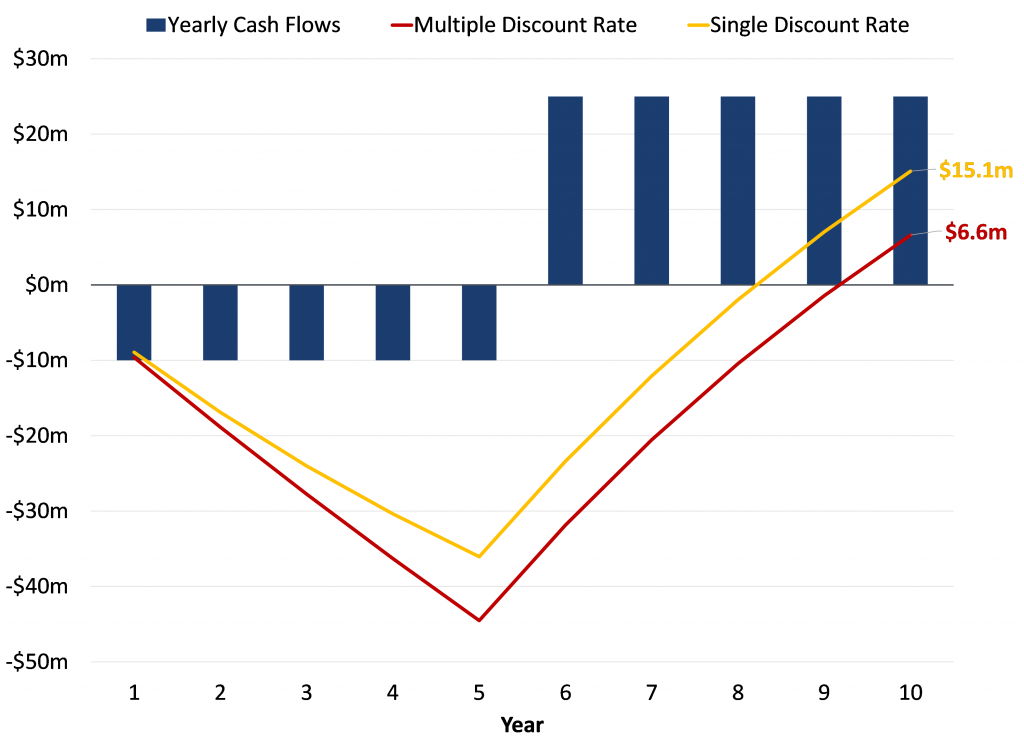
The resulting valuation outcome differs substantially from that of the multiple discount rates approach, producing a materially higher present value by a factor of nearly 2.3,[24] despite identical cash flow projections.
Figure 1 below shows the year-by-year comparison of the two methods. The main difference between them is that the multiple discount rates method applies a smaller discount to early losses, whereas the single discount rate applies a much higher rate of 12% to those same negative cash flows—resulting in greater net negative cash flows (in absolute terms) for the former during the early years.
Figure 1: DCF with Single and Multiple Discount Rates Resulting in Different Valuation Outcomes
This highlights the extent to which a methodological choice can influence valuation results. In litigation, such as matters involving damages, shareholder disputes, or bankruptcy proceedings, the choice of discount rates may materially affect outcomes related to liability, compensation, or settlement terms. The example illustrates that even when cash flow projections are held constant, the decision to apply a single or multiple discount rates framework may have outsized effects on the final valuation.
Example 2
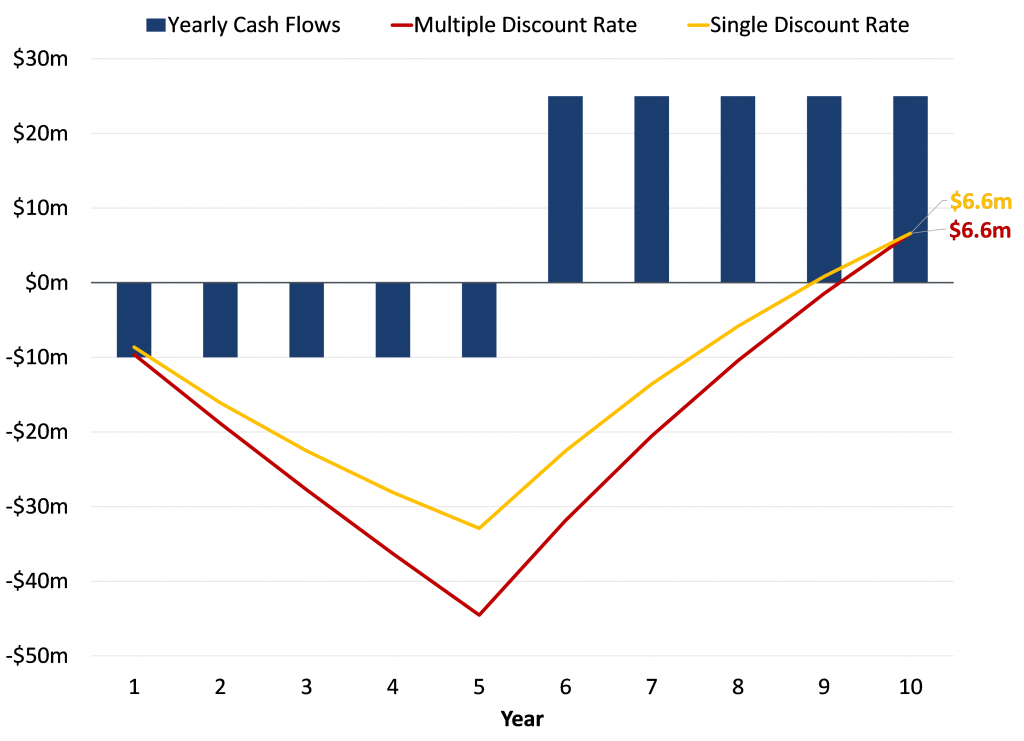
In this second scenario, we revisit the same projected cash flows but ask a different question: Is there a single discount rate that produces the same present value as the multiple discount rates model? The answer is yes. By adjusting the discount rate applied uniformly across all ten years, one can identify a rate—approximately 15.8%—that equates the present value of the cash flows to the $6.6 million obtained under the multiple rate approach.
Figure 2 below shows a comparison of the two methods. Although discounting with a single rate of 15.8% results in smaller net negative cash flows in absolute terms during the early loss-making years, the multiple discount rates approach catches up in the later period of positive earnings, as it applies a lower rate of 12% to those cash flows—ultimately resulting in equivalent net cash flows.
Figure 2: DCF with Single and Multiple Discount Rates Resulting in Identical Valuation Outcomes
While this may appear to reconcile the two methodologies in terms of numerical outcome, it raises a conceptual challenge: In this example, the 15.8% rate is neither the firm’s hypothetical cost of capital of 12% nor the risk-free rate of 4%. In fact, it lies outside the range defined by those two benchmarks. It may not reflect any identifiable investment alternative, capital market benchmark, or macroeconomic condition. In other words, while mathematically convenient, the adjusted discount rate here lacks a clear theoretical or empirical foundation, which may weaken its credibility in expert analysis or legal proceedings.
This example reinforces that numerical equivalence does not necessarily guarantee conceptual soundness. In practice, the selection of discount rates, whether single or multiple, should be supported by economic rationale, consistency with market expectations, and alignment with the risks underlying the projected cash flows.
Conclusion
Valuation plays a critical role in many litigation settings, where financial conclusions can influence outcomes related to liability, damages, and settlement terms. DCF is one of the more frequently applied methodologies in these contexts of enterprise valuation, due to its flexibility and grounding in forward-looking projections. Within this framework, the decision to apply a single or multiple discount rates can have a meaningful impact on the resulting valuation.
As demonstrated in the examples, both approaches can produce significantly different outcomes, even when based on the same projected cash flows. While it is sometimes possible to align their numerical results, doing so may require selecting a discount rate that lacks a clear theoretical or empirical reference point. This underscores the importance of articulating the rationale behind discount rate assumptions and ensuring consistency with the underlying risk characteristics of the cash flows.
Ultimately, the appropriate methodology will depend on the specific facts of the case, the nature of the business or asset being valued, and the analytical goals of the valuation exercise. Maintaining transparency in modeling decisions and grounding assumptions in sound economic reasoning are essential across all approaches.
While the discount rate is a critical input, and this article specifically focuses on assumptions related to discount rate selection, other factors also significantly influence the DCF outcome. These include, for example, the length of the projected cash flow period, the size and timing of expected cash flows, the timing of discounting, the assumptions used for terminal value, the growth rates applied during the forecast period (which reflect expectations about how the business or asset will grow over time), and the overall risk profile of the asset or business being evaluated. ↑
U.S. courts have recognized this distinction and adopted multiple-rate approaches where appropriate to reflect phase-specific risk dynamics. See, e.g., S’holder Representative Servs. LLC v. Alexion Pharms., Inc., 341 A.3d 513 (Del. Ch. 2025). ↑
SeeRichard A. Brealey, Stewart C. Myers & Franklin Allen, Principles of Corporate Finance, 20–45 (Ch. 2: How to Calculate Present Values) (13th ed., McGraw-Hill Education, 2020); Jonathan Berk & Peter DeMarzo, Corporate Finance 246–272 (Ch. 7: Investment Decision Rules) (5th ed., Pearson 2020). ↑
See, e.g., Northwest Inv. Corp. v. Wallace, 741 N.W.2d 782 (Iowa 2007). ↑
See, e.g., Su v. Bensen, No. 19-3178, 2024 U.S. Dist. LEXIS 145404 (D. Ariz. Aug. 15, 2024). ↑
See, e.g., BP Amoco v. Flint Hills Res., No. 05 C 5661, 2009 U.S. Dist. LEXIS 131272 (N.D. Ill. June 4, 2009). ↑
See, e.g., Dietz v. Jacobs, No. 12-1628, 2014 U.S. Dist. LEXIS 37144 (D. Minn. Mar. 21, 2014). ↑
In re Appraisal of Dell Inc. No. 9322-VCL, 2016 Del. Ch. LEXIS 81 (Del. Ch. May 31, 2016). ↑
Andaloro v. PFPC Worldwide, Nos. 20336, 20289, 2005 Del. Ch. LEXIS 125 (Del Ch. Aug. 19, 2005). ↑
This approach is generally more appropriate when a firm undertakes a project consistent with its core operations. For projects that fall outside the firm’s typical business (for example, a utility company investing in a tech startup), the risk profile may differ significantly. In such cases, one may prefer to use a discount rate different from the firm’s overall WACC. ↑
All discounting examples presented in this article assume that cash flows are realized at the end of each year (e.g., t = 1 for year 1, t = 2 for year 2, and so on) and are discounted back to the beginning of the hypothetical study period (i.e., t = 0). ↑
Note that these studies highlight ongoing discussion around the limitations of single-rate DCF models and the potential for alternative methods, such as multi-rate discounting, to address evolving or segmented risk structures within an investment or project. Whether and how these ideas are implemented in practice varies, and their relevance depends on the specific assumptions and characteristics of the valuation at hand. ↑
Geltner and Mei (1995) and Tiwari (1994) show that shifts in interest rates, inflation, and market risk premiums can cause required returns to fluctuate, making the assumption of a constant discount rate unrealistic. Investors, therefore, form expectations at t = 0 not only about future cash flows but also about how discount rates may change as market conditions evolve. See Kashi Nath Tiwari, Single Versus Multiple Discount Rates in Investment Theory, 7 J. Financial & Strategic Decisions 19–42 (1994); David Geltner & Jianping Mei, The Present Value Model with Time-Varying Discount Rates: Implications for Commercial Property Valuation and Investment Decisions, 11 J. Real Estate Fin. & Econ. 119–135 (1995). Empirical evidence further indicates that valuation models incorporating time-varying discount rates better explain observed market values than those assuming a single, constant rate. See Sujata Behera, Does the EVA Valuation Model Explain the Market Value of Equity Better Under Changing Required Return Than Constant Required Return?, 6 Fin. Innovation 9 (2020). ↑
See Vicente Alcaraz, Should Practitioners (Continue to) Use a Single Discount Rate in Large-Scale Project Valuation?, 20 J. Structured Fin. 93 (2014); Ken Fuller et al., The Problem of Discount Rate in Infrastructure Projects: Exploring the Idea of Financial Twins (Feb. 6, 2023) (unpublished manuscript) (SSRN); Babak Jafarizadeh & Reidar B. Bratvold, Project Economics in the Big-Bets Industry: The Integrated Valuation in Practice, 197 J. Petroleum Sci. & Eng’g 108095 (2021). ↑
SeeBrealey, Myers & Allen, Principles of Corporate Finance 590–613 (Ch. 22: Real Options); Avinash K. Dixit & Robert S. Pindyck, Investment Under Uncertainty (1st ed. Princeton University Press 1994); David Espinoza et al., DNPV: A Valuation Methodology for Infrastructure and Capital Investments Consistent with Prospect Theory, 38 Constr. Mgmt. & Econ. 259–274 (2020). ↑
See, e.g., Brealey, Myers & Allen, Principles of Corporate Finance 228–256 (Ch. 9: Risk and the Cost of Capital), which lists the risk of a dry hole in oil exploration as an example of “bad outcome” that appears to reflect diversifiable risks that would not affect the expected rate of return demanded by investors. ↑
SeeBrealey, Myers & Allen, Principles of Corporate Finance Ch. 9, which lists the risk of unacceptable side effects of a new drug as an example of “bad outcome” that appears to reflect diversifiable risks that would not affect the expected rate of return demanded by investors. ↑
SeeBrealey, Myers & Allen, Principles of Corporate Finance 260 (“Diversifiable risks do not increase the cost of capital. They do affect expected cash flows, however.”); Berk & DeMarzo, Corporate Finance 421 (“Firms sometimes try to adjust for this risk by assigning a higher cost of capital to new projects. Such adjustments are generally incorrect, as this execution risk is typically firm-specific risk, which is diversifiable. . . . Of course, this does not mean that we should ignore execution risk. We should capture this risk in the expected cash flows generated by the project.”). ↑
These examples are not intended to imply that any particular methodology is preferred or should be used in any specific industry. Rather, they illustrate scenarios in which varying risk exposures over time have led researchers and practitioners to explore valuation methods that account for such differences. ↑
See S’holder Representative Servs. LLC v. Alexion Pharms., Inc., 341 A.3d at 547 (“But the risks underlying the metrics in Milestones 2 through 7 are ‘diversifiable.’ A diversifiable risk is one ‘that is peculiar to an individual company.’ Such risks can be ‘diversified away’ through a broad investment portfolio ‘due to the law of large numbers.’ . . . For Milestones 2 through 7, the discount rate is the risk-free rate plus a credit risk premium.” (citations omitted)). ↑
See S’holder Representative Servs. LLC v. Alexion Pharms., Inc., 341 A.3d at 548 (“Milestone 8 is different because the risk associated with its underlying metric is ‘nondiversifiable.’ As the name suggests, nondiversifiable (or ‘systemic’) risk, ‘cannot be fully removed through diversification’ because it is ‘correlated with the market.” . . . Milestone 8’s net sales metric carries nondiversifiable risk. So the milestone’s discount rate must therefore include a risk premium.” (citations omitted)). ↑
The purpose of this example is to demonstrate how the application of multiple discount rates may affect valuation outcomes under certain assumptions. It does not imply that this approach is preferable, superior, or recommended in any given case. The appropriateness of any methodology depends on factors such as the specific context, assumptions, and purpose of the valuation. ↑
Imagine: A compliance officer at a broker-dealer is asked to draft a new written supervisory procedure on reviewing securities transactions of associated persons. The compliance officer asks his personal version of ChatGPT to draft him an appropriate policy. The compliance officer then has a number of interactions with ChatGPT, and it produces a final written supervisory procedure, which is adopted by the firm. Unfortunately, the written supervisory procedure lacked some key elements, and the Financial Industry Regulatory Authority (“FINRA”) asks who wrote the policy. The compliance officer admits that they asked ChatGPT to draft the procedure but failed to retain the prompts sent to ChatGPT or responses received from ChatGPT. FINRA enforcement alleges that the firm failed to keep records and failed to supervise the compliance officer.
Although this is a hypothetical example, it is likely to occur regularly. The promise of generative artificial intelligence is certainly seductive, but there are important issues for broker-dealers to consider. Should the broker-dealer have a policy on employee AI usage and if so, are the prompts and responses records that are required to be retained under Rule 17a-4 of the Exchange Act?
History of the SEC’s Recordkeeping Rule
In order to implement Section 17(a)(1) of the Exchange Act, in 1935 the Securities and Exchange Commission adopted Rules 17a-3 (records to be made) and 17a-4 (records to be preserved). Rule 17a-4(b)(4) still requires a broker-dealer to preserve “[o]riginals of all communications received and copies of all communications sent (and any approvals thereof) by the member, broker or dealer (including inter-office memoranda and communications) relating to its business as such . . . .”[1]
Though the SEC has modernized Rules 17a-3 and 17a-4 several times over the intervening ninety-one years, it has yet to cleanly advise as to the meaning of “communications” and “business as such.” As a result, compliance officers and lawyers will need to make informed decisions about whether generative AI prompts and responses are communications and whether they relate to the broker-dealer’s business as such.
How Generative AI Work Appears
Most generative AI operates using statistical probability to predict the most likely sequence of tokens (i.e., pieces of data like letters or words) when responding to prompts. If you enter “duck, duck . . .” generative AI will likely respond with the word “goose.” If you were to then prompt “Why goose?” the generative AI would likely respond with something like, “Because goose frequently appears after duck, duck” or explain the game duck, duck, goose. On review, it appears that the person and the AI system are “talking”; some data scientists even refer to the exchange as a “conversation.” This interaction allows the system to refine its outputs based on preceding context, mimicking the flow of natural dialogue between two people in real time. In short, generative AI looks and feels like talking with a person. That look and feel are at the heart of the issue of whether prompts and responses are communications.
Arguments That AI Prompts and Responses Are Not Required Records
There are several good arguments that certain AI prompts and responses should not be treated as 17a-4 records.
Generative AI Conversations Are Not Communication. In common discourse, communication involves the transmission of information from one person to another person. After all, you don’t talk to a computer; you issue commands. In many respects, prompting is similar to entering a search query into a research database, instructing a spreadsheet to perform a calculation, or directing a word processing program to generate a document, none of which would generally be deemed communications for recordkeeping purposes.
Many Prompts and Responses Are Not About “Business as Such.” A prompt and response about how to draft written supervisory procedures may not relate to a broker-dealer’s business as such. While they relate to the broker-dealer’s compliance policies, it could be argued that they do not relate to its actual business as such. The phrase “as such” clearly limits the application of Rule 17a-4 in a way that excludes some communications that relate to the broker-dealer’s business tangentially. Here, the AI prompt and response relate to compliance, which could be argued not to be about the trading of securities (i.e., the business as such).[2]
Rule 17a-4’s “Inter-Office Memoranda” Parenthetical Confirms the Rule Only Applies to Select One-Sided Communications. If the SEC intended to capture all one-sided communications, it arguably would have said so. Instead, the SEC explicitly referenced one-sided communications in an exclusive way by providing that communications to be saved are “(including inter-office memoranda and communications)” in Rule 17a-4. Because the SEC did not use the phrase “among other things,” inter-office memoranda and communications could be the only one-sided communications required to be retained.
Arguments That AI Prompts and Responses Are Required Records
Conversely, there are several good arguments as to why AI prompts and responses should be treated as 17a-4 records.
Prompts and Responses Are Indirect Communications with the AI Company’s Employees. Prompts and AI responses could be argued to constitute communication because they are transmitted to and processed by infrastructure controlled by humans. Prompts are sent to corporate entities, which have employees, and responses are received from those same entities and their employees. When a broker-dealer employee prompts a public AI system, that input is not merely an internal mental draft but rather a transmission to an external service provider whose personnel design, maintain, and monitor such inputs, and in some cases review or use them for system improvement or safety.[3] Moreover, a court recently determined that generative AI usage can invalidate the attorney-client privilege, which would only be possible if there were human viewers.[4]
AI Output Has Been Deemed Communication in Another Context. Regulators have already treated correspondence between an AI chatbot and humans as “communications.” FINRA’s Advertising Regulation FAQs make clear that “Firms are responsible for their communications, regardless of whether they are generated by a human or AI technology. Accordingly, firms must ensure that AI-generated communications they distribute or make available comply with applicable federal securities laws and regulations and FINRA rules.”[5] The FAQs further reflect that communications made available through online or interactive platforms are considered communications with the public if they are accessible to investors, and firms must retain records of such communications in accordance with applicable recordkeeping obligations.[6] This framework supports the conclusion that prompts submitted to, and outputs generated by, AI or chatbot systems fall within existing communications and recordkeeping requirements without regard for whether there were two humans directly involved in the communication.
Prompts and Responses Look Like Communication. Prompts and AI-generated responses could be treated as required records because, functionally, they fit squarely within the regulatory concept of a “communication.” The SEC has long emphasized that communications subject to recordkeeping obligations under Rules 17a-3 and 17a-4 include any written or electronic messages relating to a firm’s business, regardless of format or technology.[7] Furthermore, due to the natural language search and response patterns as well as the ability to interact and train your AI agents, sessions with generative AI are analogous to communication.
Retention Is Consistent with the Purpose of Rule 17a-3 and 17a-4. The classification of AI prompts and responses as required records hinges on their role as primary source material for a firm’s supervisory framework. Would retaining these provide evidence that could be useful in an enforcement action or examination? Here, the conversations function as the modern equivalent of compliance work papers or internal memoranda. The digital exchanges possess significant probative value as an audit trail revealing the firm’s intent, the depth of its due diligence, and whether the resulting policies were “reasonably designed” to ensure regulatory adherence. Failing to retain these records would undermine the purpose of the recordkeeping requirements, as staff could effectively hide the decision-making process and any potential shortcuts or misunderstandings from regulatory oversight during enforcement action.
The SEC’s Past and Current Positions
Past SEC Chair Gary Gensler brought a series of high-profile enforcement actions against broker-dealers for allowing their staff to use “off-channel” communications methods that created records but did not retain them and for allowing written communications that could not be supervised.[8] More recently, Commissioner Hester M. Peirce criticized the prior enforcement program as overreaching and as an example of regulation through enforcement.[9] As a result, under the current administration, it is unlikely that the SEC would bring high-dollar enforcement actions against firms that do not treat their use of generative AI as creating records that must be preserved. However, broker-dealers should carefully consider their tolerance for compliance risk in the event that an administration chooses an enforcement approach or if the firm is already in a precarious position.
Risk Tolerance
Because the SEC and FINRA have not issued guidance on the question of whether generative AI prompts and responses are communications subject to Rules 17a-3 and 17a-4, and they are unlikely to provide a dispositive answer other than the statement that the rules are technologically neutral, firms must make a risk decision on how to treat the data. Usually, each broker-dealer’s risk management program has buckets for risk acceptance, including a bucket for compliance or regulatory risk. Typically, firms adopt a low tolerance for compliance risk. Those firms should carefully consider whether their staff, including management, is using generative AI on unapproved and unmonitored providers for business purposes. Firms with a low compliance risk tolerance should consider a policy restricting generative AI use to approved providers, where records of prompts and responses are retained and the activity is supervised.
SeeSEC v. Arete Wealth Mgmt., LLC, No. 25 C 616, slip op. at 27–32 (N.D. Ill. Feb. 26, 2026). Arete argued unsuccessfully that text messages concerning outside sales activities and compliance matters were not required to be retained because “business as such” was unconstitutionally vague, violating due process, and that some texts did not relate to the firm’s securities business. ↑
For example, OpenAI’s Terms of Use state, “We may use Content to provide, maintain, develop, and improve our Services, comply with applicable law, enforce our terms and policies, and keep our Services safe.” Terms of Use, OpenAI (Jan. 1, 2026). ↑
SeeUnited States v. Heppner, No. 1:25-cr-00503-JSR, 2026 WL 436479 (S.D.N.Y. Feb. 17, 2026) (finding that sourcing documents from a generative AI system invalidated a claim that the documents were privileged, even if the documents were subsequently provided to counsel). ↑
The U.S. Court of Appeals for the Second Circuit decided four arbitration cases in 2025, each addressing a different piece of the process: agreement formation, scope, waiver, and judicial oversight of ongoing arbitration proceedings. Individually, they generated the usual case-specific commentary. But read together, they tell a bigger story: The Second Circuit is done treating arbitration agreements as a special category of contract that gets the benefit of the doubt. Going forward, they will be evaluated like any other agreement.
You Need Real Consent
Start with how agreements get made. In Davitashvili v. Grubhub Inc.,[1] the court examined Grubhub’s checkout page and arbitration clause through a consumer-protection lens. In particular, the court focused on where the hyperlink to the arbitration provision sat, how cluttered the screen was, and whether the prompt was clear enough to put a reasonable user on notice. Under the circumstances presented, the clause survived—but barely. Judge Pérez wrote separately to warn that the page was “likely the high-water mark” for enforceability. In other words, a slightly more jumbled checkout screen likely would have defeated the clause altogether.
In Sudakow v. CleanChoice Energy, Inc.,[2] the Second Circuit went further. In this decision, a company mailed an arbitration clause in a “Welcome Package” weeks after the customer had already signed an enrollment agreement, and nothing flagged the new terms. Simply receiving the Welcome Package and continuing to pay for electricity were not enough, the court held, to establish assent to arbitration.
The bottom line from both cases is that if you want an arbitration clause to survive a challenge in the Second Circuit, you need genuine assent at the point of contracting because constructive notice buried in later materials is not enough.
Broad Language Won’t Cover Every Claim
Davitashvili also addresses what arbitration clauses actually cover. Grubhub’s clause was extremely broad, covering disputes that “in any way relate to your use of the Platform.”[3] Nonetheless, the court held that antitrust claims about anti-price-competition provisions between Grubhub and restaurants lacked a sufficient connection to an individual customer ordering dinner through the Grubhub app. Judge Sullivan dissented, arguing that a more lenient “meaningful nexus” standard should apply, while the majority required a more substantial link. The practical upshot is that where statutory claims (for example, antitrust, consumer protection, or securities claims) are conceptually distinct from the transaction governed by the general terms of service, you should not assume that a broadly worded arbitration clause will sweep them in.
Pick Your Forum Early or Lose It
Doyle v. UBS Financial Services, Inc.[4] changed the Second Circuit’s approach to waiver of the right to arbitrate. Previously, a party could often avoid the waiver as long as the other side was not prejudiced by delay in seeking arbitration. Doyle removed that requirement, following the Supreme Court’s 2022 decision in Morgan v. Sundance, Inc.,[5] which stripped courts of the ability to require a showing of prejudice before finding waiver. Now, the waiver turns on whether a party acted inconsistently with the right to compel arbitration. In Doyle, arbitration was waived where the defendant joined a motion to dismiss, waited to see how it played out, and only then moved to compel arbitration after an adverse decision. The days of “testing the waters” in court before falling back on arbitration appear to be over.
Once You’re In, You’re In
Frazier v. X Corp.[6] addresses what happens after arbitration has started. In a mass-arbitration dispute involving former Twitter employees, the district court ordered the company to pay arbitration fees as assessed by JAMS. The Second Circuit reversed, holding that fee allocation is a procedural question for the arbitral forum to address; it was not a “failure, neglect, or refusal to arbitrate” that courts may remedy under the Federal Arbitration Act. The decision aligns the Second Circuit with the Third, Fifth, Ninth, and Eleventh Circuits. Because companies facing thousands of individual arbitration demands can be forced to pay millions of dollars in filing and administrative fees before the merits are even considered, court-ordered fee payments have become a central pressure point in mass-arbitration campaigns—and that lever has now been limited.
What It All Adds Up To
The pattern is clear. At every stage (formation, scope, waiver, and judicial oversight), the Second Circuit is applying the same basic principle: an arbitration agreement is a contract, and it gets treated like one. You need real consent. Your clause covers what it says it covers, not everything you wish it covered. You have to commit to arbitration early or risk losing it. And once the arbitration is underway, courts generally will not step in to manage the proceeding.
The immediate implication is a shift in leverage. Consumers and employees gain more room to challenge arbitration at the front end (especially where assent is imperfect or the clause is presented late), and plaintiffs with statutory claims may more often keep at least some theories in court when the dispute is only loosely connected to the underlying transaction. Businesses, by contrast, lose some of the “margin for error” that historically made arbitration a reliable default—and they lose the ability to wait and see how a case develops before invoking the clause.
None of this means that the Second Circuit is hostile to arbitration. Properly implemented, arbitration remains a powerful tool. But these recent 2025 decisions clarify who is likely to win and who is likely to lose. The practical takeaway is straightforward: make assent unmistakable; draft scope with precision; move to compel early; and expect procedural fights to be decided in arbitration, not federal court.
When President Trump signed the Guiding and Establishing National Innovation for U.S. Stablecoins Act (the “GENIUS Act”) into law on July 18, 2025, the reaction across the digital asset industry was almost uniformly positive. At long last, the United States had delivered what the industry had been requesting for years: a comprehensive regulatory framework for dollar-backed stablecoins. Industry leaders and market participants welcomed the legislation and the clarity that it would offer the crypto industry.
On April 8, 2026, the U.S. Department of the Treasury’s Financial Crimes Enforcement Network (“FinCEN”) and the Office of Foreign Assets Control (“OFAC”) announced a joint notice of proposed rulemaking (the “Proposed Rule”) that would operationalize the GENIUS Act’s mandates. The Proposed Rule would classify permitted payment stablecoin issuers (“PPSIs”) as a new category of financial institution under the Bank Secrecy Act (“BSA”), separate from money services businesses (“MSBs”), and impose a comprehensive suite of anti-money laundering (“AML”), countering the financing of terrorism (“CFT”), and sanctions compliance obligations on PPSIs. Notably, the Proposed Rule would also be the first federal regulation to codify what constitutes an “effective” OFAC sanctions compliance program, attaching penalties for PPSIs that fail to maintain required program elements—even absent underlying sanctions violations.
The FinCEN/OFAC Proposed Rule does not exist in isolation. As described below, it is part of a broader, multi-agency implementation effort under the GENIUS Act. Stablecoin issuers should be monitoring these rulemakings in parallel, particularly those subject to overlapping federal and state jurisdiction. Separately, FinCEN has also issued a proposed rule that would overhaul AML/CFT program requirements more broadly for a wider range of financial institutions, which shares structural similarities with the PPSI-specific rule and may result in overlapping obligations for companies subject to both.
The Proposed Rule has significant implications for current and prospective stablecoin issuers, their parent institutions, and the broader digital asset ecosystem. Comments are due June 9, 2026, and final regulations are expected by July 18, 2026, with the effective date scheduled for January 2027.
This article discusses the Proposed Rule’s key elements, beginning with a primer on the GENIUS Act framework.
The GENIUS Act
Understanding the Proposed Rule requires a brief detour through the statute it implements. The GENIUS Act is the first U.S. federal regulatory framework for payment stablecoins—defined under the statute as a digital asset that is used or designed for use as a means of payment or settlement, where the issuer is obligated to redeem it for a fixed monetary value and represents that it will maintain a stable value relative to that amount (in practice, one U.S. dollar). The statute provides the answers to questions regulators had been sidestepping for years: What exactly is a stablecoin, who is permitted to issue one, and how are they regulated?
The statute answers the last question with a licensing framework. Only “permitted payment stablecoin issuers,” or PPSIs, may issue payment stablecoins in the United States. There are three pathways to PPSI status: a PPSI may be (1) a subsidiary of an insured depository institution approved by its primary federal banking regulator to issue stablecoins; (2) a federally qualified payment stablecoin issuer, including nonbank entities chartered by the Office of the Comptroller of the Currency (“OCC”); or (3) a state-qualified payment stablecoin issuer approved by a state regulator meeting federal standards. Knowingly issuing payment stablecoins without PPSI authorization can result in fines of up to $1 million per violation and imprisonment for up to five years under the GENIUS Act.
The GENIUS Act also constrains what PPSIs can do. Their authorized activities are limited to issuing and redeeming payment stablecoins, managing reserve assets (which must back outstanding stablecoins on at least a 1:1 basis), and providing custodial services.
Two additional features of the GENIUS Act are worth flagging. First, the statute amends the federal securities laws and the Commodity Exchange Act to provide that qualifying payment stablecoins issued by PPSIs are excluded from the definitions of both “security” and “commodity.” This is a significant jurisdictional carve-out: The Securities and Exchange Commission and Commodity Futures Trading Commission do not regulate payment stablecoins under the GENIUS Act. Instead, oversight falls to banking regulators—the OCC, the Federal Deposit Insurance Corporation (“FDIC”), the Board of Governors of the Federal Reserve System, the National Credit Union Administration (“NCUA”), and state banking regulators—along with FinCEN and OFAC for illicit finance and sanctions. Second, the GENIUS Act contains bankruptcy protections for stablecoin holders, including a priority claim senior to all other creditors and an exclusion of reserve assets from the bankruptcy estate.
The GENIUS Act requires that the Department of the Treasury, including FinCEN and OFAC, as well as the federal banking agencies, promulgate rules to implement the GENIUS Act. The Proposed Rule addressed in this article is part of this multi-agency effort, and its implications for stablecoin issuers’ compliance infrastructure are among the most significant of the proposed rules to date. Since the GENIUS Act’s enactment, the designated regulatory agencies have moved quickly to implement the statute. The OCC published a proposed rule in February 2026 establishing a comprehensive prudential, operational, and supervisory framework for PPSIs under its jurisdiction. The FDIC followed in April 2026 with a proposed rule addressing PPSI subsidiaries of FDIC-supervised insured depository institutions. The NCUA has published proposed rules as well. The Treasury Department established principles determining whether state-level regulatory regimes are “substantially similar” to the federal framework. In addition, FinCEN issued a separate proposed rule in the same week as the Proposed Rule that would overhaul AML/CFT program requirements for a wider range of financial institutions, including by encouraging financial institutions to consider the use of digital identity, blockchain analytics, and generative artificial intelligence to prevent financial crime.
A New Category of Financial Institution
The Proposed Rule’s most consequential result is the creation of a new, standalone category of financial institution under the BSA. Many stablecoin issuers have historically been subject to BSA obligations as money transmitters, a subcategory of MSBs, under FinCEN rules. Under the Proposed Rule, PPSIs would no longer be classified as MSBs. Instead, they would be regulated under a separate framework with some obligations mirroring those applicable to banks.
This is not a cosmetic change, as PPSIs will become subject to a range of requirements that MSBs are not, including enhanced due diligence for correspondent and private banking accounts and compliance with special measures when foreign financial institutions or transactions are deemed to be of primary money laundering concern. In practice, this means that if FinCEN designates a foreign jurisdiction or institution as being of primary money laundering concern—as the Trump administration has recently done with certain Mexican financial institutions in its push to address illicit drug trafficking—PPSIs with exposure to those jurisdictions or institutions would need to comply with any restrictions or enhanced due diligence requirements imposed.
The reclassification also reflects FinCEN’s stated assessment in the Proposed Rule that the economic functions PPSIs perform more closely resemble those of banks than those of traditional money transmitters. In short, PPSIs issue a widely used medium of exchange, maintain reserve assets, and facilitate payments—functions that in key respects more closely resemble banking than traditional money transmission. The Proposed Rule relies on FinCEN’s authority under the BSA to designate PPSIs as businesses engaged in activities “similar to, related to, or a substitute for” the activities of enumerated financial institutions.
Primary and Secondary Markets
The Proposed Rule divides the stablecoin ecosystem into primary and secondary markets, with different compliance obligations in each.
The “primary market” covers transactions where a PPSI interacts directly with a user or holder of a payment stablecoin. Issuance, redemption, and direct transfers are primary market activity. In the primary market, the full suite of AML/CFT obligations applies: customer identification, ongoing due diligence, suspicious activity monitoring, and the other requirements discussed below.
The “secondary market” covers transactions where the PPSI has no direct interaction with the transacting parties. Value moves between users through the PPSI’s smart contract without any direct customer relationship. This is the peer-to-peer transfer environment, the on-chain world where stablecoins circulate between wallets, exchanges, and DeFi protocols without the issuer’s active involvement in any given transaction.
The Proposed Rule does not require PPSIs to file suspicious activity reports or conduct customer due diligence on secondary market activity. However, it does require PPSIs to maintain the technical ability to block, freeze, and reject transactions across their entire network, including the secondary market. This is where much of the real compliance cost resides. If OFAC designates a wallet address, the issuer must be able to prevent that address from transacting with its stablecoin, even though the issuer has no customer relationship with the owner of the wallet. In other words, PPSIs would bear no affirmative obligation to monitor or report on secondary market transactions, but they would bear a full obligation to intervene in those same transactions when directed by law, regulation, or sanctions designation. That tension—between passive observation and active enforcement capability—is where much of the industry commentary is likely to focus.
AML/CFT Program Requirements
In the primary market, the Proposed Rule would explicitly require PPSIs to conduct ongoing customer due diligence, including complying with “know your customer” requirements and monitoring accounts for suspicious transactions. Many stablecoin issuers that currently operate as MSBs conduct some form of customer identification, but the Proposed Rule would implement new expectations.
The Proposed Rule would require PPSIs to file suspicious activity reports (“SARs”) with FinCEN for any primary market transaction involving $5,000 or more, adopting the same dollar threshold that currently applies to banks. This is a notable departure from the MSB framework, where the SAR filing threshold for money transmitters is $2,000. The higher threshold may reduce volume, but the underlying obligation to detect and report suspicious activity across the full range of primary market transactions is no less demanding.
PPSIs would be required to retain records on transfers of $3,000 or more and to share specified information with other financial institutions involved in fund transfers. This recordkeeping threshold mirrors the existing requirement for financial institutions under the BSA’s funds transfer rules. The information-sharing obligation is designed to create an auditable trail across institutions, enabling regulators and law enforcement to reconstruct the flow of funds when investigating potential illicit activity.
The Proposed Rule would require PPSIs to collect beneficial ownership information for business customers, an obligation that does not currently apply to MSBs and that represents one of the more operationally significant new requirements. Issuers will need to build infrastructure for identifying and verifying the natural persons who ultimately own or control their business counterparties. For issuers whose customer base includes institutional participants, exchanges, or other entities, this requirement may necessitate new data collection workflows.
The Proposed Rule would extend to PPSIs two obligations drawn directly from the USA PATRIOT Act that apply to banks: enhanced due diligence programs for correspondent and private banking accounts, and the obligation to respond to government information-sharing requests. In the PPSI context, correspondent account due diligence would require issuers to assess and manage the risks posed by relationships with foreign financial institutions that hold accounts with the PPSI or use the PPSI’s payment infrastructure, while private banking account due diligence would impose heightened scrutiny on high-value individual accounts. For issuers that serve institutional customers, foreign exchanges, or other entities that function as intermediaries, these requirements could necessitate substantial new compliance processes for onboarding and ongoing monitoring of those relationships.
PPSIs would become subject to both the mandatory and voluntary information-sharing provisions of Section 314 of the USA PATRIOT Act. Under the mandatory provision (Section 314(a)), FinCEN and law enforcement agencies can query PPSIs about whether they maintain accounts or have conducted transactions for specified individuals or entities. Under the voluntary provision (Section 314(b)), PPSIs would be permitted to share information with one another and with other financial institutions for purposes of identifying and reporting potential money laundering or terrorist financing activity, with a safe harbor from liability for such sharing.
The illicit finance data motivating these requirements is substantial. According to the Proposed Rule, between January 2015 and November 2025, FinCEN received approximately 55,000 suspicious activity reports referencing specific stablecoins, and OFAC received approximately 5,800 blocked property reports and 3,000 rejected transaction reports referencing stablecoins. The Proposed Rule cites the use of stablecoins in money laundering chains, North Korean cyber theft, sanctions evasion networks, fentanyl precursor procurement, and terrorist financing as the specific risks driving the rulemaking.
The First Codified Sanctions Compliance Program Requirements
Perhaps the most significant regulatory development in the Proposed Rule is OFAC’s decision to codify, for the first time in its regulations, what constitutes an “effective” sanctions compliance program and penalties for failing to maintain one.
All U.S. persons are already required to comply with OFAC-administered sanctions, including stablecoin issuers. But until now, OFAC has never required any category of U.S. person to maintain a formal compliance program with potential penalties for failure to do so. OFAC’s longstanding “Framework for OFAC Compliance Commitments,” published in 2019, laid out a five-element structure for an effective sanctions program: management commitment, risk assessment, internal controls, testing and auditing, and training. Additionally, OFAC’s 2021 “Sanctions Compliance Guidance for the Virtual Currency Industry” specifically addressed sanctions compliance best practices for the virtual currency industry. However, both materials represented regulatory guidance, not a binding legal obligation.
The GENIUS Act changes this. The statute directs that PPSIs maintain an “effective economic sanctions compliance program . . . consistent with [f]ederal law,” and the Proposed Rule operationalizes that directive by incorporating OFAC’s five-element framework into binding regulation. A PPSI’s sanctions compliance program must include: management commitment from senior leadership; a risk assessment process that identifies sanctions risks specific to the issuer’s products, customers, and geographic exposure; risk-based internal controls to identify, block, and reject transactions that may violate sanctions; independent testing and auditing of the program’s effectiveness; and training for all relevant personnel.
This represents a meaningful paradigm shift. For years, OFAC’s enforcement posture relied on the implicit message that the voluntary framework was, in practical terms, non-optional. OFAC would consider a company’s compliance infrastructure, or lack thereof, when determining potential enforcement or penalties for sanctions violations. But the gap between favorable treatment for maintaining a good program and a legal requirement to have one, backed by penalties for failure to maintain it, is significant. Practitioners should expect it to serve as a template for other regulated industries. For this reason, we anticipate industry commentary to focus on this net-new requirement—especially as it is in direct tension with Treasury’s broader effort in a separate proposed rule to focus enforcement actions on outcomes rather than “foot fault” program deficiencies.
Block, Freeze, Reject, and Burn
The Proposed Rule’s most operationally demanding requirement is arguably its mandate that PPSIs maintain the technical capability to block, freeze, and reject impermissible transactions, as well as comply with lawful orders to seize, freeze, burn, or prevent the transfer of payment stablecoins.
These requirements extend to both primary and secondary market activity. In the primary market, where the issuer has a direct relationship with the customer, the block-and-freeze architecture maps reasonably well onto existing bank compliance workflows. In the secondary market, however, the requirement has no direct parallel for other BSA-regulated financial institutions. Banks are not generally required to control transactions between third parties with whom they have no customer relationship. But a stablecoin issuer, whose product circulates freely on public blockchains, would be required to maintain the infrastructure to intervene in peer-to-peer transfers if required by a lawful order or sanctions designation.
In practice, this means issuers will need on-chain compliance infrastructure that monitors activity with which they have no direct commercial relationship. That means transaction screening systems, smart-contract-level controls, and the engineering capacity to execute freezes and burns in response to regulatory directives. The engineering investment required to build and maintain these capabilities is substantial. The inclusion of “burn”—meaning the permanent and irreversible destruction of tokens, effectively removing them from circulation with no possibility of recovery by the holder—is notable. Unlike a freeze, which temporarily restricts access, or a block, which prevents a specific transaction, a burn eliminates the tokens entirely. While some issuers have built burn capabilities into their smart contracts, codifying this as a regulatory requirement raises novel questions about property rights, due process, and the limits of issuer control over circulating tokens.
This Is a Proposed Rule
Currently, this remains a notice of proposed rulemaking. The rule is not final and is subject to revision based on public comment. Those revisions could be meaningful.
The comment period is open, and comments are due June 9, 2026. Final regulations are expected by July 18, 2026, consistent with the GENIUS Act’s one-year implementation deadline, with enforcement beginning no later than January 2027.
The sixty-day comment period presents a genuine opportunity. Several aspects of the Proposed Rule invite industry input. The “burn” requirement and secondary market compliance obligations, particularly the scope of the block-and-freeze mandate for peer-to-peer transactions, are likely to generate significant comment. The codification of a burn requirement—authorizing the permanent destruction of tokens—raises novel questions about property rights and due process that are also likely to draw substantial feedback. The interaction between the new PPSI category and existing MSB registrations raises transitional questions that FinCEN has acknowledged but not fully resolved. The OFAC sanctions program requirements, while largely tracking the voluntary framework, introduce new specificity around what “effective” means in practice, and industry participants may have views on calibration. The SAR and recordkeeping thresholds, inherited from the bank framework, may warrant stablecoin-specific adjustments.
The final rule could differ meaningfully from the proposal based on feedback received. The rulemaking record will shape not only the contours of the final regulation but also the interpretive guidance and examination expectations that follow it. For issuers, exchanges, custodians, compliance technology providers, and the institutions that bank stablecoins, this is the moment to shape the framework that will govern the U.S. stablecoin market for the foreseeable future.
Nevertheless, payment stablecoin issuers should not wait for the final rule to begin preparing. The scope and detail of the Proposed Rule make clear that significant compliance changes are coming, and issuers should be evaluating their programs now to ensure they are positioned to meet these new obligations when enforcement begins.
In April 2026, the New York Times profiled the founder of Medvi, a new AI-enabled telehealth company selling weight-loss drugs. So far, Medvi is on track to do $1.8 billion in revenue this year with just two employees. Like every fast-growing company operating in a highly regulated industry, Medvi has significant and growing legal exposure. And like most companies at that stage, its founder is not looking to become the quarterback of a complex legal function.
Every company needs a legal partner who understands its business and takes ownership of that exposure as it grows. Unfortunately, the legal market has never built that.
This market gap is not AI-driven. Companies have always sought to focus on their core business. As legal needs grow and regulatory complexity increases, companies have been forced to build internal legal expertise—not because they wanted to, but because the market never offered a better option.
The Model Was Never Built for Clients
The prevailing legal model is the billable hour, which doesn’t just misalign incentives: It structurally prevents firms from delivering what clients want. Compensation structures reward hours, not outcomes. Origination credit belongs to someone who may no longer provide any value to the client. Referring a client to a colleague inside the firm often carries more personal financial risk than reward for the lawyer doing the referring. The result is that firms with dozens of practice areas may serve the same client as a series of disconnected engagements, while the client bears the cost of coordinating across teams that have no formal incentive to work together.
The model doesn’t just fail clients; it creates challenges for lawyers. Firms expect partners to serve as subject matter experts, business developers, relationship managers, mentors, and technology adopters while rewarding billing activity above nearly everything else. The result is a structure that makes client-centered collaboration difficult. Good lawyers know that this dynamic creates a fundamentally flawed structure and is part of why capable attorneys have been leaving Big Law in meaningful numbers. Not because they don’t want to do excellent work, but because the model and resulting culture prevent them from doing it in a way that feels aligned with real client value.
General counsel are expected to be strategic legal partners to the business while simultaneously managing outside counsel, coordinating legal work across multiple specialties, and identifying risks before they become problems. In many organizations, they are carrying responsibility for a function that remains fragmented by design.
AI Has Not Changed the Fundamental Dynamic
Generative AI has not created a crisis in the legal market; it has revealed one that was already there. And it is arriving at exactly the moment when legal complexity is accelerating.
Law firms are responding by investing in AI to protect and extend the existing model. They are offering faster research, smarter document review, and more efficient billing, all at higher rates. The goal is for their lawyers to do more of the same work in about the same way with the same economics intact. Separately, AI-native companies are going directly to clients, bypassing law firms entirely for commoditized work. Sequoia Capital has mapped $20–25 billion in legal transactional work, contract drafting, nondisclosure agreements, and regulatory filings—all work that AI can now deliver directly to the client.
Despite their differences, both approaches leave the same responsibility in the same place: with the client. Whether the work is performed by outside counsel or a tech platform, the company is still expected to identify legal issues, determine what expertise is required, coordinate solutions across disciplines, and manage the outcome.
The Model That Has to Be Built from Scratch
Consider a fast-growing healthcare company operating across multiple states. Under the current model, the company may separately retain employment counsel, regulatory counsel, privacy counsel, litigation counsel, and commercial contract counsel, while its internal legal department coordinates the risks and communication between them. The client is responsible for connecting issues across the business, identifying emerging exposure, and determining when legal intervention is needed.
A different model would reverse that burden. A law firm built specifically around healthcare companies would proactively monitor regulatory developments, coordinate legal strategy across disciplines, identify patterns before they become disputes, and manage recurring operational legal needs through integrated workflows and technology-enabled systems. Instead of paying multiple disconnected providers to react to problems after they emerge, clients would operate within a coordinated system designed to identify risk earlier, reduce duplication, create institutional knowledge, accelerate response times, and lower the overall cost of managing legal exposure.
A full-service law firm built around a specific industry vertical and using AI where it makes the most sense starts from a blank page. The model is designed around a complete understanding of what clients in a specific industry actually need across their full legal function, then built up from there using best practices from business and professional services firms. That is a different exercise than redlining a traditional law firm model. Every element of the model, from compensation to technology to service delivery, is designed around client outcomes. Lawyers focus on what only lawyers can do. Dedicated professionals manage workflow, track obligations, and anticipate what clients will need next. Generative AI is deployed where it drives the most value for the client, eliminating the friction that inflates cost, slows delivery, and prevents proactivity in legacy models. The firm’s team sees the full picture and takes the work off the client’s plate entirely.
Traditional law firm remuneration makes this structurally impossible to build within most existing firms—not because the desire doesn’t exist, but because the incentives prevent it. Generative AI is making the economics of the traditional model less and less viable, and creating room for a model that law firms never had a financial incentive to build.
Building a legal services operation that actually delivers what full-service law firms have always promised is what corporate clients want, but what the market has never produced. The ability to build it exists and that makes this a race. The people who move first will be the ones who finally give the market an option that it has been asking for.
Beyond a lawyer’s professional responsibility to provide services to those who cannot afford to secure legal representation, pro bono work is emerging as a powerful vehicle for strategic, lasting, and transformative change in communities.
At the ABA Business Law Section 2026 Spring Meeting held in Atlanta, Georgia, the ABA Business Law Section Pro Bono Committee hosted the roundtable “Investing in High-Impact Pro Bono Projects,” discussing how legal professionals, including transactional attorneys, empower businesses through pro bono legal assistance and leverage innovative models to scale impact. The roundtable discussion, moderated by Sandrine Siewe, ABA Business Law Fellow, featured insights from Radha Sathe Manthe, Pro Bono Deputy at King & Spalding LLP; Kerry-ann Archer, Senior Counsel at Wells Fargo Legal Department; Kate M. Gaffney, Pro Bono Director at Atlanta Legal Aid Society; and Alina Lee, Founding Partner, Aspire Law.
High-Impact Pro Bono Opportunities for Transactional Attorneys in Atlanta
When explaining how their organizations identify high-impact pro bono opportunities, Manthe and Lee emphasized that they ground their pro bono assistance in what communities need through strong collaboration with their local partners, such as Georgia Justice Project, Atlanta Legal Aid Society, and Pro Bono Partnership of Atlanta.
At Aspire Law, as Lee explained, representing or assisting pro bono clients with legal matters gives lawyers a sense of connectedness and purpose, assuring them that their efforts matter and they make a difference in their community. A crucial step Aspire Law takes in identifying impactful pro bono opportunities is consulting legal aid nonprofits about the practice areas with the most pressing needs, drawing on their expertise on the ground. Some of the firm’s pro bono services include creating and sharing contract templates with Pro Bono Partnership of Atlanta and providing a training program for nonprofit board members that outlines best practices in board governance and fiduciary duties. To date, this training has been rolled out to over a hundred nonprofits across Georgia.
At King & Spalding, pro bono work is informed by community needs through several partnerships, including with Georgia Justice Project and Atlanta Legal Aid Society. Many of their transactional lawyers enjoy assisting small businesses and nonprofit organizations with their legal needs. Entrepreneurs often lack access to legal advice early on, and assistance with issues such as entity formation, contracts, and governance can be critical to helping those organizations launch and grow. The firm’s pro bono work also includes immigration matters, which, Manthe emphasized, can be transactional in nature and do not always involve court appearances. Attorneys may assist with drafting asylum applications, preparing affidavits, and gathering relevant evidence. Although immigration work may sound intimidating to some transactional attorneys, their attention to detail is a useful skill set for immigration applications.
Partnerships Between Law Firms, Corporations, and Legal Service Providers
Community-informed pro bono services require trust and sustained relationships between law firms, corporations, and legal service providers. To ensure a successful and sustainable collaboration, organizations should be intentional about the values that guide their relationship. At Atlanta Legal Aid Society, client needs and mission alignment are central to partner selection. Gaffney noted that Atlanta Legal Aid Society is grateful for partners who are flexible in meeting evolving client needs rather than defining those needs themselves. Actions that make strong partnerships include firms offering to staff all cases on a clinic date, piloting a new project, offering candid feedback and allowing for ongoing improvements, reassigning cases internally when an associate leaves, and developing project mentors within firms.
In legal departments, partnerships with local partners may have a different structure. There is a growing trend toward the development of joint pro bono ventures between in-house and outside counsel that allow each party to the relationship to leverage their particular strengths and skills. For instance, Wells Fargo collaborates with law firms and legal service providers through a variety of channels, including the Charlotte Triage Pro Bono Partnership. This initiative was launched in 2018, bringing together law firms and corporations to focus on areas of greatest need identified by local legal aid organizations. Through this partnership, Wells Fargo in-house counsel assist indigent clients with a variety of matters ranging from advising consumers and small businesses to helping tenants across North Carolina with housing issues.[1] For instance, Archer has assisted small and emerging businesses on various matters. She has also had the opportunity to work on housing-related matters, including eviction defense work to prevent homelessness. These matters often involve urgent circumstances for families, and even limited legal intervention can make a significant difference in stabilizing housing and preventing displacement.
Such strategic partnerships help coordinate participation of legal professionals and ultimately, build civic infrastructure needed for improved access to justice. Indicators of success beyond case outcomes include repeat collaborations, program renewals, and increased participation from legal professionals.
Innovative Models of Pro Bono Support and the Future of Access to Justice
As the demand for pro bono services continues to outpace available resources, the panelists highlighted some innovative approaches and technologies their organizations and clients are adopting or considering to address longstanding challenges in the pro bono sector, including resource constraints and access barriers. With a view to optimizing available resources, Atlanta Legal Aid Society may offer very defined litigation opportunities with detailed training and mentorship for transactional lawyers interested in experience outside their area, such as temporary protective order matters, name change cases, or eviction clinics. To help scale up pro bono work, other organizations are adopting tools powered by artificial intelligence when providing legal services, while taking into account ethical risks related to emerging technologies. For instance, one of Lee’s clients, the legal department of an Atlanta-based company, is actively training an AI agent to answer the most common legal questions for pro bono matters, making it easier and faster for their attorneys to provide pro bono legal support. The company also plans to make the AI agent available to pro bono organizations after adequate testing for greater impact.
The panelists’ insights reflect how firms can thoughtfully invest their business law resources and transactional talent in high-impact pro bono work. The outcomes of such an investment are practical and sustainable: a nonprofit that can now legally raise funds, a small-business owner who fully understands their contractual obligations, and a community organization with governance structures and systems that outlast its founder’s departure.
ABA National Public Service Award
Each year, the ABA Business Law Section presents the National Public Service Award as part of its efforts to recognize significant pro bono legal contributions in a business context. Following the roundtable, the ABA Business Law Section Pro Bono Committee presented the 2026 National Public Service Award to Fenwick & West LLP and Justin B. Finn, for their outstanding commitment to providing legal services to individuals and entities that could not otherwise afford them. Amid rapid policy changes, natural disasters, and economic uncertainty, Fenwick provided 24,256 hours of pro bono legal services, raised almost $500,000 for organizations addressing food insecurity and disaster relief, and hosted more than 120 pro bono clinics and high-impact programs serving those most affected. Finn is widely recognized for his leadership in advancing bipartisan civic engagement and public service through innovative legal and community initiatives that bridge societal divides while promoting collaboration, dialogue, and democratic participation.
This article reflects insights from the 2026 ABA Pro Bono Happy Hour Roundtable held in Atlanta, Georgia, and organized by Jayme Cassidy and Brenda Barrett, Co-Chairs of the ABA Business Law Section Pro Bono Committee.
Charlotte Triage was launched by pro bono leaders from Bank of America, McGuireWoods, Duke Energy, Moore & Van Allen, Wells Fargo and Husqvarna. ↑
Connect with a global network of over 30,000 business law professionals