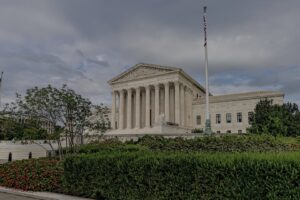



On July 24, 2026, in Fairholme Funds, Inc. v. Federal Housing Finance Agency,[1] a unanimous panel of the U.S. Court of Appeals for the District of Columbia Circuit affirmed a district court decision that permitted holders of common and junior preferred shares of two government-sponsored enterprises (“GSEs”)—the Federal National Mortgage Association (“Fannie Mae”)[2] and the Federal Home Loan Mortgage Corporation (“Freddie Mac”)[3]—to proceed to trial with claims based on breach by the federal government of an implied covenant of good faith and fair dealing. After trial of those claims, a jury ultimately awarded $812 million in damages (including prejudgment interest).[4]
Brief Background
For years, both Fannie and Freddie used the capital provided by their private shareholders to provide liquidity to the residential mortgage market. Though privately owned, both benefited from a public misperception (shared by the ratings agencies) that the federal government had implicitly guaranteed the securities they issued;[5] this allowed Fannie and Freddie to purchase more mortgages and mortgage-backed securities in the market and at cheaper rates[6] and to achieve market dominance in mortgage securitization.[7]
In 2007, the housing market collapsed, and the U.S. economy fell into a severe recession. The financial crisis was occasioned, in part, by a plethora of mortgage loans to borrowers with poor credit. As a direct result of policies of the federal government, among other factors, lenders were strong-armed into easing their standards for loans designated as subprime mortgages: [8] Little or no down-payment was required, nor was much in the way of documenting the borrower’s income, and loans were frequently originated with contractually discounted interest rates that were then reset after two years.[9] Those same policies pushed the GSEs not just to relax their standards[10] but to invest $2 trillion in subprime mortgages.[11] These low-quality loans were then packaged into pools and securitized, and the resulting mortgage-backed securities were given deceptively high credit ratings.[12]
In the wake of the subprime lending and housing crisis that began circa 2007, the two GSEs, which at the time controlled combined mortgage portfolios valued at approximately $5 trillion—nearly half of the United States mortgage market—suffered multibillion-dollar losses. They lost more in 2008 ($108 billion) than they had earned in the previous thirty-seven years combined ($95 billion).[13] Congress reacted with the Housing and Economic Recovery Act of 2008 (“HERA”),[14] which abolished two prior federal regulators, the Federal Housing Finance Board and the Office of Federal Housing Enterprise Oversight, and replaced them with the Federal Housing Finance Agency (“FHFA”), which became the principal oversight authority for the Federal Home Loan Banks as well as the two GSEs. Among other things, Congress authorized FHFA to place Fannie and Freddie into conservatorship,[15] which FHFA promptly did.[16]
As conservator or receiver of a regulated entity, FHFA enjoys sweeping authority. It may “exercise all powers and authorities specifically granted to conservators or receivers, respectively, under [12 U.S.C. § 4617], and such incidental powers as shall be necessary to carry out such powers”;[17] in so doing, it may “take any action authorized by this section, which the Agency determines is in the best interests of the regulated entity or the Agency.”[18] FHFA is authorized to “take such action as may be . . . (i) necessary to put the regulated entity in a sound and solvent condition; and (ii) appropriate to carry on the business of the regulated entity and preserve and conserve the assets and property of the regulated entity.”[19]
Specifically, FHFA may “take over the assets of and operate the regulated entity with all the powers of the shareholders, the directors, and the officers of the regulated entity and conduct all business of the regulated entity.”[20] FHFA may also “collect all obligations and money due,”[21] “perform all functions of the regulated entity in the name of the regulated entity which are consistent with the appointment as conservator or receiver,”[22] “preserve and conserve the assets and property of the regulated entity,”[23] and “provide by contract for assistance in fulfilling any function, activity, action, or duty of the Agency as conservator or receiver.”[24] As with conservators and receivers in general, the FHFA, when acting in either capacity, “immediately succeed[s] to all rights, titles, powers, and privileges of such regulated entity . . . with respect to the regulated entity and the assets of the regulated entity”[25] and may “transfer or sell any asset or liability of the regulated entity in default . . . without any approval, assignment, or consent.”[26]
As part of that process, FHFA and the Treasury Department entered into senior preferred stock purchase agreements (“Preferred Stock Agreements”), whereby the latter would provide capital to Fannie and Freddie, initially in exchange for fixed-rate dividends. Pursuant to these Preferred Stock Agreements, Treasury made $100 billion in emergency capital support[27] available to Fannie and Freddie in exchange for $1 billion in newly created preferred stock in each GSE, plus warrants for the purchase of common stock of each representing 79.9 percent of the common stock of each GSE on a fully diluted basis at a nominal price, and each agreed to pay Treasury a quarterly dividend in the amount of 10 percent.[28] Further, the Preferred Stock Agreements prohibited Fannie and Freddie from declaring or paying any dividend (preferred or otherwise) or making any other distribution (by reduction of capital or otherwise) without Treasury’s consent.
Through the end of Q1 FY2012, Fannie Mae drew on $116.2 billion and Freddie Mac drew on $71.3 billion for a total draw of $187.5 billion.[29] Meanwhile, the Preferred Stock Agreements were amended twice in 2009—once in May to raise the cap on Treasury support to $200 billion,[30] and again in December to remove the cap altogether through 2012. In addition to dividends, Fannie and Freddie had to pay quarterly commitment fees to Treasury for making the capital support available.
The Obama administration, meanwhile, drastically changed the ground rules. In a 2011 white paper, buried among a lot of high-sounding rhetoric, was the following proclamation: “The Administration will work with [FHFA] to develop a plan to responsibly reduce the role of [Fannie and Freddie] in the mortgage market and, ultimately, wind down both institutions.”[31] Thus, what had begun as a conservatorship to assist with a liquidity problem at two government-sponsored, but privately owned, enterprises that were concededly solvent at the time the conservatorships were imposed[32] ended up being a somewhat clandestine nationalization of the two mortgage giants.[33] The descriptor “somewhat clandestine” refers to the deliberate acquisition of warrants for 79.9 percent of the stock of Fannie and Freddie:
If the United States took an option on 80% of the shares or more, it would have to report the Fannie and Freddie debt on its balance sheet, which it was loath to do. This situation allowed it to acquire the benefits of economic control in the event of an upswing without having to bear any of the short-term consequences of it.[34]
According to the Perry Capital LLC v. Mnuchin court:
Fannie’s and Freddie’s frequent inability to make those dividend payments, however, meant that they often borrowed more cash from Treasury just to pay the dividends, which in turn increased the dividends that Fannie and Freddie were obligated to pay in future quarters. In 2012, FHFA and Treasury adopted the Third Amendment to their stock purchase agreement, which replaced the fixed 10% dividend with a formula by which Fannie and Freddie just paid to Treasury an amount (roughly) equal to their quarterly net worth, however much or little that may be.[35]
In 2012, the Preferred Stock Agreements were amended so that Fannie and Freddie were required to pay the Treasury dividends equal to their net worth above a specified reserve, a change known as the “Net Worth Sweep.” This was the Third Amendment to the Preferred Stock Agreements (“Third Amendment”), which eliminated the prior 10 percent dividend and substituted instead an arrangement whereby all profits over a certain threshold were “swept” into the Treasury. Pursuant to the Third Amendment, from and after January 1, 2013, every positive net worth dollar the GSEs generated above the capital reserve account would be the new “Dividend Amount,” payable to Treasury as a dividend on its existing senior preferred stock. As a result, neither Fannie nor Freddie was permitted to amass any capital except for a small reserve.[36]
Announcement of this amendment caused the value of Fannie and Freddie shares to plummet, and shareholders, including those holding both common and junior preferred shares, filed multiple lawsuits[37] challenging the legality of the actions by FHFA in its conservatorship role on a variety of federal statutory and constitutional claims, as well as state law contract claims. These lawsuits variously called into question Treasury’s actions during 2008 to stabilize the home mortgage market, challenged the constitutionality of forcing Fannie and Freddie into conservatorship, and questioned the government’s operation of the two GSEs.
One of those cases went to the U.S. Supreme Court. In Collins v. Yellen,[38] the Court held, on the one hand, that HERA’s restriction on removal by the president of the FHFA director was unconstitutional based on a similar ruling involving the director of the Consumer Financial Protection Bureau (“CFPB”),[39] but, on the other hand, that HERA had authorized FHFA to replace a fixed-rate dividend formula with a variable one, that FHFA had not exceeded its authority in choosing that option, and that 12 U.S.C. § 4617(f)[40] prohibited courts from restraining the exercise of FHFA’s conservatorship powers or functions.
The Fairholme Funds Appeal
The appeal in Fairholme Funds followed a lower-court ruling that let stand a jury verdict awarding shareholders $612.4 million in damages after finding FHFA had breached the implied covenant of good faith and fair dealing. The district court, in upholding that verdict in March 2025, rejected FHFA’s argument that the Supreme Court’s 2021 decision in Collins v. Yellen foreclosed the shareholders’ claims.
FHFA’s position on appeal was that Collins undercut that verdict and reinforced how much latitude Congress gave the agency under HERA when it placed Fannie and Freddie into conservatorship.[41] The panel, consisting of Senior Circuit Judge Douglas Ginsburg and Judges Justin Walker and J. Michelle Childs, distinguished Collins as having addressed a statutory claim concerning the scope of the FHFA’s authority as conservator, not a contract claim for damages. While FHFA enjoyed broad authority to act in the public interest, this power did not give it license “arbitrarily or unreasonably” to violate the reasonable expectations of parties with whom it had a contract.
The court of appeals also rejected FHFA’s contention that the implied covenant could not apply because the shareholder agreements gave the agency wide discretion. Citing Delaware and Virginia law, the court held that such broad grants of discretion are precisely when the implied covenant of good faith is most needed to prevent arbitrary conduct. The covenant is a gap-filler with respect to how such broad discretion may be exercised.
Finally, the court rejected the idea that the shareholders’ position constituted merely an “unripe claim for anticipatory breach” about future dividends. Instead, the court found that the adoption of the Net Worth Sweep was itself a breach of the ongoing duty of good faith, for which the shareholders could seek damages based on the immediate drop in value of their shares.
Affirming the district court’s judgment, the D.C. Circuit held that the implied covenant claim was foreclosed neither by Supreme Court precedent nor by HERA, that the claim was available against FHFA as conservator, and that the Net Worth Sweep violated the reasonable expectations of shareholders. The court of appeals read the Supreme Court’s statutory holding in Collins as applying only to FHFA’s statutory authority as conservator but not foreclosing a contract law claim for damages.[42]
The court held, as it had in Perry Capital LLC v. Lew,[43] that when a contract authorizes a party to act in its “sole discretion,” that party may still violate the implied covenant of good faith and fair dealing if it exercises that discretion “arbitrarily or unreasonably.” In doing so, the court rejected FHFA’s invitation to reassess evidence and discredit testimony heard by the jury.[44] Finally, the D.C. Circuit determined that post–Net Worth Sweep purchasers of shares could pursue the claim and that the denial of restitution and reliance damages was proper.[45] Accordingly, the award of expectation damages was affirmed.
No. 25-5113, 2026 U.S. App. LEXIS 22075 (D.C. Cir. July 24, 2026), aff’g 2022 U.S. Dist. LEXIS 180141 (D.D.C. Oct. 3, 2022). The D.C. Circuit opinion was authored by Senior Circuit Judge Douglas H. Ginsburg, who has served on the court for forty years. ↑
Popularly known as “Fannie Mae” or sometimes just “Fannie,” this entity was created during the Great Depression to “provide stability in the secondary market for residential mortgages,” to “increas[e] the liquidity of mortgage investments,” and to “promote access to mortgage credit throughout the Nation.” See National Housing Act Amendments of 1938, ch. 13, 52 Stat. 8 (codified at 12 U.S.C. § 1716). Originally a government agency, Fannie was designed to facilitate the creation of, and to participate in, a secondary market for mortgage loans. In 1954, Fannie Mae was transformed from a government agency into a mixed ownership (i.e., public-private) corporation, and in 1968, to remove Fannie from the federal budget, the enterprise was converted into a publicly traded, entirely privately owned corporation that funded its operations via market operations in stocks and bonds. ↑
Popularly known as “Freddie Mac” or sometimes just “Freddie,” this entity was created in 1970 (as a younger sibling to Fannie) to “increase the availability of mortgage credit for the financing of urgently needed housing.” See Emergency Home Finance Act of 1970, Pub. L. No. 91-351, 84 Stat. 450 (1970). As with Fannie, Freddie was ultimately transformed (in the 1989 savings and loan bailout legislation popularly known as FIRREA) into a publicly traded, privately owned, for-profit corporation. ↑
Fairholme Funds, 2026 U.S. App. LEXIS at *3. ↑
See Fed. Deposit Ins. Corp., Assessing the Banking Industry’s Exposure to an Implicit Government Guarantee of GSEs (2004). ↑
See Perry Cap. LLC v. Lew, 70 F. Supp. 3d 208, 215 (D.D.C. 2014). ↑
See generally Viral V. Acharya, Governments as Shadow Banks: The Looming Threat to Financial Stability, 90 Tex. L. Rev. 1745 (2012). ↑
Edward J. Pinto, Government Housing Policies in the Lead-up to the Financial Crisis: A Forensic Study (2011). ↑
Joint Center for Housing Studies of Harvard University, The State of the Nation’s Housing: 2008, at 2 (2008). ↑
See, e.g., Charles Duhigg, Pressured to Take More Risk, Fannie Reached Tipping Point, N.Y. Times (Oct. 4, 2008). ↑
See, e.g., Pinto, supra note 8. ↑
See Crash Course: The Origins of the Financial Crisis, The Economist (Sept. 7, 2013). ↑
See Off. of Inspector Gen., FHFA, White Paper No. WPR-2013-002, Analysis of the 2012 Amendments to the Senior Preferred Stock Purchase Agreements 5 (2013). ↑
See Housing and Economic Recovery Act of 2008, Pub. L. No. 110-289, §§ 1101–1163, 1311–1314 (codified at 12 U.S.C. ch. 46). ↑
See 12 U.S.C. § 4617 (a). ↑
See Press Release, Fed. Hous. Fin. Agency, Statement of FHFA Director James B. Lockhart at News Conference Announcing Conservatorship of Fannie Mae and Freddie Mac (Sept. 7, 2008). ↑
12 U.S.C. § 4617(b)(2)(J)(i) ↑
Id. § 4617 (b)(2)(J)(ii) (emphasis added) ↑
Id. § 4617(b)(2)(D). ↑
Id. § 4617(b)(2)(B)(i). ↑
Id. § 4617(b)(2)(B)(ii). ↑
Id. § 4617(b)(2)(B)(iii). ↑
Id. § 4617(b)(2)(B)(iv). ↑
Id. § 4617(b)(2)(B)(v). ↑
Id. § 4617(b)(2)(A)(i). ↑
Id. § 4617(b)(2)(G)–(H). ↑
This was later doubled to $200 billion. See Perry Cap., 70 F. Supp.3d at 216 (“On May 6, 2009, Treasury and the GSEs, through FHFA . . . doubled its funding cap to $200 billion for each GSE.”). ↑
The rate would increase to 12 percent if, in any quarter, the dividends were not paid in cash, until such time as all dividends had been paid in cash. Id. ↑
Fed. Hous. Fin. Agency, 2013 Performance and Accountability Report 110 (2013). ↑
See U.S. Dep’t of Treasury, Fed. Nat’l Mortg. Ass’n, First Amendment to Amended and Restated Senior Stock Purchase Agreement § 4 (May 6, 2009); U.S. Dep’t of Treasury, Fed. Home Loan Mortg. Corp., First Amendment to Amended and Restated Senior Stock Purchase Agreement § 4 (May 6, 2009). ↑
Dep’t of the Treasury & Dep’t of Hous. & Urb. Dev., Reforming America’s Housing Finance Market: A Report to Congress 4 (Feb. 2011). ↑
See Off. of Inspector Gen., FHFA, Analysis of the 2012 Amendments to the Senior Preferred Stock Purchase Agreements 5 (Mar. 20, 2013). ↑
See Building a Sustainable Housing Finance System—Examining Regulatory Impediments to Private Investment Capital: Hearing Before the H. Comm. on Fin. Servs., 112th Cong. (2013) (statement of James E. Millstein, Chief Executive Officer, Millstein & Co.) (asserting that major government interventions “effectively nationalized the residential mortgage market” and that this form of “continued government dominance of the mortgage market is unacceptable”). ↑
Richard A. Epstein, The Government Takeover of Fannie Mae and Freddie Mac: Upending Capital Markets with Lax Business and Constitutional Standards, 10 N.Y.U. J.L. & Bus. 379, 425 (2014). ↑
Perry Cap. LLC v. Mnuchin, 864 F.3d 591, 598 (D.C. Cir. 2017). ↑
Whether or not the Treasury’s concerns—which were the basis for the Third Amendment—about Fannie and Freddie entering a vicious cycle of endless Treasury borrowings just to pay required dividends under the Preferred Stock Agreements had any basis in reality, it is clear that they turned out to be unfounded. Under the Net Worth Sweep arrangement, as of year-end 2014 Freddie Mac had repaid the Treasury approximately $91 billion compared with total Treasury advances of $71 billion. See generally Freddie Mac, Update: Investor Presentation 12–13 (Dec. 2014) (showing profitable quarters since a final draw on the Treasury in the first quarter of 2012, and Fannie Mae had repaid Treasury approximately $134.5 billion compared with total Treasury advances of $116.1 billion); Press Release, Fannie Mae, Fannie Mae Reports Net Income of $3.9 Billion and Comprehensive Income $4.0 Billion for Third Quarter 2014, at 1 (Nov. 6, 2014). ↑
See, e.g., Saxton v. Fed. Hous. Fin. Agency, 901 F.3d 954, 2018 U.S. App. LEXIS 23769 (8th Cir. 2018); Collins v. Mnuchin, 896 F.3d 640 (5th Cir.), vacated, 908 F.3d 151 (5th Cir. 2018) (en banc); Roberts v. Fed. Hous. Fin. Agency, 889 F.3d 397, 399 (7th Cir. 2018); Robinson v. Fed. Hous. Fin. Agency, 876 F.3d 220 (6th Cir. 2017); Perry Cap. LLC v. Lew, 70 F. Supp. 3d 208 (D.D.C. 2014), aff’d in part, rev’d in part sub nom. Perry Cap. LLC v. Mnuchin, 848 F.3d 1072 (D.C. Cir. 2017), amended, 864 F.3d 591, cert. denied, 583 U.S. 1115 (2018), cert. denied sub nom. Cacciapalle v. Fed. Hous. Fin. Agency, 583 U.S. 1115 (2018), and cert. denied sub nom. Fairholme Funds, Inc. v. Fed. Hous. Fin. Agency, 583 U.S. 1115 (2018). ↑
594 U.S. 220 (2021). The case came out of the U.S. Court of Appeals for the Fifth Circuit as Collins v. Mnuchin, 896 F.3d 640 (5th Cir. 2018), aff’d in part, rev’d in part, 938 F.3d 553 (5th Cir. 2019) (en banc), but the name changed when Janet Yellen succeeded Stephen Mnuchin as secretary of the Treasury. ↑
See Seila Law LLC v. Consumer Fin. Prot. Bureau, 591 U.S. 197 (2020) (holding that restrictions in the Dodd-Frank legislation on the removability of the CFPB director violated the separation of powers). ↑
That statute provides, ‘Except as provided in this section or at the request of the Director, no court may take any action to restrain or affect the exercise of powers or functions of the Agency as a conservator or a receiver.” ↑
FHFA’s argument was based on 12 U.S.C. § 4617(f), which provides in pertinent part: “Except as provided in this section . . . no court may take any action to restrain or affect the exercise of powers or functions of the Agency as a conservator or a receiver.” FHFA relied on the Supreme Court’s holding that § 4617(f) protects the FHFA’s business decisions from judicial review. Collins, 594 U.S. at 254. From this, FHFA contended, the jury could not second-guess the Net Worth Sweep because it was a “core exercise” of the FHFA’s “broad” powers under HERA. Furthermore, the agency argued, because Collins held the FHFA “could have reasonably concluded” that the Net Worth Sweep was in the public’s interest, id. at 239, the Supreme Court’s decision necessarily rejected the central element of the shareholders’ implied covenant claim — that FHFA acted “arbitrarily or unreasonably” in agreeing to the Net Worth Sweep. The shareholders’ rejoinder was that FHFA was overreading Collins, which simply involved a claim under the Administrative Procedure Act about the scope of the agency’s and did not decide how § 4617(f) would apply to a claim for contract damages or whether the Net Worth Sweep was consistent with the reasonable expectations of the parties. ↑
Fairholme Funds v. Fed. Hous. Fin. Agency, No. 25-5113, 2026 U.S. App. LEXIS 22075, at *14–20 (D.C. Cir. July 24, 2026). The D.C. Circuit had reached a similar conclusion in its pre-Collins decision in Perry Capital LLC, 864 F.3d at 604–16, and reaffirmed it in Fairholme Funds. ↑
70 F. Supp. 3d 208. ↑
Fairholme Funds, 2026 U.S. App. LEXIS 22075, at *29–32. ↑
Id. at *32–38. The court was persuaded that, under Delaware law, “the implied covenant claim traveled with the shares.” Id. at *34. ↑