What Exactly Is This Private Target Deal Points Study, Anyway?
The Private Target Deal Points Study is a publication of the Market Trends Subcommittee of the Business Law Section’s M&A Committee. It examines the prevalence of certain provisions in publicly available, private target M&A transactions during a specified time period. The Private Target Deal Points Study is the preeminent study of M&A transactions, widely utilized by practitioners, investment bankers, corporate development teams, and other advisors.
What Time Period Will Be Covered by the Study?
The 2025 iteration of the Private Target Deal Points Study will analyze publicly available definitive acquisition agreements for transactions executed and/or completed either during calendar year 2024 or during the first quarter of calendar year 2025.
What Industries Will Be Covered by the Study?
The deals in the Private Target Deal Points Study reflect the broad array of industries of the deals that were conducted in our time period. In this year’s study, the technology, healthcare/pharma/biotech, and industrial goods & services / manufacturing sectors were the largest sectors, together making up approximately 41 percent of the deals.
What Is the Size of the Transactions of the Study?
The transactions analyzed in the Private Target Deal Points Study were in the “middle market,” with purchase prices ranging between $25 million and $900 million; purchase prices for most deals in the data pool were $200 million or below.
Where Are You in the Process of Releasing the Study?
Almost all of our ten issue groups have turned in their data, and we are processing and analyzing it, running quality control checks, and finalizing the slides.
Can You Share Any Sneak Preview Data?
We shared a couple of sneak preview data points with attendees at the meeting of the Market Trends Subcommittee at the ABA’s M&A Committee meeting in September and encourage you to sign up for the M&A Committee and its various subcommittees if you haven’t already—at the following link: Join the BLS M&A Committee.
We can give you a peek ahead (understand, however, that our process is still ongoing and thus these data points may not be final):
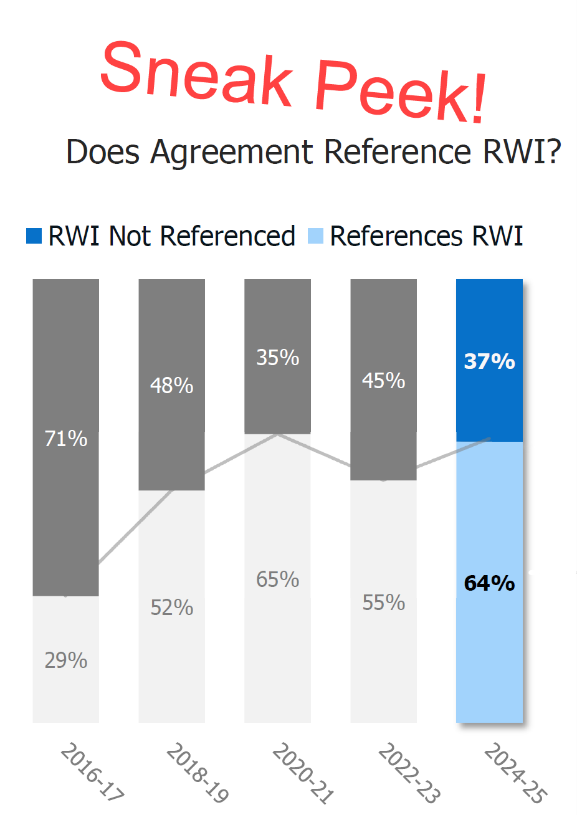
Number of deals referencing RWI has come back up
The sneak peek: Representations and warranties insurance (“RWI”) has been a huge game changer in M&A deals. We measure whether a deal in our study pool utilized RWI by the closest proxy we can access: whether the purchase agreement references RWI. (Of course, RWI may have been obtained without such a reference in the purchase agreement.) The 2023 version of the Private Target Deal Points Study showed RWI references dropping to 55 percent (down from nearly two-thirds of deals referencing RWI in the 2021 version of the Study). In 2025, we are back to nearly two-thirds (64 percent) of all deals in the Study pool referencing RWI.
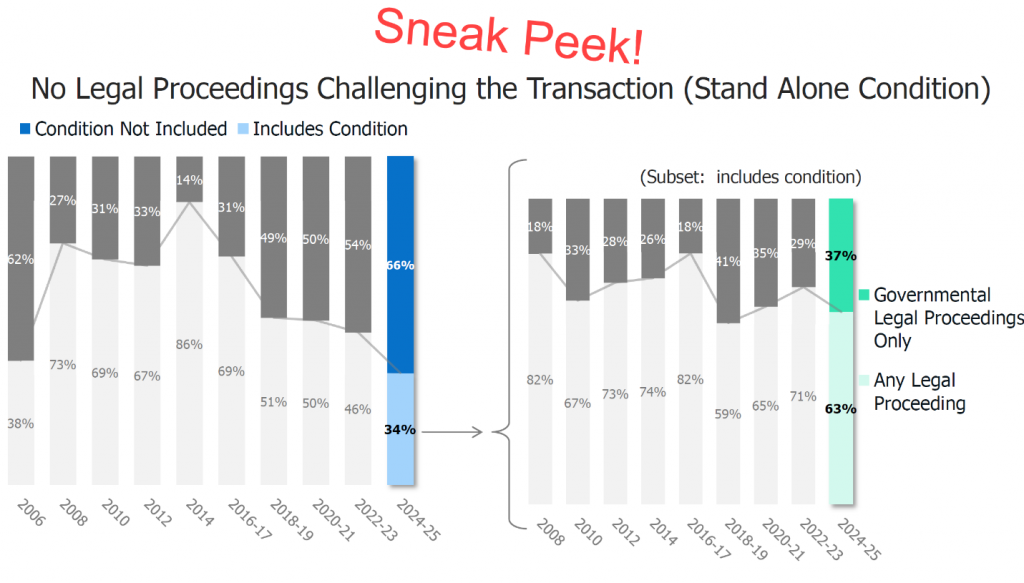
Sellers benefiting from fewer closing conditions related to legal proceedings
The sneak peek: Stand-alone conditions to closing related to legal proceedings challenging the transaction dropped down from 46 percent in the 2023 version of the Study to 35 percent in this iteration of the Study. In that subset of deals where this condition was included, it is now more likely to be limited to governmental proceedings only (as opposed to any legal proceedings).
Please keep an eye out for our study and for an In the Know webinar to be scheduled, during which the chairs and issue group leaders will provide analysis and key takeaways from the results of the 2025 Private Target M&A Deal Points Study.
A junior-level staff member reports that she is being bullied by a supervisor. A mid-level staff member appears to be using the nonprofit organization’s credit card for occasional personal purchases. A senior-level staffer reports alleged financial improprieties relating to a federal grant. The CEO reports that the board chair is acting too familiar, with personal comments and affectionate touches. In each of these circumstances, a nonprofit may be called upon to conduct an internal investigation. This article provides practical tips for conducting defensible and effective internal investigations.
1. The Preliminary Assessment
Before an investigation commences, the organization must swiftly assess the nature of the allegations to ascertain whether there are any immediate threats to physical safety or business operations that can and should be managed. For example, if an employee reports a credible threat of workplace violence, of course, the first step is to notify local law enforcement and implement any other interim measures reasonably calculated to protect employee safety. The organization also should assess immediate threats to the organization itself. For example, if it is alleged that an employee is using the employer’s credit card for personal purchases, the organization may want to put a temporary hold on the employee’s account or monitor the account more closely while the investigation is pending. In other circumstances, where there are concerns about evidence preservation, the organization may direct IT to capture a forensic snapshot of a computer.
Other preliminary considerations concern the nature of the allegations and the party best suited to conduct the investigation. Regarding the nature of the allegations, one should ask, “If the allegations are true exactly as they are presented, do they amount to a violation of the law or organizational policy?” Not all allegations warrant a timely and costly investigation. Imagine, for example, that the organization has a policy prohibiting open-toed shoes in the workplace. An employee reports that her supervisor “bullied” her by admonishing her for wearing flip-flops to work. Even though the organization likely has an anti-bullying policy, it is not reasonable to conclude that a supervisor’s effort to enforce a workplace dress code by itself amounts to bullying. Carefully making these preliminary assessments can protect the organization from unnecessary expenditure of time and resources. Be careful, though, not to summarily dismiss actionable claims simply because they do not incorporate expected buzzwords. A report that an employee is being treated dissimilarly from other employees from different racial backgrounds must be investigated, whether or not the complainant expressly labels the differential treatment as “discrimination.”
Moreover, the organization must evaluate who is best suited to conduct an investigation, which requires thoughtful analysis of potential legal, reputational, financial, operational, and ethical risks facing the organization. Human resources staff may be well suited to address more routine workplace matters. Other matters may require an external investigator. For example, assume a party alleges that the chief human resources officer harbors bias against her. Depending on the facts, it may be prudent for an organization to engage an external, independent investigator to extinguish any claims about compromised neutrality. Alternatively, if sensitive allegations are raised involving the CEO and the board chair, or if the allegations implicate legal or other high-profile matters, it may be prudent to engage external legal counsel to conduct a privileged investigation.
Finally, note that not all internal investigations need to be “independent” ones (although some do call for such independence). Be sure to carefully consider the role of attorney-client privilege (although not all internal investigations are designed to be or remain privileged), and be sure to involve legal counsel at the outset of and throughout all internal investigations (if legal counsel is not conducting the investigation). For instance, if a forensic audit needs to be conducted as part of an investigation, presuming it is a privileged investigation, the nonprofit will want legal counsel to retain the forensic audit firm so that the audit firm’s work product is protected by privilege.
2. Identifying Governing Laws and Organizational Policies
Once the organization decides to proceed with an investigation, the lead investigator must determine which laws and organizational policies govern. For example, if an employee alleges that they are being sexually harassed by a supervisor, Title VII of the Civil Rights Act of 1964 (depending on the size of the organization), state laws, and organizational policies are likely implicated. Notably and importantly, allegations may evolve over time; as such, the investigator must be able to identify when other policies or laws are triggered. Of course, as is true for all operations, the organization must follow policies to a tee. Failure to do so will usually create legal exposure for the entity.
3. Planning the Investigation Strategy
Next, the lead investigator must thoughtfully craft an investigation strategy. What steps does the organization’s policy require? In what order? What is the scope of the investigation? What is being investigated? What is not being investigated? What information must be acquired to substantiate or refute a policy violation? Who may have personal knowledge of the facts underlying the allegations? What might each person be able to tell the investigator? Who else may have valuable information? What tangible evidence might exist that will help the investigator acquire needed information (e.g., account statements, video footage, text messages, emails)? Which witness should be interviewed first? Last? When should each witness be notified? A thoughtful strategy is key to a successful investigation.
4. Conducting Interviews
There is an art and a science to conducting investigative interviews that involves everything from building rapport, to funneling information, to deescalating emotions. While a full treatment of interview methodology is not possible here, a brief comment on the art of the question may prove valuable. Certainly, an investigator will prepare by broadly identifying key topics and questions. Even so, the most defensible investigation will derive from organic conversation, which almost never follows a prepared script. The best investigators ask open-ended questions, listen, and pull threads, taking cues from the interviewees regarding how the conversation will proceed. For example, imagine a sexual harassment investigation. The organization’s policy prohibits “severe or pervasive” sex-based misconduct, and the investigator must engage the interviewee in a neutral manner to make a finding of fact as to whether the described conduct was “severe or pervasive.” Often, investigators’ first instinct is to parrot the policy, asking, “Would you describe the conduct as ‘severe or pervasive?’” That is not a good strategy. The more defensible approach is to ask neutral, open-ended questions such as the following: “What did he say next?” “Tell me more.” “How often did that happen?” Asking open-ended questions and letting the interviewee guide the conversation enables the investigator to elicit unprimed information and better carry out their role as a neutral fact-finder.
From time to time, an investigator may encounter an uncooperative complainant, respondent, or witness. As matter of law, and with some exceptions, employers can require that employees participate in internal investigations, though again, this kind of action should be undertaken only upon advice of legal counsel. (Generally, volunteer leaders such as officers and directors cannot be compelled to participate in such investigations.) When an investigation must proceed without a complainant, respondent, or others, the investigator should clarify that findings of fact will be made without the benefit of the uncooperative party’s input. That admonishment sometimes prompts the uncooperative party to participate, when they initially would not.
5. Gathering and Evaluating Evidence
During interviews, interviewees may refer to emails, text messages, social media posts, photographs, and other evidence to support their representations. Make note of this tangible evidence and ask the interviewee to send documents and information after the interview concludes.
6. Making Findings of Fact
With all evidence acquired, the investigator must ask themselves, “What facts are not in dispute?” Mark those down, as they are as germane to the investigation as disputed facts. Next, identify disputed facts. Of the disputed facts, which facts are corroborated? Does an email or video footage verify a particular version of a story? Did multiple witnesses share the same recollection? If an information gap persists, is there any way the gap can be closed, either through an additional interview or through acquiring additional tangible evidence?
On occasion, but rarely, an investigator may be required to make a finding of fact based on a credibility assessment alone—that is, a determination regarding whose version of events is more likely to be true. Ideally, credibility assessments should be grounded in objective criteria. Did one individual’s story change over time while the other’s remained intact (of course, keeping in mind trauma-informed practices where appropriate)? What are the parties’ underlying motives—who had more to lose? Did you hear the same story from multiple disinterested parties and a different story from one individual? All of these questions and more can help an investigator make reasoned credibility findings.
Unless the law, or the organization’s employee handbook or governing policies, require a higher standard of proof, findings of fact should be based on a “preponderance of the evidence”—that is, “Is it more likely than not that [the event in question] did or did not occur?” For each finding of fact, the investigator should be able to produce clear and articulable grounds underlying the finding.
7. The Investigation Report
Finally, and importantly, findings of fact should be memorialized in a written investigation report. At a minimum, the report should include a recitation of the allegations, a description of the investigation methodology, a list of operative policies and procedures, a description of the evidentiary standard, a statement of undisputed facts, and factual findings (including the evidentiary grounds upon which the findings are based), and potentially recommendations as well, depending on the role of the investigator.
While the aforementioned tips generally reflect sound investigation practices, each circumstance is unique, especially in a remote-work environment, where multiple jurisdictions’ laws may graft onto the employer (as state employment laws generally apply based on the jurisdiction in which the employee principally works). Further, each fact pattern is unique. An investigation into a potential misappropriation of federal funds may trigger federal reporting obligations. Significant diversions of assets such as embezzlement and theft are required to be reported on the IRS Form 990. A sexual misconduct investigation involving a California employee may require a host of rights and protections not required in other jurisdictions. And, of course, when, how, and to what extent to keep the nonprofit’s volunteer leadership involved is always a key consideration; generally speaking, keeping at least the entity’s senior volunteer leaders informed (be it the board chair, executive committee, or full board of directors) is certainly prudent, but always with strict confidentiality reminders.
Finally, whether an organization decides to proceed with an in-house investigation, outsource the investigation to an independent third party, or engage an attorney (whether in-house or external), it is crucial that the investigator is knowledgeable about the law and best practices for each of many unique circumstances. In all cases, it is advisable to consult legal counsel throughout the process.
Holly Peterson is Counsel at Tenenbaum Law Group PLLC. She regularly conducts internal investigations for nonprofit organizations and educational institutions on complex employment and governance matters. Holly can be reached at [email protected].
If your clients use artificial intelligence (“AI”) tools for content creation, something that is incredibly likely given AI’s widespread adoption of late, two federal court decisions from June 2025—Kadrey v. Meta Platforms, Inc.[1] and Bartz v. Anthropic PBC[2]—just changed their liability exposure. Both rulings found that AI training constitutes fair use, but each emphasized that businesses using AI-generated content remain liable for any copyright infringement in the outputs that they create and publish.
These cases focused on AI training specifically, but, in doing so, they also addressed output liability—highlighting risks that many businesses haven’t fully considered or prepared for. For example, a marketing firm using AI to draft client proposals faces the same copyright liability that it would for human-authored content that infringes, but it may not have policies addressing this exposure. Similarly, a law firm generating brief templates with AI faces potential copyright issues that don’t exist when using AI for case research. Understanding how these decisions analyze AI technology helps business lawyers better advise clients on managing copyright risks in all aspects of AI-generated content creation.
What the Courts Actually Decided
Both courts distinguished between AI training (how systems learn from data) and AI generation (when users prompt systems to create content). While training received fair use protection, the judges emphasized that businesses using AI tools remain liable for copyright infringement in the outputs that they create and use.
Judge Chhabria in Kadrey introduced a “market competition” theory that could dramatically expand copyright liability. Traditional copyright law requires that infringing works serve as substitutes for originals—someone reads the copy instead of buying the original. The Kadrey court suggested that AI-generated content might infringe simply by competing with copyrighted works, even without direct substitution. Under this theory, a consulting firm using AI to generate market research reports could face liability if those reports compete with copyrighted research, regardless of whether clients would have purchased the original reports.
Judge Alsup in Bartz took a different approach, fragmenting the analysis into separate questions about data acquisition and training. His decision suggests that how AI companies obtained their training data could affect fair use protection for end users. Companies using AI systems trained on unauthorized content might face greater liability than those using systems trained only on licensed materials—though most businesses have no visibility into their AI providers’ training data sources.
Immediate Business Risk Assessment
These decisions create different exposure levels depending on how clients use AI tools.
Content creation presents the highest risk under the new Kadrey framework. An advertising agency using AI to create campaign materials that resemble existing advertisements faces potential liability even if the AI outputs serve different purposes than the originals. A marketing firm generating social media content with AI tools must consider whether those outputs compete with copyrighted posts, graphics, or campaign materials.
Professional services face more complex analysis. A law firm using AI to draft contracts or briefs creates potential exposure if outputs closely resemble copyrighted legal materials, particularly specialized forms or distinctive arguments from legal publications. However, a firm using AI for case research or document review operates in safer transformative use territory because these applications serve different purposes than the original materials.
Healthcare organizations using AI for patient communications or educational materials must monitor whether outputs resemble copyrighted medical publications or patient education resources. Financial services firms generating investment analysis or client reports with AI face liability if those outputs compete with copyrighted financial research or proprietary investment strategies.
Operational applications like customer service chatbots or internal documentation generally present lower risks, but companies should still establish policies preventing deliberate reproduction of copyrighted materials.
Five Critical Questions Before Using AI for Content Creation
Business lawyers should walk clients through this assessment before implementing AI content generation:
Does the AI output compete in the same market as copyrighted works? If yes, document why the use serves different purposes and implement review procedures.
Can you identify the training sources for your AI system? If using commercial AI services with opaque training data, which will often be the case, strongly consider additional safeguards against reproducing copyrighted content.
Do you have policies preventing deliberate copying? Establish clear guidelines prohibiting employees from prompting AI systems to reproduce known copyrighted materials.
Can you demonstrate transformative purpose? Document how AI usage serves legitimate business functions distinct from consuming original copyrighted works.
Do you have review procedures for high-risk outputs? Implement screening for AI-generated content intended for publication, marketing, or external distribution.
Practical Compliance Framework
Companies should implement documentation showing good-faith efforts to prevent copyright infringement. This includes maintaining records of AI implementation purposes, establishing clear usage policies that prohibit deliberate reproduction of copyrighted content, and providing employee training on both AI capabilities and copyright limitations.
For higher-risk applications like content creation, establish review procedures before publication or distribution. A simple workflow requiring human review of AI-generated marketing materials, social media posts, or client communications can demonstrate reasonable efforts to prevent infringement while preserving operational benefits.
Employee training should emphasize that fair use protection isn’t automatic. Staff need to understand that prompting AI systems to create content “in the style of” specific copyrighted works or asking for materials that closely mimic known publications creates liability exposure. Clear examples help: asking ChatGPT to “write a blog post about cybersecurity” generally presents low risk, while asking it to “write a blog post like the recent Harvard Business Review article on cybersecurity” creates potential problems.
Companies should also address inherited liability from AI systems trained on questionable datasets. While legal standards remain unclear, businesses can demonstrate good faith by avoiding AI services known to have used unauthorized training materials and transitioning to providers with transparent data sourcing when feasible.
Documentation should include regular risk assessments evaluating AI applications across different business functions. Higher-risk uses like creative content generation require additional safeguards, while operational applications like data analysis face lower exposure.
Litigation Strategy Implications
These recent court decisions shift copyright litigation strategy significantly. Discovery will focus on internal policies, employee training, and evidence of intentional copying rather than just comparing AI outputs to copyrighted works. Companies that can show robust compliance frameworks and good-faith efforts to prevent infringement strengthen their defense position.
The Kadrey market competition theory creates new motion practice challenges. Even businesses demonstrating transformative purpose might face factual disputes about market competition that survive early dismissal motions. This makes settlement discussions more attractive, particularly when focused on prospective compliance measures rather than retrospective damages.
Defense strategies should emphasize documented transformative purposes and compliance with recognized governance frameworks. Companies maintaining clear records of legitimate business purposes for AI usage, comprehensive employee training, and procedures for addressing potential copyright issues will have stronger positions in any litigation.
Managing Uncertainty During Appeals
While these district court decisions will likely face appellate review, the two- to three-year timeline for resolution means that businesses must address current exposure. The cost of implementing reasonable AI governance policies remains modest compared to potential copyright litigation expenses, making cautious compliance a sound business decision regardless of how these legal theories ultimately develop.
Companies should monitor legal developments while implementing protective measures now. Basic documentation, employee training, and usage policies provide protection against various liability theories, not just the specific approaches in Kadrey and Bartz. These measures also demonstrate good faith in any future litigation, providing valuable leverage regardless of how appellate courts rule.
The key insight from these decisions is that businesses cannot simply assume that AI tool usage is protected. While AI training generally receives fair use protection, companies using AI-generated content must implement appropriate safeguards and compliance measures. Those establishing robust governance frameworks now—treating these decisions as important guidance while they work through the appellate process—will be best positioned regardless of how this legal landscape ultimately develops.
No. 23-cv-03417-VC, slip op. (N.D. Cal. June 25, 2025). ↑
No. 24-cv-05417-WHA, slip op. (N.D. Cal. June 23, 2025). ↑
This is the ninth installment in the Year in Governance Series from the In-House Subcommittee of the ABA Business Law Section’s Corporate Governance Committee. Each month, the series will share key tips on a different corporate governance topic. To get involved in the Corporate Governance Committee, please visit the committee’s webpage.
A message from Kathy Jaffari: “As Chair of the Corporate Governance Committee, I would like to extend my sincere appreciation to the authors for this publication. The Corporate Governance Committee has ongoing opportunities for writing and volunteering with various projects, whether it’s an article you want to publish or a CLE that you want to present. Our Committee is dedicated to helping you promote informative resources for corporate governance practitioners. You may contact me at [email protected] to get involved.”
The attorney‑client privilege—a cornerstone of sound governance—allows for candid legal advice, but it can be waived through common missteps, and small missteps can waive protection for the entire board of directors. These ten tips offer practical advice to preserve the privilege.
Master the fundamentals. Broadly, a communication is privileged if it seeks or provides legal advice and is maintained as confidential. It is the content of the communication that matters, not the label: copying in-house counsel on a purely business email chain and marking it “Privileged” does not make it so. Remember that the privilege belongs to the corporation, not individual directors—a distinction that becomes critical during investigations or when the interests of directors (individually or as a group) diverge from those of the company.
Wear multiple hats, but—preferably—not at the same time. In-house counsel who also have business roles routinely offer business, not legal, advice. That business advice is not protected by the attorney-client privilege. Sometimes counsel’s advice is “mixed” because the business and legal advice are intertwined. If litigation ensues, you will need to examine each communication to categorize it as business, or legal, or mixed advice. When the board is seeking legal advice from in-house counsel who has dual roles, it should be made clear—at the meeting and in the minutes—and the transition into seeking legal advice should be expressly memorialized. As for documents, separate the legal and business documents to the extent possible. If the documents have mixed content, try to separate and label the legal sections. This will make it easier to identify—and, later, protect—privileged information.
Protect the privilege when drafting minutes. Board meeting minutes should record that legal advice was received on a particular topic but need not summarize the substance of that advice. For executive sessions where legal matters are discussed with counsel present, keep a separate set of privileged minutes prepared by counsel. These privileged legal minutes should be maintained by counsel, follow retention policies, and be redacted before they are shared outside the privilege circle, such as with auditors. Recordings for board and committee meetings are strongly discouraged, but if audio or video recordings are created, they should be destroyed right away: the minutes are the sole official record, making it much easier to isolate and protect the privilege.
Manage digital communications. To maintain confidentiality, you must demonstrate an intent to maintain privacy. But many directors use employer-provided email accounts, personal email accounts, and other informal channels of communication that undermine any expectation of privacy and jeopardize privilege. Explicitly discourage substantive texting by directors, as text messages are discoverable in litigation. The ideal approach is for directors to use a secure board portal for all substantive communications. Another option is to issue company-hosted email accounts for directors and have them use only those accounts for all substantive communications. Alternatively, directors can also use a dedicated, secure personal account exclusively for board work. It may help to remind directors how litigation typically proceeds: that is, the collection and review of all emails and text messages and then a review for relevance. This reality check may help focus the directors’ minds on following these protocols.
Admit only necessary third parties. Third parties generally waive privilege unless their presence is necessary to provide or receive legal advice. For example, counsel advising about the propriety of insurance reserves may need an actuary present to explain the underlying analysis. When third parties are essential to effective communication, have counsel state why their presence is needed to obtain legal advice, and ensure counsel states this rationale on the record for inclusion in the minutes. To the extent possible, engage and direct the third parties through outside counsel. If the third party is not essential for the legal advice—e.g., bankers, public relations personnel, board observers, etc.—excuse them and memorialize that action in the minutes.
Treat AI tools as potential third parties. Boards should establish clear protocols for using new technologies, including artificial intelligence (“AI”). To begin, a board should use only enterprise-grade technology with verified confidentiality protections. Turn off auto-recording on collaboration platforms, and for executive sessions discussing legal matters, consider avoiding AI transcription entirely: handwritten notes still work just fine. If the company uses AI to summarize or analyze large volumes of materials (such as board books), ensure that the tools used have been vetted for confidentiality, cybersecurity, and the appropriate data-use restrictions.
Insulate Special Committee investigations. When a Special Committee is formed, that committee—not the full board—becomes the “client” for purposes of the investigation. It is helpful to have separate counsel for the Special Committee run the process, provide the relevant Upjohn warnings, and report substantive findings only to unconflicted directors. Any advisors (e.g., forensic accountants, bankers) engaged for the Special Committee should be retained by counsel for a defined legal purpose, with committee counsel controlling the distribution of drafts and materials. Resist sharing detailed findings with conflicted directors or the full board: such disclosure can waive the privilege. And be clear about this approach when the Special Committee is formed.
Navigate cross-border investigation challenges. Attorney-client privilege rules may be different internationally. For example, in European Union competition matters, communications with in‑house counsel are not privileged. You should therefore default to local outside counsel and keep sensitive cross‑border advice in counsel‑controlled channels. Before sending any board materials to regulators, coordinate with counsel and assume that the voluntary disclosure of privileged materials risks broader waiver in subsequent litigation. When cooperating, prioritize facts and nonprivileged documents, and avoid waivers unless there is a deliberate, board‑approved strategy.
Treat the privilege like it matters. Treat privilege as you would any other governance risk: educate new directors during onboarding and re-educate current directors. Train directors and key executives on the fundamentals: legal versus business boundaries, proper use of the board portal, and communication protocols. Use clear subject lines like “Privileged & Confidential—Request for Legal Advice re [topic],” but use the labels appropriately. Also, consider having your outside counsel assess your privilege practices as they would in litigation, and conduct annual privilege audits to review practices and identify vulnerabilities.
Prepare for privilege challenges. Even if the board follows each of these tips, privilege may be challenged in litigation or inadvertently waived. Establish clear protocols now: designate who is empowered to waive privilege (typically only the board or authorized officers), document your privilege procedures, and maintain a privilege log for sensitive matters. Understand the consequences of waiver (including deliberate waivers), which can extend beyond a single document to the entire subject matter. When litigation looms, do not wait to implement a legal hold, and seek a Rule 502(d) order to protect against inadvertent waiver. By implementing these protocols, you can create a culture that minimizes risk and preserves the attorney-client privilege.
The views expressed in this article are solely those of the authors and not their respective employers, firms or clients.
This article was published in advance of a Showcase CLE program titled “What’s Up with the Tariffs? A Primer on Tariffs, Trade Agreements, Economic Sanctions, Business Impact, and the Economy” that took place at the American Bar Association Business Law Section’s 2025 Fall Meeting. All Showcase CLE programs were recorded live and will be available for on-demand credit, free for Business Law Section members.
Since taking office on January 20, the U.S. President has issued a series of Executive Orders (“EOs”) declaring national emergencies with regard to drug and human trafficking and other criminal behavior in North America, as well as worldwide trade imbalances, and imposing tariffs (collectively, the “2025 Tariffs”). Since then, the tariffs have been the subject of litigation, attempted Congressional action, and economic debate.
Executive Orders and Actions Timeline for the 2025 Tariffs: Canada and Mexico
February 1: The U.S. President issued two EOs declaring states of emergency with regard to the northern border with Canada and the southern border with Mexico and imposing 25% tariffs on imports from Canada and Mexico (EOs 14193 and 14194). Energy and energy resources were only subjected to 10% tariffs.
The EOs invoked the International Emergency Economic Powers Act of 1977 (“IEEPA”) to impose the additional tariffs. There was explicitly no de minimis carveout. Both EOs also stated that the tariffs and their scope might be increased or expanded if Canada or Mexico imposed retaliatory tariffs on imports from the United States.
The justification cited for the import tariffs on goods from Canada was “failure of Canada to do more to arrest, seize, detain, or otherwise intercept [drug trafficking organizations], other drug and human traffickers, criminals at large, and drugs.” The justification for the Mexican import tariffs on goods from Mexico was identical, except that it targeted “illicit drugs” rather than all drugs.
February 3: Tariffs were paused until March 4 in recognition of the governments of Canada and Mexico taking “immediate steps designed to alleviate the illegal migration and illicit drug crisis through cooperative actions” (EOs 14197 and 14198).
March 2: De minimis import tariffs from Canada and Mexico were paused (EOs 14226 and 14227). Historically, de minimis imports have been duty-free to avoid administrative expense and inconvenience disproportionate to the revenue that would be collected.
March 6: Eliminated tariffs for all imports from Canada and Mexico that were duty-free under the existing United States-Mexico-Canada Agreement (“USMCA”) (EOs 14231 and 14232). The reason cited for the tariff adjustment was the employment and innovation that the automotive production industry brings to the United States. The duty on potash, used to make agricultural fertilizer, was also reduced from 25% to 10%.
April 2: Imports from Canada and Mexico were exempted from a new general 10% tariff on “all imports from all trading partners” worldwide, plus an additional 11–50% on imports from a list of fifty-seven countries, imposed in response to concerns cited about trade deficits and lack of reciprocity in bilateral trade relationships (EO 14257). The EO similarly invoked IEEPA to impose the tariffs.
No additional tariffs were imposed on Canada and Mexico. However, the EO provides that if the tariffs already imposed this year are terminated or suspended, there would be a 12% tariff on imports not eligible for special treatment under the USMCA with the following exceptions: energy and energy resources, potash, and parts or components of “an article substantially finished in the United States.”
July 12: The U.S. President posted a letter on social media to the President of Mexico announcing a 30% tariff would go into effect on August 1.
July 30: The de minimis tariff exemption for goods shipped for consumption was suspended globally, including for imports from Canada and Mexico (EO 14324). Effective August 29, the IEEPA-related tariffs apply, plus a specific duty per package ranging from $80 to $200 per item.
July 31: The U.S. President announced on social media that there would be a ninety-day delay on the Mexico tariffs. By contrast, tariffs on imports from Canada were increased from 25% to 35%, with the EO citing “Canada’s lack of cooperation in stemming the flood of fentanyl and other illicit drugs across our northern border” (EO 14325). An additional 40% tariff rate was also applied to goods “transshipped to evade applicable duties.” The tariffs were effective August 1.
Litigation
The 2025 Tariffs have been challenged in numerous courts, including the U.S. Court of International Trade (“CIT”). On May 28, the CIT in V.O.S. Selections, Inc. v. Trump vacated the orders for what it referred to as the “Trafficking Tariffs” and the “Worldwide and Retaliatory Tariffs,” holding that IEEPA did not authorize imposing them, and granted a permanent injunction. The plaintiffs are five businesses that make or import products including wine and spirits, water line pipes, children’s learning kits, fishing gear, and cycling clothing, as well as twelve states. The injunction was stayed pending appeal.
Also, on May 29, in Learning Resources, Inc. v. Trump, the U.S. District Court for the District of Columbia (“DDC”) found that jurisdiction over the tariffs was not exclusive to the CIT because the tariffs were based on IEEPA authority. The DDC granted a preliminary injunction only as to the two plaintiffs, which are companies that make children’s educational toys. The injunction was stayed pending appeal in the U.S. Court of Appeals for the District of Columbia.
Legal Analysis
Taxation and the Separation of Powers
Tariffs are a tax paid by businesses and consumers that import goods from other countries. The U.S. Constitution grants Congress the exclusive power to impose and collect taxes and duties as well as to regulate commerce with foreign nations (Article I, Section 8, Clauses 1 and 3).
Congress has periodically delegated limited authority to impose tariffs to the President—for example, with regard to administration of tax collection. Under certain circumstances, the President has also been granted the authority to adjust tariffs by international trade agreements that are approved by Congress. However, in each case the statutory grant of authority has imposed clear limitations, and IEEPA contains no such delegation.
International Emergency Economic Powers Act
IEEPA gives the President the authority to declare a national emergency in response to an “unusual and extraordinary threat” to the “national security, foreign policy, or economy of the United States.” The threat must have “its source in whole or substantial part outside the United States,” and the exercise of authority must “deal with” the threat.
This is the first time that IEEPA has been used as a basis for imposing tariffs. The U.S. Department of the Treasury’s Office of Foreign Assets Control (“OFAC”) has interpreted and administered IEEPA and other sanctions laws to impose targeted economic and trade sanctions against named countries, individuals, and organizations since its creation in 1950. Regulations issued under IEEPA Section 1702 generally include instructions to block or license transactions as opposed to imposing a tax or a fee.
The authority to tax is not listed in the enumerated IEEPA powers. All three courts that have ruled on the 2025 Tariffs considered the meaning of the authority to “regulate . . . importation” that is enumerated in Section 1702 and concluded that the 2025 Tariffs exceeded the President’s authority.
The rulings so far have suggested the power to “regulate . . . importation” in IEEPA would be better interpreted consistent with historic context. For example, it might be deemed authority to “fix or adjust the time, amount, degree, or rate of” transactions as in the third meaning of regulate in the Merriam-Webster dictionary.
IEEPA was also intended to be more limited in scope and have more procedural limitations than the Trading with the Enemy Act (“TWEA”) that had been the primary basis for economic and trade sanctions prior to IEEPA’s enactment in 1977. All three courts expressed concerns about the lack of limitations on the 2025 Tariffs, for example on scope, magnitude, and duration. The procedural limitations of IEEPA also include being subject to the National Emergencies Act of 1976 (“NEA”), which requires reporting to Congress and gives Congress the authority to terminate a national emergency declared by the President.
An additional consideration is that there is no direct nexus between the 2025 Tariffs and stopping illicit drug transactions, human trafficking, or criminal activity. IEEPA requires that the sanctions “deal with an unusual and extraordinary threat with respect to which a national emergency has been declared . . . and may not be exercised for any other purpose.” If the intent of the tariffs is to raise taxes, then they are not being imposed for the purpose of dealing with those threats. And while they may make those transactions more expensive, they do not stop them, change their legal status, or bring the perpetrators to justice as enforcement of other existing laws might do.
United States v. Yoshida
The government relied in its arguments on the precedent in United States v. Yoshida International, a 1975 U.S. Court of Customs and Patent Appeals (“CCPA”) decision upholding a 10% import surcharge imposed for five months by President Nixon in August 1971. As described in the DDC decision, the tariffs were only imposed on “goods already subject to tariff reductions,” so the surcharges “did not exceed the original statutory maximum set out by Congress.”
Importantly, the 10% import surcharge at issue in Yoshida was adopted in response to a balance of payments deficit, which is not the same as a trade deficit. At the time, the U.S. dollar had a fixed exchange rate with gold at $35 per ounce. The exchange rate was set in accordance with the international Bretton Woods Agreement signed by forty-four countries in 1944 and adopted by Congress in 1945.
In August 1971, the U.S. government did not have sufficient gold reserves to cover the dollars in circulation around the world. So President Nixon suspended the “gold standard,” and other countries could not exchange dollars for gold at a fixed rate. The import surcharges were a temporary measure in anticipation of exchange rate fluctuations.
In March 1973, the United States and other countries instituted floating exchange rates, so that issue is now moot.
Pending Supreme Court Litigation
On September 9, the U.S. Supreme Court agreed to consider consolidated expedited appeal of the V.O.S. Selections and Learning Resources cases. Oral argument is scheduled for the first week of November, and it is anticipated that the Supreme Court will rule on the validity of the tariffs. If they are invalidated, the government may have to refund the tax revenue.
The 2025 Tariffs will remain in place in the interim unless the President rescinds them or Congress acts sooner.
Congressional Action
Congress can terminate an emergency declared under the National Emergencies Act of 1976 with a joint resolution that has sufficient support to survive a Presidential veto. There have been numerous bills related to the 2025 Tariffs introduced in both the U.S. Senate and the U.S. House of Representatives. Among them:
Senate Joint Resolution 37 to terminate the national emergency with regard to Canada declared on February 1, 2025, passed the Senate on April 2, 2025, by a vote of 51–48, but it has not been acted on in the House.
Senate Joint Resolution 49 to terminate the national emergency declared on April 2, 2025, in justification for the Worldwide Tariffs was narrowly defeated on April 30 by a vote of 49–49.
Bipartisan companion bills S. 1272 and H.R. 2665 have been introduced that would subject import duties under the Trade Act of 1974 to a forty-eight-hour notification requirement and a maximum period of sixty days unless Congress approves or disapproves them by joint resolution.
The draft Joint Resolutions that would terminate the national emergencies were voted on prior to the CIT, DDC, and Federal Circuit decisions. A carefully phrased preamble to a joint resolution that takes into account other existing laws more appropriate to address the challenges facing the United States, as well as the economic impact of the tariffs, could bring broad bipartisan support.
Tax Revenue and Economic Developments
According to U.S. Department of the Treasury data, tariffs generated approximately $165 billion in tax revenue this year as of September 9, which is already an increase of almost $90 billion more than the amount for the entire 2024 calendar year. However, tariffs are intended to reduce imports. So over time, tariff revenue should decrease.
Capital-intensive industries in particular have faced extraordinary tax increases as a result of the 2025 Tariffs. For example, U.S. auto manufacturers Ford Motor Company and General Motors issued company statements forecasting that they will pay approximately about $2 billion and up to $5 billion respectively this year as a result of the tariffs.
Preliminary Bureau of Labor Statistics (“BLS”) data shows that manufacturing jobs decreased by 33,000 between January and August. There are also other increasing signs of economic harm.
According to BLS, the annualized inflation rate increased from a 2025 low of 2.3% in April to 2.9% in August. The unemployment rate increased from 3.7% in January to 4.3% in August.
Conclusion
The 2025 Tariffs have been imposed in a series of EOs carried out mercurially in an extraordinarily compressed timeframe. They have damaged international relations, made it impossible to conduct business with any certainty, and been the subject of successful legal challenges. They have also created artificial price inflation for businesses and consumers and appear to be causing economic harm to the U.S. economy.
Costs from the 2025 Tariffs increase every day, as do the economic disruptions and distortions. Other existing laws such as anti-money laundering, narrowly tailored sanctions with regard to named individuals or organizations, and criminal laws are more appropriate to address concerns with illicit drugs, human trafficking, and criminal behavior.
Trade agreements are carefully crafted during multiyear negotiations because they are a balance of economic interests. Those years allow input from stakeholders, including governments, businesses, and consumer groups. They also allow time for stakeholders to adjust, plan, budget, negotiate or renegotiate mutually beneficial business agreements, establish infrastructure, and arrange financing.
Canada and Mexico are the closest trading partners to the United States both geographically and by trade volume. The USMCA covers both tariff and nontariff barriers, and it just came into force in 2020. Its predecessor, the North American Free Trade Agreement (“NAFTA”), was in place for twenty-six years.
The USMCA is the appropriate mechanism for addressing any trade imbalances and trade disputes. To the extent there are any adjustments that need to be made, the USMCA is scheduled for joint review on July 1, 2026.
Advance consultations are already beginning. On September 16, the Office of the United States Trade Representative (“USTR”) issued a request for comment and scheduled a public hearing for November 17.
When an insured is pursuing a representation and warranty insurance (“RWI”) claim, a critical consideration is whether diminution in value damages (“DIV Damages”) can be asserted as Loss covered by the RWI policy.[1] This article, being published in four parts, discusses Delaware mergers and acquisitions (“M&A”) damages law regarding DIV Damages and describes how an insured can pursue them as part of an RWI claim.
This is Part III of this article; it discusses the requirements for a DIV Damages award as part of an RWI claim. Part I of this article addressed (i) the principal differences between DIV Damages calculated using a multiple of EBITDA methodology (“MOE Methodology”) and DIV Damages calculated using a discounted cash flow methodology (“DCF Methodology”), and (ii) the evolution of cases involving DIV Damages calculated using an MOE Methodology under Delaware M&A damages law.[2]Part II of this article addressed the evolution of cases involving DIV Damages calculated using a DCF Methodology under Delaware M&A damages law. Part IV of this article will discuss the limitations on, and other matters regarding, a DIV Damages award as part of an RWI claim.
Each part of this article contains practice tips for attorneys for insureds seeking recovery of DIV Damages as part of an RWI claim.
Requirements for DIV Damages With Respect to an RWI Claim
There are three basic requirements for any RWI claim,[3] and therefore for any claim for DIV Damages under an RWI policy. An insured must establish that:
R&W Breach: An R&W Breach has occurred;
Loss: The target business or the insured has suffered a Loss as defined in the RWI policy (in the case of DIV Damages, a diminution in value of the target business with recurring effect);
Proximate Cause: The R&W Breach was the proximate cause of the Loss.
A different way to say the foregoing is that after the Acquisition, (i) the insured becomes aware of revenue or expense information about the target business without required disclosure by the seller, and (ii) had the insured known about the problem prior to the Acquisition, the insured would have reduced the purchase price that it paid for the target business.
Effectively, the DIV Damages serve as a post-Acquisition purchase price adjustment in favor of the insured.
1. R&W Breach
Some types of R&W Breach are more likely to lead to a claim for DIV Damages, while others are more likely to lead to a claim for out-of-pocket damages (i.e., a “1x claim”).
The following types of R&W Breach are more likely to lead to a claim for DIV Damages:
Historical Income Statements: R&W Breaches regarding the target’s historical income statements[4]—provided in the case of DIV Damages calculated using an MOE Methodology that the income statement line items in question are not those added back in calculating EBITDA (interest on certain types of debt (I), income and similar types of taxes (T), depreciation (D), and amortization (A)) or in making adjustments to EBITDA as that term was used by the buyer—may lead to a claim for DIV Damages.
Significant Customers: R&W Breaches regarding the target’s significant customers are also likely to lead to DIV Damages, particularly representations and warranties that deal with the continued existence or strength of significant customers’ relationships with the target business or the pricing of the products or services provided to those customers.[5]
Other Types: Any other type of R&W Breach that can be deemed to have an adverse effect on the target business’s (i) Measurement Period EBITDA, and an anticipated recurring adverse effect on the target business’s EBITDA going forward after the Acquisition, or (ii) projected cash flows going forward after the Acquisition, may lead to a claim for DIV Damages. Examples are representations and warranties regarding compliance with laws, disclosure of liabilities, operating taxes (e.g., sales and use taxes), and regulatory status.
One other note regarding R&W Breaches: Very rarely does an Acquisition Agreement contain a representation and warranty with respect to the Measurement Period EBITDA itself or with respect to projections provided for the target business.[6] Even though Measurement Period EBITDA or projections may be a critical piece of information regarding the target business and the purchase price to be paid therefor, buyers typically do not request and sellers typically do not offer such a representation and warranty.[7]
2. Loss
Two types of loss can result from an R&W Breach:
Third-party loss, for which the amount is rarely in doubt after the amount owed to the third party has been liquidated or settled, even though there may be an issue of whether the amount thereof (as well as any defense costs with respect thereto) is covered by the RWI policy.
First-party loss, for which both the amount and whether that amount is covered by the RWI policy are at issue.
DIV Damages are expectation damages that are a type of first-party loss. Although there may be other types of methodologies to calculate DIV Damages, they almost always are calculated using an MOE Methodology or a DCF Methodology.[8]
a. Issues With Respect to DIV Damages Using Either an MOE Methodology or a DCF Methodology
Certain issues are similar regardless of the methodology used in calculating DIV Damages.
i. Determining the Validity of DIV Damages
The Loss must be in the form of an adverse effect on the target business.
Examples in the case of an MOE Methodology:
An actual adverse effect in the form of an overstatement of the target business’s Measurement Period EBITDA by reason of revenues of the target business having been overstated or expenses of the target business having been understated due to a financial statements R&W Breach.
A deemed adverse effect in the form of the target business being forced to pay an expense after the Acquisition that should have been reflected in the target business’s Measurement Period EBITDA, such as a regulatory fine or an operating expense that relates back to the EBITDA Measurement Period.
A deemed adverse effect in the form of the target business’s Measurement Period EBITDA having included revenue from a customer that has been lost during or after the end of the EBITDA Measurement Period, with that customer loss being the subject of an R&W Breach regarding significant customers. (Note in this example that the historical Measurement Period EBITDA was still accurate, but that cash flows from that customer will not recur after the Acquisition and can therefore be treated as a deemed reduction of the target business’s Measurement Period EBITDA.)
Examples and principles in the case of a DCF Methodology:
Any type of R&W Breach that has a recurring adverse effect on EBITDA of the target business should also have an adverse effect on the projected cash flows of the target business for the DCF Measurement Period.[9]
The adverse effect on the target business’s projected cash flows may be the result of an overstatement of revenue, an understatement of expense, or a combination of the two. It may be an adverse effect that began before the consummation of the Acquisition of the target business, or after the consummation, but in either case it must result from the R&W Breach in question.
The focus of the Loss requirement for an RWI claim is on an anticipated adverse effect on the target business’s projected cash flows for the DCF Measurement Period. Unlike the adverse effect on the target business’s Measurement Period EBITDA in the case of DIV Damages calculated using an MOE Methodology, which can be either actual or deemed, the adverse effect on the target business’s projected cash flows will always be an actual adverse effect, even to the extent that it is still only anticipated.
A claim for DIV Damages can only readily be made if the buyer can prove that the purchase price for the target business was based on either an MOE Methodology or a DCF Methodology.
The simplest and most effective proof of that is if the indication of interest (“IOI”) or the letter of intent (“LOI”) for the Acquisition explicitly sets forth the metrics of the methodology that the buyer used in arriving at the proposed purchase price for the target business.[10]
Short of such explicit proof, evidence that the buyer established the purchase price for the target business on such a basis and that the seller knew the buyer was doing so should be sufficient under Delaware M&A contract damages law.[11]
Short of that would be proof that the buyer primarily used such a methodology and that it was the most appropriate way to have valued the target business or established the purchase price for the target business.[12]
ii. Determining the Diminution in Value
The determination of the diminution in value resulting from an R&W Breach is more of a forensic science than a legal analysis, and even then with some art mixed in.
The first step is to identify the actual or deemed adverse effect of the R&W Breach on the Measurement Period EBITDA or on the projected cash flows and terminal value. It may seem obvious, but if, for example, a significant customer has been lost prior to the consummation of the Acquisition without required disclosure by the seller, then the adverse effect is not measured by the revenue received from that lost customer during the Measurement Period but instead by that amount of revenue net of the costs that would have been incurred to earn such revenue and that can be avoided by the target business, often referred to as “avoided costs.”[13]
The second step is to determine whether or not such net revenue (i.e., EBITDA or cash flow) from that customer would have been recurring enough to justify the award of DIV Damages.[14]
b. Issues With Respect to DIV Damages Calculated Using an MOE Methodology
An MOE Methodology is composed of two elements: (i) Measurement Period EBITDA and (ii) a multiple applied to the Measurement Period EBITDA.
i. Measurement Period EBITDA
In addition to add-backs for I, T, D, and A, EBITDA is often adjusted to add back certain other costs and expenses to arrive at an “Adjusted EBITDA” for the target business. The buyer’s accounting expert’s quality of earnings (“Q of E”) report is the best source for an explanation of such adjustments and for information about a target business’s EBITDA generally.
ii. Multiple
If the purchase price for the target business was calculated using an MOE Methodology, then the multiple used in calculating DIV Damages should be the same multiple that was used in calculating the purchase price.[15] If a multiple has more than one number right of the decimal point, it is most likely an implied multiple (i.e., a multiple derived simply by dividing the purchase price by the Measurement Period EBITDA).[16]
c. Issues With Respect to DIV Damages Calculated Using a DCF Methodology
A DCF Methodology is composed of three elements: (i) cash flow projections, (ii) terminal value, and (iii) a discount rate applied to each of the projected cash flows and the terminal value.[17]
i. Cash Flow Projections
Because such projections are of cash flows, not of financial accounting income, noncash charges such as depreciation and amortization typically are not treated as reductions to revenue, unlike cash charges such as cost of goods sold (“COGS”) and selling, general, and administrative expenses.[18]
If the purchase price for the target business was calculated using a DCF Methodology, then the calculation of DIV Damages may not require an in-depth analysis of the cash flow projections that were so used, but instead may only require use of the same projections but with the effects of the R&W Breach in question (including any avoided costs) backed out to calculate the deemed actual value of the target business as of the date of the R&W Breach.[19]
ii. Terminal Value
There essentially are two types of terminal value used in a DCF Methodology:
The first type (which is more of a “continuing value”) assumes that the target business will experience steady growth after the final period of the projections, and then applies a mathematical formula to the final period’s net cash flow amount to calculate a sum of the infinite, growing cash flows, with that result discounted to net present value by application of the chosen discount factor.
The second type (which is more of an actual “terminal value”) takes the final period’s net cash flow amount and multiplies it by a market multiple, with that product discounted to net present value by application of the chosen discount factor.[20]
In either case, the terminal value will constitute a significant portion (often 70 percent or more, pre-discounting) of the aggregate cash expected to be received from the target business.
iii. Discount Rate
Except to the extent that the cash flow projections were themselves adjusted for risk, the discount rate used should account for risk,[21] and not solely to account for the time value of money (often referred to as the “risk-free rate”), to arrive at the DIV Damages—that is, the appropriate post-Acquisition purchase price adjustment discounted to then-present dollars and to reflect the probability of future risk.
A typical factor to use to account for risk is the buyer’s weighted average cost of capital (“WACC”).[22] However, if DIV Damages are being calculated on a “with/without” basis, then the same discount rate used by the buyer in calculating the purchase price for the target business (the “with” case) should be used to calculate the deemed actual value of the target business backing out the effects of the R&W Breach in question (the “without” case).
It is often the case that the buyer did not actually use a DCF Methodology to “set the purchase price” for the target business, but instead only to confirm that the purchase price was within a range in line with the buyer’s expectations for its return on the Acquisition. In that context, it may be necessary to resize the DIV Damages calculated from the “with/without” analysis to correspond to the purchase price.[23]
3. Proximate Cause
For DIV Damages to be recoverable Loss under an RWI policy, it is not sufficient merely to identify an R&W Breach and a Loss in the form of a shortfall in Measurement Period EBITDA or with respect to projected cash flows of the target business. That R&W Breach must have been the proximate cause of that Loss.[24]
The typical process for an insured to formulate an RWI claim is to identify an R&W Breach and then to determine what losses have been proximately caused by that R&W Breach and whether such losses are recoverable under the RWI policy.
However, sometimes the script is flipped, and the insured identifies a loss impacting the target’s post-Acquisition business and then tries to find an R&W Breach that might have “caused” that loss (a “loss in search of a breach”).
In the case of an R&W Breach or Breaches with respect to the target’s historical income statement(s), the R&W Breach(es) needs to cover the entire Measurement Period for DIV Damages calculated using an MOE Methodology to be recoverable. Since the Measurement Period will often be a last twelve months (“LTM”) or trailing twelve months (“TTM”) period that does not match up with a single historical income statement covered by the financial statements representation and warranty, the R&W Breaches will need to apply to more than one such financial statement.[25]
Practice Tips for Attorneys for Insureds
In the RWI policy claim evaluation phase, consider doing the following:
Have a qualified forensic accounting firm or valuation firm weigh in on the evaluation and calculation of potential DIV Damages.
Interview any manager or other key employee who worked for both the target business or the seller prior to the Acquisition and the target business or the buyer after the Acquisition, with an eye toward getting their input on the information going into a potential DIV Damages claim (before the RWI carrier or its counsel does so).
For DIV Damages calculated using an MOE Methodology, review in depth the Q of E report prepared for the buyer prior to consummation of the Acquisition to understand the target business’s EBITDA generally and any adjustments thereto specifically.
Determine whether anything should be done or not done to attempt to mitigate Loss associated with the potential DIV Damages.
Try to avoid any action or omission by the target business or the insured that could be asserted as calling into question any material element of the DIV Damages.
This article is the third in the RWI Practice Insights series by John T. Capetta.
This article focuses on buyer-side RWI policies and U.S. law (principally Delaware case law). For purposes of this article:
DIV Damages are a form of expectation damages in which the amount of the damages is the difference between (i) the value of the target business as represented to the buyer, almost always the purchase price paid for the target business by the buyer, and (ii) the value of the target business after giving effect to the diminution in the target business resulting from a breach of the Acquisition Agreement representations and warranties (“R&W Breach”) or from fraudulent misrepresentation or deceit regarding the target business.
Although there are other methods to calculate DIV Damages, this article focuses on those calculated by using either (i) in the case of a multiple of EBITDA methodology (“MOE Methodology”), (a) an actual or deemed shortfall in the EBITDA of the target business for a specified measurement period (“Measurement Period EBITDA”) caused by the R&W Breach or the fraudulent misrepresentation or deceit, times (b) the multiple applied by the insured to the Measurement Period EBITDA in determining the purchase price to pay for the target business; or (ii) in the case of a discounted cash flow methodology (“DCF Methodology”), the loss of future cash flows and of terminal value over a specified period caused by the R&W Breach or the fraudulent misrepresentation or deceit, discounted to present value by the application of a discount factor.
The period of time for which the historical EBITDA is measured in an MOE Methodology and the period of time for which the projections used in a DCF Methodology are included are each referred to in this article as the Measurement Period.
As used in this article:
the term Loss has the definition set forth in the RWI policy;
the term Acquisition Agreement includes stock purchase agreements, merger agreements, asset purchase agreements, and other types of business combination agreements by which a buyer acquires a target business from a seller;
the term Acquisition refers to the business combination contemplated by the Acquisition Agreement;
the term the buyer and the term the insured are often used interchangeably;
the term target and the term target business are used interchangeably;
the term R&W Breach also includes a claim under an RWI policy with respect to a tax indemnification provision in the Acquisition Agreement; and
the phrase without required disclosure by the seller refers to a failure by the seller to make a disclosure to the buyer even though required to do so by a representation and warranty in the Acquisition Agreement.
“Expectation damages” are also sometimes referred to by courts as expectancy damages.
Although relevant M&A damages law regarding DIV Damages may apply with respect to fraudulent misrepresentation or deceit (each a tort) regarding the target business as well as an R&W Breach (a breach of contract), DIV Damages with respect to an RWI claim can only be asserted for an R&W Breach and therefore will always be subject to M&A contract damages law. However, note in this regard the argument described in infra note 3 with respect to an R&W Breach in the form of a claim under the tax indemnity provision in an Acquisition Agreement. ↑
An argument can be made that an indemnification provision in an Acquisition Agreement that is triggered by a specific event, rather than by a breach of representation and warranty, may not be subject to M&A contract damages requirements and limitations that would apply in the context of breach. See Glenn D. West & Sara G. Duran, Reassessing the “Consequences” of Consequential Damage Waivers in Acquisition Agreements, 63 Bus. Law. 777, 785 (May 2008) (section titled “The Impact of Indemnification Provisions on General Contract Damages Rules”). The foregoing brings into question whether an R&W Breach in the form of a claim under a tax indemnification provision triggered by the incurrence post-Acquisition of taxes with respect to the pre-Acquisition Measurement Period may be more effective than one in the form of a claim for breach of the taxes representation and warranty in an Acquisition Agreement with respect to the same incurrence.
On a different side of the foregoing argument, the provision of indemnification as a remedy (and even the sole remedy) in an Acquisition Agreement for breaches of representation and warranty should not be interpreted to prohibit a claim for the contractual remedy of expectation damages, unless expectation damages have been expressly excluded. SeeInterim Healthcare, Inc. v. Spherion Corp., 884 A.2d 513, 549 (Del. Super. Ct. 2005); see alsoHudson’s Bay Co. Luxembourg, S.A.R.L. v. JZ LLC, No. 10C-12-107, 2011 WL 3082339, at *2 (Del. Super. Ct. July 26, 2011) (“A claim for indemnification resulting from the breach of a representation and warranty is a claim for breach of contract.”), aff’don other grounds, 80 A.3d 960 (Del. 2013) (unpublished table decision). ↑
However, if an R&W Breach with respect to the historical balance sheets of the target business leads to the need to create a new accrual or to increase an existing accrual, and the accrual or increase would have a recurring effect on EBITDA or on the projected cash flows of the target business post-Acquisition, then DIV Damages may be appropriate. ↑
The length of the relationship with those customers is important for this purpose, but with the focus being on the anticipated prospective length, not on the historical retrospective length. ↑
Indeed, most Acquisition Agreements contain an explicit disclaimer of any representation or warranty regarding projections provided to the buyer for the target business. ↑
In Dura Medic, the target did make representations and warranties as to its last twelve months (“LTM”) ending on April 30, 2018, financial statements, but appears not to have explicitly made a representation and warranty as to the LTM April 30, 2018, EBITDA derivable therefrom. In re Dura Medic Holdings, Inc. Consol. Litig., 333 A.3d 227, 243 (Del. Ch. 2025). In Cobalt, the opinion refers to “Crystal’s representation that WRMF’s annual broadcast cash flow was $5 million,” Cobalt Operating, LLC v. James Crystal Enters., LLC, No. 714, 2007 WL 2142926, at *1 (Del. Ch. July 20, 2007) (footnote omitted), aff’d, 945 A.2d 594 (Del. 2008) (unpublished table decision); to “WRMF’s cash flow [being] in fact $5 million, as represented by Hilliard [Crystal’s sole owner],” id. at *7 (footnote omitted); and to “Hilliard’s representation that WRMF’s cash flow for the twelve months leading up to the closing would be $5 million,” id. at *8. However, the description of the Acquisition Agreement in Cobalt does not refer to such a representation, id., and thus the references in the opinion to such a “representation” by Crystal or Hilliard appear not to be references to a representation and warranty in the Acquisition Agreement about WRMF’s cash flow for the Measurement Period. For a finding that a buyer could have sought a specific representation and warranty regarding the value of the target business but failed to do so, see Interim, 884 A.2d at 551. However, the foregoing finding in Interim does not appear to have been followed in other Delaware M&A damages cases. ↑
SeeNetApp, Inc. v. Cinelli, No. 2020-1000, 2023 WL 4925910, at *18 (Del. Ch. Aug. 2, 2023) (“Precedent in the M&A context provides . . . illuminating guidance. In that setting, Delaware courts routinely use the purchase price as the starting point for benefit-of-the-bargain damages calculations. This makes sense. The purchase price for a company is often the result of arms’-length negotiations between sophisticated parties and reflects the potential risks and rewards of execution. The price might have been established with a market approach using a multiple, or an income approach using a discount rate. Damages, then, may be calculated using the corresponding method to account for any diminution in value attributable to the misrepresentation.” (footnotes omitted)).
Interestingly, in NetApp, Vice Chancellor Will rejected the buyer’s claim for lost synergistic profits calculated using a DCF Methodology but granted the buyer DIV Damages calculated using a multiple of revenue methodology proposed by the seller.
It should be noted that, in the case of either methodology, the purchase price calculated assumes a cash-free, debt-free target business, and the purchase price would be subject to adjustment to the extent that was not the case at the closing of the Acquisition. ↑
However, to the extent that the projected cash flows do not include add-backs for Interest or Taxes, or for adjustments to EBITDA, there may be an adverse effect on projected cash flows even though there would not be an adverse effect on EBITDA. ↑
Even where an IOI or an LOI sets forth an anticipated Measurement Period EBITDA and a multiple to be applied thereto, the seller (and therefore the RWI carrier) might still argue that the foregoing did not constitute agreement between the seller and the buyer to that as the methodology of setting the purchase price for the target business, and therefore for calculating DIV Damages, or that any such agreement was nonbinding; but any such assertions would likely have little weight with a court or arbitrator authorized to resolve such a dispute, particularly in light of then–Vice Chancellor Strine’s findings in Cobalt. Seeinfra note 15. ↑
See, e.g., Cobalt, 2007 WL 2142926, at *7; Swipe Acquisition Corp. v. Krauss, No. 2019-0509, 2020 WL 5015863, at *7 (Del. Ch. Aug. 25, 2020) (“At the pleadings stage, it is reasonably conceivable that an EBITDA multiple could support a damages calculation. Plaintiff alleges that the parties discussed using an EBITDA multiple to calculate the purchase price and that the Buyers, in fact, did so.” (footnote omitted)). In Cobalt, as often happens in such a dispute, the seller Crystal contended that it had “not rel[ied] on cash flow in reaching its decision to sell WRMF for $70 million”; that “it would not have sold for anything less than that price”; and that “regardless of what WRMF’s actual or legitimate cash flow was at the time, Crystal would never have done a deal at that [reduced] price.” Cobalt, 2007 WL 2142926, at *29. But then–Vice Chancellor Strine rejected that argument, stating among other things that “[t]his argument misses the point of awarding a remedy in a breach of contract case like this, which is to compensate the non-breaching party for the injury caused by the breach,” and that, “regardless of whether a deal would have been reached at a reduced price, Cobalt has demonstrated an injury equal to the value of the station in light of its legitimate earnings.” Id. Although the inquiry regarding the R&W Breach is focused on the reasonable expectations of the parties ex ante, the inquiry regarding DIV Damages is focused on the reasonable expectation of the nonbreaching party ex ante. See, e.g., Duncan v. Theratx, Inc., 775 A.2d 1019, 1022 (Del. 2001) (“Expectation damages . . . require the breaching promisor to compensate the promisee for the promisee’s reasonable expectation of the value of the breached contract and, hence, what the promisee lost.”); NetApp, 2023 WL 4925910, at *17 (“Damages are measured from the plaintiff’s perspective at the time of the breach.” (footnote omitted)). Notwithstanding the foregoing, Vice Chancellor Will did not accept the plaintiff’s claim of synergistic damages in NetApp but instead awarded the plaintiff DIV Damages calculated using a multiple of revenue, as proposed by the seller. ↑
See, e.g., WaveDivision Holdings, LLC v. Millennium Digit. Media Sys., L.L.C., No. 2993, 2010 WL 3706624, at *23 (Del. Ch. Sept. 17, 2010) (in addition to the buyer’s assertion that it had relied on a multiple of EBITDA methodology in calculating the value to it of the cable systems it had sought to acquire before being jilted, then–Vice Chancellor Strine also favorably noted that it was common in the cable industry to use a multiple of EBITDA valuation methodology, and that the seller, certain debtholders of the seller, and the buyer all used such a methodology to value cable systems in transactions); Taylor Precision Prods., Inc. v. Larimer Grp., Inc., No. 15-CV-04428, 2023 WL 6785802, at *2 (S.D.N.Y. Oct. 13, 2023). In the absence of proof that the seller either agreed to the determination of the purchase price based on a multiple of Measurement Period EBITDA methodology or was at least aware that the buyer was using such a methodology, the seller (and therefore the RWI carrier) may argue that the buyer’s assertion is merely self-serving or does not reflect the entirety of how the buyer determined the purchase price, putting more pressure on the buyer’s proof in that regard.
It is, of course, possible that a buyer may have calculated the purchase price it offered or paid for the target business using neither an MOE Methodology or a DCF Methodology, or using one or both of those methodologies among others. In that situation, the buyer or its expert may introduce evidence regarding what it believes to be the best way to calculate the actual valuation of the diminished target business, but the buyer’s burden of proof will likely be greater in that situation since it cannot rely simply on its calculated expectation of what the target business was worth as the starting point to calculate that diminution in value. ↑
See, e.g., In re Dura Medic Holdings, Inc. Consol. Litig., 333 A.3d 227, 257 (Del. Ch. 2025) (noting that “the Buyers’ [damages] expert . . . calculated the lost earnings for those two customers for LTM April 2018, including offsets for costs and expenses the Company would not have incurred”). For a detailed description of how those avoided costs and expenses were calculated in that case, see id. at 258, n.48. See alsoRestatement (Second) of Contracts § 347 cl. (c) (A.L.I. 2024) (“Subject to the limitations stated in §350-53, the injured party has a right to damages based on his expectation interest as measured by (a) the loss in the value to him of the other party’s performance caused by its failure or deficiency, plus (b) any other loss, including incidental or consequential loss, caused by the breach, less (c) any cost or other loss that he has avoided by not having to perform.”). The issue of which costs and expenses would be avoided, in full or in part, and which would continue to be incurred is one of the most demanding issues in evaluating DIV Damages, and one in which the input of the insured’s forensic accountants or valuation expert is essential.
See the discussion of Zayo and Dura Medic in Part I of this article regarding the need for a recurring effect. Zayo Grp., LLC v. Latisys Holdings, LLC, No. 12874, 2018 WL 6177174 (Del. Ch. Nov. 26, 2018); Dura Medic, 333 A.3d 227; see also NetApp, 2023 WL 4925910, at *20 (“This did not amount to a one-time loss for NetApp, but would continue to affect future cash flows. In these circumstances, dollar-for-dollar damages would not make NetApp whole.” (footnote omitted)). ↑
There appears to have been only one case under Delaware or New York M&A damages law in which a buyer attempted to use a different, reduced multiple to calculate DIV Damages than the one used to calculate the purchase price for the target business, albeit unsuccessfully. SeeTaylor, 2023 WL 6785802, at *5. ↑
For an example of the derivation of an implied multiple, see, e.g., Taylor, 2023 WL 6785802, at *5. Of course, a “multiple” can be derived by dividing the purchase price for a target business by any metric, not just Measurement Period EBITDA. ↑
An attorney familiar with the use of a discounted cash flow methodology to calculate lost profits damages will be familiar with much of the terminology used in this subsection. However, it cannot be emphasized enough that there is a fundamental difference between the calculation of DIV Damages using a DCF Methodology and the calculation of lost profits damages using a discounted cash flow methodology. The former is largely an exercise in doing a “with/without” comparison, and the latter is largely an exercise in searching for an unknown number based on cash flow projections likely to be somewhat unreliable and with a discount factor chosen solely for purposes of that exercise. ↑
Cf.S.C. Johnson & Son, Inc. v. DowBrands, Inc., 294 F. Supp. 2d 568, 582 (D. Del. 2003) (“As to depreciation, . . . SCJ contends that Mr. Dunbar, DowBrands’ expert, agreed that SCJ would have appropriately subtracted that number if the depreciation was included in the cost of goods sold and . . . depreciation was included in the cost of goods sold.”), rev’don other grounds, 111 F. App’x 100 (3d Cir. 2004). ↑
To the extent that the cash flow projections used in the DCF Methodology were prepared by the buyer, then the RWI carrier may have more opportunity to challenge their reliability. The basis and nature of a challenge to the cash flow projections can get into particularly thorny issues such as, or akin to, proximate cause, contributory fault, no windfall, unjust enrichment, seller disclaimer, discount rate suitability, and RWI carrier substitution for the seller, which are beyond the scope of this article. ↑
This second type of terminal value resembles a sale valuation of the target business as of the end of the final period of the cash flow projections calculated in accordance with an MOE Methodology, substituting the projected net cash flow of the target business for the final period for the Measurement Period EBITDA and then subjecting that future deemed sale valuation to the discount factor to account for the time value of money and the “de-risking” of that sale valuation. ↑
Technically, the term risk as used in this context should take into account both the probability that a lesser amount of future cash flows or terminal value will be achieved and the probability that a greater amount of future cash flows or terminal value will be achieved, but it is often understood to mean only the former.
Although a seller (or an RWI carrier, standing in the liability shoes of a seller) could attempt to argue that a disclaimer in the Acquisition Agreement regarding representations and warranties with respect to target business projections precludes their use in DIV Damages calculated using a DCF Methodology, such an argument should fail on the basis that the use of such projections in a DCF Methodology is only for purposes of comparing the ”with” and the “without” cases in such a calculation. ↑
See, e.g., Surf’s Up Legacy Partners, LLC v. Virgin Fest, LLC, No. N19C-11-092, 2024 WL 1596021, at *23 (Del. Super. Ct. Apr. 12, 2024) (“A 26.47% discount rate was used and traditional WACC.” (footnote omitted)).
The use of the buyer’s WACC in determining the appropriate risk-adjusted discount rate is justifiable on the basis that the purchase price represents the amount invested by the buyer to acquire the target business, and the WACC represents the rate of return that the buyer would expect to receive on that investment, taking into account the risks associated with achieving the future cash flows reflected in the projections used. The cost of capital is a weighted average between the expected rate of return on the buyer’s indebtedness and the expected rate of return on the buyer’s equity. The calculation of the former should be relatively straightforward based on the interest rates charged by the buyer’s financing sources, while the calculation of the latter is fairly complex, involving an attempt to approximate the rate of return expected by the buyer’s stockholders on the equity invested in the buyer.
A further explanation of the discount rate is beyond the scope of this article, and likely beyond the scope of what an attorney for an insured needs to know compared to the buyer’s forensic accountants or valuation expert. For anyone interested in a further explanation, albeit one targeted to a lawyer involved in lost profits litigation, see Robert M. Lloyd, Discounting Lost Profits in Business Litigation: What Every Lawyer and Judge Needs to Know, 9 Transactions: Tenn. J. Bus. L. 9 (2007). ↑
See, e.g., S.C. Johnson, 294 F. Supp. 2d at 595–96 (“The Court concludes that SCJ’s damages calculation must be reduced to reflect the ratio of the purchase price to the valuation. Given that SCJ paid $1.125 billion for DowBrands, which was 93% of the valuation, SCJ’s agreement that DowBrands is responsible to reimburse them for the ‘amount of the purchase price’ attributable to Latin America and the instructive case law on the benefit of the bargain rule, the Court concludes that SCJ is entitled to damages in the amount of $21,948,000.00, which is 93% of its valuation of the Latin American business as derived from the valuation of the business as a whole.”). ↑
See, e.g., In re Dura Medic Holdings, Inc. Consol. Litig., 333 A.3d 227, 255–56 (Del. Ch. 2025) (“In addition to showing the existence of damages, the plaintiff must show that the damages flowed from the defendant’s violation of the contract. The court evaluates but-for causation by considering how the positions of the parties would differ in the ‘but-for’ world—i.e., the hypothetical world that would exist if the [a]greement had been fully performed. The court evaluates proximate causation by considering how close the relationship is between the causal factor and the resulting damages. If the causal factor is too attenuated, then a court can decline to award damages because of a lack of proximate cause.” (footnotes and internal quotation marks omitted)); NetApp, Inc. v. Cinelli, No. 2020-1000, 2023 WL 4925910, at *26 (Del. Ch. Aug. 2, 2023) (loss of synergistic profits not the proximate result of the misstatements regarding the target business).
The importance of proximate cause between the R&W Breach, on the one hand, and the Loss, on the other hand, is exemplified by Vice Chancellor Glasscock’s holding in Great Hill Equity Partners IV, LP v. SIG Growth Equity Fund I, LLLP, No. 7906, 2020 WL 948513 (Del. Ch. Feb. 27, 2020):
In Great Hill, Vice Chancellor Glasscock rejected most of the plaintiffs’ claims of breach of contractual representations and warranties in the Acquisition Agreement and of fraud in connection with the purchase of the target company, Plimus (an intermediary between payment processors and vendors), but did find in favor of the plaintiffs with respect to certain breaches of contractual representations and warranties and fraud, in the latter case committed by the target company’s CEO.
The most significant of such R&W Breaches and fraud involved nondisclosure to the buyer of pre-Acquisition termination threats by PayPal, which at the time of the closing of the Acquisition was the target company’s largest payment processor by volume and its only United States–based payment processor.
In addition, Vice Chancellor Glasscock found that the plaintiffs “suffered harm from the non-disclosure of PayPal’s termination threats.” Id. at *23 (footnote omitted), Moreover, the plaintiffs asserted an enormous amount of losses suffered by them after the Acquisition, in total exceeding the purchase price that the buyer paid for the target company.
Nevertheless, Vice Chancellor Glasscock “award[ed] no fraud or contract damages to the Plaintiffs in connection with the misrepresentations regarding PayPal’s termination threats.” Id. at *23 (emphasis added).
Although the opinion referenced a number of flaws in the plaintiffs’ damages assertions, particularly speculativeness (i.e., a lack of certainty, to be addressed in Part IV of this article), the court’s decision to award the plaintiffs no damages for the R&W Breaches and the fraud regarding the undisclosed PayPal termination threats came down to the lack of proximate cause between those breaches and fraud and the losses that the plaintiffs had asserted.
Those losses assumed that the plaintiffs would prevail on all of their R&W Breach and fraud claims, and the plaintiffs chose not to pare back their losses assertions to those that were the proximate result of the R&W Breaches and fraud that they did prevail on.
Vice Chancellor Glasscock found that the plaintiffs’ choice prevented him from awarding damages to them with respect to the undisclosed PayPal termination threats.
To use a baseball analogy, the plaintiffs in Great Hill tried to hit a grand slam and instead struck out looking with the bases loaded.
For example, if the Measurement Period EBITDA is for a TTM or an LTM Measurement Period ending on April 30, it may be necessary to piece together that twelve-month period from two or more income statements covered by the financial statements representations and warranties in the Acquisition Agreement, such as an annual income statement and one or more interim income statements. ↑
If you are accepting a letter of credit (“LC”) as support for a payment or performance owed to you, what should you require?
LC Features and Types
Determining what to require depends on the underlying transaction supported by the LC and understanding two key features of an LC: it is documentary, and it is independent.
An LC is “documentary” in that it is an undertaking by an issuer to a beneficiary to honor a documentary presentation by payment (or, in rare cases, by delivery of an item of value).[1] In other words, the issuer promises to pay the beneficiary if the document or documents specified in the LC are presented in accordance with the LC. An LC is not a suretyship undertaking, where a surety promises to pay if a primary obligor breaches a payment or performance obligation; an LC issuer’s payment obligation is triggered by the presentation of documents, not by the occurrence of a breach.
An LC is “independent” in that the issuer’s obligation is “independent of the existence, performance, or nonperformance of a contract or arrangement out of which the [LC] arises or which underlies it. . . .”[2] A promise to pay if a primary obligor defaults is a suretyship undertaking; a promise to pay if a beneficiary presents a statement that a primary obligor has defaulted is an LC. An LC issuer’s obligation to pay the beneficiary is independent of whether the issuer is reimbursed or paid a fee or whether the primary obligor actually defaulted.
These features make LCs desirable to beneficiaries, but a promise is only as good as the promisor. You want a creditworthy and reliable issuer, typically an issuing bank or confirming bank located in your jurisdiction and subject to your local law. If the issuer fails to honor the LC, you want to be able to sue it for wrongful dishonor in a convenient forum and not have to worry about cross-border issues like sanctions or currency controls blocking payment.
You also want assurance that the LC is not forged, so you may want your trusted bank to “advise” the LC to you, which means that it communicates the terms and conditions of the LC to you and checks the apparent authenticity of the issuer’s request to communicate those terms and conditions.[3]
LCs are often classified as “commercial” or “standby” LCs. Commercial LCs (sometimes called documentary LCs) are intended to be drawn upon as payment for the sale or lease of goods or provision of services. Standby LCs (sometimes called independent guarantees) are generally intended to be drawn upon only if an underlying obligor defaults in payment or performance. There is a subset of standby LCs called “direct-draw” LCs, which are typically intended to be drawn upon to avoid the preference risk of the underlying obligor paying the beneficiary and thereafter becoming bankrupt during the preference period.
Choice of Law and Practice Rules
Most LCs state that they are subject to letter of credit practice rules. Beneficiaries would generally be well served to require the International Standby Practices 1998 (“ISP98”) as the rules for a standby LC. The Uniform Customs and Practice for Documentary Credits No. 600 (“UCP 600”) is almost always chosen as the rules for a commercial LC.
The beneficiary would typically want the governing law of the LC to be the law of its local jurisdiction (not, if different, the local law of the issuer or of the obligor that owes the underlying performance or payment).
Obtainment of Payment
The LC should describe each document that must be presented to obtain payment. It often helps to attach a form of each required document as an exhibit to the LC.
The beneficiary should ascertain that it will be able to timely obtain and present each required document in every scenario where it expects payment under the LC. For example, if the LC specifies that a document be signed by a third party, will the beneficiary be able to obtain the signed document?
Beneficiaries should resist any requirement in the LC that the “original” LC must be presented for payment lest they risk nonpayment if the original LC is lost, stolen, or destroyed. Alternatively, beneficiaries can insist on a provision for an LC to be replaced by the issuer if the beneficiary certifies that the original LC has been lost, stolen, or destroyed.
Beneficiaries should check the mechanics for how to present the required document(s). For example, the issuer may specify that the document(s) be presented in paper form at its office. The beneficiary should consider requiring the option to instead present by email or fax.
If the LC’s purpose is to protect you both from the risk of nonpayment of the underlying obligation and the risk that payment will be made but must subsequently be disgorged as preferential in the payer’s bankruptcy, consider using a “direct-pay” LC so that you are paid by the issuer rather than the underlying obligor.
Expiration Dates
An LC typically contains an expiration date (or other presentation deadlines). Make sure that each deadline is far enough in the future that you will have ample time to demand payment in every plausible scenario and that, if the issuer refuses to pay, the deadline allows time for one or two subsequent attempts to cure any discrepancies claimed by the issuer. For example, if the underlying performance is owed to you by December 31, 2025, you may want an expiration date not earlier than January 31, 2026.
If the LC contains an “evergreen” or “auto-extension” clause that automatically extends the expiration date from time to time unless the issuer sends you at least “XX” days’ written notice that there will be no further extension, make sure that the LC permits you to demand payment by presenting a document stating that you received a nonextension notice rather than having to state some other basis for drawing. Also, consider requiring the LC to provide for any notice of nonextension to be sent to at least two people or addresses; this reduces the risks of nonreceipt of the notice and of failing to act timely on the notice.
Transferability
LCs are generally nontransferable unless they provide for transfer. There are circumstances where the beneficiary should require transferability. For example, if the LC is acting as a security deposit supporting a real estate lease, the beneficiary should want the ability to transfer the LC to a new owner if the building is sold. The transfer rules in ISP98 and UCP 600 are complicated and may not fit your transaction, but well-drafted provisions in an LC can override any ill-fitting transfer rules.
Final Thoughts
These are just basics to consider. Particular transactions may raise additional concerns. The structuring and drafting of each LC should be carefully coordinated with the structuring and drafting of the underlying contract or arrangement to be supported by the LC.
A well-drafted LC from a strong, reliable local issuer can provide you with valuable credit support. A poorly drafted LC or an undesirable issuer may leave you unpaid.
See U.C.C. § 5-102(a)(6) (“Document”), -102(a)(10) (“Letter of credit”), -102(a)(12) (“Presentation”). ↑
A recurring issue under the Investment Company Act of 1940 (“Investment Company Act”)[1] is whether particular types of loans are considered “securities.” If an operating company holds too many loans that are securities, that company inadvertently could become an investment company.[2] This issue arises, for example, for certain nonbank lending entities, for companies that sell merchandise on credit (the receivable created could be a note or other instrument that is a security), and for companies that make intercompany loans to affiliates.
While the U.S. Supreme Court addressed the issue of when a loan or note is a security under the Securities Act of 1933 (“Securities Act”)[3] and the Securities Exchange Act of 1934 (“Exchange Act”),[4] the Court did not expressly address the issue of when a note or loan is a security under the Investment Company Act. And, despite the fact that the definition of “security” in each of the Securities Act, the Exchange Act, and the Investment Company Act (collectively, “Acts”) includes the term “note,”[5] the U.S. Securities and Exchange Commission (“SEC”) and its staff have suggested, with at least some merit but almost no actionable guidance, that the definition of the term “note” may be broader under the Investment Company Act than it is under the Securities Act or the Exchange Act.
This article analyzes the law governing when a loan constitutes a security for purposes of the Investment Company Act. It discusses the views expressed by the SEC on the question and suggests that some of these views are overbroad (and in some cases likely wrong). It also discusses some of the challenges created by the SEC’s views, particularly with respect to intercompany loans.
Reves and the Family Resemblance Test
While none of the Acts have identical definitions of the term “security,” each definition includes “notes” as securities, and each definition is identical with respect to the inclusion of “note.” Despite the inclusion of the term “note” in each definition, however, determining whether a note, loan, or similar instrument is actually a security is not always a straightforward analysis, particularly for purposes of the Investment Company Act.
The seminal Supreme Court case of Reves v. Ernst & Young[6] sets out the core analysis of when such an instrument meets the definition of “security” for purposes of the Securities Act and the Exchange Act. However, that opinion (and subsequent case law building on Reves) did not discuss the definition in the Investment Company Act.
In Reves, the Supreme Court held that promissory notes payable on demand issued by a farmers’ cooperative were notes, and thus securities, within the meaning of the Securities Act and the Exchange Act.[7] The Court stated, however, that not all notes are necessarily securities because they “are used in a variety of settings, not all of which involve investments.”[8]
In order to determine whether a note is a security, the Court adopted the “family resemblance” test.[9] Under the family resemblance test, a note is presumed to be a security.[10] That presumption may be rebutted by a showing that the note bears a strong resemblance to one of an enumerated category of instruments that are not securities, such as consumer financing notes, mortgages, short-term notes secured by a lien on a small business or some of its assets, short-term notes secured by an assignment of accounts receivable, a note that simply formalizes an open-account debt incurred in the ordinary course of business (particularly if, as in the case of the customer of a broker, it is collateralized), or notes evidencing loans by commercial banks for current operations.[11]
In order to determine whether a note bears a strong resemblance to one of these enumerated categories, four factors should be examined.[12]
First, the motivations of both the buyer and the seller must be examined. According to the Court,
[i]f the seller’s purpose is to raise money for the general use of a business enterprise or to finance substantial investment and the buyer is interested primarily in the profit the note is expected to generate, the instrument is likely to be a “security.” If the note is exchanged to facilitate the purchase and sale of a minor asset or consumer good, to correct for the seller’s cash-flow difficulties, or to advance some other commercial or consumer purpose, on the other hand, the note is less sensibly described as a “security.”[13]
Second, the plan of distribution is examined “to determine whether it is an instrument in which there is common trading for speculation or investment.”[14]
Third, the reasonable expectations of the investing public are examined. In this regard, the Court stated that it would “consider instruments to be ‘securities’ on the basis of such public expectations, even where an economic analysis of the circumstances of the particular transaction might suggest that the instruments are not ‘securities’ as used in that transaction.”[15]
Fourth, it is necessary to examine whether some factor such as the existence of another regulatory scheme significantly reduces the risk of the instrument, thereby rendering application of the Securities Act and the Exchange Act unnecessary.[16]
If, based upon these factors, an instrument is not sufficiently similar to an item on the list, the decision of whether another category should be added is to be made by examining the same factors.[17]
Since the Reves decision, courts have applied the family resemblance test to determine whether loans are securities for purposes of the Securities Act and the Exchange Act.[18] However, courts have generally not had occasion to determine whether the same test applies for purposes of the Investment Company Act. Furthermore, while the SEC and its staff have made several statements evidencing the view that many loans that may not be securities under Reves for purposes of the Securities Act and the Exchange Act are securities for purposes of the Investment Company Act, there has been little SEC or staff guidance regarding whether Reves should apply and how to analyze whether any particular loan, note, or similar instrument is a security for purposes of the Investment Company Act.
Analysis of the SEC’s Views
The SEC’s Position
Over the years, the SEC and its staff have tried to distance the loan/security analysis under the Investment Company Act from the test set forth by Reves and its progeny. The SEC staff has argued, for example, that
while excluding commercial [loan] instruments from the disclosure requirements of the Securities Act and the Exchange Act is consistent with the purposes of those Acts, issuers that pool these instruments nevertheless may be functionally equivalent to, and present the same investor protection concerns as, investment companies that invest in securities that are registered under those Acts.[19]
The rationale behind this view presumably is that, in the hands of an issuer, a receivable owed by another person in exchange for a loan is, from an economic and risk-based perspective, no different than owning a debt security of the other person. An investment in Issuer A, the assets of which primarily consist of loan receivables owed by other persons, presents the same risks as an investment in Issuer B, the assets of which primarily consist of debt securities of those same persons. Given that Issuer B would generally need to be registered as an investment company, it arguably makes sense from a policy and investor protection standpoint to require Issuer A to register as well.
However, this policy objective runs squarely into a legal issue, alluded to above and discussed further below—that is, the Reves Court held that certain types of notes are not securities, and Congress did not include a provision in the Investment Company Act expressly stating that notes should be deemed to be securities for purposes of the Investment Company Act even when they are not securities for purposes of the Securities Act and the Exchange Act. If certain notes are not securities under the Investment Company Act, then a company or pool holding those notes is not an investment company, regardless of the policy and investor protection considerations of concern to the SEC and its staff.
Informally, and with some merit, the SEC staff has suggested that there also is a statutory basis under the Investment Company Act to treat loans as securities even if they are not securities under Reves. As discussed below, the structure of the Investment Company Act could indicate that Congress intended to include at least some issuers in the definition of an investment company where those issuers’ assets consist primarily of loans. However, that is not the only plausible interpretation of the drafting decisions made by Congress. And even to the extent that a broader category of loans are securities under the Investment Company Act than would be under the Reves test, the structure of the Investment Company Act does not imply that all loans are securities for purposes of the Investment Company Act.
Certain Exemptions Under the Investment Company Act
The SEC’s view that a loan may be a security for purposes of the Investment Company Act, even where it is not a security for purposes of the Securities Act or the Exchange Act, likely stems from several provisions of the Investment Company Act exempting issuers that are engaged in certain lending businesses from the definition of “investment company.”
Section 3(c)(3) of the Investment Company Act, for example, exempts from the definition of “investment company,” in relevant part, “[a]ny bank or insurance company; any savings and loan association, building and loan association, cooperative bank, homestead association, or similar institution, or any receiver, conservator, liquidator, liquidating agent, or similar official or person thereof or therefor; or any common trust fund. . . .”[20]
Most categories of assets that would typically be held by a bank—cash; property, plant, and equipment; etc.—are clearly not “securities” and, therefore, would not contribute to the 40 percent limit for “investment securities” under § 3(a)(1)(C). However, in addition to these assets, banks may also hold large amounts of loan receivables. By exempting such “banks” from the definition of “investment company,” an implication could be that, absent the exemption, at least some banks could meet the “investment company” definition in § 3(a)(1)(C).
Similarly, § 3(c)(4) of the Investment Company Act exempts from the definition of investment company “[a]ny person substantially all of whose business is confined to making small loans, industrial banking, or similar businesses.”[21] The SEC staff has interpreted this provision to apply only to consumer financing agencies,[22] and like § 3(c)(3), an implication of this provision could be that absent this exemption, the loan receivables held by such entities could constitute “securities” under the Investment Company Act.
While one plausible reading of these provisions is that the loans held by these lending institutions are or could be securities, a perhaps more straightforward interpretation is that Congress thought that banks and other lending institutions were comprehensively regulated by federal and state regulators, and that the application of the Investment Company Act to those entities was therefore inappropriate, regardless of whether they held securities (whether those securities were in the form of “loans” or otherwise).
Another example that the staff often informally points to is § 3(c)(5) of the Investment Company Act, which exempts from the definition of the term “investment company”:
Any person who is not engaged in the business of issuing redeemable securities, face-amount certificates of the installment type or periodic payment plan certificates, and who is primarily engaged in one or more of the following businesses: (A) purchasing or otherwise acquiring notes, drafts, acceptances, open accounts receivable, and other obligations representing part or all of the sales price of merchandise, insurance, and services; (B) making loans to manufacturers, wholesalers, and retailers of, and to prospective purchasers of, specified merchandise, insurance, and services; and (C) purchasing or otherwise acquiring mortgages and other liens on and interests in real estate.[23]
As is the case for the exemptions in §§ 3(c)(3) and 3(c)(4), an implication of the exemption in § 3(c)(5) could be that the instruments described in the section—such as notes, open accounts receivable, loans, mortgages, and other liens on real estate—are or may in some instances be securities under the Investment Company Act.
Again, however, another and perhaps more likely basis for the § 3(c)(5) exceptions is that when enacting the Investment Company Act in 1940, Congress concluded that “factoring” companies (as described in clause A), “sales financing” companies (as described in clause B), and mortgage lenders (as described in clause C) are not entities that Congress thought should be regulated under the Investment Company Act, regardless of whether the instruments that those entities held were or were not securities. This interpretation is consistent with the structure of the “3(c)” exemptions (i.e., the other exemptions under § 3(c) of the Investment Company Act). Aside from §§ 3(c)(1) and 3(c)(7), each of the 3(c) exemptions exempt a specific business from the definition of “investment company,” rather than discussing which assets constitute “investment securities.” And §§ 3(c)(1) and 3(c)(7)—the exemptions primarily used by private funds—provide exemptions based on the owners of an issuer rather than the business or the nature of its assets.
Furthermore, this interpretation of Congress’s intent is supported by the identical use of the word “note” in the definition of “security” in each of the Acts. Had Congress intended that the term “note” in the Investment Company Act’s definition should mean something different than the term “note” in the Securities Act’s and Exchange Act’s definitions, it would have been a simple matter to explicitly provide for a different meaning. Opting instead to imply a different meaning for the term through the inclusion of certain exemptions in the statute seems an unlikely way for Congress to indicate a difference in the definitions.
Examination of Sections 3(c)(5)(A) and (B)
Sections 3(c)(5)(A) and (B), in particular, merit a deeper examination.
Section 3(c)(5)(A) applies to companies primarily engaged in the business of purchasing or acquiring notes, drafts, acceptances, open accounts receivable, etc. This exemption seems to indicate Congress’s belief that, in the hands of a purchaser or acquirer, such notes, drafts, acceptances, open accounts receivable, etc., could be investment securities, and therefore, a specific exemption for factoring businesses was needed to ensure that such businesses would not inadvertently become investment companies.
Section 3(c)(5)(A) does not apply to companies that originate such instruments. Take, for example, a company (“Tractor Co.”) that manufactures and sells tractors. Tractor Co. sells some of its tractors for cash and some of its tractors on credit. When selling such tractors on credit, Tractor Co. has created, depending on the terms, an open account receivable, a note, or another type of loan receivable owed by its customer. Section 3(c)(5)(A) does not apply to Tractor Co. because (i) Tractor Co. is engaged in the business of manufacturing and selling tractors, not in purchasing instruments described in the section, and (ii) it originated the instrument rather than purchasing it. However, if a factoring company (“Factoring Co.”) purchases instruments such as the one originated by Tractor Co., § 3(c)(5)(A) implies that such instruments in the hands of Factoring Co. could be investment securities, but provides that Factoring Co. may be eligible for the exemption if it meets the § 3(c)(5)(A) conditions.
As § 3(c)(5)(A) applies only to companies that purchase or acquire loans, it does not say anything about, or imply any particular treatment of, loans in the hands of the company that makes the loan, like Tractor Co.
Section 3(c)(5)(B) applies to companies primarily engaged in the businessof making loans to manufacturers, wholesalers, and retailers of, and to prospective purchasers of, specified merchandise, insurance, and services. This exemption seems to indicate Congress’s belief that, in the hands of a company primarily engaged in the business of making such loans, the loans could be investment securities, and therefore, a specific exemption for sales financing businesses was needed to ensure that such businesses would not inadvertently become investment companies.
Section 3(c)(5)(B) also doesnot apply to companies like Tractor Co., which are primarily engaged in other businesses (e.g., manufacturing and selling tractors) and not in the business of making loans. And § 3(c)(5)(B) does not say anything about, or imply any particular treatment of, loans in the hands of a company that is not primarily engaged in the business of making loans but that nevertheless makes a loan.
As a result, neither § 3(c)(5)(A) nor § 3(c)(5)(B) would apply to a company like Tractor Co., which makes loans rather than acquiring them but is not “primarily engaged” in the business of making loans. But that does not mean that a loan extended by Tractor Co. is an investment security in the hands of Tractor Co. It is highly unlikely that Congress intended for Tractor Co. to be an investment company solely because it sells merchandise to customers on credit. The test in Reves, including whether Tractor Co. had an investment or a commercial intent when making the loan, seems to fit naturally in determining whether such an instrument should be a security in the hands of Tractor Co.
The SEC and its staff, however, have put forward a much broader analysis. In particular, the SEC and its staff have stated on multiple occasions that “notes representing the sales price of merchandise, loans to manufacturers, wholesalers, retailers and purchasers of merchandise or insurance, and mortgages and other interest in real estate are investment securities for purposes of the [Investment Company] Act.”[24] Given the specific language used (mirroring that in § 3(c)(5)), the SEC and its staff seem to be taking the position that §§ 3(c)(5)(A) and (B) provide a default position that loans are securities, and therefore, an issuer holding large enough amounts of loans must generally meet one of the exemptions in § 3(c)(5) (or another exemption) in order to avoid investment company status.
For the reasons discussed above, this analysis is almost certainly overbroad. If this analysis were correct, §§ 3(c)(5)(A) and (B) would seem to imply that Tractor Co. extending credit to its purchaser would result in Tractor Co. owning an investment security—yet being ineligible to rely on either § 3(c)(5)(A) (as the maker, rather than purchaser, of the loan) or on § 3(c)(5)(B) (as a company not primarily engaged in the business of extending loans).[25]
Applicability of Reves
As discussed above, it is not clear that Congress actually intended the definition of “security” under the Investment Company Act to be broader than the definitions under the Securities Act or the Exchange Act. But even if a broader set of loans may be securities under the Investment Company Act, that does not mean that Reves does not apply, at least in part, when determining whether a loan is a security for purposes of the Investment Company Act. Given the similarity in the definition of “security” between the Acts, it is hard to imagine that Reves is not at least relevant in the determination of when a loan is a security for purposes of the Investment Company Act.
One could envision the SEC taking Reves into consideration in any such determination. For example, a sensible approach might be to start any analysis of whether a loan is a security with the Reves family resemblance test and then, where the analysis is for purposes of the Investment Company Act, separately make a determination of whether, notwithstanding the instrument not being a security under the Reves test, the activities of the issuer indicate that the instrument should be treated as an investment security for purposes of determining whether the issuer is an investment company.
Implications for Companies with Intercompany Loans
One area of particular difficulty for many issuers, in light of the SEC’s aggressive views with respect to loans under the Investment Company Act, arises in the case of intercompany loans (i.e., a loan between two related companies). Companies with multiple subsidiaries may put intercompany loans in place for a variety of valid business reasons. For example, a company wishing to focus its resources on parts of the enterprise that the company feels could be most impacted by additional capital might establish a loan from one subsidiary to another.
While Congress’s drafting of the Investment Company Act did not obviously scope intercompany loans into the definition of “investment security,” and while the limited case law that exists on the topic seems to weigh against treating an intercompany loan as an investment security,[26] the SEC has indicated that it generally views intercompany loans as investment securities. For example, in a 2022 enforcement action, the SEC charged BlockFi Lending LLC with, among other things, acting as an illegally unregistered investment company.[27] In determining that BlockFi met the definition of an investment company in § 3(a)(1)(C), the SEC pointed to several different assets held by BlockFi that the SEC asserted were investment securities, including (without any analysis, citations, or explanation) “intercompany receivables.”[28]
The view that intercompany loans are “investment securities” can mean that a corporate subsidiary making such intercompany loans might face Investment Company Act status challenges. However, in most cases, a corporate subsidiary with a large percentage of its assets consisting of intercompany loan receivables would not raise the same risks from an investor protection standpoint as an investment company. An investor in a company that primarily invests in traditional securities, or else primarily extends loans to third parties, is relying on the ability of company management to pick the right third parties to invest in (or loan money to), and the investor’s returns will depend on the performance of those third parties. Investors in a company that has extended a large intercompany loan to a corporate affiliate have completely different considerations. The investors are not relying on company management to pick the right entity to loan to—they are relying on the ultimate parent of the company to efficiently engage in commercial activities and generate a profit from those activities. The point of most intercompany loans is not for the lender to generate returns from lending money to an affiliate, but instead to aid the overall enterprise in its commercial activities.
Additionally, the SEC’s view that intercompany loans are “investment securities” can mean that a parent of a subsidiary making such intercompany loans might face Investment Company Act status challenges as well. For example, if the subsidiary fails the test in § 3(a)(1)(C), the parent may have to treat its interest in the subsidiary as an “investment security” for purposes of its own § 3(a)(1)(C) analysis. And in this case, an investment in the corporate parent certainly does not raise the same risks from an investor protection standpoint as an investment company. Rather than looking to the performance of one party on a loan, an investor in the parent company likely would not care one way or the other that an intercompany loan exists between two of the parent’s subsidiaries. The economics of that loan cancel out at the level of the parent, and the investor’s returns are not related to the performance of the loan at all.
Due to the potential draconian consequences of transacting with an unregistered investment company,[29] lenders, underwriters, or other counterparties to a transaction often require an issuer to obtain an unqualified opinion from its counsel prior to any such transaction, which states that the issuer is not, and is not required to register as, an investment company. Given the SEC’s expressed view that intercompany loans are generally investment securities, many practitioners treat them as such for purposes of determining whether an issuer is an investment company, despite the unclear legal or policy-based reasoning behind the SEC’s view.[30] This creates unnecessary challenges for issuers that are plainly operating companies but that have large enough intercompany loans in place such that a practitioner treating intercompany loans as securities would not be able to deliver an unqualified opinion that the issuer is not an investment company.
Conclusion
The SEC should reconsider its stance on loans under the Investment Company Act and, in particular, its stance on intercompany loans. The legal basis for the SEC’s apparent position that Reves does not apply to the determination of when a loan is a security for purposes of the Investment Company Act is unclear, and in many cases the policy basis is unclear as well. Until the SEC revisits this stance, issuers that have substantial intercompany loans in place will continue to face challenges in avoiding investment company status, despite not raising the concerns that the Investment Company Act was designed to address.
Investment Company Act, 15 U.S.C. § 80a-1–a-64 (1940). ↑
Seeid. § 3(a)(1)(C) (providing that an issuer that owns or proposes to acquire “investment securities” having a value exceeding 40 percent of the issuer’s total assets may, depending on its business, be an “investment company” for purposes of the Investment Company Act). ↑
Based upon the family resemblance test articulated in the Reves decision, the Reves Court found that the notes were securities because they were sold to raise capital for the cooperative, sold to a broad segment of the public, characterized by the issuer as investments, and not regulated by any other regulatory scheme. Id. at 67–70. ↑
Id. at 62. The Court stated that “the phrase ‘any note’ should not be interpreted to mean literally ‘any note,’ but must be understood against the backdrop of what Congress was attempting to accomplish in enacting the Securities Acts.” Id. at 62–63 (footnote omitted). This statement is notable in light of the Court’s frequent statement that “[t]he starting point in every case involving construction of a statute is the language itself.” See, e.g., Landreth Timber Co. v. Landreth, 471 U.S. 681, 685 (1985). ↑
494 U.S. at 64. The Court noted that the family resemblance test and an alternative test evaluating whether a note was made for investment versus commercial purposes “are really two ways of formulating the same general approach.” Id. However, the Court adopted the family resemblance test because the Court believed that test “provides a more promising framework for analysis.” Id. at 64–65. ↑
See, e.g., Kirschner v. JP Morgan Chase Bank, N.A., 2020 U.S. Dist. LEXIS 90797 (S.D.N.Y. May 22, 2020), aff’d No. 21-2726-cv, 2023 WL 5439495 (2d Cir. Aug. 24, 2023). ↑
U.S. Sec. & Exch. Comm’n Div. of Inv. Mgmt., Protecting Investors: A Half Century of Investment Company Regulation, at n.339 (1992); see also Brief for the United States as Amicus Curiae, at *22–23, Marine Bank v. Weaver, 455 U.S. 551 (1982) (No. 80-1562), 1981 WL 390025 (SEC explaining that “[w]hile the language in the Investment Company Act’s definition of the term ‘security’ is identical to that in the Securities Act, the regulatory context under the Investment Company Act differs fundamentally from that under the Securities Act and the . . . Exchange Act”—and that, as a result, the definitions should be interpreted differently (in this case, the instrument at issue was a bank certificate of deposit)). ↑
15 U.S.C. § 80-3(c)(3). In addition, Investment Company Act Rule 3a-6 provides a similar exemption for foreign banks. 17 C.F.R. § 270.3a-6. ↑
See, e.g., GINS Cap. Corp., SEC Staff No-Action Letter (Sept. 16, 1985); Brody, Robert D., SEC Staff No-Action Letter (Nov. 22, 1979); Prudential Mortg. Bankers & Inv. Corp., SEC Staff No-Action Letter (Dec. 4, 1977); Douglass-Carver Cmty. Devs., SEC Staff No-Action Letter (July 25, 1974); Commonwealth Fund, SEC Staff No-Action Letter (July 15, 1971); see also Navidec Fin. Servs., Staff Response to Registrant’s Response to Staff Threshold Comment Letter on Registration Statement on Form 10-SB (July 13, 2006) (the mere fact that registrant is regulated by federal consumer protection regulations, such as the Truth in Lending Act and Real Estate Settlement Procedures Act, is not enough to establish that registrant can avail itself of § 3(c)(4) exception). ↑
See, e.g., U.S. Sec. & Exch. Comm’n Div. of Inv. Mgmt., supra note 19, at n.251 (emphasis added) (citing SEC Report on the Public Policy Implications of Investment Company Growth, H.R. Rep. No. 2337, at 328 (1966)). ↑
A surface-level reading of §§ 3(c)(5)(A) and (B) could give the impression that Congress intended for loan receivables to generally be considered securities for purposes of the Investment Company Act, and for an issuer holding large amounts of loan receivables to be an investment company unless (i) the issuer has purchased or acquired the loan receivables and meets the conditions of § 3(c)(5)(A) or (ii) the issuer has made the loans and meets the conditions of § 3(c)(5)(B). However, as discussed above, this analysis overlooks the fact that many entities making loans, such as Tractor Co., are not entities covered by § 3(c)(5)(B), as they are not “primarily engaged” in the business of making loans but instead are primarily engaged in their own operating activities. Given that Congress believed a sales financing company, primarily engaged in the business of making certain types of loans, does not raise investment company registration concerns, it seems inconceivable that Congress believed that an operating company, primarily engaged in a noninvestment, non-loan business and extending such loans as part of its business, somehow does raise investment company registration concerns.
Read with this understanding, it seems plain that Congress did not intend §§ 3(c)(5)(A) and (B) to imply that all loan receivables should generally be considered securities for purposes of the Investment Company Act, and that any issuer holding large amounts of loan receivables needs to fit within one of the exemptions. ↑
See, e.g., SEC v. Fifth Ave. Coach Lines, Inc., 289 F. Supp. 3, 33 (S.D.N.Y. 1968), aff’d, 435 F.2d 510 (2d Cir. 1970). In Fifth Avenue Coach Lines, the court held (among other things) that an advance by a parent company for the benefit of a subsidiary, which was a type of intercompany loan, was a cash item and not an investment security. The court noted that to treat these advances as “evidence of indebtedness,” and thus investment securities, “is an unrealistic and incorrect construction of the statutory language.” Id. at 33–36. ↑
In re BlockFi Lending LLC, SEC Release No. 33-11029, ¶ 29, at 7–8 (Feb. 14, 2022). ↑
Section 7(a) of the Investment Company Act generally prohibits illegally unregistered investment companies from, among other things, offering, selling, or purchasing any securities (including their own securities) through the use of the mails or interstate commerce, or engaging in any business in interstate commerce. Section 47(b) of the Investment Company Act provides that a contract that violates the Investment Company Act is unenforceable by any party to the contract, or by a non-party to the contract with knowledge that the contract violated the Investment Company Act, unless a court finds that enforcement of the contract would produce a more equitable result and that the result would not be inconsistent with the purposes of the Investment Company Act. As a result, underwriters, banks and other lenders, and certain other parties that contract with a company may be concerned that if that company is an illegally unregistered investment company, that company’s sale of securities or agreement to borrow money or agreement to enter into other arrangements may be illegal under § 7(a). If so, such an underwriter, bank, other lender, or other party may be concerned that any agreement it entered into with the company (such as an agreement to underwrite the sale of the company’s securities or loan the company money) could be void under § 47(b). This might lead to, for example, a purchaser of the company’s securities in an underwritten offering being able to force the underwriter to unwind the transaction in which the purchaser bought those securities, or the illegally unregistered investment company arguing that it was permitted to unwind a loan transaction notwithstanding any restrictions on termination in the lending agreement. See, e.g., Herpich v. Wallace, 430 F.2d 792, 814 (5th Cir. 1970) (“Section 7 of the [Investment Company Act] imposes the penalty of exclusion from all channels of interstate commerce of investment companies that fail to register in compliance with section 8 [of the Investment Company Act], and contracts made by unregistered companies are subject to the voiding provisions of section 47(b). . . .”). But see Saba Cap. Master Fund, Ltd. v. Blackrock ESG Cap. Allocation Tr., No. 23-8104, 2024 WL 3174971 (2d Cir. June 26, 2024), cert. granted sub nom. FS Credit Opportunities Corp. v. Saba Cap. Master Fund, Ltd., No. 24-345, 2025 WL 1787708 (U.S. June 30, 2025) (granting a writ of certiorari in a case challenging whether a private right of action exists under § 47(b)). ↑
Practitioners that treat intercompany loans as investment securities often take the position that a loan from a parent company to a majority-owned subsidiary is not an investment security because any security issued by a majority-owned subsidiary is not an investment security under § 3(a)(2). ↑
Alternative Dispute Resolution (“ADR”) can be a cost-saving alternative to litigation, but did you know that your contractual provisions designed to take advantage of ADR could likely be stronger? This article will provide succinct practical tips for drafting powerful ADR clauses for your agreements.
Parties can count on faster speed to resolution (and therefore lower costs) when using ADR to resolve their disputes. Quickly reaching a decision is often critical so that business planning can continue and long-term projects can proceed uninterrupted. For example, the average duration for a “full-length” commercial arbitration case from commencement to award is 14.5 months, according to statistics from CPR Dispute Resolution, the ADR provider arm of the International Institute for Conflict Prevention and Resolution (“CPR”). In comparison, the current median time from filing to trial in a civil case in U.S. district courts is 33.7 months[1]—without taking into consideration the additional time the trial, rendering a decision, and the possibility of a lengthy appeal may add to the process. Arbitration facilitates resolution on a faster track, with fewer steps in the process and shorter deadlines. Moreover, most institutions provide an option for expedited arbitration proceedings, such as the CPR Fast Track Arbitration Rules, which contemplate a 90- to 180-day proceeding.
Speed and savings are not the only benefits of ADR. Party control of the process is one of the tenets of ADR, allowing the parties to craft their own process to fit their needs. For example, parties may select knowledgeable neutrals with subject-matter expertise, rather than judges or juries who may not have any experience in the topic area. By using ADR, parties are also afforded greater confidentiality and privacy for sensitive matters, such as proprietary business information, trade secrets, and other intellectual property. ADR offers the possibility of selecting a venue that is neutral to the parties and logistically convenient to both sides. Arbitration offers the certainty of resolution, as awards are generally final and binding (though parties may elect to add an appellate review). Finally, parties will find greater logistical flexibility in ADR processes, which allow them to proceed on their own schedules, rather than a court’s calendar, and provide the option to conduct hearings virtually.
So what can parties do to avail themselves of these benefits? The key is drafting a strong ADR clause in their B2B contract. Arbitration agreements cannot be approached with a “one-size-fits-all” mentality; rather, parties should consider the actors involved and their particular circumstances, so that they can tailor arbitration agreements to best fit their needs.
Necessary Elements in an Arbitration Clause
Every good ADR clause starts with the necessary elements, after which the parties can include additional, optional elements as they see fit. An effective arbitration clause must do the following:
Clearly and broadly define the disputes subject to arbitration.
Commit the parties to arbitration.
Choose an arbitral institution and its rules, or ad hoc arbitration rules (and, in the latter case, an appointing authority).
Choose the seat of arbitration (in a country that has ratified the New York Convention).
Choose the language of the arbitration.
A narrow arbitration clause might only include the above necessary elements. For example, it might read:
Any dispute arising out of or relating to this contract, including the breach, termination or validity thereof, shall be finally resolved by arbitration in accordance with [the CPR Rules for Administered Arbitration (the “Rules”)]. The seat of the arbitration shall be [New York, New York]. The language of the arbitration shall be [English]. There shall be [one or three] arbitrators, [selected in accordance with the Rules].
First, the parties will want to define the disputes subject to arbitration. This is generally achieved with the broad statement “arising out of or relating to this contract” and then a statement committing those types of disputes to arbitration (“shall be finally resolved by arbitration”). However, the parties may also wish to include some carve-outs (such as IP issues, for example) that they wish to have adjudicated in court instead.
Next, parties should decide whether to choose an arbitral institution and its rules or select ad hoc arbitration. Notably, there can be drawbacks to ad hoc proceedings when parties reach a stalemate in the agreed-upon process (for example, if there are issues with arbitrator appointment or payment of fees, or a challenge to an appointed arbitrator), and there is no support or oversight by a neutral outside institution to monitor the arbitrator’s billing, assist in scheduling, or review the award before it is rendered. A solution might be to select non-administered rules that provide fallback provisions, assigning an institution to assist with any issues that might arise. For example, CPR’s Non-Administered Rules provide a safety net, providing a process in case the parties cannot agree during the non-administered proceeding but allowing them to proceed independently if there are no issues. When selecting an arbitral institution, parties should keep in mind differences between institutions on issues such as the costs of administrative fees, responsiveness of staff, etc., as well as differences in the institutional rules. Note that while most rules for domestic commercial arbitration are similar, they may differ on issues such as confidentiality; the default number of arbitrators appointed to a dispute and method of their appointment; procedural time limits; discovery; or triggers for procedures such as mediation or truncated “fast track” procedures.
Finally, the parties should consider the seat, language, and governing law for any disputes. The seat of the arbitration will be the place where the award is deemed to have been made. The governing law of an arbitration agreement is the law that will be applied to determine any dispute that may arise as to the validity, scope, or interpretation of the agreement to arbitrate. Although standard arbitration agreements do not specify the governing law of the arbitration agreement, it is good practice for the drafter to include a governing law provision in case problems arise. In the absence of a clause indicating the governing law of the arbitration, the law governing the seat of arbitration will apply. Parties contemplating international disputes may also wish to specify that English (or another language, if desired) shall be the language of the proceeding.
After including these necessary elements in an arbitration clause, parties wishing to avail themselves of the benefits of arbitration will need to consider whether to include additional components. Many of the additional elements discussed below are addressed by the arbitral rules specified in the ADR clause; however, parties should consider the types of disputes that may arise and whether they expect the rules’ default provisions to be sufficient, or whether they want to customize the process.
Neutral Selection
Parties should consider including additional information surrounding the appointment of the arbitrator. For example, the number of arbitrators may be specified in the ADR clause. Where disputes are likely to be high value and complex, a tribunal consisting of three arbitrators may be more appropriate. Since most arbitrations do not have an appeal process, a three-person tribunal is generally considered a safer option because it is seen as more “balanced” and neutral, in part because it allows for diversity in legal knowledge, culture, and experience among arbitrators, thereby reducing the risk of potential error or mistake. However, a three-person tribunal can be costly, and slower to reach a final resolution due to factors like coordinating schedules for hearings or deliberations. In fact, over the course of the arbitration, three arbitrators may cost almost five times as much as a sole arbitrator. Therefore, if the dispute is low-value and uncomplicated, a sole arbitrator may be a more cost-effective and efficient choice. Parties may specify a financial threshold amount or types of disputes that will have one or three arbitrators. Note that most arbitral institutions’ rules provide the default number of arbitrators: for example, the American Arbitration Association (“AAA”) and CPR have a $3 million threshold for three arbitrators (otherwise one is the default), while JAMS provides for a sole arbitrator by default.
Parties may also wish to specify the method of appointment or selection of the arbitrator(s), or specific qualifications or expertise of the arbitrator(s). However, it is prudent to not be too prescriptive in this area, as a complicated appointment process might greatly increase the time to appointment, and overly specific description of the neutral’s qualifications may unreasonably narrow the pool of available, competent, and qualified arbitrators. Parties should also consider adding a timing provision for arbitrator selection. By adding this provision to the arbitration agreement, parties not only have an expected timeline of when arbitrators will be chosen but also commit to a more efficient process. Yet parties should be careful not to set the time limits too short, so that the choice of neutral is not rushed or hasty.
Resolution Prior to Arbitration
Parties can insert a provision mandating or suggesting negotiation or mediation prior to initiating arbitration. These clauses are often referred to as “step clauses.” The use of mediation and/or negotiation can be helpful to parties, as it can potentially lead to an early settlement and allow the parties to save on costs. However, step clauses can also cause unnecessary delay, particularly if one side has no intention of settling. To mitigate potential drawbacks, drafters should include time limits on each “step.” Alternately, they can include concurrent processes where the mediation or negotiation proceeds in parallel with the arbitration process.
These step clauses may provide off-ramps that will allow the parties to save the time and costs they would need to devote to a full arbitration or litigation process. Negotiation between executives allows those in charge to have a frank discussion before the matter progresses. Furthermore, mediation can end in agreement 70–80 percent of the time.[2] Mediation agreements have high rates of compliance and can preserve business relationships and goodwill.
The flexibility of these processes allows the people involved to find the best path to agreement. Even if there is no settlement reached, parties can narrow the issues or resolve certain interests, thereby shortening the arbitration.
Other Considerations
Arbitrability is a threshold inquiry, asking whether there is a valid agreement to arbitrate. Generally, questions of arbitrability are decided by the court, but parties to an arbitration agreement may agree to delegate questions of arbitrability to the arbitrator. Under CPR Administered Arbitration Rule 8.1 and AAA Commercial Rule R-7(a), the tribunal has the power to hear and determine challenges to its jurisdiction, including any objections with respect to the existence, validity, or scope of the arbitration agreement.
In order for the question of arbitrability to be delegated to the tribunal, there must be “clear and unmistakable” evidence indicating that the arbitrators must decide questions of arbitrability. Most courts have held that incorporating the institutional rules is sufficient. But for those parties that wish to be overly cautious, or in certain jurisdictions, it may be best to include a delegation clause, such as the following:
The arbitrator(s), and not the court, shall have primary responsibility to hear and determine challenges to the jurisdiction of the arbitrator(s).
Or:
The court, and not the arbitrator(s), shall have primary responsibility to hear and determine challenges to the jurisdiction of the arbitrator(s).
Another detail to consider is provisional relief. Most arbitral institutions’ rules expressly authorize arbitrators to issue interim measures to preserve the status quo or to protect the interests of the parties pending the outcome of the proceeding. Drafters can also address the need for provisional relief if they do not wish to rely upon the provisions in the governing institutional arbitration rules.
Parties may also wish to include the type of award to be issued by the arbitrator(s). Institutional rules may specify whether a reasoned or simple award is the default, and parties should be cognizant of which type of award is called for under the rules. Parties might wish to see a reasoned award, as the writing process is an opportunity for the tribunal to carefully consider the evidence, arguments, and law, and it enables the parties to better understand the award. Additionally, some jurisdictions may require a reasoned award for enforcement. However, parties may also wish to consider the time and cost of the award drafting, especially if three arbitrators are involved. Notably, a more detailed award does not entail a higher possibility of challenge in court, as there is a very high threshold for overturning awards in court whether simple or detailed.
Most users of arbitration find the finality of an arbitration award to be an appealing aspect of ADR. But some parties may be concerned about the possibility of an aberrant award and would like to be able to appeal such an award. Many arbitral institutions, including CPR, AAA, and JAMS, have promulgated appellate procedures that allow parties to seek a modified or vacated award in specified circumstances. If parties wish to include an appellate process, this should be agreed to in the arbitration clause. Once the award is issued, parties will be unlikely to agree to an appeal, and it may even be too late, as most appellate processes have requirements, such as a transcript of the hearings, that may not have been fulfilled.
While a simple ADR clause might seem like the easy route, especially if it is the last part of the contract to be negotiated, parties should carefully consider the elements in their ADR clause in order to be able to utilize the benefits of arbitration to the fullest. Many ADR institutions have model clauses or interactive tools for drafting these clauses, which can help guide parties through the process.[3] It is important to consider the types of disputes that might arise, the parties’ relationships, and other factors that are important to the parties when finalizing the ADR clause. Reviewing the above considerations will allow drafters to create a stronger ADR clause for their clients.
This article is related to a CLE program that took place during the ABA Business Law Section’s 2025 Spring Meeting. To learn more about this topic, listen to a recording of the program, free for members.
This is a commonly cited statistic in the industry, and the number varies depending on the study conducted but generally remains in that range. See, e.g., Jeanne M. Brett, Zoe I. Barsness & Stephen B. Goldberg, The Effectiveness of Mediation: An Independent Analysis of Cases Handled by Four Major Service Providers, 12 Negot. J. 259 (1996). ↑
Hong Kong is among the world’s top three financial centers. It has maintained favorable economic relationships with both the United States (“U.S.”) and the People’s Republic of China (“PRC”) for decades, serving as an “economic Switzerland” of sorts between the two superpowers. Given the recent tension between the U.S., the PRC, and Hong Kong, this article explores whether Hong Kong remains a bridge for PRC and U.S. companies to do business. We also assess the advantages of secondary listings on the Hong Kong Stock Exchange (“HKSE”) and provide guidance to navigate regulatory risks across the U.S.-PRC-Hong Kong nexus.
Hong Kong–U.S. Relations
Since 1992, the U.S.-Hong Kong Policy Act has allowed the U.S. to treat Hong Kong separately from the PRC in trade and economic relations. That led to Hong Kong’s status as a distinct customs territory from the PRC, an estimated $33.8 billion in 2024 trading volumes with the U.S.,[1] and $90.6 billion of direct U.S. investment in 2023.[2] With approximately 1,300 U.S. firms operating in Hong Kong,[3] an estimated 84,000 American citizens living there,[4] and visa-free travel between the two locations, Hong Kong and the U.S. share a strong relationship.
Hong Kong–PRC Economic Integration
Since the Maritime Silk Road in the second century BCE, Hong Kong has been the world’s springboard into what is now the PRC. Today, Hong Kong also facilitates the PRC’s global access; in 2022, $1.6 trillion of the PRC’s $2.7 trillion in outward direct investment was channeled through Hong Kong.[5]
The relationship between Hong Kong and the PRC is likely to become even more important as the PRC invigorates growth by shifting from an export-oriented economy to a “dual circulation” model.[6] This model includes the PRC’s Belt and Road Initiative, a global infrastructure and economic development strategy that facilitates trade between 150 countries around the world.[7] Hong Kong’s part in the dual circulation model includes:
Renminbi (“RMB”) Hub: Hong Kong is the world’s largest offshore RMB hub, processing over 70 percent of the world’s offshore RMB payments.[8]
Dispute Resolution: As a leader in Asia-Pacific dispute resolution, Hong Kong plays a significant role in resolving disputes related to the Belt and Road Initiative.[9]
Stock Connect: The Stock Connect Program facilitates cross-border stock trading between Hong Kong and the PRC. Through it, the world can directly access PRC stock markets from Hong Kong, and PRC investors can invest directly in Hong Kong–listed companies.[10] Stock Connect has opened trading for more than 3,300 stocks, representing nearly 90 percent of the total market capitalization across the Shanghai-Shenzhen-Hong Kong markets.[11]
HKSE secondary listings (defined below) also provide critical support for the dual circulation model, enhancing PRC firms’ global profiles, brand recognition, and valuations. Secondary listings also help companies navigate complex regulatory environments in different markets.[12]
What Makes Hong Kong Special?
Hong Kong became a preeminent global financial hub between 1983 and 1997.[13] The advantages of doing business “through” Hong Kong for U.S. businesses are numerous and include the following:
Internationally Aligned Financial and Regulatory Systems: Hong Kong’s legal and financial systems, based on British common law principles, are distinct from the PRC’s. In alignment with the needs of the international business community, they provide contract and intellectual property protection, as well as transparent taxation.
Geographic and Cultural Advantages: As Hong Kong borders the PRC, professionals in Hong Kong speak English, Cantonese, and Mandarin, facilitating cultural alignment. Located at the center of the Greater Bay Area—an area that includes Macao and nine key cities in the PRC’s Guangdong Province, with a population exceeding 87 million and a GDP of more than US$1.9 trillion[14]—Hong Kong is positioned within a regional economy whose industrial prowess rivals that of San Francisco and Tokyo.
Logistical Integration: Hong Kong ports, logistical infrastructure, and talent, coupled with its free and open markets, connect countries around the world, including for the Belt and Road Initiative.[15]
Secondary Listings: Access to Global Markets
Hong Kong invites “secondary listings” where companies already publicly traded on one stock exchange can also list on the HKSE. Hong Kong has the highest stock-market-capitalization-to-GDP ratio or “Buffett Indicator” in the world at approximately 1406.42 percent as of September 3, 2025—almost seven times that of the U.S.[16] This means the HKSE provides tremendous international financial exposure. Companies are increasingly pursuing secondary listings in Hong Kong to access new capital pools and protect themselves from geopolitical and regulatory volatility.
The HKSE’s stringent listing rules mean that having a secondary listing in Hong Kong bolsters companies’ (including PRC companies’) reputation for the following:
Credibility: Investors can trust HKSE-listed companies to maintain high governance standards and not use secondary listings to evade regulatory oversight.[17] HKSE explicitly rejects applicants who attempt to circumvent primary listing rules, thereby maintaining market integrity.[18]
Compliance and Capitalization: Only well-established companies with a minimum of two to five years of regulatory compliance on a qualifying stock exchange[19] and market capitalization of HK$3 billion to HK$40 billion may be listed.[20]
U.S.-PRC Regulatory Challenges
Despite the PRC’s status as the U.S.’s third-largest trading partner,[21] with approximately 5,000 PRC companies operating in the U.S. as of the end of 2022[22] and more than 280 PRC companies listed on U.S. stock exchanges,[23] recent tension between the two countries has led regulators to erect barriers on both sides.
PRC regulations that may be thorny for U.S. businesses include the following:
Unreliable Entity List: The 2020 Unreliable Entity List allows the PRC to restrict PRC company interactions with foreign entities deemed threats to national sovereignty, security, and development. Restrictions include fines, entry restrictions, prohibitions on import/export, and investing restrictions.[24] To date, the PRC has only added U.S. firms to the Unreliable Entity List.[25]
Extraterritorial Export Controls: The PRC has traditionally restricted the export of “dual use” items (i.e., items that can be used for both civilian and military purposes),[26] but since December 2024, it has applied those restrictions extraterritorially.[27] This creates additional compliance burdens and supply chain risks.
Rules on Counteracting Unjustified Extraterritorial Application of Foreign Legislation and Other Measures: In 2021, the PRC enacted this rule to protect PRC entities from foreign laws that infringe on PRC sovereignty or economic interests. For example, if a U.S. rule prohibited a PRC firm from doing business with Iran, this rule would, among other things, give the PRC firm standing to sue the U.S. actor in Chinese court.[28]
Anti-Foreign Sanctions Law: This law authorizes the PRC to restrict visas, freeze assets, and restrict business activities in the PRC for foreigners that break PRC rules.[29] For example, in February 2022, the Chinese government used the Anti-Foreign Sanctions Law to sanction Lockheed Martin and Raytheon Technologies for arms sales to Taiwan.[30]
The U.S.’s regulatory barriers are similarly daunting for doing business with companies in the PRC. The U.S. Office of Foreign Assets Control prohibits U.S. companies from trading PRC securities in the defense and surveillance industries.[31] It further restricts U.S. persons from engaging in transactions with PRC persons or entities on the Specially Designated Nationals and Blocked Persons List.[32] The U.S. Department of Commerce also maintains a similar list called the Commerce Control List, which restricts PRC transactions involving nuclear materials, semiconductors, and telecommunications software.[33]
As for U.S. tariffs, in 2018, the Office of the U.S. Trade Representative issued tariffs on certain PRC imports under Section 301 of the Trade Act of 1974 (“Section 301 Tariffs”), which have since been expanded multiple times.[34] Beginning in February 2025, in addition to existing tariffs (including Section 301 Tariffs), the U.S. also imposed tariffs on imports of most PRC goods pursuant to the International Emergency Economic Powers Act (“IEEPA Tariffs”), which gradually increased through March and April 2025, reaching 145 percent by April 10, 2025.[35] Subsequently, in May 2025, the U.S. and China agreed to temporarily reduce certain tariffs for ninety days, until August 12, 2025, to reach a formal trade agreement.[36] The temporary reduction has since been extended for another ninety days, until November 10, 2025.[37]
Readers should note that tariff rates and circumstances may have changed since the time of writing. Further, as of the time of writing, the legal status of IEEPA Tariffs remains unsettled.
U.S.-PRC-Hong Kong Relations: A Changing Landscape
Given the U.S.-PRC tension discussed above, it makes sense that U.S. regulators would view Hong Kong and the PRC differently and that secondary listings in Hong Kong would differentiate PRC firms. However, Hong Kong’s robust relationship with the U.S. began to change after the PRC issued the National Security Law, which covers certain acts that endanger national security, including secession, subversion, terrorism and collusion with foreign forces.[38] In response, the U.S. issued Executive Order 13936, suspending Hong Kong’s special status under the U.S.-Hong Kong Policy Act (i.e., beginning “Hong Kong normalization”);[39] modified export controls and licensing requirements on dual-use technologies, semiconductors, and technologies related to artificial intelligence from Hong Kong;[40] and required all imported goods produced in Hong Kong to show “China” as their country of origin.[41] The IEEPA Tariffs equally apply to Hong Kong, although Hong Kong–origin products are not subject to Section 301 Tariffs.[42]
So, although Hong Kong is still a critical business intermediary for the U.S. and the PRC, the complex relationships between the three entities require that U.S. and PRC companies take precautions when considering business together—even for Hong Kong–listed firms.
Accordingly, here are nine steps U.S. and PRC companies should consider taking when doing business together:
Perform due diligence on the counterparty’s beneficial owners to ensure compliance with the Unreliable Entity List (PRC) and the Specially Designated Nationals and Blocked Persons List (U.S.).
Determine whether related products or services are on either country’s restricted lists.
Determine the transaction’s reliance on exports and whether those exports are subject to extraterritorial controls.
Consider the costs of tariffs and determine alternative methods, components, and materials to reduce costs.
Perform a detailed risk assessment on geopolitical and supply chain risks for each product or service, in consultation with appropriate advisors. Analyze relevant data, including the product’s country of origin, classification, and valuation, as well as insights from supply chain mapping.
Regularly review and update contracts to manage and allocate geopolitical risks and costs. For example, consider including events such as embargoes, tariffs, and import/export restrictions in force majeure provisions.
Continuously monitor and assess changes in global trade developments, including tariffs and export controls, to facilitate timely compliance and strategic alignment.
Proactively engage in transparent communications and strategic discussions with stakeholders (including employees, suppliers, and customers), which is essential to successfully navigate the evolving complexity between Hong Kong, the PRC, and the U.S.
Work with strategic partners knowledgeable about how to navigate relationships across the three borders.
This was due to rapid, post–World War II economic growth; the Hong Kong dollar being pegged to the U.S. dollar in 1983; and the “One Country, Two Systems” principle established in 1997. ↑
See, e.g., Notice of Modification: China’s Acts, Policies and Practices Related to Technology Transfer, Intellectual Property and Innovation, 89 Fed. Reg. 76581 (Sept. 18, 2024); Notice of Modification: China’s Acts, Policies, and Practices Related to Technology Transfer, Intellectual Property, and Innovation, 89 Fed. Reg. 101682 (Dec. 16, 2024). ↑