Overview of a Compensation Committee’s Basic Responsibilities
The listing requirements of both NASDAQ and the New York Stock Exchange mandate that a committee of independent, nonemployee directors must have principal responsibility for the compensation of CEOs and other executive officers. Accordingly, as part of their basic responsibilities, compensation committee members regularly will be engaged in assessing the performance and determining the pay levels of executive officers, the design of the compensation programs applicable to them, and the contractual arrangements governing their employment. The compensation committee members typically also are responsible for formulating share ownership guidelines, compensation clawback policies, insider-trading and anti-hedging policies, and approving compensation-related proxy disclosure.
The compensation committee also is tasked with assessing the link between compensation and enterprise risk management. In that regard, since 2009 the SEC in Item 402(s) of Regulation S-K under the Securities Act of 1933 (as amended) has required a company to disclose whether “risks arising from the registrant’s compensation policies and practices for its employees are reasonably likely to have a material adverse effect on the registrant” and, if so, to disclose the compensation policies and practices as they relate to risk management. As a practical matter, this has led companies to engage in a careful risk assessment of their compensation programs, not limited to those applicable to executive officers. Given the ultimate oversight duties of a board of directors, and the specialized knowledge possessed or developed by members of the board’s compensation committee, it is unsurprising that compensation committees are frequently given the principal responsibility of overseeing the process of ensuring that compensation design throughout the organizations does not encourage inappropriate risk-taking.
The Link Between Compensation and Risk
Following the corporate scandals of the early 2000s (e.g., Enron, WorldCom, and Global Crossing), corporate-governance experts, academics, the media, elected officials, regulators, and the general public began to focus on the possible role that executive compensation played in incentivizing inappropriate behavior. In particular, many argued that the excessive risk-taking that led to such scandals was fueled by an inordinate management focus on short-term stock price gains that was tied to the overuse of stock options. The basic insight of these critics was that stock options had at least two major drawbacks. First, the flexibility as to timing of exercise allows executives to benefit from short-term stock price increases that do not necessarily reflect the creation of long-term shareholder value. Second, stock options provide an asymmetrical incentive, with the holders benefiting from stock gains but not losing any investment through stock price losses. As a consequence, all things being equal, executives with substantial stock-option holdings are more likely to favor high risk/reward investments or other corporate actions that could generate significant stock increases in the short-term (that could be captured by option exercises by those executives), but might have significant long-tail risk.
Critics recognized that there were substantial accounting and tax incentives for corporations to use stock options, and their concerns led to a revisiting of the accounting treatment of stock options and ultimately to the adoption of FAS 123R (now redesignated as ASC 718), which requires the expensing of the grant date value of stock options determined by using Black Scholes or other option valuation methodology. This led to a reduction in the use of stock options and an increased utilization of restricted stock and restricted stock units coupled with shareholding requirements—the thought being that these instruments would better align executive incentives with those of the corporation and its shareholders over the longer term, and dis-incentivize executives from excessive risk-taking.
At most public companies, compensation committees became responsible for ensuring that the design and mix of executive officer compensation elements did not create incentives for unacceptable risk-taking, and approved the annual disclosure under Item 402(s) of Regulation S-K of the Securities Act of 1933 (as amended) regarding whether the “risks arising from the registrant’s compensation policies and practices for its employees are reasonably likely to have a material adverse effect on the registrant.”
Expanding the Committee’s Role
Until recently, most compensation committees focused their compensation risk assessment exclusively on the remuneration of executive officers and, in regulated financial institutions, “significant risk-takers” (i.e., the individuals who are in the position to make significant bets of company capital). The exceptions tend to be in certain industries—in addition to financial services, the pharmaceuticals and medical-device industries are the sectors in which public companies currently are somewhat more likely to involve the independent directors in overseeing broader employee incentives. Unfortunately, most companies in which compensation committees currently are engaged in overseeing the risk assessment of rank-and-file employee compensation arrangements do not provide sufficiently detailed disclosures to describe differences in approach in any depth.
More recent events, particularly the sales practices controversy at Wells Fargo, have illustrated for corporations more generally that the conduct of relatively low-level employees can have a huge reputational impact on companies, and that the role compensation may play in incentivizing inappropriate conduct cannot be overlooked. Trusting management to police incentive arrangements of rank-and-file employees without director-level oversight seems somewhat naïve in 2017.
As a result, we can expect more and more compensation committees to undertake additional oversight responsibility over compensation arrangements applicable to employees below the executive officer level. Although this is unlikely to involve retaining day-to-day decision making about rank-and-file incentives, one can expect that companies will establish structures whereby management will be required to report regularly to compensation committees about the design of such incentives and safeguards protecting against their potential for promoting inappropriate conduct. Companies also may be more likely to highlight such oversight in their public disclosures. It should be instructive to observe the different models of risk director oversight of rank-and-file incentives—and perhaps consensus best practices—that will be developed in the coming years.
“Garbage in, garbage out” is a phrase data scientists often use. One can apply it in many contexts, but it arises from the idea that the quality of the output of a computer will only be as good as the quality of its programming. In that simple phrase, there is a central truth often overlooked in discussions surrounding artificial intelligence (AI) and machine learning (ML): no matter how skilled your coders, or how great your algorithms, the quality of the results, signals, insights, and “learnings” these technologies provide will only be as good as the data fed to them.
AI and ML are nebulous terms often used interchangeably; however, they are not the same. AI was famously described by Marvin Minsky in Steps Toward Artificial Intelligence as the ability of machines to behave and learn like humans. ML, a subset of AI, has been best described recently by Amanda Levendowski in How Copyright Law Can Fix Artificial Intelligence’s Implicit Bias Problem as the application of mathematics and computer science to create a machine’s ability to improve automatically through experience. Just like humans use massive data sets (our memories) to become more efficient and make better decisions over time, AI and ML systems rely on data to do the same.
Therefore, data is at the core of developing new AI and ML systems. Accessing and securing the most and best data is where the attorneys come in. Companies and organizations developing AI technologies want access to the best data possible with the least restrictions possible. At the same time, companies and organizations want to retain exclusive access to datasets that are (or could be) market differentiators. There are tensions between these interests, and data-licensing attorneys will increasingly be at the center of navigating them, including during negotiations with third parties and regulators and in the creation and management of data retention and usage policies.
There are terabytes of free harvestable data available online. Wikipedia, for example, is a common source of no-cost “general knowledge” data for AI and ML technologies. Many other datasets are freely available to AI and ML developers with open-access or attribution-only licenses. Attorneys must analyze each one of these licenses in the context of the use cases their clients are pursuing (or may pursue later). Conducting such an analysis requires careful planning and interviews with clients so that the attorney can accurately understand the use case for the data accessed to ensure it is consistent with the licenses granted by the licensor of the data set.
The owners and licensors of free data often lack the resources to actively curate or inspect the data to ensure quality and accuracy. Therefore, many free data sets contain errors, bias, and misinformation that can negatively affect the AI and ML systems using it. This quality-control problem has created a large market for curated data sets that sit behind paywalls, restricted licenses, and regulatory hurdles. Data-licensing attorneys are increasingly asked by clients to negotiate and draft license rights to highly protected and expensive data sets. This raises the stakes of the license analysis and negotiations. Given that exactly how AI and ML systems use data to “learn” can be opaque, a simple contractual miscalculation or limitation on use rights in a data-licensing agreement can have catastrophic results on development if the developers cannot use the data in the way that is most effective for the AI or ML system they’ve designed. Therefore, it is a good practice for data-licensing attorneys to get involved and provide advice and counsel during the development process so that that the development team can understand the legal ramifications of its design choices, and so that the attorney can work in parallel to pave the way toward accessing the best data assets available. Being embedded will also help attorneys counsel clients on regulatory compliance, privacy, and security related to the onboarding and processing of such data in real time.
AI and ML systems have a tremendous appetite for data. Failure to use the best and most accurate data can have both negative business consequences (loss of revenue and failure to remain competitive) and harmful societal implications (biased, unethical, or disparate outcomes). Some of the biggest obstacles to fueling AI and ML with the best data are not technological, but legal in nature. Thus, collaboration among lawyers, product developers, regulators, and data scientists is critical to ensuring that, as AI and ML technologies continue to develop and mature, they have access to the best data available and simultaneously protect the privacy of data subjects and the security and integrity of the data and the technologies that use it.
At one time, the New Business Rule generally prevented an injured party from obtaining a damages award for lost profits due to the opposing party if the injured party was a newly established business (R. Dunn, Recovery of Damages for Lost Profits, 3d ed.,1987). Absent a history of past profits, future profits seemed too “uncertain and speculative,” particularly in the progress-oriented atmosphere of the late 1800s when rules defining damages first developed (Hickman v. Coshocton Real Estate Co., 58 Ohio App. 38 (Ohio ct. App. 1936)). In addition to their desire to limit excessive damages, courts often distrusted jurors with the discretion necessary to evaluate the reasonableness of future profit estimates (B. Bollas, New Business Rule and the Denial of Lost Profits, 48 Ohio State L.J. (1987)).
Changing attitudes towards jurors, a consensus focused on the inherent injustice to new businesses, and recognition of the economically nonoptimal allocation of resources that the New Business Rule encouraged may have all played a role in the shift in the interpretation of the rule away from a finding of law to a finding of fact, as pointed out by Bollas in the Ohio State Law Journal, and by Everett Gee Warner and Mark Adam Nelson in “Recovering Lost Profits,” 39 Mercer L. Rev. (1988). In most cases, says Michael L. Roberts in his article, “Recovery for the New or Unestablished Business” (The Alabama Law. (Mar. 1987)), the emphasis focuses on the fact that profits were lost, not on an absolute measure of those profits. As a result, calculation of lost profits need no longer conform to “absolute certainty” requirements; the “reasonable certainty” standard as applied to existing businesses with a history of profits has been applied to new enterprises as well (Michael G. Stewart, The Evolution of the New Business Rule, 17 Cumberland L. Rev. (1986)). However, as evidenced in Schonfel v. Hilliard, 62F. Supp. 2d 1062 (S.D.N.Y 1999) and Tipton v. Mill Creek Gravel, Inc., 373 F.3d 913 (2004) courts still give lost-profits claims heightened scrutiny when the party has no financial history. Clearly, when a business can show a history of profitability, both in the long-term and recent past, this profitability can often be reasonably projected into the future (with all other variables held constant). Additionally, if the contractual agreement between two parties makes mention of expected profits, quantification of those profits lost in the event of a breach proceeds without difficulty.
When faced with quantifying lost profits for new businesses with little or no history of earnings prior to the breach, quantification of lost profits becomes more of a challenge. Fortunately, the widespread application of the “reasonable certainty” standard allows several methods of quantifying damages without the requirement of complete and absolute certainty as to amount. The specific approach taken depends upon the operational effect the breach has upon the new business. An enterprise that fails because of the breach necessitates slightly different analysis than does one which continues operations at a reduced or at a level capacity. Regardless of the approach taken, however, an overriding concern focuses on the individuality of the case.
1. Business Enterprise Continues
If the business enterprise survives the breach, post-breach income figures, either for the injured party or for another who continues the enterprise at the same location, may be used to approximate profits lost due to the breach.
Post-Breach Profits, Injured Party
In some cases, the harmed business may be able to resume business along the same growth curve as existed prior to the breach. Although no permanent harm has occurred, the business has experienced a shortfall in income from the time of breach until production returns to normal. Profits will always lag as a result of the breach.
Notice that this method does not rely upon profitability at the time of breach. Rather, it focuses on the timing of profits. In limited circumstances, it may be possible to utilize post-breach income numbers as a proxy for expected income during the shortfall period. Additionally, use of this method depends heavily upon the continuation of existing market and production factors after the breach.
McDermott v. Middle East Carpet Co. Associated, 811 F.2d 1422, (11th cir.1987) (MECCA) applied this concept in determining a damage award for lost profits. Plaintiffs McDermott and his corporation Criterion Mills served as co-consultants to the royal family of Kuwait during construction of a carpet factory in the Middle East. As a result of McDermott’s inability to perform his contractual duties, production of the facility fell behind schedule. Additionally, McDermott ordered raw materials that were incompatible with production equipment installed earlier. In combination, these factors caused an eight-month delay in the production of carpets. MECCA suffered diminishing losses for 1979, 1980, and 1981 before a fire destroyed the factory in 1982. A new carpet plant completed in late 1982 was profitable.
Expert testimony utilizing a hypothetical economic model incorporating market variables established that a “delay in commencing production will cause a corresponding delay in reaching full profitability.” Significantly, profits were awarded based on MECCA’s profit and loss statement for 1983, more than four years subsequent to the breach and with a reconstructed facility. Post-fire income figures were sufficient because the relevant variables remained constant. The new facility produced the same kind of carpet, used similar machinery, and operated within the same market as the destroyed facility. The pattern of diminishing losses just prior to the fire, consistent with the expert’s economic model, suggested that MECCA would have soon reached profitability.
Expert testimony convincingly quantified lost profits because the economic model supported the substitution of the new facility’s performance for that of the old. Additionally, the model properly accounted for variables such as changes in management, labor, capital, and raw materials. Finally, the existence of a “stable and monopolistic” Egyptian market and protection from foreign competition simplified the analysis by eliminating many variables associated with a free-market system.
Post-Breach Profits, Successor Business
It is possible that the injured party may vacate the premises of former activity, only to be replaced by another company in the same business. In this case, assuming that market variables have remained constant, an extrapolation can be calculated based on comparing the replacement business entity with the original. Care should be taken here to ensure that the replacement business is actually comparable to the original. Calculating lost profits in these circumstances approaches quantification using benchmarking techniques.
2. Business Enterprise Ceases
Using post-breach income figures makes sense when a business merely experiences a temporary shortfall in production of income or is continued by a different entity. However, in the event that the new business is unable to recover from the breach, it will have neither a significant history nor a future of recorded profits. Although this complicates matters, lost profits may still be quantified with reasonable certainty.
In all cases, the most important step involves the identification of critical success factors. Critical success factors, as the name implies, are those elements that are absolutely necessary for a particular business to succeed. Although most businesses share a common core of essential skills and attributes that promote economic viability, the mix of these skills can vary widely among individual businesses. Elements that are important for the success of a service-oriented business may differ substantially from that of a capital-intensive business. For example, the critical success factors for a health spa may include location, marketing strength, employee reputation, management expertise, and start-up capital. On the other hand, the critical success factors for a computer manufacturer may be sufficient capital, patented technology, distribution channels, supplier relationships, and advantageous labor relationships.
Short-Term, Prebreach Operations
Prior to the breach, the new business may have experienced some level of short-term operations. Even if the business operated for less than one year, sufficient information may exist to extrapolate lost profits as a result of the breach. So long as some information is available, it can serve as the starting point for a comparison to industry statistics. Key industry statistics to examine, among others, include financial ratios such as profit margins, debt-to-equity ratios, and receivable and inventory turnover. Other vital information includes trends in sales, cost of sales, general and administrative expenses, customer profiles, and potential regulatory impacts. Furthermore, a thorough analysis of contracts such as sales contracts, lease agreements, and employee contracts can provide a valuable source of information regarding projected future revenue and expenses.
It is not even necessary in all cases to demonstrate the existence of profits during that abbreviated period (Brookridge Party Center v. Fisher Foods, Inc.,12 Ohio App. 3d 130 (1983)). For example, most new businesses experience an initial period of diminishing losses followed by a gradual progression to profitability as the business moves up the learning curve. Losses in the initial stages of the business’ life cycle are to be expected, particularly if they remain in line with industry averages. If the business possesses the critical success factors specific to its particular enterprise, it can be reasonably expected to perform at least as well as the industry average, implying that it would “turn the corner” at some point in the future (along the industry average growth curve).
Example
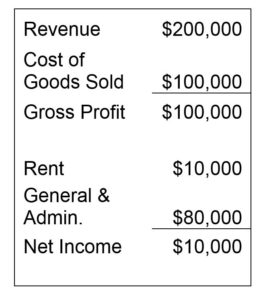
Assume a retail business commences operations on January 1, 20X0 and ceases business on October 31, 20X0 due to a contract breach. Furthermore, assume it is now January 20X5 and the case is going to trial. Actual net income for the ten months ending 10/31/20X0 is as follows:
Step 1
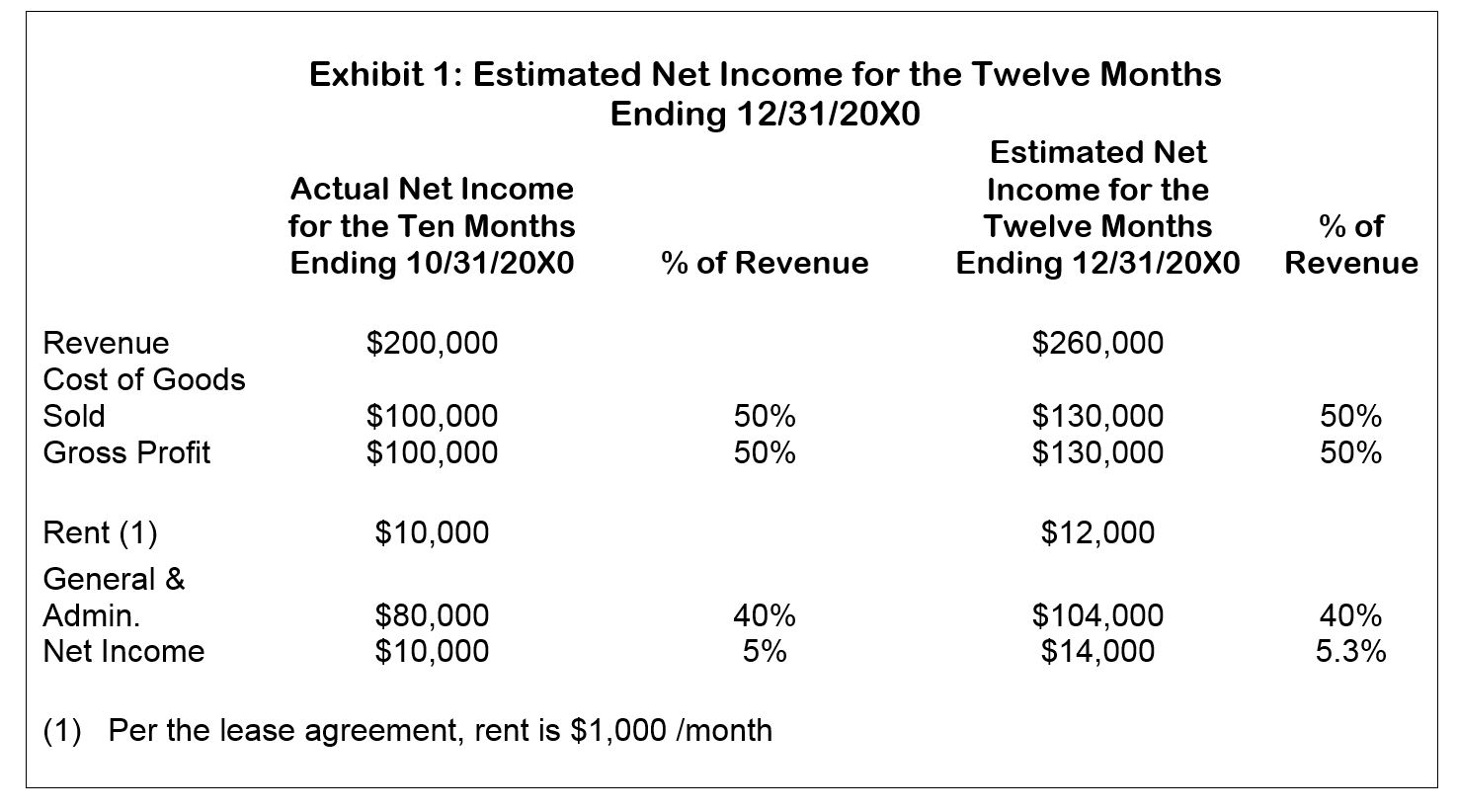
The first step involves projecting financial results achieved in the first 10 months over a 12-month period. Where possible, contracts or agreements should be used to determine future activity.
For example, let us assume that rent expense is fixed at $1,000 per month as stipulated by the lease agreement. Therefore, we would expect rent expense of $12,000 for the 12-month period ending 12/31/20X0 ($10,000 plus $2,000 rent for November and December). Where contracts and agreements cannot be used to project financial results, other techniques must be employed. Assume that an interview of similar retailers at the same location reveals that January to November sales are relatively constant, with December averaging twice that of any other single month. Multiplying actual financial results for the 10-month period ending 10/31/20X0 by a multiple of 13/10 provides a reasonable estimate of results for the year ended 12/31/20X0 (see Exhibit 1).
Step 2
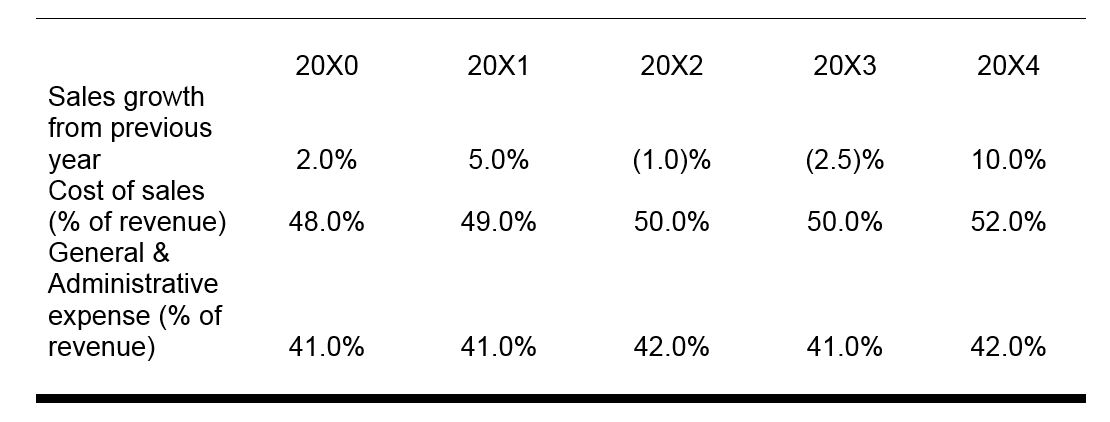
The next step involves accumulating industry data (statistics and financial ratios) for companies operating in the same industry as the injured company. This information can be accumulated by conducting database searches. For example, the SIC (standard industry code supplied by the IRS) for the injured company can be used to search databases such as Dunn & Bradstreet, NEXIS, and the SEC for financial data specific to that industry. Let us assume that the following information regarding financial results was uncovered thorough a database search for our example (see below).
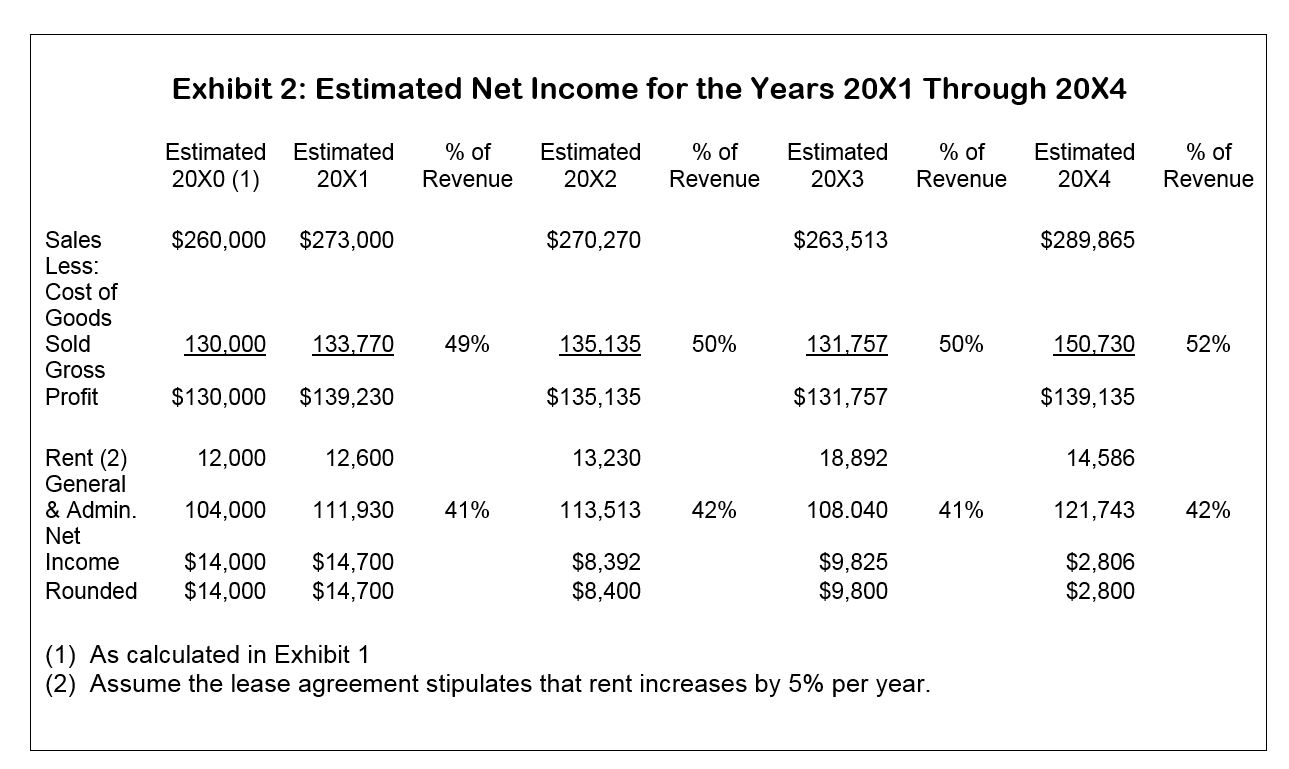
These ratios can then be applied to the injured company to estimate financial results in the years 20X1 to 20X4 (see Exhibit 2).
Note that the estimated financial results in 20X0 do not exactly match industry ratios in that same year. One would expect a start-up company to operate with less efficiency than industry averages (which include companies with significant experience). However, given that actual financial results in the first 10 months ending 10/31/20X0 approximate industry ratios in 20X0, actual results for that 10-month period are used to project earnings in future years.
Losses suffered during initial operations do not necessarily preclude projection of profits in future years. For example, if the injured company in the example below suffered an actual loss in the first 10 months of 20X0, one could argue that industry ratios should be applied to actual revenue in 20X0 to estimate net income or net loss in 20X0. After all, as a start-up company, the injured company can expect losses in its initial period of growth. By utilizing industry ratios, we nullify the “start-up effect” by assuming performance of an established company.
Bear in mind that industry averages are meant merely as guidelines; they should not be taken verbatim. Industry average statistics and specific company statistics commonly differ, particularly when the specific company is a brand-new enterprise.
This means merely that industry statistics and ratios should be used as a starting point, with adjustments made to approximate the specific circumstances of the injured company. For example, if you know that the injured company utilizes a greater proportion of debt financing than the industry average, estimated interest expense should be increased accordingly. Additionally, if the injured company is more labor intensive than that of the industry average, salary expense should be adjusted accordingly.
Benchmarking
Another effective method often utilized to quantify lost profits when a business ceases operations is benchmarking (see Lehrman v. Gulf Oil Corp.,464 F.2d 26 (5th Cir. 1969). As the term suggests, benchmarking calculates likely anticipated earnings based on a relative comparison of the defunct business to a similar company in the same industry. Theoretically, a company that is comparable in size, location, management, product lines, and market position could experience the same approximate earnings stream. Earnings for a similar company can be used as a proxy for earnings of the defunct business provided that relevant factors are identified and determined roughly equivalent.
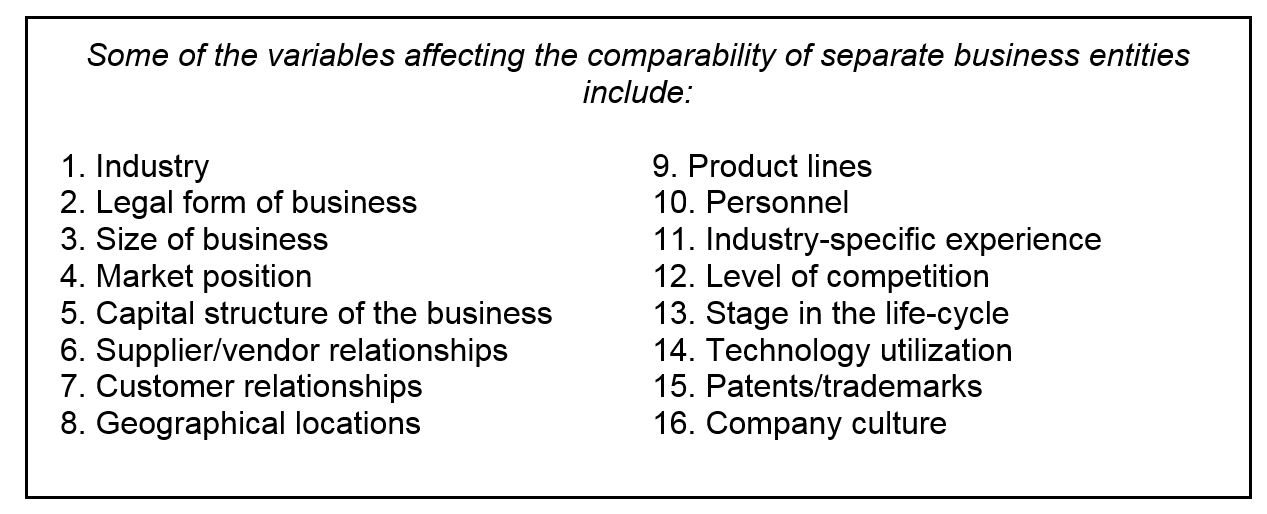
Although benchmarking makes intuitive sense, it can be difficult to implement. In practice, no two companies are equivalent, even in general terms. Differences in just one of the variables in the following box can make a tremendous difference in performance between two otherwise similar firms. For example, two publishing companies in the same city with similarly sized staffs may have vastly different earnings potential simply because they market their services to different clients.
Another potential difficulty with using benchmarking as a means for estimating lost earnings lies in the availability of information. Because of regulatory requirements, publicly traded companies must make selected financial and accounting information available to stakeholders and potential investors. Thus, benchmarking can usually be used on a general level for publicly traded companies. However, comparison of privately held and nonregulated companies becomes more difficult simply because information cannot be readily obtained.
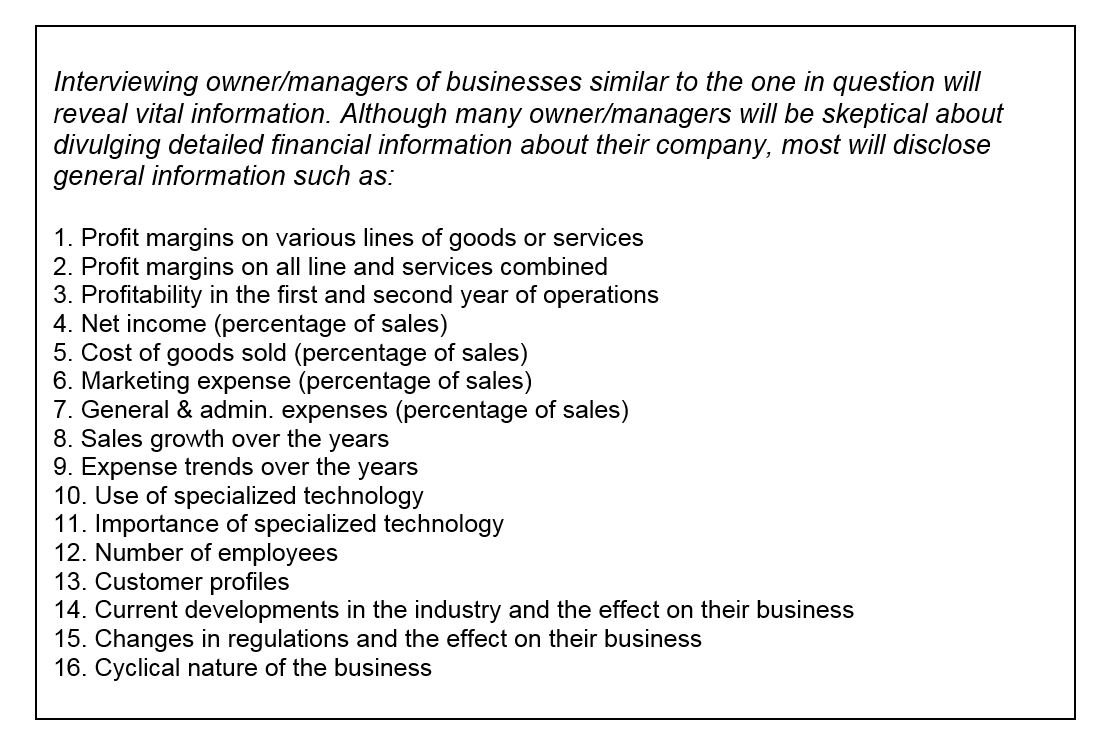
An effective method of overcoming the limitations in the availability of detailed information for privately held or nonregulated companies is through the use of interviews.
The key to using benchmarking as a means of quantifying lost profits is the realization that it can provide a general estimate of profits when little else is available. If a sufficiently similar business enterprise can be identified, benchmarking can be a powerful tool for demonstrating likely lost profits. Because of the assumptions made, however, benchmarking must be used carefully, with particular attention given to assumptions made about what constitutes a “mirror” company. As with other methods, critical success factors should be identified, both for the defunct business and potential “mirror” businesses. Furthermore, differences in facts between the injured company and the benchmarked company should be taken into consideration, and adjustments to financial results should be made accordingly.
Past Experiences, Injured Party
If the injured party has prior experience with a similar business, financial and operational information from that business may translate roughly into projections for the new, injured business. As is the case with benchmarking, the previous business should be examined carefully to ensure that it compares sufficiently to the new business. If the prior business passes the test of comparability, using past experience has the added benefit of intuitively including hard-to-quantify variables such as industry-specific experience (presumably the same with the same business owner/manager).
Conclusion
In determining lost profits for start-up companies with little or no prior earnings history, several methods can be utilized to arrive at an estimate backed by reasonable certainty. Crucial in selecting the method of projecting or applying those profits is the recognition of the individual characteristics of the business in question in relation to the industry and market as a whole. Numbers alone are not enough; qualitative as well as quantitative factors must be taken into account. In the final analysis, assumptions made and calculations performed must make sense from a general business perspective and must be supportable. Through an understanding of the strengths and weaknesses of common techniques for determining lost profits, an appropriate mix of approaches can be utilized to produce reasonably certain, supportable results.
The following is an adaptation of remarks by Simon M. Lorne, vice chairman and chief legal officer of Millennium Management LLC and business law advisor to the Professional Responsibility Committee, at its meeting at the Business Law Section’s 2017 Annual Meeting in Chicago.
In my years of practice, I’ve been privileged to occupy a number of different positions, from law firm partner, to the Securities Exchange Commission’s general counsel, to my current role as chief legal officer of a major hedge fund advisor. In all of those roles, I’ve been actively involved with this committee, and particularly with the question of how appropriately to balance the lawyer’s duty of client confidentiality with the ability to perceive, and perhaps to prevent, a course of client conduct that may subsequently be characterized by enforcement authorities—the SEC, the Commodity Futures Trading Commission, the Department of Justice, etc.—as client improprieties. Perhaps obviously, I choose my words carefully. When those authorities do challenge a course of conduct, they are likely to identify it as “fraud,” but it was likely not identified as such by the lawyer at the time, and to so characterize it is to bias the analysis of the lawyer’s obligation. Those questions were surfaced in a number of high-profile SEC cases from the 1970s to the early 1990s. The principal cases from that era are probably SEC v. National Student Marketing Corp., Fed. Sec. L. Rep. (CCH) ¶93,581 (DDC 1972); SEC v. Nat’l Student Marketing Corp., 402 F. Supp. 641 (DDC 1975); SEC v. Nat’l Student Marketing Corp., Fed. Sec. L. Rep. (CCH) ¶96,027 (DDC 1977); In re Carter, Sec. Exch. Act Rel. No. 17,597 (Feb. 28, 1981); and In re Kern, Sec. Exch. Act Rel. No. 29,356 (June 21, 1991).
These issues received focused attention from the securities bar in 2003 when the SEC adopted the Attorney Conduct Rules, Part 205 of Title 17 of the Code of Federal Regulations (the Rules). With that promulgation, law firms throughout the country (and in some foreign climes) adopted policies, established committees, saw to the education of younger attorneys, and in other ways prepared for the potential onslaught of SEC actions charging lawyers with a failure to act properly—generally defined in the rules as escalating attention to the chief legal officer and, if necessary, the board of directors whenever a lawyer “appearing and practicing” before the SEC became aware of “credible evidence” of a violation of the securities laws or breach of fiduciary obligations. Under the SEC’s interpretation of the Rules (although this remains a hotly contested point), the Rules further operated to pre-empt any contrary state law to permit such a lawyer to report a matter directly to the SEC if a matter were not handled appropriately (apparently, as determined by the lawyer’s own judgment) by the highest authority within the corporation.
Then a funny thing happened. Silence.
In what is now 14 years since the adoption of the Rules, the actual number of attorney conduct cases brought by the SEC, including both litigated cases and settled cases, has been . . . zero. There was one Department of Labor case in which the Rules were relevant to the purported wrongful discharge of a lawyer-employee, but that’s been it. See Jordan v. Sprint Nextel Corp., Dep’t. of Labor Admin. Review Bd. Case No. 06-105, ALJ Case No. 2006-SOX-041 (Sept. 30, 2009).
However, the Rules remain in place, and with inactivity on the SEC’s enforcement side (not that any lawyers I know are complaining about that inactivity), I feel comfortable in suggesting that many of the law firm policies and procedures initiated in response to the initial adoption of the Rules have fallen into disuse. It is almost certain that there are a number of lawyers today who have been practicing for as many as 10 years or more who have never even heard of the Rules, and that number only grows as we look at more recent law school graduates.
The enforcement environment will inevitably change, and I would not take much comfort in the notion that the current administration will be softer on enforcement. Historically (although, as the SEC requires us to say in another context, past performance may certainly be no indication of future results), SEC enforcement has often been tougher in Republican administrations, just as regulatory enhancements have been more relaxed. Be that as it may, there will in the future be a corporate fraud—we hope not on the scale of Enron or WorldCom—and there will be lawyers who will have been on the scene, who will have been “appearing and practicing” before the SEC, and who will have become aware of “credible evidence” of the fraud. They will find themselves on the wrong side of an SEC complaint, or perhaps worse, and they will wish that their law firm had been more diligent in impressing upon them the requirements of the Rules.
A court’s primary goal in the interpretation of a commercial contract is to discern the parties’ intentions. In Canada, courts use a range of tools to achieve this end. They look to the ordinary meaning of the words chosen by the parties in their agreement. They also consider which interpretation of the contract will give it business efficacy or which will make the most commercial sense.
A recent debate has emerged in Canadian contract law about whether and how courts should consider the parties’ conduct in determining their contractual intentions. In a leading case, Sattva Capital Corp. v. Creston Moly Corp., [2014] SCC 53, per Rothstein J., the Supreme Court of Canada made it clear that when interpreting a commercial agreement, courts should consider evidence of what it calls the “factual matrix” to determine the contract’s meaning.
The factual matrix “consists only of objective evidence of the background facts at the time of the execution of the contract—that is, knowledge that was or reasonably ought to have been within the knowledge of both parties at or before the date of contracting” (emphasis added).
Evidence of the factual matrix may very well include evidence of the parties’ negotiations and correspondence at the time they executed the agreement. In this way, Sattva aligns Canadian contract law with its American counterpart. See, for example, Droplets Inc. v. E*Trade Financial Corp., 939 F. Supp. 2d 336 (Apr. 4, 2013).
Sattva left one key issue unresolved, however: can a court consider evidence of the parties’ conduct after they enter into a commercial agreement as an aid to its interpretation?
Canadian courts have now answered this question in the affirmative, with one significant qualifier. Evidence of the parties’ post-contract conduct is admissible as an aid to contract interpretation, but only in cases of contractual ambiguity. In the absence of ambiguity, the evidence is inadmissible. Even where the court finds that evidence of the parties’ “subsequent conduct” is admissible, it must then decide whether to accord the evidence any weight. Shewchuk v. Blackmount Capital Inc., [2016] ONCA 912, per Strathy C.J.O., at ¶ 56.
This approach represents a departure from the rigid position in the United Kingdom, where post-agreement conduct has long been deemed inadmissible. See id. at ¶ 43 (citing James Miller & Partners Ltd. v. Whitworth Street Estate (Manchester Ltd.), [1970] A.C. 583 (H.L.), per Lord Reid, at 603; F.L. Shuler A.G. v. Wickman Machine Tool Sales Ltd., [1974] A.C. 235 (H.L.), per Lord Wilberforce, at 261. U.K. courts have expressed concern that if post-agreement evidence is used as a tool for contractual interpretation, the meaning of the commercial contract will change over time. This could undermine the principle of contractual certainty. As one U.K. court put it, “one might have the result that a contract meant one thing the day it was signed, but by reasons of subsequent events meant something different a month or a year later.” James Miller & Partners, supra, at 603.
In rejecting the U.K. position, Canadian courts are not blind to the inherent dangers of using the parties’ subsequent conduct to interpret a contract. In Shewchuk, which opened the door to the admissibility of evidence of the parties’ subsequent conduct, the court identified the perils of such evidence as:
allowing the meaning of the contract to fluctuate over time, as recognized by the U.K. courts;
ambiguity in that a party not enforcing strict legal rights under a contract does not necessarily mean that the party never enjoyed those rights; and
the commercial parties beginning to conduct themselves in a way that favors their interpretation of the contract; by admitting evidence of post-agreement conduct, the courts would be rewarding this type of self-serving behavior.
Despite these concerns, the Shewhuck court recognized that “evidence of subsequent conduct may be useful in resolving ambiguities”—that is, the parties’ behavior after the execution of the contract could support an inference regarding their original intentions at the time of contract formation. The court likened the evidence of post-contract conduct to a criminal’s behavior after the commission of an offence:
However, the lesson learned in Canada from the British position is that the parties’ subsequent conduct is relevant only to inferentially establishing their intentions at the time they executed their contract. Like evidence of post-offence conduct in criminal matters, it is a kind of circumstantial evidence that “invokes a retrospectant chain of reasoning”; the trier of fact is invited to infer the parties’ prior intentions from their later conduct. . . .
Once admitted, however, the evidence is still subject to the court’s scrutiny. The court must decide whether to give it any weight. In deciding the evidence’s reliability, the court will consider whether the conduct is that of both parties, is intentional, is consistent over time, and belongs to individuals, rather than agents of corporations. The court will also give the evidence more weight if it is unequivocal “in the sense of being consistent with only one of the two alternative interpretations of the contract.” Moreover, the closer in time to the execution of the contract, the more likely the evidence will be considered reliable.
The reasoning in Shewchuk remains to be tested. As a recent decision of the Ontario Court of Appeal, it is not yet clear whether Shewchuk has injected of level of contractual uncertainty in the Canadian legal landscape.
Despite all the safeguards in place to ensure that evidence of post-agreement conduct is properly admitted and weighed by the courts, commercial parties may be tempted to engage in self-serving behavior after the execution of the contract, knowing that there is a possibility such behavior could support their preferred interpretation of a contractual ambiguity.
Canadian courts must be on their guard and approach any evidence of the parties’ post-contract dealings with caution. They must bear in mind that post-agreement conduct is generally unreliable and often undermines the parties’ original contractual intentions.
Of all the ways that a merger can go wrong, it is hard to think of a worse scenario than the deal falling apart and the parties being subject to a criminal investigation. Lawyers are constantly tracking and negotiating terms in an effort to close the deal. And in this push to finalize the transaction and meet the expectations of clients and various regulatory agencies, practitioners can be faced with potential ramifications far more serious to the business than they ever would have expected (or, at least, had hoped not to expect).
At its surface, antitrust can neatly be divided into civil and criminal matters. Civil matters involve merger review, civil non‑merger conduct review, and civil litigation. Criminal matters generally consist of investigating violations of price-fixing, bid rigging, and market allocation. Two U.S. agencies, the Federal Trade Commission (FTC) and the U.S. Department of Justice Antitrust Division (Antitrust Division), are responsible for enforcing federal antitrust laws. While the FTC is solely civil, the Antitrust Division is separated into civil and criminal enforcement sections. The Antitrust Division’s offices responsible for criminal enforcement are located in Washington, D.C., San Francisco, Chicago, and New York. Although these criminal offices have assigned territories, they are not bound by geography, as investigations often take place across the country and around the globe. The six civil sections of the Antitrust Division are all located in Washington and are divided by subject matter expertise.
But that separation of criminal and civil enforcement sections at the Antitrust Division does not create walls or silos. The different criminal offices often work together on large investigations and trials. Similarly, the size of many civil investigations requires pulling resources from the various civil sections, as well as from the Antitrust Division’s Appellate, International, and Competition Policy and Advocacy sections. But the collaboration does not end there. Coordination between the civil and criminal sections is the norm. Section managers meet regularly to discuss matters and often consult on an informal basis. Cross‑pollination occurs at the trial attorney level as attorneys are detailed to other sections for specific matters or periods of time. And understanding this collaboration between the civil and criminal sections is vital to attorneys and their clients subject to the merger review process. A recent case not only shows how in sync the Antitrust Division’s criminal and civil sections are, but also highlights the implications of that collaboration.
In December 2014, two packaged seafood companies announced their proposed merger. As is customary to the review process, the parties submitted documents to one of the Antitrust Division’s civil sections. What followed was anything but routine. However, based on the level of collaboration within the Antitrust Division, it should not have been unexpected.
From document review to charges for price-fixing
The Antitrust Division’s civil attorneys reviewed the documents submitted by the parties and uncovered information that raised concerns of price‑fixing. When the parties walked away from the deal on December 3, 2015, then-Assistant Attorney General Bill Baer’s statement in the press release made a veiled reference to their problematic documents. He said, “Our investigation convinced us—and the parties knew or should have known from the get-go—that the market is not functioning competitively today, and further consolidation would only make things worse.”
The parties’ abandonment of the deal did not end the Antitrust Division’s investigation. Instead, the civil attorneys conducting the merger review shared their findings with their criminal counterparts. A criminal section proceeded to open a price‑fixing investigation based on the shared materials. That investigation has borne fruit and is ongoing. To date, three individuals and one company have been charged for participation in a price‑fixing conspiracy. Criminal antitrust violations, such as price-fixing, have serious implications. Not only are the criminal penalties substantial, but companies can be subject to civil suits with treble damages (15 U.S.C. § 15.).
For individuals, the maximum penalties are 10 years in prison and a $1 million fine. For corporations, the maximum fine is $100 million. Fines for both individuals and corporations can exceed the statutory maximum amount by up to twice the gain derived or twice the loss by victims. See, e.g., Price Fixing, Bid Rigging and Market Allocation: An Antitrust Primer, Department of Justice Antitrust Division, available at https://www.justice.gov/atr/priceifxing-bid-rigging-and-market-al location-schemes (discussing the Sherman Act).
While it is not public what specific information was contained in the documents that raised the attention of the reviewing attorneys, or exactly how the process happened, the Antitrust Division did state that the criminal investigation was triggered by “information and party materials produced in the ordinary course of business.” Until more information is revealed, several questions remain, including whether similar criminal investigations based on documents submitted for merger review could be waiting to surface.
The packaged seafood matter is not the first criminal case to stem from a civil investigation and likely will not be the last. The hand‑in‑hand coordination between the civil and criminal sections of the Antitrust Division will continue. Companies need to be increasingly aware of the risks that ordinary course documents present, not just in impacting merger approval but also in criminal implications. Merger review does not exist in a vacuum. Once documents fall into the Antitrust Division’s (or FTC’s) hands, parties can expect that they will be closely reviewed with an eye toward both civil and criminal actions. Documents always tell a story—and attorneys need to be sure that the story told is one to support a proposed deal and not a criminal investigation.
Similarly, the FTC and Antitrust Division share a close working relationship. We will continue to explore and monitor the collaboration between those two agencies as well as with state attorneys general. We also plan to address the collaboration among competition agencies around the world. Stay tuned.
Craig Lee and Creighton Macy are antitrust partners in Baker McKenzie’s Washington, D.C., office. Prior to joining the firm, Craig served as assistant chief of Washington Criminal 1 and Creighton served as chief of staff and senior counsel at the Antitrust Division. All discussions of DOJ matters in this article are based on public information.
In his latest book, The Undoing Project, author Michael Lewis introduces us to the fathers of behavioral economics, Amos Tversky and Daniel Kahneman. Its first chapter describes how Houston Rockets General Manager Daryl Morey used behavioral economics to rebuild the team beginning in 2007. The key, Daryl Morey noticed, was that his recruiters and coaching staff invariably fell prey to specific errors in their decision making when selecting players. For example, recruiters who found a candidate they liked tended to overvalue information reinforcing their decision and ignore information suggesting that the player should not, in fact, be drafted. Eliminate these errors in judgment, replacing “judgment calls” with hard data, and they could pay less for better players. This was the same approach the Oakland A’s used to achieve success during their famous 2002 baseball season and the subject of Michael Lewis’ prior book, Moneyball.
What is behavioral economics, and how does it relate to the work we do as business lawyers? In short, behavioral economics is the science of how people make decisions. By understanding the techniques people use to make their decisions, including those that cause us to occasionally make bad decisions, we can accomplish two things. First, we can help other people make better decisions (or perhaps, instead, make the decisions we want them to make). Second, we can better understand our own decision making processes and, with a more concrete understanding, improve them.Understanding decision making can improve our performance in a large number of arenas, but certainly assists in performing such tasks as negotiating deals, structuring contracts, or building compliance systems.
Behavioral economics builds on the traditional economics concept of normative decision theory, which describes the rules by which a fully rational individual makes choices. Normative decision theory makes two basic assumptions. First, that the person making choices has complete information. In other words, the person knows all the information relevant to making the choice. Second, normative decision theory assumes that the person is rational—that is, capable of making choices that are logical and consistent based on that person’s desires. For example, if a person prefers coffee to tea, and also prefers hot chocolate to coffee, then a rational person will ask for a hot chocolate when offered a choice between that and tea (this is called the principal of transitivity). When you know the logical rules by which rational persons make decisions, the argument goes, you can build mathematical and logic models of their behavior, use those models to predict results, and also develop responsive strategies. These rules of logical choice, called utility theory, were described by mathematician John von Neumann and economist Oskar Morganstern in their 1944 work, Theory of Games and Economic Behavior, and form the basis for modern game theory.
The problem with utility theory is its limited application in real-world situations. People don’t have complete information when they make decisions, and as Tversky and Kahneman proved, people do not follow the rules of rational decision making when making choices. Instead, decision making employs a variety of cognitive short cuts, called heuristics. Behavioral scientists, through empirical studies, have identified dozens of these heuristics. They bear names such as “planning fallacy,” “anchoring,” “confirmation bias,” and “loss aversion,” but they essentially describe the rules by which human minds tend to make decisions in place of the strict logical constructs that utility theory describes. In short, behavioral economics provides a useful tool for predicting and understanding decisions where standard economics tends to fail. For example, anchoring refers to a tendency to determine subjective values based on recent exposures to something similar, although unrelated. When asked to guess the percentage of African countries in the UN, people consistently pick a higher number when exposed to the number 65 than when exposed to the number 10 just prior to guessing.The planning fallacy refers to the consistent tendency to underestimate the length of time a task will take, even when a person has extensive experience performing that task. Kahneman and Tversky’s work is significant—Kahneman was awarded the Nobel Prize in Economics for his work in the area.
Understanding these rules can play a significant role in negotiations. For example, an attorney who understands how anchoring works can employ the concept to set expectations both for his client and the opposite party that are reasonable and conducive to obtaining a negotiated solution. In addition, the attorney can be more aware of situations where anchoring might be affecting her own decision making, resulting in a potentially poor negotiation outcome. This article explores some of the more significant heuristics and how they affect negotiations.
Planning Fallacy
In Thinking, Fast and Slow, Daniel Kahneman describes the process of planning a book for a psychology course. When he polled the group of authors about how long they thought the project would take, they estimated about two years. Kahneman then asked the most experienced member of the group how long similar projects had taken in the past. After a little thought, the expert replied, “I cannot think of any group that finished in less than seven years,” and he said that about 40 percent of the projects had failed to reach completion altogether! Still, even though none of the authors were prepared to make a seven-year investment in a project with only a 60-percent chance of success, they went ahead designing the book. They finished it eight years later, and it was never used.
Closely related to the optimism heuristic, the “planning fallacy” refers to the tendency for people to consistently underestimate both the time and costs for completing projects. Although the most obvious examples come from large public works projects, any lawyer can think of the times that a lawsuit, negotiation, or business deal took longer than expected and cost more than estimated. Empirical studies show that the planning fallacy reflects an underlying psychological tendency to ignore historical evidence when estimating the time and expense for a project. In one study, students were asked to estimate the length of time needed to complete and submit their honors thesis. The average estimated time was 34 days. The average actual time was 55 days. Follow-up studies showed that formalized planning and thinking about the results of prior projects had little effect on the planning error. Studies show not only that the planning fallacy is pervasive across different activities, but that even experienced professionals fall prey to planning errors on a consistent basis.
In a negotiation, the planning fallacy can play a significant role in how each side evaluates its positions. In a litigation situation, both sides will likely underestimate not only the amount of time needed to reach a conclusion, but also the cost of the litigation process. This will make them less likely to settle, based on a mistaken belief about the costs of reaching a non-negotiated resolution. In short, parties elect to take on unanticipated risks based on their unrealistic belief in the potential results. They fail to settle when they should because of the planning fallacy.
In a deal situation, the planning fallacy has a different, but equally unfortunate, effect. Parties will underestimate the time needed to work through the negotiations or even the amount of time needed to negotiate and draft the details of the relevant documents. The unpredicted delay creates frustration as tasks a client or her counsel thought would take a couple of days or maybe a week to complete remain unfinished weeks later. In some cases, this frustration, resulting from the original unrealistic expectations, can cause a deal to blow up.
Daniel Kahneman suggests that the best way of avoiding the planning fallacy is to use a technique called “reference class forecasting.” Essentially, reference class forecasting entails a four-step process. First, identify a set of similar activities. When trying to predict how much a lawsuit might cost in legal fees, for example, identify a group of similar lawsuits. This group of similar, prior lawsuits is your reference class. Second, collect data on the reference class. How long did those lawsuits last from beginning to end? How much were the total legal fees? This data provides the baseline for evaluating your own situation. So, if your firm has handled 10 similar types of lawsuits in the past, and the average legal fees incurred were $100,000, then $100,000 is your baseline. Third, evaluate the effect of concrete differences between your particular case and the reference class cases. For example, if your firm’s hourly rates have increased year over year, you will want to adjust the baseline estimate upward to reflect the increases in hourly rates. If some of the prior cases required more witnesses than your case will, you might adjust your estimate downward.
Finally, the fourth, and possibly hardest, step is to actually use the estimate and ignore your inevitable desire to use your original “prediction” about the cost in place of the hard data. By using a data-driven, objective approach to forecasting, you can reduce the planning fallacy effect and make better decisions in negotiations.
Anchoring
Amos Tversky and Daniel Kahneman ran an experiment where college students spun a number wheel rigged to stop only on the numbers 10 and 65. After each student spun the wheel, he or she had to guess the percentage of African nations in the United Nations. Oddly, the number on which the number wheel landed had a profound effect on the guess. Students whose spin resulting in a 10 guessed, on average, that 25 percent of African nations were in the UN, whereas the students whose spin resulted in a 65 had an average guess of 45 percent. Kahneman and Tversky called this mental heuristic—the tendency for a recently experienced number to affect decision making—“anchoring.” Kahneman describes anchoring as “one of the most reliable and robust results of experimental psychology.”
Most lawyers are familiar with the concept, although they might tend to think about it in basic terms. Lawyers learn to begin negotiations with either a high number or a low number to set expectations about the final result. Anchoring does work in this context, but anchoring effects also operate in subtle ways that are harder to identify and more effective than one might think. First, the number used as an anchor does not have to be related to the number being anchored. In the African nations experiment, the number on the wheel was unrelated to the question of how many African nations are in the UN, but greatly influenced the students’ decision making. In another common experiment, subjects are asked to write down the last few digits of their Social Security number and then guess the number of marbles in a jar. Subjects with higher Social Security numbers invariably guess higher. Anchoring effects are hard to shake and operate even where the subject has independent information on which to make a reasoned decision. In one experiment, real estate agents were told the listing price of a property and then were asked to appraise it. Even when they had complete information about the property, their appraisals remained anchored to the listing price (including when the listing price was clearly implausible).
According to Kahneman, two different mechanisms cause anchoring: one that operates when we consciously think about the decision, and one that operates when we do not. When we are making conscious decisions about values (what Kahneman refers to as System 2 thinking), we tend to find an initial anchor for the value and adjust from that value. We also tend to under-adjust. As a result, the starting point supplied has a very real effect on the final result. In a negotiation, making the first offer—or even opening negotiations with a discussion that includes appropriately scaled numbers—can help set that anchor point and thus affect the final negotiation results.
Anchoring also affects unconscious decision making (what Kahneman refers to as System 1) through something called the “priming” effect. In this context, the anchoring number can create mental associations that inform the final decision making. Although the mechanism is different, the final effect remains similar.
In negotiations, taking advantage of the anchoring effect means acting quickly, perhaps by making an early offer designed to anchor the final results, or perhaps by opening negotiations with a discussion designed to expose the other party to higher or lower numbers generally. Anchoring doesn’t necessarily have to target the final result. You might seek to anchor the inputs to the other party’s decision making processes, such as their view of your client’s cost of capital, litigation costs, or other factors. Also consider the setting for negotiations. Conducting a meeting in a cheap coffee shop might create mental associations that help you negotiate a lower price, whereas meeting in an expensive restaurant might have the opposite effect. In any negotiation, anchoring efforts should occur early in the process, before the other party has an opportunity to anchor based on its own decision making processes or other experiences.
Confirmation Bias
In Predictably Irrational, psychologist Daniel Ariely describes an experiment where he asked MIT students to taste-test two types of beer. One is a regular beer, and the other is the same beer, but with some balsamic vinegar added. They called this “MIT Beer.” Predictably, when forewarned that MIT Beer contained vinegar, the students preferred the regular beer. When they were not forewarned about the secret ingredient, however, the students typically preferred MIT Beer. This and similar experiments demonstrated that peoples’ prior perception of something strongly affects their interpretation of future experiences. This heuristic is commonly referred to as “confirmation bias”—the idea that we tend to interpret new facts and experiences in ways that reinforce our pre-existing beliefs. When we expect a beer to taste odd because we are told in advance that it contains vinegar, we are more likely to dislike the flavor when we actually drink the beer.
Confirmation bias affects how people process new information and leads to serious errors in judgment. For example, a lawyer who believes strongly in his client’s case might discount the effect of negative testimony at a deposition, focusing on the parts of the deposition that support his client’s position. As a result, he will fail to properly evaluate his case, concluding that the deposition testimony helped his case more than it hurt. A CEO trying to close an M&A transaction that she championed to her board of directors, with an eye on the big payoff from a successful merger, might ignore information about the buyer’s poor history of successfully integrating prior acquisition targets. Confirmation bias can affect how we and our clients process all kinds of information, including factual information, legal research results, case evaluation, and even the desirability of doing a deal in the first place.
This tendency to focus on facts that confirm pre-existing beliefs, while discounting facts that counter those beliefs, contributes to a related heuristic called “optimism bias.” Optimism bias is the demonstrated tendency for people to overestimate their chances of success in a particular endeavor. For example, one study found that 68 percent of entrepreneurs believe that their company is more likely to succeed than other similar companies; by definition, only 50 percent are more likely to succeed. Another study found that optimistic CEOs are 65 percent more likely to complete mergers and more likely to overpay, leading to a post-merger failure.
In negotiations, confirmation bias and optimism bias can lead to suboptimal decision making on both sides and interfere with parties reaching a deal. A seller might enter a negotiation discussing facts it thinks strongly support its decision and will help sway the buyer’s pricing, failing to realize the buyer discounts those facts. Particularly in a dispute, optimism bias can give each side an unrealistic viewpoint of its chance of success, leading to negotiation deadlocks. These heuristics are most likely to affect decision making where parties enter into negotiations already holding well-defined beliefs.
Understanding these cognitive effects helps us control the extent to which we might make misjudgments based on the information we receive during a negotiation. Confirmation bias can be countered by approaching, from the start of a matter, issues from an objective viewpoint. We can also counter bias by seeking input and feedback from objective third parties during the process and listening to what they have to say. A conscious effort can be made to identify negative information and carefully analyze the effect that information should have on our decisions. Careful, systematic approaches to evaluating information provide a way to counter confirmation bias in our own decision making.
Other parties in negotiations are also subject to confirmation bias. We can recognize that where the other side in a negotiation is starting with a different set of beliefs or a different starting viewpoint, they will evaluate the information shared during the negotiation in a different light. An effort to consider their point of view and evaluate how they are receiving and interpreting information will provide greater insight into their decision-making processes and make negotiations more productive.
Finally, like anchoring, these biases are best countered by opening negotiations and discussions early in the dispute-resolution process, before parties have an opportunity to develop strongly held beliefs about facts and positions.
Loss Aversion
Traditional economic theory posits that a dollar gained is equivalent to a dollar lost. Thus, people who have an item (a mug, for example) should be willing to sell that mug, on average, for the same price that a similar group of people would be willing to pay for a mug; however, that is not the case. In a famous experiment, people who had a mug wanted, on average, twice as much for the mug than people without a mug were willing to pay. This effect, called the “endowment effect,” has been demonstrated experimentally over and over again.People who have an item inherently give that item a higher value than those thinking about acquiring it. The endowment effect goes hand in hand with a concept Daniel Kahneman referred to as “loss aversion”—the simple idea that people fear losses more than they desire gains, and so the value of a thing, whether money or some other object, depends on the person’s point of view. A person viewing themselves as losing something places more value on the thing than someone who views the transaction as receiving the thing. As Kahneman put it, “losses loom larger than gains.”
Understanding how loss aversion might affect each party’s perception of value in a negotiation helps to understand the incentives behind each party’s positions. Understanding these incentives can help you to set up the negotiation to benefit your client or simply better align the party’s economic incentives to increase the chance of reaching a successful result. For example, imagine that you are negotiating whether your client’s business partner is due a performance bonus under a contract. If your client’s starting position is that the bonus was not earned, your client will view paying the bonus as a loss. On the other hand, where the bonus has been paid or escrowed already, and your client later discovered that its business partner was arguably not entitled to the bonus, your client might view any return of the bonus money as a gain. In the first situation, your client is less likely to want to pay any part of the bonus, potentially making settlement more difficult. On the other hand, when your client still has the funds, the other party might view any funds received as a gain and be more willing to settle. Here, loss aversion suggests making sure your client holds the funds pending negotiations; the combination of your client being less willing to pay, and the other party being more willing to settle, should result in a better settlement for your client.
Loss aversion also explains a benefit of escrows. Both sides should view funds placed in an escrow pending resolution of a dispute as held by a third party. For each side, it can only receive a gain from a resolution, not a loss. This will increase the willingness to settle and help bring together the parties negotiating positions. Loss aversion suggests using escrow arrangements even when both parties are financially capable of covering any payments that might need to be made.
The lawyer who can frame the negotiation’s effect on the other party as a gain should do better than when the effect is viewed as a loss. This might be done through prenegotiation litigation, such as by attaching a bank account or real estate. When this occurs, the other party gains from the settlement, rather than loses, and because the dollars gained are valued less than dollars lost, the other party should be willing to “pay” more for a settlement. Alternatively, a lawyer might frame the details of the deal so as to make an element appear as a gain instead of a loss. For example, in a shipping contract, a lawyer might start with a higher base price that includes insurance and offer a discount if the customer maintains its own insurance, rather than start with a lower base price and then try to get the customer to pay extra for the shipper to cover insurance. Loss aversion suggests that the customer will view the discount as a gain, and the payment of extra fees as a loss, and be more willing to forgo the discount than pay the extra fees.
Conclusion
This article describes just four of many biases and heuristics identified by behavioral economists through empirical research.The planning fallacy, anchoring, the confirmation bias, and loss aversion strike familiar chords among experienced attorneys. But, behavioral economics provides more than vague concepts about behavior. Its research provides deeper insights into exactly how and when these mechanisms operate, and also provides tools for mathematically modelling behavior in negotiations and litigation. Lawyers who become familiar with this new social science will undoubtedly gain an edge over their competition.
Additional Resources
Behavioral economics generally:
Lewis, Michael. The Undoing Project (W. W. Norton & Company, 2016) (as much a story about Daniel Kahneman and Amos Tversky as a book about behavioral economics, but an easy introduction to the subject).
Thaler, Richard & Sunstein, Cass. Nudge (Yale University Press, 2008).
Kahneman,Daniel. Thinking, Fast and Slow(Farrar, Straus and Giroux, 2011).
Planning fallacy:
Kahneman, Daniel and Amos Tversky. 1979. “Intuitive Prediction: Biases and Corrective Procedures.” TIMS Studies in Management Science, 12, 313–27.
Buehler, Roger, Dale Griffin, and Michael Ross. 1994. “Exploring the Planning Fallacy: Why People Underestimate their Task Completion Times.” 67 Journal of Personality and Social Psychology 366–81.
Anchoring:
Mussweiler, Thomas, Fritz Strack and Tim Pfeiffer. 2000. “Overcoming the Inevitable Anchoring Effect: Considering the Opposite Compensates for Selective Accessibility.” Personality and Social Psychology Bulletin 26: 1142–50.
Northcraft, Gregory B., and Margaret A. Neale. 1987. “Experts, Amateurs, and Real Estate: An Anchoring-and-Adjustment Perspective on Property Pricing Decision.” Organizational Behavior and Human Decision Processes 39: 84–97.
Tversky, Amos, and Daniel Kahneman. 1974. “Judgment under Uncertainty: Heuristics and Biases.” Science 185: 1124–30.
Confirmation bias:
Baker, Malcolm, Richard S. Ruback, and Jeffrey Wurgler. 2007. Behavioral Corporate Finance: A Survey, Vol. 1 of Handbook of Finance Series, Chap. 4.
Malmendier, Ulrike, and Geoffrey Tate. 2008. “Who Makes Acquisitions? CEO Overconfidence and the Market’s Reaction.” The Journal of Finance 89(1): 20–43.
Loss aversion:
Kahneman, Daniel, and Amos Tversky, 1976. “Prospect Theory: An Analysis of Decision Under Risk.” Econometrica 47: 263–91
Kahneman, Daniel,Knetsch, Jack L.; Thaler, Richard H. (1990). “Experimental Tests of the Endowment Effect and the Coase Theorem.” Journal of Political Economy. 98 (6): 1325–48.
Hossain, Tanjim, List, John A. (2012). “The Behavioralist Visits the Factory: Increasing Productivity Using Simple Framing Manipulations.” Management Science. 58 (12): 2151–67.
So long as marijuana remains illegal at the federal level, many financial institutions (FIs) will remain wary of the industry, no matter how many states legalize marijuana. However, there may be changes on the horizon for dispensaries and other marijuana-related businesses (MRBs) seeking access to banking services. According to a recent report from the Financial Crimes Enforcement Network (FinCEN), 368 banks and credit unions are providing services to MRBs. For MRBs, this is undoubtedly a positive, if still nascent, development. For this growth to continue, FIs and MRBs must work together to ensure that financial services are provided to, and used by, the marijuana industry in a responsible, safe, and sound manner.
The Regulatory Framework for Banking MRBs
Although marijuana remains illegal under the federal Controlled Substances Act (CSA), 29 states and the District of Columbia have authorized the use and sale of medical marijuana, and eight states and the District of Columbia have legalized its recreational use. In response to these developments, the Department of Justice’s Deputy Attorney General James M. Cole issued a memorandum in August 2013 advising U.S. attorneys on marijuana enforcement under the CSA, and then issued a second memorandum in February 2014 addressing application of federal law to FIs that deal with MRBs (collectively, the Cole Memos).
The Cole Memos direct DOJ attorneys and law enforcement to focus their resources on persons or organizations whose conduct interferes with any one or more of eight enforcement priorities, such as preventing the distribution of marijuana to minors. On the regulatory side, FinCEN has issued guidance (FinCEN Guidance) clarifying how FIs can provide services to MRBs consistent with their anti-money-laundering (AML) obligations under the Bank Secrecy Act (BSA). The FinCEN Guidance establishes unique suspicious-activity reporting (SAR) procedures for MRB-related accounts, including the filing of limited, priority, and termination SARs, depending on specific circumstances.
How Banks and Merchants Can Work Together to Improve MRB Banking
Together, the Cole Memos and FinCEN Guidance provide the framework for banking the marijuana industry. This framework is high level, however, and leaves most day-to-day compliance issues unaddressed. Given the regulatory challenges in banking MRBs, it is critical for banks and their MRB customers to develop a common understanding of these challenges and best practices for banking high-risk merchants.
From a bank’s perspective, the starting point for banking MRBs is ensuring that the bank has a BSA program that satisfies all of the regulatory basics. From there, the bank must enhance and tailor its program for dealing with MRB customers. FinCEN has directed banks to perform comprehensive due diligence on applicants, and then to monitor MRB customers closely once accounts are opened. Given these expectations, a bank may be better served by committing to providing services to the industry (and developing formal MRB-specific components within its AML program) than by accepting MRB customers on an ad hoc basis.
For MRBs, understanding the framework for banking marijuana and the pressures banks face when serving the marijuana industry is critical to developing and maintaining a successful banking relationship. There are a number of steps that can help put an MRB in the best possible position to work with a bank. Although obtaining all necessary state licenses to operate an MRB is a given, an MRB should also appoint a compliance officer and implement policies and procedures for compliance with applicable laws and requirements, including areas impacted by the Cole Memos.
When applying for a bank account, an MRB must provide accurate and truthful information in all applications and other materials submitted to a bank—providing false information to a bank is a potential federal offense. Once an account is opened, the MRB must use the account responsibly and in compliance with applicable laws and regulations. Similarly, MRBs should be prepared to provide any documentation or information the bank requests as part of its initial or ongoing due diligence.
Although banks are likely to continue to take a cautious approach to MRBs for the foreseeable future, MRBs and banks would both benefit from working together to ensure that banking services are provided in a safe, sound, and responsible manner. Doing so can help protect the banking system and ensure that responsible MRBs are able to obtain banking services.
On March 22, 2017, the U.S. Supreme Court addressed and decided whether features incorporated into the design of a useful article are eligible for protection under federal copyright law. In a 6-2 decision, and in an opinion written by Justice Thomas, the court held in Star Athletica, LLC v. Varsity Brands, Inc.that such features are protectable under federal copyright law only if: (i) they can be perceived as a two- or three-dimensional work of art separate from the useful article, and (ii) they would qualify as protectable pictorial, graphic, or sculptural work separately from the useful article into which they are incorporated. In the case, which concerned graphic design features of cheerleading uniforms, the court held that the conjunctive test announced in its decision had been met and that the designs at issue were protectable.
The underlying litigation arose from a copyright infringement complaint filed against Star Athletica for the marketing and sale of cheerleading uniforms that were claimed to be substantially similar to those designed, marketed, and sold by Varsity Brands. The principal basis and support for the complaint was 17 U.S.C. § 101, which protects “pictorial, graphic, or sculptural features” in the “design of a useful article” if they can be identified separately and can exist independently of the “utilitarian aspects of the article.”
Varsity had obtained “more than 200 U.S. copyright registrations for two-dimensional designs appearing on the surface of their uniforms and other garments,” which included shapes, lines, curves, angles, and “chevrons.” After summarizing the travel of the case in the lower courts and recounting the statutory definitions under the Copyright Act of 1976 (the Copyright Act) for “works of authorship” and “useful article,” the court defined the central question as “whether the arrangements of lines, chevrons, and colorful shapes appearing on the surface of respondents’ cheerleading uniforms are eligible for copyright protection as separable features of the design of those cheerleading uniforms.”
Justice Thomas’s opinion for the majority first rejected the notion that “separability” analysis—i.e., the question whether the decorations at issue were separable from the utilitarian aspects of the uniforms—was not required under section 101 for “two-dimensional artistic features on the surface of useful articles.” Citing to the text of section 101, the court emphasized that the statute required separability analysis for “any pictorial, graphic, or sculptural features incorporated into the design of a useful article,” regardless of whether they are two- or three-dimensional. Indeed, on its face, Justice Thomas emphasized that section 101 textually defined “pictorial, graphical, and sculptural works to include” two-dimensional works of art.
Justice Thomas next explained that, under the Copyright Act, the particular order in which the “pictorial, graphic, and sculptural works” were created does not affect their protectability. In other words, they can be created as “free-standing art or as features of useful articles.” As a result, the critical question is therefore “whether the feature for which copyright protection is claimed would have been eligible for copyright protection . . . had it originally been fixed in some tangible medium other than a useful article before being applied to a useful article.” He concluded the court’s analysis by citing to the history of the Copyright Act as interpreted by the U.S. Supreme Court, explaining that, “[i]f a design would have been copyrightable as a standalone pictorial, graphic, or sculptural work, it is copyrightable if created first as a part of a useful article.”
Justice Thomas then applied the court’s test to the surface decorations of Varsity’s cheerleading uniforms and held that they are protectable. The decorations at issue first had “pictorial, graphic, or sculptural qualities” and would qualify as two-dimensional works of art when separated from the uniforms themselves. In addition, Justice Thomas importantly noted that the court’s holding did not concern the “shape, cut, and dimensions” of the cheerleading uniforms as they are ultimately manufactured. Rather, “the only feature of the cheerleading uniform eligible for a copyright in this case is the two-dimensional work of art fixed in the tangible medium of the uniform fabric.” Finally, the court rejected the argument that the conceptual, statutory undertaking of separability required a free-standing “useful article to remain,” and it rejected the notion that its test should include “objective” components, primarily those concerning “the designer’s artistic judgment” and the marketability of the protectable feature “without its utilitarian function.”
The court’s holding—that “an artistic feature of the design of a useful article is eligible for copyright protection if the feature (1) can be perceived as a two- or three-dimensional work of art separate from the useful article and (2) would qualify as a protectable . . . work either on its own or in some other medium if imagined separately from the useful article”—is not without its detractors. Justice Breyer, joined by Justice Kennedy, dissented, believing that Varsity’s designs were not eligible for copyright protection because the designs cannot be perceived as two- or three-dimensional works of art separate from the useful article.
Their dissenting opinion emphasized that the separable design feature must be “capable of existing independently” without replication of “the useful article of which it is a part.” This focus stemmed from the designs submitted by Varsity themselves, which, when arranged physically or on a blank sheet, still comprised “a cheerleader’s dress.” As a result, the dissent argued that the designs were not copyrightable because each one “is not physically separate, nor is it conceptually separate, from the useful article it depicts, namely, a cheerleader’s dress.” In other words, and in summary, Justice Breyer believed that the majority ignored an important limiting principle of the Copyright Act: “One may not claim a copyright in a useful article merely by creating a replica of that article in some other medium, such as in a picture.”
Reaction to the court’s majority opinion has been mixed, but favorable overall. If clothing designers, for example, overcome the initial originality hurdle, some believe that designers can be expected to start applying for copyrights in the clothing industry, which today is rare. Others believe that the opinion simplified the traditional analysis but left some questions unanswered. Some see implications that may reduce competitive forces in the garment and apparel industry, perhaps permitting larger companies to claim copyright protection and to pursue statutory damages against smaller competitors over designs incorporated into useful articles that have traditionally not been considered protectable.
Taking a different tack, Justice Ginsburg concurred in the result but not in the opinion, believing that the question of separability did not need to be reached in the first place. Indeed, she believed that: “Consideration of [the separability] test is unwarranted because the designs at issue are not designs of useful articles. Instead the designs are themselves copyrightable pictorial or graphic works reproduced on useful articles.” All three opinions appeared to agree that the Copyright Act was in need of revision, or its interpretation changed, but the Supreme Court may have simply selected the wrong case in which to announce its views, which will lead to future uncertainty and further litigation.
Most interesting from a purely jurisprudential perspective is that, although all three justices writing opinions for the court claimed to be reading and following the clear and plain meaning of the Copyright Act, they reached entirely different conclusions. How can this be?
In addition to the text most immediately applicable, Justice Thomas looked “to the provisions of the whole law to determine § 101’s meaning.” It appears that Justice Thomas thus adopted the rule of statutory interpretation “that best fits with the statute and other related elements in the legal order, determined as of the time the statute was enacted.” Reed Dickerson, The Interpretation and Application of Statutes 243 (1975). In more contemporary terms, this device is called the “whole-text canon,” in which the court considers “the entire text, in view of its structure and of the physical and logical relation of its many parts.” Antonin Scalia & Bryan A. Garner, Reading Law: The Interpretation of Legal Texts 167 (2012).
Justice Ginsberg read section 101 in light of the factual record developed below and determined that the separability test was “unwarranted because the designs at issue are not designs of useful articles.” It appears that Justice Ginsberg thus adopted what she considered “the preferable rule for the kind of situation before [the court], as determined without regard to legislative intent or the related elements of the legal order, including the statute under consideration.” Dickerson, at 243. Here, she also appears to have employed the “traditionalist view” that the “enacted text is itself the law,” and that section 101’s separability test, in whatever formulation, simply did not apply. Scalia & Garner, at 397 (exploring the plain language of the statute as evidence of legislative intent).
Finally, Justice Breyer relied on the majority opinion itself, secondary sources, the expressed views of the Copyright Office, and the legislative history of the Copyright Act to interpret “Congress’ own expressed intent” through section 101. It appears that Justice Breyer thus adopted the rule of statutory interpretation “that the original legislature probably would have adopted had it dealt with the problem at the time it enacted the statute,” including consideration of evidence of legislative intent “outside legislative context” and “occasional items of legislative history.” SeeEiner Elhauge, Statutory Default Rules: How to Interpret Unclear Legislation 119–133 (2008) (outlining the various legitimate objections to the use of legislative history and concluding that judges may rely on committee and sponsor statements to identify legislative statements to which no objection was lodged and to identify “the best evidence of what political preferences were actually enactable”).
The Copyright Act was passed some time ago in 1976. What are the actual political preferences of today’s voters and the Millennials? Considering the divergent views of the statute expressed in the Supreme Court’s decisions, is it time for Congress again to speak on the subject?
By Jennifer S. Martin, Colin P. Marks, and Wayne Barnes*
The survey that follows highlights the most important developments of 2016 dealing with domestic and international sales of goods, personal property leases, payments, letters of credit, documents of title, investment securities, and secured transactions. Along with the usual descriptions of interesting judicial decisions highlighted in the survey, there has also been legislative progress in several areas. The 2012 amendments to U.C.C. Article 4A, which address issues related to the implementation of the Dodd-Frank Wall Street Reform and Consumer Protection Act of 2010, have been adopted by forty-six states and the District of Columbia, and introduced in Connecticut and Oklahoma.1 In 2011, the Uniform Law Commission completed a new Uniform Certificate of Title for Vessels Act that is designed to harmonize state certificate of title laws with federal laws regarding vessels, and with Article 9 to impede theft and facilitate boat financing.2 This has been adopted by the states of Virginia and Connecticut, as well as the District of Columbia, but is not currently under consideration anywhere else as of the date of this survey.3 Adoption of the 2003 revisions of Article 7 has now been accomplished by all fifty states and the District of Columbia, with Missouri’s adoption earlier this year.4
There were also significant and instructive judicial developments in 2016. There were interesting developments under Article 2, including formation decisions applying section 2-207(3) in a case where both the buyer’s purchase order and the seller’s sales order confirmation objected to the terms and conditions of the other party. When a dispute arose concerning indemnity for a failed adhesive, the court granted summary judgment to the seller, finding that because both parties objected to the terms of the other, the contract was formed under section 2-207(3) and did not include the indemnity. In another case where the writings did not agree, the court granted partial summary judgment to a buyer of wooden pallets that became moldy, finding a contract formed by conduct under section 2-207(3) and turning to the Code’s supplementary terms on course of dealing to supply the terms.5
The survey of cases under the United Nations Convention on International Sales of Goods (“C.I.S.G.”) covered one notable case that considered the application of the C.I.S.G. where neither party had raised its application until more than three years after the suit was filed. The United States Court of Appeals for the Second Circuit clarified the issue of waiver, holding that the C.I.S.G. is “incorporated federal law, which applies ‘so long as the parties have not elected to exclude its application.’”6
The leasing survey also includes a number of interesting cases, particularly in interpreting “true lease” status. One case from the Northern District of New York Bankruptcy Court involved a lease with end-of-term options that required the lessee either to purchase the equipment for a fixed price, or return it to the lessor. In analyzing the lease under the “bright-line” test, the court ultimately concluded that the customer was economically compelled to purchase the equipment by comparing the cost to purchase the equipment to the cost of returning it. That analysis is more often described as an economic realities test, and not a nominality test.7 In another case out of the Middle District of Florida, the court considered the effect of a “Terminal Rental Adjustment Clause,” or TRAC clause, on a leasing agreement. All fifty states and the District of Columbia have enacted laws that provide that the mere presence of a TRAC clause does not destroy true lease status or create a sale or security interest. Despite this, the court concluded the TRAC provision effectively divested the lessor of any real residual interest in the equipment. This was an unexpected result that should be of particular concern for truck and other commercial vehicle lessors who have long thought that TRAC statutes afforded them a reliable safe harbor from a re-characterization as a sale.8
In the payments area, one of the reported decisions included in this year’s survey relates to the nature of the bank’s duty to exercise ordinary care in handling items of its customer. In the case, an attorney was victimized by an ostensible client that provided a counterfeit cashier’s check for deposit into the client’s trust account. The bank gave provisional credit for the item, and the attorney then immediately wired the funds out at the client’s request. Subsequently, however, the bank charged the item back when the item was discovered to be counterfeit. The attorney argued that his bank had failed to exercise ordinary care as required by Article 4, by not discovering false routing numbers, investigating the check’s origin, or providing more obvious notice of its right to charge back unpaid items. The court, however, refused to find the bank negligent, noting that banks do not insure the legitimacy of items deposited, and further that the right of chargeback is an express right granted by Article 4.9
There were several decisions concerning letters of credit in 2016. One case dealt with a claim by an applicant that the issuer wrongfully honored the letter of credit because of deficient presentation to the issuer by the beneficiary. The letter of credit in question required that the beneficiary present copies of all unpaid “commercial invoices” along with an accompanying declaration that such invoices were ten days past due. An invoice was presented that included the description: “Market Loss incurred on order cancellation by [buyer/applicant].” The court rejected the applicant’s complaint for wrongful dishonor, noting that the issuer bank was not required to ascertain whether the seller/beneficiary was entitled to invoice for such market loss.10
This year saw only a small amount of case law addressing Article 7, including one case that addressed an attempted waiver of liability by a warehouse against any responsibility for physical loss or damage to stored goods. The goods in question consisted of artwork stored in a warehouse, which was damaged in Superstorm Sandy when the artwork was not kept off the floor. The court allowed an action to proceed for failure to exercise ordinary care, noting that Article 7 does not authorize complete and total disclaimers of warehouse liability.11
The most significant development in securities law was by far the United States ratifying the Hague Securities Convention (the “Convention”) in December 2016,12 which became effective as a matter of U.S. law under its own terms on April 1, 2017.13 The Convention will unify choice of law rules across borders. This year’s survey reviews the Convention’s major points of parallel and departure from the U.C.C. rules.14
While the amendments to Article 9 targeted specific commercial law issues, there were judicial decisions on others that continue to challenge lenders. Among the cases dealing with secured transactions, there were two that were very distressing. In one, a federal circuit court of appeals incorrectly concluded that a security interest in existing and after-acquired general intangibles did not attach to the settlement of a commercial tort claim. In so doing, the court erroneously applied a rule relating to commercial tort claims to the payment intangible created by the settlement.15 In the other case, a judgment creditor had a marshal levy on funds credited to a deposit account subject to a perfected security interest. The court erroneously granted the judgment creditor priority, even though the marshal had not yet released the funds, after concluding that the judgment creditor did not act in collusion with the debtor to violate the secured party’s rights.16
____________
* Jennifer S. Martin is a professor of law at St. Thomas University School of Law in Miami Gardens, Florida. Colin P. Marks is a professor of law at St. Mary’s University School of Law in San Antonio, Texas. Wayne Barnes is a professor of law at Texas A&M University School of Law in Ft. Worth, Texas. Professors Martin, Marks, and Barnes are the editors of this year’s Uniform Commercial Code Survey.
5. See Jennifer S. Martin, Sales, 72 BUS. LAW. 1061, 1066–67 (2017).
6. See Kristen David Adams & Candace M. Zierdt, United Nations Convention on International Sales of Goods, 72 BUS. LAW. 1165, 1165 (2017) (quoting BP Oil Int’l Ltd. v. Empresa Estatal Petroleos de Ecuador, 332 F.3d 333, 337 (5th Cir. 2003)) (internal quotations omitted).
7. See Edward K. Gross, Dominic A. Liberatore & Stephen T. Whelan, Leases, 72 BUS. LAW. 1079, 1079–81 (2017).
9. See Carter Klein & Jessie Cheng, Payments, 72 BUS. LAW. 1097, 1112 (2017).
10. See James G. Barnes & James E. Byrne, Letters of Credit, 72 BUS. LAW. 1119, 1120–21 (2017).
11. See Anthony B. Schutz, Documents of Title, 72 BUS. LAW. 1129, 1131 (2017).
12. See Press Release, Hague Conference on Private Int’l Law, USA Ratifies the 2006 Hague Securities Convention, Triggering Its Entry Into Force on 1 April 2017 (Dec. 15, 2016), https://www.hcch.net/en/news-archive/details/?varevent=531 (announcing that on December 15, 2016, the United States ratified the Convention); see also SEN. EXEC. REP. 114–15, at 7 (2016) (setting forth a resolution that the Senate advises and consents to ratification).
13. See Hague Securities Convention art. 19(1), July 5, 2006, 46 I.L.M 649 (“This Convention shall enter into force on the first day of the month following the expiration of three months after the deposit of the third instrument of ratification . . . .”). The United States was the third ratifying nation, the first two being Switzerland and Mauritius.
14. See Carl S. Bjerre, Investment Securities, 72 BUS. LAW. 1133, 1133–37 (2017).
15. See Steve Weise & Stephen Sepinuck, Personal Property Secured Transactions, 72 BUS. LAW. 1143, 1145–46 (2017).
Article 2 applies to “transactions in goods”1 and defines “goods” to include tangible personal property that is “movable at the time of identification to the contract.”2 Courts tend to read section 2-102 more narrowly than its text invites by applying Article 2 to present sales of goods and to contracts for the future sale of goods.3
A recurring issue is whether Article 2 applies to transactions involving the sale and creation of a security interest in goods when the contract is assigned thereafter to a lender. In Coastal Federal Credit Union v. Brown,4 the court considered a retail installment sales contract that the buyer entered into with an Isuzu dealership that gave the dealership a security interest in the vehicle. The dealership assigned the contract immediately to a lender that repossessed the vehicle after the buyer failed to make the required payments. The lender sold the car and sought a deficiency, claiming the Article 2 statute of limitations applied to the case because it was a transaction in goods. The court agreed with the lender and applied Article 2, finding a majority of jurisdictions have concluded Article 2 applies because the nature of a deficiency suit is more related to the sales aspect than the security aspect of the transaction, even though the right to repossession arises under Article 9.5
In mixed-sales transactions, such as those involving goods and services, courts often apply a predominant purpose test.6 Under this test, Article 2 applies if the transaction is predominantly for the sale of goods, but it does not apply if the transaction is predominantly for the provision of services.7 The application of this test is illustrated by one interesting case decided since the publication of the last survey.
In Babcock & Wilcox Co. v. Cormetech, Inc.,8 the court considered whether a transaction involving the purchase of catalyst modules used in the design and construct of a catalyst system to control emissions at a power station was predominantly for a service or a good.9 Babcock & Wilcox Company (“Babcock”) contracted with Kansas City Power & Light (“KCPL”) for Babcock to construct the system, and Babcock contracted with Cormetech, Inc. (“Cormetech”) to obtain catalyst modules for the system. The Cormetech catalyst reached the end of its life before the warranted number of hours. KCPL brought suit against Babcock, which settled in mediation. Babcock, thereafter, sought to recover the settlement amount from Cormetech. The court first considered whether the U.C.C. should apply to the transaction when the contract was for mixed goods and services.10 The court concluded Article 2 did apply under the “predominant purpose” test considering “(1) the language of the contract; (2) the payment terms; (3) the mobility of the goods; (4) the value of the goods and services; and (5) the business of the seller.”11 The court concluded that the catalyst was movable, the contract proposal was for the supply of the catalyst and included warranties, and the value of the goods indicated a sale of goods where the cost of services under the contract was small compared to the purchase price of the catalyst.12 Moreover, the field services were to be billed only when required, and Cormetech described itself as a manufacturer.13 Services incidental to the installation of the catalyst, such as final inspection, testing, and repair provided in the event of a failure of the catalyst, did not transform the transaction to a contract for services.14 Thus, the court concluded Article 2 applied to the mixed transaction.15
STATUTE OF FRAUDS
To be enforceable, an agreement to buy and sell goods for a price of $500 or more must normally be evidenced by one or more signed writings.16 In S & P Brake Supply, Inc. v. STEMCO LP,17 the Montana Supreme Court considered a claim by S & P Brake Supply, Inc. (“S&P”) regarding the formation of an oral contract with STEMCO LP (“STEMCO”) for the sale of remanufactured brakes. The parties signed an agreement for S&P to become an authorized remanufacturer, but STEMCO denied any agreement pertaining to the duration of the contract. After STEMCO began to use another supplier, S&P brought suit for breach of contract. While there was no writing evidencing the five-year understanding, the court affirmed the trial court’s conclusion that exceptions for part performance and estoppel could apply to contracts that do not satisfy the writing requirement under section 2-201.18 The court observed that the “part performance” exception under section 2-201(3)(c), however, is narrower than part performance at common law.19 The court, reversing the lower court, rejected the application of the “partial performance” exception, as the five-year arrangement for remanufactured brakes did not involve any goods received and accepted.20 The court affirmed the judgment of the lower court, although it held that the exception to the statute of frauds for promissory estoppel was properly submitted.21
In Topflight Grain Co-op., Inc. v. RJW Williams Farms, Inc.,22 the court considered whether the “merchants must read their mail” exception to section 2-20123 would validate a transaction for grain. Topflight Grain Co-op., Inc. (“Topflight”) agreed to purchase corn from RJW Williams Farms, Inc. (“RJW”). The parties later orally agreed to split the order into two orders, and Topflight mailed a confirmation to RJW the next day. When RJW failed to deliver some of the corn and Topflight brought suit for breach, RJW claimed there was no contract due to the lack of writing signed by it. The court observed that office customs regarding mailing are evidence of a written confirmation when corroborating evidence exists.24 The court upheld the trial court’s finding regarding Topflight’s mailing of the confirmation.25 Topflight’s grain merchandising manager testified that he mailed the written confirmation and, in particular, that the customary business practice was to print, fold, and place contracts with the address showing into a windowed envelope. Those envelopes then go to a postage meter and lastly are placed at a desk where the US Postal Service picks up the mail.26 The court found that because the confirmation was not returned undeliverable and RJW did not object to it, the trial court’s conclusion that RJW received the written confirmation was not against the weight of evidence.27
CONTRACT FORMATION
Sections 2-204 through 2-207 govern contract formation under Article 2. Section 2-204 abrogates a strict requirement of offer and acceptance, providing instead that an agreement may be reached in any manner and can subsequently be found to exist even if the moment of its creation cannot be determined.28 The decision in Extreme Machine & Fabricating, Inc. v. Avery Dennison Corp.29 turned on the application of section 2-204.
Extreme Machine & Fabricating, Inc. (“Extreme”) sold two sample racks used for rolls of paper to Avery Dennison Corp. (“Avery”), but a dispute developed over pricing. Extreme sent Avery a quotation for 2,302 racks at $669 per rack along with a price for two sample racks at $1,320, stating the price was “only good if an order is received for 2,300 racks within 6 weeks after receiving the order for the 2 sample racks.”30 Avery responded with a purchase order for the two sample racks in accordance with the quotation. Extreme responded by e-mail with a revised quotation for the two sample racks that restated the 2,300-rack requirement and specified that if no such order was received, then a material and engineering charge of $30,000 would apply. Ultimately, Avery decided not to order the 2,300 racks and refused to pay $30,000 for the samples, causing Extreme to bring suit. Both parties moved for summary judgment. Denying summary judgment, the court concluded that the contract was formed under section 2-204 when Extreme sent the quotation and Avery responded with a purchase order.31 The court held that under section 2-204(3), a contract could be formed even though the parties did not specify the amount that Avery would pay in the event that it failed to order the 2,300 racks and only purchased the sample racks, reasoning that a missing price term would not cause the contract to fail for indefiniteness.32 The court found the revised quotation was “an untimely attempt to alter a binding written contract.”33
Section 2-206 was at issue in Signature Marketing, Inc. v. New Frontier Armory, LLC.34 Signature Marketing, Inc. (“Signature”) and New Frontier Armory, LLC (“New Frontier”) entered into discussions whereby Signature would provide custom firearm components to New Frontier through its manufacturer EXTAR, LLC (“EXTAR”). After discussions, Signature sent EXTAR a quotation that specified “[t]o accept this quotation, sign & date here and return.”35 EXTAR never signed the quotation, but it did e-mail Signature to confirm receipt of a deposit on some of the components, which Signature ultimately shipped. After problems arose with the components, New Frontier found another supplier, and Signature brought suit for breach of contract against New Frontier and EXTAR. The defendants moved for summary judgment, arguing that the parties did not form a contract because the Signature quotation provided for acceptance pursuant to a sign-date-and-return process. Denying summary judgment, the court emphasized that the liberal policy of contract formation provided under Article 2 extended to acceptances such that a restriction on acceptance would not be considered exclusive unless it is “unambiguously indicate[d].”36 Accordingly, the court concluded that the “quote did not contemplate acceptance exclusively through the signing, dating and returning of the form.”37
The analysis of section 2-207 in Building Materials Corp. of America v. Henkel Corp.38 focused on how the parties created their contract and what terms were included. Building Materials Corporation of America (“BMC”) purchased adhesive from Henkel Corporation (“Henkel”). BMC brought suit for breach of contract against Henkel after it failed to indemnify BMC when the adhesive failed. The BMC purchase order provided it was “expressly subject to the terms and conditions on the face and reverse sides hereof and the vendor’s unconditional acceptance thereof[,]”39 which included an indemnity clause. In response, Henkel provided a sales order confirmation that stated that its acceptance was “expressly made conditional” on assent to its terms and conditions.40 Granting Henkel’s motion for summary judgment, the court concluded that the indemnity clause did not become part of the contract, applying section 2-207.41 The court reasoned that because both parties objected to the terms and conditions of the other, the contract was formed under 2-207(3) based on the conduct of the parties.42 As such, the contract consisted of the terms on which the parties agreed, such as price, quantity, and location of delivery, but did not include BMC’s indemnity clause because the parties’ writings conflicted with regard to liability.43
The decision in Starbucks Corp. v. Amcor Packaging Distribution44 considered section 2-207(3) and the use of course of dealing45 to demonstrate agreement to contract terms. Starbucks Corporation (“Starbucks”) agreed to purchase 9,480 wooden pallets from Amcor Packaging Distribution and its affiliates (“Amcor”) for storing its green coffee pursuant to a specification sheet that included moisture content requirements. Following each delivery, Amcor would issue invoices that disclaimed warranties, excepting replacement, and Starbucks would pay the invoice. Ultimately, the pallets contained too much moisture, forming mold and damaging the coffee. Starbucks brought suit for breach, and Amcor disputed liability due to the disclaimer on the invoices.
Granting Starbucks’ motion for partial summary judgment, the court first determined that a contract was formed based upon the conduct of the parties under section 2-207(3).46 The court found that section 2-207(1) did not apply where the installment contract was formed prior to the individual shipments and invoices, and the invoices themselves were not written confirmations of the installment contract.47
In particular, the court observed that the parties had agreed to conform to Starbucks’ specification sheet, whereas the invoices did not contain the specifications of the pallets.48 Because the writings did not agree with regard to the disclaimers, the court turned to supplementary provisions of the Code, particularly the parties’ course of dealing. Applying section 1-303, the court concluded “the repeated sending of a writing which contains certain standard terms, without any action with respect to the issues addressed by those terms, cannot constitute a course of dealing which would incorporate a term of the writing otherwise excluded” for purposes of section 2-207.49 Accordingly, neither a prior single transaction nor Starbucks’ payment of the invoices on the installment contract amounted to assent to the disclaimers to support the finding of a course of dealing.50
CONTRACT MODIFICATION
Article 2 expressly recognizes both the enforceability of a clause prohibiting subsequent oral modification51 and the possibility that the parties may waive such a clause,52 but section 2-209 does require an actual “agreement modifying a contract” that is in compliance with the statute of frauds, where applicable.53 In Ross Island Sand & Gravel Co. v. Lehigh Southwest Cement Co.,54 the court agreed with the seller that the parties did not modify their contract.55 The parties had entered into contracts for Ross Island Sand & Gravel Company (“Ross”) to purchase concrete from Lehigh Southwest Cement Company (“LSC”). The parties would occasionally agree to price protection, granting Ross discounted prices for specified large construction projects. In 2012, the parties discussed price protection for three construction projects, documented by Ross in a hand-written note the next day. Ross later claimed that it asked LSC to provide price protection on additional projects, to which LSC directed Ross to engage in future discussions when needed. Ross later asserted that LSC orally agreed to price protection for four additional contracts, but it could provide no additional writing. Granting LSC’s motion for summary judgment, the court concluded that the argument in favor of modification must fail when there is no writing satisfying the statute of frauds supporting an agreement by the parties with regard to the modification when e-mail evidence only indicated that the contract might change, not that it had changed.56
OPEN PRICE TERM
Section 2-305 allows parties to contract before they have agreed upon a price.57 In addition to expressly authorizing several methods by which the price may later be fixed, section 2-305 directs that, when parties have failed to agree to a price or a methodology for determining a price, a “reasonable price at the time for delivery” is to be used.58 In Chemours Co. TT, LLC v. ATI Titanium LLC,59 the court considered a breach of contract claim brought by the buyer after a dispute developed over the price for titanium tetrachloride (“TiCL4”), where a long-term supply agreement provided a price calculated by the sum of the components, including a chlorine component, which was adjusted periodically. The buyer claimed that the seller overcharged for TiCL 4after the construction of an on-site facility substantially increased the price to an amount greater than the prevailing market price, which is in violation of the good-faith requirement of section 2-305(2).60 The seller argued that section 2-305 did not apply and that, if it did, the seller acted in good faith. Denying the seller’s motion for summary judgment, the court concluded that section 2-305’s obligation of good faith with respect to fixing the price did apply because the agreement provided that the seller would adjust the price of TiCL4 semiannually in accordance with whatever price it agreed to pay the suppliers of its choice, a process entirely within the seller’s control.61 The court also found that summary judgment was inappropriate where a fact issue existed with regard to the commercial reasonableness of the seller’s price-fixing.62
WARRANTIES
PRIVITY
Privity of contract is generally required to assert a successful breach of contract action, but in the warranty context, the traditional notions of privity are sometimes relaxed.63City of Wyoming v. Procter & Gamble Co.,64 applying the Minnesota version of section 2-318, underscored the importance of the alternative adopted in the jurisdiction. A number of municipalities brought suit against several manufacturers of “flushable” hygienic wipes that damaged the sewer systems and water treatment facilities of the municipalities. Denying the manufacturers’ motion to dismiss, the court explained the two situations that are within the coverage of Minnesota’s relaxation of privity: (1) “where a third-party suffers lost profits (or other economic loss) after repurchasing or using or otherwise acquiring an item manufactured or made by a defendant,” and (2) “where a third-party suffers property damage from a product.”65 By contrast, there is no relaxation of privity in a situation “where a party suffers some sort of economic loss (such as lost profits), but does not suffer property damage or physical injury, and never uses, purchases, or otherwise acquires the at-issue product, that person is not a third-party beneficiary.”66 The claim of the municipalities was permissible in the absence of privity because it fell within the second category, as they had alleged property damage to treatment facilities caused by the hygienic wipes.67
WARRANTY CREATION AND DISCLAIMERS
A seller provides a warranty to a buyer in most cases that “title conveyed shall be good, and its transfer rightful.”68 In McCoolidge v. Oyvetsky,69 the buyer purchased a used Honda at an auction, but the buyer initially had difficulty registering the car with the certificate of title provided by the seller.70 The certificate of title initially provided by the seller did not document the proper assignments from the prior owner through to the seller.71 Eventually, the buyer was able to receive a certificate of title for registration of the car but did not want to register the car until receiving resolution from the court.72 The court, affirming the judgment of the trial court, held that the seller initially breached the warranty by failing to provide a registerable certificate of title for the used Honda purchased by the buyer, even though the seller provided a registerable certificate later.73 Unfortunately for the buyer, he was unable to prove damages from any remaining shadow on the title.74
“Any affirmation of fact or promise made by the seller to the buyer which relates to the goods and becomes part of the basis of the bargain” can create an express warranty.75AEP Industries Inc. v. Thiele Technologies Inc.76 turned on express warranties, the implied warranty of merchantability, and an attempt to limit warranties by the seller under section 2-316.77 Thiele Technologies Inc. (“Thiele”) sold a bagging machine to AEP Industries Inc. (“AEP”). Thiele represented to AEP that the machine had specified production capabilities. Thiele’s terms and conditions, though, only warranted against defects in material and workmanship and provided “[t]he Warranties set forth herein are in lieu of all other warranties, whether expressed, implied or statutory, including but not limited to implied warranties of merchantability and fitness for a particular purpose.”78 When the machinery failed to meet the production targets as promised, AEP brought suit for breach of contract. Relying on the limited warranty and warranty disclaimer, Thiele moved for dismissal of the action. The court agreed in part, holding that the warranty disclaimer sufficiently disclaimed implied warranties.79 With respect to express warranties, though, the court denied the seller’s motion to dismiss, finding that while a design defect was not covered by the contract, Theile could not disclaim a warranty it made “because it would be unreasonable to permit a seller to create an express warranty in its offer and then add a term or condition at the end that effectively excludes the very warranty it created.”80
The decision in Nestlé Purina PetCare Co. v. Blue Buffalo Co.81 turned on express warranties as well as the implied warranty of fitness under 2-31582 and merchantability under section 2-314.83 Nestlé Purina PetCare Company brought numerous claims against a competitor, the Blue Buffalo Company (“Blue Buffalo”), for false advertising, and Blue Buffalo in turn sued its ingredient supplier, Wilbur-Ellis, and broker, Diversified Ingredients, for deceiving them as to the contents of its pet foods. Diversified, in turn, brought numerous claims against its suppliers, Custom Ag and one of its employees (“Custom Ag”) and Wilbur-Ellis, which both moved to dismiss Diversified’s claims. As to the express warranty claim, the court denied the motion to dismiss, finding that Diversified alleged sufficient facts: (i) concerning descriptions and specifications of the goods as chicken meal and turkey meal without any description that would include byproduct, (ii) that the meal did not meet the description, (iii) that it was unable to detect the nonconformity, and (iv) that it was injured.84 The court also denied the motion to dismiss the claim for breach of warranty of fitness as the complaint alleged a need for unadulterated meal and that Custom Ag paid lower market prices for the adulterated meal, which would infer concealment because Diversified was relying on the representations regarding the product specifications.85 Finally, the court also denied the motion to dismiss with respect to the warranty of merchantability, where the facts taken together sufficiently pled that the goods were not unadulterated meal and that Custom Ag is a merchant dealing in goods of the kind in light of its dealing in chicken and turkey meal to Diversified and others in the pet food industry for years.86
NOTICE
Section 2-607(3)(a) requires a buyer to give the seller notice of a breach of warranty within a reasonable time after the buyer discovers, or should have discovered, the breach.87 Buyers who fail to give the required notice will find their claims barred.88 The reasonableness of the notice is ordinarily a question of fact. Section 2-608(2) contains a similar requirement that the buyer provide notice of revocation of acceptance within a “reasonable time” after the buyer discovers, or should have discovered, the defect.89
ENTRUSTMENT
Section 2-403 permits a merchant who deals in goods of the kind to transfer all rights of an “entruster” of the goods to a buyer in the ordinary course.90 In Zaretsky v. William Goldberg Diamond Corp.,91 the court considered a claim involving a large diamond brought by current possessors who purchased the diamond several transactions after an earlier owner, William Goldberg Diamond Corporation (“WGDC”) had consigned it to Derek Khan, a celebrity fashion stylist (“Khan”). The court, reversing a lower court decision, held that Khan was not a merchant who deals in goods of the kind for purposes of section 2-403’s entrustment doctrine as Khan did not regularly sell diamonds or other high-end jewelry.92 As such, the court observed that WGDC would have had little reason to suspect Khan to sell a diamond consigned to him, even though the parties’ consignment agreement contemplated that Khan would sell consigned jewelry when approved in writing by WGDC.93
PERFORMANCE AND BREACH
REJECTION, ACCEPTANCE, AND REVOCATION OF ACCEPTANCE
Section 2-606 governs a buyer’s acceptance of goods, including a buyer’s failure to make an effective rejection under section 2-602.94 Section 2-608 provides aggrieved buyers with a limited right to revoke acceptance of non-conforming goods.95 For a buyer to exercise this right under section 2-608, the nonconformity must substantially impair the value of the goods, and the buyer must have accepted the goods either on the reasonable assumption that the nonconformity would be cured or without discovering the nonconformity, because discovery would be difficult, or because of the seller’s assurances.96 The decision in House of Brides, Inc. v. Alfred Angelo, Inc.97 turned on the application of these sections.
In House of Brides, Inc., the court examined whether a manufacturer of wedding apparel, Alfred Angelo, Inc. (“Angelo”), breached its contract with the retailer, House of Brides, Inc. (“House of Brides”). House of Brides and Angelo had a long-standing agreement for wedding products that began to experience difficulty in 2010 when House of Brides alleged that Angelo began delivering gowns late, defectively made, or simply the wrong dress, resulting in customer refunds. Despite the problems, Angelo would not accept returns for which House of Brides eventually brought suit for breach of contract. On Angelo’s motion for summary judgment, House of Brides argued that it either rejected or revoked acceptance of the goods such that it did not owe payment. The court disagreed, finding that an acceptance of goods occurred because House of Brides failed to make a rejection when they communicated the issues with respect to the deliveries, but, nevertheless, retained the dresses and resold some of them.98 Moreover, House of Brides did not provide evidence to support its claim of the alleged nonconformities.99 The court also rejected the argument of revocation of acceptance because House of Brides did not show which orders had defects and failed to establish that it provided Angelo notice and an opportunity to cure.100 Accordingly, the court concluded House of Brides had accepted the goods and not revoked the acceptance.101
REMEDIES
SELLER’S REMEDIES
Article 2 provides a seller with some leverage in the form of replevin against the buyer who fails to pay for the goods under sections 2-507102 and 2-702.103 These provisions were at issue in the bankruptcy context in the case of In re Leonard.104 Charles Leonard (“Leonard Cattle”) agreed to purchase cattle from Leigh Murphy (“Murphy Cattle”), with Murphy Cattle delivering the cattle to a third party’s feedlot on September 23, 2015. When several of Leonard Cattle’s checks were dishonored in October 2015, Murphy Cattle filed for replevin of the cattle on November 3, 2015. Shortly thereafter, Leonard Cattle filed for Chapter 11 bankruptcy and attempted to avoid Murphy Cattle’s right of reclamation.
The bankruptcy court held that Murphy Cattle was entitled to reclaim the cattle for which Leonard Cattle had not paid in that the complaint for replevin was timely.105 The court held that Murphy Cattle exercised its right to reclamation as a cash seller under section 2-507 after the Leonard Cattle checks were dishonored.106 The court rejected Leonard Cattle’s argument that the transaction was converted to one for a sale of goods on credit, to which section 2-702 imposes strict time restrictions on reclaiming goods, when Leonard Cattle failed to pay.107 The court also rejected Leonard Cattle’s argument that the rate of reclamation was avoidable in bankruptcy, finding that the statutory right to reclaim under Article 2 is not a priority in conflict with the Bankruptcy Code or avoidable in bankruptcy.108 Importantly, though, the court did not decide who would receive the proceeds of the sale of the cattle among Murphy Cattle, the feedlot that loaned Leonard Cattle money and cared for the cattle, and another lender.109
Article 2 provides an aggrieved seller with several potential remedies, including resale under section 2-706 by a seller who has possession of the goods,110 recovery of the difference between the market price and the contract price under section 2-708,111 or recovery of the price under section 2-709.112
The decision in Wisconsin Cranberry Co-op. v. Groupe Alimonco, Inc.113 turned on the application of section 2-706. Wisconsin Cranberry Cooperative, the seller, agreed to sell cranberries to Groupe Alimonco, Inc., the buyer, at a price of $.65 per pound. The buyer took only two of the ten orders and the seller later sold the cranberries to a third party at $.40 per pound. The seller claimed its resale remedy at the rate of $.25 per pound plus incidental damages in the form of freezer-storage costs. The trial court agreed with the buyer, and the court of appeals affirmed.114 The court found that the sale made four months later was still a resale, even though the goods are fungible, because the majority of other sales by the seller were of specialty cranberries not of the type at issue and there was only a small sale of whole cranberries.115 The court also concluded that the sale was done “in good faith and in a commercially reasonable manner,” even though the seller took a loss on the cranberries when the seller attempted to resell the cranberries through its standard marketing efforts, both domestically and internationally.116 Finally, the court also upheld and awarded one cent per pound per month for freezer-storage costs as incidental damages under section 2-710, as the rate claimed was the same used in many of the contracts between the parties.117
BUYER’S REMEDIES
Section 2-711 generally permits an aggrieved buyer to pursue specified remedies, including the recovery of payments made to the breaching seller.118 Section 2-712 entitles an aggrieved buyer to “cover” by making reasonable, good-faith purchases of substitute goods.119 In cases where the goods are accepted, recovery may be pursued under section 2-714, which provides that an aggrieved buyer’s damages are measured by the difference between the value of the goods as accepted and the value if the goods were as warranted.120
The appropriateness of an award of damages for defective goods under section 2-714 was considered in Lincoln Composites, Inc. v. Firetrace USA, LLC.121 Firetrace USA, LLC (“Firetrace”) agreed to sell fire detection tubing to Lincoln Composites, Inc. (“Lincoln”). After some of the tubing was defective and not repaired, Lincoln demanded a refund and, ultimately, brought suit for breach of contract. The jury ruled in favor of Lincoln and awarded $920,227.76 in damages for breach of warranty; Firetrace appealed. The jury applied section 2-714 to award the value of the tubing as promised because the value of the tubing received was zero. The appellate court rejected Firetrace’s argument that not all tubing had failed and that some of the tubing could be sold for scrap, holding that even a low risk of failure was a question for the jury and not against the weight of the evidence.122 The court also upheld the award of consequential damages for expenses related to travel and labor for future replacements of tubing, noting that “damages need not be proved with mathematical certainty,” and the jury weighed the evidence.123
Article 2 also permits a breaching buyer to recover in restitution at least some of the deposit paid toward goods under section 2-718.124McCann v. McSorley125 applied this provision in a case involving the buyer’s repudiation of a purchase of custom slipcovers for boat cushions. In McCann, the buyer paid a deposit of $1,800 toward boat cushions with the total cost of $3,320 but later repudiated after the seller had spent $600 on materials. Applying 2-718, the court held that while the buyer had breached the agreement, he was entitled to the return of his $1,800 deposit less $500 as the lesser amount under section 2-718(2) and less $600 in damages for the unusable materials under section 2-718(3).126 Thus, the buyer could recover $700 of his deposit.127
STATUTE OF LIMITATIONS
Article 2 generally requires that actions for breach must be brought within four years of when the cause of action accrues.128 Plaintiffs who delay in filing a lawsuit and come up against the statute of limitations often make creative arguments to avoid the dismissal of their suits as time-barred. Such was the case in Lara v. Delta International Machinery Corp.,129 where an employee of a purchaser of a secondhand table saw brought suit for breach of warranty against the table saw manufacturer after he was injured using said saw. The table saw was manufactured in 1986 and acquired secondhand by the employer in 2008 or 2009. Granting the manufacturer’s motion for summary judgment on warranty claims, the court strictly enforced the four-year statute of limitations.130 The court explained that the statute of limitations begins to run from the original purchase, not from the date of the secondhand purchase.131 Accordingly, the breach of warranty claim by the employee was time-barred.132
Whether a warranty ran to future performance such that the statute of limitations extended beyond four years under section 2-725(2) was at issue in LTL Acres L.P. v. Butler Manufacturing Co.133 The contract at issue provided that the cladding materials would be free of defects and would not within ten years “lose their bond, peel, flake or chip, and further that the finish will be feed resistant, . . . and will be water resistant so long as surface integrity is retained.”134 The court held that the use of the word “will” referred to the future and created a warranty that the materials would perform for ten years.135 As such, discovery of any breach must await future performance and the four-year statute of limitations would run from when either the breach occurred or should have been discovered.136
____________
* Jennifer S. Martin is a professor of law at St. Thomas University School of Law. The author wishes to thank research assistants Leonard Caracappa, Mireya Cuza, Johanne Larosiliere, Yamilla Lorenzo, Jason Ross, and Danielle Schwabe, of St. Thomas University School of Law, for their valuable work on this project.
1. See U.C.C. § 2-102 (2011). Neither Article 2 nor Article 1 defines “transaction.” See Lakeview Pharm. of Racine, Inc. v. Catamaran Corp., No. 3:15-0290, 2016 WL 3227258, at *4 (M.D. Pa. June 13, 2016) (holding a contract with a pharmaceutical benefits manager was not a transaction in goods where the manager acted as a middleman between plan sponsors, plan members, and retail pharmacies and never had possession of, or title to, the goods sold or otherwise acted as a buyer or seller of goods); Rizzo v. Applied Materials, Inc., No. 6:15-cv-557, 2016 WL 1122063, at *2–3 (N.D.N.Y. Mar. 22, 2016) (holding there was no transaction in goods where an employee was injured by chemical fumes used in manufacturing at employer’s facility); Reis v. Spectrum Health Sys., No. 15-CV-2348-H, 2016 WL 4582241, at *5 (Mass. Super. Ct. Aug. 16, 2016) (holding a contract between medical service provider and patient was not a transaction in goods).
2. See U.C.C. § 2-105(1) (2011); see also Dakota Style Foods, Inc. v. Sunopta Grains & Foods, Inc., No. 1:16-CV-01036-CBK, 2016 WL 7243534, at *2 (D.S.D. Dec. 13, 2016) (holding contract for the sale of sunflower products at a future date was a sale of goods under Article 2, reasoning Article 2 governs growing crops); Jacks v. Vanderbilt Mortg. & Fin., Inc., No. CIV-16-805-M, 2016 WL 5720835, at *2 (W.D. Okla. Oct. 3, 2016) (holding a manufactured home is a good under Article 2); In re Wometco De P.R. Inc., No. 15-02264, 2016 WL 155393, at *2 (Bankr. D.P.R. Jan. 12, 2016) (holding electricity is a good under Article 2). But see Hilsen v. Am. Sleep Alliance, LLC, No. 2:15-cv-00714-DBP, 2016 WL 3948065, at *3 (D. Utah July 19, 2016) (holding a contract for the licensing of patent was not one for goods); see also id. (holding a royalty contract for a patent was not a transaction in goods).
3. While “transactions” appears to include more than just present and future sales, a narrower reading is not without support in Article 2. Section 2-106 begins, “[i]n this Article unless the context otherwise requires, ‘contract’ and ‘agreement’ are limited to those relating to the present or future sale of goods.” U.C.C. § 2-106(1) (2011). Because most of the substantive provisions in Article 2 apply to contracts or agreements, it is logical for courts to focus on contracts or agreements for the present or future sale of goods. See Sutherland v. Francis, No. 14-15438, 2016 U.S. App. LEXIS 5844 (9th Cir. Mar. 30, 2016) (upholding dismissal of claims arising out of alleged oral sales contract for purchase of fractional interests in heavy machinery, finding that sale of a part interest could be a transaction under Article 2, but that the plaintiffs had not alleged they took title from the sellers); SAS Inst., Inc. v. World Programming Ltd., No. 5:10-25-FL, 2016 WL 3435196, at *5 (E.D.N.C. June 17, 2016) (holding a contract to license software was not a transaction in goods under Article 2); Isenbergh v. S. Chi. Nissan, No. 1-15-3510, 2016 Ill. App. Unpub. LEXIS 1947 (Sept. 16, 2016) (holding Article 2 applied to oral agreement to repurchase “temporary car” at a future date).
5. Id. at 420 (citing Richard H. Nowka, The Secured Party Fiddles While the Article 2 Statute of Limitations Clock Ticks—Why the Article 2 Statute of Limitations Should Not Apply to Deficiency Actions, 7 FLA. ST. U. BUS. REV. 1, 5 (2008)); see also SunTrust Bank v. Venable, 791 S.E.2d 5, 7 (Ga. 2016) (applying Article 2 to a deficiency action).
6. See, e.g., Okla. Gas & Elec. Co. v. Toshiba Int’l Corp., No. CIV-14-0759-HE, 2016 WL 3659941, at *3 (W.D. Okla. July 1, 2016) (applying the predominant purpose test to conclude a contract for refurbishment of an electric power generator that later failed was predominantly one for services where work performed and testing services were substantial).
9. Id. at 1024; see U.C.C. § 2-105(1) (2011) (“‘Goods’ means all things (including specially manufactured goods) which are movable at the time of identification to the contract . . . .”).
10. Babcock & Wilcox Co., 168 F. Supp. 3d at 1023–25.
11. Id. at 1024 (citing Boardman Steel Fabricators, Ltd. v. Andritz, Inc., 14-2-GFVT, 2015 WL 5304293, at *4 (E.D. Ky. Sept. 9, 2015)).
16. See U.C.C. § 2-201(1) (2011); see also Reser’s Fine Foods, Inc. v. Bob Evans Farms, Inc., No. 3:13-cv-00098-AA, 2016 WL 3769361, at *11 (D. Or. July 13, 2016) (showing question of fact existed as to whether statute of frauds satisfied, precluding summary judgment); see Isenbergh, supra note 3 (holding Article 2 statute of frauds requires a writing documenting agreement to repurchase “temporary car” because the goods were over $500).
20. Id.; But see Coastal Sunbelt Produce, LLC v. Saldivar & Assocs., Inc., No. 1:16cv449, 2016 WL 5661558, at *4 n.4 (E.D. Va. Sept. 1, 2016) (finding the partial performance exception did apply where seller sought to recover payment for goods both delivered and accepted by the buyer).
23. See U.C.C. § 2-201(2) (2011) (validating written confirmations by a merchant otherwise satisfying section 2-201(1) when not objected to in writing within ten days); see also SMK Ass’n, LLC v. Sutherland Global Servs., No. 14 C 284, 2016 WL 5476256, at *4–5 (N.D. Ill. Sept. 29, 2016) (denying summary judgment where fact issue existed as to receipt of mailed contract); In re Kent, 554 B.R. 131, 142–43 (N.D. Miss. 2016) (denying creditor’s summary judgment, holding fact issue existed as to whether one of the parties qualified as a merchant).
24. Topflight Grain Co-op., 2016 WL 3003619, at *5.
32. Id. at 331 (quoting the Official Comment); see also Obermeyer Hydro Accessories, Inc. v. CSI Calendering, Inc., 158 F. Supp. 3d 1149, 1164 (D. Colo. 2016) (quoting section 2-204(c) and holding contract formed, even though terms regarding the billing timeline and calendaring were left open). But see C.G. Schmidt, Inc. v. Permasteelisa N.A., 825 F.3d 801, 806 (7th Cir. 2016) (holding no contract was formed for glass curtainwall where bid was never accepted and parties continued to negotiate over price and other terms).
33. Extreme Machine & Fabricating, 49 N.E.3d at 331; see also Stardust Ventures, LLC v. Roberts, 65 N.E.3d 1122 (Ind. Ct. App. 2016) (both parties manifested assent to enter into agreement for a houseboat, such that a later revocation of the buyer’s offer had no effect).
36. Id. at *5–6; see also Starbucks Corp. v. Amcor Packaging Distrib., No. 2:13-1754 WBS CKD, 2016 WL 3543371, at *5 (E.D. Cal. June 23, 2016) (holding contract for wooden pallets was formed when seller shipped wooden pallets); but see Liddell Bros., Inc. v. Impact Recovery Sys., Inc., No. 15-13226-FDS, 2016 WL 1091065, at *5–6 (D. Mass. Mar. 21, 2016) (purchase order that followed four months after price quote, ordered different products, and contained a rejection of the seller’s terms and conditions was not an acceptance under section 2-206).
40. Id. at *3; But cf. AEP Indus. v. Thiele Techs., Inc., No. 2:15-CV-315-WKW, 2016 WL 1230010, at *5–6 (M.D. Ala. Mar. 29, 2016) (applying section 2-207(2) after finding contract formed under section 2-207(1) where seller’s offer contained advance objection to later terms and buyer’s purchase order did not make acceptance expressly conditional on its terms, but rather provided that no variations would be effective unless agreed to in writing); Archer W. Contractors, LLC v. Synalloy Fabrication, LLC, No. CCB-14-3031, 2016 WL 930965, at *8 (D. Md. Mar. 11, 2016) (holding acceptance “based on” additional terms and conditions did not prevent formation of a contract under (1)).
49. Id. at *8 (quoting Transwestern Pipeline Co. v. Monsanto Co., 46 Cal. App. 4th 502, 517 (Ct. App. 1996)).
50. Starbucks Corp., 2016 WL 3543371, at *9–11; id. at *14; see also Redi-Co, LLC v. Prince Castle, LLC, No. 3:15-CV-01810-HZ, 2016 WL 740426 (D. Or. Feb. 24, 2016) (finding that a course of performance cannot be used to contradict a writing).
63. See U.C.C. § 2-318 (2011) (providing states with three alternatives for adoption that permit persons, other than immediate buyers of goods, to pursue claims of breach of warranty against sellers of goods); see also H. Hirschmann, Ltd. v. Green Mountain Glass, LLC, No. 5:15-CV-00034, 2016 WL 3683518, at *3–4 (D. Vt. July 6, 2016) (discussing the relaxation of express and, sometimes, implied warranties in Vermont, Michigan, and New Hampshire); Traxler v. PPG Indus., Inc., 158 F. Supp. 3d 607, 623–26 (N.D. Ohio 2016) (discussing exceptions to privity in New York, North Carolina, Ohio, and Washington); but see Lambert v. G.A. Braun Int’l, Ltd., No. 3:14-CV-00390-JHM, 2016 WL 3406155, at *5 (W.D. Ky. June 17, 2016) (finding relaxation of privity in Kentucky did not extend to a buyer’s employees).
67. Id.; see also Arçelik, A.S¸. v. E.I. Du Pont De Nemours & Co., No. CV 15-961-LPS, 2016 WL 5719681, at *2 (D. Del. Sept. 29, 2016) (granting seller’s motion to dismiss applying Alternative B to conclude that the provision required a natural person); Chapin v. Great S. Wood Preserving Inc., No. 2012-77, 2016 WL 2992117, at *3–4 (D.V.I. May 22, 2016) (granting seller summary judgment applying Alternative B to conclude that the provision required a personal injury).
68. U.C.C. § 2-312(1)(a) (2011). Section 2-312 also provides a warranty against claims of infringement where the seller was regularly dealing in goods of the kind. Id. § 2-312(3).
69. McCoolidge v. Oyvetsky, 874 N.W.2d 892 (Neb. 2016).
76. AEP Indus. Inc. v. Thiele Tech. Inc., No. 16-C-391, 2016 WL 4591902 (E.D. Wis. Sept. 2, 2016).
77. See U.C.C. § 2-316 (2011) (permitting certain exclusions and modifications of warranties); see also Atkinson Trucking & Logging, Inc. v. Blanchard Machinery Co., No. 2:15-cv-00202-JHR, 2016 WL 5660288, at *4 (D. Me. Sept. 30, 2016) (holding disclaimer in the form of an “as is” clause appearing on its own line of text of a one-page contract was conspicuous and disclaimed warranties).
80. Id. at *6 (citing Paulson v. Olson Implement Co., 319 N.W.2d 855 (Wis. 1982)).
81. 181 F. Supp. 3d 618 (E.D. Mo. 2016); see also Zajac, LLC v. Walker Indus. & Turck Inc., No. 2:15-CV-507-GZS, 2016 WL 3962830, at *7–8 (D. Me. July 21, 2016) (holding buyer properly pled warranty claims).
82. See U.C.C. § 2-315 (2011) (requiring goods to be fit for the buyer’s particular purposes where the seller had reason to know of the purpose and the buyer relied on the seller’s skill or judgment); but see Traxler v. PPG Indus., Inc., 158 F. Supp. 3d 607, 618–19 (N.D. Ohio 2016) (dismissing fitness for particular purpose claims of buyers who did not assert a particular purpose distinct from the ordinary purpose of the product).
83. See U.C.C. § 2-314 (2011) (requiring goods to be fit for the ordinary purposes for which such goods are used); see also Roy v. Quality Pro Auto, LLC, 132 A.3d 418, 421 (N.H. 2016) (holding car that was described as not passing New Hampshire inspection and could not be driven on state roads was merchantable within the meaning of the contract).
84. Nestlé Purina PetCare Co., 181 F. Supp. 3d at 643.
86. Id. at 644; but see Spano v. Domenick’s Collision, No. 2015-280KC, 2016 WL 733628, at *1 (N.Y. App. Div. Feb. 23, 2016) (holding no warranty of merchantability where seller of vehicle was not a merchant).
88. Id. (“[A buyer] must . . . notify the seller . . . or be barred from any remedy.”); see, e.g., Dilly v. Pella Corp., Nos. 2:14-mn-00001-DCN, 2:14-cv-03307-DCN, 2016 WL 53828, at *11 (D.S.C. Jan. 4, 2016) (dismissing buyer’s claim where buyer admitted he did not provide pre-suit notice); see also Badilla v. Wal-Mart Stores E., Inc., 389 P.3d 1050, 1058 (N.M. Ct. App. 2016) (notice given three years, two months after purchase was not a reasonable time).
89. U.C.C. § 2-608(2) (2011); see, e.g., Princeton Indus. Prods., Inc. v. Precision Metals Corp., 120 F. Supp. 3d 812, 824 (N.D. Ill. 2015) (finding a notice one year after over-shipments came too late because notice of revocation must do more than inform of non-conformity and be sent in a reasonable time).
96. Id. § 2-608(1); see, e.g., New Eng. Precision Grinding, Inc. v. Simply Surgical, LLC, 46 N.E.3d 590, 595 (Mass. App. Ct. 2016) (holding the buyer did not have a right to revoke acceptance of goods where they were conforming).
102. U.C.C. § 2-507(2) (2011) (stating a buyer’s right to retain goods is conditional upon the payment due).
103. Id. § 2-702(2) (providing a seller may reclaim goods upon demand within ten days after receipt if the buyer has received the goods on credit while insolvent).
104. Leonard v. Murphy (In re Leonard), Nos. BK15-82016, A15-8044, 2016 WL 1417964 (Bankr. D. Neb. Apr. 8, 2016).
110. U.C.C. § 2-706(1) (2011) (providing that the breaching buyer is liable for the difference between the resale price of the goods and the contract price where the resale “is made in good faith and in a commercially reasonable manner”).
111. Id. § 2-708(1). A party that sells the goods after a buyer’s breach is not necessarily precluded from pursuing a remedy pursuant to section 2-708, as the Code gives a seller the choice of either remedy. See Jennifer S. Martin, Sales, 70 BUS. LAW. 1165, 1178–79 (2015) (describing Peace River Seed Coop., Ltd. v. Proseeds Mktg., Inc., 322 P.3d 531 (Or. 2014), in which the Oregon Supreme Court permitted an aggrieved seller to recover market differential, despite a resale).
112. U.C.C. § 2-709 (2011); see also House of Brides, Inc. v. Alfred Angelo, Inc., 163 F. Supp. 3d 534, 539 (N.D. Ill. 2016) (finding seller of wedding gowns entitled to price when the buyer failed to pay without a valid defense).
118. U.C.C. § 2-711(1) (2011); see, e.g., Pyskaty v. Wide World of Cars, LLC, No. 15 Civ. 1600 (JCM), 2016 WL 828135, at *8–9 (S.D.N.Y. Feb. 23, 2016), appeal docketed, No. 16-815 (2d Cir. Mar. 16, 2016) (holding buyer, who alleged she revoked acceptance of defective vehicle, but did not purchase a replacement vehicle or prove market value, could still recover amount paid to seller and incidental damages).
119. U.C.C. § 2-712(1) (2011); see id. § 2-712(2) (permitting the recovery of the difference between the cost of cover and the contract price); see, e.g., In re ADI Liquidation, Inc., 555 B.R. 423, 437–40 (Bankr. D. Del. 2016) (holding buyer under supply agreement rejected by seller could claim cover damages for purchase of more expensive goods).
120. U.C.C. § 2-714 (2011) (permitting the recovery of the difference between the value as accepted and value as warranted, along with incidental and consequential damages).
124. U.C.C. § 2-718(2) (2011) (permitting the recovery by a breaching buyer who has made payment toward the goods of the amount exceeding liquidated damages or, if there is no liquidated damages provision, 20 percent of the value of the performance or $500, whichever is smaller).
128. U.C.C. § 2-725(1)–(2) (2011). The four-year statute of limitations generally commences when the breach occurs which, for a warranty, is generally on tender of delivery of the goods. Id. § 2-725(2); but see id. § 2-725(4) (“This section does not alter the law on tolling of the statute of limitations . . . .”). The statute of limitations does not begin to run on tender of delivery if “a warranty explicitly extends to future performance of the goods and discovery of the breach must await the time of such performance.” Id. § 2-725(2). In that case, the period begins to run when the breach is or should have been discovered. Id. Moreover, the parties may reduce, by agreement, the period of limitations to not less than one year. Id. § 2-725(1).
By Edward K. Gross, Dominic A. Liberatore, and Stephen T. Whelan*
CASE LAW DEVELOPMENTS
This survey covers a number of cases decided in 2016 involving disputes between parties to equipment financing transactions or with third parties regarding the transactions or the related equipment. The courts in these surveyed cases considered many of the issues that are fundamental to establishing the respective rights, obligations, interests, and remedies associated with equipment financings. These issues include, among others, whether a transaction documented as a lease creates a true “lease” or a security interest, the rights of assignees of interests under a lease, certainty of payment issues such as waivers of defenses and “hell-or-high water” payment obligations, vicarious liability of a lessor, a lessor’s damages remedies, and options reserved to lessees relating to the leased equipment.
TRUE LEASE
The characterization of a contract as a “true” lease or a lease that creates a security interest is typically raised by lessees and other parties in the context of bankruptcy or enforcement cases, or priority disputes, for the purpose of achieving greater rights or protections in matters involving the purported lessor of the related equipment.
The characterization analysis in In re Ajax Integrated, LLC1 involved a lease with end-of-term options that required the lessee either to purchase the equipment for a fixed price, or return it to the lessor, at the lessee’s expense, to a location designated by the lessor in the continental United States and in the same condition and appearance as when delivered (reasonable wear and tear excepted), and to pay the full monthly rental from the expiration date until the equipment was returned.2 The court relied on “former” N.Y. U.C.C. § 1-201(37), “which provides a two prong ‘Bright-Line Test’ that, if satisfied, calls for the lease to be recharacterized as a secured transaction.”3 Among other things, the court noted that this statutory test looks to the substance, not the parties’ intent, and if not satisfied, then the court “must apply a contextual analysis that examines the facts and circumstances of the case to determine if a security interest was, in fact, created.”4 This contextual analysis, referred to as the “economic realities” test, determines, “‘whether the lessor retains a meaningful residual interest’ at the end of the lease term.”5
The first prong of the statutory test was satisfied because the lessee could not terminate the agreement without paying all of the amounts then due in addition to the purchase option price.6 The court then focused on whether the purchase option price was “nominal” and concluded that the fixed purchase option price of $16,900 was nominal compared to the expense of returning the equipment to an unknown location in the continental United States, which was estimated by the debtor to be “anywhere from $10,500 to $15,000,” in addition to any repair expenses necessary to cause the equipment to be in the “as delivered” condition (reasonable wear and tear excepted).7 The court also conducted a contextual analysis of the transaction and, based on the totality of the circumstances, reached the same result.8 As a result, the lessor was deemed to be a secured creditor and was denied any recovery relating to the residual value of the equipment.9 Although many of the characterization cases turn on the nominality of a purchase option price, this case is rather unique because it considers the nominality using both the bright-line test in former section 1-201(37)(a)(iv) (the law in effect when the leases were entered into)10 and a contextual analysis of the economic realities of the transaction. Also, the court ultimately concluded that the customer was economically compelled to purchase the equipment by comparing the cost to purchase the equipment to the cost of returning it.11 That analysis is more often described as an economic realities test, not a nominality test.
In In re Lightning Bolt Leasing, LLC,12 the court reached an unexpected result of particular concern for truck and other commercial vehicle lessors. This is a bankruptcy case involving a purported lease that included a Terminal Rental Adjustment Clause, providing for an upward or downward rental adjustment to reflect the difference, if any, between the actual disposition value (i.e., in this case, the amount of the disposition proceeds received by the lessor) and the residual value anticipated by the parties at lease commencement and specified in the lease.13 The contemplated rental “adjustment” provides for, as applicable, either the Debtor’s payment to the lessor, CIT, of any deficiency if the actual disposition proceeds are less than the anticipated residual value, or the Debtor’s right to receive or retain any excess if the actual proceeds received exceed the anticipated value.14 All fifty states and the District of Columbia have enacted laws that provide that “for commercial leases of cars, trucks and trailers, the mere presence of a TRAC clause does not destroy true lease status or create a sale or security interest.”15
After determining that the lease agreement did not per se create a secured transaction, the court identified the threshold issue, “how the agreement allocates risk of ownership (if a lease) or credit (if a form of loan).”16 The lessee argued that the lease agreement created a secured transaction because it had the “true ‘upside right’ and ‘downside risk’” after the lease term expired.17 The court agreed with the lessee, finding that the TRAC provision “effectively divests [CIT] of any real residual interest in the Equipment as the lessee retains no risk associated with the sale or other disposition of the Equipment.”18
Most lessors have assumed that the courts in any state considering the characterization implications of a TRAC provision in a purported lease would inarguably follow the pertinent TRAC statute and, unless there were other provisions that were wildly inconsistent with the applicable U.C.C. characterization test (e.g., the lease contained a $1 purchase option), deem the transaction to constitute a true lease. This presumption that these state TRAC statutes afford a reliable safe harbor from a re-characterization is supported by most of the published cases that have addressed this issue.19 In that regard, it is noteworthy that a case relied upon by the Lightning Bolt court, In re Zerkle Trucking Co., is an outlier because it characterized a TRAC lease as a secured transaction on similar grounds, despite the existence of a TRAC statute.20 Perhaps the Lightning Bolt court would have viewed the “economic realities” differently if the lease was structured as a “split-TRAC,”21 and the lessor would have retained some of the downside risk, but most lessors would argue that the existence of a TRAC statute alone should have been dispositive in characterizing this TRAC lease as a true lease.
RIGHTS OF ASSIGNEES
In Blanken v. Kentucky Highlands Investment Corp.,22 Wells Fargo entered into a lease agreement with the lessee, which allowed the lessee to purchase the leased equipment at the end of the lease term for $1.23 In round one of the litigation, the court ruled that this transaction was a “sham lease” and that it was in fact a “secured transaction under the UCC,” making the lessee the economic owner of the equipment.24 However, the plaintiff alleged that he became the owner of the leased equipment when he received a post-default assignment of Wells Fargo’s security interest in the equipment and subsequently executed an amendment to the lease (the “Second Amendment”), which provided that he became the owner of the equipment.25 Because the plaintiff believed that he was the true owner of the equipment, he did not file a financing statement to perfect his interest in the equipment, as permitted by U.C.C. section 9-505.26 A priority dispute arose when the defendant, an all-assets, perfected secured creditor of the lessee, took possession of the equipment and disposed of it by private sale.27 Despite the plaintiff ’s argument that the Second Amendment effected a “strict foreclosure” under section 9-620 of the U.C.C., the court held that there was no evidence of the lessee’s “consent to [the] [p]laintiff ’s acceptance of the [equipment] in satisfaction of its [lease] debt,” even though the lessee intended for the plaintiff to become the true owner of the equipment.28 Accordingly, the court determined that the competing creditor of the lessee prevailed in this priority dispute.29 This situation demonstrates the significant need to file a protective financing statement against a lessee, whether or not the lessor believes that the agreement is a true lease.
The plaintiff could have made two additional arguments that the court refrained from addressing. First, it appears that the plaintiff, having purchased the lease and Wells Fargo’s interest in the equipment, never made the argument that the Second Amendment converted the agreement from a security device to a true lease—which might have enabled him to prevail, as the economic owner of the equipment, over the competing creditor that claimed its interest by reason of the lessee’s purported ownership thereof. Second, the plaintiff failed to argue that a multi-step transaction occurred as follows: 1) Wells Fargo assigned the lease and its security interest in the equipment to Mr. Blanken; 2) upon execution of the Second Amendment, the lessee, as economic owner, effectively transferred its ownership interest in the equipment to Mr. Blanken; and 3) Mr. Blanken, as owner of the equipment, then leased it to the lessee. However, each of these arguments would have deprived the lessee’s creditor (Kentucky Highlands) of its first priority security interest in the equipment, which had been granted when the lessee was the economic owner of the equipment under what was then a non-true lease and, hence, Mr. Blanken’s arguments likely would have been rejected.
WAIVER OF DEFENSES
Two decisions illustrate conflicting state law interpretations of waiver-of-defenses clauses. In React Presents, Inc. v. Sillerman,30 the guarantor asserted an affirmative fraud-based defense in response to the plaintiff ’s attempt to enforce both a Guaranty containing a waiver-of-defenses clause and a Reaffirmation of that Guaranty.31 The court interpreted the Guaranty and Reaffirmation of Guaranty under Illinois law and determined that, read together, they confirmed and ratified the guarantor’s reservation of fraud-based defenses.32 This decision is remarkable because the court went further to find that even if a waiver-of-defenses clause is clear and unambiguous, a “‘covenant of good faith and fair dealing is implied in every contract, absent express language to the contrary, even when a guaranty waives all defenses.’”33
On the other hand, in Overseas Private Investment Corporation v. Moyer,34 a lender sought summary judgment against two guarantors, asserting that pursuant to the Guaranty agreement, the guarantors unequivocally waived their defenses.35 Under the Guaranty, the lender’s rights and the guarantors’ obligations “were made ‘absolute, unconditional, irrevocable and continuing.’”36 The court found that based on “New York law, the only affirmative defenses that are not waived by an absolute and unconditional Guaranty are payment and lack of consideration.”37 In the court’s view, this “rule reflects the notion that when parties have expressly allocated risks, the judiciary shall not intrude into their contractual relationship.”38
“HELL-OR-HIGH-WATER” CLAUSES
In GreatAmerica Financial Services Corp. v. Meisels,39 the lessee attempted to reject its acceptance of equipment after it had signed a certificate of acceptance and made fifteen rental payments to the assignee-lessor under an equipment finance lease containing both a “hell-or-high-water” clause and a waiver-of-defenses clause.40 The court noted that the lessee’s “would-be revocation of its acceptance after fifteen months of payments [was] untimely and not an ‘effective rejection.’”41 The lessee’s action having constituted acceptance, it was required to “fulfill its obligations under the lease in all events.”42 This decision is noteworthy, not only for upholding “hell-or-high-water” and waiver-of-defenses clauses, but also for rejecting the lessee’s argument that the lease (which had been assigned to GreatAmerica) and the service contract with the original lessor (which had not been assigned) constituted a “unified agreement.”43
In CDK Global, LLC v. Tulley Automotive Group, Inc.,44 the lessor (under a so-called “bundled contract”) alleged that the lessee wrongfully terminated the Master Services Agreement (the “MSA”), which provided that the lessor would “deliver equipment in ‘good working order,’ and furnish software and services which would ‘conform to their respective functional and technical specifications.’”45 Despite the lessor’s argument that the integration clause in the MSA barred the lessee’s fraud in the inducement claim, the court held that the lessor’s representations that its equipment and software would increase the lessee’s business efficiency and reduce costs “concerned matters extrinsic” to the MSA.46 Surprisingly, the court also denied the lessor’s motion to dismiss the lessee’s claim that the transaction violated the New Jersey Consumer Fraud Act, even though the transaction involved goods and services provided to a business, because the lessor’s acts of advertising its products and services to several different industries “permit[s] an inference that CDK’s DMS products are sold to the public at large.”47 This decision illustrates the wisdom of including a “hell-or-high-water clause” in a “bundled contract”—and if the customer balks, then including a liquidated damages clause in lieu of other customer remedies.
VICARIOUS LIABILITY OF MOTOR VEHICLE AND AIRCRAFT LESSORS
There have been no reported decisions successfully challenging the Graves Amendment48 since last year’s leasing law survey. However, there have been many other noteworthy cases to report. In Johnke v. Espinal-Quiroz,49 involving three consolidated cases relating to a multi-vehicle accident, the plaintiff argued that preemption under the Graves Amendment was not applicable on the basis that defendant Eagle Transport Group, LLC (“Eagle Transport”), the owner and lessor of the semi-trailer involved in the accident, was not “engaged in the trade or business of renting or leasing motor vehicles”50 because in addition to renting or leasing motor vehicles, such defendant also delivered product to its customers.51 The court rejected this position and held that “Plaintiffs have not provided any support for [the] notion that a defendant must only engage in the business of renting or leasing in order to trigger Graves Amendment preemption.”52 Based on information contained in the plaintiff ’s complaint and the lease agreement itself, the court found that, as required by 49 U.S.C. § 30106(a)(1), Defendant Eagle Transport was “engaged in the trade or business of renting or leasing motor vehicles.”53
Another interesting aspect to Johnke is the plaintiff’s attempted application of the negligence “savings clause” in the Graves Amendment.54 Plaintiff alleged that the defendant was “directly negligent (e.g., by permitting Defendant Espinal-Quiroz to operate a commercial motor vehicle while legally blind in one eye, for failing to properly maintain the trailer, for failing to inspect the trailer, etc.).”55 The court held that only claims based on vicarious liability are subject to Graves Amendment protection rather than claims based on direct liability, such as negligent entrustment and negligence, which are expressly excluded from Graves Amendment protection.56 The court therefore denied defendant’s motion to dismiss based on preemption with respect to the alleged negligent entrustment and negligence.57
In Johnke, the plaintiff also raised the interesting question of whether a plaintiff can bring a vicarious liability claim (i.e., no allegation of negligence) “against an owner/lessor by alleging that the owner/lessor was the statutory employer of the lessee, thereby avoiding Graves Amendment preemption.”58 The court rejected this position and found that “[t]he Graves Amendment was designed to protect rental companies who are sued simply because they own a vehicle that was involved in an accident.”59 The court further noted that “[a]gency and employer-based theories of liability presuppose a level of involvement by the lessor that goes beyond simply owning the vehicle, thereby putting such claims beyond the scope of the Graves Amendment.”60
Finally, in Johnke, the plaintiff also sought to hold one of the defendants liable under a theory of agency, namely that the owner of the vehicle can be liable for the acts of others within the scope of their authority.61 The court held that “[w]hile it is not inconceivable that an owner/lessor might also exercise control over a lessee so as to create an agency relationship, the only relationship presented in Plaintiff ’s operative complaints is that Defendant Eagle Transport was a lessor and Defendant Espinal Trucking was a lessee.”62 The court, therefore, concluded that the plaintiffs had not alleged a plausible claim for agency.63
In Stratton v. Wallace,64 one of the co-defendants, Great River Leasing, LLC (“Great River”), sought an interlocutory appeal of a previous decision65 rendered by the same court to the U.S. Court of Appeals for the Second Circuit on the basis that the Graves Amendment protection was broader than the court found in its previous decision.66 Great River argued that the Graves Amendment completely preempts state-law vicarious liability of owners of motor vehicles in the business of renting or leasing motor vehicles.67 The court held that Great River “identifies no sign of a ‘clear and manifest’ Congressional purpose to preempt all state-law vicarious liability in the language and structure of the statute.”68 Indeed, the court pointed out that “the text of the [Graves Amendment] shows Congress intended to save state-law vicarious liability from preemption where there is ‘negligence or criminal wrongdoing on the part of the owner (or an affiliate of the owner).’”69 The court therefore denied defendant’s motion for an interlocutory appeal.70
In Escobar v. Nevada Helicopter Leasing LLC,71 the case involved an aircraft lessor, rather than a motor vehicle lessor. Accordingly, rather than applying the Graves Amendment, the court analyzed a different federal statute, the Federal Aviation Act (“FAA”).72 The plaintiffs brought a claim for negligence against Airbus Helicopters SAS, the manufacturer of a helicopter, and Nevada Helicopter Leasing LLC (“Nevada Leasing”), the owner of the helicopter.73 Nathan Cline was the helicopter pilot and was employed by Helicopter Consultants of Maui, Inc., doing business as Blue Hawaii Helicopters (“Blue Hawaii”), the lessee of the helicopter.74 On November 10, 2011, Mr. Cline was piloting the helicopter when it crashed on the Island of Molokai, fatally injuring Mr. Cline and all passengers.75 The estate of Mr. Cline brought suit against the above defendants.76 Nevada Leasing argued that the state tort law claims are preempted by the Act.77
The court held that “[t]he plain language of the . . . the Federal Aviation Act states that owners and lessors of aircraft cannot be held liable for personal injury, death, and property damages unless the secured party, owner, or lessor was ‘in the actual possession or control’ of the aircraft.”78 The court noted that “[t]he legislative history of the Limitations on Liability provision of the Federal Aviation Act is clear. It was intended to preempt state laws that impose liability on the financiers, owners, and lessors of aircraft who were not in actual possession or control of the aircraft.”79 The court held that plaintiff had not in fact provided any evidence to establish that Nevada Leasing had actual possession or control over the helicopter after delivery to Blue Hawaii and that instead the helicopter remained in Blue Hawaii’s possession and control until the time of the fatal crash.80 Additionally, the court pointed out that the underlying lease agreement provided that the helicopter “will at all times be and remain in the possession and control of” the lessee.81 The lease further provided that the lessee “would be responsible for all maintenance, repairs, and inspections for the Subject Helicopter.”82 The court therefore found that plaintiff ’s state law claims were in fact preempted by the FAA.83
ELECTRONIC CHATTEL PAPER
There have been no reported decisions directly analyzing electronic chattel paper involving equipment leasing under U.C.C. section 9-105.84 However, there have been a few noteworthy analogous cases dealing with electronic mortgages, another subset of electronic chattel paper. In Rivera v. Wells Fargo Bank, N.A.,85 the court analyzed a portion of Florida’s version of the Uniform Electronic Transactions Act (“UETA”)86 dealing with whether the foreclosing lender (Fannie Mae) had control (i.e., the electronic equivalent of having possession of the original) of the electronic promissory note (“e-note”) securing certain real estate.87 The borrowers argued that the lender did not have control of the e-note and therefore was not authorized to pursue the foreclosure.88 The court proceeded to analyze the merits of the case under UETA, the language of which is substantially similar to U.C.C. section 9-105.89 In particular, the court reviewed UETA section 668.50(16)(b), which provides that “[a] person has control of a transferable record if a system employed for evidencing the transfer of interests in the transferable record reliably establishes that person as the person to which the transferable record was issued or transferred.”90 The court found that “[t]he bank’s evidence proved that Fannie Mae had control of the e-note by showing that the bank, as Fannie Mae’s servicer, employed a system reliably establishing Fannie Mae as the entity to which the e-note was transferred.”91 The court further noted that “the bank’s system stored the e-note in such a manner that a single authoritative copy of the e-note exists which is unique, identifiable, and unalterable.”92
Similarly, in New York Community Bank v. McClendon,93 the court analyzed a portion of the Electronic Signatures in Global and National Commerce Act94 (“ESIGN”) dealing with whether the foreclosing lender had control of the e-note securing certain real estate.95 The borrowers here also argued that the lender did not have control of the e-note and therefore lacked standing to pursue the foreclosure.96 The court proceeded to analyze the merits of the case under ESIGN, which contains identical language to the above UETA provision (and which is substantially similar to U.C.C. section 9-105).
The court quoted the applicable ESIGN language contained in 15 U.S.C. § 7021(b): “A person has control of a transferable record if a system employed for evidencing the transfer of interests in the transferable record reliably establishes that person as the person to which the transferable record was issued or transferred.”97 The court found that the e-note transfer history demonstrated that the e-note was transferred to the foreclosing lender prior to the foreclosure action, stating that “the transfer history, together with the copy of the e-Note itself, were sufficient ‘to review the terms of the transferable record and to establish the identity of the person [or entity] having control of the transferable record.’”98
The above two cases are significant because the referenced language in UETA and ESIGN is nearly word for word the same as the language contained in U.C.C. section 9-105 and should prove helpful when other courts are faced with interpreting “control” of electronic chattel paper under U.C.C. section 9-105. It is noteworthy, however, that while the above court holdings are quite helpful in terms of the resulting decisions, it would have been even more helpful if the courts would have provided more detailed guidance as to precisely how a lender can effectively demonstrate control, including the types of transfer history and the attributes of the underlying systems that would substantiate that the lender does indeed have control of the electronic chattel paper. Until further case law develops, lenders and buyers of such electronic equipment leases will be left to speculate whether such systems do in fact reliably establish the secured party as the person to which the chattel paper was assigned. Nonetheless, the above decisions flowing from other finance industries (i.e., the above decisions do not involve U.C.C. section 9-105 electronic equipment leases) should by analogy provide a big step toward, and a catalyst for, this analysis and development.
Finally, a recent California bankruptcy case, In re Mayfield,99 raised some unfounded concerns regarding electronic chattel paper. Fortunately, the case stood for a very limited proposition that is not relevant to the equipment leasing industry or for that matter electronic contracting generally. The decision simply relates to a local California bankruptcy court procedural rule (LBR 9004-1(c))100 pursuant to which court pleadings must be signed in wet ink.101 Counsel for the debtor filed a court petition using DocuSign’s electronic signature service.102 The court pointed out that LBR 9004-1(c) required that pleadings be signed with original wet-ink signatures.103 The court also referenced an exception in ESIGN that provides that ESIGN “does not apply to ‘court orders or notices or official court documents (including briefs, pleadings and other writings) required to be executed in connection with court proceedings.’”104 The court further observed that the case at hand did not involve an agreement where the parties had agreed to use electronic signatures, which the court seemed to implicitly concede would be covered by ESIGN.105
DAMAGES
There were only a few reported cases addressing a lessor’s right to recover liquidated or other damages from a lessee after the occurrence of a default under a personal property lease. It is interesting to note that none of the opinions summarized below include an analysis by the issuing court of the pertinent damages provisions of U.C.C. Article 2A. These decisions emphasize the need for a damages clause to avoid overreaching and to credit the lessee for an appropriate measure of remarketing proceeds.
In the first liquidated damages case, BA Jacobs Flight Services, LLC v. Rutair Ltd.,106 the lessor was pursuing accelerated damages calculated pursuant to one of the remedies provisions in the lease.107 After recovering possession of and disposing of the leased aircraft, the lessor sought to recover damages from the lessee, including the accelerated rent payments, pursuant to the following lease provision: “Notwithstanding any repossession or other action that Lessor may take, Lessee shall be and remain liable for the full performance of all obligations on the part of Lessees to be performed under the lease and specifically liable for the remaining rent due to Lessor until completion of the lease.”108 Rutair argued that this acceleration clause was unenforceable because it constituted an illegal penalty.109 The court cited other liquidated damages cases that had applied Illinois law,110 as well as the Restatement (Second) of Contracts,111 concluding that in order for a liquidation of damages to be valid under Illinois law, it “‘must be a reasonable estimate at the time of contracting of the likely damages from breach, and the need for estimation at that time must be shown by reference to the likely difficulty of measuring the actual damages from a breach of contract after the breach occurs.’”112 The court held that a liquidated damages provision that entitles a lessor to claim the remainder of rent due under a lease as damages irrespective of any repossession or other remedial action taken by the lessor is an unenforceable penalty.113
Assuming that this transaction constituted a true lease (as discussed above), it is unclear why the court did not refer to the guidance provided by U.C.C. section 2A-504.114 However, it is unlikely that section 2A-504 would have produced a different result.115 In any event, the court did award BA Jacobs what were deemed to be the actual damages it suffered as a result of Rutair’s default under the lease, calculated to include the aggregate rent payments that were due by Rutair from the date the aircraft was recovered by BA Jacobs up to the date the aircraft was ultimately sold.116
By contrast, the court in Xerox Corp. v. AC Square, Inc.117 awarded the plaintiff both acceleration-type damages and the right to recover the equipment, without requiring any mitigation credit, under seven “product lease contracts” and one “product maintenance contract.”118 However, despite referring to seven of the contracts as “lease agreements” and the related equipment as “leased equipment,” the Xerox court also did not consider the applicable provisions of U.C.C. Article 2A, U.C.C. Article 9119 (if a non-true lease), or any other commercial or contract laws regarding liquidated damages, when it determined the appropriate remedies.120
PNC Equipment Finance, LLC v. MDM Golf, LLC121 involved another liquidated damages claim by a lessor. Similar to the Xerox case, the court was “required to conduct an inquiry in order to ascertain the amount of the damages with reasonable certainty.”122 The lessor claimed damages equal to the deficiencies remaining after the lessor recovered and sold the leased equipment and applied the net disposition proceeds against the stipulated loss value and other amounts due under the leases.123 Without analysis regarding the laws pertinent to the lessor’s damages claim, the court entered a default judgment against the lessee and guarantor for the full amounts demanded, including interest at the statutory rate, and reasonable attorney’s fees and costs relating to the collection of the payments.124
The court in BLB Aviation South Carolina, LLC v. Jet Linx Aviation, LLC125 denied an aircraft lessor’s claim for damages despite finding that the lessee breached its obligations under two different agreements relating to the return of the leased aircraft.126 The two issues presented were (1) whether the appropriate measure of damages was the cost of remediating the breached obligations, or the diminution in value attributable to the breaches; and (2) whether the plaintiff proved its damages with “sufficient certainty.”127 In this case, the lessor purchased and dry-leased an aircraft (Aircraft 1) to the lessee pursuant to a lease (the “Lease”) and also entered into a management-services agreement (the “MSA”) with the lessee so that it could charter another of the lessor’s aircraft (Aircraft 2).128 Both the Lease and the MSA contained provisions requiring that the lessee maintain and, as needed, repair the pertinent aircraft and ensure that all such maintenance and repair work was “performed in accordance with the standards set by the Federal Aviation Regulations” and to “maintain log books and records” in accordance with the Federal Aviation Regulations.129 When both aircraft were returned by the lessee to the lessor, the lessee had breached both the Lease and MSA by failing to keep proper records and part tags as required under the applicable Federal Aviation Regulations (“FARs”) for maintenance performed on each of Aircraft 1 and Aircraft 2.130
The lessor claimed that the correct measure of damages was the “cost of repair” and presented evidence supporting the amount of repair costs it was demanding.131 The court noted that “[i]f a defect in the performance of a contract can be remedied, the ordinary measure of damages is the cost of repair.”132 In this case, the breach could be remedied by re-doing all of the maintenance work on each aircraft and recording the maintenance and part tags appropriately.133 However, the lessee contended that this would constitute “economic waste” (i.e., a windfall to the lessor) and that the more appropriate measure of damages recoverable by the lessor would be the diminution in value of the respective aircraft.134 The court analyzed whether the “cost of repair would be grossly out of proportion to the value which the correction would add to the property involved”135 and balked at the “notion of replacing undisputedly good parts with new parts for the sake of obtaining complete maintenance records.”136 Additionally, the lessor had already sold Aircraft 1, and the lessee contended that awarding damages to the lessor based on the cost-of-repair would result in a windfall to the lessor, as there was no practical likelihood that the lessor would actually re-do the maintenance work.137 The court agreed and held that the appropriate measure of damages to compensate the lessor should have been an amount representing the diminution in value suffered by each aircraft as a result of the lessee’s non-compliance with the aircraft return conditions.138 Unfortunately for the lessor, it had not presented sufficient evidence of any diminution in value damages.139 As a result, the court found that the lessor failed to prove its damages with “sufficient certainty” and awarded the lessor nothing for the lessee’s breaches.140
Lessors should write the return provisions in their aircraft lease forms to avoid any “economic waste” defenses and to provide for damages formulas that compensate the lessor without affording it a windfall.
____________
* Edward K. Gross is a member of the District of Columbia and Maryland bars and practices law with Vedder Price LLP in Washington, D.C. Mr. Gross is the current chair of the Subcommittee on Leasing of the Uniform Commercial Code Committee of the ABA Business Law Section. Dominic A. Liberatore is a member of the New York, Pennsylvania, and New Jersey bars and is Deputy General Counsel for DLL. Mr. Liberatore is a past chair of the Legal Committee for the Equipment Leasing and Finance Association. Stephen T. Whelan is a member of the New York bar and practices law with Blank Rome LLP in New York City. Mr. Whelan is a past chair of the Subcommittee on Leasing of the Uniform Commercial Code Committee of the ABA Business Law Section.
2. Id. at 575. The leases also contained early termination options, conditioned upon payment of all amounts then due, all future rent, and the fixed purchase option price. Id.
3. See id. at 577–78 n.8 (“Since the Agreement was entered into on June 7, 2013, the court looks to former N.Y. U.C.C. § 1-201(37), which is substantively similar to the current law per the current law’s Official Comments.”); see also N.Y. U.C.C. § 1-203 (McKinney 2016) (codifying the same bright-line rule test as N.Y. U.C.C. § 1-201(37)).
5. Id. (quoting In re QDS Components, Inc., 292 B.R. 313, 333 (Bankr. S.D. Ohio 2002)).
6. In re Ajax Integrated, 554 B.R. at 579. As noted above, the early termination option required payment by the lessee of all amounts due upon termination, together with all future rent and the fixed purchase option price, not the “walk away” right that have been consistent with the lease being terminable by the lessee as contemplated in N.Y. U.C.C. § 1-201(37)(b).
8. Id. at 582 (citing In re WorldCom, Inc., 339 B.R. 56, 65 (Bankr. S.D.N.Y. 2006)); see also In re QDS Components, Inc., 292 B.R. at 333. The court explained that the “pivotal question” was whether the transaction was structured in such a way that the lessor had an “objectively reasonable expectation that the equipment would be returned at lease expiration.” In re Ajax Integrated, 554 B.R. at 582 (citing In re Ecco Drilling Co., 390 B.R. 221, 227 (Bankr. E.D. Tex. 2008)). Among other considerations, the court concluded that the lessor must have known that the lessee would exercise the option; otherwise it would have made little economic sense for the lessor to obligate itself to pay the (back-leveraging) loan balance owed to its lender in an amount equal to the fixed purchase option price. Id. The court also deemed noteworthy that “after forty-eight monthly payments, a mere four more to become the owner of three pieces of John Deere Equipment seems more than reasonable and likely.” Id.
9. Id. at 583. The case also included arguments by the trustee that the lessee took free of the defendants’ interests because the lessee was a “buyer in the ordinary course” when it acquired the equipment pursuant to this secured financing. Id. at 583–84. The issue was not fully analyzed or resolved, but it is noteworthy that the trustee was intending to raise the issue as a defense to the defendants’ claims because it represents another (arguable) vulnerability for purported lessors if the transactions they enter into are recharacterized as secured transactions.
10. Id. at 578 (citing former N.Y. U.C.C. § 1-201(37)).
12. No. 3:15-bk-05173-JAF (M.D. Fla. May 25, 2016) (Order Denying Central Truck Finance LLC’s Motion for Summary Judgment and Granting the Debtor’s Motion for Summary Judgment) [hereinafter In re Lightning Bolt Leasing] (citing In re Dena Corp., 312 B.R. 162, 169 (Bankr. N.D. Ill. 2004)).
14. Id. Although there may be various iterations of this adjustment clause in other equipment financings, clauses of this type are most often found in tax-priced commercial truck and other over-the-road vehicle leases having terms consistent with 26 U.S.C. § 7701(h) (2012). Edwin E. Huddleson, TRAC Vehicle Leasing, J. EQUIP. LEASING, Fall 2015, at 2.
19. See, e.g., In re HB Logistics, LLC, 460 B.R. 291, 304–05 (Bankr. N.D. Ala. 2011) (considering the characterization issue under the applicable state law and holding that the subject TRAC lease was a true lease); Hitchin Post Steak Co. v. Gen. Elec. Capital Corp., 436 B.R. 679, 693–95 (Bankr. D. Kan. 2010) (same); In re Double G Trucking, 432 B.R. 789, 802 (Bankr. W.D. Ark. 2010) (same), Morris v. Dealers Leasing, Inc. (In re Beckham), 275 B.R. 598, 604 (Bankr. D. Kan. 2002) (same), aff ’d, In re Beckham, No. 02-3035, 2002 WL 31732497, at *1 (10th Cir. Dec. 6, 2002); Morris v. U.S. Bancorp Leasing & Fin., 278 B.R. 216, 223–24 (Bankr. D. Kan. 2002) (same).
20. See In re Zerkle Trucking Co., 132 B.R. 316, 323 (Bankr. S.D. W. Va. 1991) (holding that the subject TRAC lease was a disguised security interest).
21. A split-TRAC lease is a lease that “gives the owner/lessor an entrepreneurial stake in the residual: that is, a minimum ‘at risk’ stake in the vehicle (e.g., 20 percent of original cost) that is not subject to variation by the TRAC clause[] and a maximum lease term that ensures that the lease does not use up the economic life of the vehicle.” Huddleson, supra note 14, at 3.
24. Id.; see also Blanken v. Ky. Highlands Inv. Corp., No. 13-47-DLB, 2014 WL 800487, at *1 (E.D. Ky. Feb. 27, 2014).
25. Blanken, 2016 WL 310363, at *2. Upon the assignment of the lease from the lessor to the plaintiff, the plaintiff and the lessee “executed a Second Amendment to [the] Lease, which amended the assigned ‘loan documents’ to reduce [the lessee’s] monthly payments, eliminate [the lessee’s] purchase rights, and provide under its terms that [the] [p]laintiff was the owner of the [equipment].” Id.
26. Id. Wells Fargo had filed a protective financing statement, but Mr. Blanken apparently had not taken an assignment of, or continued, that filing. Id. at *1.
28. Id. at *4. Under section 9-620 of the U.C.C., “‘strict foreclosure’ . . . permits a secured party to accept collateral in full or partial satisfaction of the debtor’s obligation if the following three requirements are met: (1) consent of the debtor, (2) the creditor’s acceptance of the collateral in satisfaction of the debt, and (3) a record authenticated after default in which the terms are agreed upon.” Id. Here, the court held that the transfer of ownership of the equipment did not occur in satisfaction of the debt because the debtor did not explicitly provide consent nor did the amendment to the lease qualify as a “record authenticated after default.” Id. at *6.
33. Id. at *5 (quoting Fifth Third Bank (Chi.) v. Stocks, 720 F. Supp. 2d 1008, 1011–12 (N.D. Ill. 2010) (emphasis added by court)). The guarantor expressly waived “every present and future defense (other than the defense of payment in full and fraud based defenses)” in the Guaranty. Id. at *4. However, the plaintiff argued that the Reaffirmation of that Guaranty did not reserve any fraud-based defenses because it stated that “[e]xcept as specifically and expressly modified by this letter agreement, the Guaranty (including any and all provisions thereof ) shall not be, and is not, impaired, limited, reduced, compromised or modified by any acts or dealings of the parties prior to the date hereof.” Id. The court rejected this argument, finding that such ambiguous language must be interpreted in the defendant’s favor under Illinois law. Id. at *5.
34. No. 15-CV-8171, 2016 WL 3945694 (S.D.N.Y. July 19, 2016). The guarantors “agreed that their obligation would continue notwithstanding ‘any change of circumstances, whether or not foreseeable,’ ‘any law, regulation, decree, or judgment now or hereafter in effect that may in any manner affect the payment of any of the Obligations or any of OPIC’s rights under the Loan Documents,’ or ‘any other circumstance that might otherwise constitute a defense available to, or a discharge of, the Borrower, the Guarantor, or any other guarantor or surety.’” Id. at *5.
43. Id. (citing C & J Vantage Leasing Co. v. Wolfe, 795 N.W.2d 65, 77 (Iowa 2011)). Article 64 of the United Nations Commission on International Trade Law (UNCITRAL) Model Law on Secured Transactions (adopted in Vienna in 2016) takes a different approach: unless otherwise agreed by the debtor and secured creditor, the former can raise “all defences and rights of set-off arising from that contract, or any other contract that was part of the same transaction” (emphasis added). U.N. COMM’N ON INT’L TRADE LAW, UNCITRAL MODEL LAW ON SECURED TRANSACTIONS, U.N. Sales No. E.17.V.1 (2016), http://www.uncitral.org/pdf/english/texts/security/ML_ST_E_ebook.pdf.
45. Id. at *2. CDK is a developer and seller of dealer management systems or “DMS.” Id. at *1. “[T]he MSA deals primarily with the terms of the lease, installation of software, and CDK’s support services for the software and equipment.” Id. at *4.
46. Id. at *4. Here, the court found an exception to the parol evidence rule for evidence that “is not offered to add or change contract terms but to void the contract altogether.” Id. at *3.
47. Id. at *6. The New Jersey Consumer Fraud Act also covers merchandise that is “expensive, uncommon, or only suited to the needs of a limited clientele.” Id. (quoting Prescription Counter v. AmeriSource Bergen Corp., No. 04-5802, 2007 WL 3511301, at *14 (D.N.J. Nov. 14, 2007)).
48. 49 U.S.C. § 30106(a) (2012) (“An owner of a motor vehicle that rents or leases the vehicle to a person (or an affiliate of the owner) shall not be liable under the law of any State or political subdivision thereof, by reason of being the owner of the vehicle (or an affiliate of the owner), for harm to persons or property that results or arises out of the use, operation, or possession of the vehicle during the period of the rental or lease, if—(1) the owner (or an affiliate of the owner) is engaged in the trade or business of renting or leasing motor vehicles; and (2) there is no negligence or criminal wrongdoing on the part of the owner (or an affiliate of the owner).”).
50. Under 49 U.S.C. § 30106(a)(1), the owner of the vehicle must be “engaged in the trade or business of renting or leasing motor vehicles.” 49 U.S.C. § 30106(a)(1) (2012).
54. 49 U.S.C. § 30106(a)(2) requires that “there is no negligence or criminal wrongdoing on the part of the owner (or an affiliate of the owner).” 49 U.S.C. § 30106(a)(2) (2012).
65. See Stratton v. Wallace, No. 11-CV-74-A (HKS), 2014 WL 3809479, at *2 (W.D.N.Y. Aug. 1, 2014). In this case, the court held that “the text and structure of [the statute] require ‘both the vehicle’s owner, and the owner’s affiliate . . . to be free from negligence in order for [the statute] to shield Great River from vicarious liability.’” Stratton, 2016 WL 3552147, at *2 (summarizing previous decision).
Control of Electronic Chatter Paper. (a) [General rule: control of electronic chattel paper.] A secured party has control of electronic chattel paper if a system employed for evidencing the transfer of interests in the chattel paper reliably establishes the secured party as the person to which the chattel paper was assigned. (b) [Specific facts giving control.] A system satisfies subsection (a) if the record or records comprising the chattel paper are created, stored, and assigned in such a manner that: (1) a single authoritative copy of the record or records exists which is unique, identifiable and, except as otherwise provided in paragraphs (4), (5), and (6), unalterable; (2) the authoritative copy identifies the secured party as the assignee of the record or records; (3) the authoritative copy is communicated to and maintained by the secured party or its designated custodian; (4) copies or amendments that add or change an identified assignee of the authoritative copy can be made only with the consent of the secured party; (5) each copy of the authoritative copy and any copy of a copy is readily identifiable as a copy that is not the authoritative copy; and (6) any amendment of the authoritative copy is readily identifiable as authorized or unauthorized.
106. No. 12 C 2625, 2015 WL 8328631 (N.D. Ill. Dec. 8, 2015).
107. This case relates to a decision summarized in our 2016 Survey in which the court granted the lessor partial summary judgment as to the defaulted aircraft lessee’s liability despite the lessee’s argument that the default trigger and related repossession remedy were ambiguous. Edward K. Gross et al., Leases, 71 BUS. LAW. 1263, 1276–77 (2016) (citing BA Jacobs Flight Servs. v. Rutair Ltd., No. 12 C 2625, 2015 WL 360758 (N.D. Ill. 2015)). The lessee argued that the pertinent default trigger and repossession and other remedies were ambiguous and should not be enforced. Gross et al., supra, at 1277. As noted in the 2016 Survey case summary, the lessee argued that “it was not in default under the lease because a non-payment default would occur pursuant to the pertinent lease provision only if the lessee failed to ‘make any payment of rent’ within the proscribed period, and that lessee had actually made some payments of rent each month.” Id. Although the case summarized in the text above was decided in 2015, the opinion was published too late to be covered in our 2016 Survey, so we chose to cover it in this year’s survey.
108. See BA Jacobs Flight Servs., 2015 WL 8328631, at *2.
110. Id. (citing Lake River Corp. v. Carborundum Co., 769 F.2d 1284, 1289 (7th Cir. 1985); Grossinger Motorcorp, Inc. v. Am. Nat’l Bank & Trust Co., 607 N.E.2d 1337 (Ill. App. Ct. 1992)).
111. Id. at *3; see RESTATEMENT (SECOND) OF CONTRACTS § 356(1) (AM. LAW INST. 1981) (“Damages for breach by either party may be liquidated in the agreement but only at an amount that is reasonable in the light of the anticipated or actual loss caused by the breach and the difficulties of proof of loss. A term fixing unreasonably large liquidated damages is unenforceable on grounds of public policy as a penalty.”).
112. BA Jacobs Flight Servs., 2015 WL 8328631, at *2 (quoting Lake River Corp., 769 F.2d at 1289).
113. Id. at *2–3. The court reasoned that the losses to the lessor resulting from the lessee’s breach were easily calculable and that acceleration of rent irrespective of the lessor’s enforcement of other remedies did not approximate the actual damages. Once the aircraft was sold, the lessor no longer had the carrying costs of the equipment and in the court’s view recovering all of the monthly rent payments would have been a windfall for the lessor. Id. at *3.
114. U.C.C. section 2A-504(1), which has been codified in Illinois, states:
Damages payable by either party for default, or any other act or omission, including indemnity for loss or diminution of anticipated tax benefits or loss or damage to lessor’s residual interest, may be liquidated in the lease agreement but only at an amount or by a formula that is reasonable in light of the then anticipated harm caused by the default or other act or omission.
U.C.C. § 2A-504(1) (2016); see also 810 ILL. COMP. STAT. ANN. 5/2A-504 (West 2016). Unlike the referenced Restatement and case law cited in the opinion, U.C.C. section 2A-504(1) does not require that the loss be difficult to prove, nor does it mention that unreasonably large liquidated damages are unenforceable as a matter of public policy because they constitute a penalty.
115. The acceleration formula in this case failed to discount the accelerated amounts to their present value and to afford the lessee a mitigation credit to reflect the lessor’s recovery of the leased equipment, and the resulting windfall to the lessor would have caused the damages provision also to fail the “reasonableness” requirement in section 2A-504. Note that a quick search did not yield any reported cases considering the enforceability of liquidated damages provisions under Illinois’ version of U.C.C. section 2A-504. See, for example, In re Snelson, 305 B.R. 255 (Bankr. N.D. Tex. 2003), in which the court applied section 2A-504 as then adopted in New Jersey and considered the discounting and mitigation aspects of the subject liquidated damages formula to be meaningful when deeming it to be enforceable. It is also interesting to note that there was no discussion in the opinion regarding BA Jacobs’ right to seek another remedy provided under Article 2A to determine the appropriate damage amount, given the unenforceability of the acceleration remedy in what we assume was a true lease. See U.C.C. § 2A-504(2) (2011) (stating, “[i]f the lease agreement provides for liquidation of damages, and such provision does not comply with subsection (1), or such provision is an exclusive or limited remedy that circumstances cause to fail of its essential purpose, remedy may be had as provided in this Article”); see also id. § 2A-528(1) (outlining the U.C.C.’s rent acceleration remedy).
116. See BA Jacobs Flight Servs., LLC v. Rutair Ltd., No. 12 C 2625, 2017 WL 277913, at *4 (N.D. Ill. Jan. 20, 2017).
117. Xerox Corp. v. AC Square, Inc., No. 15-cv-04816-DMR, 2016 WL 5898652 (N.D. Cal. 2016).
119. Assuming that each of the seven leases were true “leases” under California law, section 10504 of the California Commercial Code should govern the calculation of liquidated damages. If the seven leases were not true “leases,” section 1671 of the California Commercial Code and relevant case law should control.
120. Xerox Corp., 2016 WL 5898652, at *5–8. Also, unlike the court in the BA Jacobs case, the recommended remedies did not take into account the possibility of economic waste that might have resulted if the plaintiff both recoverd the accelerated rent and had an opportunity to sell or re-lease the equipment and retain any disposition proceeds without crediting the proceeds or other mitigation amount against the lessee’s obligation. BA Jacobs Flight Servs., 2017 WL 277913, at *3. When considering the court’s approach to determining the appropriate damage amount, note that this was a default judgment and the defendant did not appear so as to raise defenses to the claim.
125. 808 F.3d 389 (8th Cir. 2015). Although this case was decided in 2015, we are covering it in this 2017 Survey because it remains relevant and was not covered in our 2016 Survey.
135. Id. (citing A-1 Track & Tennis Inc. v. Asphalt Maint., Inc., No. A-99-433, 2000 Neb. App. LEXIS 187, at *5 (Ct. App. June 20, 2000)).
136. Id. The lessee’s position was bolstered by the testimony of both its own expert and the lessor’s expert, each of whom testified that there were alternative methods of compliance with the pertinent FARs without having to replace the new parts or re-perform the maintenance work. Id. at 393–94.
137. Id. at 394 (noting that the Restatement “explicitly links windfall with economic waste”); see RESTATEMENT (SECOND) OF CONTRACTS § 348 cmt. c (AM. LAW INST. 1981).
140. Id. at 395. In Nebraska, it is a question of law as to whether “the evidence of damages is ‘reasonably certain.’” Id. The only evidence presented by the lessee to the court that might have been pertinent to a diminished value claim was that the lessor had sold Aircraft 1 for $425,000. Id. However, no pre-buy inspection was performed, and the lessor failed to provide any evidence as to how much the aircraft would have been worth had the lessee not breached its obligations and proper records and tags were available. Id. The lessor also failed to present any evidence that the value of Aircraft 2 was diminished by the lessee’s failure to obtain and maintain proper maintenance and repair records and tags for Aircraft 2. Id.
This year’s survey of developments in payments law begins with a review of principal federal regulatory developments. The survey then continues with a review of the year’s most important judicial decisions involving Articles 3, 4, and 4A of the Uniform Commercial Code (the “Code” or the “U.C.C.”).
FEDERAL REGULATORY DEVELOPMENTS
PREPAID ACCOUNTS
Two years ago, this survey featured developments with respect to prepaid accounts—the issuance by the Consumer Financial Protection Bureau (“CFPB”) of a proposal in late 2014 to bring prepaid accounts fully under the umbrella of Regulation E, which implements the Electronic Fund Transfer Act.1 Coverage for prepaid products at that time were either unclear or lacking under federal consumer protection laws, namely, Regulation E and Regulation Z, the latter of which implements the Truth in Lending Act. Spurred by the growth in usage of prepaid products and the emergence of fundamentally new products such as digital wallets, the CFPB sought to cure the “gaps in the existing Federal regulatory regimes that cause certain prepaid products not to receive full consumer protections.”2 After considering over 6,500 comments received in response to its 2014 proposed rule, the CFPB released a final rule on October 5, 2016.3
The CFPB’s final rule applies, for the first time, specific federal consumer protections to broad swaths of the prepaid market—whether cards, codes, or other devices. It generally takes effect on April 1, 20184 and follows the same approach as the proposed rule: prepaid products, defined as prepaid accounts, are to be considered accounts under Regulation E and therefore subject to the consumer disclosure, error-resolution, and liability-protection requirements generally set out in the regulation.5 Like the proposed rule,6 the final rule adapts certain aspects of the regulatory scheme in Regulation E to prepaid accounts in particular and brings prepaid products with certain credit features within the ambit of Regulation Z.
In response to public comments to the proposed rule, the bureau restructured the proposed rule’s definition of prepaid account to streamline it and more cleanly differentiate between products that are subject to the final rule’s particular provisions and those that are subject to Regulation E’s general requirements.7 The final rule identifies specific types of prepaid products that are considered prepaid accounts: “payroll card account[s]” and “government benefit account[s],” as well as accounts that are “marketed or labeled as ‘prepaid’ and that [are] redeemable upon presentation at multiple, unaffiliated merchants for goods or services or usable at automated teller machines.”8 The final rule also includes a fourth category of prepaid products by reference to their functionality—a product can also be a prepaid account if it (1) “is issued on a prepaid basis in a specified amount” or is “capable of being loaded with funds” after issuance; (2) has a “primary function” of conducting “transactions with multiple, unaffiliated merchants for goods or services” or at ATMs, or “to conduct person-to-person transfers”; and (3) is “not a checking account, share draft account, or negotiable order of withdrawal account.”9 This fourth category, in particular, highlights the final rule’s departure from the historical limitations of federal consumer protection laws. Rather than being tied to payments made to or from consumer bank accounts, the final rule essentially reaches products issued with or capable of holding consumer funds. The final rule provides for a number of exclusions from the definition of prepaid account, such as gift cards and gift certificates, consistent with the proposed rule.10
The final rule differs from the proposed rulemaking discussed in the prior survey in a couple of other noteworthy respects. One point of departure relates to certain applications of Regulation E’s liability limits and error-resolution protections for prepaid accounts other than payroll accounts and government benefit accounts. The proposed rule would have allowed financial institutions to forego providing all liability limits and error resolution protections for those prepaid accounts that have not completed the consumer identification and verification process, so long as the financial institution had disclosed to the consumer the risks of not registering the prepaid account.11 In contrast, the final rule allows financial institutions to forego only extending provisional credit to such accounts as part of the error-resolution process.12 The bureau made this modification to its proposed rule in response to comments that, as drafted, it would have resulted “in a class of un-registrable prepaid accounts that do not receive any limited liability or error resolution protections.”13
Additionally, the final rule includes new clarifications around the circumstances under which a prepaid card that accesses such credit is not a hybrid prepaid-credit card subject to the provisions in Regulation Z for credit cards. At a high level, hybrid prepaid-credit cards (prepaid cards that access overdraft services, overdraft lines of credit, or other credit features for a fee) are generally considered credit cards subject to the rules in Regulation Z for credit cards. However, the final rule clarifies that a prepaid card is not a hybrid prepaid-credit card when the prepaid card accesses “incidental credit” in the form of a negative balance on the account where the prepaid account issuer generally does not charge credit-related fees for such credit14—e.g., credit related to “force pay” transactions (where the preauthorization process results in the consumer unintentionally overdrawing the balance), a de minimis $10 cushion, or a delayed load cushion (where credit is extended pending a load of funds).15 Under the final rule, this type of credit generally is subject to Regulation E, instead of Regulation Z.
Several key aspects of the prepaid accounts rule are subject to potential modification as of the date this survey goes to print and thus, care should be taken to confirm the status of the note.
NATIONAL BANK CHARTERS
On March 15, 2017, the Office of the Comptroller of the Currency (the “OCC”) issued for comment a draft licensing supplement for its evaluation of charter applications from financial technology companies,16 following on its December 2, 2016, paper titled Exploring Special Purpose National Bank Charters for Fintech Companies.17 The draft supplement details the chartering process and supervisory standards for financial technology (“fintech”) companies that wish to be chartered as special purpose national banks. The OCC issued the draft supplement and December 2016 paper as part of its broader initiative to facilitate “responsible innovation,” which it has defined as: “[t]he use of new or improved financial products, services, and processes to meet the evolving needs of consumers, businesses, and communities in a manner that is consistent with sound risk management and is aligned with the bank’s overall business strategy.”18
As the OCC notes in its December 2016 paper: “Special purpose national bank charters have been in use for some time . . . most common[ly for] . . . trust banks (national banks limited to the activities of a trust company) and credit card banks (national banks limited to a credit card business).”19 In contrast to a full-service national bank, a special purpose national bank limits its activities to its articles of association or through OCC-imposed conditions for approving the charter. Like full-service national banks, however, special purpose national banks must limit their activities to “bank-permissible activities” as defined in statutes, OCC regulations, and OCC legal opinions and corporate decisions.20 In considering the grant of such a charter to a fintech company, the OCC views its statutory chartering authority as “sufficiently adaptable” to permit national banks to engage in “new activities as part of the business of banking or to engage in traditional activities in new ways.”21
For those fintech companies that offer banking products and services and successfully apply for a special purpose national bank charter, an important practical consequence is federal preemption of certain state laws—namely, those laws that would require a national bank to be licensed in order to engage in certain types of banking activities, such as state-level money transmitter licensing requirements for certain payments-related activities. Rather, a fintech company chartered as a special purpose national bank would be subject to the OCC’s prudential regulation and supervision,22 “the same laws, regulations, examination, reporting requirements, and ongoing supervision as other national banks.”23 Such a fintech company may also need to engage with other regulators, such as the Consumer Financial Protection Bureau.24
BANK SECRECY ACT
On August 25, 2016, the Financial Crimes Enforcement Network (“FinCEN”) issued a notice of proposed rulemaking intended to eliminate a certain “regulatory gap” between banks with a federal functional regulator and those without one.25 Specifically, the proposed rule would extend minimum standards for anti-money laundering (“AML”) programs, customer identification program (“CIP”) requirements, and beneficial ownership requirements to banks that lack a federal functional regulator, which are currently exempt from such regulations. Such banks primarily include state-chartered non-depository trust companies, non-federally insured credit unions, private banks, non-federally insured state banks and savings associations, and international banking entities that are not federally insured but are authorized by Puerto Rico and the U.S. Virgin Islands to provide certain services.26
FinCEN requires most banks, but not those without a federal functional regulator,27 to establish an AML program that includes, at a minimum, (1) internal policies, procedures, and controls; (2) the designation of a compliance officer; (3) an ongoing employee training program; and (4) an independent audit function to test the effectiveness of the program28—the proposed rule extends these requirements to banks that lack a federal functional regulator.29 The proposed rule also extends to those banks additional requirements, applicable to most other banks,30 with respect to establishing CIP and certain due diligence programs to identify and verify the identity of beneficial owners of their legal entity customers (consistent with the recently implemented customer due diligence amendments).31
It is FinCEN’s expectation that this proposed rule would ensure uniform regulatory coverage across the banking industry, which would “reduce the opportunity for criminals to seek out and exploit banks subject to less rigorous AML requirements.”32 As a practical matter, FinCEN anticipates that banks lacking a federal function regulator will be able to leverage existing policies, procedures, and internal controls required by other applicable statutory and regulator requirements to fulfill the proposed requirements.33
The comment period for the proposed rule expired on October 24, 2016.
CASES INVOLVING ARTICLES 3 AND 4 OF THE U.C.C.
FEDERAL REGULATION, PREEMPTION, BANKRUPTCY, AND BANK FRAUD
Two 2016 cases deal with claims for losses arising out of presentment of check images, which were decided by reference to Federal Reserve Board Regulations J and CC—presentment of both the image and physical check for payment, and failure of the check image to reproduce security features of the original check. Another case discussed in this section involves interpretation of the applicability of Regulation CC’s requirement to give customers prompt notice of returns of items they deposit. Two bankruptcy cases deal with the interplay of cash management and bankruptcy. Finally, the U.S. Supreme Court weighs in on what constitutes bank fraud under the United States Criminal Code when funds in a customer’s bank account are fraudulently transferred out of the account but the bank itself does not suffer a loss.
Duplicate Presentment. The first reported case to deal with duplicate presentment is 1409 West Diversey Corp. v. JPMorgan Chase Bank, N.A.34 The case involved an employee using her iPhone’s remote deposit capture feature to scan and deposit two payroll checks to her account with Chase Bank. She then took the physical checks to a currency exchange and cashed them, effectively obtaining a second payment on the same items. The employer’s bank dishonored the later presentment of the checks cashed at the currency exchange based on the bank’s earlier payment of these same checks presented through Chase Bank’s mobile deposit capture. The currency exchange, as a holder in due course of the physical checks, filed suit against the employer. The employer, fearing liability for attorney’s fees and treble damages under the Illinois bad check law, paid to settle the claim of the currency exchange. Instead of demanding its own bank recredit its account for the image payment or filing suit against Chase Bank and/or its own bank for breach of warranty against duplicate presentment under Regulation J, CC, or ECCHO Rules,35 the employer filed a class action suit against Chase Bank for negligence for Chase’s failure to provide adequate security against duplicate presentments under Chase’s mobile deposit capture.36 The court dismissed the suit on the ground that Chase Bank owed no duty to a noncustomer, the drawer of the check.37 Of more significance is the court’s alternate ground for dismissal that extending a common law negligence claim to Chase Bank for its remote deposit capture service would “significantly interfere” with the authorized power of national banks to take deposits and therefore is preempted by the National Bank Act and regulations under it that authorize and regulate deposit activities of national banks.38 The court noted:
Particularly as technology advances and paperless deposits become more prevalent[,] allowing a state common law to micromanage the deposit procedures of banks would intrude far into the realm reserved for federal law when regulating national banking institutions. Absent a preemption of such common law claims, banks could also face a myriad of conflicting laws across this country relating to deposit procedures.39
Accuracy of Check Image. Regulation J of the Federal Reserve Board provides that when a Federal Reserve Bank presents an image of a check electronically for payment, “the electronic image . . . [must] accurately represent . . . all of the information on the front and back of the original check as of the time that the original check was truncated.”40 In First American Bank v. Federal Reserve Bank of Atlanta,41 First American, as payor bank, tried to use this section to hold the presenting banks responsible for First American’s payment of a $486,750.33 counterfeit check for which First American recredited its customer’s account upon the customer’s discovery of the fraud. The check was deposited by an attorney in the all-too-common scheme of an offshore fraudster (in this case the infamous “Fumiko Bandit”) providing a check to the attorney, supposedly from a divorce settlement. The attorney deposits the check in his account and after believing or supposedly being assured in some fashion by his bank that it has cleared, wires out most of the money to the fraudster from the attorney’s IOLTA account.42 In this case, however, instead of being returned, the check was actually paid because, although counterfeit, it was drawn on a real account of a real customer of a real bank, and the bank did not discover the counterfeit nature of the check until after it paid it. The bank argued that the Federal Reserve Bank of Atlanta presented an electronic image of the check that omitted or distorted physical security features and characteristics contained on the original of the check required by Regulation J—microprint on the signature line, watermark, padlock icon, and a security box on the back of the check that resisted scanning. The court rejected this claim because watermarks, micro-printing, and other features that cannot survive the imaging process are exempt from the equivalence requirement43 unless a substitute check is requested and presented and an indemnity claim made for its omission of security features, citing Federal Reserve Board Commentary under Regulation CC.44 The Seventh Circuit commented that had First American been suspicious of the electronic image that it received from the Federal Reserve Bank of Atlanta, it could have demanded a “substitute check,” which may have otherwise allowed First American to discover the fraud and avoid loss.45
Late Notice of Return of Item. In Continental Title Agency, LLC v. Fifth Third Bancorp,46 Continental, a title company, was scammed after it accepted a counterfeit $395,000 check for deposit to its trust account for a purported closing. The check was drawn on a Toronto branch of JP Morgan Chase Bank. Before notice of the check’s return as counterfeit was received by Continental’s bank, Fifth Third Bank, the fraudster stated that he was cancelling the closing and requested the funds deposited with Continental be wired out to another account. Continental alleged that it was told by Fifth Third that the funds from the check were good and that the check had cleared; Continental’s online statement allegedly confirmed that the funds were available for withdrawal, so it wired out the funds. Four days later, Fifth Third received notice from Chase Bank that the check was being returned as counterfeit. Another four days later, Fifth Third notified Continental by e-mail that the check was counterfeit. In the ensuing lawsuit, Continental argued that Fifth Third violated Regulation CC’s requirement that it inform Continental of the returned check by “midnight of the banking day following the banking day on which it received the returned check.”47 The district court held that Regulation CC does not apply to checks drawn on foreign banks or on foreign offices of U.S. banks.48 The court also disposed of this count of the complaint on the basis of Regulation CC’s “no harm, no foul” rule—even had Fifth Third given timely notice of the returned counterfeit check, it would have been too late because Continental had already wired out the funds four days earlier.49
Preferences and Cash Management. An important bankruptcy case for banks that provide cash management services to their commercial customers was decided in In re Agriprocessors, Inc.50 The case arose out of Sholom Rubashkin’s Iowa kosher meatpacking plant’s financial fraud and its slide into bankruptcy. The Chapter 7 trustee sought to recover over $5,000,000 in alleged preferences from Luana Savings Bank, Agriprocessor’s bank, based on wire transfers to Agriprocessor’s main checking account to cover intraday overdrafts and “true” overdrafts. The district court held that wire transfers that covered intraday overdrafts within the bank’s midnight deadline for revoking provisional settlement of checks drawn on Agriprocessor’s account were not preferences. In so holding, the court looked to whether the intraday overdrafts created an “antecedent debt” that the wire transfers satisfied, as required by section 547(b)(2) of the Bankruptcy Code. Based on the banking practice of deferred posting and policy considerations favoring banks continuing to provide provisional credit to their commercial customers for orderly business operations, the district court determined that they did not, citing U.C.C. sections 4-215, 4-301, and 3-502 and conducting an extensive review of the case law.51 The court determined that the debt that was paid by the wire transfers did not arise for bankruptcy preference purposes until the checks drawn on the account were finally paid, i.e., when the bank’s midnight deadline passed without revoking provisional credit.52 Thus, there was no antecedent debt for intraday overdrafts paid by wire transfer before the bank’s midnight deadline passed and, thus, no preference liability.53 The same was not the case for “true overdrafts”; overdrafts that existed in the account after the midnight deadline had passed. In those cases, the bank’s receipt of funds to cover them were deemed preferential.54 The court did allow netting of Agriprocessors’ funds held in a separate reserve account by the bank to reduce the bank’s preference exposure, but the court denied the various defenses and other legal positions argued by the bank: (1) that it gave new value by allowing future overdrafts, (2) that the payments of the true overdrafts were in the ordinary course of business between the bank and Agriprocessors (the true overdrafts became more frequent and larger within the ninety-day preference period), (3) that the bank’s exposure should be limited to the largest true overdraft funded within the ninety-day preference period, and (4) that the trustee was seeking double recovery from the bank for preferences the trustee also was recovering from the creditors of Agriprocessors paid from the bank’s honoring checks that created true overdrafts.55 The net result was an affirmance of the bankruptcy court’s finding that the bank was subject to a net liability of $1,556,782.89 for true overdrafts after taking into account the reserve account held by the bank.56
Preferences and Tracing Security Interests. Although not involving Articles 3 and 4 of the U.C.C., the Fifth Circuit reached a controversial result in In re Tusa-Expo Holdings, Inc.,57 dealing with the tracing of a secured creditor’s security interest in funds transferred into and from three different bank accounts. In Tusa, checks representing proceeds of accounts receivable in which Knoll, a furniture supplier to Tusa, retained a first security interest pursuant to an intercreditor agreement with Textron, were deposited to a lockbox account that Textron required under Textron’s loan arrangements with Tusa and in which Textron had a first priority perfected security interest (pursuant to a subordination agreement). The lockbox account was swept daily to Textron, and the next day Textron would advance funds to Tusa’s operating account in accordance with the terms of its loan agreement. Tusa would use the advances for operating expenses and to pay its creditors, including Knoll. In a remarkable exercise of tracing, the Fifth Circuit determined that Knoll’s security interest followed the proceeds of the checks deposited into the lockbox in which Textron held a first security interest, then followed their transfer to Textron to pay down Textron’s loan, then followed the advances to Tusa’s operating account, and then followed them back to Knoll in the form of payment of its invoices.58 Knoll thus avoided a preference because its invoices were paid, in the court’s mind, from identifiable proceeds of its own collateral.59 In reaching its result, the court determined that section 9-332 did not apply to any of the transfers to strip Knoll’s security interest from the proceeds, because it determined that the lockbox account was the debtor’s, and the comments to section 9-332 explain that “the debtor itself is not a transferee.”60 In particular, the court made the statement that will come as a surprise to secured lenders with a security interest in a deposit account that section “[9-332(b)] ensures that the funds in a deposit account remain unencumbered by a security interest in the deposit account itself.”61
Bank Fraud. In Shaw v. United States,62 Laurence Shaw obtained bank statements from Stanley Hsu, a Taiwanese businessman, who unwisely had his bank statements sent to Shaw’s home and did not examine them on a regular basis. Shaw used the bank account information on the statements to transfer funds from Hsu’s checking account at Bank of America to other accounts in Hsu’s name and then to various accounts or payees Shaw established and from which Shaw obtained the funds. When convicted of bank fraud,63 Shaw appealed, arguing that he did not intend to harm the bank and the bank in fact did not lose any money. Shaw argued, rather, that he only intended to harm a bank depositor and, thus, claimed the statute was not applicable. The Supreme Court rejected Shaw’s arguments.64 The Court stated that the bank fraud statute covers schemes to deprive a bank of money in a customer’s deposit account because the bank does have property rights in the bank accounts of its customers.65 The Court noted that when a customer deposits funds, the bank ordinarily becomes the owner of the funds, which the bank has a right to use as a source of loans that help the bank earn profits.66 Hence, for purposes of the bank fraud statute, a scheme fraudulently to obtain funds from a bank depositor’s account normally is also a scheme fraudulently to obtain property from a “financial institution,” at least where, as here, the defendant knew that the bank held the deposits, the funds obtained came from the deposit account, and the defendant misled the bank in order to obtain those funds, even if Shaw may not have intended to cause the bank financial harm.67
CUSTOMER-BANK AGREEMENT
In Majestic Building Maintenance, Inc. v. Huntington Bancshares, Inc.,68 the payor bank avoided liability for unauthorized checks drawn on its customer’s business checking account by a provision in its customer’s “Master Services” account agreement that made the customer responsible for unauthorized account transactions if the customer did not avail itself of a fraud prevention service that was offered by the bank and designed to discover or prevent the type of unauthorized activity that occurred. Because the customer was eligible for the bank’s “Positive Pay” service, which was designed to discover and allow the customer to prevent out of sequence checks, raised checks, and checks not issued by the customer, the bank was able to shift the risk of loss to its customer based on the loss prevention language of the Master Services agreement, even though it did not specifically mention the bank’s “Check Positive Pay” program by name.69 The court held that the provision in question was not manifestly unreasonable and did not relieve the bank of its duties of good faith and exercising ordinary care; rather it was a permissible variation of Article 4’s default rule that the drawee bank is responsible for forged checks.70 This is not the first case to give the bank a defense based on a requirement in the bank-customer account agreement that the customer is responsible for losses that it could have avoided if it failed to use the bank’s positive pay service.71
In Oguoguo v. Wells Fargo Bank, N.A.,72 a New Jersey federal district court enforced the provision in a bank’s customer account agreement that cut off claims for payment of items bearing unauthorized drawer’s signatures if not reported within thirty days after the account statements were made available to the customer and also cut off claims based on any future unauthorized signatures of the same wrongdoer thereafter even if reported within the thirty-day period after delivery of later monthly statements. The court found that the thirty-day time limit was not manifestly unreasonable because it reflected an interest in stopping further fraudulent activity in the account, minimizing losses from bank fraud, and was not an unreasonable burden on the customer.73 On the other hand, a Texas case, Calleja-Ahedo v. Compass Bank, held that if a fraudster contacts the customer’s bank and without the authority of the customer, changes the address where account statements are to be mailed to prevent the account holder from receiving them and notifying its bank of fraudulent checks being paid from the account, such statements are not deemed to be “made available” to the customer within the terms of the customer’s account agreement to cut off otherwise untimely claims.74 In that case, the account agreement contractually required account statements to be delivered “in accordance with your [the customer’s] request or instructions.”75
In Regions Bank v. Kaplan,76 customers wire transferred funds out of their account based on provisional credit for checks they deposited to it. The checks were returned for breach of presentment warranties and the customers’ bank debited their account creating an overdraft. The customers alleged that their bank was responsible for the overdraft because they ordered their bank not to wire funds out until the checks had cleared and that they were assured by bank personnel that the checks had cleared. The court rejected these claims, pointing to terms in the customer account agreement that wire transfer instructions had to be in writing,77 Because the customers were sophisticated in understanding funds availability, they could not have relied on statements from the bank that the funds had cleared on the day that they were deposited.78
In order for the terms of a customer account agreement to protect the bank from claims of its customers that would otherwise be barred by those terms, the bank has to show that the customer signed or assented to the bank’s account agreement. The usual way for such agreement to be shown is by the customer’s signing a signature card that incorporates the bank’s account terms by reference. In Tran v. Citibank, N.A., Citibank’s inability to produce a signature card signed by its customer complaining of unauthorized withdrawals from her account prevented the bank from disposing of the customer’s suit based on a provision in its account terms that reduced the time for its customers to file claims to a period of one year after the claim arose.79
DISHONEST EMPLOYEE, FAMILY MEMBER, OR CAREGIVER OF DRAWER OR PAYEE
Several cases decided in 2016 favored the payor bank and the bank of first deposit (“BOFD”) defending against drawer or payee claims of loss from defalcations of dishonest employees, family members, or caregivers of the drawer under the negligence bar (section 3-406), the employee rule (section 3-405), the impostor rule (section 3-404), the various standing rules (sections 3-309, 3-310, and 3-414), or the time bars of U.C.C. sections 4-406, 3-118(g), or 4-111.
In Travelers Casualty & Surety Co. v. Washington Trust Bank,80 a dishonest employee of a nonprofit agency serving disabled adults procured and diverted over 300 checks totaling in excess of a half million dollars drawn on the agency’s account and made payable to service providers to the agency’s clients or to the clients themselves. The employee endorsed them in her name personally, took them to the agency’s bank, cashed them, and kept the proceeds.81 The Washington Supreme Court held that the writings placed on the back of the checks by the employee were “indorsements” under section 3-204 and not acknowledgments of receipt of cash.82 The claims against the agency’s bank were thus subject to the agency’s duty under Washington’s nonuniform version of section 4-406(f ) to discover and report to its bank unauthorized indorsements within one year after monthly statements together with images of the front side of items containing the unauthorized indorsements were made available to the customer.83In Silver v. Wells Fargo Bank, N.A.,84 the dishonest employee took one step further than the dishonest employee in the Travelers case and over a period of several years stole blank checks of her employer; forged her employer’s signature on them; made them payable to herself, her creditors, and fictitious payees; and deposited or cashed them at her bank. The majority of the time, the dishonest employee forged the stated payee’s indorsement in order to cash or deposit the checks. Notwithstanding that indorsements were sometimes missing, scribbled, or without a corporate deposit stamp where the payee was a commercial entity, the court rejected the employer’s claim that its bank or the BOFD failed to exercise ordinary care; it viewed as too general the allegations of what the drawer claimed were sufficiently suspicious circumstances to impose a share of the loss on the banks.85
In Mt. Hope Universal Baptist Church, Inc. v. Bowen,86 life insurance checks never reached the church after the death of the church’s founder, even though the church was the named beneficiary in a policy insuring the founder’s life. The founder’s children and grandchildren obtained the death benefit check directly from the life insurance company, opened a fictitious bank account, and deposited and collected the check. Because the church never obtained possession of the misappropriated check, the court held it had no interest in the check and therefore had no standing to assert a claim of conversion against the bank of first deposit.87 Presumably the church’s remedy is to require the life insurance company to issue another death benefit check.88
In Midwest Feeders, Inc. v. Regions Bank,89 the plaintiff lender made advances to a borrower’s bank account to finance its livestock business. Over 300 fraudulent checks were drawn against the account, totaling $23 million written by the wife of the owner of the borrower’s cattle business on the account, to purported cattle sellers but to whom she intended to give no interest in the checks. She forged indorsements, deposited them to an account she opened at Regions Bank, and withdrew the proceeds. The court held that the lender lacked standing to claim Regions Bank converted the checks.90 While the lender may have held an interest in the funds in the account, that interest did not support, in the court’s mind, an interest in the fraudulent checks drawn on the account to confer standing on the lender to pursue claims for conversion of the checks.91
Two related Illinois cases dealt with an employee engaging in theft of incoming corporate checks and their conversion by the employee’s or her confederate’s indorsements on them. In Affiliated Health Group, Ltd. v. Citibank,92 an employee, with the responsibility for posting and documenting incoming medical insurance payments payable to a group of related medical service provider companies, stole hundreds of incoming insurance checks over a twelve-year period totaling between $14 million and $16 million and deposited them to accounts she and confederates opened at another bank in the name of entities bearing similar names to the true payees. The drawee banks were absolved from liability for paying the diverted checks under the responsible employee rule of section 3-405.93 The court also rejected the claim that the drawee bank had a duty of ordinary care that extended to reviewing the indorsements on the diverted checks, noting that that duty applied to the depository bank and not to the drawee bank.94 In a companion case, Affiliated Medical Group and its affiliates filed suit against the insurance companies that issued the checks payable to them, which were stolen by their dishonest employee.95 Affiliated argued that the checks were never received or accepted within the meaning of sections 3-414(c) and 3-310(b)(1) and, therefore, payment of the underlying insurance claims that the checks were issued to satisfy was not made. The court properly rejected these arguments, as the checks at issue were initially received by the intended payees, paid by the drawee banks, and not dishonored.96
In PSI Resources, LLC v. MB Financial Bank, N.A.,97 the insiders of three corporations deposited hundreds of thousands of dollars of checks payable to one of the three corporations to the account of the other two corporations with or without regard to which corporation was the actual payee and with or without proper indorsements. The assignee of the corporations conducted an audit and sued the depository bank for misapplying the deposited checks. The corporate assignee’s claims against the corporations’ bank were held time barred by section 4-111’s three-year statute of limitations rather than the Illinois ten-year statute of limitations for written contracts, because the U.C.C. statute of limitations was the more specific statute and applying it furthered the U.C.C. policies of certainty and commercial finality.98
BANK’S DUTY OF ORDINARY CARE
In the defrauded attorney case of Law Offices of Oliver Zhou v. Citibank, N.A.,99 the attorney wired out most of the funds of a counterfeit cashier’s check deposited and provisionally credited to his trust account, only to find that the cashier’s check was returned as counterfeit and that he owed his bank and his clients for the funds provisionally credited to his account that he wired offshore to the fraudster when the provisional credit was reversed. The court rejected the attorney’s argument, among other theories, that its bank failed to exercise ordinary care under Article 4 and owed him a duty to identify false routing numbers, use fraud detection devices, investigate the source of the counterfeit check, or provide more explicit notice of the bank’s right of chargeback of unpaid checks.100 In so holding, the court noted that the bank was not the insurer of the validity of checks its customers deposit with it, and that Article 4 gives an explicit right of chargeback for provisional credits paid out but not collected.101 Other cases dealing with a bank’s duty to exercise care are discussed elsewhere in this survey.102
In this day and age of automated check processing, the exercise of ordinary care by a drawee bank does not normally include the obligation to visually inspect and compare the drawer’s signatures on checks presented for payment with those on file at the bank.103 That principle was reaffirmed in a recent New Jersey case.104
ACCORD AND SATISFACTION
In Fox Consulting Group, Inc. v. Spartan Warehouse & Distribution Inc.,105 a $2,500 check with a statement that acceptance of the check would constitute “acceptance and termination of all past and future obligations to each other” extinguished the consultant payee’s claim for $27,439 when the payee deposited the $2,500 check after the drawer terminated the payee’s services.106 Consistent with the operation of section 3-311 as an informal and expeditious way to settle disputes, the court rejected the consultant’s technical argument that there was no obligation for future amounts yet due under the contract terminated and therefore accepting the check did not bar the consultant’s claim for them.107 Rather, the court held that the completed accord and satisfaction resolved all present and future claims.108 On the other hand, in Spatafore v. Wells Fargo Bank, N.A.,109 a mortgage debtor’s partial payment to the lender via a $135 money order with a notation “full payment for loan account no. xxxxx” that the lender collected did not constitute an accord and satisfaction of the borrower’s $248,000 mortgage loan. The borrower knew how much he owed for property taxes the bank paid to reinstate the mortgage, there was no evidence or explanation that the debt was disputed, and the notation was clearly not tendered by the borrower in good faith.110
Consistent with U.C.C. sections 3-104(a)(3) and 3-112, the existence of a confession of judgment clause in a note did not render it non-negotiable, even though the note provided for a variable interest rate.111 A power of attorney that did not comply with statutory requirements under Illinois law failed to give an attorney the power to sign his client’s indorsement on a settlement check made payable to him and his client.112 Reversal of a payment to an indorsee of a check based on the original payee’s false affidavit of forgery of the indorsement does not give rise to a claim against the drawee bank that relied on the false affidavit of forgery; rather, the claim should be made with the indorsee’s own bank, which had the duty to determine that the indorsement was valid and which warranted that fact to the drawee bank.113
CASES INVOLVING ARTICLE 4A OF THE U.C.C.
RIGHTS AND LIABILITIES GROUNDED IN OTHER LAW
Much litigation around Article 4A revolves around the question of the extent to which its provisions limit the judicial remedies available under other law that a party may assert in a dispute involving a funds transfer. In Wright v. Citizen’s Bank of East Tennessee,114 the plaintiff husband and wife bank customers instructed their bank, defendant Citizen’s, to initiate a wire transfer from their checking account to an account of theirs at a different institution. Although the Wrights provided the Citizen’s teller with written wire instructions, the teller made an error in entering the beneficiary’s account number into the wire-transfer form, which went undetected by the Wrights. As a result, the wire did not go through that day and the funds were returned to Citizen’s; it was not until the next day, upon discovering and correcting the error, that Citizen’s successfully resent the wire transfer. However, unbeknownst to the Citizen’s teller, the reason the Wrights had initiated the transfer to that account was to cover a margin call on the account. Because of Citizen’s delay in successfully sending the wire transfer, the Wrights had failed to timely transfer money into their margin account and, as a result, a certain amount of their investments was sold by the time Citizen’s successfully resent the wire transfer. Moreover, because the value of the investments had decreased in value from the time the Wrights had received the initial margin-call notice, the amount actually sold was significantly higher than the amount of the original margin call.
The Wrights sued Citizen’s for, among other claims, negligence with respect to the wire transfers, fraud based on Citizen’s resending of the second wire transfer (which the Wrights assert they did not authorize), and misrepresentation based on the bank’s statements regarding the training and abilities of its employees. Finding that the Wright’s common-law negligence and fraud claims were “inconsistent” with Article 4A—that is, their claims “ar[o]se out of a situation covered by the provisions of Article 4A, and . . . attempt[ed] to create rights, duties, and liabilities inconsistent with Article 4A”115—the court held that they were therefore displaced and denied the Wrights the consequential damages they sought under those common-law claims.116
Article 4A, however, does not displace any and all claims related to a funds transfer. The Wright court declined to find that Article 4A also displaced the misrepresentation claim as inconsistent, reasoning that “Article 4A does not address representations made by a bank representative about the bank’s personnel’s training, experience, or ability to perform wire transfers.”117 Another recent case, Thompson v. Citizens National Bank,118 reached a similar conclusion with respect to the plaintiff customer’s common-law claims against her bank and other parties based on allegedly egregious conduct, including forgery, false representation, and her bank’s failure to train employees. In determining whether claims “concern conduct ‘distinct and independent’ from the wire transfer,” the court observed that “[a]lthough Defendants’ actions allegedly led to or concealed the wire transfers, the transfers themselves are not the sole basis of Plaintiff’s claims.”119 Therefore, the court concluded they were not covered by Article 4A.120
SECURITY PROCEDURES
As noted in prior surveys, Article 4A introduces loss allocation rules for unauthorized funds transfers intended to encourage banks and their funds transfer services customers to develop and agree to security procedures for verifying the authenticity of payment orders sent to the bank in the name of the customer. If a bank accepts a payment order that has not been authorized by its customer, Article 4A allows the bank to avoid liability—and shift the loss to the customer—if it accepted the order “in good faith” and complied with an agreed, “commercially reasonable” security procedure.121 If a bank cannot establish those elements, Article 4A allocates the loss to the bank.122
In Banco del Austro v. Wells Fargo Bank, N.A.,123 a bank’s agreement with one of its customers adopted the authentication procedures of the Society for World-wide Interbank Financial Telecommunication (“SWIFT”) as the security procedure for funds transfer payment orders received by the bank through the SWIFT network, which included the unauthorized payment orders at issue. The customer did not allege that the bank failed to adhere to these procedures, but argued that other terms in the agreement required additional safeguards. Specifically, the customer argued that the governing law provision of the agreement— which referenced federal and New York law, including Articles 3, 4, 4A, and 5 of the U.C.C.—incorporated certain “know your customer” fraud detection policies into the agreement.124 The court rejected that argument, finding that those provisions “did not transform any and all violations of federal and state law into breaches of contract and did not modify the security procedure explicitly outlined under separate header” elsewhere in the agreement.125
Even where a bank establishes that it followed the agreed-upon security procedure, it still bears the loss and must reimburse the customer for the unauthorized funds transfer if either (1) the bank nevertheless failed to act in “good faith” or (2) the security procedure was not “commercially reasonable.”126 Although the U.C.C. sets out these two elements as separate inquiries, the Banco del Austro court observed that they are often “redundant”—“especially so where there is no plausible allegation that the authorizing bank failed to adhere to the agreed-upon procedure.”127 Given “the fact-intensive nature of the commercial reasonableness inquiry,” the court denied the defendant bank’s motion to dismiss the plaintiff customer’s bad faith and commercial reasonableness claim.128
SANCTIONS PROGRAMS
Under the U.C.C., a payment order is cancelled by operation of law if it is not accepted by execution within five business days, and, in such event, an intermediary bank must refund any payment it received to the bank that sent the payment order.129Receivers of Sabena SA v. Deutsche Bank A.G.130 considers the application of these simple rules to an electronic funds transfer that was frozen at a New York intermediary bank pursuant to a federal executive order. The originator of the funds transfer at issue fell within the scope of an executive order issued by the President. As a result, the intermediary bank, upon receiving the payment order from the originator’s bank, immediately blocked the order—that is, rather than accepting the payment order by executing it (i.e., sending its own payment order to the beneficiary’s bank, for the benefit of the beneficiary), the intermediary bank credited the funds to a segregated, interest-bearing account. Over a decade later, the beneficiary applied to the Office of Foreign Assets Control (“OFAC”) for and received a license authorizing the intermediary bank to release the funds—the intermediary bank subsequently did so, but contrary to the beneficiary’s expectations, it released the funds to the originator’s bank.
The court held that the intermediary bank acted appropriately. The court reasoned that the funds transfer was canceled by operation of law under the New York Uniform Commercial Code as a result of the delay of more than five business days imposed by the federal blocking order.131 This cancellation cut off the intermediary bank’s option to accept the payment order it had received.132 Upon un-blocking of the transaction pursuant to the OFAC license, the New York Uniform Commercial Code “triggered the right of the originator’s bank to a refund from the intermediary bank to the extent the originator’s bank had already paid the intermediary bank with respect to the transaction,” rather than the right of the beneficiary bank to receive payment of the un-blocked funds.133
____________
* Carter Klein is a partner at the law firm Jenner & Block, LLP. He surveyed the judicial decisions involving federal law and Articles 3 and 4 of the Uniform Commercial Code. Jessie Cheng is deputy general counsel at Ripple. She prepared the part of this year’s survey that discusses federal regulatory developments and Article 4A of the Uniform Commercial Code.
1. See Stephen C. Veltri & Greg Cavanagh, Payments, 70 BUS. LAW. 1197, 1203–05 (2015).
2. Prepaid Accounts Under the Electronic Fund Transfer Act (Regulation E) and the Truth in Lending Act (Regulation Z), 81 Fed. Reg. 83934, 83945 (Nov. 22, 2016) (to be codified at 12 C.F.R. pts. 1005 & 1026) [hereinafter Prepaid Accounts].
4. Prepaid Accounts Under the Electronic Fund Transfer Act (Regulation E) and the Truth in Lending Act (Regulation Z); Delay of Effective Date, 82 Fed. Reg. 18975 (Apr. 25, 2017).
5. Prepaid Accounts, supra note 2, at 84325–26 (to be codified at 12 C.F.R. § 1005.2(b)(3)).
6. See Veltri & Cavanagh, supra note 1, at 1203–05.
8. Id. at 84325–26 (to be codified at 12 C.F.R. § 1005.2(b)(3)(i)(A)–(C)).
9. Id. at 84326 (to be codified at 12 C.F.R. § 1005.2(b)(3)(i)(D)).
10. Id. at 84326 (to be codified at 12 C.F.R. § 1005.2(b)(3)(ii)). Health savings, flexible spending, and medical savings accounts, as well as health reimbursement arrangements, would also be excluded. See id.
11. Prepaid Accounts Under the Electronic Fund Transfer Act (Regulation E) and the Truth in Lending Act (Regulation Z), 79 Fed. Reg. 77102, 77185–86 (proposed Dec. 23, 2014), corrected by 80 Fed. Reg. 6468 (Feb. 5, 2015).
12. Prepaid Accounts, supra note 2, at 84326, 84335 (to be codified at 12 C.F.R. §§ 1005.11(c)(2)(i)(C), 1005.18(e)(3)). Under the final rule, to be codified at 12 C.F.R. § 1005.11(c)(2), financial institutions may take up to forty-five days (or ninety days, where applicable) to investigate an error claim without provisionally crediting the account in the amount at issue for those prepaid accounts that have not completed the consumer identification and verification process. Id. at 83986, 84326.
In addition, a change to the commentary in the final rule clarifies that a financial institution can be “deemed” to have completed its consumer identification and verification process with respect to an account—and thus unable to avail of itself of the limitation on the requirement to extend provisional credit—if it obtains such information from a third party prior to or as part of the account acquisition process (e.g., a financial institution that obtains identifying information necessary to disburse funds in connection with student financial aid disbursement or insurance payouts). See id. at 84362 (to be codified at 12 C.F.R. § 1005.18, cmt. 18(e)-6).
23. EXPLORING SPECIAL PURPOSE NATIONAL BANK CHARTERS FOR FINTECH COMPANIES, supra note 17, at 5.
24. COMPTROLLER’S LICENSING MANUAL DRAFT SUPPLEMENT: EVALUATING CHARTER APPLICATIONS FROM FINANCIAL TECHNOLOGY COMPANIES, supra note 16, at 1, 10.
25. Customer Identification Programs, Anti-Money Laundering Programs, and Beneficial Ownership Requirements for Banks Lacking a Federal Functional Regulator, 81 Fed. Reg. 58425, 58428 (Aug. 25, 2016) [hereinafter Customer Identification Programs].
“Federal functional regulator” is defined to include the federal banking agencies as well as the U.S. Securities and Exchange Commission and the Commodity Futures Trading Commission. 31 C.F.R. § 1010.100(r) (2016).
34. No. 16 C 256, 2016 WL 4124293 (N.D. Ill. Aug. 3, 2016).
35. The Electronic Check Clearing House (“ECCHO”) Rules and Regulations J and CC have created warranties not found in Articles 3 and 4 of the U.C.C. for the handling, presentment, settlement, and return of imaged items and substitute checks. One of the new warranties imposes liability on any bank that presents an electronic or imaged item if the physical item is later presented, i.e., a warranty that the payor bank is indemnified if it has to pay twice for the same item. Ultimately, the liability falls on the bank that first took the electronic item for collection. See, e.g., ECCHO R. XIX(L)(7); Regulation J, 12 C.F.R. § 210.5(a)(4)(ii) (2016); Regulation CC, 12 C.F.R. § 229.52(a)(2) (2016).
36. The plaintiff alleged that with the rise of remote and mobile deposit capture, the incidence of duplicate presentments is becoming “epidemic,” increasing from 5–7 items per million payments in 2006 to 40–100 duplicate items per million payments currently, an increase of 1100 percent. Class Action Complaint at para. 13, 1409 W. Diversey Corp. v. JPMorgan Chase Bank, N.A., No. 16 C 256, 2016 WL 4124293 (N.D. Ill. Aug. 3, 2016).
37. 1409 W. Diversey Corp., 2016 WL 4124293, at *3.
38. Id. at *2 (citing National Bank Act, 12 U.S.C. § 24 (national banks have the authority to receive deposits); 12 C.F.R. § 7.4007(a) (right of national banks to receive deposits and engage in any activity incidental to receiving deposits, subject to OCC regulations and applicable federal law); 12 C.F.R. § 7.5002(a) (national banks may perform, provide, or deliver through electronic means and facilities any activity, function, product, or service that it is otherwise authorized to perform)).
39. 1409 W. Diversey Corp., 2016 WL 4124293, at *2.
42. A counterfeit cashier’s check fraud on an attorney was reported in Law Offices of Oliver Zhou v. Citibank, N.A., No. 15 Civ. 5266 (ER), 2016 WL 2889060 (S.D.N.Y. May 17, 2016), amended complaint dismissed, 2017 WL 979062 (Mar. 13, 2017), discussed in infra notes 99–102 and accompanying text.
43. The phrase “all of the information on the front and back of the original check as of the time that the original check was truncated” is not defined in Regulation J but is in Regulation CC. Terms not defined in Regulation J have the meanings set forth in Regulation CC. 12 C.F.R. § 210.2(s)(1) (2016). Regulation CC commentary that discusses this phrase in relation to substitute checks does not require that the security features visible on the original check be included on the electronic item. 12 C.F.R. pt. 229, app. E (Commentary on Regulation CC), § 229.51(a)(3) (2016).
44. First Am. Bank, 842 F.3d at 489; 12 C.F.R. pt. 229, app. E (Commentary on Regulation CC), § 229.51(a)(3). Regulation CC’s indemnity is referenced in Regulation J as the appropriate indemnity for violating Regulation J’s equivalence warranty. See 12 C.F.R. § 210.6(b)(3)(ii)(A) (2016).
45. First Am. Bank, 842 F.3d at 489. Under Regulation CC, a “bank that transfers, presents, or returns a substitute check or a paper or electronic representation of a substitute check for which it receives consideration shall indemnify the recipient and any subsequent recipient . . . for any loss incurred by any recipient of a substitute check if that loss occurred due to the receipt of a substitute check instead of the original check.” 12 C.F.R. § 229.53(a) (2016). The Commentary to this section gives the following two examples of situations in which the indemnity applies and does not apply:
a. A paying bank makes payment based on a substitute check that was derived from a fraudulent original cashier’s check. The amount and other characteristics of the original cashier’s check are such that, had the original check been presented instead, the paying bank would have inspected the original check for security features. The paying bank’s fraud detection procedures were designed to detect the fraud in question and allow the bank to return the fraudulent check in a timely manner. However, the security features that the bank would have inspected were security features that did not survive the imaging process (see the commentary to § 229.51(a)). Under these circumstances, the paying bank could assert an indemnity claim against the bank that presented the substitute check.
b. By contrast with the previous examples, the indemnity would not apply if the characteristics of the presented substitute check were such that the bank’s security policies and procedures would not have detected the fraud even if the original had been presented. For example, if the check was under the threshold amount at which the bank subjects an item to its fraud detection procedures, the bank would not have inspected the item for security features regardless of the form of the item and accordingly would have suffered a loss even if it had received the original check.
50. 547 B.R. 292 (N.D. Iowa 2016), aff’d, 859 F.3d 599 (8th Cir. 2017). The bankruptcy court’s decision in this case was discussed in last year’s survey. See Stephen C. Veltri & Greg Cavanagh, Payments, 71 BUS. LAW. 1279, 1283–84 (2016).
51. In re Agriprocessors, Inc., 547 B.R. at 303–09.
55. Id. at 312–23. The court acknowledged the validity of the double recovery defense, but determined that the bank failed to prove which of the bank’s checks that it honored creating true overdrafts were paid to specific creditors that were subject to a preference recovery. Id. at 323.
60. Id. at 794 (citing TEX. BUS. & COM. CODE ANN. § 9-332 cmt. 2). A somewhat contrary result was reached in Stierwalt v. Associated Third Party Administrators, No. 16-mc-80059-EMC, 2016 WL 2996936 (N.D. Cal. May 25, 2016) (section 9-332 gave a garnishing judgment creditor as a nonconsensual transferee of funds in the deposit account superior rights to them over a secured creditor’s prior perfected security interest in the deposit account).
63. U.S. law makes it a crime “knowingly [to] execut[e] a scheme or artifice (1) to defraud a financial institution; or (2) to obtain any of the moneys, funds, credits, assets, securities, or other property owned by, or under the custody or control of, a financial institution, by means of false or fraudulent pretenses, representations, or promises.” 18 U.S.C. § 1344 (2012).
81. According to the bank, the dishonest employee, who had authority to endorse the agency’s checks, told the agency’s bank that she was endorsing the checks on behalf of the homebound clients of the agency who could not get to the bank and needed the cash for their daily living expenses.
82. Id. at 934–36. The court cited Official Comment 1 to section 3-204, which explains that an unqualified signature on the back of a check where indorsements normally appear may be an indorsement even though the signer intended the signature to be a receipt. That same comment also states that a signature is an indorsement unless the signer unambiguously makes clear an intent not to sign as an indorser.
83. Id. at 940 (citing WASH. REV. CODE § 62A.4-406(f)). Washington’s version of section 4-406(f ) bars claims asserted after one year for unauthorized indorsements as well as for alterations and unauthorized drawers’ signatures.
85. Id. at *4–5 (citing U.C.C. §§ 3-404, 3-405, and 3-406). Another court reached the opposite result, in the context of denying a Rule 12(b)(6) motion to dismiss, on the issue of the sufficiency of the allegations that the dishonest employee’s bank failed to exercise ordinary care in accepting $503,382.77 of checks deposited to an account of a fictitious entity. Travelers Cas. & Sur. Co. of Am., Inc. v. Associated Bank, N.A., No. 15-CV-499-WMC, 2016 WL 3163155 (W.D. Wis. June 3, 2016).
95. Affiliated Health Grp., Ltd. v. Devon Bank, 58 N.E.3d 772 (Ill. App. Ct. 2016).
96. Id. at 777–78. Another way of deciding the case is by reference to section 3-420(a) for resolving actions for conversion. If the check reaches the payee and the check is then converted, the underlying debt is discharged and the payee’s remedy, if it is not barred by the employee rule or some other defense, is on the check. If the check never reached the payee and is converted, the underlying debt is not discharged and the payee has a right to demand the drawer to pay the underlying debt the stolen check was issued to satisfy and the drawer can demand the payor bank to recredit its account for the conversion. See U.C.C. § 3-420(a) cmt. 1 (2011).
98. Id. at 195–96. Two other 2016 cases that held that the drawer’s claims were time-barred are Union Street Corridor Development Corp. v. Santander Bank, N.A., 191 F. Supp. 3d 147 (D. Mass. 2016) (court rejected applying discovery rule to section 4-406’s one-year statute of repose), and Zerjav v. JP Morgan Chase National Corporate Services, Inc., 185 F. Supp. 3d 1149 (E.D. Mo. 2016) (wife’s claim against husband’s depository bank for accepting jointly payable check without her endorsement was barred by Article 3’s three-year limitations period; court rejected discovery rule to toll the commencement of the statute of limitations).
99. No. 15 Civ. 5266 (ER), 2016 WL 2889060 (S.D.N.Y. May 17, 2016). Defendant was given leave to amend its complaint against Citibank as to counts of breach of contract and fraudulent concealment, but the amended complaint was also dismissed with prejudice. 2017 WL 979062 (S.D.N.Y. Mar. 13, 2017).
102. See discussions earlier in this survey of PSI Resources, LLC v. MB Financial Bank, N.A. (supra notes 97–98 and accompanying text); Silver v. Wells Fargo Bank, N.A. (supra notes 84–85 and accompanying text); and Affiliated Health Group, Ltd. v. Citibank, N.A. (supra notes 92–96 and accompanying text).
103. Section 3-103(a)(9) pertinently defines ordinary care as follows: “In the case of a bank that takes an instrument for processing for collection or payment by automated means, reasonable commercial standards do not require the bank to examine the instrument if the failure to examine does not violate the bank’s prescribed procedures and the bank’s procedures do not vary unreasonably from general banking usage not disapproved by this Article or Article 4.” U.C.C. § 3-103(a)(9) (2016).
104. Oguguo v. Wells Fargo Bank, N.A., No. 14-2383 (SRC), 2016 WL 3041853, at *5 (D.N.J. May 27, 2016).
105. No. C-160251, 73 N.E.3d 1055 (Ohio Ct. App. 2016).
116. Id. at 408–10 (characterizing the first attempted wire transfers as “noncompletion of the funds transfer” and the second successful transfer as a “delayed wire transfer,” each covered by Article 4A of the Tennessee Uniform Commercial Code).
131. Id. at 105–06 (referring to New York U.C.C. § 4-A-211(4)). New York denominates the funds transfer article as “4-A” rather than “4A.”
132. Id. at 105–08 (citing Calderon-Cardona v. Bank of N.Y. Mellon, 770 F.3d 993 (2d Cir. 2014)).
133. Id. at 97. The court further noted that in no event would the intermediary bank have incurred an obligation under the New York Uniform Commercial Code to the beneficiary (whose successor-in-interest brought the action against the intermediary bank). Id. at 103–06.
This survey concentrates on the most significant letter of credit (“LC”)1 issues addressed in cases decided in the United States in the year 2016.2
PRE-HONOR CASES
Pre-honor cases are those in which a dispute arises before a demand for payment under an LC has been honored. These actions typically involve a beneficiary or other presenter claiming wrongful dishonor by the issuer, and they focus on: (i) whether the issuer gave timely and sufficient notice of dishonor,3 (ii) whether the discrepancies stated in that notice justify dishonor,4 or (iii) whether there are extraordinary reasons requiring or permitting dishonor, such as forgery or material fraud,5 injunction, governmental order, or insolvency.
DISCREPANCY DEFENSES AND PRECLUSION
Arch Specialty Insurance Co. v. First Community Bank of Eastern Arkansas6 is an especially smart, short, and readable opinion awarding summary judgment for the beneficiary in a wrongful dishonor case. The court, applying New York law, was persuaded that the issuer had a strict compliance defense because the beneficiary failed to present the original letter of credit.7 However, because the issuer failed to give a notice of dishonor within seven business days of receiving the beneficiary’s presentation, the court ruled that the issuer was precluded from asserting that defense under New York U.C.C. sections 5-108(b) and (c). The court also ruled that the beneficiary’s wrongful dishonor claim was unaffected by the applicant’s bankruptcy.8 Finally, the court awarded 9 percent prejudgment interest running from the seventh day after presentation to the issuer upon application of New York U.C.C. section 5-111(d), treating the issue as a substantive entitlement “to be made whole.”9
Societe Anonyme Marocain De L’Industrie Du Raffinage v. Bank of America N.A.10 involved a standby LC issued to support the second installment due on a sale and shipment of crude oil. The LC provided for automatic reduction “BY THE AMOUNT OF ANY PAYMENT MADE BY BANK OF AMERICA, N.A. IN FAVOR OF BENEFICIARY REFERRING TO THIS STANDBY LETTER OF CREDIT.”11 Payment by the issuer outside the LC satisfied the issuer’s “credit overdrawn” defense (based on automatic reductions) and also gave rise to an LC fraud defense (based on the beneficiary’s presentation of a false “unpaid” invoice). Because the LC was issued from Pennsylvania, the court in New York applied Pennsylvania law to the issuer’s discrepancy and fraud defenses. The court dismissed the plaintiff-beneficiary’s wrongful dishonor claim and awarded attorney’s fees to the issuer under Pennsylvania U.C.C. section 5-111(e).12
In Mago International v. LHB AG,13 the U.S. Court of Appeals for the Second Circuit affirmed summary judgment for a German confirming bank that had dishonored the plaintiff beneficiary’s presentation of unsigned copies of bills of lading. The letter of credit called for a “photocopy of B/L evidencing shipment of the goods to the applicant.”14 The court recognized that the LC was issued subject to UCP600, including standard international banking practice, which requires that B/Ls be original and signed, but treats a B/L copy as not a B/L and as not requiring a signature. However, the court held that the LC text controlled in this case, and that the B/L copy presented could “evidence” shipment only if it was a photocopy of a B/L signed by the carrier.15
The opinion is discomfiting in its imposition of a signature requirement where none is stated in the LC text and where UCP600 negates signature requirements for transport document copies. More important, the LC was a standby to be used if the applicant failed to pay within forty-five days after invoice date. Copies of commercial documents, such as invoices and transport documents, have a different function under standby LCs, i.e., to identify a defaulted payment obligation rather than to meet the perfect tender requirements for paying against documents covering the sale and delivery of goods in transit.
This opinion unfortunately extends the reputation of New York courts for deciding close compliance disputes against LC beneficiaries, while the LC community tries to distinguish standby LC practice from commercial LC practice, particularly in the examination of live commercial documents versus stale copies.16
In International Union of Operating Engineers v. L.A. Pipeline Construction Co.,17 the Supreme Court of Appeals of West Virginia answers a certified question arising under state statutes with conflicting public policies. West Virginia’s wage bond statute provides that a wage bond LC may only be terminated by the Commissioner of the Division of Labor, whereas U.C.C. section 5-106(d) provides that an LC that states that it is perpetual expires after five years. The court opined that the wage bond statute controlled, with the effect of preventing the issuer of a wage bond LC from ever terminating its obligation without the Commissioner’s consent.18
U.C.C. section 5-106(d) is one of the few provisions made non-variable under section 5-103(c). U.C.C. section 5-102(a)(10), another non-variable provision, defines “letter of credit” as a “definite undertaking.” A purported letter of credit that is, or must be interpreted as, perpetual or otherwise indefinite is outside the scope of U.C.C. Article 5 and other laws and regulations that rely on letter of credit law to set the scope of undertakings that are independent.19 Accordingly, knowledgeable LC bankers in the United States try not to issue an undertaking that might not qualify as a U.C.C. Article 5 “letter of credit” or require cash collateral and otherwise observe regulatory limitations on their issuance of suretyship undertakings.20
In Navana Logistics Ltd. v. TW Logistics, LLC,21 the plaintiff freight forwarder sued Israel Discount Bank of New York for wrongful dishonor of commercial letters of credit, alleging that it “stands in the shoes” of the named beneficiaries,22 and that those beneficiaries are unpaid suppliers seeking payment from the plaintiff, as well as the applicant-purchaser. The court dismissed this claim because the plaintiff did not allege that it was a beneficiary or that any beneficiary ever assigned or transferred any LC rights to it.23 The memorandum and order covering the wrongful dishonor claim aptly emphasized that an LC “is totally independent of the underlying transaction, and, as a non-party to those letters of credit, [plaintiff] Navana has no plausible claim for wrongful dishonor.”24 This plaintiff clearly lacked standing to sue for wrongful dishonor under the cases cited in Navana applying New York law before the 2001 effective date of New York U.C.C. Article 5.25 The same “no standing” result would obtain under U.C.C. Article 5.26
In Dorchester Financial Holdings Corp. v. Banco BRJ, S.A,27 the defendant Brazilian bank obtained summary judgment in its favor after a hearing on the merits of the bank’s defenses that the various documents attributed to it were forgeries, including a purportedly bank-signed agreement to issue a $100,000,000 LC, an unauthenticated SWIFT interbank message purporting to verify issuance of an authentic LC, and a purportedly bank-signed $250,000,000 LC.28 Apart from testimony by bank officers denying bank involvement, the court relied on an expert report (from James E. Byrne) about typical LC scam documentation and the irregularities in the particular documents attributed to the bank. The opinion includes considerable detail comparing regular LC transactions versus scam LC promotions, including authenticated SWIFT MT700 series messages for LCs versus unauthenticated MT 999 messages.
Tesoro Refining & Marketing. Co. v. National Union Fire Insurance. Co.29 held that an employer’s commercial crime insurance policy covering “theft” did not cover a credit manager-employee’s forgery of bank LCs purportedly supporting an insolvent customer’s payment obligations.
Singapore has become an increasingly important forum for LC disputes, including inter-bank disputes. In Grains & Industrial Products Trading Pte Ltd v. Bank of India,30 the beneficiary sued the issuing bank and also the nominated bank for wrongful dishonor of the beneficiary’s presentation to the nominated bank of complying documents before the expiry date. The documents were for-warded to the issuing bank a month later, before payment under the LC would come due, but after the expiration date. The Singapore Court of Appeal held the issuing bank liable for wrongful dishonor because the LC authorized presentation to the nominated bank.31 The nominated bank successfully defended on the basis that it did not confirm the LC, accept the 180-day time draft presented to it, or otherwise enter into an enforceable agreement with the beneficiary to negotiate (i.e., purchase or “discount”).32
The lengthy opinion of the Singapore Court of Appeal includes extensive consideration of the issuing bank’s counterclaim against the nominated bank based on a one-month delay in forwarding the documents, as to which the majority preferred a “purposive” interpretation of UCP600 based on market expectation, and the concurring opinion preferred to limit inquiry to the LC text and UCP600. This aspect of the case was mooted by the issuing bank’s failure to plead or prove any loss resulting from delayed forwarding of documents. (It appears that the underlying transaction was an arranged financing,33 so that the documents were not original or intrinsically valuable, and that the delay related to a failure to reach agreement on the “discounting” aspect of the arrangement.)
FRAUD DEFENSES AND INJUNCTIONS
U.C.C. section 5-109 applies to an apparently complying presentation that is subjected to a defense or claim that a required document is forged or materially fraudulent or that honor would facilitate a material fraud by the beneficiary.34 Issuers are not legally obligated to raise a fraud defense and are reluctant, if not unable, to do so. Accordingly, most LC fraud claims decided by courts are raised in emergency actions brought by applicants to obtain pre-honor injunctive relief, and section 5-109 dictates how U.S. courts should balance LC independence with fraud deterrence.
There continue to be very few U.S. cases involving applicant injunction actions or issuer defenses based on claims of forged or materially fraudulent presentation, a tribute to the specificity with which the LC fraud exception is addressed in section 5-109 and to the imposition of fees and costs on an applicant or issuer that unsuccessfully invokes the LC fraud exception.35
In Arrowhead General Insurance Agency, Inc. v. Lincoln General Insurance Co.,36 the plaintiff-applicant obtained a preliminary injunction against drawing by the defendant-beneficiary under a standby LC supporting contingent financial obligations. The beneficiary had threatened to draw the full amount following the issuer’s sending of a non-extension notice. The applicant’s liquidator argued that all underlying disputes had been resolved in its favor by completed arbitration and that pending litigation between the parties would confirm that. The federal district court in Pennsylvania applied Pennsylvania case law on LC fraud,37 and it granted preliminary injunctive relief conditioned on the applicant’s posting of security in an amount equal to the LC amount.38
There are two English Court of Appeal decisions in January 2017 involving large cross-border project standbys that are of worldwide interest. National Infrastructure Development Co. v. Banco Santander S.A.39 upheld the enforcement of a standby LC issued subject to ISP98 and governed by English law. After quoting from ISP98 Rule 1.06 on the independence of an ISP98 standby,40 the court rejected two extraordinary defenses asserted by the issuer—that the drawing was fraudulent and that honor had been enjoined by a court in Brazil. The court accepted that the beneficiary honestly believed that the amount demanded was “due and owing” (as stated in the beneficiary’s demand) and gave no effect to the Brazilian injunction in light of the choice of English law in the standby and the importance of timely and certain honor of standby LCs, citing the Power Curber case as precedent.41
Petrosaudi Oil Services (Venezuela) Ltd v. Novo Banco S.A.42 involved a standby LC requiring presentation of an unpaid invoice and a beneficiary certification “that the applicant is obligated to the beneficiary . . . to pay the amount demanded under the drilling contract [between them]”43 under circumstances where the law applicable to their contract prohibited payment of invoices until certain additional procedures were observed. The appellate court overturned the trial court’s conclusion that the presentation was fraudulent because certification was false and known by the beneficiary to be false.44 The approach taken by the appellate court is meticulous and instructive to drafters and interpreters of standby LCs, particularly of common forms of beneficiary statements justifying a demand for payment, whether of overdue payment obligations or of cash collateral to cover contingent obligations (and the range of possibilities in between).45
POST-HONOR CASES
Disputes that arise after the issuer honors an LC typically focus on: (i) whether the issuer is entitled to reimbursement, indemnification, subrogation, or other recovery from the applicant or, in some cases, from the beneficiary or other presenter, or (ii) whether the applicant or beneficiary may have impaired or enhanced rights against each other based on honor of the LC.
ISSUER RECOVERIES
In Republic Steel v. ProTrade Steel Co.,46 the court dismissed the applicant’s complaint against the issuer for wrongful honor and conversion under a UCP600 standby LC requiring presentation of a copy of any unpaid commercial invoice with beneficiary’s statement that it was ten days past due. The presented invoice included order numbers, etc., and the description “Market Loss incurred on order cancellation by Republic.”47 (The case apparently started with previously dismissed claims against the issuer for pre-honor declaratory and injunctive relief.) The court was persuaded that the presented invoice was a “commercial invoice” and that HSBC was not obligated to determine whether the beneficiary could properly invoice for market loss.48 The court also dismissed the applicant’s conversion claim as subsumed in the failed wrongful honor claim.49
State of Oklahoma ex rel. Doak v. Pride National Insurance Co.50 addresses the status of cash collateral securing the LC reimbursement obligations of an applicant, in this case an insolvent insurance company. The applicant’s deposit account had been pledged to the bank when it gave value by issuing its LC. The LC was honored. The issuer was prevented from reimbursing itself by the stay and turnover order obtained by the state insurance commissioner in the trial court. The appellate court ruled that the trial court abused its discretion in denying the issuer’s motion for relief from the stay and in ordering the issuer to relinquish its perfected security interest; the case was remanded to lift the stay and allow the issuer to access the cash collateral.51
APPLICANT/BENEFICIARY RECOVERIES
Post-honor disputes between applicants and beneficiaries are typically based on the underlying agreements between them but are sometimes importantly supplemented by U.C.C. Article 5.52 (U.C.C. Article 5 does not provide beneficiary v. applicant rights and remedies arising out of unissued or dishonored LCs.53) Several 2016 cases involved judicial interpretation of the underlying agreement between the beneficiary and applicant regarding application of LC proceeds. None were based on U.C.C. sections 5-110 or 5-117.
International Cards Co. v. MasterCard International Inc.54 involves a dispute over the defendant-beneficiary’s obtaining honor of an LC by presenting a statement demanding payment of the full amount of the LC “representing funds . . . due and payable.” The court denied motions for summary judgment on claims of breach of the underlying contract and conversion of (LC) collateral, given the lack of information affecting the existence and amount of contingent obligations supported by the LC and, post-honor, by the LC proceeds.55 The applicant’s claims might qualify as a U.C.C. section 5-110(a)(2) breach of warranty to the extent the drawing itself violated underlying obligations. To the extent that some but not all of the amount drawn may not be required to satisfy contingent obligations supported by the LC, the rights and remedies of the applicant (and beneficiary) with respect to any excess will not depend on U.C.C. Article 5.
In Koenig & Strey GMAC Real Estate v. Renaissant 1000 South Michigan I, LP,56 a bank lender exercised its discretion under its agreement with its borrower when applying LC proceeds to the borrower’s obligations to the bank. The court correctly concluded that the LC supported the obligations of the named applicant-borrower to the named beneficiary-bank lender, and not to the individual plaintiff guarantors who were claiming that the LC proceeds should have been applied to reduce their obligations under a separate guarantee of the loans.57
In re Stone & Webster, Inc.58 holds that a surety’s claims in a debtor’s bankruptcy are not reduced by a prepetition drawing under an LC supporting the debtor’s obligations to the surety unless the surety receives a double recovery.59
In re Circuit City Stores, Inc.60 holds that the Bankruptcy Court has subject matter jurisdiction to determine the trustee’s right to recover “excess” LC proceeds held in a workers’ compensation fund as security to the extent there are any excess LC proceeds.61
____________
* James G. Barnes practices law with Baker & McKenzie LLP in Chicago, Illinois. James E. Byrne directs the Institute of International Banking Law & Practice, Inc. (“IIBLP”). Mr. Barnes chaired the Subcommittee on Letters of Credit from 1991 to 1996, and Professor Byrne from 1996 to 2000. Both authors have played important roles in the reform of letter of credit law and practice on the national and international levels, including U.C.C. Article 5, the United Nations Convention on Independent Guarantees and Standby Letters of Credit, ISP98, UCP600, and most recently the ISP98 Forms. Mr. Barnes assumed primary responsibility for this survey. Professor Byrne served as an expert in the Societe Anonyme Marocain (see infra note 10) and Dorchester Financial (see infra note 27) cases. The research assistance of IIBLP Associate Counsel Justin B. Berger, IIBLP Research Director Karl Marxen, and IIBLP Research Associates Greg M. Caffas (J.D. 2017, George Mason University School of Law), Matthew J. Kozakowski (J.D. Candidate 2018, George Mason University School of Law), and Christopher Robertson (J.D. Candidate 2018, George Mason University School of Law) is gratefully acknowledged. Mr. Barnes and Professor Byrne have co-authored this survey annually since 1992.
1. Unless otherwise indicated, “LC” or “credit” means “letter of credit,” “U.C.C.” refers to Revised U.C.C. Article 5 (2011), “ICC” refers to the International Chamber of Commerce, “UCP600” refers to the Uniform Customs and Practice for Documentary Credits, 2007 revision (ICC Pub. No. 600), and “ISP98” refers to the International Standby Practices (ICC Pub. No. 590). “ISP98 Forms” refers to the annotated standby forms (numbered 1 through 8 and 11.1), freely available at www.iiblp.org/resources/isp-forms/. The texts of these laws, rules, and ISP98 Forms 1 and 2 are reprinted in LC RULES & LAWS: CRITICAL TEXTS FOR INDEPENDENT UNDERTAKINGS (James E. Byrne ed., 6th ed. 2014).
2. This survey also includes a few non-case developments and a few non-U.S. cases of interest in the LC field. For articles of interest and for abstracts of all available LC cases, see 2017 ANNUAL REVIEW OF INTERNATIONAL BANKING LAW & PRACTICE (James E. Byrne et al. eds., 2017). LC cases decided shortly before or after 2016 may be covered in a prior or subsequent year’s The Business Lawyer survey.
7. Id. at *2 (applying N.Y. U.C.C. LAW § 5-108 (Consol. 2016)). The opinion in Arch Specialty appropriately distinguishes non-presentation of an LC from non-presentation of an LC amendment under an LC requiring presentation of the original LC and all amendments. Id.; see Ladenburg Thalmann & Co. v. Signature Bank, 6 N.Y.S.3d 33 (App. Div. 2015), discussed in James G. Barnes & James E. Byrne, Letters of Credit, 71 BUS. LAW. 1299, 1300–01 (2016).
9. Id. at *3 (applying N.Y. U.C.C. LAW § 5-111 (Consol. 2016)). U.C.C. section 5-111 mandates payment to a prevailing beneficiary of interest from the date of dishonor as well as attorney’s fees, while excluding consequential damage remedies.
12. Id. at *4–6 (applying 13 PA. CONS. STAT. §§ 5108, 5111, 5116 (2016)). The New York U.C.C. omits the uniform subsection 5-111(e) regarding attorney’s fees.
13. 833 F.3d 270 (2d Cir. 2016); see also James G. Barnes & James E. Byrne, Letters of Credit, 70 BUS. LAW. 1219, 1223–24 (2015) (discussing the trial court decision and noting that the parties initially agreed in this case to treat a German LC confirmation as a New York law governed guaranty).
15. Id. at 271–73. The opinion undertakes to interpret the LC text strictly against the issuer and concludes that there is no ambiguity in the “evidencing shipment” text because the B/L photocopy could not evidence shipment given the lack of a signature in the signature block reciting receipt of goods for carriage. Compare id. at 273, with Credit Agricole Indosuez v. Muslim Commercial Bank Ltd., [2000] 1 Lloyd’s Rep. 275, 281 (Eng.), http://www.simic.net.cn/upload/2008-07/20080722081743324.pdf (dismissing issuing bank’s appeal and stating: “The relevant principle was stated by Lord Diplock in Commercial Banking Co. of Sydney v. Jalsard Pty. Ltd., [1972] 2 Lloyd’s Rep. 529 at p. 533; [1973] A.C. 279 at p. 283 in the passage cited by Sir Christopher Staughton. That shows that even though a Court might arrive at a different construction, the banker [plaintiff confirming bank presenting to defendant issuing bank] can safely act upon a reasonable construction of ambiguous or unclear terms.”).
16. Prior years’ surveys have addressed this topic. See, e.g., James G. Barnes & James E. Byrne, Letters of Credit, 67 BUS. LAW. 1281, 1282 n.12 (2012) (contrasting standby practice under ISP98 Rule 4.20 (and Rule 4.07) with standby practice under UCP600, Article 1 of which effectively says that parts of UCP600 are inapplicable to standbys, but nowhere clarifies which parts (or what makes a letter of credit a standby)).
19. See, e.g., 12 C.F.R. § 7.1016(a)–(b) (2017) (“General Authority” and “Safety and Soundness Considerations”); RESTATEMENT (THIRD) OF SURETYSHIP AND GUARANTY § 4(2) (AM. LAW INST. 1996) (“The Restatement of this subject does not apply to obligations governed by the law of letters of credit.”). Beneficiaries also may suffer from having to enforce such undertakings under non-LC laws.
20. For an extended discussion of undertakings that provide that they continue until released by the beneficiary, see James G. Barnes & James E. Byrne, Letters of Credit, 62 BUS. LAW. 1607, 1608–09 (2007); see also ISP98 Form 2 (focusing on duration issues in drafting standby LCs); ISP98 Form 11.1 [U.S.] (focusing on those and other issues as applied to standby LC forms mandated by government agencies).
25. For another 2016 case applying pre-2001 New York law, see Indoafric Exports Private Ltd. v. Citibank N.A., No. 15-cv-9386 (VM), 2016 WL 6820726 (S.D.N.Y. Nov. 7, 2016) (general statute of limitations barred wrongful dishonor and related claims under a confirmation issued and dishonored in the 1990s), appeal docketed, No. 16-4101 (2d Cir. Dec. 7, 2016).
26. U.C.C. section 5-111 limits wrongful dishonor remedies to a beneficiary, a successor beneficiary, and a nominated person presenting on its own behalf. Who may qualify as such is determined under U.C.C. sections 5-102 (Definitions), 5-112 (Transfer of Letter of Credit), and 5-113 (Transfer by Operation of Law).
27. No. 11-CV-1529 (KMW), 2016 WL 1169508 (S.D.N.Y. Mar. 21, 2016). Summary judgment based on lack of jurisdiction over the bank defendant had been granted earlier but was reversed and remanded for an evidentiary hearing. See Dorchester Fin. Sec., Inc. v. Banco BRJ, S.A., 722 F.3d 81 (2d Cir. 2013) (per curiam), discussed in James G. Barnes & James E. Byrne, Letters of Credit, 69 BUS. LAW. 1201, 1204–05 (2014).
29. 833 F.3d 470 (5th Cir. 2016), aff’g 96 F. Supp. 3d 638 (W.D. Tex. 2015). The 2015 district court opinion was discussed in last year’s survey. See Barnes & Byrne, supra note 7, at 1301.
33. For a discussion of arranged “structured” or “synthetic” LC financings, see James G. Barnes & James E. Byrne, Letters of Credit, 66 BUS. LAW. 1135, 1140–41 (2011).
35. Id. § 5-111(e) (“Reasonable attorney’s fees and other expenses of litigation must be awarded to the prevailing party in an action in which a remedy is sought under this article.”).
37. Id. at *4. U.C.C. section 5-109 on LC fraud was not mentioned, although Official Comment 1 to that section approvingly cites the two Pennsylvania law cases cited in Arrowhead. U.C.C. § 5-109 cmt. 1 (2011) (citing Intraworld Indus. v. Girard Trust Bank, 336 A.2d 316 (Pa. 1975); Roman Ceramics Corp. v. People’s Nat‘l Bank, 714 F.2d 1207 (3d Cir. 1983)).
38. Arrowhead Gen. Ins. Agency, 2016 WL 3522961, at *6–7. The scope of the security is unclear, as is the effect of substituting that security for preference-proof LC support. (Another approach is to allow LC honor and order attachment of the LC proceeds under U.C.C. section 5-109 to the extent of honestly claimed contingent obligations supported by the LC.)
40. Nat’l Infrastructure Dev. Co., [2017] EWCA (Civ) 27, at para. 10. (The affirmed trial court decision quoted ISP98 Rules 1.06, 1.07, and 2.01.)
41. Id. at para. 13 (quoting drawing notice); id. at paras. 45–46 (citing Power Curber Int’l Ltd. v. Nat’l Bank of Kuwait S.A.K., [1981] 1 WLR 1233 (Eng.)). The equivalent U.S. precedent is Banco Nacional de México, S.A. v. Societe Generale, 820 N.Y.S.2d 588 (App. Div. 2006).
45. See ISP98 Forms, particularly the form of demand and related endnotes 25–29 in ISP98 Form 1 (Model Standby Incorporating Annexed Form of Payment Demand with Statement).
48. Id. at *3–4. If the parties intended this standby to support payment of the purchase price for goods sold and delivered, as is usually but not invariably the case with “commercial standbys,” then the applicant would have a U.C.C. section 5-110(a)(2) warranty claim against the beneficiary, which would focus on their intention regarding the scope of standby LC support rather than the scope of the term “commercial invoice” in an LC.
49. Id. at *4. As to the effect of U.C.C. section 5-108 on rights and remedies available for wrongful honor, see Barnes & Byrne, supra note 7, at 1304–05.
51. Id. at 1062. The court noted that LC honor is from the assets of the issuer rather than the applicant. Id. at 1061 (citing Kellogg v. Blue Quail Energy, Inc. (In re Compton Corp.), 831 F.2d 586, 589 (5th Cir. 1987)).
52. See U.C.C. §§ 5-110, 5-117 (2011) (providing applicants with post-honor warranty and subrogation rights). Insolvency laws also may affect the application of LC proceeds.
53. Cases involving alleged agreements between beneficiaries and applicants to cause an LC to be issued or amended (or cancelled), like cases involving enforcement of obligations underlying a dishonored LC, depend on the law governing the underlying obligation, such as U.C.C. section 2-325 (addressing LC payment terms in contracts for the sale of goods). See, e.g., In re Arbitration Between Kailuan (H.K.) Int’l, Co. v. Sino Minerals, Ltd., No. 16 Civ. 2160 (PKC), 2016 WL 7187631 (S.D.N.Y. Dec. 9, 2016) (dismissing petition to vacate arbitral award, noting that presentation of discrepant documents under LC did not materially affect seller’s breach of contract claim against buyer); Nat’l Union Fire Insur. Co. v. Monarch Payroll, Inc., No. 15-cv-3642 (PKC), 2016 WL 634083 (S.D.N.Y. Feb. 17, 2016) (granting summary judgment on claim for breach of contract based on failure to cause a replacement LC to be issued against return of cash collateral from drawing under prior LC following non-extension notice and dismissing fraud and conversion claims as duplicative of the contract claim).
All fifty states and the District of Columbia have now adopted the 2003 revisions of Article 7.1 Missouri was the last remaining state to adopt them, and it adopted the revisions this year.2
CASE UPDATE
EXISTENCE AND CONTENT OF A WAREHOUSE RECEIPT
The court in PQ Corp. v. Lexington Insurance Co.3 was faced with an insurance dispute concerning coverage of goods in storage. Under the warehouse’s insurance policy, the stored goods were only covered if the warehouse obtained either a “signed warehouse receipt from the customer at the time the customer deposited [its] personal property [with the warehouse]” or a “signed storage agreement from the customer covering the personal property.”4 The court consulted section 1-201(b)(42) to determine that the transactions between the bailor and the warehouse did not involve the issuance of a “warehouse receipt” as required by the insurance policy, because the documents (titled “bills of lading”) were not issued by the warehouse, but rather by the bailor.5 Efforts at classifying the warehouse’s online inventory-tracking system as a warehouse receipt were also unavailing because the storer never signed through that system. Further arguments concerning waiver were also unavailing.
In a notable case on the content of a warehouse receipt, Cincinnati Insurance Co. v. Uncommon Carrier, Inc.,6 the court denied the warehouse’s motion for summary judgment based upon a claim that the terms and conditions of a warehouse receipt barred suit unless a notice of claim was given, and suit was filed against the warehouse within nine months of the loss. The plaintiffs’ claims were based on multiple warehouse receipts and the cited terms and conditions were included on the warehouse’s website. According to the warehouse, the receipts included a reference to the website, which included the terms and conditions. The court, however, in denying the warehouse’s motion for summary judgment, concluded that the warehouse would need more evidence of the cross-reference than the existence of one receipt that contains it, especially in light of two receipts that the plaintiff offered that did not contain the cross-reference.7
WAREHOUSE LIENS
Another interesting warehouse case, Canon Garth Ltd. v. Banner Grain & Peanut Co.,8 involved the financing of a large quantity of peanuts. As a peanut dealer and a peanut storer, Banner Grain held a large quantity of peanuts that were owned by the Commodity Credit Corporation (“CCC”), a governmental entity that assists in maintaining the prices of commodities. Banner Grain desired to purchase peanuts from the CCC, but it needed financing and found such financing with Canon Garth. Canon Garth and Banner Grain structured their deal as a sale of the peanuts to Canon Garth (which borrowed the money to buy the peanuts from another party). Banner Grain then agreed to purchase the peanuts back from Canon Garth over time, and to make payments to Canon Garth pursuant to a sliding scale pay structure. Banner Grain never came up with the money to buy the peanuts and Canon Garth wound up selling much of them to third parties. Banner Grain delivered some of the peanuts, but it refused to deliver some as well. Canon Garth claimed a contract balance owed in excess of $2.6 million.
The case is interesting on a number of fronts,9 but the most significant aspect of the case for present purposes has to do with Banner Grain’s claim that it held a lien on the commodities for approximately $2.2 million for services it rendered in relation to the goods under section 7-209 of the U.C.C. The court concluded that Banner Grain, as warehouse, lost its lien with respect to the goods it had voluntarily delivered, granting Canon Garth partial summary judgment. But with respect to the goods that Banner Grain retained possession of, the court denied summary judgment by concluding that whether the refusal to deliver was justified remained an issue of disputed fact.10
LIABILITY LIMITS
XL Specialty Insurance Co. v. Christie’s Fine Art Storage Services, Inc.11 involved a claim by a subrogated insurer against a warehouse storing fine art. The warehouse allegedly failed to protect the stored artwork from damage associated with flooding from Hurricane Sandy.12 The agreement between the owner and the warehouse provided that: (1) the warehouse “shall not be liable for any physical loss of, or damage to, the Goods,” (2) the bailor would “effect and maintain adequate insurance in respect of the Goods deposited,” (3) “even if [the warehouse was] liable for any loss of, or damage to, the Goods,” liability was not to exceed the lower of $100,000 or the market value of the goods, and (4) the bailor would secure insurance on the stored goods and secure a waiver of subrogation rights from the insurer it hired.13
The damage to the goods occurred because the warehouse allegedly failed to place the plaintiff ’s goods out of harm’s way (off of the floor of the warehouse). The claim was that the warehouse failed to exercise reasonable care. Section 7-204(a) imposes this duty on the warehouse, and section 7-204(b) allows for limitations on the amount of damages.14 Section 7-204(b), however, does not allow blanket disclaimers, according to the court. The court drew support from section 7-202(c), which prohibits warehouse receipt terms that impair a warehouse’s duty of care under section 7-204.15
As a result, the court concluded that the subrogated insurer could maintain the action against the warehouse.16 This was true, even though the contract provided that the insured bailor agreed to secure a waiver of subrogation rights from the insurer. To the court, this contract provision amounted to an indirect attempt by the bailee to exonerate itself, and, as the court stated, “[p]rovisions purporting to exempt the bailee from liability for damage to stored goods from perils against which the bailor had secured insurance, even when caused by the bailee’s negligence, have been held to run afould of the statutory scheme of UCC article 7.”17 Thus, that clause was held to be ineffective as well.18 As a result, the court reversed and remanded the matter. The court did not mention whether the fallback liability limitation of $100,000 would remain effective under section 7-204.
____________
* Professor Schutz is an associate professor of law at the University of Nebraska College of Law. Many thanks to MacKenzie Hertz for her research assistance.
9. This includes the impact of the United States Warehouse Law on a tariff claim for storage. See id. at *9–11.
10. Id. at *12 (quoting GA. CODE ANN. § 11-7-209(e) (“A warehouse loses its lien on any goods that it voluntarily delivers or unjustifiably refuses to deliver.”)); see U.C.C. § 7-209(e) (2011).
This year’s Uniform Commercial Code Investment Securities Survey begins by outlining some of the most important provisions of the Hague Securities Convention, which has now become effective as a matter of United States law. The Survey then briefly examines a Fourth Circuit case that probably should have been resolved under UCC Article 8, but which the panel resolved without addressing UCC Article 8 at all.
THE HAGUE SECURITIES CONVENTION
The United States ratified the Hague Securities Convention (the “Convention”) in December 2016,1 and the Convention became effective as a matter of U.S. law under its own terms on April 1, 2017.2 The Convention, more formally entitled the Convention on the Law Applicable to Certain Rights in Respect of Securities Held with an Intermediary, addresses choice-of-law issues affecting indirectly held securities—held in what U.S. lawyers often call the “indirect holding system.” It applies in a U.S. forum, and hence as a transactional planning tool as well, for any transaction “involving a choice” between the laws of different nations.3 The different nations in question need not be parties to the Convention,4 and as a result the Convention will determine the applicable law in a large number of transactions, even before the Convention—as is hoped and expected— becomes more widely ratified.
Of course UCC sections 8-110(b) and (e) and, for secured transactions, 9-305(a) have already provided choice-of-law rules for indirectly held securities.5 In fact, these rules have already applied to the international context, and they have generally worked quite well. But the UCC rules were never anything other than the United States’ own choice-of-law rules—and in a modern age of rapid cross-border book entry transfers, there has been a growing need to unify choice-of-law rules even across national borders.
The Convention should serve that purpose very well, and with minimal disruption to prior U.S. law and practice. The Convention was promulgated by the Hague Conference on Private International Law, composed of eighty member nations from Albania to Zambia plus the European Union, following nearly three years of in-person meetings among thirty-one delegations plus observer nations.6 It is written from a functional perspective designed to apply across widely varying national systems of substantive law, and yet its central rules fit very well with the UCC rules referred to above.
This Survey is not the place for a thorough examination of the Convention,7 but its major points of parallel with and departure from the UCC rules will be briefly noted.
In common with the UCC rules cited above, the Convention covers a broad range of commercial law issues affecting ownership and transactions in intermediated securities, notably the rights and duties of the intermediary and its customer inter se; the perfection, effect of perfection or non-perfection, and priority of security interests; and certain duties or vulnerabilities toward adverse claimants. But the Convention also covers some issues that the UCC leaves—or at least might leave—to contractual specification by the parties (sometimes subject to section 1-301(a)’s reasonable relationship requirement).8 Notable among these additional covered rules are the characterization of a transaction as a secured transaction or outright transfer;9 the requirements for foreclosure or other exercise of remedies by a secured party or other acquirer;10 and the third-party effects of attachment of a security interest.11 In the interest of simplicity and transparency across differing bodies of law, under the Convention all of the covered issues must be governed by the same body of law, rather than being treated “à la carte.”
Very much like UCC sections 8-110 and 9-305(a)(3), the Convention achieves clarity and certainty by focusing on the terms of the account agreement (defined as the agreement between the intermediary and its customer governing the securities account),12 even as regards the rights of third parties. The account agreement’s governing law clause may be determinative under both bodies of law;13 and the same is true of an alternative clause focusing specifically on the applicable commercial law issues.14 If the alternative clause is used under the Convention, it should refer expressly to all issues covered by the Convention (and it is not advisable simply to use the UCC formulation “securities intermediary’s jurisdiction,” given that the Convention covers more issues than does the UCC provision). In the absence of a clause that is effective under either provision, the Convention supplies fallback rules which differ somewhat from those of Articles 8 and 9,15 but which almost by definition will not be a subject of transactional planning. And where a secured party seeks to perfect its interest by filing a financing statement, the Convention accommodates UCC Article 9’s place-of-filing rules to a degree that is remarkable for an international instrument,16 subject to two limitations discussed below.
The most prominent difference between the Convention and the UCC rules is that the Convention has a so-called Qualifying Office requirement, which modestly constrains the contractual selection of law provided by an account agreement. Under the Qualifying Office requirement, the account agreement’s selection of a jurisdiction’s law is effective only if the law is that of a country in which the intermediary, at the time that the parties enter the agreement, has an office for maintaining securities accounts.17 (If the account agreement selects the law of any U.S. state, then the Qualifying Office requirement is satisfied by an office of the intermediary in that or any other U.S. state.18 ) Articles 8 and 9 have no similar provision. The Qualifying Office requirement may seem conceptually somewhat reminiscent of UCC section 1-301(a)’s reasonable relationship test, but it is best understood as an accommodation to legal systems following a lex rei sitae approach to conflicts of law questions.19 In any case, the Qualifying Office requirement is well focused and structured, and should rarely pose a practical problem.20
The Convention’s accommodation of UCC Article 9’s place-of-filing rules is limited in two principal respects. First, if the account agreement chooses the law of a non-U.S. jurisdiction, then the Article 9 filing rules are inapplicable because the non-U.S. jurisdiction rather than any Article 9 jurisdiction supplies the governing law.21 In effect, the Convention’s reference to the law selected by the account agreement acts as a gateway to the filing rules, in a way that UCC sections 8-110 and 9-305(a)(3) do not. And second, if Article 9 would deem the debtor to be located in a non-U.S. jurisdiction, then the Convention rather than Article 9 determines the availability of perfection by filing, using the law that the account agreement chooses as described above. In other words, the Convention accommodates UCC Article 9’s place-of-filing rules only if those rules point to a U.S. jurisdiction—which may incidentally include the District of Columbia in the case of many non-U.S. debtors.22 Both of these situations are described, with examples, in the sources cited above.23
The assets covered may differ somewhat as between the Convention and UCC Article 8’s indirect holding system. The Convention defines “securities” more broadly in some respects than does UCC Article 8,24 but the Convention’s overall reach is narrower than that of the UCC’s indirect holding system. This is because Article 8 permits the intermediary and its customer to agree that any property other than securities will also be treated as a “financial asset” to which the indirect holding system will apply,25 and the Convention contains no such option for expanding its scope by agreement. Also, the UCC’s indirect holding system clearly applies to “cash” (i.e., credit balances) if considered part of the securities account itself or the intermediary and customer have agreed to treat it as a financial asset; by contrast, the Convention expressly excludes cash even if the cash would otherwise have been considered a “financial asset” within the Convention’s usage of that term.26 Overall, though, the Convention is designed like the UCC to be flexible and to have fluidly broad coverage that will meet the demands of market practices.
Perhaps future work at the Hague Conference might lead to an expansion of the Convention’s scope. But regardless of that possible development, the Convention is already a welcome addition to the cause of cross-border harmonization of law, and it is to be hoped that other nations will join the initial three in adopting the Convention.
IS A SECURITIES INTERMEDIARY AN ACCOUNT DEBTOR?
Our sole court opinion for this Survey period is Forest Capital, LLC v. Black-Rock, Inc.,27 in which the court did not expressly address the important underlying Article 8 principle at all, but plowed through some interesting Article 9 issues instead and reached the right result for what appears to have been a wrong reason. Unfortunately, the end result is a precedent tending to suggest, inarticulately, that a securities intermediary might be subject to Article 9’s redirection of payment rules. This is clearly contrary to statute.
The Article 9 term “account debtor” signifies in common-sense terms a person who owes a debt that is assigned by its original creditor (the assignor) to a third party (the assignee).28 The assignment may be either outright (because Article 9 applies to sales of most receivables) or as collateral for a loan.29 It is easy to imagine these roles being extended to a credit balance owed by a broker, custodian bank, or other securities intermediary to its entitlement holder—after all, the credit balance looks and feels like a debt, and assets in the Article 8 indirect holding system can be very attractive to the parties as, for example, collateral in a secured loan. But as explored below, the UCC’s text does not support the idea of a securities intermediary being treated as an account debtor, and for good reason.
An energy company, People’s Power & Gas (“PP&G”) had a factoring arrangement with Forest Capital, LLC, and as part of the transaction PP&G had also granted Forest Capital a security interest in substantially all of its assets.30 After a default by PP&G, and to induce Forest Capital to forbear on carrying out remedies, PP&G “re-directed” to Forest Capital certain payments owed by PP&G’s investment firm, BlackRock, Inc.; in other words, BlackRock was told by PP&G that payments must thereafter be made directly to Forest Capital rather than to PP&G. This redirection of payments notice expressly stated that it could not be altered without Forest’s consent.31 Even so, PP&G later “de-redirected” the payments, instructing BlackRock to resume paying PP&G directly. Surprisingly—because Forest had not consented to the de-redirection—BlackRock did proceed to pay PP&G an aggregate of over $1 million, and Forest sued BlackRock for the amount of those payments. The district court dismissed Forest’s complaint and the Fourth Circuit affirmed, with both courts treating BlackRock as an account debtor under Article 9.32 But a better grounds for the outcome may have been that BlackRock was not an “account debtor” at all.
Article 9 defines an account debtor as a person obligated on an account, chattel paper, or a general intangible;33 accounts are rights to payment arising from a broad but not unlimited roster of transactions;34 general intangible is a residuary category.35 But, crucially, the definitions of both accounts and general intangible expressly exclude “investment property,”36 and thereby exclude a securities account.37 In short, assuming that BlackRock was a securities intermediary obligated on a securities account that it maintained for PP&G, this precluded BlackRock from being an account debtor.
At issue here is more than just a knot of definitional technicalities. Instead, these facts present a choice between two very different frameworks for the relationship among an obligor, an obligee, and a third party. Article 9’s rules for account debtors postulate that the debt is a relatively free-floating asset that is subject to redirection of payment at the will of the assignor or assignee; but Article 8’s rules for securities intermediaries create a tight dyad between the intermediary and its customer,38 with the intermediary being free from the responsibility to direct payments hither, thither, and yon.39
On the narrow facts of the case, the initial purported redirection of payment came from PP&G, not from Forest Capital—but it is crucial to note that, if BlackRock were to be subject to Article 9’s account debtor rules, then a redirection of payment would have been effective against BlackRock even if it had come from Forest Capital. After all, section 9-406(a) gives effect to notifications “authenticated by the assignor or the assignee.”40 But this fails to fit with a principle running throughout Article 8’s provisions for the indirect holding system. The principle is that a securities intermediary’s duty runs to its customer, not to third parties such as creditors or assignees of the customer, unless the intermediary has affirmatively agreed otherwise. As one illustration, directly germane to the case under discussion here, section 8-507(a) requires the intermediary to comply with an entitlement order—such as a request that the intermediary release funds from the account41 if, among other things, it is “originated by the appropriate person.” The latter term is defined in section 8-107(a)(3) as only the entitlement holder, not the entitlement holder’s creditors or assignees.42 Sections 8-506 and 8-508, concerning the intermediary’s obligations to exercise voting, conversion, or other rights, and to change a security entitlement into another available form of holding respectively, further illustrate the point by being tied only to directions given by the entitlement holder, not the entitlement holder’s creditors or assignees.
Even more robustly establishing the same principle, Article 8 provides strong immunity against adverse claimants to an intermediary that has transferred a financial asset pursuant to its entitlement holder’s instructions. The immunity, under section 8-115, has only three exceptions (involving legal process, collusion, and a narrow circumstance involving certificated securities),43 and the Official Comments make clear that the immunity applies even if the intermediary has “notice or knowledge” of the adverse claim.44 By clear contrast, Article 9 provides no protection for account debtors paralleling section 8-115; on the contrary, an account debtor that questions the legitimacy of a redirection of payment is put to the burden of requesting proof from the assignee that an assignment has been made, and of then evaluating whether any such proof that the assignee offers is “seasonable” and “reasonable.”45 In a nutshell, under section 9-406(a) a notification from the assignee suffices, and under section 8-115 it does not.
This difference between the three-party framework of intermediary, customer, and others on one hand, and the three-party framework of other obligors, obligees/assignors, and assignees on the other, is highlighted on the facts of the case by PP&G’s relationship with ISO New England (“ISO-NE”), a power transmission company from which PP&G bought energy. As collateral for PP&G’s obligations to pay ISO-NE, ISO-NE had a security interest in PP&G’s account maintained by BlackRock, perfected by a three-party control agreement.46 By virtue of the control agreement, BlackRock had voluntarily obligated itself by contract to comply with ISO-NE’s entitlement orders.47 By contrast, in maintaining the securities account BlackRock agreed only to comply with those of PP&G.48
Having established that an intermediary’s obligations are investment property (and thus not themselves covered by Article 9’s account debtor rules because not an account, chattel paper, or a general intangible), it might still be possible to ask whether the intermediary’s obligations under the securities account include an “embedded” and separable payment intangible, when the securities account includes a positive credit balance. (After all, a payment intangible is defined as a general intangible “under which the account debtor’s principal obligation is a monetary obligation.”49) Without getting too metaphysical here, the main thought on this point is that the Article 8 principle discussed above applies equally well as a practical matter, regardless of what one might view as the “true nature” of a securities account. Prompted by the notorious In re Commercial Money Center case of several years ago,50 the 2010 amendments to Article 9 contemplated and expressly rejected a similar slicing-and-dicing approach as applied to the assignment by a lessor of goods of its rights to payment under the lease.51
____________
* Kaapcke Professor of Business Law, University of Oregon School of Law. Member, Uniform Law Commission; member, Permanent Editorial Board for the Uniform Commercial Code. The views expressed here are the author’s own.
1. See Press Release, Hague Conference on Private Int’l Law, USA Ratifies the 2006 Hague Securities Convention, Triggering Its Entry into Force on 1 April 2017 (Dec. 15, 2016), https://www.hcch.net/en/news-archive/details/?varevent=531; see also S. EXEC. REP. 114–15, at 7 (2016) (setting forth a resolution that the Senate advises and consents to ratification).
2. See Hague Securities Convention art. 19(1), July 5, 2006, 46 I.L.M 649 (“This Convention shall enter into force on the first day of the month following the expiration of three months after the deposit of the third instrument of ratification . . . .”). The United States was the third ratifying nation, the first two being Switzerland and Mauritius.
4. See Convention art. 9. In international law parlance, the Convention is “of general applicability.” Id.
5. See U.C.C. § 8-110(b), (e) (2011) (providing for application of the local law of the securities intermediary’s jurisdiction and providing how this is to be determined); id. § 9-305(a) (providing choice of law rules for security interests in investment property and cross-referencing § 8-110(b), (e)).
6. See ROY GOODE, HIDEKI KANDA & KARL KREUZER, EXPLANATORY REPORT ON THE HAGUE CONVENTION ON THE LAW APPLICABLE TO CERTAIN RIGHTS IN RESPECT OF SECURITIES HELD WITH AN INTERMEDIARY 3–8, 169–73, 177–83 (2d ed. 2017) [hereinafter EXPLANATORY REPORT], https://www.hcch.net/en/instruments/conventions/publications1/?dtid=3&cid=72.
7. For an exhaustive treatment, see EXPLANATORY REPORT, supra note 6. Several U.S. sources are also available. The Permanent Editorial Board for the Uniform Commercial Code has published a Commentary on the Convention, including amendments to the UCC’s relevant Official Comments; see PERMANENT EDITORIAL BD. FOR THE UNIF. COMMERCIAL CODE, PEB COMMENTARY NO. 19, HAGUE SECURITIES CONVENTION’S EFFECT ON DETERMINING THE APPLICABLE LAW FOR INDIRECTLY HELD SECURITIES (Apr. 2017), https://www.ali.org/about-ali/committees/joint-committees; see also Carl S. Bjerre, Sandra M. Rocks & Edwin E. Smith, Changes in the Choice-of-Law Rules for Intermediated Securities: The Hague Securities Convention Is Now Live, BUS. L. TODAY (forthcoming 2017). The Tri-Bar Opinion Committee is also expected to issue a report on related opinion practice.
8. See U.C.C. § 1-301(a) (2011) (permitting contractual agreement on governing law “when a transaction bears a reasonable relation to this state and also to another state or nation”); U.C.C. § 9-301 cmt 2 (2013) (referring to certain issues governed by § 1-301).
13. See Convention art. 4(1) (“[t]he law applicable to all the issues specified in Article 2(1) is the law in force in the State expressly agreed in the account agreement as the State whose law governs the account agreement . . . ,” provided that the Qualifying Office test described below is met); see also U.C.C. § 8-110(e)(2) (2011).
14. See Convention art. 4(1) (“. . . or, if the account agreement expressly provides that another law is applicable to all such issues, that other law[,]” provided that the Qualifying Office test described below is met); see also U.C.C. § 8-110(e)(1) (2011).
19. See EXPLANATORY REPORT, supra note 6, at paras. Int-36, Int-37 & 4–5.
20. For a discussion highlighting this structure, see Carl S. Bjerre & Sandra M. Rocks, A Transactional Approach to the Hague Securities Convention, 3 CAP. MKTS. L.J. 109, 119–21 (2008).
22. U.C.C. § 9-307(b), (c) (2013) (deeming a debtor to be located in the District of Columbia if the jurisdiction in which it would otherwise be located does not generally require filing, registration, or other recordation for the purpose of prevailing over a lien creditor).
23. See PEB COMMENTARY NO. 19, supra note 7, at 8 n.25; Bjerre, Rocks & Smith, supra note 7.
24. See Convention art. 1(1)(a) (“any shares, bonds or other financial instruments or financial assets (other than cash), or any interest therein”). The term financial asset is not defined in the Convention.
28. See U.C.C. § 9-102(3) (2013) (defining “account debtor” in relevant part as “a person obligated on an account, chattel paper, or general intangible”).
29. See id. § 9-102 cmt. 26 (noting that the term “assignment” can refer to either the outright transfer of an ownership interest or the transfer of a limited interest such as a security interest).
31. Id. at 677. Under the common law, elementary property principles suggest that a non-gratuitous assignment is generally irrevocable, even if the instruction to the obligor (account debtor) does not expressly provide for irrevocability. In fact, even a gratuitous assignment is irrevocable under a limited set of circumstances (e.g., the assignor’s delivery of a signed writing, the assignee’s obtaining of a judgment against the obligor, or reasonably foreseeable reliance by the assignee or a sub-assignee). See RESTATEMENT (SECOND) OF CONTRACTS § 332(1), (3), (4) (1981) (addressing the revocability vel non of gratuitous assignments).
32. Forest Capital, 658 F. App’x at 677–78, 682. The district court’s opinion focused mainly on the description of collateral, and it also noted the existence of an antiassignment clause in the agreement between BlackRock and PP&G, while failing to consider the fact that Article 9 overrides many such clauses. Forest Capital, LLC v. BlackRock, Inc., No. JFM-14-1530, 2015 WL 874611 (D. Md. Feb. 26, 2015), aff’d, 658 F. App’x 675 (4th Cir. 2016).
The primary grounds for the Fourth Circuit’s affirmance was that U.C.C. section 9-406(a) did not create an implied private right of action for Forest. Forest Capital, 658 F. App’x at 682. The statute provides:
[A]n account debtor . . . may discharge its obligation by paying the assignor until, but not after, the account debtor receives a notification, authenticated by the assignor or the assignee, that the amount due or to become due has been assigned and that payment is to be made to the assignee. After receipt of the notification, the account debtor may discharge its obligation by paying the assignee and may not discharge the obligation by paying the assignor.
U.C.C. § 9-406(a) (2013). In the Fourth Circuit’s view, this statute provided rights only to BlackRock as account debtor, not to Forest as assignee; and the rights of the assignee, by contrast, were created by the contract and the assignment thereof. Forest Capital, 658 F. App’x at 680. (The court applied similar reasoning to U.C.C. section 9-607(a), and it also rejected an argument based on Maryland’s common law of conversion.) Id. at 681–82. Forest did argue breach of contract, but only in its reply brief on appeal, and the court declined to address the tardily asserted cause of action on procedural grounds. Id. at 682.
Based on these conclusions, the Fourth Circuit was able to deliberately dodge the intermediary-as-account-debtor issue addressed below. Id. at 679 n.3 (“BlackRock objects to being called an account debtor, but we need not address the issue because of our holding that the statute does not provide Forest a right of action.”).
34. Id. § 9-102(a)(2) (defining “account” as including the “right to payment of a monetary obligation” arising from, among other things, property sold and services rendered).
35. Id. § 9-102(a)(42) (defining the term as “any personal property, including things in action,” subject to a broad set of exclusions).
36. See id. § 9-102(a)(2), (42) (“The term does not include . . . investment property . . . .”).
37. See id. § 9-102(a)(49) (“‘Investment property’ means a security, whether certificated or uncertificated, security entitlement, securities account, commodity contract, or commodity account.”).
38. See generally Joseph H. Sommer, International Securities Holding and Transfer Law, 18 ARIZ. J. INT’L & COMP. L. 685 (2001) (characterizing the relationship between the securities intermediary and entitlement holder as a law of messages between the members of a sender-and-receiver dyad).
39. In addition to the section 9-406(a) issue presented by the immediate case, other issues arising from characterizing the intermediary as an account debtor would include the overriding of anti-assignment clauses under sections 9-406(d) and 9-408 and the rules under sections 9-403 and 9-404 on claims and defenses that may be asserted against an assignee. The question of anti-assignment clauses was addressed in passing in this case by the district court, and ignored on appeal. See Forest Capital, LLC v. BlackRock, Inc., No. JFM-14-1530, 2015 WL 874611 (D. Md. Feb. 26, 2015), aff’d, 658 F. App’x 675 (4th Cir. 2016).
41. See U.C.C. § 8-102(a)(8) (2011) (defining “entitlement order” as “a notification communicated to a securities intermediary directing transfer or redemption of a financial asset to which the entitlement holder has a security entitlement”).
42. See id. § 8-107(a) (“‘Appropriate person’ means . . . (3) with respect to an entitlement order, the entitlement holder . . . .”). The provisions in subsections (4) and (5) for representatives of an entitlement holder who is deceased or lacks capacity are not germane to the discussion in this text.
44. Id. § 8-115 cmt. 3. “Notice” can come from a notification, see id. § 1-202(a)(2), which makes clear that section 8-115 is ruling out liability for the intermediary on facts involving the type of notification by an assignee that section 9-406(a) contemplates.
46. Forest Capital, LLC v. BlackRock, Inc., 658 F. App’x 675, 677 (4th Cir. 2016).
47. See U.C.C. § 8-106(d)(2) (2011) (providing that a purchaser has control of a security entitlement if the intermediary “has agreed that it will comply with entitlement orders originated by the purchaser without further consent by the entitlement holder” (emphasis added)).
48. See id. § 8-501(a) (defining a “securities account” as involving an agreement in which the intermediary undertakes to treat “the person for whom the account is maintained” as entitled to exercise the relevant rights).
50. In re Commercial Money Ctr., Inc., 350 B.R. 465 (B.A.P. 9th Cir. 2006).
51. See U.C.C. § 9-102 cmt. 5.d (2013) (explaining that if a lessor’s rights to payment and rights with respect to leased goods are evidenced by chattel paper, “then, contrary to In re Comercial Money Center . . . an assignment of the lessor’s right to payment constitutes an assignment of the chattel paper”); see also id. § 9-108 cmt. 4 (“a security interest in a securities account would include credit balances due to the debtor from the securities intermediary, whether or not they are proceeds of a security entitlement”).
The first task for a lawyer involved in a secured transaction is to determine whether Article 9 of the U.C.C. applies to the transaction. Reaching an incorrect conclusion on this issue can lead to a disastrous result. For example, if a person is unaware that Article 9 applies, the person might fail properly to perfect a security interest and end up losing all rights in the collateral to someone else claiming an interest in it.
A variation of this problem occurred in F.R.S. Development Co. v. American Community Bank & Trust,1 which involved a bank loan to real estate developers. After the developers defaulted, the bank brought an action to foreclose on the real property and related personal property. As part of a settlement, the developers consented to a judgment of foreclosure except as to intangible collateral. They also transferred to the bank the developers’ right to recapture from the local government amounts they had expended on sewer improvements. In return, the bank released its interest in all other general intangibles.2 A dispute later arose relating to the developers’ right to recapture some of the cost of roadway and intersection improvements that benefitted property outside of the development. The court ruled these rights were personal property—specifically, a general intangible—and thus the bank did not acquire those rights when it acquired the real property in the foreclosure. Instead, the bank had released its security interest in those rights when the bank released its security interest in general intangibles.3 The decision serves as a reminder to lenders to real estate developers that take an interest in collateral other than the real property—e.g.¸ recapture rights, architectural plans, trademarks and trade names—that the security interest in such collateral is governed by Article 9, not by real property law.
Article 9 also governs several transactions that do not involve the use of collateral to secure an obligation. In particular, it applies to many consignment transactions.4 Article 9 treats the consignment as a security interest, the consignor as a secured party, the consignee as the debtor, and the consigned goods as the collateral.5 More important, if the consignor’s security interest is unperfected, Article 9 treats the consignee as having sufficient rights in the consigned goods to grant a security interest in them to someone else.6 However, if the consignee is “generally known by its creditors to be substantially engaged in selling the goods of others,” the transaction falls outside the Article 9 definition of “consignment”7 and outside the scope of Article 9.
In Overton v. Art Finance Partners LLC,8 an individual delivered expensive works of art to a broker for sale, but failed to file a financing statement. The broker’s secured lenders claimed a security interest in the artworks. However, the court noted that the broker was generally known by his creditors to be engaged in selling the works of others, a fact supported by statements on the debtor’s own website. Thus, the transaction between the broker and the owner did not qualify as a “consignment” governed by Article 9.9 As a result, the secured lenders of the broker had no interest in the artworks.10
II. ATTACHMENT OF A SECURITY INTEREST
A. IN GENERAL
In general, there are three requirements for a security interest to attach; that is, for the interest effectively to encumber collateral: (i) the debtor must authenticate a security agreement that describes the collateral; (ii) value must be given; and (iii) the debtor must have rights in the collateral or the power to transfer rights in the collateral.11 There were interesting cases on the first two requirements last year.
B. DESCRIPTION OF THE COLLATERAL IN THE SECURITY AGREEMENT
The requirement of an authenticated security agreement is fairly easy to satisfy. When the security interest secures an obligation,12 the agreement must include language indicating that the debtor has transferred an interest in personal property to the secured party to secure payment or performance of an obligation,13 and must describe the collateral.14 No specific language is required and, if no single document satisfies these requirements, multiple writings may do so collectively, under what is known as the “composite document rule.”15
Despite the simplicity of this requirement, a credit union encountered difficulty in satisfying it in In re White.16 That case involved the documents for a third loan between a credit union and one of its customers. The documents described the collateral as including “all property securing other plan advances and loans received in the past or in the future” and also stated “[c]ollateral securing other loans with the credit union may also secure this loan.”17 The court concluded that the language—particularly the phrase “may also secure”—was ambiguous.18 Consequently, the credit union was not entitled to summary judgment on the customer’s claim for violation of the automatic stay and discharge injunction.19
In general, the description of collateral in a security agreement does not need to be specific or expressly list every item, it needs only to “reasonably identif[y]” the collateral.20 In other words, the security agreement must “make [it] possible” to identify the collateral.21 For most types of property, a description by a type defined in the U.C.C. is sufficient.22 However, section 9-108(e)(1) makes such a description insufficient for commercial tort claims,23 and hence the security agreement must describe the claim with greater specificity. In Bayer CropScience, LLC v. Stearns Bank,24 the court misapplied this rule to proceeds of a commercial claim.
The facts of the case are fairly simple. In 2002, Stearns Bank acquired and perfected a security interest in the debtor’s existing and after-acquired general intangibles. In 2007, Amegy Bank acquired and perfected a security interest in the debtor’s commercial tort claim against Bayer AG and several related entities (collectively, “Bayer”). In 2012, Bayer agreed to pay $2.1 million to settle the suit. After a portion of the proceeds were distributed and the remainder deposited with the court, each of the two banks claimed a prior security interest in the balance on hand.25
The proper way to analyze and resolve this dispute is not all that complicated. When the commercial tort claim was settled, a payment intangible was created. Amegy Bank’s security interest attached to the payment intangible as proceeds of the commercial tort claim.26 That security interest was automatically perfected.27 At the same moment, Stearns Bank’s security interest attached to the payment intangible as after-acquired property.28 That security interest was also immediately perfected.29 When the payment intangible was paid, both security interests attached to, and were perfected in, the cash proceeds, again simultaneously. Under the first-to-file-or-perfect priority rule,30 Stearns Bank should have had priority because it filed before Amegy Bank either filed or perfected.
Unfortunately, the court fixated on section 9-108(e)(1), which requires extra specificity in the description of a commercial tort claim as collateral. The court concluded—without any textual support in the Code—that this rule must also apply to a payment intangible arising from the settlement of a commercial tort claim, as well as to any payment made pursuant to that settlement agreement.31 In short, the court concluded that “the drafters of the [U.C.C.], in implementing the heightened identification requirements of commercial tort claims . . . intended for the proceeds of a commercial tort claim to be excluded from an after-acquired general intangible clause.”32 This is incorrect.33
C. VALUE GIVEN
The requirement for attachment that “value has been given”34 is intentionally written in the passive voice. The value need not come from the secured party and need not go to the debtor (that is, the value need not go to the owner of the collateral).35 In fact, Article 9 contemplates that the debtor need not be the principal obligor or even owe the secured obligation at all, but might instead be someone other than the person to whom the secured party extended credit.36 However, lenders sometimes run into trouble when the person to whom the security interest is granted is not the person to whom the secured obligation is owed.37
Such was the case in In re Southeastern Stud & Components, Inc.,38 in which a supplier of steel obtained a security agreement from a customer identifying the supplier as the secured party. Initially, the supplier sold steel to the debtor through one of its “divisions.”39 However, after about two years, the supplier formed a new limited liability company, of which the supplier was the sole member, to operate the division. It was the LLC that sold steel to the debtor thereafter.40 After the debtor filed for bankruptcy protection, the trustee objected to the supplier’s secured claim.
The court concluded that, even though the invoices to the debtor were in the LLC’s name, the LLC was the steel supplier’s delegate under the contract with the debtor. In so concluding, the court noted that the LLC sought authorization from the supplier prior to each transaction with the debtor.41 Further, all payments made by the debtor on account of the transactions’ invoices were remitted to the supplier lockbox account and were applied to reduce the debtor’s indebtedness.42 Thus, the debtor’s obligation to pay the purchase price was an obligation owed to the supplier (and not to the LLC), and hence the collateral secured that obligation.43 The decision seems correct, but the supplier could have avoided this problem if the entity identified as the secured party in the security agreement and the entity identified in the invoices as the seller to which the debt is owed were the same.
III. PERFECTION OF A SECURITY INTEREST
A. METHOD OF PERFECTION AND GOVERNING LAW
In general, perfection of a security interest is necessary, but not always sufficient, for the secured party to have priority over the rights of lien creditors, other secured parties, and buyers, lessees, and licensees of the collateral.44 The method or methods by which a secured party can perfect a security interest depend on the type of collateral and the nature of the transaction. The dominant method of perfection is by filing a financing statement, but other methods include taking possession or control of the collateral, complying with a certificate-of-title statute, and complying with any preemptive federal law.45 Some security interests—including a purchasemoney security interest in consumer goods not covered by a certificate of title—are perfected automatically upon attachment.46 The first steps in determining how to perfect are often to identify and classify the collateral and then to ascertain whether Article 9 applies to a security interest in that collateral. Two cases from last year deal with the intersection of Article 9 and real property law.
In In re Blanchard,47 the Blanchards contracted to sell their home to the Hoffmans for $30,000 up front with the balance due in five years. Also as part of the deal, the Blanchards obtained a $142,000 mortgage loan on the property and leased the property to the Hoffmans, apparently with the expectation that the Hoffmans would eventually pay off the mortgage, probably by getting a loan in their own names. The mortgage lender received an assignment of rents and leases but neglected to obtain an assignment of the land contract between the Blanchards and the Hoffmans. After the Blanchards filed for bankruptcy protection, the trustee claimed that the mortgage lender did not have a perfected interest in the land contract, because that was personal property, and any security interest in it needed to be perfected pursuant to Article 9.48
The court ruled that a vendor’s interest in a land contract—bare title and the right to be paid—is real property under Wisconsin law and that recording a mortgage was effective to perfect a real property lien in the land contract.49 The court acknowledged that the right to payment for real property sold is now an “account” under Article 9,50 and that perfecting under Article 9 might also be effective,51 but, it did not have to resolve whether perfecting under Article 9 would have been effective.
The court’s decision creates potential problems. If the Hoffmans had reified their payment obligation in a promissory note secured by a mortgage, perfection of a security interest in the note would undoubtedly be governed by Article 9,52 and the mortgage would follow the note.53 Structuring the transaction as a land contract should not make any difference. Consequently, under the court’s approach, a lender with a security interest in a vendor’s interest in a land contract could perfect either under real property law (by recording a mortgage) or under Article 9 (by filing a financing statement in the appropriate office). That means a prospective lender needs to search in both systems. Even worse, there is no clear rule for determining priority between an Article 9 security interest and a mortgage in the same property (other than fixtures).
In In re Story,54 a lender advanced funds to consumers to purchase an HVAC unit for installation in their home. Although the lender never filed a financing statement, the court held that the lender had an automatically perfected purchase-money security interest in the unit as a consumer good, and that the lender did not lose perfection when the unit was installed in the consumers’ home and became a fixture.55 Because fixtures and consumer goods are overlapping terms, the court reasoned, the unit remained a consumer good even after becoming a fixture.56 Moreover, the court noted, a fixture filing is not necessary to perfect a security interest in fixtures, merely to have priority over certain real estate interests.57 The decision is correct.
After determining that Article 9 applies to a security interest, the next step in determining how to perfect is to ascertain which state’s law governs. In general, the law in which the debtor is located governs perfection and the effect of perfection.58 This rule tripped up a secured party in one case of note from last year.
In PHI Financial Services, Inc. v. Johnston Law Office, P.C.,59 Choice Financial Group (“Choice”) loaned a North Dakota general partnership $6.75 million in 2007 and 2008, secured by the partnership’s interest in, among other things, its right to government payments under crop insurance programs. Choice filed in Texas, where the crops were located. In 2008, PHI Financial Services, Inc. (“PHI”) loaned the partnership $6.6 million, secured by general intangibles. PHI filed in North Dakota. Subsequently, Choice filed in North Dakota. In 2011, the debtor received a payment of $328,000 from the federal government for crop losses in 2009, and the two secured parties each claimed priority in what remained of those funds.60
The trial court ruled that PHI had priority because it filed first in North Dakota. The North Dakota Supreme court affirmed. It ruled that the insurance payments were neither crops nor proceeds of crops, but general intangibles.61 Because the law that governs perfection of a security interest in general intangibles is the jurisdiction of the debtor’s location, and hence that is the jurisdiction in which to file a financing statement, PHI had priority as the first to file or perfect in North Dakota.62
B. ADEQUACY OF A FINANCING STATEMENT
To be sufficient to perfect a security interest, a filed financing statement must provide the name of the debtor, provide the name of the secured party or a representative of the secured party, and indicate the collateral.63 In In re Fairmont General Hospital, Inc.,64 a filed financing statement identified the initial secured party as the debtor and the secured party’s assignee as the secured party. The court correctly ruled that the financing statement was ineffective to perfect because the financing statement did not identify the debtor.65 The court then ruled that a subsequently filed financing statement properly identifying the debtor as debtor and identifying the initial secured party as the secured party was also ineffective to perfect because the initial secured party no longer had a security interest.66 This conclusion is questionable; the court never addressed whether the initial secured party was an agent or representative of the assignee.
C. COMPLIANCE WITH CERTIFICATE-OF-TITLE STATUTE
When collateral, other than inventory held for sale or lease by a person in the business of selling goods of that type, is covered by a certificate-of-title statute, the way to perfect the security interest is through compliance with that statute.67 Filing a financing statement is ineffective,68 and there is no automatic perfection even if the collateral is consumer goods subject to a purchase-money security interest.69 Some take the position that taking possession of the certificate of title is sufficient to perfect, but in most states more must be done to comply with the certificate-of-title statute.
Such was the case in In re Hadley,70 in which the debtor’s attorney claimed to have a lien on two vehicles. The debtor had given the attorney possession of the unendorsed certificates of title in 2008 as a form of security for payment of unpaid legal fees, although no security agreement was ever executed. In the spring of 2012, when another creditor began to pressure the debtor for payment, the debtor transferred possession of the vehicles to the attorney. In August of 2012, six days prior to filing for bankruptcy protection, the debtor endorsed the certificates. The trustee sued to avoid the attorney’s interest as a preference in the bankruptcy proceeding.71
The absence of an authenticated security agreement was a problem for the attorney, and much of the discussion by the court centered on whether the attorney had a lien on the vehicles at all.72 But, the court concluded, even if the attorney had a valid common-law pledge of vehicles,73 that lien was not perfected by the attorney’s possession of either the unendorsed title certificates or the vehicles. Instead, because Ohio law requires that the security interest be noted on the certificates, perfection occurred, at the earliest, when the debtor endorsed the certificates, which occurred during the preference period.74
IV. PRIORITY OF A SECURITY INTEREST
A. COMPETING SECURED PARTIES
In general, when there are two perfected security interests in the same collateral, priority is determined under the first-to-file-or-perfect rule. The first security interest perfected or subject to an effective financing statement has priority, provided there was no period thereafter when there was neither filing nor perfection.75 This reasonably simple rule was misapplied in WM Capital Management, Inc. v. Stejksal,76 a case that provides a cautionary tale for the buyers of secured loans.
The facts are reasonably straightforward. In 2010, Edgebrook Bank made a loan to Global Cash Network (“Global”), secured by substantially all of Global’s assets. The bank perfected the security interest by filing a financing statement. The security agreement contained a future advances clause. In 2011, the bank made a second loan to Global. Although there was no need to do so, due to the future advances clause in the initial security agreement, Global authenticated a second security agreement covering the same collateral. Although the court did not mention it, the bank also filed a second financing statement. This too was unnecessary. The bank then sold the 2010 loan to Republic Bank “(Republic”) and the 2011 loan to WM Capital Management (“WM Capital”). After Global defaulted, the two buyers disputed the relative priority of their security interests.77
The court first ruled that WM Capital could claim no benefit from the future advances clause in the initial security agreement because it was not an assignee or third party beneficiary of that security agreement.78 From this premise the court concluded that Republic’s security interest had priority.79 The court did not indicate what the basis for this conclusion was; perhaps it was because Republic’s interest was first in time. That is, Republic’s security interest was both created and perfected before WM Capital’s security interest was created or perfected. Unfortunately, this analysis is flawed.
While it is clear that Edgebrook Bank made the second secured loan, it is not clear whether the bank held one security interest in Global’s collateral or two. If Global had not authenticated a second security agreement, the future advances clause in the original security agreement would undoubtedly have been sufficient to make the collateral secure the 2011 loan (as well as the 2010 loan).80 Thus, there would have been one security interest securing two obligations. The fact that a second security agreement was created might not change things. Certainly, there are occasions when it is appropriate to treat a single lender as having two different liens on the same collateral, such as when the liens secure different obligations and have different priorities because the intervening interest of someone else is subordinate to one of those liens and superior to the other. However, this was not such a case, at least not before the bank sold the loans.
More to the point, regardless of whether the bank had one security interest or two, there was but a single priority date. Priority of competing security interests is generally based on the first-to-file-or-perfect rule of section 9-322(a)(1). Thus, even if the bank’s 2011 loan was also secured by a separate security interest, the priority of the first security interest dated from when the initial financing statement was filed, not when the second security agreement was authenticated or when the second financing statement was filed. Thus, even if the bank had two security interests, they were of equal priority.
The bank’s sale of the loans did not alter the priorities. There are three different ways to analyze the issue, but they each lead to the same result. First, if the bank initially had only one security interest despite the existence of two security agreements and two financing statements, and if selling the loans did not affect that but was instead akin to creating a participation interest, then the two buyers undoubtedly continued to share priority. After all, there would still be only one security interest. Second, if the bank initially had only one security interest but the act of selling one of the secured obligations caused the security interests to bifurcate or sever, then each security interest would remain perfected.81 Moreover, the priority of each would date back to the bank’s first financing statement because there was never a period thereafter—for either security interest—when there was neither filing nor perfection. Third, if the bank initially had two security interests in the same collateral, each security interest remained perfected after the sale, with the result that again their priorities date back to when the first financing statement was filed. Thus, under no theory was the court’s conclusion correct.
This analysis is important for buyers of secured loans: it suggests what they need to do as part of their due diligence. In most cases, such a buyer makes some assessment of the creditworthiness of the borrower and the value of the collateral. It also either gets the originator to represent and warrant that the security interest is perfected or it independently so concludes after conducting a search for filed financing statements. What the buyer also needs to do, however, is inquire whether the originator has made any other loans to the borrower. If the originator has made another loan, and if that loan is secured by the same collateral—which it might be pursuant to either a separate security agreement or the terms of the security agreement associated with the loan to be sold—the buyer would be getting a security interest of equal priority with the security interest securing the other loan. If that is the case, the buyer needs some intercreditor agreement to protect its interest in the collateral.
B. OTHER CLAIMANTS
Although a perfected security interest has priority over a subsequent judicial lien,82 section 9-332(b) provides that a transferee of funds from a deposit account takes free of a security interest in the deposit account unless the transferee acts in collusion with the debtor to violate the rights of the secured party.83 These two rules came into play last year in Stierwalt v. Associated Third Party Administrators.84
After Stierwalt obtained a judgment against his former employer for improper termination, Stierwalt obtained a writ of execution to levy on funds that the employer had in a deposit account. After the U.S. Marshal levied and, apparently, obtained the funds from the bank, but before the funds were remitted to Stierwalt, a secured party intervened, claiming to have a perfected security interest in the debtor’s deposit account as identifiable proceeds of other collateral.85
Both Stierwalt and the court readily acknowledged that the secured party had priority in the deposit account over a levying judgment creditor.86 Nevertheless, the court ruled that, when the marshal levied on or received the funds, Stierwalt took free of the security interest under section 9-332(b), because he did not act in collusion with the debtor to violate the secured party’s rights. The decision is wrong.
Although the court correctly concluded that section 9-332(b) protects a “transferee,” not just a “purchaser,” and, therefore, could apply to a judicial lien creditor,87 Stierwalt was not yet a transferee because he had not received the funds.88 The marshal is, after all, an agent of the court, not an agent of the levying creditor. There are no public policy reason to interpret section 9-332(b) as the Stierwalt court did. Recall that a secured party with a perfected security interest does, and is supposed to, have priority over the rights of a subsequent lien creditor. Section 9-332(b) is an important exception to that rule, designed not to “impair the free flow of funds.”89 Put another way, it is intended to protect finality by not upsetting a completed transaction.90 The transaction in Stierwalt was not completed. For that reason, the policy underlying section 9-322(b) was not implicated and the court misapplied that provision to rule for Stierwalt.91
VI. ENFORCEMENT OF A SECURITY INTEREST
A. NOTIFICATION OF DISPOSITION
After default, a secured party may repossess and dispose of the collateral.92 Before most dispositions, the secured party must send notification of the disposition to the debtor and any secondary obligor.93 This duty cannot be waived or varied in the security agreement,94 but can be waived in an agreement authenticated after default.95
In In re Knight,96 after the debtors experienced a difficult crop year in which they incurred financial losses, the debtors decided to discontinue farming. They sold their crops and remitted the proceeds to their secured lender. They then sold their equipment and again used the proceeds to pay down their secured obligation.97 In their later bankruptcy proceeding, they objected to the secured lender’s deficiency claim on the basis that the lender had not provided notification of the sale. The court ruled for the secured lender. Because the debtors were the ones who orchestrated the sale by, among other things, selecting the auctioneer and choosing the auction date, the court concluded that the secured party had not foreclosed and, thus, was not required to provide notification.98 The decision is consistent with other cases ruling that the secured party’s duties to provide notification of a disposition and to conduct a disposition in a commercially reasonable manner do not apply when the debtor sells the collateral.99
B. CONDUCTING A COMMERCIALLY REASONABLE DISPOSITION
A secured party may dispose of collateral by a sale, lease, or license.100 The disposition may be public—that is, typically an auction—or private.101 However, every aspect of a disposition must be “commercially reasonable.”102 If a secured party’s compliance with this standard is challenged, the secured party has the burden of proof.103 There were several notable cases about commercial reasonableness last year.
In 395 Lampe, LLC v. Kawish, LLC,104 a secured party purchased the debtor’s minority membership interest in an LLC at a public auction conducted by the largest Pacific Northwest-based auction-marketing firm. The sale was preceded by newspaper ads and direct marketing to 150 targeted prospects and fifteen prospective bidders, which all signed confidentiality agreements, allowing them access to a data room.105 The court concluded, on a motion for summary judgment, that the sale was conducted in a commercially reasonable manner even though the secured party was the only bidder, made a credit bid, and acquired a controlling interest.106 The court also discounted the fact that the sale was delayed by three years. Because (i) the debtors did not show that the collateral had declined in value during that period, (ii) the collateral generated more in income during that period than the amount of default-rate interest that accrued on the secured obligation, and (iii) much of the delay was attributable to the debtor’s litigation, the court ruled that the debtor failed to raise a genuine issue of material fact regarding the commercial reasonableness of the disposition.107
Delay was also the central issue in WM Capital Partners, LLC v. Thornton.108 In that case, the debtor, a trucking company, defaulted on the secured obligation after losing its largest customer and repeatedly asked the secured party to repossess and sell the collateral. The secured party declined, each time directing the debtor to continue operating. About two years later, the secured party’s assignee sold the collateral and then sought a deficiency judgment against the two guarantors.109 The court ruled that, because a secured party has no obligation to repossess the collateral, a delay in acquiring possession or control has no bearing on the commercial reasonableness of a subsequent disposition.110 However, because a delay between the secured party’s acquisition of possession or control of the collateral and the disposition can affect the commercial reasonableness of the disposition, and the debtor had put commercial reasonableness at issue, summary judgment was not appropriate.111
Another interesting case about the timing of a disposition, Highland CDO Opportunity Master Fund, L.P. v. Citibank,112 arose out of the financial crisis. The debtor invested in collateralized debt obligations (“CDOs”) and collateralized loan obligations (“CLOs”). It had substantial loans from Citibank affiliates, secured by its mezzanine and equity tranches of CDOs and CLOs.113 In the fall of 2008, when the value of the collateral collapsed, Citibank issued margin calls.114 By the end of the year, the debtor was unable to comply with the margin calls and, on December 24, Citibank declared a default and issued a “bids wanted in competition” with respect to the collateral.115 Bids were due at 10:00 am on December 31. A total of sixty-eight bids were received, resulting in ten sales of thirty-four assets for $2.5 million. The debtor claimed, when sued for a deficiency, that this amount was at least $6.3 million less than the fair market value of the assets.116 Although Citibank was not the high bidder, its trading desk was “interested in bidding . . . , given the lack of liquidity and the likely low bids for the assets.”117
The court began by noting that, under section 9-627(b), “[a] disposition of collateral is commercially reasonable manner if it is made: ‘(1) in the usual manner on any recognized market; (2) at the price current in any recognized market at the time of the disposition; or (3) otherwise in conformity with reasonable commercial practices among dealers in the type of property that was the subject of the disposition.’”118 Although the debtor acknowledged that the public auction conformed to the practices used by dealers of such assets, the court denied both sides’ motions for summary judgment. There was some expert evidence that the request for bids was “poorly timed and poorly executed,” and the auction was not conducted “under normal business conditions when market participants are fully staffed and have available balance sheet and appetite to purchase securities.”119 More to the point, it is notable that section 9-610(b) requires every aspect of a disposition of collateral to be commercially reasonable, including “the method, manner, time, place, and other terms.”120 In contrast, when it applies, section 9-627(b) creates a safe harbor only for the method of a disposition, not for its timing or other terms.
C. COLLECTING ON COLLATERAL
Upon default, or when the debtor agrees otherwise, a secured party may instruct account debtors to make payment directly to the secured party.121 After receipt of such an instruction, along with proof of the secured party’s security interest, if requested and not previously provided, an account debtor may discharge its obligation only by paying the secured party; payment to the debtor will not discharge the obligation.122 Two cases from last year deal with the efficacy of such an instruction.
In TemPay, Inc. v. Tanintco, Inc.,123 a factor’s initial written instruction to an account debtor to pay the factor had four errors: (i) it misidentified the account debtor, (ii) it was directed to the “Accounts Payable Manager” but the account debtor employed no one with that title, (iii) it instructed the account debtor to pay the debtor, and (iv) it used an incorrect entity designation for the debtor.124 The account debtor nevertheless paid the factor directly for a year after receiving wiring instructions. The following year, the account debtor paid more than $500,000 directly to the debtor after being verbally instructed to do so by the debtor’s president.125 The factor then sued the account debtor. The court concluded that, despite the errors in the factor’s written instruction, the account debtor’s history of paying the factor for more than a year created a factual issue about whether the instruction reasonably identified the rights assigned.126 The court then ruled that, because the instruction purported to apply “until further notice,”127 but did not expressly indicate that such notice had to come from the factor, there was a factual issue about whether the debtor’s president had properly revoked the instruction.128
In Northwest Business Finance, LLC v. Able Contractors, Inc.,129 the court also ruled that summary judgment was properly denied on a factor’s claim against an account debtor for paying the debtor directly. Although a notification attached to most of the debtor’s invoices to the account debtor instructed the account debtor to remit all payments to the factor, the invoices on which the account debtor made direct payment to the debtor lacked that notification.130 Moreover, the court noted, an instruction to pay must identify the accounts it covers and a statement that “all” accounts have been assigned does not reasonably identify the covered accounts.131 The court’s conclusion about the insufficiency of a reference to “all” accounts is questionable.
Even when an account debtor is obligated to make payment directly to the secured party, the secured party’s rights are subject to all the terms of the agreement between the account debtor and the debtor, including any defense arising from the transaction that gave rise to the account debtor’s payment obligation, and any other defense or claim the account debtor has against the debtor and that arose before the account debtor received notification of the assignment to the secured party.132
In Factor King, LLC v. Block Builders, LLC,133 a general contractor on a parking garage construction project entered into a subcontract for materials and services with a subcontractor. The agreement expressly provided that the subcontractor would hold progress payments it received from the general contractor in a “trust fund to be applied first to the payment of any person furnishing labor materials or services.”134 The subcontract also authorized the general contractor to make progress payments in the form of joint checks to the subcontractor and its suppliers.135
The following month, the subcontractor entered into a factoring agreement with a factor. The factor then notified the general contractor of its interest in the subcontractor’s accounts and, a few days later, instructed the general contractor to pay the factor directly.136 Thereafter, two invoices were generated. The first was for $404,000. Apparently, $184,000 was due to suppliers and, with no objection from the factor, the general contractor paid that amount directly to the suppliers and the remaining balance of $220,000 to the factor.137 The second invoice was for $215,000. The factor sent a letter to the general contractor requesting confirmation that the invoice would be paid to the factor “without recoupment, setoff, defense or counterclaim.”138 A representative of the general contractor signed that confirmation. Nevertheless, the general contractor issued a change order which reduced the amount owed by $6,000, further reduced the invoice by $20,000 for work allegedly not completed, and then paid the revised amount directly to suppliers.139 The factor sued.
The court granted summary judgment to the general contractor, concluding that the factor’s rights were subject to all terms of the agreement between the contractor and the subcontractor, that the subcontract provided that the subcontractor was entitled only to the funds that remained after the suppliers were paid, and that the joint pay agreements authorized the general contractor to pay the suppliers.140 The court also rejected the factor’s argument of detrimental reliance, finding that the assignment agreement only “constitute[d] an agreement to pay [the f]actor the amount it was owed under the subcontract.”141
Two cases last year dealt with a security interest in a law firm’s accounts due from clients, and whether the assignment or collection of such accounts violates public policy. In Santander Bank v. Durham Commercial Capital Corp.,142 the court ruled that the agreement by which a law firm sold its accounts receivable to a factor was not void as against public policy, even though the agreement required the law firm to forward to the factor copies of invoices that contained information regarding the names of a bank client’s borrowers, their addresses, their account numbers, and a description of actions taken by the law firm in representing the bank.143 The court held that, even if these disclosures violated the law firm’s duty of confidentiality, it did not render the factoring agreement void.144 Moreover, the court added that, although the factor’s notification to the bank client instructing it to make payment to the factor included a signature line for the bank’s representative to accept, and the bank did not, the notification was nevertheless effective.145 However, the court concluded that the bank had a claim in recoupment for the law firm’s breach of its confidentiality agreement.146 Because the amount of the bank’s damages were in dispute, summary judgment was not proper on the factor’s claim against the bank for paying the law firm after it received the instruction to pay the factor.147 Moreover, the bank’s conduct in making payments to the law firm did not unequivocally waive its right to recoupment, especially given that many of the facts giving rise to its recoupment claim had yet to occur.148
In Durham Commercial Capital Corp. v. Select Portfolio Servicing, Inc.,149 the court similarly ruled that an agreement by which a law firm sold its accounts receivable to a factor was not void as against public policy, even though the agreement required the law firm to provide the factor with copies of the law firm’s invoices to its clients.150 Moreover, the court ruled that the law firm’s client was not entitled to summary judgment as to whether the law firm had breached its agreement with the client by disclosing confidential information to the factor because the client had consented to the factoring agreement, which implicitly required disclosure of the client’s need for representation and the fees it was charged.151 On the other hand, the factor was not entitled to summary judgment because the law firm might have breached the agreement with its client and the client had not waived its right to set-off by making payments to the law firm after being instructed to pay the factor, especially because, at that time, it might not have known of the alleged breach.152
D. OTHER ENFORCEMENT ISSUES
After default, a secured party may propose to accept some or all of the collateral in full or partial satisfaction of the secured obligation.153 To have an effective acceptance, the secured party must send the proposal to the debtor and not receive an objection from the debtor or anyone else with an interest in the collateral subordinate to the secured party’s security interest.154 The secured party is also required to send the proposal to anyone else who has filed a financing statement or otherwise notified the secured party of an interest in the collateral,155 and the secured party’s failure to do so is actionable,156 but does not prevent the acceptance from becoming effective.157
In Agri-Science Technologies, L.L.C. v. Greiner’s Green Acres, Inc.,158 a secured party with the senior security interest failed to send to a junior secured party a proposal to accept the collateral in satisfaction of the debt. The court properly ruled that the acceptance was nevertheless effective.159 It also ruled that the junior secured party was unable to show any damage from the senior secured party’s failure to send the proposal because the collateral was worth less than the amount of the secured obligation owed to the senior secured party.160
V. LIABILITY ISSUES
There was an interesting case last year about liability in connection with a secured transaction. In Mac Naughton v. Harmelech,161 a security agreement authenticated by the debtor purported to grant a security interest in “all of [the debtor’s] . . . personal property wherever located,” and authorized the secured party to sign on the debtor’s behalf “any UCC-1 or other documents reasonably necessary to perfect the security interest.”162 The collateral description in the security agreement was ineffective because the super-generic language did not reasonably describe the collateral.163 The debtor claimed that the putative secured party was therefore liable under section 9-625(e)164 for filing an unauthorized record or for failing to file a termination statement after demand that he do so. The court rejected the debtor’s claims. It concluded that, by authenticating the security agreement, the debtor authorized the putative secured party to file a financing statement, even though no security interest attached.165
VI. OTHER CASES AFFECTING SECURED TRANSACTIONS
Three federal circuit court decisions from last year, although not interpreting or applying Article 9, have important implications for secured transactions. The first deals with patent rights; the other two concern fraudulent transfer claims against a secured party.
In Lexmark International, Inc. v. Impression Products, Inc.,166 a re-sale buyer of printer cartridges purchased cartridges knowing that the manufacturer/patentee had initially sold the cartridges pursuant to agreements that prohibited re-use and resale. The manufacturer sued the buyer for infringing on the patent by engaging in restricted resale and use.
Hearing the case en banc, the Federal Circuit began its analysis by noting that section 271 of the Patent Act provides that “whoever without authority makes, uses, offers to sell, or sells any patented invention, within the United States . . . during the term of the patent therefor, infringes the patent.”167 The court acknowledged the existence of the first-sale doctrine (otherwise known as exhaustion), which addresses when the sale of a patented good by the patentee authorizes the buyer to engage in acts involving the good, such as resale, that would otherwise infringe on the patent. However, the court regarded the first-sale doctrine as only an “interpretation” of the “without authority” language in section 271, and hence subject to the supremacy of the statute itself.168 It then concluded that a sale made under a clearly communicated, otherwise-lawful restriction as to post-sale use or resale does not confer on the buyer or on a subsequent purchaser with knowledge of the restriction the authorization to engage in the use or resale that the restriction precludes.169
The Lexmark decision suggests that, absent the consent of manufacturers with patent rights, a secured party can be subject to the same restrictions on resale that limit the debtor. For example, if the debtor is a distributor or retailer of patented products, the debtor buys the goods from the manufacturer subject to restrictions on resale—e.g., a limitation to sales in a specified geographic area or to sales in the ordinary course of business—and the secured party, as part of its due diligence, learned of those restrictions, any disposition of the goods by the secured party would be similarly restricted.
A secured party is not normally bound by the debtor’s contractual promises to third parties. The decision in Lexmark does not alter that rule; it does not impose contractual duties on the secured party.170 However, it does preserve and extend a patentee’s patent rights in goods sold to the debtor and which constitute all or part of the collateral. This is potentially more serious than the imposition of contractual duties because it subjects a secured party that knows of and violates those patent rights to statutory damages and injunctive relief, even if the patentee had no provable damages under contract law. However, the Supreme Court reversed the Federal Circuit.171 The Supreme Court held that “a patentee’s decision to sell a product exhausts all of its patent rights in that item, regardless of any restrictions the patentee purports to impose or the location of the sale.”172
The first of the two fraudulent transfer cases is In re Sentinel Management Group, Inc.173 Sentinel was a cash management firm: it invested cash, lent to it by persons or firms, in liquid low-risk securities. It also traded on its own account, using money borrowed from Bank of New York (“BONY”). In violation of federal law, Sentinel pledged securities that it had bought for its customers “with their money” to secure the loans used for trading on its own account.174
In August 2007, Sentinel experienced trading losses that prevented it from both maintaining its collateral with BONY and meeting the demands of its customers for redemption. It filed for bankruptcy, owing BONY $312 million.175 The trustee refused to regard BONY as a senior secured creditor and claimed that transfers of customer assets to accounts that Sentinel could (and did) use to collateralize its loans from BONY to be avoidable intentionally fraudulent transfers under section 548(a)(1)(A) of the Bankruptcy Code.176
The issue came down to whether BONY had accepted the pledge of the assets “in good faith,” and was therefore entitled to a defense to avoidance under section 548(c).177 The court stated that BONY would not have been in good faith if it had “inquiry notice,” which the court described as “knowledge that would lead a reasonable, law-abiding person to inquire further—make him in other words— suspicious enough to conduct a diligent search for possible dirt.”178
Applying that standard, the court then quoted a note that the bank’s Managing Director of Financial Institutions Credit sent to other bank employees, which stated: “How can they [i.e., Sentinel] have so much collateral? With less than $20 [million] in capital I have to assume most of this collateral is for somebody else’s benefit. Do we really have rights on the whole $300 [million]?”179 He received a nonresponsive answer to the question and no further inquiry was conducted. The court concluded that this was more than sufficient to create inquiry notice.180 The managing director was suspicious, and that was enough to place him on notice of a possible fraud and so require that he or others at the bank investigate. The “obtuseness” of the recipient of the managing director’s note was immaterial.181 Moreover, the bank had in its possession documents that would show, on even a casual perusal, that Sentinel lacked authority to pledge all the assets that it pledged to BONY.182
The second fraudulent transfer case is In re Fair Finance Co.,183 which involved the purchase of a business in a leveraged buyout, followed by the use of the business as the front for a Ponzi scheme. As part of the buyout, Textron and United Bank made extensive loans and acquired a security interest in the debtor’s existing and after-acquired assets. As early as 2002, Textron became aware of extensive insider loans and expressed concern, both internally and to the debtor. As the 2004 maturity date of the loans approached, Textron sought some assurances from the debtor. After (i) reviewing the debtor’s offering circulars, (ii) receiving accountant assurances that insiders had sufficient assets to repay the debts, (iii) receiving a promise to have insiders pay down a portion of the loans, and (iv) introducing a covenant that limited future insider loans, Textron felt comfortable renewing the loan. United Bank did not, and wanted out. Accordingly, Textron and the debtor entered into a new loan and security agreement. The loan documents provided for a new interest rate, a new fee schedule, new events of default, and new covenants.184
In 2007, the debtor found alternative financing and paid Textron the $17 million it then owed. Two years later, the debtor’s business collapsed and an involuntary bankruptcy petition was filed against the debtor. During the bankruptcy proceeding, the trustee sought to avoid the payoff to Textron as an intentionally fraudulent transfer.185
The Uniform Fraudulent Transfer Act excludes from the term “asset,” which can be the subject of an avoidable fraudulent transfer, “property to the extent it is encumbered by a valid lien.”186 The debtor had paid Textron with encumbered funds, but if the trustee could avoid the grant of the security interest, then the payment would have been of unencumbered funds and, thus, also avoidable.
The trustee argued that the 2004 transaction constituted a novation. Thus, upon execution of the 2004 loan documents, the earlier security interest was extinguished. As a result, the debtor’s assets were not encumbered by a preexisting valid lien and that the trustee could, therefore, treat the 2004 transfer of the security interest as a new “transfer.”187
The court agreed. It concluded that there was sufficient evidence that the 2004 transaction was a novation. In so doing, the court stressed the language of the agreement—the part about “superseding”188 prior agreements—the new terms, the new notes, and the new guarantees.189
The case is very troubling. The court never discussed why characterization of the 2004 transaction as a novation would matter. After all, even if it was a novation, and even if that means it involved a new security interest, there was never an instant when the collateral was unencumbered. It went from being encumbered by the original loan documents to being encumbered under the 2004 loan documents. Perhaps this issue will be explored on remand. In any event, the advice to secured parties is to think hard before structuring a refinancing so that a court might later treat it as a novation.
____________
* Steven O. Weise is a partner in the Los Angeles office of Proskauer Rose LLP. Stephen L. Sepinuck is the Frederick N. & Barbara T. Curley Professor of Law at Gonzaga University School of Law and the director of its Commercial Law Center.
12. Some security interests arise from an outright sale of most types of payment rights. See id. § 9-109(a)(3). In such a transaction, the security interest does not secure an obligation.
15. See, e.g., In re Outboard Marine Corp., 300 B.R. 308, 323 (Bankr. N.D. Ill. 2003); see generally In re Weir-Penn, Inc., 344 B.R. 791, 793 (Bankr. N.D. W. Va. 2006) (citation omitted) (referencing “a collection of documents . . . [that] in the aggregate disclose an intent to grant a security interest in specific collateral”).
36. See, e.g., id. § 9-102(a)(59), (72) (defining “obligor” and “secondary obligor,” respectively); id. § 9-611(c)(1), (2) (specifying to whom notification of a disposition must be sent); id. § 9-621(b) (indicating when a secondary obligor is entitled to be sent a proposal to accept collateral); id. § 9-623(a) (indicating who may redeem collateral); id. § 9-625(b) (indicating who is entitled to damages if a secured party fails to comply with Part 6 of Article 9).
37. See, e.g., In re Adirondack Timber Enter., Inc., No. 08-12553, 2010 WL 1741378 (Bankr. N.D.N.Y. Apr. 28, 2010) (debtor that authenticated an agreement granting a security interest to a farm implements manufacturer to secure all obligations owed to the manufacturer and its affiliates did not grant a security interest to the bank subsidiary of the manufacturer, and thus the bank was not entitled to adequate protection).
38. No. 14-32906-DHW, 2016 WL 2604535 (Bankr. M.D. Ala. May 3, 2016).
50. Id. at 987 (citing WIS. STAT. § 409.102(1) (2015)); see also U.C.C. § 9-102(a)(2) (2013). Prior to enactment of revised Article 9, a vendor’s right to payment under a land contract was a “general intangible.” In re Blanchard, 819 F.3d at 987.
52. See U.C.C. § 9-109(a)(1) (2013). Indeed, Article 9 applies to a sale of a promissory note as well as to a transaction in which a promissory note secures an obligation. See id. §§ 9-109(a)(3), 9-309(3).
62. Id. at 921–22. The court offered no explanation of why the partnership was located in North Dakota, other than to note that the issue was undisputed. Id. at 922. A general partnership is not a registered organization, see U.C.C. § 9-102(a)(71) & cmt. 11 (2013), so its location is: (i) if it has one place of business, at that place of business; or (ii) if it has more than one place of business, at its chief executive office. Id. § 9-307(b)(2)–(3). The debtor clearly “conduct[ed] its affairs,” id. § 9-307(a), in Texas, so it is not clear why it was—or whether it should have been—regarded as located in North Dakota.
73. Id. at 392–93. This portion of the opinion seems misguided. Article 9 governs transactions previously constituting a pledge under the common law. See U.C.C. § 9-109(a)(1) (2013). Moreover, it is clear that no authenticated security agreement is needed if the secured party has possession of the collateral pursuant to an unauthenticated agreement (which can be oral). See id. § 9-203(b)(3)(B). Thus, the attorney apparently did have an attached security interest in the vehicles as of the moment the attorney received possession of them.
74. See In re Hadley, 561 B.R. at 393–94 (citing Ohio’s Certificate of Title Act, OHIO REV. CODE ANN. § 4505.13(B)).
87. Id. at *6–8 (citing Orix Fin. Servs., Inc. v. Kovacs, 83 Cal. Rptr. 3d 900 (Ct. App. 2008)); see also U.C.C. § 1-201(b)(29), (30) (2011) (defining “purchase” and “purchaser,” respectively).
88. Cf. Zimmerling v. Affinity Fin. Corp., 14 N.E.3d 325 (Mass. App. Ct. 2014) (an account debtor’s wire of funds to an escrow account, pursuant to a court order in action brought by a judgment creditor, did not cause either the escrow agent or the judgment creditor to take free of the secured party’s perfected security interest under section 9-332(b), particularly given that the court order was intended to preserve the existing priorities); Sonic Eng’g, Inc. v. Konover Constr. Co. S., No. CV030824817S, 2003 WL 22133874 (Conn. Super. Ct. Sept. 3, 2003) (a levying judgment creditor that received a bank check from the debtor’s bank was not a “transferee” within the meaning of section 9-332(b), and thus did not have priority over a creditor with a perfected security interest in the deposit account, because a stop payment order was placed on the check before it was paid).
91. Under Orix, 83 Cal. Rptr. 3d at 902–05, a secured party loses if it waits too long and allows a judgment creditor to receive funds from the debtor’s deposit account. Under Stierwalt, a secured party loses priority much sooner: as soon as funds credited to the deposit account are levied upon (or transferred to) the sheriff or marshal. If the secured party is not the depositary itself, and thus might not have immediate notice of the judgment creditor’s actions, that leaves the secured party with remarkably little time to act. For further discussion of the Stierwalt case, see Bjerre & Sepinuck, supra note 33, at 10–11; California Court Confirms Rule Giving Priority to Judgment Creditor as a “Transferee” from the Debtor’s Deposit Account, 32 CLARKS’ SECURED TRANSACTIONS MONTHLY 1, 1–3 (Sept. 2016) (suggesting the decision is correct, but acknowledging good arguments to the contrary).
99. E.g., Border State Bank v. AgCountry Farm Credit Servs., 535 F.3d 779 (8th Cir. 2008) (lenders were not required to give junior secured party notification of a sale of the collateral, although held at their insistence, because the debtor itself conducted the sale and remitted the proceeds to the lenders); Wells Fargo Bank, N.A. v. Witt, No. 4:13-CV-477-VEH, 2014 WL 1373633 (N.D. Ala. Apr. 8, 2014) (because the debtor—not the secured party—sold the collateral, the secured party had no duty to provide notice of the sale to the guarantor and the requirement that the sale be conducted in a commercially reasonable manner did not apply); cf. In re Reno Snax Sales, LLC, No. NV-12-1512-DKICO, 2013 WL 3942974 (B.A.P. 9th Cir. July 31, 2013) (a sale of collateral by bankruptcy trustee was not a disposition by the secured party under Article 9 or under a state statute requiring a secured party disposing of a repossessed vehicle to notify all obligors, even though the secured party received most of the sale proceeds; thus the secured party had no duty to notify a co-obligor of the sale). But cf. Regions Bank v. Trailer Source, Inc., 72 U.C.C. Rep. Serv. 2d 434 (Tenn. Ct. App. 2010) (a senior secured creditor’s control over and approval of debtor’s sale of collateralized trailers after default was sufficient to trigger the requirement, with respect to junior secured creditor, that the sale be conducted in a commercially reasonable manner).
111. Id. at *6–7; see also VFS Fin., Inc. v. Shilo Mgmt. Corp., 372 P.3d 582 (Or. Ct. App. 2016) (even though the secured party had, early in its post-default litigation against the debtor, obtained possession of the collateral, the secured party was nevertheless entitled to summary judgment on the debt because, under New York law, it is not commercially unreasonable or bad faith for a creditor to seek damages on the note or guaranty while continuing to hold the collateral).
160. Id. at *3. For further discussion of the Agri-Science case, see Strict Foreclosure on Agricultural Equipment Extinguishes Junior Lien Even in Absence of Notice, 32 CLARKS’ SECURED TRANSACTIONS MONTHLY 5, 5–8 (Sept. 2016).
162. Id. at *3 (quoting plaintiff ’s motion for summary judgment). Note, since the revisions to Article 9, neither the debtor nor the secured party needs to sign a financing statement. Instead, the debtor’s “authoriz[ation]” is needed to file a financing statement. See U.C.C. § 9-509(a)(1), (b) (2013).
163. Mac Naughton, 2016 WL 3771276, at *5 (quoting Mac Naughton v. Harmelech, No. 09-5450 (PGS), 2010 WL 3810846, at *5 (D.N.J. Sept. 22, 2010)); see also U.C.C. § 9-108(c) (2013).
180. Id. The circuit court, however, ruled that there was insufficient evidence that BONY knew of the fraud, and thus the trustee’s claim to equitably subordinate the bank’s then-unsecured claim failed. Id. at 965.
CHOICE OF LAW AND APPLICATION OF THE C.I.S.G.: WAIVING APPLICATION OF THE C.I.S.G.
In the Fall 2015 Survey,1 we reported on the case of Rienzi & Sons, Inc. v. Puglisi.2 In that case, the court held the parties had waived application of the C.I.S.G. because neither party had raised the potential applicability of the C.I.S.G. until more than three years after suit had been filed.3 The United States Court of Appeals for the Second Circuit affirmed this decision and, in doing so, has clarified the issue of waiver.4 Specifically, the Second Circuit held that it is not quite correct to say that the C.I.S.G. “is ‘incorporated into’ or ‘a part of’ [state] law.’”5 Instead, the court held, because the C.I.S.G. is a self-executing treaty between the United States and the other signatories, it is more appropriate to characterize the C.I.S.G. as “‘incorporated federal law,’ which applies ‘so long as the parties have not elected to exclude its application.’”6
A second case this year also addresses the issue of waiver. In Shaoxing Aceco Blanket Co. v. Aceco, Inc.,7 a case between Chinese manufacturers of textile products for home use and New York-based importers, the court rejected the New York parties’ attempt to rely on the C.I.S.G. for the first time on appeal for its treatment of course of dealings.8 The case arose from alleged nonconformities in the textiles the Chinese manufacturers had delivered to the New York parties. Specifically, the New York parties argued that they communicated complaints to the manufacturer by phone. They conceded that they did not provide written notice. Such notice, they argued, should be considered sufficient based on the parties’ course of dealing.
In rejecting this argument, the court noted that the C.I.S.G. was not raised prior to trial or even during trial.9 The court also noted that the Uniform Commercial Code (“U.C.C.”), which it held governed the transaction,10 would allow course-of-dealing evidence,11 although it went on to hold that the New York parties had failed to prove any such course of dealing.12 Finally, the court also held that, even assuming the C.I.S.G. applied, the New York parties had failed to produce evidence showing they gave notice “specifying the nature of the lack of conformity,” as C.I.S.G. article 39 would require.13
CHOICE OF LAW AND APPLICATION OF THE C.I.S.G.: PARTIES’ PLACES OF BUSINESS
In Asia Telco Technologies v. Brightstar International Corp.,14 the court considered at the dismissal phase whether the C.I.S.G. applied to the sale of wireless USB modems between Asia Telco Technologies (“Asia Telco”), a seller with its principal place of business in China, and Brightstar International Corporation (“Brightstar”), a buyer with its principal place of business in Florida. At first blush, this would seem an easy analysis, since the C.I.S.G. “applies to contracts of sale of goods between parties whose places of business are in different States . . . when the States are Contracting States.”15 To complicate the matter, Brightstar sent its purchase order to Asia Telco’s Brazil address. At the time of contract, Brazil was not a Contracting State.16
When a party has more than one place of business, article 10(a) provides that “the place of business is that which has the closest relationship to the contract and its performance, having regard to the circumstances known to or contemplated by the parties at any time before or at the conclusion of the contract.”17 Instead of arguing that the C.I.S.G. did not apply based on article 10(a), however, Brightstar argued that the matter fell outside the C.I.S.G. based on article 1(2), which provides that “[t]he fact that the parties have their places of business in different States is to be disregarded whenever this fact does not appear either from the contract or from any dealings between, or from information disclosed by, the parties at any time before or at the conclusion of the contract.”18 The only evidence Brightstar identified in support of this assertion was the fact that it sent the purchase order to Asia Telco’s address in Brazil. The court found this argument insufficient for dismissal, noting other evidence, such as the Letter of Credit listing an address for Asia Telco in China, militating in the other direction.19
PREEMPTION: STATE LAW CLAIM FOR BREACH OF ORAL CONTRACT
The court also considered Asia Telco’s claim that Brightstar had breached an oral contract. Rather than bringing this claim under the C.I.S.G., which would have made sense because article 11 expressly recognizes oral contracts,20 Asia Telco proceeded under state law, citing a 2011 case permitting an unjust enrichment claim to go forward as not being preempted by the C.I.S.G.21 The court dismissed this claim, noting that, unlike unjust enrichment, which presupposes that a contract does not exist, a claim for breach of an oral contract lies only when a contract exists.22 Any claim sounding in contract would be governed by the C.I.S.G.23
PREEMPTION: STATE LAW CLAIM FOR PROMISSORY ESTOPPEL
Asia Telco also asserted a state-law claim for promissory estoppel. The court acknowledged differing opinions among courts and scholars as to whether C.I.S.G. article 1624 was meant to preempt such a claim.25 Ultimately, the court allowed the claim to proceed past dismissal as an alternative means of recovery if Asia Telco could not prove the existence of a contract.26 In so holding, the court noted courts’ historical reluctance to find federal preemption of an area traditionally addressed by state law and the fact that it could locate no reported decisions finding preemption of such a claim by the C.I.S.G.27
PERFORMANCE OF THE CONTRACT: TIMELY INSPECTION AND NOTICE
MCF Liquidation, LLC v. International Suntrade, Inc.28 involved a contract for the sale of apple juice concentrate (“AJC”) that ended up being adulterated with isomaltose. The AJC had been delivered on April 19, 2011. Mrs. Clark’s Foods, L.C. (“Mrs. Clark’s”), the buyer and predecessor in interest to MCF Liquidation, LLC, sued sellers International Suntrade, Inc. (“Suntrade”) and Miller & Smith Foods, Inc. (“Miller & Smith”) (collectively, “Sellers”) on several theories, including breach of warranty and breach of contract.
The parties agreed that the C.I.S.G. governed their dispute, but disputed whether Mrs. Clark’s had made timely inspection of the goods pursuant to article 38 and provided timely notice of nonconformities as required by article 39. The following facts were not in dispute: First, Mrs. Clark’s Standard Operating Procedures (“SOPs”) provided for testing the first lot from any supplier for authenticity. For existing suppliers, testing would be done randomly. Second, Mrs. Clark’s used external sources to complete its authenticity testing, although it performed certain other tests in house. Third, Mrs. Clark’s had its outside source complete authenticity testing on Suntrade’s AJC on November 19, 2011, after obtaining test results for AJC from another Chinese supplier showing inauthenticity. Fourth, Mrs. Clark’s had already incorporated the AJC into products it had produced and distributed. Fifth, the testing revealed adulteration, then Mrs. Clark’s issued a recall, and Mrs. Clark’s notified Miller & Smith on December 1, 2011.
Sellers claimed that Mrs. Clark’s seven-month delay in inspection was not only per se unreasonable, but also a violation of Mrs. Clark’s own SOPs since Sellers were new suppliers. Sellers further claimed that Mrs. Clark’s notice of nonconformity was unreasonable as a matter of law because it was given only after Mrs. Clark’s had used and repackaged the AJC into other products. Mrs. Clark’s, in response, emphasized the fact-specific nature of the notice inquiry and pointed out that the C.I.S.G. provides an outside limit of two years for notice,29 thus making it clear that relatively long periods for inspection and notice are sometimes to be expected.
In allowing the breach-of-contract claim to proceed past summary judgment, the court noted questions of fact as to whether Sellers were new suppliers.30 The court also noted conflicting expert testimony regarding the appropriateness of Mrs. Clark’s inspection protocols.31 Finally, the court found insufficient evidence to make a determination as a matter of law whether notice given only after the goods were repackaged and used was legally insufficient.32
PERFORMANCE OF THE CONTRACT: CONFORMITY
Insofar as Mrs. Clark’s breach-of-warranty claim was concerned, the parties disputed Sellers’ level of knowledge regarding Mrs. Clark’s intended use for the goods, as well as the representations made to Mrs. Clark’s. Specifically, the parties disputed whether Sellers knew that Mrs. Clark’s required 100 percent AJC. Although the parties’ transaction documents did not include a reference to 100 percent AJC, Mrs. Clark’s supplied other evidence, including testimony and e-mails stating that Sellers had been given Mrs. Clark’s specifications referencing 100 percent AJC, to suggest that Sellers were aware of Mrs. Clark’s requirements. Noting that the C.I.S.G. contains no parol evidence rule33 and that all of this evidence would thus be relevant to its determination on the merits, the court denied summary judgment as to this claim, as well.34
INCOTERMS AS TRADE USAGES
In In re World Imports, Ltd.,35 a bankruptcy case, the C.I.S.G. was applied only for the purpose of determining when buyer World Imports, Ltd. (“World”), the debtor, had received a shipment of goods from sellers Fujian Zhangzhou Foreign Trade Co., Ltd. (“Fujian”) and Haining Wansheng Sofa Co., Ltd. (“Haining”). The purpose of this inquiry was to determine whether Fujian and Haining qualified for an administrative expense priority pursuant to 11 U.S.C. § 503(b)(9). As Fujian and Haining have their principal place of business in China, World had its principal place of business in the United States, and the subject matter of the contract was within the scope of the C.I.S.G., the court rejected Fujian and Haining’s contention that the U.C.C. should supply the operative definition.36 Instead, noting that there was no evidence that the parties had excluded application of the C.I.S.G., the court looked to the treaty for guidance on the matter.37
Because the C.I.S.G. does not supply a definition of “receipt,” unlike the U.C.C.,38 the court looked to the Incoterms rules promulgated by the International Chamber of Commerce as a means of gap filling as directed by C.I.S.G. article 7(2).39 As the court noted, the Incoterms rules are considered trade usages pursuant to C.I.S.G. article 8(3).40 In this case, the parties had used the “Free on Board” (“FOB”) Incoterms rule. Noting that the seller makes delivery of goods, in an FOB contract, on board the vessel at the named port of shipment, the court held that the buyer had received the goods at that point, for purposes of 11 U.S.C. § 503(b)(9).41 Because this date fell outside the twenty-day period prescribed by the statute, the court held that Fujian and Haining did not qualify for the administrative expense priority.42
Although the court was correct in applying the C.I.S.G. rather than the U.C.C., applying the F.O.B. term from the U.C.C. would have yielded the same result. The U.C.C. includes the F.O.B. term in U.C.C. section 2-319(1), which defines when delivery takes place.
HYBRID CONTRACT AND BREACH
Syral, a business located in Belgium, contracted with US Ingredients (“USI”), a Delaware corporation with its principal place of business in Pennsylvania, to sell wheat gluten. In Syral Belgium N.V. v. I.s. Ingredients Inc.,43 Syral sued for breach of contract and USI filed a counterclaim. After Syral filed a motion to dismiss the counterclaim, USI amended its counterclaim alleging that Syral sent shipments that were oversized and too large to handle, and that this violated trade usage in the industry. USI also claimed that the parties had modified their contract and Syral breached the modification by refusing to compensate USI for the expenses caused by the oversupply (“reimbursement breach”). Additionally, USI claimed that Syral failed to deliver the amount of wheat gluten required by the contract (“termination breach”).
Although the parties agreed that the C.I.S.G. applied to the original oral contract,44 Syral argued that the subsequent modification was not governed by the C.I.S.G. because it related to a service—the payment of storage costs.45 The court cited C.I.S.G. article 3(2)46 when it determined that the C.I.S.G. covered the whole contract because the “preponderant part” of the entire obligation was for the sale of goods and not services.47
REIMBURSEMENT BREACH
After determining that the C.I.S.G. governed the contract, the court considered the two breaches claimed by USI: 1) reimbursement breach and 2) termination breach. In terms of the reimbursement breach, where USI claimed Syral failed to pay as required by the modification,48 the court held that the allegations contained in USI’s pleading were insufficient because they did not identify the specific trade usage or how such usage was breached.49 Further, USI did not provide adequate notice about the specifics of the alleged breach, so Syral had no way to calculate how much it allegedly owed USI for reimbursement costs.50 As a result, the court found that USI failed to state a claim for relief on its amended counterclaim for reimbursement as required by the modification.51
TERMINATION BREACH
Next, the court considered USI’s claim that Syral wrongfully terminated the contract. This too failed because USI did not plead that it had paid for any of the wheat gluten or what amount of wheat gluten had been delivered.52 The court noted both C.I.S.G. article 71,53 which permits a party to suspend its performance if it appears that the other party will breach because the other party either does not have the ability to perform or conduct indicates it will not perform, and C.I.S.G. article 64,54 which permits termination of the contract for a failure to perform.55 With those articles in mind, the court found that USI’s claim failed because it did not provide any facts showing that Syral’s termination was unjustified under those articles.56 USI did not make any detailed allegations, such as attaching invoices to show it was substantially performing its obligations.57 Consequently, the claim by USI that Syral breached by terminating the contract was dismissed.58
CONTRACT FORMATION AND PREJUDGMENT INTEREST
In the case of Shantou Real Lingerie Manufacturing Co., Ltd. v. Native Group International, Ltd.,59 Shantou Real Lingerie (“Shantou”), with its principal place of business in China, manufactured and exported intimate wear garments to Native Group (“Native”), a New York corporation. Native placed dozens of orders to Shantou during a six-month time period in 2012. After each order, Shantou sent Native a confirmation stating the cost, quantity, and type of goods ordered and a representative from Native signed them. Shantou manufactured and delivered the goods in five separate shipments. Accompanying each shipment was an invoice that stated the price, quantity, and type of good shipped. Although Native accepted the shipments and made no claims against Shantou prior to this lawsuit, it had an unpaid balance of $272,040.
CONTRACT FORMATION AND NOTICE
Shantou incorrectly referenced the U.C.C. when it filed its suit; however, the court applied the C.I.S.G. to the contract because the parties both had businesses in different countries that were signatories to the C.I.S.G. and did not explicitly exclude the C.I.S.G.60 When determining whether a contract had been formed, the court noted that the C.I.S.G. has no statute of frauds and, consequently, the contract does not have to be written.61 It then reviewed the purchase orders, sales confirmations, and conduct of the parties to determine whether a contract had been formed. It first looked to C.I.S.G. article 14, which states that a proposal may constitute an offer as long as it shows the offeror intended to be bound and the proposal contained the quantity and price for the goods.62 Further, Article 18 adds that conduct may be an acceptance if it indicates an intent to be bound.63 Applying those two articles, the court indicated that the sales confirmations appeared to be acceptances and, as such, closed the deal.64 Alternatively, the court reasoned that even if the confirmations were mere acknowledgments of an offer and not acceptances, Shantou’s later conduct of shipping the goods was clearly an acceptance.65 Thus, the record shows that the parties contracted for the sale of garments, Shantou sent conforming goods, and Native failed to pay the full balance due, giving Shantou the right to recover.66
Native claimed that Shantou caused Native damages when it breached because it failed to ship the goods in a timely manner.67 Unfortunately, the evidence as to the delivery dates on the confirmations either conflicted or contained no delivery date, so the court could not conclude that any shipments were late.68 Even if Native had been able to show the shipments were late, Native still would have lost its counterclaim for failure to notify Shantou within a reasonable amount of time of the non-conformity as required by C.I.S.G. article 39.69 Native would have known of any breach of late delivery when it received the goods, and it waited one year before notifying Shantou.70 The court found one year to be an unreasonable amount of time and, as a result, Native waived any right to a claim for late deliveries and the ability to avoid paying Shantou.71
PREJUDGMENT INTEREST
Shantou then claimed and was granted prejudgment interest on the unpaid balance.72 The C.I.S.G. clearly permits a claim for prejudgment interest,73 but it does not indicate what interest rate should be charged and courts have varied in their approach to this problem.74 A court has discretion when setting the interest rate for this award.75 The court determined that the C.I.S.G. uses a standard of reasonableness throughout the law, so it should find a reasonable interest rate to use for the prejudgment interest award.76 The court noted that both Profi-Parkiet Sp. Zoo v. Seneca Hardwoods LLC77 and Delchi Carrier, SpA v. Rotorex Corp.78 used the U.S. Treasury Bill rate, but the New York statute allows a prejudgment interest rate of 9 percent per annum.79 The problem with those two rates is that the Treasury Bill rate is so low that it would not appropriately compensate Shantou for its damages and the New York rate seems too high.80 Using the reasonableness standard of the C.I.S.G., the court decided an appropriate rate would be in between those two extremes.81 Additionally, the court wanted to account for the fact that the damages accrued over time.82 The court considered the rate used in trademark cases and noted that it was the same rate that taxpayers must pay when they underpay their taxes.83 The court determined that the trademark rate was reasonable and fell in between the other two extreme rates.84
LACK OF WRITTEN CONTRACT
GPS Granite Ltd. v. Ultimate Granite, Inc.85 involved a Brazilian corporation that created and sold granite to various businesses in the United States and Canada, including the defendant Ultimate Granite, a Florida corporation. After creating the granite, GPS delivered the granite and an invoice to Ultimate at a Brazilian port. Ultimate was supposed to pay for the granite after reviewing the invoice, inspecting the granite, and taking possession of it in Brazil. Ultimate failed to pay for a number of the granite deliveries and GPS instituted this action for breach-of-contract.
The C.I.S.G. applies to the transactions between the parties because both Brazil and the United States have ratified it and the contract had no choice-of-law clause eliminating the C.I.S.G. and choosing another law to replace it.86 The court seemed troubled by Ultimate’s motion to dismiss because it was “a barely three-page motion, citing 100-year-old California state-court opinions and repeatedly arguing that Plaintiff’s allegations are ‘inherently’ or ‘patently repugnant’ to the claims raised.”87 The court made it clear that the claims were not repugnant and would not be dismissed.88
Ultimate argued, in support of its motion to dismiss the breach-of-contract claim, that GPS did not attach a signed written contract to the complaint or make any allegations that Ultimate had executed the contract. Because the C.I.S.G. contains no statute of frauds, a contract governed by the treaty does not have to be in writing.89 Further, the C.I.S.G. states that once an acceptance of an offer becomes effective a contract is formed,90 and under article 9 parties are bound by any usages they have agreed to or established between themselves.91 GPS’s claim, which is taken as true in a motion to dismiss, established a contract because it alleged that each invoice constituted an offer since it contained a description of the goods, the price, when payment was due, how to object to non-conforming goods, and penalties for a late payment.92 When Granite took the granite after inspection and without objection, it accepted the goods.93 The court noted that the C.I.S.G. allows this type of contract because it does not require a writing.94 Ultimate’s motion was dismissed because GPS pled enough facts to allege a contract had been formed under the C.I.S.G.95
GROWING INFLUENCE OF THE C.I.S.G.
In In re Colin,96 a bankruptcy case involving a separation agreement in a domestic relations case, the court used the C.I.S.G. by analogy when determining whether the parol evidence rule applied in section 523(a)(5) of the Bankruptcy Code.97 The issue revolved around whether the parties intended a payment by the ex-husband (Colin) to the wife (Edwards) to be a domestic support obligation that is non-dischargeable in a bankruptcy case or a property settlement. The settlement agreement contained a merger clause and Colin claimed that the parol evidence rule precluded the court from considering extrinsic evidence to interpret the intent of the parties. Although that would be accurate under Alabama contract law, this court held that the parol evidence rule would not apply.98
It found support for this ruling in the C.I.S.G. and the MCC-Marble Ceramic case.99 Unlike state law, the C.I.S.G. does not contain the parol evidence rule. Instead, it instructs the courts to consider all relevant evidence that may shed light on the parties’ intent.100 The court also cited to MCC-Marble Ceramic in dicta to note that the parol evidence rule is a substantive rule of law, not an evidence rule, so the court may not apply the parol evidence rule as a procedural matter.101 Although neither case involved an international commercial transaction, it shows that the C.I.S.G. is gaining more recognition from the courts, as well as having a growing influence in the law.
OTHER CASES MENTIONING THE C.I.S.G.
Several other cases mention the C.I.S.G. briefly. In CLDN Cobelfret Pte Ltd. v. ING Bank N.V.,102 a maritime case, the court cited the parties’ agreement excluding the C.I.S.G. and thus had no further analysis of the Convention.103 In Cooperativa Agraria Industrial Naranjillo Ltd. v. Transmar Commodity Group Ltd.,104 the court ignored the Peruvian seller’s contention that the cocoa butter contracts in suit were governed by the C.I.S.G., citing the well-worn language from Delchi Carrier SpA v. Rotorex Corp.,105 on which we reported previously,106 that “case-law interpreting the C.I.S.G. is relatively sparse” and applied New York domestic law instead.107 A breach-of-contract case involving parties from the United States and Italy that had been filed in both South Carolina and Italy, Custom Polymers PET, LLC v. Gamma Meccanica SpA,108 focused mainly on whether the South Carolina or Italian court should proceed to decide the case. It also addressed a choice-of-law clause in the contract that had chosen South Carolina law to govern. The court determined that the choice-of-law clause, picking South Carolina law, did not properly opt out of the C.I.S.G. because it did not specifically state the parties’ intent to opt out of the Convention in the contract.109 So, the C.I.S.G. applied and South Carolina law would fill any gaps not covered by the C.I.S.G.110 Finally, in PATS Aircraft, LLC v. Vedder Munich GmbH,111 the court determined that whether the C.I.S.G. or Delaware law applied to an aircraft contract was not relevant to the choice-of-forum issue raised in the case.112
____________
1. Kristen David Adams & Candace M. Zierdt, International Sales of Goods, 70 BUS. LAW. 1269, 1271 (2015).
13. United Nations Convention on Contracts for the International Sale of Goods art. 39(1), Apr. 11, 1980, 489 U.N.T.S. 3, 19 I.L.M. 668, 671, http://www.cisg.law.pace.edu/cisg/text/treaty.html [hereinafter C.I.S.G.] (“The buyer loses the right to rely on a lack of conformity of the goods if he does not give notice to the seller specifying the nature of the lack of conformity within a reasonable time after he has discovered it or ought to have discovered it.”).
20. C.I.S.G., supra note 13, art. 11 (“A contract of sale need not be concluded in or evidenced by writing and is not subject to any other requirement as to form. It may be proved by any means, including witnesses.”).
24. C.I.S.G., supra note 13, art. 16(2) (“[A]n offer cannot be revoked . . . if it was reasonable for the offeree to rely on the offer as being irrevocable and the offeree has acted in reliance on the offer.”).
25. Asia Telco, 2015 WL 10853904, at *4–5 (citing Caterpillar, Inc. v. Unisor Industeel, 393 F. Supp. 2d 659, 676 (N.D. Ill. 2005); Geneva Pharm. Tech. Corp. v. Barr Lab., Inc., 201 F. Supp. 2d 236, 287 (S.D.N.Y. 2002), aff’d in part, rev’d in part on other grounds & remanded, 386 F.3d 485 (2d Cir. 2004); Asante Tech., Inc. v. PMC-Sierra, Inc., 164 F. Supp. 2d 1142, 1151 (N.D. Cal. 2001); CSX Transp., Inc. v. Easterwood, 507 U.S. 658, 664 (1993)).
27. Id. Similarly, in a one-sentence analysis in the footnotes, the United States District Court for the Southern District of Texas has found that a state-law claim for unjust enrichment is not preempted by the C.I.S.G., for purposes of a motion to dismiss, where the parties dispute the existence of a contract. Yosemite Auto (Shanghai) Co. v. J.R.S. Metals, Inc., No. 4:15-CV-1641, 2016 WL 4441543, at *7 n.8 (S.D. Tex. Aug. 23, 2016).
29. C.I.S.G., supra note 13, art. 39(2) (“In any event, the buyer loses the right to rely on a lack of conformity of the goods if he does not give the seller notice thereof at the latest within a period of two years from the date on which the goods were actually handed over to the buyer, unless this time-limit is inconsistent with a contractual period of guarantee.”).
33. C.I.S.G., supra note 13, art. 8(3) (“In determining the intent of a party or the understanding a reasonable person would have had, due consideration is to be given to all relevant circumstances of the case including the negotiations, any practices which the parties have established between themselves, usages and any subsequent conduct of the parties.”).
38. The relevant U.C.C. definition is found in section 2-103(1)(c).
39. C.I.S.G., supra note 13, art. 7(2) (“Questions concerning matters governed by this Convention which are not expressly settled in it are to be settled in conformity with the general principles on which it is based or, in the absence of such principles, in conformity with the law applicable by virtue of the rules of private international law.”); In re World Imports, 59 B.R. at 824.
40. C.I.S.G., supra note 13, art. 8(3); In re World Imports, 59 B.R. at 824.
46. C.I.S.G., supra note 13, art. 3(2) (“This Convention does not apply to contracts in which the preponderant part of the obligations of the party who furnishes the goods consists in the supply of labour or other services.”).
61. C.I.S.G., supra note 13, art. 11 (“A contract of sale need not be concluded in or evidenced by writing and is not subject to any other requirement as to form.”).
62. C.I.S.G., supra note 13, art. 14; Shantou Real Lingerie, 2016 WL 4532911, at *3.
69. See C.I.S.G., supra note 13, art. 39(1) (“The buyer loses the right to rely on a lack of conformity of the goods if he does not give notice to the seller specifying the nature of the lack of conformity within a reasonable time after he has discovered it or ought to have discovered it.”); Shantou Real Lingerie, 2016 WL 4532911, at *4.
70. Shantou Real Lingerie, 2016 WL 4532911, at *4.