
When Corporate Counsel’s Phone Buzzes: A Governance Framework for Politically Consequential Board Decisions

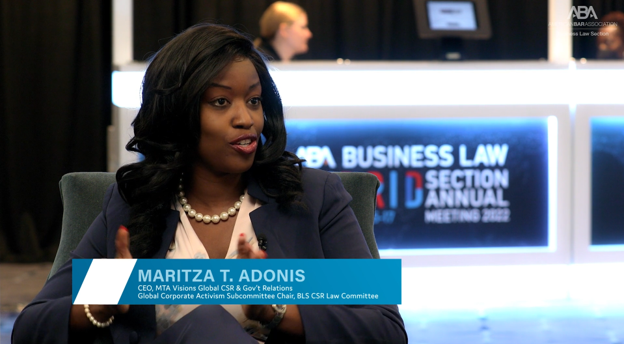
Maritza T. Adonis speaking in a post-program discussion following the ABA Business Law Section’s 2022 Annual Meeting CLE “On the Sidelines or Taking Sides: Corporations, Elections, Social Responsibility, and Long-Term Impacts on Corporate Governance.” Video still via ABA Business Law Section.

It is 8:17 a.m. The board book is complete. The agenda looks routine. Directors are scheduled to discuss a pending acquisition, executive compensation, a cybersecurity update, and several litigation matters. Corporate counsel expects another meeting focused on strategy, compliance, and risk management.

Then the phone buzzes.

Overnight, the company’s chief executive officer has come under criticism for remaining silent on a controversial state law. Employees are asking the company to issue a public statement. Shareholders want to know whether political contributions will continue. Customers have organized a boycott. Public officials in one state threaten legislative action if the company speaks. Officials in another state criticize companies that remain silent.

The board meeting has changed before it begins.

Questions that once belonged to public affairs or government relations now arrive in the boardroom. Corporate counsel is no longer asked only whether a proposed action complies with the law. Counsel is increasingly asked whether the corporation should speak, remain silent, alter a business relationship, suspend political giving, or respond to rapidly changing public expectations. Every option carries legal, financial, reputational, and governance consequences.

This scenario is no longer unusual. In 2022, while participating in an American Bar Association Business Law Section CLE examining whether corporations should take public positions on social and political issues, much of the discussion centered on defining concepts such as corporate social responsibility; environmental, social, and governance (“ESG”); stakeholder governance; and corporate political activity.[1] Looking back, that discussion identified the right problem. Experience since then suggests that the more important question is no longer whether corporations should take sides. Increasingly, they cannot avoid politically consequential decisions. The question now is how boards should govern them. For purposes of this article, a politically consequential board decision is a corporate decision that, because of its subject matter or surrounding circumstances, carries political or public-policy significance beyond the corporation’s ordinary business operations.

The public dispute between The Walt Disney Company and the State of Florida shows how quickly a corporate decision on a politically contested issue can spill far beyond the decision itself.[2] What began with Disney taking a public position ultimately drew the company into a dispute with the state over the governing structure of the district in which Walt Disney World operates.

Disney is hardly alone in confronting this problem. Boards are now being asked to respond to issues ranging from consumer boycotts and diversity initiatives to artificial intelligence and changing state regulation. Shareholder demands can also bring political questions into corporate decision-making. Empirical work on political-disclosure proposals shows that investors can press companies to reconsider their political activity and disclosure practices, even though the economic significance of greater political transparency remains unsettled.[3] These matters may begin outside the boardroom, but they do not always stay there.[4]

Recent corporate law scholarship helps explain why these decisions have become more difficult for boards. Companies operate in an increasingly polarized environment in which stakeholder demands and regulatory approaches may pull in different directions.[5] Corporate commitments can also become harder to maintain as circumstances change, particularly after shifts in governmental power.[6] Analysis of corporate DEI risk further illustrates how political pressure can distort board decision-making when corporations confront matters extending beyond ordinary business operations.[7] At the same time, corporations increasingly enter public affairs through political advocacy and other activities that can place them in roles traditionally associated with government.[8] Together, these developments have changed the environment in which boards make politically consequential decisions.

Corporate law scholarship and governance practice have approached these problems in several ways. Some scholars have questioned whether corporate political speech should be governed like an ordinary business decision at all.[9] Others have emphasized disclosure and accountability surrounding corporate political spending.[10] Governance practitioners have also developed private-ordering approaches that rely on internal controls and board oversight.[11] These approaches provide important institutional guardrails, but they leave the antecedent fiduciary question unresolved.

Before the first public statement is drafted, before a political contribution is approved, and before any disclosure obligation arises, corporate counsel must help the board determine whether the corporation should act at all and, if so, how. That is the gap this article addresses.

Maritza T. Adonis in conversation with Bruce F. Freed and Jason D. Kaune in a post-program discussion following the ABA Business Law Section’s 2022 Annual Meeting CLE “On the Sidelines or Taking Sides: Corporations, Elections, Social Responsibility, and Long-Term Impacts on Corporate Governance.” Video still via ABA Business Law Section.

From Debate to Decision

Four years ago, while participating in an American Bar Association Business Law Section CLE entitled “On the Sidelines or Taking Sides: Corporations, Elections, Social Responsibility, and Long-Term Impacts on Corporate Governance,” our discussion centered on a different question.[12] We asked whether corporations should engage in politically consequential issues at all. Much of the conversation focused on defining corporate social responsibility, distinguishing it from ESG initiatives, and considering the lawyer’s role in helping corporations navigate increasingly complex stakeholder expectations.

Looking back, I believe we were asking the right question, but an incomplete one.

Since that discussion, boards have confronted Disney’s dispute with the State of Florida, consumer boycotts affecting Bud Light and Target, increased scrutiny of corporate political activity, and backlash surrounding corporate positions on ESG and other contested issues.[13] The facts differ, but each placed corporate leadership in the middle of a controversy that could not be resolved by public messaging alone.

I had seen signs of this shift even before our 2022 discussion. In 2019, I noted that companies were developing ESG reporting capabilities in response to investor demand, while consumer demand and regulatory developments abroad were adding pressure of their own.[14] The debate has changed considerably since then, but the pressure on companies to respond has not disappeared.

One exchange from that discussion has stayed with me. Bruce Freed, president and cofounder of the Center for Political Accountability, observed that corporate leaders increasingly faced expectations from employees, investors, and consumers to speak on issues extending beyond traditional business operations.[15] As our conversation continued, however, the discussion evolved beyond whether the chief executive officer should respond. It became a broader conversation about senior leadership, institutional responsibility, and the governance process supporting those decisions. That shift reinforced something I had not fully appreciated at the time. The most important question is not who speaks for the corporation. It is who decides, and according to what process.

Returning to Governance

The conversation also reinforced another lesson. Lawyers have a unique role in these debates, not because they determine what position a corporation should take, but because corporate law provides the framework through which those decisions should be evaluated. As our discussion turned to how corporations define and carry out their responsibilities, I drew a distinction between corporate social responsibility (“CSR”) and ESG. CSR supplied the broader framework, while I described ESG as a tool for measuring how effectively a company was carrying out those commitments.[16] Over time, the political debate increasingly centered on the “E” and the “S.” The enduring contribution of corporate law has always been the “G.” Governance is what enables boards to navigate difficult questions regardless of whether the controversy arises from regulatory change, corporate political activity, emerging technology, stakeholder commitments, or corporate speech.

Politics will continue to evolve. Stakeholder expectations will continue to shift. New technologies will emerge. Headlines will change. Fiduciary duties, however, will not. For the corporation, political controversy becomes a governance question when it implicates the business and affairs of the enterprise.

A Fiduciary Decision Framework for Politically Consequential Board Decisions

Boards cannot predict how a political controversy will unfold, nor can they satisfy every constituency affected by it. They can, however, control how they make the decision. When one of these issues reaches the boardroom, corporate counsel can begin with the same fiduciary principles directors use in making other business decisions. The framework below shows how those principles can guide the board without creating new fiduciary duties for politically consequential decisions.

That framework rests on three familiar principles of Delaware corporate law. First, Section 141(a) of the Delaware General Corporation Law vests boards with authority to manage the business and affairs of the corporation.[17] Second, the duty of care requires directors to inform themselves of material information reasonably available before making a business decision.[18] Third, the business judgment rule affords directors a rebuttable presumption that, in making a business decision, they acted on an informed basis, in good faith, and in the honest belief that the action taken was in the corporation’s best interest.[19] That deference, however, does not itself supply a decision-making process. The business judgment rule largely keeps courts from second-guessing nonconflicted business decisions; it does not tell directors how to work through a politically consequential one.[20] Together, these principles provide the legal foundation for the framework that follows.

Step One: Establish the Corporate Basis for Action

Counsel should begin by asking why the matter is one for the corporation. Stakeholder demands, public pressure, and changes in the political environment may bring an issue to its attention, but they should not automatically lead to a public statement, a change in internal policy, or other action by the corporation. The board should first identify what the matter means for the corporation and why it warrants action.

That inquiry may also reveal that the response need not come from the corporation itself. Depending on the issue, counsel may consider whether another part of the organization’s existing structure, such as its government affairs function, political action committee, or corporate foundation, provides a more suitable avenue for addressing it than a CEO statement or change in internal policy.

In the opening scenario, employee concerns, a customer boycott, threatened government action, and questions about political contributions may all matter. The first task is not to decide what the company should say, but to determine why the matter calls for action by the corporation in the first place.

Step Two: Identify the Fiduciary Question

Once the board decides that the matter requires its attention, counsel should identify the corporate decision the board is actually being asked to make. The fact that a proposed action carries political consequences does not make the corporation’s political position the fiduciary question. Counsel should instead identify the corporate interests at stake, the material risks associated with the available choices, and the decision directors must make on behalf of the corporation.

In the opening scenario, the board is not deciding what the corporation believes about the state law. It is deciding whether the corporation should speak, remain silent, alter its political giving, or take some other action, and what those choices could mean for the corporation.

Step Three: Develop an Informed Record

Once counsel has identified the fiduciary question, the next task is to determine what the board needs to know before answering it. If the corporation is facing threatened state action, employee pressure, a customer boycott, and questions about its political contributions, directors may need information about each before deciding whether the corporation should speak or remain silent. Counsel’s role is to make sure the board has what it needs to evaluate those choices rather than allowing the loudest source of pressure to define the record.

The board need not know how the controversy will ultimately unfold. It does need enough information to make the decision before it.

Step Four: Deliberate and Document

With the relevant information before it, the board should have a meaningful opportunity to consider the decision, discuss the material risks, weigh alternatives, and question the advice it has received. The record should reflect that process and the basis for the board’s decision. Documentation is not a substitute for deliberation. It should capture the deliberation that actually occurred.

A decision about whether to speak on the state law, for example, might follow a discussion about whether silence would intensify the employee response or whether a public statement could affect the company’s relationship with state officials. The board’s reasons for choosing between those courses belong in the record. How the board reached its decision matters if that decision is later challenged.

Step Five: Revisit and Monitor

After the board decides to remain silent on the state law, counsel should continue to follow the matter. A threatened government response may become proposed legislation, or a customer boycott may begin affecting sales. Those developments may change the circumstances surrounding the board’s decision.

When that change is material to the basis for the board’s decision, counsel should consider whether to bring the matter back before the board.

Conclusion

At the conclusion of our 2022 ABA Business Law Section discussion, I suggested that the legal profession should move beyond debating these issues and begin building the practical resources lawyers need to navigate them. That work includes teaching, publishing, and developing governance frameworks that help boards apply familiar legal principles to unfamiliar problems.[21] This Article is offered in that spirit.

The next time corporate counsel’s phone buzzes, counsel has a place to start: establish, identify, develop, deliberate, revisit. Starting there gives counsel an opportunity to bring the board’s fiduciary responsibilities into the conversation early, before the response is shaped by communications, government affairs, or public pressure. It also puts corporate counsel where it belongs in the process, helping the board make an informed and deliberate decision before a controversy becomes a crisis.


  1. Maritza T. Adonis, Bruce F. Freed & Jason D. Kaune, A Deeper Dive—On the Sidelines or Taking Sides: Corporations, Elections, Social Responsibility, and Long-Term Impacts on Corporate Governance, ABA Bus. L. Section (Dec. 15, 2022). ↑

  2. See Walt Disney Parks & Resorts U.S., Inc. v. DeSantis, 716 F. Supp. 3d 1216 (N.D. Fla. 2024). ↑

  3. Jill E. Fisch & Adriana Z. Robertson, Proxies for Politics 1 (Univ. Pa. Inst. for L. & Econ. Rsch. Paper No. 25-21 & Eur. Corp. Governance Inst. L. Working Paper No. 889/2025, 2025). ↑

  4. Hillary A. Sale, The Corporate Purpose of Social License, 94 S. Cal. L. Rev. 785, 789–90 (2021). ↑

  5. Poonam Puri, Corporations in the Crosshairs: Stakeholder Activism and the Role of Corporations in Society, 70 McGill L.J. 587 (2025). ↑

  6. Caley Petrucci, Corporate Goodwill, 67 B.C. L. Rev. 585 (2026). ↑

  7. Veronica Root Martinez & Lisa M. Fairfax, The Miscalculation of Corporate DEI Risk, NYU Program on Compliance & Enf’t (Mar. 4, 2026). ↑

  8. Matteo Gatti, Corporate Governing: Understanding Corporations as Agents of Socioeconomic Change, 50 J. Corp. L. 149 (2024). ↑

  9. Lucian A. Bebchuk & Robert J. Jackson, Jr., Corporate Political Speech: Who Decides?, 124 Harv. L. Rev. 83, 83–84 (2010). ↑

  10. Lucian A. Bebchuk & Robert J. Jackson, Jr., Shining Light on Corporate Political Spending, 101 Geo. L.J. 923, 941–45 (2013). ↑

  11. Jeanne Hanna, Bruce F. Freed, Karl Sandstrom & William S. Laufer, Public Failure, Private Ordering: Successful Self-Regulation of Corporate Political Spending, 27 U. Pa. J. Bus. L. 1149, 1206, 1212–15 (2025). ↑

  12. Adonis, Freed & Kaune, supra note 1. ↑

  13. Jill E. Fisch & Jeff Schwartz, How Did Corporations Get Stuck in Politics and Can They Escape?, 3 U. Chi. Bus. L. Rev. 325, 344–45 (2024). ↑

  14. Hazel Bradford, Investors Continue Urging Regulators for Risk Disclosure, Pensions & Invs. (Apr. 15, 2019) (quoting Maritza T. Adonis). ↑

  15. Adonis, Freed & Kaune, supra note 1. ↑

  16. Adonis, Freed & Kaune, supra note 1. ↑

  17. Del. Code Ann. tit. 8, § 141(a) (2026). ↑

  18. Smith v. Van Gorkom, 488 A.2d 858, 872–73 (Del. 1985). ↑

  19. Aronson v. Lewis, 473 A.2d 805, 812 (Del. 1984), overruled on other grounds by Brehm v. Eisner, 746 A.2d 244 (Del. 2000). ↑

  20. Mark J. Roe, Corporate Law’s Limits, 31 J. Legal Stud. 233, 271 (2002). ↑

  21. Adonis, Freed & Kaune, supra note 1. ↑

When Copyright Claims Hit the Stream: DMCA Lessons for Live-Streamers and Their Counsel

For online streamers, copyright enforcement is no longer an abstract, back-end compliance issue. As illustrated by music educator Rick Beato’s recent disputes over copyright claims involving short clips used in commentary and teaching videos on YouTube[1] and the Twitch music takedown waves of 2020 and 2021,[2] copyright enforcement can quickly become a business-interruption problem. The streaming business model makes platform and rights-holder enforcement an immediate business risk. Streamers may use music or other copyrighted material in good faith, believing that the use is licensed, approved, or fair under copyright law, but nevertheless face muting, demonetization, removal, channel strikes, or suspension via internal platform processes.

The Digital Millennium Copyright Act (“DMCA”) provides the statutory basis and framework for removing suspected copyright-infringing content online.[3] However, the DMCA provides a baseline that protects platforms, not streamers on the platforms. In practice, platform-level enforcement policies are often more critical to streamer business models. Algorithmic recognition tools, repeat-infringer policies, publisher guidelines, and platform appeal processes can effectively decide whether created content is made publicly available, is archived, receives advertising revenue, or otherwise affects the streamer’s account or channel. These platform-level consequences may occur even when the underlying legal questions of copyright infringement, authorization, license, or fair use remain subject to debate. It is critical that streamers and their counsel understand the substantive and procedural distinctions before going live.

Why Streamers Should Care

Due to the risk of channel demonetization, counsel should be prepared to help clients treat copyright risk as an operational issue and not merely a litigation risk. A stream can be more than just a live broadcast. Advertising, subscriptions, sponsorships, donations, affiliate links, channel-affiliated merchandise stores—and even arrangements with the platforms themselves—can create diversified revenue streams. The combination of video gameplay, music, commentary, audience interaction, sponsorship, and merchandizing can turn a stream into a monetized audiovisual product that can later be recycled as clips and video-on-demand (“VOD”), extending the commercialized life of a stream for years.

So-called channel strikes can severely impact streamers’ revenue models. A channel strike is a platform penalty applied to a user’s account or channel after copyright-enforcement action, typically following a valid copyright removal request or DMCA notice. Because these actions happen within platform processes, a copyright claim, takedown notice, or platform action that mutes, disables, demonetizes created content, or contributes to a channel strike can affect revenue and audience growth without court evaluation of the substantive copyright claim. That is, platform responses are implemented without judicial input or oversight.

The DMCA operates to give qualifying platforms conditional safe harbors[4] that protect qualifying platforms and not platform users.[5] Although DMCA § 512(m) does not impose a general duty on platforms to monitor user activity, platforms may use automated tools for business, licensing, or risk-management reasons.[6] That is, a platform may enforce its own rules in order to improve DMCA compliance.[7] The streamer may choose to submit a counter-notice if there is a good-faith basis to assert mistake or misidentification.[8] However, counsel should explain to clients that a counter-notice is not a routine platform appeal, possibly escalating the dispute and prompting the rights holder to file suit.

On YouTube, a copyright strike occurs when content is removed because of a copyright removal request. Strikes expire after ninety days if the user completes a remedial copyright education program. Strikes can be removed if the user convinces the complainant to retract or if the user submits sufficient evidence of proper use through the counter-notification process. Three active copyright strikes can result in channel termination.[9]

On Twitch, a copyright strike is applied when Twitch receives a complete DMCA notification regarding allegedly infringing content if no counter-notification by the user is received in response. Users may have a copyright strike removed upon completion of Twitch’s Copyright School, once per year. Twitch generally treats a user as a repeat infringer after three copyright strikes, which can lead to account termination. Interestingly, Twitch’s guidelines advise users of possible adverse legal consequences if the user pursues a counter-notification.[10]

The surge in music-related DMCA notices at Twitch in 2020 is illustrative, as the platform publicly explained that music-related DMCA notices had jumped from fewer than fifty per year to thousands per week.[11] Older clips and archives were the primary targets. For streamers, the lesson was not simply “do not infringe”—it was that archived content can become a liability long after the live broadcast ends.

Platform Enforcement Beyond the DMCA

The DMCA is only one part of the copyright-enforcement picture. Platforms use internal enforcement systems to identify and recognize problematic content, triggering demonetization rules, repeat-infringer policies, and internal appeals. These mechanisms can operate faster and more broadly than statutory notice-and-takedown, helping platforms manage infringement at scale.

However, algorithmic identification technology is not equivalent to legal analysis and rights determination.[12] A system may recognize a musical composition, sound recording, or gameplay clip and apply preloaded licensing rules. But the system generally cannot answer the context-dependent questions that drive legal analysis. Questions such as license scope, authorization, fair use (including de minimis use, commentary, criticism, and transformative purpose), and market effect drive copyright litigation resolution,[13] but algorithmic processes are not built to address these questions. Hence, streamers may face takedowns or claims even when they have credible arguments that their uses are legally defensible.

Moreover, copyright defenses (such as fair use) do not trump a platform’s user agreement or proprietary takedown policies. Counsel should make clear to clients that having a strong legal argument is not the same as avoiding platform consequences. A use may be legitimate under copyright law, or a takedown notice contestable, but the platform may still enforce its own policies under its contractual terms and conditions with the user. Practitioners should therefore address copyright merits and platform-enforcement strategy together.

Video Containing Music: The Highest-Risk Use Combo

Video that contains music remains the most common trap. Recorded music involves separate rights in the musical composition and the sound recording, typically owned or controlled by different parties. A public-performance license for the musical composition does not include other uses. As a result, a streamer may have permission for one aspect of using a composition while still lacking the rights needed to synchronize it with video, retain it in archived content, or distribute it through clips or reposts. Likewise, the streamer may have obtained a master use license from the owner of the sound recording for one or more—but not all—intended uses. Moreover, platform licenses apply only to defined uses within the platform’s ecosystem and may vary by content type, monetization, geography, or other limitations.

Streamers should not assume that music and recordings are licensed for use in a stream simply because they are available through a platform feature or plays during gameplay. Platform music libraries, in-game music settings, and streamer modes can reduce risk, but only within defined limits. The safer approach is to use recorded music only when the streamer can document the permissions necessary for the intended uses. Streamers can also build more direct licensing paths by partnering with emerging or independent composers and artists who control their music publishing and recordings.

Furthermore, publicly available “DMCA-free” playlists may serve streamers’ music needs.[14] However, streamers should be advised that there is a risk that the curators of the playlists may not actually have secured the applicable rights—despite representations otherwise—or may have secured only some of the rights necessary for streamers’ intended uses. Regardless, platforms still exercise discretion in whether to permit such “DMCA-free” music within streams.[15]

In-Game Content: Not Always Cleared for Every Use

Music is not the only third-party content that can create rights issues in a game stream. Gameplay may also display or incorporate logos, signage, background video, tattoos, artwork, architecture, and other protected material. Courts have treated these issues as context-specific. For example, one court found the use of NBA players’ tattoos in a basketball video game defensible on de minimis use, implied license, and fair-use grounds, but the decision was fact-dependent.[16] Under a different set of circumstances, a different outcome could result.

Many game publishers permit or tolerate gameplay streaming through fan-content or streaming policies. However, such limited permissions are not equivalent to a broad license for other uses.[17] Thus, practitioners should advise clients to preserve publisher policies, platform rules, and any written permissions relied upon at the time of streaming. Unfortunately, when no express license exists, streamers often assume that fair use will provide protection. That assumption deserves careful examination.

Fair Use: A Defense, Not a Production Plan

Fair use, as a legal determination, depends on statutory factors such as the purpose and character of the use, the nature of the work, the amount used, and the effect on actual or potential licensing revenues.[18] Rebroadcasting another’s content with little or no original analysis is unlikely to qualify for fair-use protection. Fair-use arguments are strongest when the copied material is limited to what is necessary for the fair use—explaining, critiquing, teaching, or commenting on the source material.[19]

Likewise, a “transformative” purpose does not resolve the fair-use inquiry, as courts must still evaluate the statutory factors as a whole.[20] In doing so, courts are tasked with comparing the purpose and character of the challenged use with that of the original work, including the commercial licensing context.[21] That commercial context is particularly important for monetized streams, clips, and VOD. The U.S. Court of Appeals for the Ninth Circuit requires copyright owners to consider fair use before sending a DMCA takedown notice, but streamers should not mistake that requirement for approved use or immunity from platform enforcement.[22]

Practical Steps for Streamers and Counsel

Rights clearance and licensing should start before the stream, not after a claim appears. Counsel can help clients:

  • review platform and game-publisher streaming policies;
  • identify music, sound recordings, and other third-party assets;
  • determine which permissions are needed; and
  • preserve licenses, policies, and correspondence on which the streamer relies.

After a streamer receives a takedown notice, platform claim, or other enforcement action, a counter-notice should follow only if the streamer has a good-faith basis to dispute the removal and understands that doing so may trigger statutory deadlines or litigation.

Conclusion

Disputes among streamers, claimed rights holders, and platforms illustrate that streamers need a copyright strategy that considers the practical enforcement reality. Blanket avoidance of copyrighted material is probably too conservative, but discretion and careful consideration of enforcement dynamics are critical. The goal should be to bring copyright review into production planning. Before clients go live, counsel should help them develop strategies for secure monetization of the stream after-the-fact—as an archived clip, VOD, sponsored use, or off-platform repost. Secure licenses for musical compositions, sound recordings, and other high-risk rights where possible. Fair use, although important, is a fact-specific defense that does not protect against platform-specific enforcement mechanisms. In short, streamers and their counsel should engage in proactive production planning rather than brace for reactive postproduction damage control.


  1. See Skye Jacobs, YouTube Copyright Fight: Rick Beato Warns UMG Claims over Short Music Clips Could End His Channel, TechSpot (Sept. 1, 2025); see also Rick Beato, Written Responses of Mr. Rick Beato, U.S. Senate Comm. on the Judiciary (last visited July 22, 2026) (responses to questions for the record). ↑

  2. See Music-Related Copyright Claims and Twitch, Twitch (Nov. 11, 2020); Jon Brodkin, Twitch Explains Confusing Copyright Crackdown, Urges Users to Delete Videos, Ars Technica (Nov. 11, 2020); see also Nathan Grayson, Twitch Makes Deal with NMPA, but Streamers Still Can’t Play Licensed Music, Wash. Post (Sept. 21, 2021). ↑

  3. See 17 U.S.C. § 512(c)(1), (c)(3). ↑

  4. See id. § 512(c), (i), (k); see also id. § 512(c)(2) (designated agent), § 512(c)(3) (notice requirements), § 512(i)(1)(A) (repeat-infringer policy), § 512(i)(1)(B), (i)(2) (standard technical measures). ↑

  5. See id. § 512(c)(1) (limiting liability for qualifying service providers for infringement “by reason of the storage at the direction of a user of material”); see also Viacom Int’l, Inc. v. YouTube, Inc., 676 F.3d 19, 27–28 (2d Cir. 2012) (explaining that § 512(c) provides a safe harbor from certain liability for service providers but does not itself resolve the underlying infringement question). ↑

  6. 17 U.S.C. § 512(m)(1); UMG Recordings, Inc. v. Shelter Cap. Partners LLC, 718 F.3d 1006, 1022–23 (9th Cir. 2013); Viacom Int’l, 676 F.3d at 35. ↑

  7. See 17 U.S.C. § 512(c), (m) (establishing conditional DMCA safe harbors while not conditioning safe-harbor eligibility on general monitoring); About Copyright Removal Requests, YouTube Help (last visited July 22, 2026); DMCA & Copyright FAQs, Twitch (last visited July 22, 2026). ↑

  8. See 17 U.S.C. § 512(g)(3)(C). ↑

  9. Understand Copyright Strikes, YouTube Help (last visited July 22, 2026). ↑

  10. DMCA Guidelines: Digital Millennium Copyright Act Notification Guidelines, Twitch (last modified Oct. 11, 2023). ↑

  11. See Music-Related Copyright Claims and Twitch, supra note 2; Brodkin, supra note 2. ↑

  12. See Annemarie Bridy, Copyright’s Digital Deputies: DMCA-Plus Enforcement by Internet Intermediaries, in Research Handbook on Electronic Commerce Law (John A. Rothchild ed., 2016). ↑

  13. See, e.g., How Content ID Works, YouTube Help (last visited July 22, 2026); Julie A. Ahrens et al., Comments in Response to the Department of Commerce’s Green Paper, Copyright Policy, Creativity, and Innovation in the Digital Economy 8–9 (Nov. 13, 2013); Dan L. Burk, Algorithmic Fair Use, 86 U. Chi. L. Rev. 217 (rev. 2019). ↑

  14. See, e.g., StreamBeats (last visited July 22, 2026). ↑

  15. FAQ: Platform Safety, StreamBeats (last visited July 22, 2026). ↑

  16. Solid Oak Sketches, LLC v. 2K Games, Inc., 449 F. Supp. 3d 333, 344–50 (S.D.N.Y. 2020). ↑

  17. See, e.g., Amy Thomas, Merit and Monetisation of Video Game User-Generated Content Policies, 12 Internet Pol’y Rev. (2023); EA’s Content Policy, EA (last visited July 22, 2026); Streaming Guidelines, SEGA (updated Mar. 12, 2026). ↑

  18. See 17 U.S.C. § 107; Andy Warhol Found. for the Visual Arts, Inc. v. Goldsmith, 598 U.S. 508, 527–39 (2023). ↑

  19. See Rick Beato, This Record Label Is Trying to SILENCE Me, YouTube (Aug. 19, 2025). ↑

  20. 17 U.S.C. § 107; Campbell v. Acuff-Rose Music, Inc., 510 U.S. 569, 577–79 (1994). ↑

  21. Andy Warhol Found. for the Visual Arts, 598 U.S. at 527–39. ↑

  22. Lenz v. Universal Music Corp., 815 F.3d 1145, 1151–54 (9th Cir. 2016) (amended opinion superseding 801 F.3d 1126 (9th Cir. 2015)). ↑

A Contractarian Retelling of the Frog-and-Scorpion Fable

This article is Part XIV of the Musings on Contracts series by Glenn D. West, which explores the unique contract law issues the author has been contemplating, some focused on the specifics of M&A practice, and some just random.

In a single sentence of a recent Delaware Court of Chancery decision, Meteora Capital Partners, LP v. Roadzen Inc.,[1] Vice Chancellor Laster invokes the frog-and-scorpion fable: “A frog must account for a scorpion’s character, particularly when the frog has sophisticated lawyers, and the scorpion lays out what it can do in detailed agreements.”[2] Although the fable is widely known, the case suggests a different moral than the traditional one.

The Case in Brief

Meteora Capital Partners involved a typical de-SPAC transaction.[3] The merger agreement required that, “after giving effect to any redemptions,” “the SPAC have at least $50 million available at closing.”[4] Based on the redemption requests submitted, that condition would apparently not be met.[5]

To meet the minimum cash condition, the SPAC entered into a transaction with a hedge fund comprising a forward contract and a subscription agreement.[6] The transaction effectively “operat[ed] like a synthetic long put option.”[7] It was extremely complicated, and I am not sure I fully understand all its ins and outs. But the bottom line was that the transaction enabled the company to meet the minimum cash condition—at least for closing purposes.[8]

The transaction agreements created many opportunities for the hedge fund to benefit. The most important of those opportunities appeared to involve the hedge fund exercising discretionary rights.[9] The transaction agreements, in short, represented a “crazy-good deal for [the hedge fund] and a terrible deal for the Company.”[10]

But the company had been advised by “two major law firms” and “[a]ll of the risks of [the transaction] were plain from the Transaction Documents.”[11] Vice Chancellor Laster’s decision in this case arose from a summary judgment motion by the hedge fund seeking a “decree of specific performance enforcing the surviving company’s obligation to remove the transfer restrictions from shares that [the hedge fund] holds.”[12]

Under Delaware law, “[i]f a writing is plain and clear on its face, i.e., its language conveys an unmistakable meaning, the writing itself is the sole source for gaining an understanding of intent.”[13] And “[p]arties have the right to enter into both good and bad contracts, and the law enforces both.”[14]

Despite these well-established principles in most major jurisdictions, the company attempted to recast the purpose of the transaction agreements as more akin to a long-term capital investment and asserted that the hedge fund’s interpretation of those agreements was “absurd.” According to the company, the hedge fund’s interpretation of the benefits it derived from the transaction agreements was absurd because “it cannot be true that [the hedge fund] could sell shares and drive down the market price to benefit from a low Settlement Price at the end of a Valuation Period[;] [d]riving the market price down would inhibit the Company’s ability to raise capital.”[15]

Vice Chancellor Laster, however, suggested that “it is the Company’s position, not [the hedge fund’s], that could be viewed as absurd.”[16] Indeed, “[t]he Company’s understanding is so at odds with the Forward Agreement as to suggest that the Company executed the transaction without reading the documents or understanding their implications.”[17] “The Transaction Agreements are complex, and they take time to read and explain, but their meaning is clear.”[18] “All the Company had to do was map it out.”[19] And there was no suggestion of a “mutual mistake.”[20]

According to Vice Chancellor Laster:

[The hedge fund] is not a supportive supplier of patient capital, and [it] was never [making] a long-term or strategic investment. [The hedge fund] bridged the Minimum Cash Condition in exchange for rights that would turn Gordon Gekko green with envy. [The hedge fund] wielded its rights in its own interest to maximize its return. . . .

Through the Transaction Agreements, the Company entered into a zero-sum relationship with [the hedge fund]. A frog must account for a scorpion’s character, particularly when the frog has sophisticated lawyers, and the scorpion lays out what it can do in detailed agreements.

The Company cannot escape the Forward Agreement’s clear and unambiguous terms by claiming that the outcome is absurd. Impressively one-sided, yes. Absurd, no.[21]

Retelling the Frog-and-Scorpion Fable

A common version of the frog-and-scorpion fable goes something like this: The scorpion asks the frog if he can ride on the frog’s back across the pond. The frog is reluctant at first, fearing the scorpion would sting him. But the scorpion tells the frog that scorpions do not swim. The frog therefore agrees to carry the scorpion across the pond. After all, if the scorpion stings him, both will drown. Midway across, however, the scorpion stings the frog. As the now-paralyzed frog sinks in the pond with the scorpion on its back, the frog asks why the scorpion would sting him and doom them both to a watery grave. The scorpion answers, “Sorry, but you knew I was a scorpion, and that’s what we do.”[22]

The traditional moral of this story is that some people tend to hurt others and follow that instinct even when it’s not in their own self-interest. I am not a psychologist or a sociologist, so I have no comment on whether that traditional moral translates into real-life examples of self-destructive people hurting others they may depend on, when cooperative behavior would be better for everyone.[23] What I am, however, is a contract nerd, and this is part of my Contract Musings series, which means I am rejecting that traditional moral in favor of one more in keeping with a contract theme.

And, as it turns out, everyone may have gotten the traditional moral of the story wrong, assuming the scorpion drowned with the frog. While it is apparently true that a scorpion cannot swim, it can survive for at least forty-eight hours underwater (it has tremendous lung capacity)—and, without swimming, it could presumably crawl along the bottom of the pond to the shore after sinking with the frog. That’s why you are cautioned never to flush a scorpion down the toilet.[24]

With that additional information, the moral of the story changes when applied to contracts. Now the moral becomes this: Understand who your counterparty is and what they do (i.e., their business model), and make sure your contract protects you from the kinds of opportunistic conduct that counterparty is known for and has expressly retained the right to engage in (if you decide to contract with that counterparty at all)—that is, wear a protective cover on your back (or borrow a turtle’s shell) if you intend to allow the scorpion to hitch a ride.[25]

Where Is “Good Faith” in All of This?

Some of the company’s claims against the hedge fund in related litigation in other jurisdictions (and asserted as affirmative defenses to the hedge fund’s claims in the Delaware case) appeared to be premised, at least in part, on allegations that the hedge fund violated the implied covenant of good faith and fair dealing.[26] But the claims in the related litigation were apparently dismissed.[27] And Vice Chancellor Laster made clear that “the implied covenant is not at issue in this motion.”[28] Presumably, there could be no implied covenant claim if everything the hedge fund did was permitted by the express terms of the contract and, in exercising its discretionary rights, the hedge fund acted in its own legitimate self-interest, not solely to harm the company.[29]

Nonetheless, Vice Chancellor Laster took this opportunity to place the hedge fund’s exercise of its express rights within the framework of classic contract theory. First, he invoked the concept that “[t]he act of contracting is presumptively a cooperative endeavor intended to create and allocate joint surplus.”[30] He then noted that “[a] legal regime reduces that surplus when it forces parties to be perpetually on their guard against opportunistic actions by their counterparties.”[31]

This classic contract theory is the basis for Judge Richard Posner’s famous interpretation of the implied covenant:

[C]ontracts do not just allocate risk. They also (or some of them) set in motion a cooperative enterprise, which may to some extent place one party at the other’s mercy. . . . The office of the doctrine of good faith is to forbid the kinds of opportunistic behavior that a mutually dependent, cooperative relationship might enable in the absence of [the] rule. “Good faith” is a compact reference to an implied undertaking not to take opportunistic advantage in a way that could not have been contemplated at the time of drafting, and which therefore was not resolved explicitly by the parties.[32]

But Judge Posner’s interpretation of the implied covenant is far more utopian than the pedestrian way Delaware courts have traditionally applied it[33]—that is, implying terms to fill gaps consistent with the contract’s express terms and policing the exercise of discretion so that the party wielding that discretion advances its legitimate business objectives rather than solely harms its counterparty.[34]

But even if we accepted Judge Posner’s more utopian view of the implied covenant, not all contracts “set in motion a cooperative enterprise.”[35] And, according to Vice Chancellor Laster, not all contracts necessarily create a surplus. “Some contracts,” according to Vice Chancellor Laster, “are zero sum.”[36] In a zero-sum contract, “what is good for one [party] will necessarily be bad for the other.”[37]

Vice Chancellor Laster characterized the forward contract and subscription agreement as a zero-sum contract.[38] While “[t]he implied covenant still applies to those contracts[,] . . . the nature of the contract matters for purposes of a party’s reasonable expectations.”[39] Perhaps so. But I would argue that even if the forward contract and subscription agreement did not constitute a zero-sum contract (i.e., even if some economic theory holds that those transaction agreements created a surplus),[40] the more important point is that the transaction did not “set in motion a cooperative enterprise.”[41] Moreover, how could there be “an implied undertaking not to take opportunistic advantage in a way that could not have been contemplated at the time of drafting”[42] if those “opportunistic advantages” were expressly set forth in the contract?[43]

Even if anti-opportunism is the goal of the implied covenant, it is not necessarily opportunistic for a party to exercise rights expressly bargained for in the parties’ written agreement, which were therefore part of the counterparty’s “reasonable expectations.”[44] “Indeed, the uncertainty inherent in any [good-faith] doctrine to regulate opportunistic behavior may itself be opportunistically invoked.”[45]

Conclusion

When I was practicing, I sometimes cautioned clients to walk away if they had not previously engaged in certain types of transactions where more experienced “scorpions” plied their trade. Whatever the scorpion promises to pay for that ride on your back may simply not be worth the risk that they will do what they have expressly retained the right to do. That advice still looks pretty good. And in the contractarian retelling of the frog-and-scorpion fable, referring to someone as a scorpion is just a recognition of the nature of their business model; and the benefits that they bargain for as part of that business model are simply the price of obtaining the benefit you are seeking from contracting with them in the first place.

The objective theory of contract holds thus:

The words parties use to bind themselves together in a contractual relationship matter. This is especially so when sophisticated parties have engaged in extensive negotiations that produce a bespoke contract. And it is so even when one of those parties later swears that all involved in the relationship intended the contract to say something other than what is captured in its clear and unambiguous terms.[46]

One justification for the objective theory of contract is that “[t]he promisee’s affairs can be planned based on what is spoken or written, communications that can also be subsequently referenced when questions regarding performance and obligation arise[,] [and] [s]ubjective, internal equivocations or doubts . . . cannot create havoc in the parties’ reasonable expectations.”[47] This means that the objective meaning of what is said in a contract is what creates the parties’ reasonable expectations, not any subjective, unexpressed meaning they may have intended.

When contracting, words matter, whether you are the scorpion or the frog. And lest we think only the frog needs to be cautious when making a contract with a scorpion, the scorpion also needs to consider the frog’s business model; some frogs include scorpions in their diet.[48]

So perhaps my not-uncommon invocation of Sergeant Phil Esterhaus’s admonition is appropriate for both the frog and the scorpion as contracting parties: “Let’s be careful out there!”[49]


  1. Meteora Capital Partners, LP v. Roadzen Inc., No. CV 2025-0421-JTL, 2026 WL 2530118 (Del. Ch. Aug. 27, 2026). ↑

  2. Id. at *29. ↑

  3. Id. at *2. ↑

  4. Id. ↑

  5. Id. ↑

  6. Id. ↑

  7. Id. at *10. ↑

  8. See id. at *3. ↑

  9. See, e.g., id. at *5 (“The Forward Agreement gave [the hedge fund] the right to accelerate the Valuation Date, either after specified acceleration events or unilaterally in its ‘sole discretion.’”). ↑

  10. Id. at *27. ↑

  11. Id. at *11. ↑

  12. Id. at *1. ↑

  13. Id. at *20 (quoting City Inv. Co. Liquidating Tr. v. Cont’l Cas. Co., 624 A.2d 1191, 1198 (Del. 1993)). ↑

  14. Id. at *27 (quoting Nemec v. Shrader, 991 A.2d 1120, 1126 (Del. 2010)). ↑

  15. Id. at *28. ↑

  16. Id. ↑

  17. Id. ↑

  18. Id. at *16. ↑

  19. Id. at *11. ↑

  20. Id. at *19. ↑

  21. Id. at *28–29 (emphasis added). ↑

  22. See The Scorpion and the Frog, Wikipedia (last visited Sept. 4, 2026). ↑

  23. Id. ↑

  24. Katarina Betterton, Can Scorpions Swim? 10 Facts About How They Handle Water, A-Z Animals (Dec. 5, 2023). ↑

  25. In earlier Persian versions of the story, the frog was a turtle and the attempted sting by the scorpion failed. But in at least one of the Persian versions, the turtle dove underwater following the scorpion’s attempted sting and shook the scorpion off its back. See The Scorpion and the Frog, supra note 22. ↑

  26. See Meteora Cap. Partners, 2026 WL 2530118, at *15, *19. ↑

  27. See Roadzen, Inc. v. Meteora Cap. Partners, L.P., No. 25-CV-7867 (JPO), 2026 WL 1983435, at *1 (S.D.N.Y. July 9, 2026), appeal filed. ↑

  28. Meteora Cap. Partners, 2026 WL 2530118, at *29. ↑

  29. See Glenn D. West, The ‘Officious Bystander’ and the Implied Covenant of Good Faith and Fair Dealing, Bus. L. Today (May 20, 2026). ↑

  30. Meteora Cap. Partners, 2026 WL 2530118, at *28. ↑

  31. Id. ↑

  32. Mkt. St. Assocs. Ltd. P’ship v. Frey, 941 F.2d 588, 595 (7th Cir. 1991) (emphasis added) (internal quotations and citations omitted). ↑

  33. See Daniel Markovits, Good Faith as Contract’s Core Value, 2021 Mich. St. L. Rev. 1, 19 (2021) (distinguishing between the pedestrian and utopian versions of the implied covenant). ↑

  34. See West, supra note 29. ↑

  35. Mkt. St. Assocs., 941 F.2d at 595. ↑

  36. Meteora Cap. Partners, 2026 WL 2530118, at *29. ↑

  37. Paul S. Davies, The Basis of Contractual Duties of Good Faith, 1 J. Commonwealth L. 1, 22 (2019) (“Some contracts represent a zero-sum game, what is good for one will necessarily be bad for the other.”). ↑

  38. Meteora Cap. Partners, 2026 WL 2530118, at *29. ↑

  39. Id. ↑

  40. See John Enman-Beech, The Good Faith Challenge, 1 J. Commonwealth L. 35, 59 (2019) (“All contracts involve parties co-operating to make a pie and then competing over how to divide it. In the simplest transaction, say I pay a dollar for a chocolate bar, the pie can be seen as the net utility gain of the parties. Presumably I value the chocolate bar at over a dollar (say $1.10) and the shop values it at less (say ¢90). By making this trade we’ve made a (twenty cent) pie and divided it (equally).”). But I am not so sure this idealized pie-making formula is always present in every contract. ↑

  41. Mkt. St. Assocs. Ltd. P’ship v. Frey, 941 F.2d 588, 595 (7th Cir. 1991). ↑

  42. Id. ↑

  43. See MERA USA, LLC v. MCS Burbank, LLC, No. CV 2024-0188-MTZ, 2026 WL 2547077, at *22 (Del. Ch. Aug. 28, 2026) (“Where the contract reflects that the parties contemplated whether one party might take a particular action with particular consequences, the implied covenant should not be deployed.”); McKenzie v. BDO USA, P.C., No. 2025-0264-LWW, 2026 WL 191010, at *5 (Del. Ch. Jan. 26, 2026) (citations omitted) (“[I]f the scope of discretion is specified, there is no gap in the contract as to the scope of the discretion, and there is no reason for the Court to look to the implied covenant to determine how discretion should be exercised.”). ↑

  44. Meteora Cap. Partners, 2026 WL 2530118, at *29. But see LanzaTech Glob., Inc. v. Vellar Opportunity Fund SPV LLC, No. 24-CV-6362 (JPO), 2025 WL 2323834, at *6 (S.D.N.Y. Aug. 12, 2025) (a case involving a similar forward contract in which the court refused to dismiss an implied covenant claim because “based upon facts alleged by LanzaTech, the intentional use of price depreciation alongside the threat of using the Seller VWAP Trigger Event to gain an advantage in negotiations surrounding the continued [forward purchase agreement] could be legally sufficient to constitute an attempt to ‘destroy[ ] or injur[e] the right of [LanzaTech] to receive the fruits of the contract’ by changing the terms of the original agreement under pressure that Vellar created” (internal citation omitted)). ↑

  45. Davies, supra note 37, at 22. ↑

  46. Zohar II 2005-1, Ltd. v. FSAR Holdings, Inc., No. CV 12946-VCS, 2017 WL 5956877, at *1 (Del. Ch. Nov. 30, 2017). ↑

  47. Wayne Barnes, The Objective Theory of Contracts, 76 U. Cin. L. Rev. 1119, 1130 (2008). ↑

  48. See American Bullfrog, Wikipedia (last visited Sept. 4, 2026) (“Bullfrog stomachs have been found to contain rodents, small lizards and snakes, other frogs and toads, . . . scorpions, tarantulas and bats. . . .” (emphasis added)). ↑

  49. Hill Street Blues (MTM Enterprises 1981–1987) (statement of Sgt. Phil Esterhaus, played by Michael Conrad (recurring catchphrase across multiple episodes until Michael Conrad’s death in 1983)); see Glenn D. West, Contract Drafting 101—It Doesn’t Matter What You Actually Meant by What You Said; It Only Matters What Is Determined to Be Meant by What You Actually Said, Weil Glob. Priv. Equity Watch (Sept. 19, 2016) (one of my early invocations of Sgt. Esterhaus’s admonition as applied to deal lawyers). ↑

A Remedy Without a Lawsuit: Business Litigation After FS Credit Opportunities v. Saba Capital

The Supreme Court’s 2026 decision in FS Credit Opportunities Corp. v. Saba Capital Master Fund arose from a clash between Maryland control-share protections and the Investment Company Act of 1940. Several Maryland closed-end funds adopted resolutions limiting voting rights for shareholders holding disproportionate positions unless other shareholders approved. Activist investor Saba Capital argued that the resolutions violated section 18(i) of the Investment Company Act, which generally requires equal voting rights among a registered management company’s outstanding voting shares, and invoked section 47(b) to seek rescission. The district court and the U.S. Court of Appeals for the Second Circuit agreed that section 47(b) supplied an implied private action, but the Supreme Court reversed in a 6–3 decision and held that the provision governs a court’s remedial authority without independently authorizing private parties to sue.[1]

The Investment Company Act’s provisions perform different functions. Section 18(i), 15 U.S.C. § 80a-18(i), supplies the equal-voting requirement underlying Saba’s challenge. Section 47(a), § 80a-46(a), declares contractual waivers of compliance void; Section 47(b), § 80a-46(b), addresses enforceability and rescission when a contract was made or performed in violation of the Act. Section 42, § 80a-41, gives the Securities and Exchange Commission investigative and civil-enforcement authority, while Sections 36(b) and 30(h), §§ 80a-35(b) and 80a-29(h), expressly authorize or incorporate specified private actions. Saba concerns only whether Section 47(b) itself impliedly creates another private cause of action; the Court held that it does not.[2]

The decision’s broader lesson is that a statute may regulate a contract and constrain remedies without giving every affected party a federal claim. A plaintiff seeking rescission must identify an independent cause of action before the court reaches the requested relief, and counsel should separately analyze the source of the duty, the right to sue, the remedy, and federal jurisdiction at the outset of a regulated-contract dispute.[3]

Why Saba Matters to Business Litigators

Saba arose within the specialized world of registered investment companies, but its method reaches beyond that setting. The majority did not ask whether private enforcement would improve compliance or protect investors; it asked whether Congress supplied rights-creating language and a private enforcement mechanism. That sequence matters whenever a complaint treats a federal regulatory standard as though it automatically creates a civil claim. It also matters in contract disputes where a party seeks rescission because performance allegedly violated a federal statute.[4]

For companies, the ruling changes litigation architecture more than underlying compliance duties. A contract can remain subject to federal regulation even when a private plaintiff lacks authority to enforce that regulation directly. The same conduct may still support an agency proceeding, an express federal claim, a state-law claim, or an affirmative defense. Counsel must therefore avoid converting the absence of one cause of action into an assumption that the challenged conduct is lawful.[5]

The Dispute That Reached the Court

The petitioners were closed-end funds whose shares traded on the open market, while Saba pursued an activist strategy involving substantial positions in closed-end funds. The funds were incorporated in Maryland and adopted resolutions opting into the Maryland Control Share Acquisition Act. Those resolutions limited voting rights attached to control shares unless other shareholders approved them.[6] Saba alleged that the resolutions conflicted with section 18(i) of the Investment Company Act, which generally requires equal voting rights among outstanding shares.[7]

Saba relied on section 47(b) to seek rescission of the resolutions, and the district court, applying Oxford University Bank v. Lansuppe Feeder, granted summary judgment in its favor. The Second Circuit summarily affirmed.[8] Other circuits had concluded that section 47(b) did not create a private right of action, leaving a direct conflict over who could sue.[9] The Supreme Court granted review and reversed the Second Circuit.

Separating the Remedy from the Right

The majority began from the rule that Congress determines who may enforce federal law. Section 47(b) states that certain contracts are unenforceable and limits when a court may deny rescission, but it does not identify a protected class or authorize that class to file suit.[10] The provision is directed to a court that is already considering relief, not to a person seeking entry into court.[11] The Court therefore treated the statutory text as a limit on remedial discretion rather than a grant of litigation authority.

That distinction supplied the opinion’s central contract-law point. Rescission is ordinarily a remedy attached to an underlying claim, such as fraud, mistake, duress, breach of contract, or breach of fiduciary duty. Section 47(b) changes the common-law treatment of certain performed contracts by making rescission available in circumstances where it might otherwise be denied.[12] It does not itself supply the claim that permits a plaintiff to request that remedy.

The Court also rejected reliance on Transamerica Mortgage Advisors, Inc. v. Lewis, which recognized a limited rescission action under the Investment Advisers Act.[13] Congress amended section 47(b) in 1980, removed the earlier declaration that violating contracts “shall be void,” and directed the new language to courts. The majority viewed those changes as substantive and treated the remaining “shall be void” language in section 47(a) as a deliberate contrast.[14] The comparison prevented an older implied-right decision under a different statute from controlling the amended Investment Company Act.

Statutory structure reinforced the textual analysis. The Investment Company Act gives the SEC broad enforcement authority and expressly creates private actions in selected provisions. Those express actions include a security-holder suit concerning specified fiduciary duties and an incorporated action to recover certain short-swing profits.[15] Their detail showed that Congress knew how to create private enforcement when it intended to do so.

A Current Step in the Implied-Rights Doctrine

Saba fits a long movement away from judicial creation of private statutory claims. In J.I. Case Co. v. Borak, the Court looked to effective enforcement of congressional purpose when recognizing a remedy under the securities laws.[16] Cort v. Ash later framed a multifactor inquiry that included legislative intent, statutory purpose, and the traditional allocation of state and federal law.[17] By Touche Ross & Co. v. Redington, the inquiry focused on statutory text and congressional intent to create both a right and a remedy.[18] Alexander v. Sandoval later confirmed that recognition of a private remedy begins with enacted text and structure.[19]

Recent doctrine also treats comprehensive agency enforcement as evidence against additional private remedies.[20] Before Saba, that approach had already divided the circuits over section 47(b).[21] Decisions addressing other Investment Company Act provisions likewise refused to infer private claims from regulatory commands alone.[22] The new decision resolves the section 47(b) conflict and gives defendants a direct Supreme Court authority for challenging similar attempts to turn remedies or regulatory duties into unstated causes of action.

What Remains Available After Saba

The decision leaves the Investment Company Act’s express private actions intact. Section 36(b) authorizes security holders to sue on behalf of a registered investment company for specified breaches of fiduciary duty involving compensation.[23] Section 30(h) incorporates the Securities Exchange Act’s action for recovery of certain short-swing profits.[24] A complaint grounded in those provisions must still satisfy their statutory limits, but Saba does not narrow the rights Congress stated expressly.

Public enforcement also remains central. The SEC may investigate violations of the Investment Company Act and seek injunctive relief or civil monetary penalties under section 42.[25] Private parties may report suspected violations even when they cannot prosecute those violations in their own names. Corporate compliance teams should therefore preserve the same regulatory analysis and supporting records they maintained before the decision.

State-law litigation remains possible when state law supplies a valid claim or defense. The Court specifically described rescission requests attached to breach, fraud, mistake, duress, and fiduciary-duty theories.[26] Section 47(a), which retains “shall be void” language for provisions waiving compliance with the Investment Company Act, may also generate future disputes, but the Court did not decide whether it creates a private action.[27] Parties should treat these routes as distinct legal theories rather than substitutes automatically permitted by section 47(b).

Pleading and Forum Strategy

A plaintiff should build the complaint in four separate layers: duty, cause of action, remedy, and jurisdiction. A federal standard may define unlawful conduct without granting the plaintiff a claim, and a remedial provision may control relief without opening the courthouse door. Contract language that references federal compliance also requires careful treatment because a state-law contract theory cannot simply recreate a federal action Congress withheld.[28] The analysis must identify an independently enforceable promise rather than restating the statute.

Equitable pleading requires the same discipline. A traditional equitable claim may sometimes support prospective relief, but a detailed statutory enforcement scheme can foreclose an effort to enforce federal law indirectly.[29] Counsel should plead the recognized source of equitable authority and address any statutory limits on that authority. Requesting rescission in the prayer for relief cannot cure the absence of an underlying claim.

The cause-of-action question must also be kept separate from subject-matter jurisdiction. The absence of a valid federal claim ordinarily calls for a merits dismissal rather than a jurisdictional dismissal when the asserted federal theory is not wholly insubstantial.[30] A state claim incorporating a federal violation does not automatically arise under federal law, particularly when Congress supplied no private federal action.[31] The narrow route for embedded federal issues still requires a necessarily raised, actually disputed, substantial federal issue that a federal court can resolve without disturbing the federal-state balance.[32]

Defense, Contract, and Governance Consequences

Defendants should raise the private-right issue early and precisely. A motion under Rule 12(b)(6) can isolate whether the invoked statute authorizes the plaintiff to sue, while a separate jurisdictional argument can address the forum.[33] The motion should map each count to its asserted source of law and requested remedy. That structure can narrow discovery before the parties incur the cost of litigating the merits of a regulatory violation.

For boards and fund advisers, Saba does not displace state corporate law or fiduciary duties that operate consistently with federal policy.[34] Minutes, board materials, adviser presentations, and legal analyses should document the purpose and operation of control-share measures or other governance provisions. The record should address both the governing state statute and the federal requirements applicable to voting rights. A strong record matters because future plaintiffs may shift from section 47(b) to state fiduciary or contract theories.

Transactional counsel should review regulated agreements for compliance representations, termination rights, severability, restitution provisions, and risk-allocation language. State law may refuse enforcement on public-policy grounds.[35] That question is separate from whether a federal statute supplies a private cause of action. At the same time, private drafting cannot manufacture a statutory right that Congress withheld, and courts may reject contractual theories that function only as enforcement substitutes.[36] The contract should state which promises are independently enforceable and what remedies follow from breach.

A Practical Agenda for Business Counsel

Counsel should inventory pending and threatened disputes that rely on a federal regulatory provision without an express private action. For each matter, the team should identify the claimant, the protected interest, the statutory enforcer, any express private remedy, the proposed state-law theory, and the requested relief. The same review should test whether federal jurisdiction exists independently of the remedy provision. This exercise can expose weak claims and overlooked enforcement risk at the same time.[37]

Companies should also align compliance and litigation records without treating them as interchangeable. Regulatory files should demonstrate substantive compliance, while litigation files should preserve the distinct analysis of who may sue and what relief is available. Agency exposure can persist after a private claim is dismissed because the SEC’s enforcement authority does not depend on section 47(b).[38] The disciplined approach is to defend the procedural boundary recognized in Saba while continuing to evaluate the underlying regulatory duty.

Conclusion

Saba supplies a current rule with immediate value for business litigators: a remedy is not a cause of action, and a regulatory command is not necessarily a privately enforceable right.[39] The ruling narrows one route to federal court but leaves express claims, agency enforcement, state-law theories, and traditional defenses available when their elements are satisfied. Business counsel should now examine regulated-contract disputes by separating duty, enforcement authority, remedy, and jurisdiction. That separation will produce more accurate pleadings, better motion practice, and more defensible corporate records.


  1. FS Credit Opportunities Corp. v. Saba Cap. Master Fund, Ltd., No. 24-345, slip op. at 1–3 (U.S. June 11, 2026). ↑

  2. See 15 U.S.C. §§ 80a-18(i), 80a-29(h), 80a-35(b), 80a-41(a), (d)–(e), 80a-46(a)–(b) (2024); FS Credit Opportunities, slip op. at 3–8. ↑

  3. See FS Credit Opportunities, slip op. at 3–8; Alexander v. Sandoval, 532 U.S. 275, 286–91 (2001); Steel Co. v. Citizens for a Better Env’t, 523 U.S. 83, 89 (1998); Grable & Sons Metal Prods., Inc. v. Darue Eng’g & Mfg., 545 U.S. 308, 314 (2005). ↑

  4. See FS Credit Opportunities, slip op. at 3–8; Sandoval, 532 U.S. at 286–91. ↑

  5. See FS Credit Opportunities, slip op. at 5–8. ↑

  6. Id. at 1–3. ↑

  7. 15 U.S.C. § 80a-18(i) (2024); Md. Code Ann., Corps. & Ass’ns § 3-702(a)(1) (LexisNexis 2026). ↑

  8. Saba Cap. Master Fund, Ltd. v. BlackRock Mun. Income Fund, Inc., 710 F. Supp. 3d 213, 220–26 (S.D.N.Y. 2024), aff’d sub nom. Saba Cap. Master Fund, Ltd. v. BlackRock ESG Cap. Allocation Tr., Nos. 23-8104 et al., 2024 WL 3174971, at *4 (2d Cir. June 26, 2024) (summary order), rev’d & remanded sub nom. FS Credit Opportunities, slip op. ↑

  9. Compare Oxford Univ. Bank v. Lansuppe Feeder, LLC, 933 F.3d 99, 105–10 (2d Cir. 2019), with Santomenno ex rel. John Hancock Tr. v. John Hancock Life Ins. Co. (U.S.A.), 677 F.3d 178, 186–87 (3d Cir. 2012), and UFCW Loc. 1500 Pension Fund v. Mayer, 895 F.3d 695, 699–701 (9th Cir. 2018). ↑

  10. FS Credit Opportunities, slip op. at 3–7. ↑

  11. See Thompson v. Thompson, 484 U.S. 174, 183 (1988); Alexander v. Sandoval, 532 U.S. 275, 288–89 (2001). ↑

  12. FS Credit Opportunities, slip op. at 5–7. ↑

  13. Transamerica Mortg. Advisors, Inc. v. Lewis, 444 U.S. 11, 18–24 (1979). ↑

  14. FS Credit Opportunities, slip op. at 9–11. ↑

  15. Id. at 7–8; 15 U.S.C. §§ 80a-29(h), 80a-35(b), 80a-41(a), (d)–(e) (2024). ↑

  16. J.I. Case Co. v. Borak, 377 U.S. 426, 433 (1964). ↑

  17. Cort v. Ash, 422 U.S. 66, 78 (1975). ↑

  18. Touche Ross & Co. v. Redington, 442 U.S. 560, 568, 575–76 (1979). ↑

  19. Alexander v. Sandoval, 532 U.S. 275, 286–91 (2001). ↑

  20. See Gonzaga Univ. v. Doe, 536 U.S. 273, 283–90 (2002); Armstrong v. Exceptional Child Ctr., Inc., 575 U.S. 320, 327–29 (2015). ↑

  21. See Oxford Univ. Bank v. Lansuppe Feeder, LLC, 933 F.3d 99, 105–10 (2d Cir. 2019); Santomenno ex rel. John Hancock Tr. v. John Hancock Life Ins. Co. (U.S.A.), 677 F.3d 178, 186–87 (3d Cir. 2012); UFCW Loc. 1500 Pension Fund v. Mayer, 895 F.3d 695, 699–701 (9th Cir. 2018). ↑

  22. See Bellikoff v. Eaton Vance Corp., 481 F.3d 110, 116 (2d Cir. 2007); Olmsted v. Pruco Life Ins. Co. of N.J., 283 F.3d 429, 433–36 (2d Cir. 2002). ↑

  23. 15 U.S.C. § 80a-35(b) (2024); Jones v. Harris Assocs. L.P., 559 U.S. 335, 340–41 (2010). ↑

  24. 15 U.S.C. §§ 80a-29(h), 78p(b) (2024). ↑

  25. Id. § 80a-41(a), (d)–(e). ↑

  26. FS Credit Opportunities Corp. v. Saba Cap. Master Fund, Ltd., No. 24-345, slip op. at 5–7 (U.S. June 11, 2026). ↑

  27. 15 U.S.C. § 80a-46(a) (2024); FS Credit Opportunities, slip op. at 9–11. ↑

  28. Astra USA, Inc. v. Santa Clara Cnty., 563 U.S. 110, 117–18 (2011). ↑

  29. Armstrong v. Exceptional Child Ctr., Inc., 575 U.S. 320, 327–29 (2015). ↑

  30. Steel Co. v. Citizens for a Better Env’t, 523 U.S. 83, 89 (1998). ↑

  31. Merrell Dow Pharms., Inc. v. Thompson, 478 U.S. 804, 817 (1986). ↑

  32. See Grable & Sons Metal Prods., Inc. v. Darue Eng’g & Mfg., 545 U.S. 308, 314 (2005); Gunn v. Minton, 568 U.S. 251, 258 (2013). ↑

  33. Fed. R. Civ. P. 12(b)(6); Steel Co., 523 U.S. at 89. ↑

  34. Burks v. Lasker, 441 U.S. 471, 478–80 (1979). ↑

  35. Restatement (Second) of Contracts § 178 (Am. L. Inst. 1981). ↑

  36. See Astra USA, Inc. v. Santa Clara Cnty., 563 U.S. 110, 117–18 (2011). ↑

  37. See FS Credit Opportunities Corp. v. Saba Cap. Master Fund, Ltd., No. 24-345, slip op. at 3–8 (U.S. June 11, 2026); Steel Co. v. Citizens for a Better Env’t, 523 U.S. 83, 89 (1998); Grable, 545 U.S. at 314. ↑

  38. FS Credit Opportunities, slip op. at 7–8. ↑

  39. Id. at 3–8. ↑

How Helms-Burton Act Recoveries Are Taxed

The U.S. Supreme Court has eased the way for people and companies to make claims over the confiscation of Cuban property when Fidel Castro seized power in 1959. Recently, in Havana Docks Corp. v. Royal Caribbean Cruises, Ltd., 608 U.S. ___ (2026), the U.S. Supreme Court revived claims filed by a U.S. company, Havana Docks, that operated docks in the Cuban capital.

The suit targeted four cruise lines that brought tourists to Cuba during a brief reopening of Cuban relations that occurred during the Obama administration, using confiscated property claimed by Havana Docks. The pivotal law is the Cuban Liberty and Democratic Solidarity (Libertad) Act of 1996, commonly referred to as the Helms-Burton Act.

The Helms-Burton Act created a mechanism for victims of Cuba’s expropriation of private property to seek redress against private parties that “traffic” in expropriated Cuban property. It thus provides an avenue for plaintiffs to obtain redress for their damages from nongovernment parties that have made economic use of the confiscated property. Under the Helms-Burton Act, trafficking includes anyone who “purchases, leases, receives, possesses, obtains control of, manages, uses, or otherwise acquires or holds an interest in confiscated property,” or who “causes, directs, participates in, or profits from, trafficking . . . by another person, or otherwise engages in trafficking . . . through another person, or who holds an interest in or profits from confiscated property.” 22 U.S.C. § 6023(13).

The Helms-Burton Act provides a statutory measurement of damages that are to be paid under the act by the trafficker of confiscated property to the plaintiff who holds the claim for the affected properties. There are heightened damages for defendants who traffic in a confiscated Cuban property if the property was subject to a certified claim under the International Claims Settlement Act of 1949. See 22 U.S.C. § 6082(a)(3). It seems that the rationale for the heightened damages is that the prior certification of the claim provides constructive notice to potential users of the property that they are dealing with property that had been taken from a U.S. person and were subject to claims by the former owners.

Despite the significant liability ostensibly created by the Helms-Burton Act, for twenty-three years, Title III of the act, which provided for the cause of action described above, was suspended by United States presidents of both major political parties in view of broader international implications. It was only in 2019 that the Trump administration ceased the suspension of Title III so that claims under the Helms-Burton Act could proceed.

In addition to activating the law, President Trump imposed travel restrictions that stopped the cruise ships that were at issue in the Havana Docks case.

The trial court in the case awarded Havana Docks more than $400 million in damages, but a federal appeals court reversed. The Supreme Court held that the cruise lines’ use of the docks was sufficient to establish that they used “property which was confiscated by the Cuban Government” and that “Havana Docks is not required to establish that the cruise lines used its property interest,” and it sent the case back for further argument.

Numerous law firms have filed lawsuits under the Helms-Burton Act, and some plaintiffs are collecting on them. When individual plaintiffs collect damages for property that was confiscated many years ago, it is often the descendants of property owners who are the recipients. And while it might seem that they are just getting back something that was taken from them, they are paid in cash, not with actual property. To the IRS, that means taxes, as the IRS taxes most lawsuit settlements.

However, some settlements can be positioned as capital gain. A suit about damage to or conversion of property is a prime example. From a tax viewpoint, an involuntary conversion occurs if your property is destroyed, stolen, condemned, or disposed of under the threat of condemnation, and if you receive money or other property in payment. The money may come from insurance, a condemnation award, or a lawsuit settlement.

The tax rules are contained in Section 1033 of the Internal Revenue Code. Federal tax law generally treats these funds as the proceeds of settling your property. Depending on your tax basis in your property, that can trigger gain, as would occur with any other sale. Section 1033 of the tax code allows taxpayers who experience an involuntary conversion to roll over their gain into similar property. It is somewhat analogous to a Section 1031 exchange of real estate, although Section 1033 is full of special rules, timing constraints, and more.

The IRS tends to assume that litigation settlements are ordinary income. However, many successful Helms-Burton Act plaintiffs are likely to have good arguments that settlement proceeds should qualify for long-term capital gain treatment. After all, having property confiscated should mean that a later settlement is effectively paying you for your property. Settlement agreement wording could make that argument even better.

In the case of Helms-Burton Act recoveries, or any other case arising out of a taking or involuntary conversion, one needs to examine the status of the plaintiff/taxpayer. For individuals, ordinary income is taxed at up to 37 percent, while capital gain can be taxed as low as 0 percent and as high as 23.8 percent. Apart from lower tax rates, capital gain can involve recouping basis, too. If you spent $1 million in costs (such as legal fees) that you have not deducted, that is basis that can be repaid without tax before you start reporting gain.

What about legal entities that are Helms-Burton Act plaintiffs? C corporations do not receive a capital gain rate preference, so C corporations pay tax at the 21 percent federal rate, whether a recovery is ordinary or capital. S corporations, partnerships, and LLCs taxed as partnerships qualify for capital gain rates, with the gain being reported by the shareholders, partners, or members according to their K-1s.

Many Helms-Burton Act plaintiffs may not have a significant tax basis, given the lapse of time since a 1959 confiscation. But there is one other significant tax impact of reporting as capital gain. Nearly all Helms-Burton Act plaintiffs use contingent fee lawyers. When their ship comes in, the IRS will treat them as receiving not only their net recovery, but the share of the funds that goes to their contingent fee lawyers as well. That means most plaintiffs must look for a way to claim a legal fee tax deduction.

That can be tricky in some cases. However, if you recover capital gain, the tax case law is clear that you can capitalize your legal fees and offset them to reduce your gain. That is an added benefit of lawsuit settlements that are taxed as capital gain. Still, not every plaintiff who reports capital gain for a legal settlement has an easy time convincing the IRS. And while Helms-Burton confiscation cases seem fundamentally about confiscation, what if the bulk of the damage analysis is about loss of income?

It is not uncommon for the IRS in various contexts to say that loss of income claims means that a resulting settlement or judgment is taxable as ordinary income. In some cases, though, an alleged income stream is used as a kind of proxy for the value of the items taken.

Settlement Agreement Wording

In NCA Argyle LP v. Commissioner, T.C. Memo. 2020-56, the IRS and the taxpayer Newport Capital Advisors, LLC (“NCA”) faced off over the treatment of a $23 million legal settlement. The taxpayer claimed that the money was capital gain for its interests in the failed joint ventures at issue in the settled case. The IRS said the money was for the most part really future fees the joint ventures would reap, plus punitive damages, both of which are clearly taxed as ordinary income.

The settlement agreement stated that NCA received all $23 million in exchange for its interests in the joint ventures. Although settlement agreement wording does not bind the IRS, the Tax Court relied heavily on the express allocation in the settlement agreement. The court agreed with the taxpayer that these were sale proceeds and capital gain.

Tax Deferral

Finally, although it may rarely be invoked in this context, Section 1033 is another potential tax benefit for Cuban confiscation damages. Section 1033 allows you to put your gain into repairing or replacing damaged or destroyed property. There are time limits and requirements, but it is used frequently in property damage and construction defect cases. It could be used in Helms-Burton Act cases as well.

Of course, in the case of individuals, descendants of Cuban property owners paid nearly seventy years after the confiscation may be unlikely to want to reinvest their lawsuit proceeds into other property, even if it saves them taxes. However, even C corporations can claim the benefits of Section 1033, so it is conceivable that a recipient company could evaluate this tax deferral opportunity.

No one wants to go through a protracted legal dispute. After enduring that process, no one wants to go through another dispute about taxes on the money they recovered, or the money they had to pay.

D.C. Circuit Upholds Jury Damages Award to GSE Shareholders

On July 24, 2026, in Fairholme Funds, Inc. v. Federal Housing Finance Agency,[1] a unanimous panel of the U.S. Court of Appeals for the District of Columbia Circuit affirmed a district court decision that permitted holders of common and junior preferred shares of two government-sponsored enterprises (“GSEs”)—the Federal National Mortgage Association (“Fannie Mae”)[2] and the Federal Home Loan Mortgage Corporation (“Freddie Mac”)[3]—to proceed to trial with claims based on breach by the federal government of an implied covenant of good faith and fair dealing. After trial of those claims, a jury ultimately awarded $812 million in damages (including prejudgment interest).[4]

Brief Background

For years, both Fannie and Freddie used the capital provided by their private shareholders to provide liquidity to the residential mortgage market. Though privately owned, both benefited from a public misperception (shared by the ratings agencies) that the federal government had implicitly guaranteed the securities they issued;[5] this allowed Fannie and Freddie to purchase more mortgages and mortgage-backed securities in the market and at cheaper rates[6] and to achieve market dominance in mortgage securitization.[7]

In 2007, the housing market collapsed, and the U.S. economy fell into a severe recession. The financial crisis was occasioned, in part, by a plethora of mortgage loans to borrowers with poor credit. As a direct result of policies of the federal government, among other factors, lenders were strong-armed into easing their standards for loans designated as subprime mortgages:[8] Little or no down-payment was required, nor was much in the way of documenting the borrower’s income, and loans were frequently originated with contractually discounted interest rates that were then reset after two years.[9] Those same policies pushed the GSEs not just to relax their standards[10] but to invest $2 trillion in subprime mortgages.[11] These low-quality loans were then packaged into pools and securitized, and the resulting mortgage-backed securities were given deceptively high credit ratings.[12]

In the wake of the subprime lending and housing crisis that began circa 2007, the two GSEs, which at the time controlled combined mortgage portfolios valued at approximately $5 trillion—nearly half of the United States mortgage market—suffered multibillion-dollar losses. They lost more in 2008 ($108 billion) than they had earned in the previous thirty-seven years combined ($95 billion).[13] Congress reacted with the Housing and Economic Recovery Act of 2008 (“HERA”),[14] which abolished two prior federal regulators, the Federal Housing Finance Board and the Office of Federal Housing Enterprise Oversight, and replaced them with the Federal Housing Finance Agency (“FHFA”), which became the principal oversight authority for the Federal Home Loan Banks as well as the two GSEs. Among other things, Congress authorized FHFA to place Fannie and Freddie into conservatorship,[15] which FHFA promptly did.[16]

As conservator or receiver of a regulated entity, FHFA enjoys sweeping authority. It may “exercise all powers and authorities specifically granted to conservators or receivers, respectively, under [12 U.S.C. § 4617], and such incidental powers as shall be necessary to carry out such powers”;[17] in so doing, it may “take any action authorized by this section, which the Agency determines is in the best interests of the regulated entity or the Agency.”[18] FHFA is authorized to “take such action as may be . . . (i) necessary to put the regulated entity in a sound and solvent condition; and (ii) appropriate to carry on the business of the regulated entity and preserve and conserve the assets and property of the regulated entity.”[19]

Specifically, FHFA may “take over the assets of and operate the regulated entity with all the powers of the shareholders, the directors, and the officers of the regulated entity and conduct all business of the regulated entity.”[20] FHFA may also “collect all obligations and money due,”[21] “perform all functions of the regulated entity in the name of the regulated entity which are consistent with the appointment as conservator or receiver,”[22] “preserve and conserve the assets and property of the regulated entity,”[23] and “provide by contract for assistance in fulfilling any function, activity, action, or duty of the Agency as conservator or receiver.”[24] As with conservators and receivers in general, the FHFA, when acting in either capacity, “immediately succeed[s] to all rights, titles, powers, and privileges of such regulated entity . . . with respect to the regulated entity and the assets of the regulated entity”[25] and may “transfer or sell any asset or liability of the regulated entity in default . . . without any approval, assignment, or consent.”[26]

As part of that process, FHFA and the Treasury Department entered into senior preferred stock purchase agreements (“Preferred Stock Agreements”), whereby the latter would provide capital to Fannie and Freddie, initially in exchange for fixed-rate dividends. Pursuant to these Preferred Stock Agreements, Treasury made $100 billion in emergency capital support[27] available to Fannie and Freddie in exchange for $1 billion in newly created preferred stock in each GSE, plus warrants for the purchase of common stock of each representing 79.9 percent of the common stock of each GSE on a fully diluted basis at a nominal price, and each agreed to pay Treasury a quarterly dividend in the amount of 10 percent.[28] Further, the Preferred Stock Agreements prohibited Fannie and Freddie from declaring or paying any dividend (preferred or otherwise) or making any other distribution (by reduction of capital or otherwise) without Treasury’s consent.

Through the end of Q1 FY2012, Fannie Mae drew on $116.2 billion and Freddie Mac drew on $71.3 billion for a total draw of $187.5 billion.[29] Meanwhile, the Preferred Stock Agreements were amended twice in 2009—once in May to raise the cap on Treasury support to $200 billion,[30] and again in December to remove the cap altogether through 2012. In addition to dividends, Fannie and Freddie had to pay quarterly commitment fees to Treasury for making the capital support available.

The Obama administration, meanwhile, drastically changed the ground rules. In a 2011 white paper, buried among a lot of high-sounding rhetoric, was the following proclamation: “The Administration will work with [FHFA] to develop a plan to responsibly reduce the role of [Fannie and Freddie] in the mortgage market and, ultimately, wind down both institutions.”[31] Thus, what had begun as a conservatorship to assist with a liquidity problem at two government-sponsored, but privately owned, enterprises that were concededly solvent at the time the conservatorships were imposed[32] ended up being a somewhat clandestine nationalization of the two mortgage giants.[33] The descriptor “somewhat clandestine” refers to the deliberate acquisition of warrants for 79.9 percent of the stock of Fannie and Freddie:

If the United States took an option on 80% of the shares or more, it would have to report the Fannie and Freddie debt on its balance sheet, which it was loath to do. This situation allowed it to acquire the benefits of economic control in the event of an upswing without having to bear any of the short-term consequences of it.[34]

According to the Perry Capital LLC v. Mnuchin court:

Fannie’s and Freddie’s frequent inability to make those dividend payments, however, meant that they often borrowed more cash from Treasury just to pay the dividends, which in turn increased the dividends that Fannie and Freddie were obligated to pay in future quarters. In 2012, FHFA and Treasury adopted the Third Amendment to their stock purchase agreement, which replaced the fixed 10% dividend with a formula by which Fannie and Freddie just paid to Treasury an amount (roughly) equal to their quarterly net worth, however much or little that may be.[35]

In 2012, the Preferred Stock Agreements were amended so that Fannie and Freddie were required to pay the Treasury dividends equal to their net worth above a specified reserve, a change known as the “Net Worth Sweep.” This was the Third Amendment to the Preferred Stock Agreements (“Third Amendment”), which eliminated the prior 10 percent dividend and substituted instead an arrangement whereby all profits over a certain threshold were “swept” into the Treasury. Pursuant to the Third Amendment, from and after January 1, 2013, every positive net worth dollar the GSEs generated above the capital reserve account would be the new “Dividend Amount,” payable to Treasury as a dividend on its existing senior preferred stock. As a result, neither Fannie nor Freddie was permitted to amass any capital except for a small reserve.[36]

Announcement of this amendment caused the value of Fannie and Freddie shares to plummet, and shareholders, including those holding both common and junior preferred shares, filed multiple lawsuits[37] challenging the legality of the actions by FHFA in its conservatorship role on a variety of federal statutory and constitutional claims, as well as state law contract claims. These lawsuits variously called into question Treasury’s actions during 2008 to stabilize the home mortgage market, challenged the constitutionality of forcing Fannie and Freddie into conservatorship, and questioned the government’s operation of the two GSEs.

One of those cases went to the U.S. Supreme Court. In Collins v. Yellen,[38] the Court held, on the one hand, that HERA’s restriction on removal by the president of the FHFA director was unconstitutional based on a similar ruling involving the director of the Consumer Financial Protection Bureau (“CFPB”),[39] but, on the other hand, that HERA had authorized FHFA to replace a fixed-rate dividend formula with a variable one, that FHFA had not exceeded its authority in choosing that option, and that 12 U.S.C. § 4617(f)[40] prohibited courts from restraining the exercise of FHFA’s conservatorship powers or functions.

The Fairholme Funds Appeal

The appeal in Fairholme Funds followed a lower-court ruling that let stand a jury verdict awarding shareholders $612.4 million in damages after finding FHFA had breached the implied covenant of good faith and fair dealing. The district court, in upholding that verdict in March 2025, rejected FHFA’s argument that the Supreme Court’s 2021 decision in Collins v. Yellen foreclosed the shareholders’ claims.

FHFA’s position on appeal was that Collins undercut that verdict and reinforced how much latitude Congress gave the agency under HERA when it placed Fannie and Freddie into conservatorship.[41] The panel, consisting of Senior Circuit Judge Douglas Ginsburg and Judges Justin Walker and J. Michelle Childs, distinguished Collins as having addressed a statutory claim concerning the scope of the FHFA’s authority as conservator, not a contract claim for damages. While FHFA enjoyed broad authority to act in the public interest, this power did not give it license “arbitrarily or unreasonably” to violate the reasonable expectations of parties with whom it had a contract.

The court of appeals also rejected FHFA’s contention that the implied covenant could not apply because the shareholder agreements gave the agency wide discretion. Citing Delaware and Virginia law, the court held that such broad grants of discretion are precisely when the implied covenant of good faith is most needed to prevent arbitrary conduct. The covenant is a gap-filler with respect to how such broad discretion may be exercised.

Finally, the court rejected the idea that the shareholders’ position constituted merely an “unripe claim for anticipatory breach” about future dividends. Instead, the court found that the adoption of the Net Worth Sweep was itself a breach of the ongoing duty of good faith, for which the shareholders could seek damages based on the immediate drop in value of their shares.

Affirming the district court’s judgment, the D.C. Circuit held that the implied covenant claim was foreclosed neither by Supreme Court precedent nor by HERA, that the claim was available against FHFA as conservator, and that the Net Worth Sweep violated the reasonable expectations of shareholders. The court of appeals read the Supreme Court’s statutory holding in Collins as applying only to FHFA’s statutory authority as conservator but not foreclosing a contract law claim for damages.[42]

The court held, as it had in Perry Capital LLC v. Lew,[43] that when a contract authorizes a party to act in its “sole discretion,” that party may still violate the implied covenant of good faith and fair dealing if it exercises that discretion “arbitrarily or unreasonably.” In doing so, the court rejected FHFA’s invitation to reassess evidence and discredit testimony heard by the jury.[44] Finally, the D.C. Circuit determined that post–Net Worth Sweep purchasers of shares could pursue the claim and that the denial of restitution and reliance damages was proper.[45] Accordingly, the award of expectation damages was affirmed.


  1. No. 25-5113, 2026 U.S. App. LEXIS 22075 (D.C. Cir. July 24, 2026), aff’g 2022 U.S. Dist. LEXIS 180141 (D.D.C. Oct. 3, 2022). The D.C. Circuit opinion was authored by Senior Circuit Judge Douglas H. Ginsburg, who has served on the court for forty years. ↑

  2. Popularly known as “Fannie Mae” or sometimes just “Fannie,” this entity was created during the Great Depression to “provide stability in the secondary market for residential mortgages,” to “increas[e] the liquidity of mortgage investments,” and to “promote access to mortgage credit throughout the Nation.” See National Housing Act Amendments of 1938, ch. 13, 52 Stat. 8 (codified at 12 U.S.C. § 1716). Originally a government agency, Fannie was designed to facilitate the creation of, and to participate in, a secondary market for mortgage loans. In 1954, Fannie Mae was transformed from a government agency into a mixed ownership (i.e., public-private) corporation, and in 1968, to remove Fannie from the federal budget, the enterprise was converted into a publicly traded, entirely privately owned corporation that funded its operations via market operations in stocks and bonds. ↑

  3. Popularly known as “Freddie Mac” or sometimes just “Freddie,” this entity was created in 1970 (as a younger sibling to Fannie) to “increase the availability of mortgage credit for the financing of urgently needed housing.” See Emergency Home Finance Act of 1970, Pub. L. No. 91-351, 84 Stat. 450 (1970). As with Fannie, Freddie was ultimately transformed (in the 1989 savings and loan bailout legislation popularly known as FIRREA) into a publicly traded, privately owned, for-profit corporation. ↑

  4. Fairholme Funds, 2026 U.S. App. LEXIS at *3. ↑

  5. See Fed. Deposit Ins. Corp., Assessing the Banking Industry’s Exposure to an Implicit Government Guarantee of GSEs (2004). ↑

  6. See Perry Cap. LLC v. Lew, 70 F. Supp. 3d 208, 215 (D.D.C. 2014). ↑

  7. See generally Viral V. Acharya, Governments as Shadow Banks: The Looming Threat to Financial Stability, 90 Tex. L. Rev. 1745 (2012). ↑

  8. Edward J. Pinto, Government Housing Policies in the Lead-up to the Financial Crisis: A Forensic Study (2011). ↑

  9. Joint Center for Housing Studies of Harvard University, The State of the Nation’s Housing: 2008, at 2 (2008). ↑

  10. See, e.g., Charles Duhigg, Pressured to Take More Risk, Fannie Reached Tipping Point, N.Y. Times (Oct. 4, 2008). ↑

  11. See, e.g., Pinto, supra note 8. ↑

  12. See Crash Course: The Origins of the Financial Crisis, The Economist (Sept. 7, 2013). ↑

  13. See Off. of Inspector Gen., FHFA, White Paper No. WPR-2013-002, Analysis of the 2012 Amendments to the Senior Preferred Stock Purchase Agreements 5 (2013). ↑

  14. See Housing and Economic Recovery Act of 2008, Pub. L. No. 110-289, §§ 1101–1163, 1311–1314 (codified at 12 U.S.C. ch. 46). ↑

  15. See 12 U.S.C. § 4617 (a). ↑

  16. See Press Release, Fed. Hous. Fin. Agency, Statement of FHFA Director James B. Lockhart at News Conference Announcing Conservatorship of Fannie Mae and Freddie Mac (Sept. 7, 2008). ↑

  17. 12 U.S.C. § 4617(b)(2)(J)(i) ↑

  18. Id. § 4617 (b)(2)(J)(ii) (emphasis added) ↑

  19. Id. § 4617(b)(2)(D). ↑

  20. Id. § 4617(b)(2)(B)(i). ↑

  21. Id. § 4617(b)(2)(B)(ii). ↑

  22. Id. § 4617(b)(2)(B)(iii). ↑

  23. Id. § 4617(b)(2)(B)(iv). ↑

  24. Id. § 4617(b)(2)(B)(v). ↑

  25. Id. § 4617(b)(2)(A)(i). ↑

  26. Id. § 4617(b)(2)(G)–(H). ↑

  27. This was later doubled to $200 billion. See Perry Cap., 70 F. Supp.3d at 216 (“On May 6, 2009, Treasury and the GSEs, through FHFA . . . doubled its funding cap to $200 billion for each GSE.”). ↑

  28. The rate would increase to 12 percent if, in any quarter, the dividends were not paid in cash, until such time as all dividends had been paid in cash. Id. ↑

  29. Fed. Hous. Fin. Agency, 2013 Performance and Accountability Report 110 (2013). ↑

  30. See U.S. Dep’t of Treasury, Fed. Nat’l Mortg. Ass’n, First Amendment to Amended and Restated Senior Stock Purchase Agreement § 4 (May 6, 2009); U.S. Dep’t of Treasury, Fed. Home Loan Mortg. Corp., First Amendment to Amended and Restated Senior Stock Purchase Agreement § 4 (May 6, 2009). ↑

  31. Dep’t of the Treasury & Dep’t of Hous. & Urb. Dev., Reforming America’s Housing Finance Market: A Report to Congress 4 (Feb. 2011). ↑

  32. See Off. of Inspector Gen., FHFA, Analysis of the 2012 Amendments to the Senior Preferred Stock Purchase Agreements 5 (Mar. 20, 2013). ↑

  33. See Building a Sustainable Housing Finance System—Examining Regulatory Impediments to Private Investment Capital: Hearing Before the H. Comm. on Fin. Servs., 112th Cong. (2013) (statement of James E. Millstein, Chief Executive Officer, Millstein & Co.) (asserting that major government interventions “effectively nationalized the residential mortgage market” and that this form of “continued government dominance of the mortgage market is unacceptable”). ↑

  34. Richard A. Epstein, The Government Takeover of Fannie Mae and Freddie Mac: Upending Capital Markets with Lax Business and Constitutional Standards, 10 N.Y.U. J.L. & Bus. 379, 425 (2014). ↑

  35. Perry Cap. LLC v. Mnuchin, 864 F.3d 591, 598 (D.C. Cir. 2017). ↑

  36. Whether or not the Treasury’s concerns—which were the basis for the Third Amendment—about Fannie and Freddie entering a vicious cycle of endless Treasury borrowings just to pay required dividends under the Preferred Stock Agreements had any basis in reality, it is clear that they turned out to be unfounded. Under the Net Worth Sweep arrangement, as of year-end 2014 Freddie Mac had repaid the Treasury approximately $91 billion compared with total Treasury advances of $71 billion. See generally Freddie Mac, Update: Investor Presentation 12–13 (Dec. 2014) (showing profitable quarters since a final draw on the Treasury in the first quarter of 2012, and Fannie Mae had repaid Treasury approximately $134.5 billion compared with total Treasury advances of $116.1 billion); Press Release, Fannie Mae, Fannie Mae Reports Net Income of $3.9 Billion and Comprehensive Income $4.0 Billion for Third Quarter 2014, at 1 (Nov. 6, 2014). ↑

  37. See, e.g., Saxton v. Fed. Hous. Fin. Agency, 901 F.3d 954, 2018 U.S. App. LEXIS 23769 (8th Cir. 2018); Collins v. Mnuchin, 896 F.3d 640 (5th Cir.), vacated, 908 F.3d 151 (5th Cir. 2018) (en banc); Roberts v. Fed. Hous. Fin. Agency, 889 F.3d 397, 399 (7th Cir. 2018); Robinson v. Fed. Hous. Fin. Agency, 876 F.3d 220 (6th Cir. 2017); Perry Cap. LLC v. Lew, 70 F. Supp. 3d 208 (D.D.C. 2014), aff’d in part, rev’d in part sub nom. Perry Cap. LLC v. Mnuchin, 848 F.3d 1072 (D.C. Cir. 2017), amended, 864 F.3d 591, cert. denied, 583 U.S. 1115 (2018), cert. denied sub nom. Cacciapalle v. Fed. Hous. Fin. Agency, 583 U.S. 1115 (2018), and cert. denied sub nom. Fairholme Funds, Inc. v. Fed. Hous. Fin. Agency, 583 U.S. 1115 (2018). ↑

  38. 594 U.S. 220 (2021). The case came out of the U.S. Court of Appeals for the Fifth Circuit as Collins v. Mnuchin, 896 F.3d 640 (5th Cir. 2018), aff’d in part, rev’d in part, 938 F.3d 553 (5th Cir. 2019) (en banc), but the name changed when Janet Yellen succeeded Stephen Mnuchin as secretary of the Treasury. ↑

  39. See Seila Law LLC v. Consumer Fin. Prot. Bureau, 591 U.S. 197 (2020) (holding that restrictions in the Dodd-Frank legislation on the removability of the CFPB director violated the separation of powers). ↑

  40. That statute provides, “Except as provided in this section or at the request of the Director, no court may take any action to restrain or affect the exercise of powers or functions of the Agency as a conservator or a receiver.” ↑

  41. FHFA’s argument was based on 12 U.S.C. § 4617(f), which provides in pertinent part: “Except as provided in this section . . . no court may take any action to restrain or affect the exercise of powers or functions of the Agency as a conservator or a receiver.” FHFA relied on the Supreme Court’s holding that § 4617(f) protects the FHFA’s business decisions from judicial review. Collins, 594 U.S. at 254. From this, FHFA contended, the jury could not second-guess the Net Worth Sweep because it was a “core exercise” of the FHFA’s “broad” powers under HERA. Furthermore, the agency argued, because Collins held the FHFA “could have reasonably concluded” that the Net Worth Sweep was in the public’s interest, id. at 239, the Supreme Court’s decision necessarily rejected the central element of the shareholders’ implied covenant claim — that FHFA acted “arbitrarily or unreasonably” in agreeing to the Net Worth Sweep. The shareholders’ rejoinder was that FHFA was overreading Collins, which simply involved a claim under the Administrative Procedure Act about the scope of the agency’s and did not decide how § 4617(f) would apply to a claim for contract damages or whether the Net Worth Sweep was consistent with the reasonable expectations of the parties. ↑

  42. Fairholme Funds v. Fed. Hous. Fin. Agency, No. 25-5113, 2026 U.S. App. LEXIS 22075, at *14–20 (D.C. Cir. July 24, 2026). The D.C. Circuit had reached a similar conclusion in its pre-Collins decision in Perry Capital LLC, 864 F.3d at 604–16, and reaffirmed it in Fairholme Funds. ↑

  43. 70 F. Supp. 3d 208. ↑

  44. Fairholme Funds, 2026 U.S. App. LEXIS 22075, at *29–32. ↑

  45. Id. at *32–38. The court was persuaded that, under Delaware law, “the implied covenant claim traveled with the shares.” Id. at *34. ↑

Should Text Messages Be Considered ‘Calls’ Under the TCPA? The Seventh Circuit Says No

In a decision with potential far-reaching consequences, the Seventh Circuit Court of Appeals recently affirmed dismissal of a putative class action related to unwanted text messages under the Telephone Consumer Protection Act (“TCPA”), finding that text messages do not equal calls and are therefore not covered by section 227(c)(5) of the TCPA (Steidinger v. Blackstone Medical Services, No. 25-2398 (7th Cir. July 14, 2026)).

The Seventh Circuit’s decision ultimately conflicts with decisions from other circuit courts and could result in the U.S. Supreme Court deciding the issue once and for all.

What Happened?

  • Plaintiffs received numerous marketing text messages from the defendant, even after they asked it to stop (or added themselves to the Do-Not-Call Registry). In response, they filed a putative class action under the TCPA.
  • The defendant then moved to dismiss and argued that 47 U.S.C. § 227(c)(5), the provision on which the plaintiffs’ claims for relief were based, only creates a private right of action for phone calls, not text messages.
  • The district court agreed, dismissed the TCPA claims, and declined to exercise supplemental jurisdiction over the plaintiffs’ state law claims. The plaintiffs then appealed.

Based on Plain Meaning, a Text Message Does Not Equal a Telephone Call

On appeal, the Seventh Circuit Court of Appeals affirmed the district court’s decision and found that a text message is not a telephone call for purposes of § 227(c)(5) of the TCPA. That section provides for a private right of action for any person “who has received more than one telephone call within any 12-month period by or on behalf of the same entity in violation of the regulations prescribed under this subsection.”

As the court noted, it is undisputed that a “telephone call” could not have included text messages when the TCPA was enacted in 1991; the first text message was not sent until the next year. So the court looked into what “telephone call” meant back in 1991.

Because the TCPA does not define the term, the court looked to contemporaneous dictionary definitions. As the court noted, in 1991, “a telephone was ‘[a]n instrument for reproducing sounds at a distance.” Because text messages do not reproduce sounds, they did not meet the definition of a telephone call back in 1991.

The Plaintiffs’ Arguments

The court also concluded that the provisions surrounding § 227(c)(5) provided further support for this plain reading of the term telephone call. For example, §§ 227(c)(3) and (4) relate to creating a national database for individuals to object to receiving “telephone solicitations,” a term specifically defined to include more than telephone calls. The court found it telling that Congress used two different terms within the same statutory scheme and rejected the plaintiffs’ argument that those different terms should not be given different meanings.

The plaintiffs, however, rejected that conclusion and raised a number of policy-related arguments that the court rejected outright.

  • The plaintiffs contended that the term telephone call should be read broadly to encompass text messages; otherwise, “the TCPA’s protections will become increasingly ineffectual as new technologies emerge.” But the court found that the “march of technology” alone was insufficient to ignore the plain meaning of the statute.
  • Next, the plaintiffs argued that decisions by the Supreme Court and other circuits undermine the defendants’ argument. This, too, was rejected. The Seventh Circuit found that the Supreme Court cases relied upon by the plaintiffs never actually decided what the term “call” meant, noting that the parties never argued that issue, and it rejected the other circuit courts’ decisions on that same basis.
  • The Court also rejected the plaintiffs’ plea to consider the Federal Communications Commission’s interpretation of the term “call,” noting that under recent Supreme Court precedent, it is no longer bound to defer to the agency’s determination.
  • Finally, the Court rejected the plaintiffs’ public policy arguments, noting that “the plaintiffs’ policy arguments and broad invocation of the TCPA’s remedial nature ‘cannot overcome the clear commands of [§ 227(c)(5)’s] text and the statutory context.’”

What Does It Mean?

The Seventh Circuit’s ruling is binding on Illinois, Indiana, and Wisconsin, and it means that TCPA class actions under § 227(c)(5) for unwanted marketing text messages in those states are effectively dead. But this decision is only binding in the Seventh Circuit, meaning that other courts could rule differently on the issue. Furthermore, the FCC retains the ability to regulate unwanted text messages under the TCPA.

Don’t Set and Forget Your Contracts

Attorneys are problem solvers, often tasked with ensuring safe adoption of emerging technologies in real time. With our added duty of competence, we must always advocate for thoughtful implementation, even when there’s a temptation to save time or costs through automation. The magic problem-solving skills of legal work come through a competent human in the mix, not artificial intelligence or any other tool.

As a Gen X attorney, I’ve seen technology evolve from typewriters to tablets and can consider new AI automations with the benefit of lived experience. AI is not the “set it and forget it” solution to automating “simple” legal work. No matter how much pressure in-house counsel is under to reduce costs, automate, and prioritize speed in contracts, using AI without involving human judgment does the opposite. It increases costs due to mistakes, missed clauses, and renegotiations after someone signs onto an impossible promise tangled in “boilerplate” wording.

AI automations are the next tool attorneys will learn to use, implement, and perfect, just as we’ve done for generations moving from quill and ink, through the beloved early word processor WordPerfect, to the variety of digital tools used in practice today. AI tools are not magic, but with innovative attorneys at the helm, incorporating knowledge and experience into the process while thoughtfully crafting improvements, they are remarkably effective at scaling the creation of clear, cost-effective, and commercially aware agreements. As with any legal technology, our tools are most valuable to clients when attorneys are responsible for the substance of our creations.

Why Context Requires a Human

I remember the joyful power of using the “reveal codes” function in WordPerfect, and how it enhanced our new computer skills. Revealing the underlying format is an ideal example of what technology can do to empower and improve the quality of attorney work. Today we can use AI to perform a “reveal” function across all types of contracts, uncovering their structures and paving the way to make adjustments at scale with speed. Automated review of repeat contracts does not, of course, eliminate the need for a human attorney’s experience and knowledge.

The gains of automation don’t fall out of thin air. Smart gains require human attorneys who are familiar with the deal, the client, the counterparties, and any third-party beneficiaries, as well as the tricky ways contracts operate when they are treated as routine or unimportant. When a backdoor standstill is slipped into a simple deal nondisclosure agreement (NDA), an automation might not pick up the ambiguity-turned-land-mine. An experienced, detail-oriented human review will find the dangerous one-word addition of “negotiated” to a standard use restriction (you will only use X for a transaction regarding Y) and discuss the risk of “negotiated” slipped in before “transaction” with a business in a way that a computer can’t. It’s the attorney who turns insight into quality and action for clients, not the tool.

Checking Our Work, Avoiding the Foot Fault

As a later-in-life law student, I took my 1L writing classes in my thirties with professors who regaled us with tales of the halcyon days of learning to Shepardize by hand, sharing horror stories of classmates stealing a key reference from the library when they needed it most. By that time, though, we were learning not only how to find those tomes among the stacks but also how to use LexisNexis, Bloomberg, and WestLaw: ubiquitous tools in today’s practice of law.

Along with learning the foundations of the legal profession, we were taught to use current innovations to become more agile, not to avoid our duty to check those citations each time. Current advancements require the same duty to check our work. This May, the Florida Supreme Court issued an instruction reiterating what we know: innovations don’t replace attorney responsibility. In Florida (and I expect many states to follow), an attorney’s representation to the court is the accuracy of our work, including existing and accurately cited sources, not a disclosure or certification of what tool was used.

Because our duty of competence is not removed by our use of technology, AI automations included, attorneys must always check our work. Instead of slowing things down, AI can help boost the volume of our work, leaving time for careful citation checks in the same timeline it previously took to create the product to begin with. Another use of AI is searching past agreements and finding how often and in what form the counterparty agreed to wording your client needs. With AI, we don’t have to invent the wheel or delay the process to search vast troves of past agreements; we can utilize its enhanced search and summary capabilities to inform and improve our output.

When, Not If, Automation Falls Short

A May 2026 article in The New Yorker surveyed college professors about the push-and-pull of AI use on college campuses. One professor, Daniel Silver at the University of Toronto, discussed showing students that the C-grade “replacement-level work” that AI produces is the floor. Students must still learn how to think and create something better than the identifiably bland output of a large language model.

The same issue affects the use of AI tools in our profession. The first draft spit out by a large language model is not the quality of legal work we are expected to produce, nor the work a competent attorney would be comfortable presenting as their own, even the ever-maligned “first-year.”

In the rush to utilize AI automations, those of us in the transactional contract space have already seen such C-level replacement work come into our inboxes, sometimes in an email “signed” by an automation itself. Automations don’t capture the nuances of a commercial relationship in drafts or emails, despite the relationship often being equally important as the outcome of an early-stage NDA or engagement letter. A human in the mix who knows how to balance relationships and risk improves timing and success by reaching out with a quick phone call, confirming the counterparty’s intent, and sending back a finalized contract reflecting positions acceptable to everyone.

The benefits of AI to a law firm are not outputs to replace thought, innovation, or competence. Instead, AI is a particularly promising tool, allowing thoughtful attorneys to organize and monitor complex problems across discovery, depositions, governance, and reporting.

The Gordian Knot AI Can’t Untangle

As attorneys, our clients hire us to solve their problems, no matter the size or the complexity, and regardless of whether it’s ever been seen before. Trust like this—clients bringing us their Gordian knots to unweave—is why our profession requires competence, honesty, and a clear path of responsibility for our actions. These guiding principles have allowed attorneys to be leaders in AI adoption, within our firms and in partnership with our in-house clients. We are trusted to use our experience and thoughtfulness to implement the next big thing without dropping the proverbial balls of competence, honesty, and responsibility.

Those core values for attorneys are why humans will not be replaced by large language models: Our craft requires a human in the loop. Tools help attorneys synthesize and organize data, so we support our clients efficiently and build both the details and big picture needed to make the most important decisions. AI tools can find and summarize, but not decide, so attorneys are well placed to use those summaries and searches to expand the information available to compliance teams and provide the advice our clients count on.

With AI, our clients will benefit from information learned from the last fifty or five hundred contracts that have been through the same queue, but only if they can also depend on humans applying context and detail for today’s deal. An experienced attorney knows why a particular commercial term matters to sales, why checking citations for hallucinations and other mistakes (before filing) matters to courts, or why the deposition answers of the CFO and CIO should be checked against one another. Clients will not and should not rely on a C-minus draft or on automated review, but they can benefit from the knowledge gained from prior experience when that knowledge is funneled through attorney sign-off.

The Road Ahead

Pretending the next generation of attorneys will only learn by doing it our way is a recipe for stagnation. At the same time, our clients deserve our expert skills enhanced by AI tools, not replaced by them. Luckily for us, our profession is already constantly adapting to the ever-shifting landscape of legislation, markets moving at warp speed, and clients who rely on us to understand established law and find innovative theories to move their ideas in the world. Buoyed by our foundational duties of competence, honesty, and responsibility—attorney innovators will lead on AI, too. Even as the competence and honesty of AI tools’ outputs improve incrementally, our responsibility is the core reason why the most successful adoptions of AI include human involvement. Attorney skills and foresight identify mistakes, right the ship, and approve the final work product before our work is touched by a client or a court.

Attorneys have always used tools, from pen and paper through word processors and digital research repositories. As long as we maintain human oversight, AI is simply the next tool in our belt, not the Sword of Damocles.

Data Centers in the Spotlight

This article previews a Showcase CLE program at the American Bar Association Business Law Section’s upcoming Fall Meeting in Chicago, Illinois. Register now to attend the program, “Data Centers: Issues of National Infrastructure, State Investment, and Local Sustainability,” on Thursday, September 3, 2026, 12:00–1:30 p.m. CT.


Data centers have gained popular attention in the United States of late, amid an expansion of data center development fueled by the artificial intelligence boom. Many residents and local officials in communities abutting data centers—whether proposed, under construction, or in operation—have risen up in opposition, voicing their concerns about strains on the local electricity grid and depletion of clean water sources, frustration with nuisances such as heat and noise, and skepticism about whether data center projects’ promises of jobs and economic prospects to the community are justified and real.

We depend on data centers every day. When we text, email, and use generative AI tools, the data we transmit and consume fly through various data centers. Data centers use electricity to power the transmission and manipulation of data and typically use water (some use air-based systems) to cool the components and equipment that heat up as they process data. With increasing adoption of AI, data centers’ electricity usage is expected to accelerate. Hence, it would appear that though all of us benefit from data centers from anywhere, the communities hosting the data centers may be asked to shoulder a disproportionate share of the burden and externalities.

That apparent benefit-burden mismatch led me to propose the upcoming Showcase Program on data centers at the ABA Business Law Section Fall Meeting 2026 in Chicago, titled Data Centers: Issue of National Infrastructure, State Investment, and Local Sustainability. Through conversations with the panelists and members of the Section’s Community Economic Development Committee, as well as my own research, the working thesis I have developed is that durable data center development should preserve meaningful self-determination for host communities. A conscientious business lawyer engaged in or wanting to engage in data center development—whether as deal counsel, policy strategist, or community advocate—can help manifest that principle in contracts, processes, and community engagement.

Such an approach is a particularly helpful lodestar today when conversations around data centers have shifted significantly and continue to be in flux. For example, as the world’s largest data center market, northern Virginia remains the mature-market benchmark for the industry, and the state’s retail sales-and-use tax exemption was an important player in that growth. However, in March, a Virginia appellate court affirmed that the rezoning approvals for a major proposal, Prince William Digital Gateway, were void because of defective public notice, resulting in the cancellation of what reportedly would have been the world’s largest data center project. Texas—another incentive-driven market—appeared to respond to the popular opposition when Governor Greg Abbott directed the Public Utility Commission of Texas and the Electric Reliability Council of Texas to audit certain projects and to make available to the public important information about the projects, such as receipt of public financial assistance, power and water demand, and measures to reduce neighborhood impact.

Other questions persist. How will the Trump administration’s energy policy coexist with data center’s increasing demand for power? What will happen to the sprawling data center facilities should we no longer need such large footprints, whether due to technology advances or changes to our data consumption patterns? What will happen if the operator or the tenant leaves, and the facilities stop operation altogether?

The Showcase Program will help attendees to make sense of these developments, participate in the conversation, and leave with practical questions for our professional lives. The panel brings together a leading professor, a data center developer executive immersed in responsible data center development, and lawyers with deep knowledge from transactional, financing, and tax perspectives. We will ask how multifaceted influences and concerns can be aligned to support host-community agency.

During the session, the panelists will explain what data centers are and what they do; examine the legal and political considerations that shape data center development, including tax incentives and financing; and discuss how business lawyers can help catalyze host communities’ meaningful exercise of self-determination. We hope to offer concrete takeaways for lawyers in different roles and generate lively conversations. I hope you will join us.

When the Alarm Sounds: Boardroom Crisis Management in Real Time

This article previews a Showcase CLE program at the American Bar Association Business Law Section’s upcoming Fall Meeting in Chicago, Illinois. Register now to attend the program, “When the Alarm Sounds: Boardroom Crisis Management in Real Time,” on Wednesday, September 2, 2026, 12:00–1:30 p.m. CT.


Corporate crises rarely arrive at a convenient time, in a neat package, or with a complete set of facts. Lawyers cannot control when the alarm sounds. A ransomware attack locks key systems before dawn. A whistleblower complaint alleges executive misconduct on the eve of an earnings call. A regulator sends an urgent inquiry that suggests the government already knows more than the company does. A financial restatement threatens market confidence, investor relations, and board credibility all at once.

In those moments, lawyers (both outside counsel and in-house counsel) are asked to do far more than answer legal questions. They must help a company think clearly under extreme pressure—and do so in a way that holds up to real-time and post-hoc scrutiny from regulators and judges. They must also help directors and officers identify problems, preserve privilege, and satisfy fiduciary duties, all without creating new legal or ethical problems of their own along the way. The first hours matter, but so do the decisions made in the days, weeks, and months that follow.

When the Boardroom Becomes a Crisis Command Center

When a serious crisis emerges, one of the very first questions is who should take charge. The answer can be surprisingly hard to pin down. Management often has operational control and access to information, but the board may have independent oversight obligations, particularly when the allegations involve senior leadership, internal controls, financial reporting, regulatory compliance, or enterprise risk management.

The board’s role often has to be worked out in real time, and counsel needs to be ready for it. Should the full board handle this directly, or does it call for a special committee and independent counsel? Whatever the answer, directors need enough information—properly documented—to know when to defer to management and when to take a harder stance. These decisions can shape the company’s legal position, affect privilege, and determine whether later scrutiny views the company’s actions as thoughtful governance or reactive damage control.

Preserving Privilege While Finding the Facts

Internal investigations are often central to corporate crisis response. But an investigation that is poorly structured at the outset can create avoidable risk. Counsel must consider (1) who the client is; (2) who is directing the investigation; (3) who should conduct interviews; (4) how documents should be collected; (5) how findings should be reported; and (6) whether any report should be written, oral, privileged, or shared with third parties.

To complicate matters, there is a practical tension between learning the facts quickly and preserving legal protections. In a crisis, business leaders want answers immediately. Regulators may expect cooperation. Auditors, insurers, lenders, investors, and counterparties may demand information. Employees may be anxious or confused. The media may ask questions before the company has completed its own review. Lawyers must help the company gather reliable information without sacrificing privilege, waiving protections unnecessarily, or creating a record that is inaccurate, incomplete, or damaging.

Communications, Candor, and Control

Every corporate crisis is also a communications crisis. Silence can create suspicion, but premature statements may create liability. Public companies may face disclosure obligations. Regulated entities may have reporting duties. Private companies have their own audiences to manage, from employees and customers to lenders and business partners. And in nearly every significant crisis, someone will be watching: regulators, plaintiffs’ lawyers, the media, competitors, stockholders, consumers, and/or the court of public opinion.

Shaping communications that are accurate, disciplined, and consistent with the company’s legal obligations is its own kind of advocacy. That does not mean turning lawyers into public relations professionals. It means understanding how communications strategy, litigation risk, regulatory exposure, and corporate governance intersect. Counsel must also be sensitive to the danger of inconsistent messaging. What the company tells employees should not undermine what it tells regulators. What it says publicly should not conflict with what the board has been told privately. What appears in a press release may later appear in a complaint, deposition, enforcement action, or judicial opinion. Good crisis management requires coordination, judgment, and restraint.

Ethics in the Pressure Cooker

Crisis conditions can magnify ethical risk. Lawyers may face difficult questions about organizational representation, conflicts, confidentiality, reporting obligations, document preservation, witness communications, and interactions with government agencies. In-house counsel may be asked to serve simultaneously as legal adviser, business strategist, investigator, and institutional memory. Outside counsel may be asked to move quickly while still maintaining independence and professional judgment. But many fundamental and difficult questions arise quickly:

  • Whom does counsel represent?
  • What happens when the interests of the company and individual executives diverge?
  • How should counsel communicate with employees during internal interviews?
  • What must be done to preserve documents and electronically stored information?
  • When does zealous advocacy become obstruction, overstatement, or concealment?

These issues matter not only to corporate lawyers but also to judges and government lawyers who later evaluate whether a company acted responsibly. A crisis response that is ethical, organized, and well-documented can affect regulatory credibility, settlement posture, judicial perception, and litigation outcomes.

A Practical Framework for the Full Life Cycle of a Crisis

Crises tend to unfold in phases, but the planning for them has to happen long before any crisis exists. What counsel needs is a practical framework for advising boards and companies through the full life cycle of a corporate crisis. This framework must be built well in advance, not improvised under pressure.

The first phase is preparation, which includes refining governance structures, setting escalation protocols, drafting crisis playbooks, addressing privilege issues, training incident response teams, and educating the board, long before any of it is actually needed. That groundwork pays off in the first critical hours, when counsel must help identify the problem, convene the right decision-makers, preserve evidence, retain necessary advisers, and control communications.

From there, the response widens: internal investigations, regulatory engagement, public disclosures, employee communications, insurance coordination, remediation, litigation strategy, and board oversight, often running at the same time.

And once the immediate crisis passes, the work is not finished. Counsel must turn to identifying lessons learned, effectuating governance reforms, implementing compliance improvements, and, where needed, the slower work of rebuilding trust.

Conclusion

Corporate crises test institutions. They also test the lawyers and public relations professionals who serve those institutions, often before key audiences—boards, regulators, judges, juries—who will judge the process as closely as the outcome.

When the alarm sounds, the lawyer’s role is not simply to say what the law requires. It is to help the organization make careful decisions under intense pressure, protect the integrity of the process, and guide the client from the first frantic phone call to whatever resolution eventually follows. The lawyers who do this well are usually the ones who did the unglamorous work months or years earlier—the playbook, the trained team, the privilege protocols already worked out—long before anyone could have guessed which crisis would actually occur.

Program attendees will leave with guidance on the following:

  • How to organize the first forty-five minutes to an hour after a crisis is identified.
  • How to determine who should lead and who should be informed.
  • How to preserve privilege while gathering facts.
  • How to navigate legal ethical dilemmas.
  • How to coordinate legal and communications strategies without increasing liability.
  • How to advise boards through difficult governance decisions under time pressure.
  • How to recognize common mistakes that often worsen a crisis.