



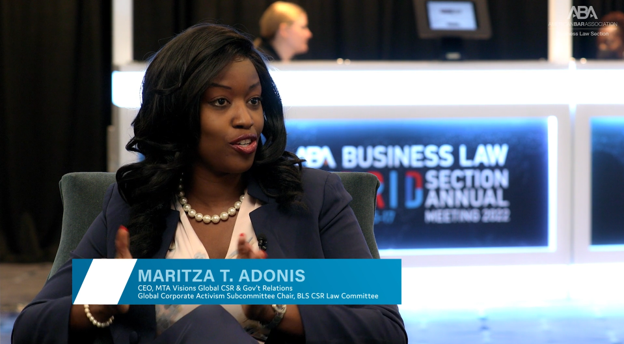
Maritza T. Adonis speaking in a post-program discussion following the ABA Business Law Section’s 2022 Annual Meeting CLE “On the Sidelines or Taking Sides: Corporations, Elections, Social Responsibility, and Long-Term Impacts on Corporate Governance.” Video still via ABA Business Law Section.
It is 8:17 a.m. The board book is complete. The agenda looks routine. Directors are scheduled to discuss a pending acquisition, executive compensation, a cybersecurity update, and several litigation matters. Corporate counsel expects another meeting focused on strategy, compliance, and risk management.
Then the phone buzzes.
Overnight, the company’s chief executive officer has come under criticism for remaining silent on a controversial state law. Employees are asking the company to issue a public statement. Shareholders want to know whether political contributions will continue. Customers have organized a boycott. Public officials in one state threaten legislative action if the company speaks. Officials in another state criticize companies that remain silent.
The board meeting has changed before it begins.
Questions that once belonged to public affairs or government relations now arrive in the boardroom. Corporate counsel is no longer asked only whether a proposed action complies with the law. Counsel is increasingly asked whether the corporation should speak, remain silent, alter a business relationship, suspend political giving, or respond to rapidly changing public expectations. Every option carries legal, financial, reputational, and governance consequences.
This scenario is no longer unusual. In 2022, while participating in an American Bar Association Business Law Section CLE examining whether corporations should take public positions on social and political issues, much of the discussion centered on defining concepts such as corporate social responsibility; environmental, social, and governance (“ESG”); stakeholder governance; and corporate political activity.[1] Looking back, that discussion identified the right problem. Experience since then suggests that the more important question is no longer whether corporations should take sides. Increasingly, they cannot avoid politically consequential decisions. The question now is how boards should govern them. For purposes of this article, a politically consequential board decision is a corporate decision that, because of its subject matter or surrounding circumstances, carries political or public-policy significance beyond the corporation’s ordinary business operations.
The public dispute between The Walt Disney Company and the State of Florida shows how quickly a corporate decision on a politically contested issue can spill far beyond the decision itself.[2] What began with Disney taking a public position ultimately drew the company into a dispute with the state over the governing structure of the district in which Walt Disney World operates.
Disney is hardly alone in confronting this problem. Boards are now being asked to respond to issues ranging from consumer boycotts and diversity initiatives to artificial intelligence and changing state regulation. Shareholder demands can also bring political questions into corporate decision-making. Empirical work on political-disclosure proposals shows that investors can press companies to reconsider their political activity and disclosure practices, even though the economic significance of greater political transparency remains unsettled.[3] These matters may begin outside the boardroom, but they do not always stay there.[4]
Recent corporate law scholarship helps explain why these decisions have become more difficult for boards. Companies operate in an increasingly polarized environment in which stakeholder demands and regulatory approaches may pull in different directions.[5] Corporate commitments can also become harder to maintain as circumstances change, particularly after shifts in governmental power.[6] Analysis of corporate DEI risk further illustrates how political pressure can distort board decision-making when corporations confront matters extending beyond ordinary business operations.[7] At the same time, corporations increasingly enter public affairs through political advocacy and other activities that can place them in roles traditionally associated with government.[8] Together, these developments have changed the environment in which boards make politically consequential decisions.
Corporate law scholarship and governance practice have approached these problems in several ways. Some scholars have questioned whether corporate political speech should be governed like an ordinary business decision at all.[9] Others have emphasized disclosure and accountability surrounding corporate political spending.[10] Governance practitioners have also developed private-ordering approaches that rely on internal controls and board oversight.[11] These approaches provide important institutional guardrails, but they leave the antecedent fiduciary question unresolved.
Before the first public statement is drafted, before a political contribution is approved, and before any disclosure obligation arises, corporate counsel must help the board determine whether the corporation should act at all and, if so, how. That is the gap this article addresses.

Maritza T. Adonis in conversation with Bruce F. Freed and Jason D. Kaune in a post-program discussion following the ABA Business Law Section’s 2022 Annual Meeting CLE “On the Sidelines or Taking Sides: Corporations, Elections, Social Responsibility, and Long-Term Impacts on Corporate Governance.” Video still via ABA Business Law Section.
From Debate to Decision
Four years ago, while participating in an American Bar Association Business Law Section CLE entitled “On the Sidelines or Taking Sides: Corporations, Elections, Social Responsibility, and Long-Term Impacts on Corporate Governance,” our discussion centered on a different question.[12] We asked whether corporations should engage in politically consequential issues at all. Much of the conversation focused on defining corporate social responsibility, distinguishing it from ESG initiatives, and considering the lawyer’s role in helping corporations navigate increasingly complex stakeholder expectations.
Looking back, I believe we were asking the right question, but an incomplete one.
Since that discussion, boards have confronted Disney’s dispute with the State of Florida, consumer boycotts affecting Bud Light and Target, increased scrutiny of corporate political activity, and backlash surrounding corporate positions on ESG and other contested issues.[13] The facts differ, but each placed corporate leadership in the middle of a controversy that could not be resolved by public messaging alone.
I had seen signs of this shift even before our 2022 discussion. In 2019, I noted that companies were developing ESG reporting capabilities in response to investor demand, while consumer demand and regulatory developments abroad were adding pressure of their own.[14] The debate has changed considerably since then, but the pressure on companies to respond has not disappeared.
One exchange from that discussion has stayed with me. Bruce Freed, president and cofounder of the Center for Political Accountability, observed that corporate leaders increasingly faced expectations from employees, investors, and consumers to speak on issues extending beyond traditional business operations.[15] As our conversation continued, however, the discussion evolved beyond whether the chief executive officer should respond. It became a broader conversation about senior leadership, institutional responsibility, and the governance process supporting those decisions. That shift reinforced something I had not fully appreciated at the time. The most important question is not who speaks for the corporation. It is who decides, and according to what process.
Returning to Governance
The conversation also reinforced another lesson. Lawyers have a unique role in these debates, not because they determine what position a corporation should take, but because corporate law provides the framework through which those decisions should be evaluated. As our discussion turned to how corporations define and carry out their responsibilities, I drew a distinction between corporate social responsibility (“CSR”) and ESG. CSR supplied the broader framework, while I described ESG as a tool for measuring how effectively a company was carrying out those commitments.[16] Over time, the political debate increasingly centered on the “E” and the “S.” The enduring contribution of corporate law has always been the “G.” Governance is what enables boards to navigate difficult questions regardless of whether the controversy arises from regulatory change, corporate political activity, emerging technology, stakeholder commitments, or corporate speech.
Politics will continue to evolve. Stakeholder expectations will continue to shift. New technologies will emerge. Headlines will change. Fiduciary duties, however, will not. For the corporation, political controversy becomes a governance question when it implicates the business and affairs of the enterprise.
A Fiduciary Decision Framework for Politically Consequential Board Decisions
Boards cannot predict how a political controversy will unfold, nor can they satisfy every constituency affected by it. They can, however, control how they make the decision. When one of these issues reaches the boardroom, corporate counsel can begin with the same fiduciary principles directors use in making other business decisions. The framework below shows how those principles can guide the board without creating new fiduciary duties for politically consequential decisions.
That framework rests on three familiar principles of Delaware corporate law. First, Section 141(a) of the Delaware General Corporation Law vests boards with authority to manage the business and affairs of the corporation.[17] Second, the duty of care requires directors to inform themselves of material information reasonably available before making a business decision.[18] Third, the business judgment rule affords directors a rebuttable presumption that, in making a business decision, they acted on an informed basis, in good faith, and in the honest belief that the action taken was in the corporation’s best interest.[19] That deference, however, does not itself supply a decision-making process. The business judgment rule largely keeps courts from second-guessing nonconflicted business decisions; it does not tell directors how to work through a politically consequential one.[20] Together, these principles provide the legal foundation for the framework that follows.
Step One: Establish the Corporate Basis for Action
Counsel should begin by asking why the matter is one for the corporation. Stakeholder demands, public pressure, and changes in the political environment may bring an issue to its attention, but they should not automatically lead to a public statement, a change in internal policy, or other action by the corporation. The board should first identify what the matter means for the corporation and why it warrants action.
That inquiry may also reveal that the response need not come from the corporation itself. Depending on the issue, counsel may consider whether another part of the organization’s existing structure, such as its government affairs function, political action committee, or corporate foundation, provides a more suitable avenue for addressing it than a CEO statement or change in internal policy.
In the opening scenario, employee concerns, a customer boycott, threatened government action, and questions about political contributions may all matter. The first task is not to decide what the company should say, but to determine why the matter calls for action by the corporation in the first place.
Step Two: Identify the Fiduciary Question
Once the board decides that the matter requires its attention, counsel should identify the corporate decision the board is actually being asked to make. The fact that a proposed action carries political consequences does not make the corporation’s political position the fiduciary question. Counsel should instead identify the corporate interests at stake, the material risks associated with the available choices, and the decision directors must make on behalf of the corporation.
In the opening scenario, the board is not deciding what the corporation believes about the state law. It is deciding whether the corporation should speak, remain silent, alter its political giving, or take some other action, and what those choices could mean for the corporation.
Step Three: Develop an Informed Record
Once counsel has identified the fiduciary question, the next task is to determine what the board needs to know before answering it. If the corporation is facing threatened state action, employee pressure, a customer boycott, and questions about its political contributions, directors may need information about each before deciding whether the corporation should speak or remain silent. Counsel’s role is to make sure the board has what it needs to evaluate those choices rather than allowing the loudest source of pressure to define the record.
The board need not know how the controversy will ultimately unfold. It does need enough information to make the decision before it.
Step Four: Deliberate and Document
With the relevant information before it, the board should have a meaningful opportunity to consider the decision, discuss the material risks, weigh alternatives, and question the advice it has received. The record should reflect that process and the basis for the board’s decision. Documentation is not a substitute for deliberation. It should capture the deliberation that actually occurred.
A decision about whether to speak on the state law, for example, might follow a discussion about whether silence would intensify the employee response or whether a public statement could affect the company’s relationship with state officials. The board’s reasons for choosing between those courses belong in the record. How the board reached its decision matters if that decision is later challenged.
Step Five: Revisit and Monitor
After the board decides to remain silent on the state law, counsel should continue to follow the matter. A threatened government response may become proposed legislation, or a customer boycott may begin affecting sales. Those developments may change the circumstances surrounding the board’s decision.
When that change is material to the basis for the board’s decision, counsel should consider whether to bring the matter back before the board.
Conclusion
At the conclusion of our 2022 ABA Business Law Section discussion, I suggested that the legal profession should move beyond debating these issues and begin building the practical resources lawyers need to navigate them. That work includes teaching, publishing, and developing governance frameworks that help boards apply familiar legal principles to unfamiliar problems.[21] This Article is offered in that spirit.
The next time corporate counsel’s phone buzzes, counsel has a place to start: establish, identify, develop, deliberate, revisit. Starting there gives counsel an opportunity to bring the board’s fiduciary responsibilities into the conversation early, before the response is shaped by communications, government affairs, or public pressure. It also puts corporate counsel where it belongs in the process, helping the board make an informed and deliberate decision before a controversy becomes a crisis.
Maritza T. Adonis, Bruce F. Freed & Jason D. Kaune, A Deeper Dive—On the Sidelines or Taking Sides: Corporations, Elections, Social Responsibility, and Long-Term Impacts on Corporate Governance, ABA Bus. L. Section (Dec. 15, 2022). ↑
See Walt Disney Parks & Resorts U.S., Inc. v. DeSantis, 716 F. Supp. 3d 1216 (N.D. Fla. 2024). ↑
Jill E. Fisch & Adriana Z. Robertson, Proxies for Politics 1 (Univ. Pa. Inst. for L. & Econ. Rsch. Paper No. 25-21 & Eur. Corp. Governance Inst. L. Working Paper No. 889/2025, 2025). ↑
Hillary A. Sale, The Corporate Purpose of Social License, 94 S. Cal. L. Rev. 785, 789–90 (2021). ↑
Poonam Puri, Corporations in the Crosshairs: Stakeholder Activism and the Role of Corporations in Society, 70 McGill L.J. 587 (2025). ↑
Caley Petrucci, Corporate Goodwill, 67 B.C. L. Rev. 585 (2026). ↑
Veronica Root Martinez & Lisa M. Fairfax, The Miscalculation of Corporate DEI Risk, NYU Program on Compliance & Enf’t (Mar. 4, 2026). ↑
Matteo Gatti, Corporate Governing: Understanding Corporations as Agents of Socioeconomic Change, 50 J. Corp. L. 149 (2024). ↑
Lucian A. Bebchuk & Robert J. Jackson, Jr., Corporate Political Speech: Who Decides?, 124 Harv. L. Rev. 83, 83–84 (2010). ↑
Lucian A. Bebchuk & Robert J. Jackson, Jr., Shining Light on Corporate Political Spending, 101 Geo. L.J. 923, 941–45 (2013). ↑
Jeanne Hanna, Bruce F. Freed, Karl Sandstrom & William S. Laufer, Public Failure, Private Ordering: Successful Self-Regulation of Corporate Political Spending, 27 U. Pa. J. Bus. L. 1149, 1206, 1212–15 (2025). ↑
Adonis, Freed & Kaune, supra note 1. ↑
Jill E. Fisch & Jeff Schwartz, How Did Corporations Get Stuck in Politics and Can They Escape?, 3 U. Chi. Bus. L. Rev. 325, 344–45 (2024). ↑
Hazel Bradford, Investors Continue Urging Regulators for Risk Disclosure, Pensions & Invs. (Apr. 15, 2019) (quoting Maritza T. Adonis). ↑
Adonis, Freed & Kaune, supra note 1. ↑
Adonis, Freed & Kaune, supra note 1. ↑
Del. Code Ann. tit. 8, § 141(a) (2026). ↑
Smith v. Van Gorkom, 488 A.2d 858, 872–73 (Del. 1985). ↑
Aronson v. Lewis, 473 A.2d 805, 812 (Del. 1984), overruled on other grounds by Brehm v. Eisner, 746 A.2d 244 (Del. 2000). ↑
Mark J. Roe, Corporate Law’s Limits, 31 J. Legal Stud. 233, 271 (2002). ↑
Adonis, Freed & Kaune, supra note 1. ↑

