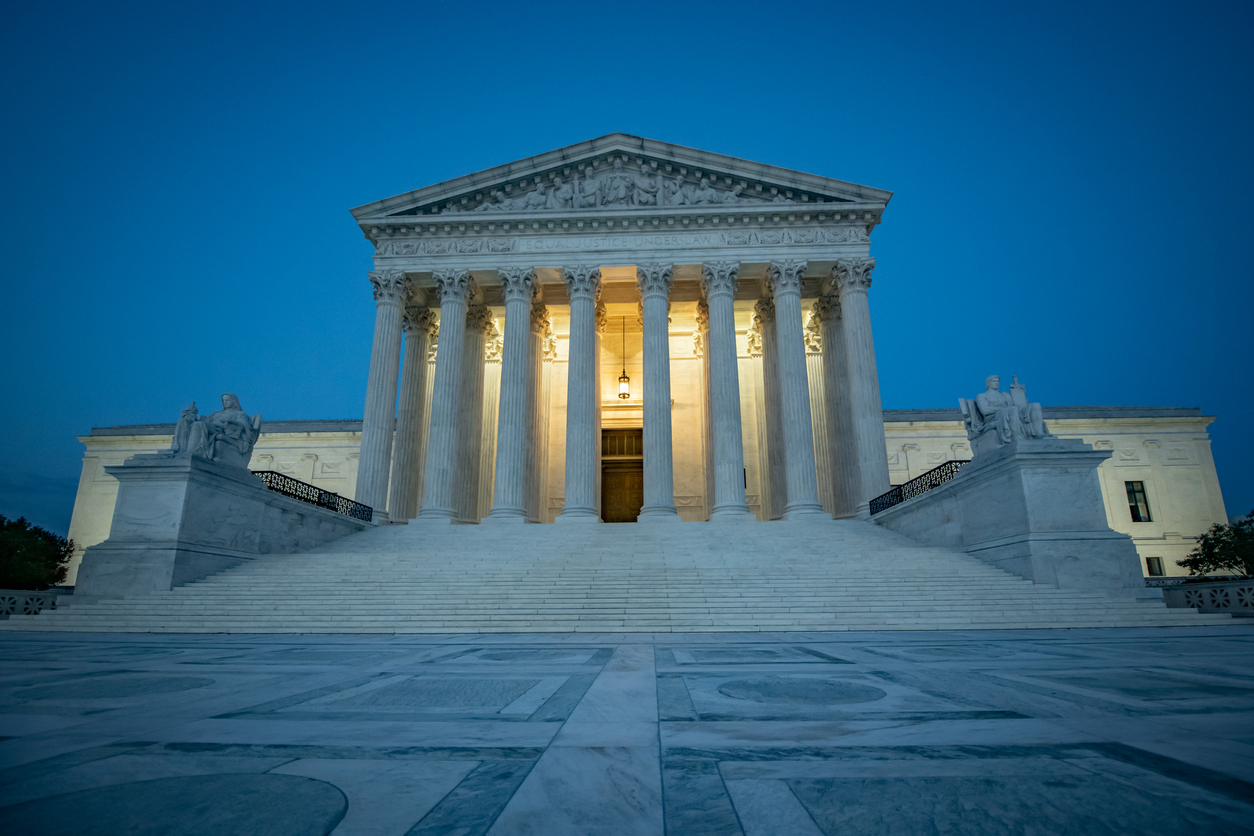


The Fee Hike Dilemma: The U.S. Supreme Court Resolves Fee Dispute and Holds Fee Hike Unconstitutional

As the recent Congressional tax hike for chapter 11 debtors demonstrates, the existence of two programs to administer bankruptcy cases can result in vehemently different outcomes for similarly situated debtors. In 2017, Congress temporarily increased the quarterly fees large chapter 11 debtors pay during their bankruptcy cases.[1] The change in fees was intended to provide continued funding of the U.S. Trustee program (“UST”).[2] Although a change in fees sounds relatively routine, this Congressional amendment to the bankruptcy code caused an uproar. The controversy was due to the significant variation in fees chapter 11 debtors paid for a few years solely because of geographic differences, rather than a material difference in the bankruptcy filing or debtor’s situation. Debtors in regions administered by the UST program paid significantly higher fees than debtors in regions administered by the Bankruptcy Administrator program (“BAP”). Fees were higher in UST districts because the increase was effective earlier (January 2018).[3] In addition, the fee increase applied prospectively to pending cases. In contrast, debtors in BAP regions paid lower fees because the increase was effective three quarters later (October 2018) and did not apply prospectively to pending cases.[4]

The variation in quarterly fee amounts for similarly situated debtors largely due to geography revived questions regarding the constitutional uniformity of a bifurcated case administration system. The ensuing legal challenges to the fee increase led to contrasting results, in part, because uniformity “has defied principled interpretation since its adoption and continues to be a source of analytical confusion.”[5] Accordingly, the Fourth and Fifth Circuits upheld the fee increase while the Second and Tenth Circuits held that the fee increase was not constitutionally uniform.[6] Signaling the importance of this issue and to resolve the split among circuits, the U.S. Supreme Court (the “Supreme Court”) granted certiorari to the Fourth Circuit case, Siegel v. Fitzgerald (In re Circuit City Stores, Inc.).[7] In considering Siegel, the Court had a rare[8] opportunity to further delineate the meaning of constitutional uniformity in bankruptcy and to address whether the bifurcated case administration system meets that definition.

Despite this rare opportunity, the Supreme Court declined to address whether a bifurcated case administration system is constitutional. Instead, it held that the fee hike was not constitutional and remanded the issue of the appropriate remedy to the Fourth Circuit.[9] Below is a brief history of the events leading to Siegel, a summary of the oral arguments in Siegel, as well as an analysis of the Supreme Court’s decision.

Background

In 1978, to alleviate bankruptcy judges’ administrative burdens and remove the appearance of bias arising from their dual roles as case administrators and jurists—Congress established a pilot UST program.[10] The intent was to “eliminate the appearance of favoritism arising from the close relationship[s] [. . .] between judges and trustees, and to address the problem of ‘cronyism [. . . due to the] appointment of trustees by bankruptcy judges.’”[11] This program became permanent in 1986 in all judicial districts except for Alabama and North Carolina.[12] Many have proffered that this temporary exception to joining the UST program was due to politics.[13] The temporary waiver for Alabama and North Carolina became a permanent exemption from the UST program in 2000.[14]

When Congress created the UST program, it intended for “users of the bankruptcy system” to fund the program “at no cost to the taxpayer.”[15] In contrast, the BAP receives its funding from the general judiciary, which also oversees and operates it.[16] To ensure the UST program would not be funded by taxpayers, Congress promised to “monitor the self-funding mechanism” to ensure debtors would remit sufficient fees to cover costs.[17] Accordingly, 28 U.S.C. § 1930(a)(6) requires chapter 11 debtors to pay quarterly fees based on the size of disbursements debtors make to creditors.[18] Initially, debtors in BAP districts did not have to pay these quarterly fees.[19]

This disparity continued until 1994 when the Ninth Circuit ruled that imposing a “different, more costly system” on debtors everywhere except Alabama and North Carolina violated the Bankruptcy Clause’s uniformity requirement.[20] By way of background, uniformity as a tenet of bankruptcy law originates from Article 1, Section 8 of the U.S. Constitution, otherwise referred to as the Bankruptcy Clause. Under this provision, Congress has the authority to create “uniform Laws on the subject of Bankruptcies.”[21] Although the exact meaning of constitutional uniformity, as noted above, “continues to be a source of analytical confusion,”[22] uniformity should mean that bankruptcy laws treat indistinguishable debtors in a similar if not identical manner.

Rather than eradicate the dual case administrations system in response to the Ninth Circuit’s ruling, Congress enacted 28 U.S.C. § 1930(a)(7), which allowed the Judicial Conference to require BAP debtors “to pay fees equal to those imposed” in UST districts.[23] A year later, the Judicial Conference set fees in BAP districts “in the amounts specified [for UST districts], as those amounts may be amended from time to time.”[24]

The Current Fee Controversy

On October 26, 2017, the issue of constitutional uniformity emerged once again when Congress amended 28 U.S.C. § 1930(a)(6) (the “2017 Amendment” or “Amendment”)[25] in response to declining bankruptcy filings and fee collections.[26] Specifically, Congress temporarily increased fees due to projections that the UST program would have a $92 million shortfall in fiscal year 2017 and a zero balance by fiscal year 2018.[27] To ensure continued funding, the 2017 Amendment increased quarterly fees for debtors with disbursements of $1 million or more in a quarter.[28] The increase is temporary: it only applies from 2018 through 2022.[29] It is also conditional because it goes into effect only if the Trustee System Fund’s balance is less than $200 million as of September of the most recent full fiscal year.[30]

Initially, the temporary fee increase only applied to UST districts.[31] Courts in UST districts applied the new fees to any quarterly disbursements that postdated the effective date of the 2017 Amendment.[32] This meant that a bankruptcy case filed before the 2017 Amendment but still pending after the Amendment would pay the increased fees.[33] The Judicial Conference did not adopt the increased fee schedule for BAP districts until September 2018,[34] and only applied the increase to cases filed on or after October 1, 2018.[35]

The Circuit Split

The Fifth Circuit Holds That UST Fee Increase Is Constitutional.

The first circuit court to address the constitutional uniformity of the fee increase was the Fifth Circuit. The Fifth Circuit has jurisdiction over Louisiana, Mississippi, and Texas district courts—all states in the UST program. In Buffets, the Fifth Circuit ruled against restaurant operators challenging the fee increase on the basis of (1) retroactivity and (2) the constitutional uniformity requirement.[36] The debtors in Buffets operated buffet-style restaurants throughout the U.S. and filed their bankruptcy case before the 2017 Amendment.[37] Despite this, their quarterly fee amount increased from $30,000 to $250,000 because their case was still pending after the Amendment.[38] Although they challenged the increase, arguing that it did not apply because they filed the case before the Amendment, the Fifth Circuit disagreed and held that the fee increase applied to future disbursements.[39]

The Fifth Circuit also held that the 2017 Amendment was constitutionally uniform. Its rationale was that “although the Supreme Court has treated the uniformity requirement as a limit on congressional power, it has also recognized that it ‘is not a straightjacket that forbids Congress to distinguish among classes of debtors [. . .] Nor does it bar every law that allows for a different outcome depending on where a bankruptcy is filed.’”[40] Accordingly, the Fifth Circuit held that the justification for the 2017 Amendment, which was to ensure the UST program remains self-funded, passed constitutional muster.[41] To that end, the court noted that: “the uniformity provision does not deny Congress power to take into account differences that exist between different parts of the country, and to fashion legislation to resolve geographically isolated problems.”[42]

The Fourth Circuit Holds That the Fee Increase Is Constitutional.

The following year, the Fourth Circuit, in Siegel addressed the same issue in a case that would ultimately reach the Supreme Court. The Fourth Circuit encompasses district courts in Maryland, North Carolina, Virginia, and West Virginia—three states in the UST program and one (North Carolina) in the BAP. The debtor in Siegel, Circuit City Stores, Inc., and its affiliates operated a chain of consumer electronic retail stores and challenged the fee increase based on (1) retroactivity and (2) the constitutional uniformity requirement.[43] Similar to the Fifth Circuit, the Fourth Circuit held that Congress intended for the amendment to apply to all disbursements after the Amendment’s effective date.[44] It also held that the increase was constitutionally uniform because unlike the “irrational and arbitrary” distinction which Congress failed to justify[45] in St. Angelo, Congress provided a solid fiscal justification for the 2017 Amendment:[46] ensuring debtors rather than taxpayers fund the UST program.[47] The Fourth Circuit held that Congress could amend the law to apply to UST districts because only debtors in UST districts use the UST program. Congress reasonably solved the shortfall problem with fee increases in the underfunded districts.[48]

Fourth Circuit Judge Arthur Quattlebaum, Jr. issued an opinion concurring in part and dissenting in part. In his opinion, Judge Quattlebaum proffered that the bifurcated administration system is not constitutionally uniform because debtors in UST districts pay materially more in quarterly fees.[49] These fee differences “trickle down” and reduce amounts unsecured creditors receive.[50] As a result, unsecured creditors in UST program districts receive less of the amounts owed to them than similar situated unsecured creditors in Alabama and North Carolina.[51]

The Second and Tenth Circuits Hold Fee Increase Is Not Constitutional.

Months after the Fifth Circuit held that the fee increase was constitutionally uniform, the Second Circuit, in In re Clinton Nurseries, held that the increase violated the Bankruptcy Clause’s uniformity provision.[52] The Second Circuit has jurisdiction over district courts in Connecticut, New York, and Vermont—all part of the UST program. The Second Circuit noted that the Fourth and Fifth Circuits had overlooked a critical factor: uniform application of bankruptcy laws. According to the Second Circuit, the 2017 Amendment applied “to the class of debtors whose disbursements exceed $1 million,” yet there was no suggestion that members of that broad class were absent in the BAP districts.[53] The Second Circuit concluded that although the Supreme Court has held that Congress can take geographical differences into account and fashion legislation to resolve geographically isolated problems, to survive scrutiny under the Bankruptcy Clause, a law must apply uniformly to a defined class of debtors.[54]

Soon thereafter, the Tenth Circuit—which includes UST program districts in Colorado, Kansas, New Mexico, Oklahoma, Utah, and Wyoming—followed suit and adopted an identical conclusion.[55] It held that the Bankruptcy Clause required any law to “apply uniformly to a defined class of debtors.”[56] Since large debtors likely existed in districts overseen by both the UST Program and BAP, the Tenth Circuit concluded the parallel systems did not meet this standard.[57]

The Supreme Court Strikes Down Fee Hike in Siegel.

On June 6, 2022, the Supreme Court issued a unanimous decision in Siegel v. Fitzgerald and resolved the circuit split delineated above. While holding that the fee hike was not constitutional, the Supreme Court explicitly declined to address whether the bifurcated bankruptcy case administration system was constitutional.[58] The Court also declined to address the appropriate remedy, stating that it was a court of review not of “first view.”[59] Accordingly, the Supreme Court remanded the issue of the appropriate remedy to the Fourth Circuit.

The decision not to address the bifurcated bankruptcy case administration system nor remedies was surprising, given that oral arguments in the case in part focused on these two issues. Specifically, the oral arguments that occurred months before, on April 18, 2022, focused on three issues: (1) whether the dual bankruptcy case administration system was constitutionally uniform, (2) if Congress could set varying fees due to this system, and (3) possible remedies if the fee increase was not constitutionally uniform.[60] Of note from the hearing is that the Petitioner (the liquidating trustee for the Circuit City stores) failed to preserve the issue of the constitutionality of the original bifurcation for appeal.[61] 

In its opinion, the Court rejected the UST’s arguments that the fee hike was an administrative law rather than a “law ‘on the subject of Bankruptcies’ to which the uniformity requirement applies.”[62] The Court stated, “[n]othing in the language of the Bankruptcy Clause itself . . .suggests a distinction between substantive and administrative laws . . . [n]or has th[e] Court ever distinguished between substantive and administrative bankruptcy laws or suggested that the uniformity requirement would not apply to both.”[63]

According to the Supreme Court, Congress has authority to account for differences that exist between different parts of the county and to fashion legislation to resolve geographically isolated problems.[64] However, Congress does not have free rein to subject similarly situated debtors in different states to different fees because it chooses to pay the costs for some but not others.[65] The Court noted that the problems prompting Congress’ disparate treatment in Siegel stem not from an external and geographically isolated need, but from Congress’ own decision to create a dual bankruptcy system funded through different mechanisms in which only districts in two states could opt into the more favorable fee system for debtors.[66]

Potential Remedies

The issue of the appropriate remedy will be a difficult one for the Fourth Circuit to adjudicate. It may adopt the remedies that the Respondent (the United States Trustee for Region 4) prefers. These would be either a fee increase for debtors in the BAP district who paid less fees or for the Supreme Court’s decision to apply prospectively. Alternatively, it may adopt Petitioner’s remedy—a full refund. As the Supreme Court noted each of these remedies pose a host of legal and administrative concerns, which includes the practicality, feasibility, and equities of each remedy.[67] It will be of great interest to see which remedy the Fourth Circuit chooses (if it does not choose a remedy that neither Respondent nor Petitioner have offered) and whether the chosen remedy will result in another appeal to the Supreme Court.


  1.  The Bankruptcy Judgeship Act of 2017 (2017 Act), Pub. L. No. 115-72, Div. B, 131 Stat. 1229, amended the quarterly-fee statute by adding the following subparagraph to Section 1930(a)(6): “(B) During each of fiscal years 2018 through 2022, if the balance in the United States Trustee System Fund as of September 30 of the most recent full fiscal year is less than $200,000,000, the quarterly fee payable for a quarter in which disbursements equal or exceed $1,000,000 shall be the lesser of 1 percent of such disbursements or $250,000.” § 1004(a), 131 Stat. 1232 (28 U.S.C. 1930(a)(6)(B) (2018)). The increased fees took effect in the first quarter of 2018. See § 1004(c), 131 Stat. 1232.

  2. See Hobbs v. Buffets LLC (In re Buffets LLC), 979 F.3d 366, 371 (5th Cir. 2020). (“[A] decline in Bankruptcy filings meant the Trustee Program was no longer self-sustaining [. . .] Congress attempted to remedy the shortfall in the Bankruptcy Judgeship Act of 2017.”).

  3. See § 1004(c), 131 Stat. 1232.

  4. In re John Q. Hammons Fall 2006, LLC, 15 F.4th 1011, 1018 (10th Cir. Oct. 5, 2021) (stating, “The Judicial Conference didn’t increase quarterly fees for those debtors until October 2018, and then the increase didn’t apply prospectively to pending cases. Thus, in Bankruptcy Administrator districts, unlike in Trustee districts, large debtors with cases pending before October 2018 incurred no increased fees however long their cases remained pending.”).

  5. Buffets, 979 F.3d at 377 (citing Judith Schenck Koffler, The Bankruptcy Clause and Exemption Laws: A Reexamination of the Doctrine of Geographic Uniformity, 58 N.Y.U. L. REV. 22, 22 (1983)); see also Randolph J. Haines, The Uniformity Power: Why Bankruptcy Is Different, 77 AM. BANKR. L.J. 129, 165-72 (2003) (arguing against the view that uniformity is a limitation); Note, Reviving the Uniformity Requirement, 96 HARV. L. REV. 71, 73-75 (1982) (discussing different possible meanings of uniformity).

  6. See Siegel v. Fitzgerald (In re Circuit City Stores, Inc.), 996 F.3d 156 (4th Cir. 2021); In re Buffets, L.L.C., 979 F.3d 366; Clinton Nurseries of Md., Inc. v. Harrington (In re Clinton Nurseries, Inc.), 998 F.3d 56 (2d Cir. 2021); Hammons Fall, 15 F.4th 1011.

  7. See Siegel v. Fitzgerald, 213 L.Ed. 39, 142 S. Ct. 1770 (2022). A full text of the Supreme Court’s Opinion is located at https://www.supremecourt.gov/opinions/21pdf/21-441_3204.pdf.

  8. As one circuit court noted, “The Bankruptcy Clause ‘might win’ a ‘contest for least-studied part’ of Article I’s congressional powers. Buffets, 979 F.3d at 376 (citing Stephen J. Lubben, A New Understanding of the Bankruptcy Clause, 64 CASE W. RES. L. REV. 319, 319 (2013). 

  9. Siegel, 213 L.Ed. 2d at 53.

  10. Pidcock v. United States (In re ASPC Corp.), 631 B.R. 18, 38 n.1 (Bankr. S.D. Ohio 2021); Dan J. Schulman, The Constitution, Interest Groups, and the Requirements of Uniformity: The United States Trustee and the Bankruptcy Administrator Programs, 74 Neb. L. Rev. 91 (citing Act Nov. 6, 1978, Pub. L. No. 95-598, 1501-151326, 92 Stat. 2651-57 (1978) (codified at 11 U.S.C. 1501-151326 (Supp. III 1979) (repealed 1986))).

  11. St. Angelo v. Vict. Farms, 38 F.3d 1525, 1529 (9th Cir. 1994) (citing H. Rep. No. 595, 95th Cong., 2d Sess. 108 (1978), reprinted in 1978 U.S.C.C.A.N. 5963, 6069).

  12. Buffets, 979 F.3d at 366.

  13. Alabama and North Carolina initially had until 1992 to join the UST program. This was later extended to 2002. However, in 2000, Congress granted Alabama and North Carolina a permanent exemption from joining the trustee program.

  14. Citing Federal Courts Improvement Act of 2000, Pub. L. No. 106-518 501, 114 Stat. 2410, 2421-22(2000).

  15. H.R. Rep. No. 764, 99th Cong. 2d Sess. 26 (1986).

  16. Hammons Fall, 15 F.4th at 1017.

  17. H.R. Rep. No. 764, 99th Cong. 2d Sess. 26 (1986).

  18. 28 U.S.C. § 1930(a)(6)

  19. Buffets 979 F.3d at 371.

  20. St. Angelo, 38 F.3d at 1531-33.

  21. U.S. Const. art I, § 8, CL. 4. (emphasis added).

  22. Buffets, 979 F.3d at 377 (citing Judith Schenck Koffler, The Bankruptcy Clause and Exemption Laws: A Reexamination of the Doctrine of Geographic Uniformity, 58 N.Y.U. L. REV. 22, 22 (1983)); see also Randolph J. Haines, The Uniformity Power: Why Bankruptcy Is Different, 77 AM. BANKR. L.J. 129, 165-72 (2003) (arguing against the view that uniformity is a limitation); Note, Reviving the Uniformity Requirement, 96 HARV. L. REV. 71, 73-75 (1982) (discussing different possible meanings of uniformity).

  23. Federal Courts Improvement Act of 2000 § 105.

  24. Report of the Proceedings of the Judicial Conference of the United States 45-46 (2001), https://www.uscourts.gov/sites/default/files/2001-09_0.pdf

  25. See The Bankruptcy Judgeship Act of 2017. Pub. L. No. 115-72, 131 Stat. 1224, 1229-34 (2017) (stating, “In any fiscal year, the quarterly fee payable for a quarter in which disbursements equal or exceed $1,000,000 shall be 1 percent of such disbursements or $250,000, whichever is less, unless the balance in the United States Trustee System Fund as of September 30 immediately preceding such fiscal year exceeds $200,000,000.”).

  26. Buffets, 979 F.3d at 371 (“By the mid-2010s, a decline in bankruptcy filings meant the Trustee Program was no longer self-sustaining H.R. Rep. No. 115-130 at 7 (2017) reprinted in 2017 U.S.C.C.A.N. 154, 159.”)

  27. In re Exide Techs., 611 B.R. 21, 30-31 (Bankr. D. Del. 2020)

  28. Buffets, 979 F.3d at 371

  29. Id.

  30. Id.

  31. Id. at 372.

  32. Hammons Fall, 15 F.4th at 1018.

  33. Id.

  34. Id.

  35. Id.

  36. See generally Buffets 979 F.3d 366 (5th Cir. 2020).

  37. Id. at 372.

  38. Id. at 371.

  39. Id. at 375 (stating, “The mere upsetting of their expectations as to amounts owed based on future distributions does not make for a retroactive application.”).

  40. Id. at 377.

  41. Id. at 379.

  42. Id. at 378 (quoting the Supreme Court in Reg’l R.R. Reorganization Act Cases, 419 U.S. at 159, 95 S.Ct. 335 (1974), “[t]he uniformity provision does not deny Congress power to take into account differences that exist between different parts of the country, and to fashion legislation to resolve geographically isolated problems.”).

  43. See generally, In re Cir. City Stores, Inc., 996 F.3d 156 (4th Cir. 2021).

  44. Id. at 169.

  45. Id. at 166 (citing St. Angelo, 38 F.3d at 1532).

  46. Id. at 167.

  47. Id.

  48. Id.

  49. Id. at 169.

  50. Id.

  51. Id.

  52. See generally In re Clinton Nurseries, Inc., 998 F.3d 156 (2d. Cir. 2021).

  53. Id. at 169.

  54. Id.

  55. Hammons Fall, 15 F.4th at 1026.

  56. See id. at *1024 (internal quotation marks and citations omitted).

  57. Id.

  58. Siegel v. Fitzgerald, 213 L. Ed. 2d 39, 52 (2022).

  59. Id. at 53.

  60. See generally Transcript of Oral Argument, Siegel v. Fitzgerald (In re Circuit City Stores, Inc.), 142 S. Ct. 752 (2022). (No. 21-441), Available at https://www.supremecourt.gov/oral_arguments/argument_transcripts/2021/21-441_6j36.pdf

  61. Siegel, 213 L. Ed. at 48.

  62. Id.

  63. Id.

  64. Id. at 52.

  65. Id.

  66. Id.

  67. Id at 53.

Kentucky and Virginia Enact Student Education Loan Servicing Laws

Kentucky and Virginia have recently passed legislation relating to student loan servicers. In Kentucky, a new student loan servicing law creates new licensing and compliance requirements. In Virginia, an amendment limits the scope of the state’s existing student loan servicing law. An explanation of the changes follows.

Kentucky’s Student Education Loan Servicing, Licensing, and Protection Act

On April 7, 2022, the governor of Kentucky signed HB 494, the Student Education Loan Servicing, Licensing, and Protection Act (the Kentucky Act) into law, which includes a licensing requirement applicable to student loan servicers and other substantive requirements related to the regulation of student loan servicers in Kentucky. The Kentucky Act will become effective on July 13, 2022, and, therefore, entities subject to this law must prepare now to ensure compliance before the imminent effective date.

Licensing Requirement

The Kentucky Act requires a license to act as a student education loan servicer, unless an entity is exempt from the licensing requirement. Entities exempt from the licensing requirement include, among other entities:

  • a federal or state bank, trust company, or industrial loan company that is authorized to transact business in Kentucky;
  • a federally chartered savings and loan association, federal savings bank, or federal credit union authorized to transact business in Kentucky;
  • a savings and loan association, savings bank, or credit union formed under state law authorized to transact business in Kentucky; and
  • a public postsecondary education institution or private nonprofit postsecondary education institution servicing a student loan extended to a borrower.

However, note that entities exempt from the licensing requirement are still subject to the substantive conduct requirements and prohibitions under the Kentucky Act.

Definition of Servicing

HB 494 defines “servicing” to mean participating in any of the following activities related to a student education loan:

  1. performing both of the following:
    1. receiving:
      1. payments from a borrower; or
      2. notification that a borrower made a scheduled periodic payment; and
    2. applying payments to the borrower’s account pursuant to the terms of a student education loan or the contract governing the servicing of the loan;
  2. during a period when no payment is required on a student education loan, performing both of the following:
    1. maintaining account records for the student education loan; and
    2. communicating with the borrower regarding the student education loan on behalf of the owner of the student education loan promissory note;
  3. communicating with a borrower regarding the borrower’s student education loan with the goal of facilitating the borrower to:
    1. make payments on the student education; or
    2. apply for a qualified forbearance program;
  4. facilitating the activities described in paragraph (a) or (b) above.

This definition of servicing is broad because an entity needs to trigger only one of the above activities to be subject to the license requirement. For example, an entity that only engages in facilitating the receipt of payments from borrowers on behalf of the loan owner must be licensed.

Prohibited Conduct

The Kentucky Act prohibits a student education loan servicer from engaging in abusive acts or practices, including but not limited to acts or practices that: (a) materially interfere with the ability of a borrower to clarify a term or condition of a student education loan; or (b) fail to educate and inform the borrower of any of the following:

  • the material risks, costs, or conditions of a student education loan;
  • selecting or using a student education loan or a feature, term, or condition of a student education loan; or
  • accurate and relevant information related to loan payments of the loans serviced by the servicer.

A student education loan servicer is also prohibited from:

  • employing any scheme, device, or artifice to defraud or mislead a borrower;
  • engaging in any unfair, deceptive, or predatory practice toward any borrower or misrepresenting or omitting any material information in connection with servicing a student education loan, including but not limited to:
    • misrepresenting the amount, nature, or terms of any fee or payment due or claimed to be due on a student education loan;
    • misrepresenting the terms and conditions of the student education loan agreement or any modification to the agreement; or
    • misrepresenting the borrower’s obligations under the student education loan; and
    • with respect to a military borrower, “older” borrower (not defined), borrower working in public service, or a borrower with a disability, misrepresenting or omitting the availability of a program or protection specific to the respective borrower or applicable to the respective category of borrowers;
  • misapplying payments made by a borrower to the outstanding loan balance;
  • refusing to communicate with an authorized representative of the borrower, except the servicer may adopt reasonable procedures for:
    • requesting verifying documentation that the representative is in fact authorized to act on behalf of the borrower; and
    • protecting the borrower from fraud or abusive practices;
  • making any false statement or omitting a material fact in connection with any information or report filed with a governmental agency or in connection with any investigation conducted by the Kentucky Commissioner of Financial Institutions (Commissioner) or any other governmental agency;
  • if the student education loan servicer is required to report, or voluntarily reports, to a consumer reporting agency, failing to accurately report each borrower’s payment performance to a least one consumer reporting agency upon acceptance as a data furnisher by that consumer reporting agency; or
  • failing to respond timely to correspondence from the borrower, the Commissioner, or any borrower complaints submitted to the servicer by the Commissioner.

Student education loan servicers also may not impede the Commissioner from interviewing the servicer’s employees or customers and must make available and grant the Commissioner access to records and other relevant property. Among other things, the law also contains requirements related to recordkeeping and filing reports with the Commissioner.

In addition, as noted above, the substantive provisions under the law apply also to entities that are exempt from licensure.

Violations and Penalties

The Commissioner may issue a written order to deny, suspend, or revoke a license issued under the Kentucky Act if the Commissioner finds a violation has occurred. In addition to any other remedies or penalties, the Commissioner may also impose a civil penalty for repeat violations or a pattern or practice that results in a violation. A civil penalty will be at least $1,000 and may be up to $25,000 per violation per day the violation is outstanding. There is no private right of action under the law.

Virginia Amendment to Qualified Education Loan Servicer Law (SB 496/HB 203)

Virginia has also recently amended its law governing student loan servicers. SB 496, signed into law on April 11, 2022, makes definitional changes to the Virginia law governing qualified education loan servicers. The law will become effective on July 1, 2022. The amendments narrow the scope of the law by replacing the term “or” with “and” when used in the definitions of “qualified education loan servicer” and “servicing,” which are used to determine whether an entity is subject to the law. This change means that a person must meet all of the listed requirements to be considered a servicer subject to the law, rather than just one of the listed requirements. The amended statute changes the definition of “servicing” as shown below, and it makes a very similar change to the definition of “qualified education loan servicer.” The only change is from the “or” to the “and” as shown below:

“Servicing” means:

(1) (i) Receiving any scheduled periodic payments from a qualified education loan borrower or notification of such payments or (ii) applying the payments of principal and interest and such other payments, with respect to the amounts received from a qualified education loan borrower, as may be required pursuant to the terms of a qualified education loan;

(2) During a period when no payment is required on a qualified education loan, (i) maintaining account records for the loan and (ii) communicating with the qualified education loan borrower regarding the qualified education loan, on behalf of the qualified education loan’s holder; or and

(3) Interacting with a qualified education loan borrower, including conducting activities to help prevent default on obligations arising from qualified education loans or to facilitate any activity described in clause (i) or (ii) of subdivision 1.

Because of this minor change, an entity must now engage in all activities listed above to be subject to the license requirement. Under the way the definition was structured previously, an entity would be subject to the license requirement for simply interacting with a borrower, even if the entity did not receive payments or maintain account records or other activities on behalf of the loan holder. Because of the narrowed scope of the Virginia law, it is possible that some licensed student loan servicers may now reasonably consider whether they can surrender their Virginia licenses.

Proposed Canadian Privacy Bill Introduces Fines and New Requirements for Private Organizations

After a hiatus of almost two years, the Canadian Government has finally recommenced its long-awaited overhaul of existing federal private sector privacy legislation. On June 16, 2022, Bill C-27, An Act to enact the Consumer Privacy Protection Act, the Personal Information and Data Protection Tribunal Act and the Artificial Intelligence and Data Act and to make consequential and related amendments to other Acts known as the Digital Charter Implementation Act, 2022 (“Bill C-27”) received its first reading in Parliament. The Artificial Intelligence and Data Act is not covered in this article and will be summarized separately.

Similar to its predecessor privacy reform bill, Bill C-11,[1] Bill C-27 introduces bold new measures into Canada’s privacy law that will significantly impact Canadian businesses: Canadian businesses will be required to invest in the protection of personal information or face heavy administrative monetary penalties for non-compliance. Furthermore, these measures bring Canadian privacy law it into closer alignment with the European Union’s (the “EU”) General Data Protection Regulation (the “GDPR”), and Québec’s privacy reforms introduced by the recently enacted Bill 64. Closer alignment with the GDPR and Bill 64 will assist Canada in maintaining its adequacy status under the GDPR and being considered a substantially similar jurisdiction under Bill 64, respectively. This allows for Canadian businesses to transfer personal information from the EU and Québec to Canada and provinces outside of Québec without additional data protection safeguards. The following are highlights from Bill C-27. Those who are familiar with Bill C-11 will note that Bill C-27 reintroduces many of the same concepts that were first introduced by Bill C-11.

New Enforcement Powers and Financial Punishments for Contraventions to the Act

The Consumer Privacy Protection Act (“CPPA”), which will repeal Part 1 of Canada’s existing federal private sector privacy act, the Personal Information Protection and Electronic Documents Act, now expands the enforcement powers of the federal Privacy Commissioner of Canada (the “Commissioner”). Following investigation and inquiry into a contravention of the CPPA, the Commissioner can issue orders to organizations to ensure that organizations comply with the CPPA.[2] Contravening a compliance order is an offense subject to financial punishment as set out below.[3]

The Commissioner can also recommend to the newly established Personal Information and Data Protection Tribunal (the “Tribunal”) that it should impose financial penalties if an organization has contravened the CPPA.[4] The Tribunal presides over hearings related to financial penalties recommended by the Commissioner and non-penalty-related appeals.[5] The Tribunal can impose administrative monetary penalties for contraventions of the CPPA up to the greater of $10,000,000 or 3% of the organization’s gross global revenue in its financial year before the one in which the penalty is imposed.[6]

Moreover, the CPPA introduces new offenses with even higher financial punishments. These offenses include:

  • if an organization fails to report to the Commissioner any breach of security safeguards involving personal information under its control where the breach may result in a reasonable risk of significant harm to an individual,[7]
  • if an organization fails to keep and maintain a record of every breach of security safeguards involving personal information,[8]
  • if an organization attempts to re-identify individuals using de-identified information not in accordance with the prescribed exceptions,[9] and
  • if an organization disposes of personal information after an individual has requested access to it and the individual has not exhausted the individual’s recourse under the CPPA.[10]

Any organization that is found guilty of any of the offenses listed above can face a fine up to the greater of $25,000,000 or 5% of the organization’s gross global revenue in its financial year before the one in which the organization is sentenced for indictable offenses, or $20,000,000 or 4% for summary convictions, respectively.[11]

Private Right of Action

The CPPA establishes a new private right of action for individuals who are affected by an act or omission by an organization that constitutes a contravention of the CPPA. The private right of action allows these individuals to sue the organization for damages for loss or injury that the individual has suffered as a result of the organization’s contravention of the CPPA. To commence this action, the Office of the Privacy Commissioner and the Tribunal must have made findings that the organization has contravened the CPPA, and the finding must not have been appealed to the Tribunal or the Tribunal must have denied the appeal.[12]

Codification of the 10 Privacy Principles and New Requirements

The CPPA codifies the Ten Fair Information Principles of the Personal Information Protection and Electronic Documents Act (“PIPEDA”) into law[13] and introduces new requirements on organizations.

Privacy Programs

Every organization must implement and maintain a privacy management program, which, among other requirements, must be attuned to the volume and sensitivity of the personal information being collected, used, and stored.[14] These programs are reviewable by the Commissioner on request, who may provide guidance and recommend corrective measures to the organization.[15]

Anonymous and De-identified Information

Bill C-27 contains a revised definition of de-identified information and has added a definition of “anonymise” to distinguish between the two forms of information. “Anonymise” means to irreversibly and permanently modify personal information, in accordance with generally accepted best practices, to ensure that no individual can be identified indirectly or directly from the information by any means. By contrast, “de-identify” means to modify personal information so that an individual cannot be directly identified from it, though a risk of the individual being identified remains. Anonymous information is not personal information;[16] indeed, to anonymise personal information amounts to its disposal.[17] De-identified information is always personal information except with respect to certain provisions.[18]

Consent

Drawing on the Commissioner’s previously published “Guidelines for obtaining meaningful consent,” the CPPA explicitly prescribes how organizations acquire valid consent. In most cases, an organization must obtain express consent from an individual and disclose the following information:

  • the purposes for the collection, use, or disclosure of personal information determined by the organization,
  • the way in which the personal information is to be collected, used, or disclosed,
  • reasonable foreseeable consequences of the collection, use, or disclosure of personal information when obtaining consent from an individual,
  • the specific type of personal information that is to be collected, used, and disclosed, and
  • the names or types of third parties to which the organization may disclose personal information when obtaining consent from an individual.[19]

This information must be written in plain language that an individual to whom the organization’s activities are directed would reasonably be expected to understand.[20]

Bill C-27 states that the personal information of minors would be considered to be sensitive personal information.[21] Consequently, according to the previous guidance of the Commissioner, organizations would require express consent to collect, use, and disclose personal information of minors.

Additionally, Bill C-27 allows for organizations to collect and use personal information without knowledge and consent of individuals if the collection and use are made for a business activity in which the organization has a legitimate interest that outweighs the potential adverse effect on the individual resulting from that collection or use.[22] This new exception is subject to a reasonableness test. Organizations wishing to avail themselves of this new exception must perform assessments of how the business activity would adversely impact the individual,[23] document those assessments,[24] and disclose descriptions of these business activities to individuals publicly.[25]

Automated Decision Systems

The Bill also specifically references an organization’s privacy obligations around automated decision systems—any technology that assists or replaces the judgment of human decision- makers through the use of a rules-based system, regression analysis, predictive analytics, machine learning, deep learning, a neural network, or other techniques. Organizations that use personal information to inform their automated decision systems to make predictions about individuals are required to:

  • deliver a general account of the organization’s use of any automated decision system to make predictions, recommendations, or decisions about individuals that could have significant impacts on them,[26] and
  • retain the personal information related to the decisions for sufficient period of time to permit the individual to make a request for access[27] (as described below).

Security Safeguards and Breaches of Security Safeguards

Bill C-27 has expanded the scope of security safeguards to include reasonable measures to authenticate the identity of the individual to whom the personal information relates. Furthermore, the Bill confirms that organizations must protect personal information through physical, organizational, and technological security safeguards. The level of protection provided by those safeguards must be proportionate to the sensitivity of the information. In addition to the sensitivity of the information, the organization must, in establishing its security safeguards, take into account the quantity, distribution, format, and method of storage of the information. The security safeguards must protect personal information against, among other things, loss, theft and unauthorized access, disclosure, copying, use, and modification, and must include reasonable measures to authenticate the identity of the individual to whom the personal information relates.

Service Providers

Under the CCPA, organizations have control over personal information even when a service provider collects, uses, and discloses the personal information on the organization’s behalf.[28] The new Bill C-27 requires organizations to ensure, by contract or otherwise, that the service provider provides an “equivalent” level of protection, rather than “substantially similar” protection, the baseline protection used under Bill C-11.[29] The change from “equivalent” to “substantially similar” seems to suggest that Bill C-27 is endeavoring to impose a stronger or less flexible standard on organizations that use service providers.

“Service provider” is now broadly defined under the Bill as an organization, including a parent corporation, subsidiary, affiliate, contractor, or subcontractor, that provides services for or on behalf of another organization to assist the organization in fulfilling its purposes.

In addition, service providers now have an obligation to maintain adequate security safeguards to protect personal information and inform the organization that controls the personal information of any breach of the service provider’s security safeguards as soon as feasible.[30] If a service provider violates the latter, the Tribunal may impose an administrative monetary penalty as described above.[31]

Codes of Practice and Certification Programs

The CPPA allows the Commissioner to approve and certify codes of practice and certification programs designed by non-governmental entities. These codes and certifications must offer the same or substantially the same or greater protection of personal information as under the CPPA. However, the organizations that comply with these codes of practice or certification programs must still meet their obligations under the CPPA.[32]

New Rights for Individuals

In addition to codifying the information rights for individuals discussed in the PIPEDA’s Fair Information Principles,[33] CPPA establishes three new rights for individuals regarding their personal information: 

  • Data mobility rights: Individuals can request an organization directly transfer their personal information from one organization to another (subject to both organizations being part of a data portability framework).[34]
  • Transparency and explanation rights: Individuals can request an explanation from organizations that use automated decision systems using the individual’s personal information to make a prediction, recommendation, or decision about the individual that could have a significant impact on the individual.[35]
  • Disposal rights: Individuals can request an organization dispose of their personal information in specific circumstances.[36] Under the proposed Act, “dispose” means the organization will be responsible for permanently and irreversibly deleting the personal information or to anonymize it, as defined under the Act.

However, these rights do not extend to de-identified information derived from an individual’s personal information.[37]

Next Steps

While this is only the first reading of Bill C-27, we anticipate the second reading will happen shortly, and debates and committee will follow, which may result in additional changes to the draft Bill.


  1. An Act to enact the Consumer Privacy Protection Act and the Personal Information and Data Protection Tribunal Act and to make consequential and related amendments to other Acts also known as the Digital Charter Implementation Act, 2020.

  2. CPPA, s. 93(2).

  3. CPPA, s.128.

  4. CPPA, s.94(1).

  5. The Personal Information and Data Protection Tribunal Act (“PIDPTA”). See PIDPTA, s. 5.

  6. CPPA, s. 95(4).

  7. CPPA, s. 58(1) and 128.

  8. CPPA, s. 60(1) and 128.

  9. CPPA, s. 75 and 128.

  10. CPPA, s. 69 and 128.

  11. CPPA, s.128.

  12. CPPA, s. 107.

  13. The Ten Fair Information Principles are as follows: Accountability; Identifying Purposes; Consent; Limiting Collection; Limiting Use, Disclosure and Retention; Accuracy; Safeguards; Openness; Individual Access; and Challenging Compliance.

  14. CPPA, s. 9.

  15. CPPA, s.10.

  16. CPPA, s.6(5).

  17. CPPA, s.2(1).

  18. CPPA, s.2(3).

  19. CPPA, s.15(3).

  20. CPPA, s. 15(4).

  21. CPPA, s.2(2).

  22. CPPA, s.18(3).

  23. CPPA, s. 18(4).

  24. CPPA, s.18(5).

  25. CPPA, s.62(2)(b).

  26. CPPA, s. 62(2)(c).

  27. CPPA, s.54.

  28. CPPA, s. 7(2).

  29. CPPA, s.11(1).

  30. CPPA, s. 57(1) and 61.

  31. CPPA, s. 94(m).

  32. CPPA, s. 76-81.

  33. The right to withdraw consent from a provider to collect, use, and disclose their personal information, and to access and correct their personal information.

  34. CPPA, s. 72.

  35. CPPA, s. 63(3). Bill C-27 limits this right to decisions that could have a significant impact on the individual. Moreover, organizations no longer need to account for how the prediction, recommendation, or decision was arrived at but instead must only explain the reasons or principal factors that led to the prediction, recommendation, or decision.

  36. CPPA, s. 55(1). Bill C-27 narrows this right to three specific circumstances: (i) the information that was collected, used, or disclosed in contravention of the CPPA; (ii) the individual has withdrawn consent in whole or in part to the collection, use, or disclosure of their personal information; or (iii) the information is no longer necessary for the continued provision of a product or service requested by the individual. Bill C-27 also expands the exceptions contained in Bill C-11 for organizations to deny disposal requests.

  37. CPPA, s. 2(3).


Lisa R. Lifshitz, Roland Hung, Cameron McMaster

Mendes Hershman Winner Abstract: “Thou Shalt Not . . . Vaccinate? Evaluating Trans World Airlines v. Hardison’s ‘De Minimis’ Standard in the Wake of COVID-19 Vaccine Mandates”

The Mendes Hershman Student Writing Contest is a highly regarded legal writing competition that encourages and rewards law students for their outstanding writing on business law topics. Papers are judged on research and analysis, choice of topic, writing style, originality, and contribution to the literature available on the topic. The distinguished former Business Law Section Chair Mendes Hershman (1974–1975) lends his name to this legacy. Read the abstract of this year’s third-place winner, Matthew Shalna of University of Miami School of Law, Class of 2023, below. 


Religious employees in the workplace are under-protected by Title VII. In 1977, the Supreme Court of the United States in Trans World Airlines v. Hardison established the standard for what constitutes the “reasonable accommodation” of an employee’s religious beliefs. Specifically, the Supreme Court established that, if the carrying out of a request for a religious accommodation would impose more than a de minimis burden on employers, that accommodation imposes an undue hardship and is therefore not reasonable. Consequently, this created an incredibly employer-friendly standard for religious discrimination claims.

With a recent influx of religious exemption requests regarding the COVID-19 vaccine, the reasonable accommodation standard is back in the spotlight. Additionally, multiple Supreme Court Justices—particularly, Justice Alito, Justice Thomas, and Justice Gorsuch—have expressed interest in replacing the “de minimis” standard with something that provides greater protection for religious interests. This creates an interesting prospect in employment discrimination: will the Court revisit the de minimis standard it attached to religious reasonable accommodation and expand religious protections for employees? And if so, is COVID-19 vaccine litigation the proper vehicle with which to revisit the standard?

This Note explores whether the de minimis standard is likely to change in the near future, and if so, what a new standard should like. Particularly, this Note uses religious challenges to recent workplace COVID-19 vaccine mandates as a means to evaluate the current strength of the de minimis standard. Ultimately, this Note argues that the de minimis standard needs to be altered, specifically in a manner that (1) requires that reasonableness be analyzed from the employee’s, not the employer’s, perspective, and (2) replaces the de minimis standard with one that requires employers to bear a greater cost to avoid liability. This Note further concludes, however, that although de minimis needs to be replaced, COVID-19 vaccine litigation is not the proper vehicle for such a change.

Arbitration Agreements: No Worse Than Other Contracts But No Better, Either

Arbitration clauses are very common. So are disputes about whether a dispute has to be arbitrated or instead can be heard in court. The Supreme Court has been dealing with the “arbitra­tion versus litigation” issue repeatedly over the last few years. A lot of recent Supreme Court case law is heavily pro-arbitration. Case law stresses that an agreement to arbitrate has to be enforced to at least the same extent as any other agreement—after all, a deal is a deal, so if the parties agreed to arbitrate, they should be required to arbitrate. But it’s clear that even that pro-arbitration tendency has its limits. A court can’t simply make up new rules, even if the new rule favors arbitration.

The Supreme Court decided Morgan v. Sundance, Inc. on May 23, 2022. Robyn Morgan had been an employee at one of the Taco Bell franchises Sundance owns. She commenced a collective action (similar to a class action) against Sundance in federal court, claiming that Sundance violated the Fair Labor Standards Act. She alleged that because Sundance did not want to pay overtime to employees working more than forty hours a week, it recor­ded the hours employees worked in the wrong week.

At first, Sundance did not argue the case should be arbitrated. Instead, it moved to dismiss the collective action. After the court denied the motion to dismiss, Sundance answered the complaint and asserted fourteen defenses—though it did not raise arbitration as a defense. Sundance then participated in a mediation that ultimately did not succeed in resolving the dispute with Morgan.

After the mediation failed—eight months into the case—Sundance decided it wanted to ar­bitrate after all, and asked the court to refer the dispute to arbitration. That request set the stage for the issue before the Supreme Court. At what point does someone who participates in a litigation lose the right to demand arbitration? Most lower courts held that a party who participates in litigation without moving to arbitrate has waived its right only if the failure to seek arbitration earlier somehow prejudices the other side. The general rule is that a party can waive a right simply by relinquishing or abandoning it. It is not necessary that anyone else be affected. But under this majority rule, arbitration is different: a party can waive arbitration by participating in court proceedings only if that participation prejudiced the opponent. The justification for this special rule was the federal policy favoring arbitration. To effectuate that policy, anything that promotes arbitration is a good thing, so these courts imposed a prejudice rule on top of the normal waiver rules.

Morgan insisted that Sundance had waived its right to arbitrate by participating in litigation for eight months. Sundance for its part insisted that it did not matter: Morgan was not prejudiced by whatever Sundance had done in court, so there could not have been a waiver.

The Supreme Court decided unanimously that waiver is the same for arbitration as it is for any other right: it can be waived whether or not someone else is prejudiced. So just as a person can waive any other right simply by relinquishing it knowingly, a litigant can waive the right to arbitrate just by relinquishing it knowingly. Federal policy does favor arbitration, but that does not mean courts can create additional requirements, such as a showing of prejudice. Therefore, Morgan would be able upon remand to argue that Sundance had waived its right to arbitrate, even though Morgan had not suffered any prejudice due to Sundance’s eight months in court.

Did Sundance in fact waive its right to arbitrate by filing an answer and going to media­tion? The Supreme Court did not rule on that issue. It referred the issue back to the lower court, noting that in the lower court, “the waiver inquiry would focus on Sundance’s conduct,” but not on any prejudice to Morgan.

The upshot is that agreements to arbitrate have to be treated just like other agreements—no worse, certainly, but no better, either. If they are valid they must be enforced, but if one side waives its rights, it can no longer seek to enforce the agreement—precisely the same as with any other contract.

United States Supreme Court Holds Section 1782 Discovery Cannot Be Used for Private Arbitrations

A federal statute, 28 U.S.C. § 1782, empowers a district court to authorize discovery from persons or entities located in the United States “for use in a proceeding in a foreign or international tribunal.” In recent years, circuit courts across the country have split on the issue of whether a “foreign or international tribunal” includes private arbitration panels. On June 13, 2022, the U.S. Supreme Court answered the question squarely. It decided two consolidated cases, ZF Automotive US, Inc. v. Luxshare, Ltd. and AlixPartners, LLP v. Fund for Protection of Investors’ Rights in Foreign States. The Court held unanimously that Section 1782 only permits discovery in connection with proceedings involving “governmental or intergovernmental adjudicative bodies.” This includes courts, of course, but also regulatory agencies or arbitral bodies clothed with governmental authority.

This holding means that parties in private arbitrations in other countries may no longer use Section 1782 to obtain discovery from persons in the US. Before this decision, savvy parties could seek out a friendly district court in a part of the country where Section 1782 was authorized for private arbitrations. Now that is no longer an option.

Background

ZF Automotive concerned a dispute between a Michigan company and a Hong Kong company over the sale of certain business units. The parties had agreed that disputes would be submitted to arbitration before the German Institute of Arbitration (“DIS”), a private arbitral institution in Berlin. The United States District Court for the Eastern District of Michigan granted the Hong Kong company’s request to take discovery from the Michigan company under Section 1782, and the Sixth Circuit Court of Appeals declined to disturb the district court’s decision. (The Sixth Circuit had decided in 2019 that Section 1782 could be used to obtain discovery for private arbitrations.[1])

AlixPartners was a dispute between the Republic of Lithuania and a Russian investment fund over a failed bank. The Russian fund initiated arbitration under the Lithuania–Russia bilateral investment treaty, claiming that Lithuania had expropriated an investment in a failed Lithuanian bank without appropriate compensation, in violation of the treaty. After the fund commenced arbitration proceedings, it petitioned the Southern District of New York for an order authorizing discovery from AlixPartners LLP and its Chief Executive Officer, who had served previously as temporary administrator of the failed bank. In opposing the application, AlixPartners argued that the arbitration was not a “foreign or international tribunal” under Section 1782. The district court granted the Section 1782 discovery request, and the Second Circuit affirmed.

The Supreme Court’s Decision

The Supreme Court reversed the decisions in both ZF Automotive and AlixPartners. It reversed ZF Automotive because it held that Section 1782 only authorized discovery for governmental tribunals. It reversed Alix Partners because, although the arbitration in that case was proceeding pursuant to a treaty between two governments, the arbitration panel itself was not created by governments and was not exercising sovereign power.

The unanimous decision authored by Justice Barrett looked to the language of the statute in light of both the statute’s history and the context of other statutes. Standing alone, the word “tribunal” ordinarily might mean a court or court-like body, but could plausibly be read more broadly as well. But the word should not be read alone. It is part of the phrase “foreign or international tribunal.” A “foreign tribunal” is more naturally viewed as one that owes its existence to a foreign government. In other words, a “foreign tribunal” is a tribunal of a foreign country, not merely a tribunal in a foreign country. This conclusion was reinforced by internal evidence of Section 1782’s language, which refers to the “the practice and procedure of the foreign country or the international tribunal.” In the Court’s view, this language does not easily apply to private arbitral panels.

Other evidence supported this conclusion as well. The current version of Section 1782 had come about as a result of Congress establishing a Rules Commission in 1958 to “recommend procedural revisions ‘for the rendering of assistance to foreign courts and quasi-ju­dicial agencies.’” Both courts and quasi-judicial agencies are, of course, creatures of government. Private arbitral panels are not. Note also that the Federal Arbitration Act does not permit discovery for private arbitrations in the US that is anywhere near as broad as permitted under Section 1782. There is no reason to believe that Congress wanted to authorize broader discovery for private arbitrations abroad than domestically. The upshot is that a “foreign tribunal” is created by one sovereign, and an “international tribunal” is created by more than one sovereign.

 In both the cases it was addressing (ZF Automotive and Alix Partners), the Supreme Court held that foreign governments had not created the arbitral panels to exercise sovereign power. The panel in ZF Automotive was created by contract, so no governmental power was involved at all. The panel in Alix Partners was convened pursuant to treaty—but although the treaty was between two governments, the panel authorized to hear the dispute was not a creature of any government. That meant Section 1782 could not be used for the treaty-based arbitration, either.

Key Takeaways

As a result of these decisions, parties in strictly private foreign or international arbitrations cannot use Section 1782 to obtain discovery from persons or entities in the United States. The Supreme Court foreclosed any future arguments that an arbitration is governmental just because “the law of the country in which it would sit . . . governs some aspects of arbitrations” or local courts enforce the arbitral agreement. But it did leave the door open just a bit:

None of this forecloses the possibility that sovereigns might imbue an ad hoc arbitration panel with official authority. Governmental and intergovernmental bodies may take many forms, and we do not attempt to prescribe how they should be structured.

As a result of this caveat, we can expect some amount of future litigation about what may constitute a “foreign or international tribunal” for Section 1782 purposes, though not as much as may have occurred had the Supreme Court made a somewhat less restrictive decision (say, one that permitted using Section 1782 for treaty-based arbitrations but not contract-based). It is also rea­sonable to expect that arbitration clauses in a number of foreign contracts—and certainly in treaties—may be crafted deliberately either to come within or to stay outside the parameters of Supreme Court’s definition of tribunals that qualify for Section 1782 assistance.


  1. Abdul Latif Jameel Transportation Co. v. FedEx Corp, 939 F.3d 710 (6th Cir. 2019)

Out Now: New Business Law Today Video Collection

Hands with nails painted red extend into the image from the right, holding an old-fashioned video camera pointed toward the left, over a yellow background.

Our newest collection of videos takes a deeper dive into our recent Hybrid Spring Meeting CLE programs, covers chats with authors of newly released Business Law books, and provides insight into business law practice areas. Watch now!

Read more about the three business law video series and eleven videos in the collection below.

CLE: A Deeper Dive

Who Is the Client? The Ethics Rule Implications for In-House Counsel and Outside Counsel

Shannon “A.J.” Singleton and Alicia Still delve into the ethical requirements for in-house counsel and outside counsel, extending the discussion of a Showcase CLE program at the ABA Business Law Section’s 2022 Hybrid Spring Meeting (now available as on-demand CLE). Their conversation hits on the in-house implications of ABA Model Rule of Professional Conduct 4.2, what it takes to forge relationships with colleagues on the business side and why it matters, and more.

ESG: Business Risk and the New Legal and Regulatory Frontier

Neera Chatterjee, E. Christopher Johnson, Jr., and Martina E. Vandenberg explore the ins and outs of environmental, social, and governance (ESG) risk criteria, extending the discussion of a Showcase CLE program at the ABA Business Law Section’s 2022 Hybrid Spring Meeting (now available as on-demand CLE). “They’re not their own silos with separate strategies,” Chatterjee said. “Everything is interconnected… you’ve got to think across the organization.” In this video, they discuss dealing with climate-related financial risks in the banking world, addressing forced labor from multiple perspectives, and companies’ role in looking toward solutions.

Social Justice Intersecting with Sports: Is It Right?

A dynamic panel including a top journalist, legal practitioners, and senior executives in sports dives into social justice issues in the field and their legal implications, extending the discussion of a Showcase CLE program at the ABA Business Law Section’s 2022 Hybrid Spring Meeting (now available as on-demand CLE). With Jeffrey Schlerf leading the discussion, the panelists—Sterling Hawkins, Terence Moore, Ashley Hibbett Page, and Ty Thomas—weigh in on a broad range of trends. Their conversation ranges from athlete activism and discrimination lawsuits, to league policies that contribute to DEI issues, to legal developments in the realm of name, image, and likeness for collegiate athletes, and more. 

State of the States in Gaming 2022

Alexander Denton and Stephanie Maxwell explore the state of gaming law in Tennessee and Georgia and how it fits into developments across the country, extending the discussion of a CLE program at the ABA Business Law Section’s 2022 Hybrid Spring Meeting (now available as on-demand CLE). “Tennessee is on the forefront of a national conversation that’s happening about the authorization of legal sports wagering,” Denton said. Their conversation touches on the unique features of Tennessee’s sports wagering regulations, skill gaming in Georgia, the speed of recent changes, and more.

Practice Area Insights

Artificial Intelligence and Its Impact on Business Law: An Introduction

“Artificial intelligence with human intelligence really works together to increase productivity, check for error, keep everything cost-effective,” says Ingeuneal C. Gray. In this video, Gray—Commercial Vice President of the American Arbitration Association and chair of the CLE program “Artificial Intelligence in International Arbitration” at the ABA Business Law Section’s 2022 Hybrid Spring Meeting—provides an incisive overview of AI’s power and growing effects on the legal profession.

Balancing Buyer and Supplier Responsibilities: Model Contract Clauses for International Supply Chains

The COVID-19 pandemic brought “the kind of supply chain disruption that really had not been contemplated on such a scale before,” says Susan A. Maslow. Maslow is deeply knowledgeable about supply chain complexities; she and David V. Snyder are vice chair and chair of the ABA Business Law Section’s Working Group to Draft Model Contract Clauses to Protect Human Rights in International Supply Chains. In their conversation, they discuss their work on the Model Contract Clauses (MCCs) as a means to bring human rights policies into practice, the tricky commercial law issues at play, shifts between the first version and recent second version of the MCCs, and more.

Digital Assets: A Brave New World

A draft of amendments to the Uniform Commercial Code to address emerging technologies is nearing completion. In this conversation, vice chair of the drafting committee Juliet Moringiello, R. Marshall Grodner, and Christopher Odinet discuss the amendments’ effort to provide a broad framework for transacting with digital assets, from cryptocurrency to non-fungible tokens and “just about any other digital thing that we may not think of right now.” Delving into consumer concerns related to NFTs, the challenges of enacting UCC amendments in the states, and more, these experts provide a perceptive look at the nuts and bolts behind digital assets’ hype.

SPACs: Here to Stay?

Special purpose acquisition companies, or SPACs, have attracted tremendous attention in recent years, with a spike in SPAC IPOs in 2021 since tempered by increased litigation and scrutiny from regulators. In this video, Business Law Today author Frantz Jacques, who has written about the evolution of the SPAC landscape, delves into the driving forces behind SPACs’ meteoric rise; recent developments including the SEC’s SPAC rules proposal; and what’s next in the SPAC world.

Book Chats

Director’s Technology Handbook: Tips and Strategies for Advising Corporate Directors

“There is no such thing as a company that isnt a technology company today,” says Michael Fleming, contributor to Director’s Technology Handbook: Tips and Strategies for Advising Corporate Directors. “Even if youre making buggy whips, youre running a website on Buggy Whip Dot Com, or whatever the case may be.” Designed to be a practical reference tool, Director’s Technology Handbook provides guidance to help boards of directors and lawyers who advise them to decipher critical technology issues and the legal implications that can affect the organizations they serve. In this conversation, Fleming discusses the book’s origins, the range of expertise of its contributors, and its attempt to empower corporate directors to ask the right questions.

ESG in the Boardroom: A Guidebook for Directors

With ESG, CSR, and sustainability now a dynamic and critical focus of corporate governance, ESG in the Boardroom: A Guidebook for Directors provides needed insight on ESG matters, including discussions on the role of the board, ESG landscape, litigation and risk management, corporate culture and governance, and more. In this conversation, editors Katayun I. Jaffari and Stephen A. Pike discuss the shifts that put ESG on the radar, the increased sophistication of stakeholders and asset managers in engaging with businesses, and the depth of knowledge among the books contributors.

Model Business Corporation Act Annotated, Fifth Edition

The Model Business Corporation Act Annotated, Fifth Edition, is an invaluable resource for understanding developments under the MBCA, the general corporation statute for 30+ states and the source of many provisions in the general corporation’s statutes of states that have entirely adopted it. The annotation is created by the ABA Business Law Section’s Corporate Laws Committee, which promulgates the MBCA. In this conversation, Jonathan C. Lipson of the Corporate Laws Committee explains the development and uses of the annotation, which surveys “all of the important case law, all the important analysis of each provision of this Model Act,” as well as the comprehensive, searchable online site that accompanies purchases of the four-volume set available from the ABA.

A Fresh Look at #MeToo Reps & Warranties in M&A Deals

Are you adding “discrimination” to your #MeToo representations alongside “sexual harassment?” Have you considered employing the “has investigated” alternative to the popular “no allegations” variation?

We last conducted an in-depth review of #MeToo representations and warranties when they were still new in 2019, and, because we have continued to see these provisions included in even some of the largest M&A deals, we recently took a fresh look. We reviewed 311 billion-dollar M&A agreements signed between January 2018 and March 2022 containing #MeToo representations and warranties.

We have identified the most common approaches deal parties have taken in drafting these provisions over the past four years, as well as new and emerging approaches worth considering.

These Are Not Mere ‘Compliance With Laws’ Reps

The #MeToo representation and warranty, also referred to as a “Weinstein clause,” is a provision in mergers and acquisitions agreements that emerged around 2018 along with the #MeToo movement. These provisions were designed to address heightened liability risks associated with sexual harassment incidents—especially risks associated with allegations of sexual harassment against C-suite level employees—and are now commonly included in M&A agreements across industries, transaction structures, and deal sizes.

These clauses are typically included alongside labor and employment reps in M&A agreements in which the representing party, usually the target, makes a statement regarding its involvement in and/or handling of allegations of sexual harassment, sexual misconduct, or other similar incidents. They are distinct from “compliance with laws” representations—which may state that a party is in compliance with all laws including those regarding sexual harassment—in that #MeToo representations separately and specifically address the involvement of the party (including, typically, the party’s directors, officers, and employees) in incidents of sexual harassment or misconduct, and/or how the party has responded to such incidents.

Although, as discussed below, there is a wide variety of these provisions used by parties, covering a spectrum of conduct and events related to incidents of sexual harassment, as with representations and warranties in M&A agreements generally, parties also use qualifiers and delimitations to tailor and narrow the scope of coverage of the representation.

The result is often that each individual #MeToo rep and warranty found in an agreement covers a very specific and constrained set of circumstances and period of time. And there are practical reasons for this.

Ideally, a party should be making a representation regarding facts and events that it has actually verified to be true and for which exceptions can be disclosed if specific disclosures are being made in the deal. In transactions involving parties with extensive multi-jurisdictional operations—like those we reviewed involving household-name parties—specific, delineated, and qualified parameters for the types of conduct and events covered by a #MeToo representation are likely a practical necessity. Without a narrower scope, the representation cannot realistically be verified to be true, and exceptions cannot be identified and disclosed.

We found a very small number of provisions containing a reference to disclosures in our review, which may be a result of the tailored and constrained construction of these provisions.

Target or Seller Reps Qualified by Knowledge

As mentioned above, we reviewed 311 M&A agreements with a value of $1 billion or greater containing #MeToo representations and warranties dated between January 1, 2018, and March 28, 2022. More than half the agreements we reviewed were executed in 2021 or 2022. Though we didn’t limit our search by jurisdiction, the majority of the agreements we reviewed (85%) were governed, at least in part, by Delaware law.

Using Bloomberg Law’s Precedent Search, we conducted an advanced search of M&A agreements filed with the Securities & Exchange Commission via EDGAR. (Note: The search results we reviewed can be accessed here. The total number of search results is greater than 311 due to duplicate filings made by different parties and unrelated keyword hits. These were excluded from our review.)

The results of our review reflect some of the same basic characteristics we first observed in 2019, shortly after alert deal lawyers first began drafting these provisions. For example, the vast majority (87%) of the #MeToo reps reviewed were made only by the target or seller (not mutually with the acquirer); nearly three-quarters (72%) contained some form of knowledge qualifier (often as a defined term with a capital “K” for Knowledge); 83% contained a lookback period (typically three to five years); and 66% contained a limitation as to the level of employees involved in, or subject to, the allegations or claims of sexual harassment or misconduct (most commonly “directors, officers, or employees at the level of Vice President or above”).

Of the 311 agreements reviewed, thirty-nine (13%) contained mutual #MeToo representations made by both the target and/or seller and the acquirer.

"To the Knowledge of the Company..." Bar graph of top elements of #MeToo reps in billion-dollar M&A deals. Representation Made by Target/Seller: 87%. Contains Knowledge Qualifier: 72%. Contains Lookback Period: 83%. Contains Limitation on Employee Level: 66%. Source: Bloomberg Law. The data include 311 publicly filed M&A agreements dated between Jan. 1, 2018, and March 28, 2022, with a deal value of $1 billion or greater containing representations and warranties addressing sexual harassment and/or misconduct.


Surprisingly, only twenty-seven of the 311 agreements reviewed (9%) contained a reference to disclosures (most typically such references are framed as exceptions to the representation being made, e.g., “Except as disclosed in Schedule [X] . . .”).

A small number of provisions contained two different lookback periods that were applied to different portions of the same representation. For example, some had a longer lookback period for a knowledge-qualified “no allegations” representation and a shorter lookback period for a non-qualified statement that there have been no settlement agreements. In these instances, the parties seem to have balanced the burden posed by unqualified representations on the party making the representation by shortening the time period covered, and, conversely, the party to which the representation was being made negotiated a longer lookback when it was qualified by knowledge. These examples may illustrate the extent to which these provisions can be subject to negotiation.

The majority of the #MeToo representations we reviewed were framed as statements that certain events have not occured. “No allegations” was, by far, the most popular phrasing (contained in 70% of the agreements we reviewed), with “no settlement agreements” coming in second (59%). (As discussed below, these two are most often paired together in these representations.)

Most #MeToo Reps Say "No Allegations." Bar graph of events covered by #MeToo reps in billion-dollar M&A deals. "No allegations": 70%. "No settlement agreements": 59%. "No actions, suits": 28%. "No claims": 16%. "Investigated": 14%. "Corrective action": 10%. Source: Bloomberg Law. The data include 311 publicly filed M&A agreements dated between Jan. 1, 2018, and March 28, 2022, with a deal value of $1 billion or greater containing representations and warranties addressing sexual harassment and/or misconduct.


There is a wide range of other types of events that parties stated have not occurred—“no actions,” “no claims,” and “no complaints,” among others. All of these “no [events]” statements can be qualified either by materiality (e.g., “no material allegations”), by the form of the event or how it occurred (e.g., “no written allegations” or “no written or oral allegations”), and even by how such events were communicated to the representing party (e.g., no allegations made “through the Company’s anonymous employee hotline or any formal human resources communication channels”).

More than one-third of the provisions we reviewed contained some form of materiality qualifier, and roughly one-tenth included a blanket materiality qualifier applying to the entire representation (e.g., “Except as would not, individually or in the aggregate, reasonably be expected to have a Company Material Adverse Effect. . .”). In a manner very familiar to M&A lawyers, multiple materiality and other qualifiers were applied at once in some instances.

A Different Approach

The most common combination of events covered in the #MeToo representations we reviewed was “no allegations” and “no settlements.” (Other types of agreements, such as tolling agreements, non-disparagement agreements, confidentiality agreements, nondisclosure agreements, or other out-of-court arrangements were sometimes listed alongside settlement agreements). Sample language reflecting this common variation can be found in the graphic below as well as with annotations here.

Some parties, however, have begun to take a very different approach. Rather than making a “no [events]” statement, in 14% of the agreements we reviewed, the party making the representation stated that it had investigated any allegations of sexual harassment it was aware of, typically without making any representation that “no [events]” such as allegations have occurred—on that they are silent. This “has investigated” formulation is most commonly combined with a statement that the party has also undertaken corrective action in response to the misconduct, represented in 10% of the agreements we reviewed. Sample language reflecting this common variation can be found in the graphic below as well as with annotations here.

Different Approaches to #MeToo Reps Found in Large M&A Deals. Table with headings Variation, Sample Language, and Prevalence; two variations. Variation: Contains both "no allegations" and "no settlements." Sample Language: To the Knowledge of the Company, in the last five years, no allegations of sexual harrassment or other sexual misconduct have been made against (i) any current or former officer or director of the Company or (ii) any current or former employee of the Company at the level of vice president or higher, and no settlement or release agreement has been executed by the Company in connection with any such allegations. Prevalence: 49%. Variation: Contains both "investigated" and "corrective action." Sample Language: To Company's Knowledge, in the last three (3) years, the Company (i) has promptly, thoroughly, and impartially investigated all sexual harassment allegations of which it is aware, and (ii) with respect to each such allegation of sexual harassment with potential merit, has taken prompt corrective action that is reasonably calculated to prevent further improper conduct. At the bottom of the table, additional information is included. Source: Bloomberg Law. The data include 311 publicly filed M&A agreements dated between Jan. 1, 2018, and March 28, 2022, with a deal value of $1 billion or greater containing representations and warranties addressing sexual harassment and/or misconduct.


Because this “has investigated” variation is framed positively in terms of actions the party has taken, and does not address whether any allegations had been made in the first place, the scope of exceptions that would need to be disclosed here is more limited. As typically drafted, only situations in which the party became aware of an allegation and then did not investigate and/or take corrective action would need to be disclosed as exceptions, whereas a “there have been no allegations” clause variation would require any instances of allegations to be disclosed. In short, this variation is a smart choice for targets and sellers making #MeToo representations if they are confident in the consistency of their policies and procedures relating to the handling of such incidents and are in a position to verify the accuracy of the representation. This variation is also, arguably, favorable from an acquirer’s perspective, because it addresses how the target handles and responds to incidents, not just whether they have occurred.

Discrimination, Too

In addition to a wide range of events (e.g., allegations, suits, claims) covered, the current research revealed a broader spectrum of misconduct covered by these representations than we found in our 2019 research. In addition to the typical “sexual harassment” and “sexual misconduct” covered by #MeToo representations, nearly half of the provisions we reviewed also covered some form of discrimination.

#MeToo Reps Going Beyond Sexual Harrassment. Pie chart shows nearly half of reviewed provisions contained references to discrimination in addition to sexual harrassment/misconduct. 49% also cover discrimination, 51% do not cover discrimination. Source: Bloomberg Law. The data include 311 publicly filed M&A agreements dated between Jan. 1, 2018, and March 28, 2022, with a deal value of $1 billion or greater containing representations and warranties addressing sexual harassment and/or misconduct.


Some of these instances covered sex or gender discrimination only, others called out racial discrimination specifically, and there were others that covered discrimination broadly without a limitation as to the type. And some representations covered more specific forms of workplace misconduct such as “hostile work environment” or “retaliation.”

While grouping sexual harassment together with discrimination is not new to M&A agreements—as they have been commonly seen together in “compliance with laws” labor and employment representations for decades—these provisions are different. In these instances, it appears the parties have built upon the classic #MeToo representation and warranty, following the same structure and explicitly referencing sexual harassment, by simply adding discrimination and other categories of misconduct.

This shift may be interpreted as an increasing recognition by deal parties of a need to explicitly address this type of misconduct outside the bounds of the typical “litigation” and compliance with laws (or similar) representations and warranties.

Key Takeaways

#MeToo representations and warranties, much like the movement itself, are very much alive and well, and continue to be a common inclusion even in very large deals. There is a wide variety of drafting options available to parties that are tailorable to parties’ circumstances. And our review shows that some parties are taking creative approaches and even totally rethinking the classic formulation.


This work was originally published on Bloomberg Law as “ANALYSIS: A Fresh Look at #MeToo Reps & Warranties in M&A Deals” on Jun. 7, 2022. Copyright 2022 by The Bureau of National Affairs, Inc. (800-372-1033) http://www.bloombergindustry.com. Reproduced with permission.

Canadian Bill C-26 Introduces New Requirements for Federally Regulated Industries, Including Telecommunications

On June 14, 2022, the Minister of Public Safety of Canada, Marco Mendicino, introduced into Parliament the first reading of Bill C-26, An Act respecting cybersecurity, amending the Telecommunications Act and making consequential amendments to other Acts (the “Bill”). The Bill amends the Telecommunications Act and enacts a new Act: the Critical Cyber Systems Protection Act (“CCSPA”), establishing a new cybersecurity compliance regime for federally regulated private industries and new powers for the Governor-in-Council and the Minister of Industry to order Canadian telecommunication services (“Telcos”) to take action to secure the protection of the Canadian telecommunications system, including against threats of interference, manipulation, or disruption. Noncompliance with either regime may result in high monetary penalties or imprisonment for individuals.

The Critical Cyber Systems Protection Act

The CCSPA introduces a new cybersecurity compliance regime for designated operators of critical cyber systems related to vital services and systems (“Designated Operators”). A critical cyber system is defined as a cyber system that, if its confidentiality, integrity, or availability were compromised, could affect the continuity or security of a vital service or system. Currently, the list of vital services and systems is comprised of the Canadian telecommunications system, the banking systems, and other federally regulated industries, such as energy and transportation. However, the Governor-in-Council may add new vital services and systems, and such Designated Operators will be governed by the CCSPA.

Under the CCSPA, Designated Operators must:

  • establish a cybersecurity program (details of which are more fully provided in the CCSPA and its regulations) within ninety days of an order being made by the Governor-in-Council;
  • implement and maintain a cybersecurity program, as well as annually review it;
  • mitigate cybersecurity threats arising from their supply chains, or products and services offered by third parties;
  • share their cybersecurity programs and notify appropriate regulators (namely, the Superintendent of Financial Institutions, the Minister of Industry, the Bank of Canada, the Canadian Nuclear Safety Commission, the Canadian Energy Regulator, and the Minister of Transportation) (the “Appropriate Regulators”) of material changes related to the business of Designated Operators and their cybersecurity programs;
  • report cybersecurity incidents to the Canadian Security Establishment (the “CSE”);
  • comply with and maintain the confidentiality of directions from the Governor-in-Council; and
  • keep records related to the above.

To enforce these new obligations, the CCSPA grants to the Appropriate Regulators investigatory, auditing, and order-making powers, including issuing administrative monetary penalties (“AMPs”) of up to $1 million per day for individuals (such as directors and officers), and $15 million per day for other persons. Additionally, Designated Operators, and their directors and officers, may also be fined—or imprisoned if a director or officer—if either contravene specific provisions of the CCSPA; the amount of a fine is at the discretion of the federal court.

Telecommunication Act Amendments

The amendments to the Telecommunications Act (the “Amendments”) establish new order-making powers for the Governor-in-Council and the Minister of Industry (the “Minister”) to direct Telcos to take specific actions to secure the Canadian telecommunications system. Specifically, the Governor-in-Council may, by order,

  • prohibit a Telco from using all the products and services offered by a specified person; and
  • direct a Telco to remove all products provided by a specified person.

The Minister, after consultation with the Minister of Public Safety and Emergency Preparedness, may, by order,

  • prohibit a Telco from providing services to a specified person; and
  • direct a Telco to suspend any service to a specified person.

Additionally, the Amendments grant the Minister the power to direct Telcos to do anything or refrain from doing anything that is, in the Minister’s opinion, necessary to secure the Canadian telecommunications system, including the following:

  • prohibiting Telcos from using any specified product in or in relation to Telcos’ network or facilities, or part thereof;
  • prohibiting Telcos from entering service agreements for any product or service;
  • requiring Telcos to terminate a service agreement;
  • prohibiting the upgrade of any specified product or service; and
  • subjecting the Telcos’ procurement plans to a review process.

Interestingly, Telcos will not be compensated for any financial losses resulting from these orders.

The Amendments introduce new enforcement powers for the Minister of Industry to monitor the Telcos’ compliance with the orders or future regulations, including investigatory powers and issuing AMPs of up to $25,000–$50,000 per day for individuals (such as directors and officers), and up to $10–$15 million per day for other persons. Moreover, contravention of orders or regulations may result in prosecution whereby the Telcos, and their directors and officers, may have to pay fines (whose amount is at the discretion of the court) or face imprisonment.

Information Sharing and Secrecy

The CCSPA and the Amendments require Designated Operators, Telcos, and any other person to share confidential information with the Appropriate Regulators, and Governor-in-Council and Minister, respectively, in furtherance of the objectives of the Bill. This confidential information may be shared with multiple federal government organizations, provincial and foreign counterparts, as well as international organizations, to pursue the objectives of the CCSPA and the Amendments. While these information exchanges will be governed by agreements and memorandums of understanding between the parties, the Minister may disclose the information if is necessary in the Minister’s opinion to secure the telecom system.

Given the national security purpose underlying this Bill, the secrecy of the orders is paramount. The orders from the Governor-in-Council and Minister may be subject to non-disclosure requirements. Moreover, for the sake of secrecy and expediency, the orders and directions of the Governor-in-Council and Minister do not follow the complete process outlined in the Statutory Instruments Act, and thus, are not registered, published, or debated in an open manner.

Recommendations

Given that the Bill has just been introduced, its passage is not guaranteed, and additional changes to the draft law may occur. However, and in the interim, if you are a provider of vital services and systems as described in the Bill, we recommend that you consider taking the following steps to improve your cyber resilience:

  • Preemptively improve your security posture and processes to conform with the CSE’s best practices and guidance, or industry practices, and ensure that your contracts contain sufficient cybersecurity provisions to protect all parties in the supply chain; and
  • given the secrecy and potential immediacy of Government orders and directives, Telcos and Designated Operators should draft contracts to flow down potential cyber security risks appropriately.

If you are a supplier of products and services related to the critical cyber systems of Designated Operators as described in the Bill, we recommend that you consider taking the following steps:

  • Preemptively improve your security posture and processes as described immediately above in anticipation of more strenuous cybersecurity requirements requested by Designated Operators; and
  • anticipate shouldering more risk when contracting with Designated Operators and consult with your insurance provider accordingly.

Lisa R. Lifshitz, Cameron McMaster

Social Justice and the Business of Sports: Reflections with Hank Aaron

In the following excerpt from The Real Hank Aaron: An Intimate Look at the Life and Legacy of the Home Run King (Triumph Books, 2022), author and recent ABA Business Law Section Showcase CLE panelist Terence Moore discusses racism and equity in baseball. The Showcase CLE “Social Justice Intersecting with Sports: Is It Right?” took place at the ABA Business Law Section’s Hybrid Spring Meeting on Friday, April 1, 2022. Read an article delving into the program’s topic or watch the program as on-demand CLE, free for members.


Among Hank’s pet peeves? It was the insistence of Major League Baseball officials, along with team executives and scouts, that they really did want more African Americans in the game. While forming sad faces, those baseball folks said they couldn’t find them, hadn’t discovered how to retain them, or believed African American athletes were more interested in football, basketball, and other stuff, or they said the dog ate the homework after somebody forgot to set the alarm clock.

Eight percent. Eight percent! On the high side, eight percent represented the number of African American players in Major League Baseball during most seasons in the 21st century, and franchises often had rosters with zero African American players, including the Atlanta Braves, Hank’s team of nearly 70 years as a player and executive. In contrast, when Hank broke Babe Ruth’s home run mark on April 8, 1974, the percentage of African Americans in Major League Baseball was three times higher than eight percent. His 1974 Braves were on the low side since he was one of seven African Americans on their 40-man roster, but that was still 18 percent, and that was more than twice baseball’s 21st century average for teams.

“They’re trying to get all these people from all over the world to come here to play Major League Baseball. (Those who run MLB) don’t give a hoot, not one hill of beans, about (an African American) person. Not one thing whether we play baseball or not,” Aaron told me during a 2007 interview, revealed for the first time in the book. “This game of baseball, and you have to look at it, that this game was so, it was just folding until Jackie Robinson came in and lifted it to another playing level and trying to make it exciting for the fans—both Black and White.”

Aaron then sighed heavily and slowly raised his voice, “Terence, it is amazing how this game has changed for the benefit of how they want [the public] to perceive it to be, you know? Yeah, just keep your eye on it. Watch what I tell you about this game. I guarantee you [what I say is true].”

It was true. By the 2021 baseball season, which began three months after Hank’s death, the game’s biggest star was Shohei Ohtani, a pitching and hitting sensation from Iwate Prefecture, Japan, located 6,700 miles, a Pacific Ocean, and several times zones west of Mobile, Alabama, the old stomping grounds of an African American who became the greatest Major League player ever. Now baseball has virtually no African Americans.

Courtesy of Hank’s personal experiences as a player and as an executive in Major League Baseball since the early 1950s, combined with my 1982 research for the San Francisco Examiner on the state of Blacks in the game to commemorate the 35th anniversary of Jackie Robinson breaking baseball’s color barrier, Hank had splendid reasons to believe the game he cherished wasn’t loving African Americans as much as it claimed. This vanishing act involving African American players in baseball happened too fast, too dramatically, and too blatantly after the 1970s for The Myth to be more than a myth by the 21st century.

About The Myth: To hear many folks tell it, especially those involved with Major League Baseball, African Americans rolled out of bed one day and just didn’t like the sport anymore.

For more, check out The Real Hank Aaron by Terence Moore: “A heartfelt portrait of Hank Aaron, featuring nearly 40 years of stories plus never-before-told insights from the home run king.”