

The Daily Journal’s ‘Slow and Awful’ Path to LegalTech Success

The ABA Business Law Section’s Legal Analytics Committee will meet on Friday, April 23 from 10:00 am to 12:00 pm EST during its Virtual Spring Meeting. If the contents of this article interest you, you may be interested in attending. The meeting is free for ABA Business Law Section members—register here.


“All this automation and effective software is all going to happen, but it is unbelievably difficult” with respect to legal technology, remarked legendary value investor Charlie Munger at the 2020 annual meeting of the Daily Journal Corporation, which he chairs.

Though traditionally a legal publications house, the Daily Journal has, somewhat discretely, evolved into a Legal technology (“LegalTech”) company, with over 70% of revenues generated by the court case management-focused Journal Technologies unit.

Though specific to that business, Charlie Munger’s commentary in many ways captures the zeitgeist for LegalTech more broadly. While in the long run, automation and innovation represent the logical state of affairs for the legal world, that does not imply an easy path – and the ‘long run’ could still be a long ways away. 

Legal technology is at an interesting inflection point.  On the one hand, sector maturation appears to be accelerating, as evidenced by rising valuations, capital inflows and even LegalTech-specific SPACs.  Yet, due to a host of sector-specific factors, challenges remain and are likely to persist. “Hardware is hard” is an old investor adage to explain their preference for asset-light software businesses, and while substantively distinct, LegalTech’s innate challenges may be of similar magnitude. 

The Daily Journal’s development and Charlie Munger’s insights at its annual meeting provide a unique lens for assessing LegalTech’s challenges, while also highlighting its opportunities. Though, as Munger insightfully cautioned, success is “not going to be easy and it’s not going to be fast.”

Daily Journal: Background & Overview

The Daily Journal, as Charlie Munger explained, “started as a public notice rag . . . and morphed into a very successful legal daily newspaper” focused on publishing appellate opinions – “an ideal niche. . .  [for a] small but very profitable paper.”

Currently, the Daily Journal publishes 10 newspapers. The largest are the Los Angeles Daily Journal and San Francisco Daily Journal, established in 1888 and 1893, respectively, with 6,300 subscribers between them as of September 30, 2020.  The company’s other major titles include Daily Commerce, The Daily Recorder and the Inter-City Express.  The revenue model is roughly 67% subscriptions and 33% advertising.

Secular shifts have put pressure on this business model and readership has declined. “Technological change is destroying the daily newspapers in America . . . The revenue goes away and the expenses remain and they’re all dying,” Munger explained at the annual meeting.  

Along with an enviable portfolio of marketable securities, the Daily Journal has addressed these challenges by developing “a second business . . . to replace the economic strength of the newspaper that is imperiled and that’s Journal Technologies.” Munger described Journal Technologies as “a computer software business that helps courts and government agencies replace human error-prone inefficient procedures with simpler and better procedures run by software.”   

Specifically, the unit “provides case management software and related services to courts and other justice agencies,” which “use the Journal Technologies family of products to help manage cases and information electronically, to interface with other critical justice partners and to extend electronic services to the public, including a secure website to pay traffic citations online, and bar members.” The product suite is organized into three core “eSeries” products, of which the best known is eCourt®.

Journal Technologies was developed through a disciplined M&A strategy, followed by extensive ongoing investment and R&D.  The business was built through three primary transactions, as shown in the table below:
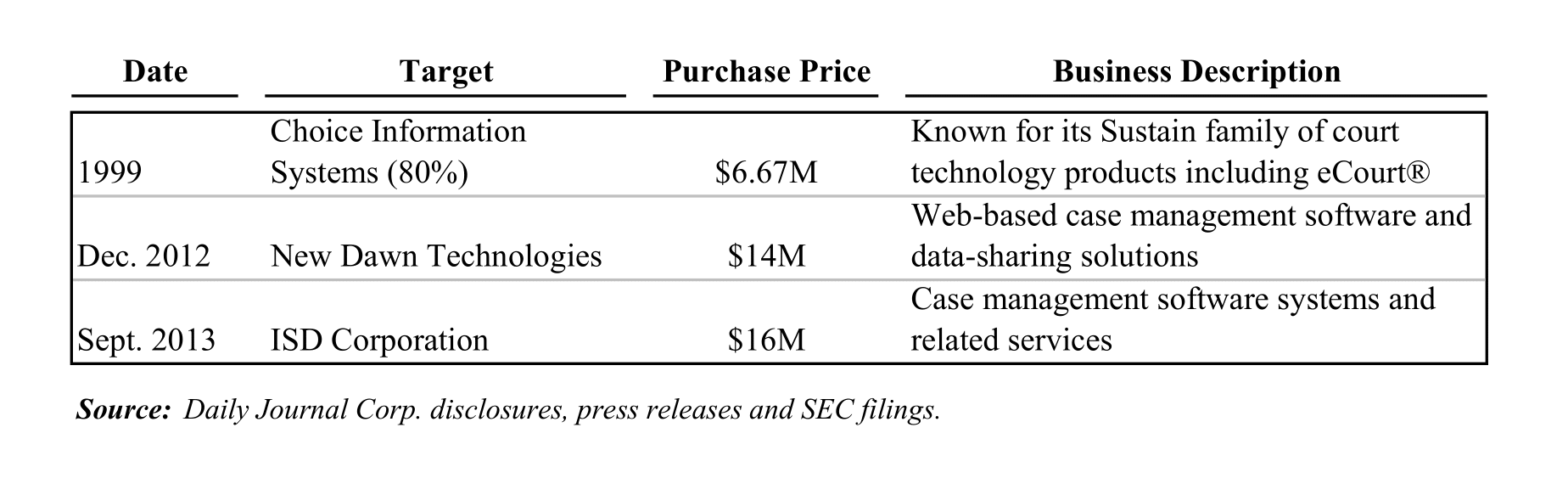
Late 2012 and 2013, as it happens, were the optimal time to purchase a LegalTech business. Those years marked the low point in LegalTech investment, but closely preceded a boom in innovation and tech maturation. In other words, a quintessential value investment.

New Dawn, for instance, generated 2013 annualized revenue of about $12.7 million, with a small operating loss, implying a purchase price of around 1.1x forward revenues.  In contrast, some LegalTech companies with comparable revenues have recently been reported to be valued at 50x their top line. 

Business Evolution

The decade between 2011 and 2020 was a period of vast transition for the Daily Journal. The two critical, interrelated themes were the decline of the traditional business – where revenues shrank 53%, from 31.5 million to $14.7 million – and the ascendancy of Journal Technologies, which saw revenues grow 1082%, from $2.98 million to $35.25 million.

These themes are displayed in the chart below, which shows revenues for the Daily Journal’s two reporting segments: (i) the Traditional Business, composed of the newspaper operations and (ii) Journal Technologies. 
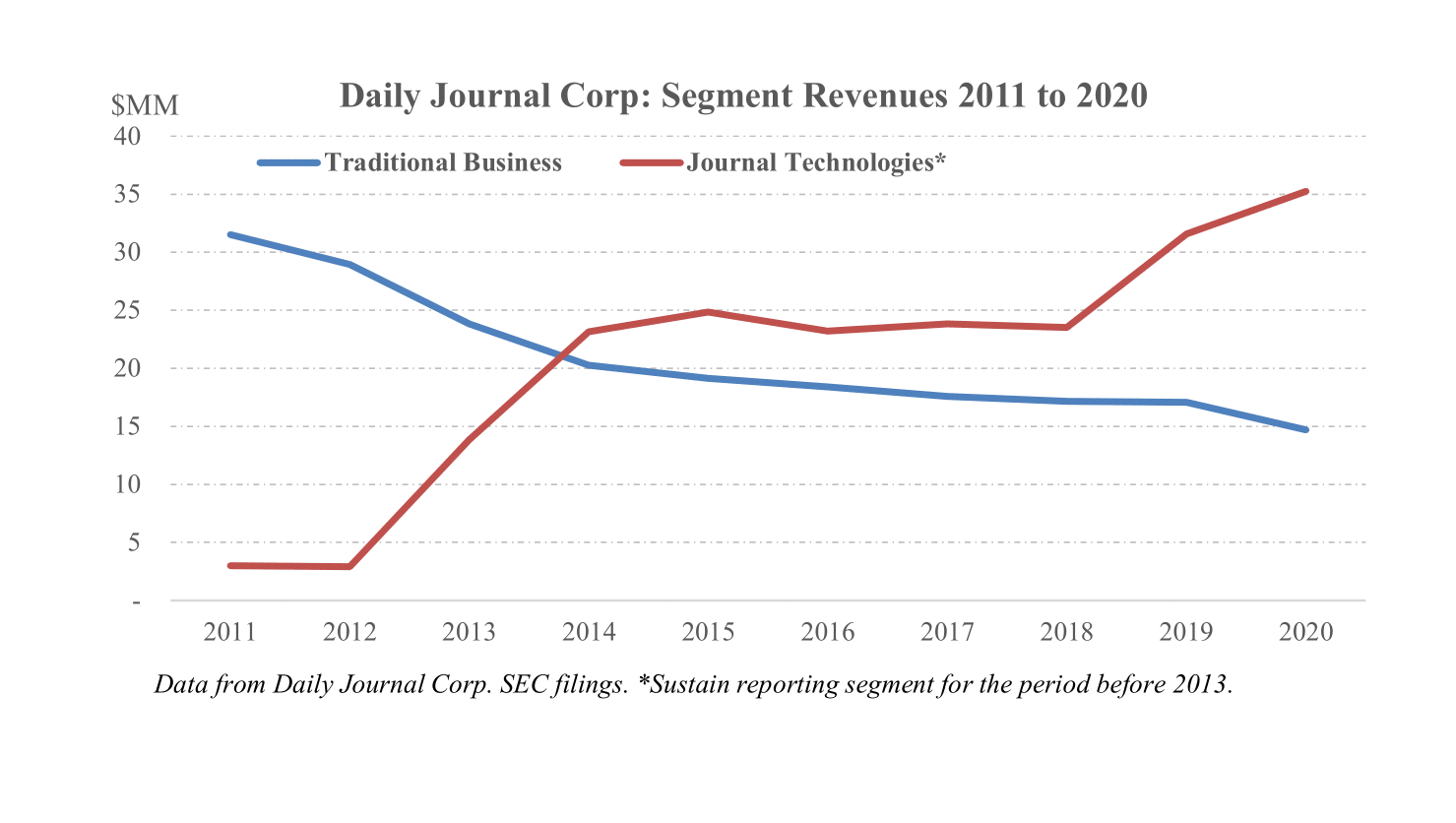
As shown above, until the 2012 and 2013 transactions, Journal Technologies represented only 9% of revenues. Subsequently, the Daily Journal’s business mix rapidly and dramatically changed, with Journal Technologies unit’s revenue overtaking the traditional business segment by 2014.

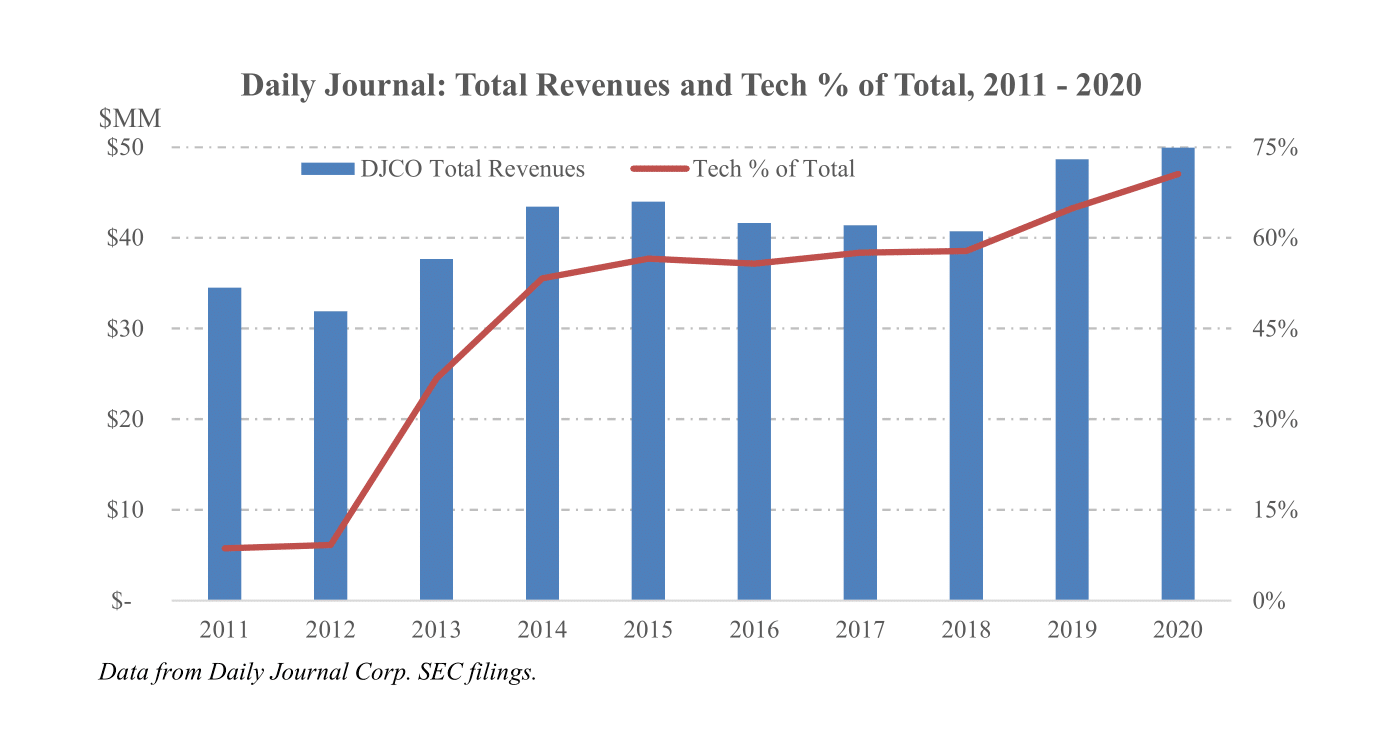
The chart below shows Daily Journal total revenues, as well as the proportion coming from Journal Technologies.  There are two notable takeaways. First, despite the continued deterioration of the traditional business, the company’s total revenues ended the period higher.  Second, as Journal Technologies’ share of revenues grew to 71% by 2020, the Daily Journal evolved into a LegalTech-focused company.
 

The growth of Journal Technologies was hardly linear or uncomplicated, however. The unit’s top line actually shrank in the four years following the New Dawn and ISD acquisitions, before experiencing strong growth in 2019 and 2020.  

Journal Technologies’ revenue mix may help explain the uneven trajectory.  The chart below shows the three segment revenue drivers – (i) licensing and maintenance fees (the SaaS business); (ii) consulting fees; and (iii) other public service fees. The purple line shows the revenue percentage from recurring licensing fees, relative to more volatile consulting and public service fees. 
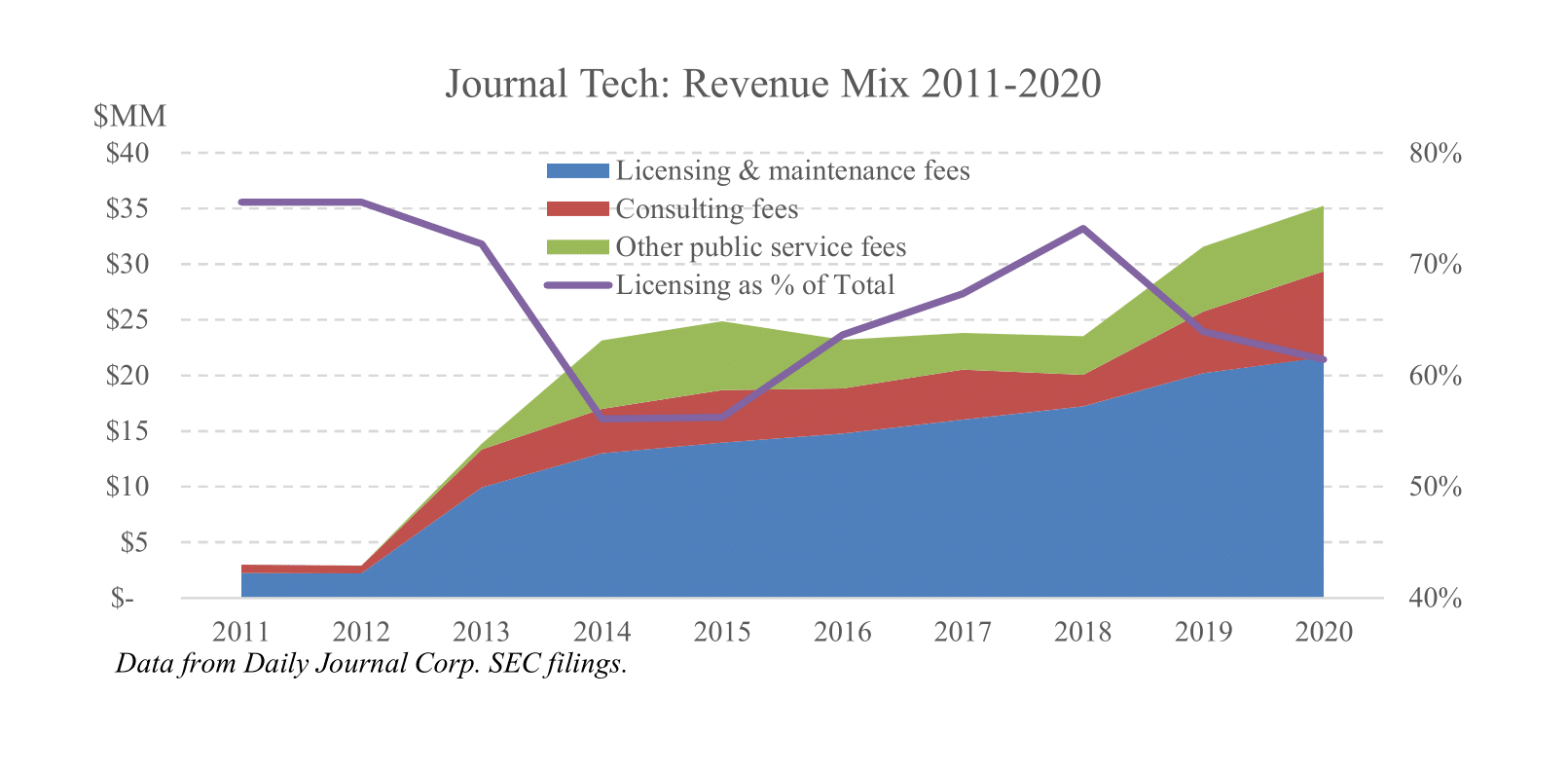
An important takeaway is that despite the lower predictability, consulting and public service fees have been crucial top-line drivers, averaging 34% of total revenues and as much as 44% in some years. LegalTech companies often debate whether to offer consulting-like services to supplement a core SaaS offering. A potential lesson from the Daily Journal’s experience is that, despite a revenue profile distinct from SaaS ARR, the approach can have merits, in part because complex products can require a higher touch. 

Indeed, for LegalTech companies, the human capital-intensive dimension of the business may also be a function of the underlying technology, which often leverages AI.  As the venture capital firm Andreesen Horowitz observed, “we have noticed in many cases that AI companies simply don’t have the same economic construction as software businesses. At times, they can even look more like traditional services companies.”

Daily Journal’s Strategy & Lessons for LegalTech

The Daily Journal’s successful transition from a newspaper group to a LegalTech platform provides several important insights for players across the LegalTech ecosystem.   

  • First, the Daily Journal did not start from scratch by entering a wholly unfamiliar technology sub-vertical. Instead, the company leveraged its existing strengths and relationships with respect to the judiciary and governmental agencies, allowing the business to evolve without completely changing its core.
  • Second, the strategy was highly forward looking – not reactive. The Daily Journal made its first acquisition in 1999, long before “LegalTech” was a term. It followed up with subsequent deals precisely when everyone else was selling, allowing it to acquire high quality assets at favorable prices with a large margin of error.
  • Finally, due to a nuanced appreciation for the complexity of the space, the Daily Journal has been patient and disciplined in building out Journal Technologies. As Charlie Munger explained, unlike traditional SaaS businesses – which can be “a gold mine because it’s just standard and you crank it out and everybody uses it” – their business is “a branch of the software that is intrinsically very, very difficult where everything takes forever, is very hard to do.” Because of this complexity, “[a] lot of people just totally avoid it . . .  They just want to crank out a few bits of software and where just everything is on the cloud – whatever they do – and count the money.” 

Distinctions Between SaaS and LegalTech  

Charlie Munger’s remarks at the Daily Journal’s 2020 Annual Meeting hit the nail on the head with respect to some of the distinctions between LegalTech and other SaaS products.

Journal Technologies’ customer base is comprised of governmental units, which “all have special requirements and they’re almost all quite bureaucratic.” While this set of challenges may be more acute for Journal Technologies, highly complex customers and procurement processes are generally inherent to LegalTech. 

At the same time, its bespoke and detail-oriented work requires “armies of people.” Further, because the company’s work concerns processes that are integral to the administration of justice, quality matters from both a commercial and normative perspective.  The business has little resemblance to an app; it can’t be plug and play with 80% operating margins – mistakes matter.

As a consequence of these sector-specific complexities, Charlie Munger aptly stated that scaling a LegalTech business is “not going to be easy and it’s not going to be fast.

This facet is also not unique to the Journal Technologies business.  COVID-era stock market darling, DocuSign, for instance, did not generate significant revenues for nearly its first decade, from 2003 through 2010, though subsequently experienced extremely fast growth, as per its  2018 Form S-1.

Yet, the success of companies like the Daily Journal and DocuSign also illustrates the vast potential of the LegalTech space. Journal Technologies is steadily growing with high revenue quality, a strong customer base and vast green fields at home and abroad.

It is “a big market” and Journal Technologies “may end up with a big share of it,” according to Charlie Munger. 

“[W]e can’t guarantee that we will succeed but I consider it likely. I just think it will be slow and awful.”


Much Obliged: Massachusetts Lenders Shouldn’t Have to Lose It Over Lost Notes

Like it or not, the real estate market relies on mortgage lenders trading mortgage loans like kids used to trade baseball cards.* And large companies, like kids who traded baseball cards in the days of yore, sometimes lose things. Luckily, the drafters of the Uniform Commercial Code (UCC) understood this, and built in provisions that allow lenders to enforce lost instruments. Unluckily, at least for mortgage lenders trying to foreclose in Massachusetts these days, case law interpreting the version of the UCC adopted by Massachusetts unnecessarily complicates the foreclosure process when it involves a lost mortgage note.

In Zullo v. HMC Assets,[1] the Massachusetts Land Court ruled that a lender who purchased a mortgage note after a prior entity lost the note cannot foreclose by showing that the prior entity assigned the lender its entitlement to enforce the lost note. Since the Zullo opinion, the notion that Massachusetts law imposes a potentially insurmountable hurdle on a lender seeking to foreclose after a prior lender lost the note appears to be taking hold as commonly accepted wisdom.

Yet a closer look at Massachusetts Supreme Court precedent and the state’s UCC shows why courts should reject this commonly accepted wisdom. As discussed below, a mortgage secures the borrower’s obligation to repay the debt, not the lender’s ability to enforce the note serving as evidence of the debt. Accordingly, the Massachusetts statutory power of sale should allow lenders who can prove that they own a lost mortgage note to foreclose even if they cannot show that the UCC would allow them to enforce the lost note.

Massachusetts’ Foreclosure Process

Under Massachusetts law, “a mortgage and the underlying note can be split”[2]—meaning that different entities can have an interest the mortgage and the note. For example, if a lender purchases a mortgage loan and the seller delivers a properly indorsed note but neglects to assign the mortgage, then the lender holds the note while the seller continues to hold the mortgage. In this situation, “the holder of the mortgage holds the mortgage in trust for the purchaser of the note, who has an equitable right to obtain an assignment of the mortgage.”[3] 

Lenders typically foreclose in Massachusetts through the statutory power of sale, which allows mortgagees to auction mortgaged property after giving proper notice if the borrower defaults.[4] The Massachusetts Supreme Court construes the term “mortgagee” in the state’s foreclosure statutes to “refer to the person or entity then holding the mortgage and also either holding the mortgage note or acting on behalf of the note holder.”[5] Importantly, the Court specifically clarified that it used the term “note holder” in the decision “to refer to a person or entity owning the mortgage note.”[6]

Massachusetts’ Lost Note Requirements

Under Massachusetts’ version of the UCC, mortgage notes typically qualify as negotiable instruments.[7] Accordingly, the “[p]erson entitled to enforce” a mortgage note means “(i) the holder of the instrument, (ii) a nonholder in possession of the instrument who has the rights of a holder, or (iii) a person not in possession of the instrument who is entitled to enforce the instrument pursuant to section 3-309 or subsection (d) of section 3-418.”[8]

For an entity to show that it is entitled to enforce the note under Massachusetts’ version of section 3-309 addressing lost notes, the entity must demonstrate that:

(i) [it] was in possession of the instrument and entitled to enforce it when loss of possession occurred,

(ii) the loss of possession was not the result of a transfer by the [entity] or a lawful seizure, and

(iii) the [entity] cannot reasonably obtain possession of the instrument because the instrument was destroyed, its whereabouts cannot be determined, or it is in the wrongful possession of an unknown person or a person that cannot be found or is not amenable to service of process.[9]

UCC § 3-309 Amendment

In the late 1990s, a federal court in the District of Columbia interpreted the language of the first requirement for enforcing lost notes to preclude any entity who obtained its interest in the loan after the note was lost from showing it could enforce the note.[10] The D.C. federal court  held that the entity necessarily could not show entitlement to enforce the note when the loss of possession occurred, because it obtained its interest in the note after the loss of possession.[11] The UCC drafting committee then convened to amend the UCC to allow an entity to enforce a lost note if it “directly or indirectly acquired ownership of the instrument from a person who was entitled to enforce the instrument when the loss of possession occurred.”[12] Massachusetts has not yet adopted the amended provision, despite it having been added to the UCC in 2002.[13]  

The Zullo Opinion

Analyzing these requirements, the Massachusetts Land Court ruled in Zullo that an entity who acquired its interest in the loan after the note was lost lacks standing to foreclose.[14] In Zullo, the lender argued that it acquired its interest from the entity who possessed the note when it was lost, and it therefore stood in that entity’s shoes by virtue of standard contract assignment law.[15]  The Land Court rejected the creditor’s argument.[16] 

Notably, the Massachusetts Land Court is a lower court, and it does not appear that the Massachusetts Supreme Court or Appeals Court have yet weighed in on the issue of whether a lender can assign its entitlement to enforce a lost note after the note is lost. Relatedly, the Land Court in Zullo acknowledged the disagreement among other state courts on this issue, and it even acknowledged that the judge who wrote the opinion came to a different conclusion earlier in the case.[17]  Nevertheless, absent further guidance from the Massachusetts Supreme Court or Appeals Court on this issue, the Zullo opinion appears to be turning into commonly accepted wisdom on the question of enforcing lost notes in Massachusetts.

Ownership of the Note vs. Entitlement to Enforce the Note

Although the common practice for foreclosing with lost notes in Massachusetts (or not foreclosing, as it were) seems to be solidifying around Zullo, courts should not treat the Zullo opinion’s analysis as the final word on the issue. Indeed, to the extent the analysis focused on a lender’s ability to assign its entitlement to enforce a lost note under principles of contract law rather than its ability to transfer ownership of the note under property law, Zullo may have misapplied Eaton altogether.

As noted above, the Massachusetts Supreme Court in Eaton confirmed that when it used the term “note holder” in the decision, it “refer[red] to a person or entity owning the ‘mortgage note.’”[18] It defined “mortgage note” as “the promissory note or other form of debt or obligation to which the mortgage provides security.”[19] This definition tracks with Eaton’s holding and discussion throughout the Court’s ruling, where the Court focused on the nature of a mortgage as security for a debt rather than focusing on a narrow application of terms removed from their overall statutory context. Indeed, the Eaton Court expressly described its interpretation as “the one that best reflects the essential nature and purpose of a mortgage as security for a debt.”[20] 

The Court’s ruling predominantly focused on the longstanding and nearly universal recognition that a mortgage is an incident to the debt.[21]  The Court discussed the need for a mortgagee exercising the statutory power of sale to maintain an interest in the underlying debt in terms of holding the note or acting for the note’s holder, but it expressly advised that it used the term “note holder” to encompass more broadly the “entity owning the mortgage note.”[22]

Importantly, the comments to Massachusetts’ UCC specify that “[t]he right to enforce an instrument and ownership of the instrument are two different concepts.”[23] The comment further provides that “ownership rights in instruments may be determined by principles of the law of property, independent of Article 3, which do not depend upon whether the instrument was transferred under Section 3-203.” Entities can “claim [ ] ownership of an instrument” even when they may not qualify as “a person entitled to enforce the instrument.”[24] Likewise, an entity can qualify as “a person entitled to enforce the instrument even though [it] is not the owner of the instrument or is in wrongful possession of the instrument.”[25]

Thus, properly harmonizing Eaton with the Massachusetts UCC should allow a lender who can demonstrate that it owns a lost mortgage note using “principles of the law of property” to exercise the statutory power of sale.[26] If the lender could not demonstrate its entitlement to enforce the lost note under Massachusetts’ UCC, it presumably could not collect any deficiency after the sale or otherwise obtain a judgment on the note, but reading Eaton together with the Massachusetts UCC should allow the lender to foreclose under the statutory power of sale as long as it can demonstrate that it owns the mortgage note.

Distinguishing the Note from the Debt

This analysis also tracks commonly accepted principles of Massachusetts law distinguishing between the ability to enforce a note and the underlying debt’s continued existence. Massachusetts has long recognized that the debt continues to exist even when the lender cannot enforce the note against the borrower, and Massachusetts courts acknowledge that a borrower’s moral obligation to repay a debt survives even when the lender cannot obtain judgment on the note. [27] The court in Nims v. Bank of New York Mellon[28] recently held that “[a] mortgage continues to be enforceable in a proceeding in rem against the security, separate and apart from an action in personam against the debtor on the note. . . . For this reason, for example, the mortgage remains enforceable in rem even when personal liability on the note has been discharged fully in bankruptcy.”  Put differently, the mortgage secures the debt, not the note.

Similarly, consider the express language in Fannie Mae’s model Massachusetts mortgage,[30] which is commonly used throughout the state. The mortgage defines the term “Note” to mean “the promissory note signed by Borrower.” The term “Loan” means “the debt evidenced by the Note, plus interest, any prepayment charges and late fees due under the Note, and all sums due under [the mortgage], plus interest.” The mortgage secures both of the following to Lender: “(i) the repayment of the Loan, and all renewals, extensions and modifications of the Note, and (ii) the performance of Borrower’s covenants and agreements under [the mortgage] and the Note.” 

In other words, the mortgage secures the borrower’s obligation to repay the loan, not the lender’s ability to enforce the promissory note the borrower gave as evidence of the debt. Accordingly, the court in Bishay v. US Bank[31] held that “[a]s long as the debt evidenced by the note remains unpaid, the mortgagee can foreclose, even if the note is otherwise unenforceable under the statute of limitations.”[32]

Thus, if the lender can demonstrate that it is entitled to enforce the note under the UCC, then it can show that the borrower owes the lender her obligation to repay the loan.[33] But the borrower’s obligation to repay the loan should survive even if the lender cannot enforce the note under the UCC, and the mortgage secures that obligation by its own express terms. Again, this analysis is consistent with Eaton’s explanation that it used the term “note holder” to refer to the note’s owner and the comments to the Massachusetts UCC specifically distinguishing between owning the note and being entitled to enforce the note.[34]

Pegging the Power of Sale to Entitlement to Enforce Harms Borrowers

Importantly, any analysis of Massachusetts law that pegs the statutory power of sale to entitlement to enforce the note rather than ownership of the note would also harm borrowers. Consider the following scenarios.

Bank loans Homeowner money to purchase a home. Homeowner executes a promissory note to Bank memorializing the loan’s terms, and gives Bank a mortgage securing her obligation to repay the debt. Bank loses Homeowner’s promissory note and later sells the lost note to Creditor. Bank assigns Creditor the mortgage. Homeowner defaults.

If Zullo correctly concluded that the Massachusetts UCC does not allow Bank to contractually assign Creditor its entitlement to enforce the note, then Bank remains the only entity entitled to enforce the note even though Creditor now owns the note. The Massachusetts UCC unquestionably distinguishes between entitlement to enforce the note and ownership of the note, and it confirms that an entity who does not own the note can still qualify as the person entitled to enforce the note.[35]

This means that if Massachusetts courts peg the statutory power of sale to entitlement to enforce the note rather than ownership of the note, then Bank—as the entity entitled to enforce the note—can foreclose under the statutory power of sale even though it no longer owns the note. It further means that despite Creditor remaining the entity who reviews Homeowner for loss mitigation options and otherwise works with Homeowner to try to save her home, Bank—who no longer has any interest in the underlying debt—may legally decide whether and when to sell the home in foreclosure.

Notably, as the entity entitled to enforce the note, Bank could even demand that Creditor, who properly and rightly owns the note, assign the mortgage back to Bank, because despite Creditor owning the note, Creditor would only hold the mortgage in trust for Bank as the entity entitled to enforce the note. Creditor could likely recover the proceeds of the foreclosure sale from Bank under UCC section 3-306, but Creditor would have no power to stop Bank from foreclosing on Homeowner, or to voluntarily delay the foreclosure while Creditor reviewed workout solutions with Homeowner.

In fact, legally savvy and ethically lacking operators could take the situation even further. Let’s change the hypothetical to say that Bank never lost the note and never sold it to Creditor. Instead, Bank indorsed the note in blank as a matter of routine practice and continued to hold it. Homeowner then defaults, and Bank delivers the blank-indorsed note to Attorney to begin the foreclosure process in Bank’s name. Attorney—having read Zullo and the Massachusetts UCC but having failed Professional Responsibility in law school—instead decides to foreclose in his own name as the holder of the note.

Bank would have the same legal recourse against Attorney that Creditor had against Bank in the first scenario, but Homeowner would be stuck in the middle of the two without any grounds to stop Attorney’s foreclosure. Attorney has possession of the note indorsed in blank, which makes him the note’s holder under the UCC. Thus, according to any legal analysis where entitlement to enforce the note overrides ownership of the note for statutory power of sale purposes, Attorney may exercise the power of sale as the note’s holder. Massachusetts courts should not interpret Massachusetts foreclosure law to countenance such absurd results.

Indeed, the Massachusetts Supreme Court expressly rejected a similar scenario when analyzing these exact types of concerns in Eaton. More specifically, the Court discounted the lender’s position that a mortgagee who holds the mortgage but cannot show ownership of the note can foreclose in its own name and “thereafter account to the note holder for the sale proceeds.”[36] Pegging the statutory power of sale to entitlement to enforce the note instead of ownership of the note would result in nearly the exact scenario Eaton rejected. It would allow, or even require, an entity without an interest in the underlying debt to foreclose in its own name and then account for the sale proceeds to the note’s true owner. This is not the correct result under Massachusetts law.

Assigning Contract Rights Versus Selling the Note

Notably, none of this analysis directly conflicts with Zullo’s ruling that parties cannot contractually assign their entitlement to enforce lost notes under the Massachusetts UCC. The Land Court in Zullo focused on the narrow issue of whether a prior lender could assign its entitlement to enforce the lost note, rather than the current lender’s ability to prove ownership of the lost note.

Reasonable minds can disagree about whether Zullo correctly concluded that lenders cannot assign their entitlement to enforce lost notes under contract law. However, even if Zullo reached the right answer to that question, Massachusetts courts properly applying the relevant standards should treat the issue of whether a lender can assign its entitlement to enforce the note differently than they treat the issue of whether a lender can demonstrate it owns the note when determining whether the lender may foreclose under Massachusetts’ statutory power of sale.

The Massachusetts UCC specifically distinguishes between entitlement to enforce the note and ownership of the note, and the standard under Eaton allows the lender to foreclose if it shows that it owns the note.[37] The legal question of whether a lender can assign its entitlement to enforce a lost mortgage note is not relevant to the distinct question of whether the lender owns the lost mortgage note. Nothing in Eaton requires lenders to show they can enforce the note. Rather, the decision allows foreclosure under the statutory power of sale if the lender shows it owns the note.

Notably, courts may require lenders to present similar (or maybe even identical) evidence to show they own the note as courts would require them to submit to prove assignment of a contract right, but the legal questions remain distinct. Even if a lender cannot contractually assign its entitlement to enforce a lost note, ownership of the note—not entitlement to enforce the note—is the standard the Massachusetts Supreme Court set for exercising the statutory power of sale to foreclose.[38]

Conclusion

Losing a promissory note changes the lender’s process for demanding repayment on a loan, but it does not relieve the borrower from having to pay the money back. Nor should it cancel the lender’s security for the loan, even if the lender acquired its interest after the note was lost. To the extent the current practice in Massachusetts may tend to accept otherwise, local practitioners should re-examine the analysis. The borrower remains obliged to repay his debt even if the note is missing. Massachusetts lenders should not have to lose their mortgage over a lost note.


* This article is not intended as and should not be considered legal advice.

[1] 25 LCR 400 (2017).

[2] See, e.g.Eaton v. Fannie Mae, 462 Mass. 569, 576 (2012).

[3] Id. at 576-77.

[4] See ALM GL ch. 183, § 21.

[5] Eaton, 462 Mass. 569 at 571.

[6] Id., n.2 (emphasis added) (cleaned up).

[7] See ALM GL ch. 106, § 3-104.

[8] Id., § 3-301.

[9] Id., § 3-309.

[10] See, e.g., Joslin v. Robinson, 977 F. Supp. 491 (D.D.C. 1997).

[11] Id. at 495.

[12] See, e.g., Zullo, 25 LCR at 404.

[13] See ALM GL ch. 106, § 3-309.

[14] See Zullo, 25 LCR at 407.

[15] Id. at 404.

[16] Id. at 404-06.

[17] Id. at 404, 406 n.2.

[18] Id., 462 Mass. at 571 n.2.

[19] Id.

[20] Id. at 584 (emphasis added).

[21] Id. at 578 n.11 (harmonizing on-point Massachusetts case law through “the general principle . . . that a mortgage ultimately depends on the underlying debt for its enforceability”) (emphasis added).

[22] Id. at 571 n.2 (emphasis added) (cleaned up).

[23] ALM GL ch. 106, § 3-203, cmt. 1.

[24] Id.

[25] ALM GL ch. 106, § 3-301.

[26] Compare Eaton, 462 Mass. at 517 n.2 with ALM GL ch. 106, § 3-203, cmt. 1.

[27] See, e.g., Wash. Mut. v. DeMello, 14 LCR 374, 376 (Mass. 2006) (“A moral obligation to pay the debt survives the [bankruptcy] discharge.”) (quoting Groden v. Kelley, 382 Mass. 333, 336 (1981)); Wexler v. Davis, 286 Mass. 142, 144 (1934) (acknowledging the “moral[ ] obligation” to repay a debt even when “[t]he remedy upon the debt . . . is at an end.”).

[28] 97 Mass. App. Ct. 12, 128-29 (2020).

[30] Available at: https://singlefamily.fanniemae.com/media/document/doc/massachusetts-security-instrument-form-3022-word.

[31] No. 18 SBQ 15269 05-100, 2020 Mass LCR LEXIS 195 *15 (Oct. 27, 2020).

[32] Cf. Duplessis v. Wells Fargo, 16-P-1040, 2017 Mass. App. Unpub. LEXIS 586 *5-*6 (May 30, 2017) (“A mortgage is not a negotiable instrument, and is not a note . . . Article 3 of the UCC, as adopted in Massachusetts, does not govern mortgages.”).

[33] See, e.g.Eaton, 462 Mass. at 583-84.

[34] See Eaton, 462 Mass. at 571 n.2; ALM GL ch. 106, § 3-203, cmt. 1.

[35] See, e.g., ALM GL ch. 106, §§ 3-203, cmt. 1; 3-301.

[36] Eaton, 462 Mass. at 577 n.10.

[37] ALM GL ch. 106, § 3-203, cmt. 1; Eaton, 462 Mass. at 571 n.2.

[38] See Eaton, 462 Mass. at 571 n.2.

Non-Fungible Tokens (NFTs) as Art Loan Collateral

Digital art represented by NFTs (non-fungible tokens) made a spectacular arrival in March with the $69.3 million (in Ether) auction sale by Christie’s of a collage by digital artist Beeple.[1] The buyer is founder of an NFT fund in Singapore. In the scramble to get up to speed on the phenomenon, NFTs have been denounced as a scam based on blockchain hype, advocated as a way to improve the economic standing of struggling non-celebrity artists[2], or heralded as a sign that the ‘Metaverse’ depicted in Neal Stephenson’s 1992 novel Snow Crash is fast becoming a reality. Regardless of the varied reactions to NFTs, it seems inevitable that financial institution lenders will be approached by customers seeking to put up newly minted NFT-linked art collections as collateral.

Real-world art loans most often take the form of revolving lines of credit using works of creative visual art as collateral. These loans use a number of techniques to mitigate the art world’s perennial issues with authentication, changes in market value, the need to obtain a first-priority security interest in the artwork, and the risk of theft or casualty loss. Historically, the default risks on these loans have been generally perceived to be relatively low in view of the affluent nature and often prominent identity of the borrowers under these credit facilities.

For institutional lenders to achieve a sufficient comfort level to consider making NFT-secured loans, a number of real-world techniques for evaluating requests for an extension of credit will need to be rethought and somehow accommodated. These considerations include ways to address risks related to provenance and authenticity, periodic appraisals to monitor changes in value, perfection of security interests, and insurance for theft or loss. 

First, as to authentication, real-world certifications will be of little use. An NFT is by definition a unique “crypto asset,” but this does not mean that each NFT represents a unique work of art – indeed, multiple NFTs may be sold based on a single work, just as a real-world artist may authorize and sign a limited number or prints of an original work.[3] To authenticate an NFT, the artist may include an e-signature in the software code that is the basis of the NFT.[4] It is also important to keep in mind that an NFT is not itself the digital artwork, but it is instead a crypto asset consisting of a “smart contract” based on a specified blockchain which “points to” the asset, which may be a JPEG or other image file or a video recording.  Many NFTs do not include any ownership interest in the underlying work, and do not transfer copyright, although they may include rights to non-commercial display on the web. In the case of Cristie’s Beeple sale, the artwork itself, in the form of a JPEG of the collage artwork, was transferred to the purchaser.[5] Tokens generally provide a kind of verifiable provenance only of the NFT itself, but not of the underlying artwork. An NFT may also impose licensing conditions on the NFT purchaser, such as a 10% royalty payable to the artist on any future resales of the NFT at a profit. The specific “bundle of rights” and obligations transferred by an NFT will have to be parsed by a lender with specificity.   

Second, appraisals of NFT assets will likely be a challenge, in view of the volatility of prices in the crypto environment. Offsetting this is the possibility that rapidly expanding secondary markets for trading NFTs may be useful in establishing a “market” price. 

Third, as to perfection of a security interest in NFT collateral, a lender may choose to perfect by treating an NFT as a “general intangible” under a local enactment of the Uniform Commercial Code (UCC) and filing a UCC-1 Financing Statement. Where a proposed borrower reaches out to a lender on the web or a blockchain, it may be challenging to identify a debtor’s precise location for purposes of a UCC filing. In addition, enforcement of a security interest perfected only by filing is less certain: Because an NFT lives only on a blockchain where the guiding principle is that “code is law,” an irreversible on-chain transfer by the borrower, even if done in violation of the terms of a security agreement, may put a crypto asset effectively beyond the reach of a conventional UCC foreclosure action on general intangibles. (Terms used here have their common meaning under most local enactments of UCC Articles 2, 8 and 9.) In addition, a security interest perfected only by filing will be inferior in priority to a security interest perfected by “control,” as discussed below.

Lenders do have other options under Articles 8 and 9 of the UCC for perfecting and enforcing a security interest in an NFT, drawing on techniques originally devised for investment securities and more recently applied to cryptocurrency and other digital assets. The lender could for instance have the crypto asset registered in the lender’s name under the terms of a security agreement, but this is often not acceptable to borrowers. 

A lender may wish to consider an approach currently in use for loans secured by cryptocurrency collateral. Looking to procedures originally devised for equity securities in the indirect holding system, a lender may require a proposed borrower to transfer the NFT or other digital asset to a “securities account” with a “securities intermediary,” generally a bank or trust company. Under a three-way account control agreement (ACA) between the lender, securities intermediary, and borrower, the securities intermediary agrees to treat the NFT as a “financial asset” under Article 8 (usefully, any property, including a real-world asset, may be a “financial asset” under Article 8 if the securities intermediary expressly so agrees). With an ACA in place, a security interest in the account and/or the financial assets held in it can be perfected in favor of the lender where the securities intermediary agrees that it will comply with orders (“entitlement orders”) from the lender “without further consent,” thus giving the lender “control” within the meaning of Articles 8 and 9. Perfection by “control” will generally provide a secured lender with priority over any other security interest perfected by filing. In addition, the risk of an irreversible transfer of the asset on-chain may be mitigated by undertakings from the securities intermediary in the tripartite agreement that it will not transfer the asset (in our example an NFT) except in strict accordance with the terms of the ACA.[6]

As for casualty loss, theft, and the other vicissitudes that may befall works of art, it may be noted that in the case of the $69.3 million Christies/Beeple sale, instead of being locked up in a museum vault, the “original” JPEG was stored on the blockchain-based Interplanetary File System (IPFS). The NFT itself resides on an Ethereum blockchain maintained by the platform that generated it for the creator of the work, and there are already reports that some other platforms have disappeared from the Web inexplicably.[7] There are also reports of NFT art heists on a popular platform[8], and a new industry of fraudsters has sprung up to form and sell NFTs based on works of art in which the NFT minters themselves have no ownership interest.[9] There will likely be a need for new and expanded types of cyber insurance to insure against such contingencies. The Metaverse may indeed be closer, but the hazards that attend the glamor and brilliance of the existing art world will find undoubtedly find new expression in the new one.


[1] An NFT is a digital asset existing on a blockchain.  A blockchain is a digital ledger verified by the consent of its users without the need for a trusted authority.  Most digital assets, including cryptocurrencies like Bitcoin, are fungible in the sense that units representing equivalent value are widely accepted in exchange, just as five pennies may be exchanged for a nickel. By contrast, each NFT has unique characteristics and is marked by a specific digital signature from the originator which is embedded in its underlying code.  Please see, e.g., “Explainer: NFTs are hot.  So what are they?” and The Atlantic, “What Critics Don’t Understand About NFTs” (comparing valuations of NFT and traditional artwork).

[2] CNN, “NFTs have completely transformed these digital artists’ lives”

[3] “Digital asset,” “smart contract” (as defined on page 23), and other terms relating to blockchain-based assets are used as defined in the ABA Derivatives and Futures Law Committee Innovative Digital Products and Processes Subcommittee (IDDPS) Jurisdiction Working Group’s White Paper, as updated December 2020.

[4] The Christie’s Beeple NFT was “encrypted with the artist’s unforgeable signature and uniquely identified on the blockchain.”  See Beeple: A Visionary Digital Artist at the Forefront of NFTs | Christie’s.

[5] Id.

[6] This article does not address a range of other issues that should be considered in connection with digital asset collateral. There are reports that tokens representing fractional interests in some art-linked NFTs are in some instances held by other persons. Such transactions raise, inter alia, a number of legal and compliance concerns relating to offers and sales of securities under US or foreign law, regulation of exchanges if traded assets are deemed be “securities,” investment company regulation, broker-dealer and investment adviser regulation, tax, and BSA/KYC/AML compliance.

[7] The Atlantic, “What Critics Don’t Understand About NFTs

[8] The Verge, “Hackers stole NFTs from Nifty Gateway users

[9] ArtNet, “A Collective Made NFTs of Masterpieces Without Telling the Museums That Owned the Originals. Was It a Digital Art Heist or Fair Game?

Minority Oppression and the LLC: Manere v. Collins, the Uniform Act, and Comment 701

For many decades, the law of closely-held businesses was the law of closely-held corporations.[1]  For entrepreneurs and attorneys, the corporate liability shield was the key desideratum, and before the advent of limited liability companies the corporation was essentially the only game in town.[2]  Unfortunately, for many decades the liability shield came with a potentially dangerous price for minority owners.[3]  The traditional corporate norms of majority rule, coupled with the minority shareholders’ inability to exit the enterprise, empowered majority shareholders to “oppress” minority shareholders or defeat such shareholders’ “reasonable expectations.”[4]  The “lock-in” phenomenon compounds the minority’s vulnerability; it is typically impossible for a minority shareholder to exit the enterprise except on terms dictated by the majority.

Today, in almost all U.S. jurisdictions special rules protect minority shareholders from outright expropriation;[5] in accord with these rules controlling shareholders must avoid abusing their co-owners.  Corporate law recognizes what was many years ago described as an “incorporated partnership”[6] – i.e., “an intimate business venture [in which] stockholders … occupy a position similar to that of joint adventurers and partners”[7] and, concomitantly, have important duties inter se.  The two most prominent terms of art – often used interchangeably – are “oppression” and “reasonable expectations.” 

However, today the closely-held corporation is no longer the only game in town.  Far from it – in every U.S. jurisdiction, formations of limited liability companies far exceed new incorporations,[8] and for some jurisdictions a better verb choice than “exceed” might be “dwarf.”[9] Every year, the percentage of closely held businesses formed as limited liability companies rises as the percentage for corporations falls.[10]

As with corporations, the overwhelming majority of limited liability companies are closely held. As a result, disputes about power abuses within closely-held businesses increasingly occur in the context of LLCs rather than corporations; and the terms “oppression” and “reasonable expectations” increasingly appear in cases involving limited liability companies.

This development is natural.  Although LLC and corporate law differ in some fundamental ways,[11] the dangers of oppression arise from a combination of business considerations and human nature.  “Choice of entity” has little impact on these factors nor on the way in which they combine.[12]

Thus, as was foreseeable,[13] “oppression” and “reasonable expectations” have migrated into the world of LLCs.  However, it has not been a simple matter to determine what these terms of art mean in the LLC context.  Even in the now-mature case law on closely-held corporations, jurisdictions vary in defining “oppression” and determining what shareholder expectations are “reasonable.”  A fortiori the LLC case law is also varied.

No single LLC case can control this determination, but a recent decision from the Connecticut Court of Appeals provides much useful guidance.  The case, Manere v. Collins, involved a dispute between the two members of a Connecticut limited liability company that operated a cafe.[14]  The minority member sought a court order dissolving the LLC.  He invoked Conn. Gen. Stat. § 34-267(a)(5)(B) of the Connecticut Uniform Limited Liability Act, which comes essentially verbatim from the Revised Uniform Limited Liability Company Act (2006, Last Amended 2013).[15]  The Connecticut version states:

On application by a member, the entry by the Superior Court for the judicial district where the principal office of the limited liability company is located, of an order dissolving the company on the grounds that the managers or those members in control of the company: … have acted or are acting in a manner that is oppressive and was, is, or will be directly harmful to the applicant ….[16]

Although “oppressive” is obviously a key term in this provision, the Connecticut statute, like its uniform progenitor, “does not define ‘oppression.’”[17]  Moreover, until Manere, neither the court of appeals nor the Connecticut Supreme Court had “had the opportunity to define oppression as that term has been utilized in § 34-267 since its inception.”[18]

Manere provided the court of appeals its first opportunity on the subject, and the court provided an analysis that is instructive in several ways.  Most categorically, for the 21 jurisdictions that have adopted the Revised Uniform Limited Liability Act,[19] the decision is precedential.  As a uniform act, “CULLCA” [the court’s acronym] by its terms “requires considering the need to promote uniformity with other states regarding LLC law when applying and construing its provisions.”[20] And in Manere, the court does just that.  In particular, the court delineates the pivotal yet undefined concept of oppression by quoting and relying on the uniform act’s official comments.[21]

Additionally, Manere will be useful beyond the realm of uniform enactments.  Given the quality of the court’s analysis, the decision is likely to be persuasive even where not formally precedential.  For example, in addition to holding that corporate precedent is relevant to the LLC context and vice versa,[22] the court “walks the walk” by using corporate cases to make specific points about oppression in LLCs. For instance, the Manere court stated that, “in assessing a minority member’s reasonable expectations, courts have noted the relevance of the operating agreements of LLCs (or other written and oral agreements).” Then, for authority, the opinion directs the reader solely to a corporate case.[23]

More broadly, i.e., whatever the jurisdiction, Manere’s greatest impact will come from the decision’s core analysis.  That analysis:

  • identifies and distinguishes the two main approaches close corporation law has taken in defining oppression, i.e.:
    • the fair dealings standard, which assesses alleged majoritarian misconduct against norms of business conduct stated in general terms – for example:
      • burdensome, harsh and wrongful;
      • evidencing a lack of probity and fair dealing in the affairs of a company to the prejudice of some of its members;
      • a visible departure from the standards of fair dealing, and a violation of fair play on which every shareholder who entrusts his money to a company is entitled to rely;[24] and
    • the reasonable expectations standard, which examines alleged majoritarian misconduct from the perspective of the complaining member:
      • occasioning a fact-intensive inquiry into the particulars of the case; and
      • assessing those facts under the objective standard of reasonableness; and
    • adopts the reasonable expectations standard:
      • relying on the official comments to the uniform act; and
      • stating that the court views the “guidance [in the official commentary] as a tacit adoption of the ‘reasonable expectations’ standard for oppression claims under the RULLCA [Revised Uniform Limited Liability Company Act].”[25]

The court quotes the guidance at length:

[A] court considering a claim of oppression by an LLC member should consider, with regard to each reasonable expectation invoked by the plaintiff, whether the expectation:

(i) contradicts any term of the operating agreement or any reasonable implication of any term of that agreement;

(ii) was central to the plaintiff’s decision to become a member of the limited liability company or for a substantial time has been centrally important in the member’s continuing membership;

(iii) was known to other members, who expressly or impliedly acquiesced in it;

(iv) is consistent with the reasonable expectations of all the members, including expectations pertaining to the plaintiff’s conduct; and

(v) is otherwise reasonable under the circumstances.[26]

These factors recognize and respect the contract-based nature of the limited liability company.  The first factor is simply the contract – i.e., the operating agreement.  The third and fourth factors reflect that norms within a contract-based organization must be shared to be enforceable.[27]  This approach is especially important in the oppression context, because “reasonable expectations” can bring relief even as to conduct that the operating agreement does not forbid.[28] 

Having adopted the commentary’s five factors, Manere then takes a further step (albeit one based on the commentary). Noting that the “ULLCA factors…indicate…that the reasonableness of a member’s expectation at the inception of an LLC may prove unreasonable over time and under particular circumstances.”[29] Manere adds a sixth factor – namely, how a plaintiff’s misconduct should figure into a “reasonable expectations” analysis.

This situation can be quite complicated, especially in one of the classic oppression scenarios – i.e., when the majority terminates a minority owner from a full-time, paid position within the enterprise and thereby cuts off the member’s only significant source of remuneration.[30]  According to Manere, even assuming minority misconduct justified the termination (i.e., any expectation of employment was no longer reasonable), some other reasonable expectation may remain.  Indeed, in Manere, while it was “the plaintiff’s own misconduct which prompted the complained of acts he has alleged as oppressive,”[31] nonetheless:

That misconduct does not obviate the need for the court to consider whether he continued to have reasonable expectations as a minority member. See Gimpel v. Bolstein, supra, 125 Misc. 2d at 53, 477 N.Y.S.2d 1014 (although minority shareholder embezzled company funds, “it does not necessarily follow that the majority shareholders may treat him as shabbily as they please”). While the plaintiff cannot establish oppression based on his termination of employment—or based on his being prevented from unfettered access to the cafe or [the LLC] bank accounts—we emphasize that the plaintiff cannot be marginalized to the extent that he would be precluded from realizing what reasonable expectation he still maintains as a minority member.[32]

This proposition seems logical in theory and with regard to nonfinancial expectations can often be achieved – e.g., appropriate access to company information, opportunity to have one’s views at least considered in good faith before major company decisions.[33]  When money is involved, however, there may be no middle ground.  The company may be cash poor, and the money formerly paid for member’s work may be needed to pay a replacement.

For that situation, the ULLCA commentary attempts no answer, and Manere provides guidance only in terms of a dispute in litigation:

[A] court should take into account not only the reasonable expectations of the oppressed minority [member], but also the expectations and interests of others associated with the company. To do so necessarily requires a balancing of factors to make an equitable determination, and, therefore, is left to the sound discretion of the trial court.[34]

What does this approach mean for litigators seeking to avoid litigation?  Or for transactional lawyers seeking to predetermine the outcome?  For the answer to these questions, one must look beyond Manere or the Uniform Law Commission’s official comments.  A future column will do so.


[1] A.B. Harvard (1972); J.D. Yale (1979).  This article reflects joint research and multiple exchanges of views with Professor Douglas K. Moll.  Any errors, however, are solely the author’s responsibility.

[2] Eventually full-shield limited liability [general] partnerships and limited liability limited partnerships became available as well. Daniel S. Kleinberger, “Sorting through the soup: How do LLCs, LLPs and LLLPs fit within the regulations and legal doctrines?” Business Law Today, Vol. 13, No. 2 (November/December 2003), pp. 14-19.  However, limited liability companies far outnumber both LLPs and LLLPs as vehicles for closely held businesses.  For example, for 2020 the Office of the Minnesota Secretary of State reported the formation of 47,464 limited liability companies, 192 limited partnerships, and 470 limited liability partnerships. https://www.sos.state.mn.us/business-liens/business-liens-data/new-business-filings-2020/?searchTerm=filings, last visited 4/2/21.  (The dataset does not distinguish between limited partnerships and limited liability limited partnerships.)  For 2019, the Delaware Division of Corporations reported the formation of 165,910 new LLCs and 13,513 new “LP/LLPs”.  Annual Report (2019); https://corp.delaware.gov/stats/, last visited 4/2/21. 

[3] The shield also posed tax issues for minority and majority owners alike. See Carter G. Bishop and Daniel S. Kleinberger, Limited Liability Companies, (WG&L 1994; RIA Supp. 2021-1) (“Bishop & Kleinberger”), ¶1.01[2]. (The Need for Limited Liability Companies: The Tax-Shield Conundrum).

[4] See, e.g., Minority Oppression & the Limited Liability Company: Learning (or Not) from Close Corporation History, 40 Wake Forest L. Rev. 883, 896–907 (2005).

[5] Delaware is the most notable exception.  See Nixon v. Blackwell, 626 A.2d 1366 (Del. 1993).  Delaware’s corporate statute does have an opt-in close corporation subchapter, 8 Del. Code subch. XIV, but anecdotal evidence suggests that the subchapter is invoked infrequently. A statistical review would likely confirm the suggestion. (For example, a learned and experienced Delaware attorney, referring to information available from the Delaware Division of Corporations, recently told that author that – in  November, 2020 – only 15 of 3973 new Delaware incorporations were for closed corporations.)

[6] See, e.g., George D. Hornstein, Stockholders’ Agreements in the Closely Held Corporation, 59 YALE LJ. 1040, 1040 (1950) (stating that “stock-holders [in a closely held corporation] … generally prefer certain of the attributes of partnership” and that “[i]n effect, they want an ‘incorporated partnership’”).

[7] Helms v. Duckworth, 249 F.2d 482, 486 (D.C. Cir. 1957)

[8] Again using Minnesota and Delaware for examples:  Minnesota new filings statistics for 2020: 47,464 newly formed LLCs; 5,345 newly incorporated corporations.  https://www.sos.state.mn.us/business-liens/business-liens-data/new-business-filings-2020/?searchTerm=filings, last visited 4/2/21.  New Delaware filings statistics for 2019:165,910 newly formed LLCs; 45,405 newly incorporated corporations.  Annual Report (2019); https://corp.delaware.gov/stats/, last visited 4/2/21.

[9] See note 8, statistics for Minnesota. The ratio of new LLCs (47,464) to new corporations (5,345) is almost 9 to 1 (8.88 [rounded] to 1).

[10] In Minnesota, the ratio of new LLCs to new corporations went from slightly over 7 to 1 in 2018, https://www.sos.state.mn.us/business-liens/business-liens-data/new-business-filings-2018/?searchTerm=filings, last visited 4/2/21, to slightly under 9 to 1 in 2020.  See note 8. In Delaware, in contrast, the change was slight.  The ratio of new LLCs to new corporations went from 3.47 [rounded] to 1 in 2017, to 3.65 [rounded] to 1 in 2019.

Annual Report (2019); https://corp.delaware.gov/stats/, last visited 4/2/21.

[11] See, e.g., Daniel S. Kleinberger & Douglas K. Moll, The Limited Effect of Maximum Effect, Business Law Today (August 13, 2020).

[12] See, e.g., Manere v. Collins, 241 A.3d 133, 153, n.20 (Conn. App 2020)

(stating that “a minority shareholder of a close corporation and a minority member of an LLC share many traits which make them vulnerable to oppression”).

[13] See, e.g., Bishop & Kleinberger, ¶ 10.09 Special Fiduciary Duties in Closely Held Limited Liability Companies; Douglas K. Moll, Minority Oppression & the Limited Liability Company: Learning (or Not) from Close Corporation History, 40 Wake Forest L. Rev. 883 (2005).

[14] Manere v. Collins, 241 A.3d 133 (Conn. App. 2020).

[15] Connecticut adopted the uniform act in 2016. Connecticut Public Act No. 16-97 (2016).

[16] Id. at 150 (quoting Conn. Gen. Stat. § 34-267 (a)(5)(B)).

[17] Id. at 150.  The court added that “[t]he term ‘oppression’…does not appear in any [other] section” of the Connecticut LLC act.

[18] Id.

[19] https://www.uniformlaws.org/committees/community-home?CommunityKey=bbea059c-6853-4f45-b69b-7ca2e49cf740, last visited 3-22-21

[20] Id. at 151 (quoting Office of Legislative Research, Bill Analysis, Substitute House Bill No. 5259, An Act Concerning Adoption of the Connecticut Uniform Limited Liability Company Act (April 28, 2016); citing the identical language in Conn. Gen. Stat. § 34-283).

[21] Id. at 152 (“Because the legislature substantially adopted the major provisions of the RULLCA, we may look to the commentaries of that uniform act for further guidance in ascertaining the legislature’s intent.”).  Of course, even within the realm of uniform enactments, a comment is not by itself precedential, See, e.g., Simmons v. Clemco Indus., 368 So. 2d 509, 514 (Ala. 1979) (stating that, “[t]hough the official comments are a valuable aid in construction, official comments have not been enacted by the legislature and are not necessarily representative of legislative intent”).  However, with that realm a court’s adoption of a comment is as much precedential as any other holding of the court.

[22] Manere v. Collins, 241 A.3d 133, 153 n. 20 (2020) (“Given that a minority shareholder of a close corporation and a minority member of an LLC share many traits which make them vulnerable to oppression, and mindful of the commentary’s guidance, we believe that the governing principles of close corporation law are instructive for our interpretation of the term ‘oppression’ as it appears in the CULLCA. For purposes of convenience, we use the terms “LLC” and ‘close corporation’ interchangeably.”).

[23] Id. at 156 (citing solely Gunderson v. Alliance of Computer Professionals, Inc., 628 N.W.2d [173], 185 [2001]); For practitioners unfamiliar with the oppression construct, Manere provides another benefit – i.e., a cogent introduction made by succinctly canvassing the relevant corporate case law.

[24] Manere v. Collins, 241 A.3d 133, 153 (2020) (cleaned up).

[25] Marene at 154 (quoting “Rev. Unif. Limited Liability Company Act of 2006 (2013) § 701, comment, 6C U.L.A. 135”).

[26] Id.

[27] Evidence of shared norms can be found in conduct as well as words.  Acquiescence may occur “expressly or impliedly.” Id

[28] When the majoritarian misconduct seems authorized by the operating agreement, an oppression claim might still work, but the implied contractual covenant of good faith and fair dealing is the more targeted weapon.  The uniform act’s official commentary discusses the applied covenant in depth.  ULLCA (2013) § 701, cmt.  See also Daniel S. Kleinberger, “Delineating the Implied Covenant and Providing for ‘Good Faith,’” BUSINESS LAW TODAY (May 2017); “In the World of Alternative Entities – What Does ‘Good Faith’ Mean?” BUSINESS LAW TODAY (March 2017).

[29] Manere at 157.

[30] In the close corporation context, the cases refer to expectations of employment.  Manere does so as well, noting that “employment by an LLC is typically the main source of income to members in an LLC.” Id. However, the word “employment” jars any LLC lawyer familiar with K-1 forms, guaranteed payments, and other nuances of income tax law. 

[31] Manere at 161.

[32] Id.  This passage is another example of the interchangeability of corporate and LLC precedent, discussed in the text above, at nn. 22-23. The court’s sole authority is Gimpel v. Bolstein, a case involving a close corporation.

[33] Each of these examples presupposes appropriate behavior by minority owner (e.g., safeguarding confidential information, not being abusive to individual providing information or taking note of the minority owner’s views), and the second example presupposes practicability (e.g., that timing and other circumstances make consultation possible).

[34] Id. at n. 27

Supreme Court Holds that “But-For” Causation Is Not Required for Specific Jurisdiction

The U.S. Supreme Court issued an important ruling in Ford Motor Co. v. Montana Eighth District Court, 592 U.S. ___ (2021), on March 25, 2021 holding that it is not necessary to have a “but-for” causal link between the defendant’s forum contacts and the plaintiff’s injury to obtain specific jurisdiction.

Under the Due Process Clause a defendant must have “minimum contacts” with the forum state seeking to exercise jurisdiction over the defendant such that exercising jurisdiction does not “offend traditional notices of fair play and substantial justice.”[1] General or “all purpose” jurisdiction is available only when a defendant is “at home” in the jurisdiction.[2] But specific or “case-linked” jurisdiction is available where suits “arise out of or relate to the defendant’s conduct with the forum.”[3]

In a string of recent opinions—largely written by the late Justice Ginsburg—the Supreme Court had consistently reversed state court decisions that improperly blurred the lines between these two distinct approaches to establishing jurisdiction.[4] In Ford Motor Co. v. Montana Eight Judicial District Court, the Supreme Court addressed the “related to” prong of specific jurisdiction.[5] Does it require a “but-for” causal connection, or does it have a broader reach?

The Supreme Court reviewed two consolidated cases, with facts straight from a law school exam. In the first, Markkaya Gullet was killed when she was driving a Ford Explorer in Montana and the tread separated from the tire, causing the car to crash. Her estate sued Ford in Montana, raising design defect and other claims. But Ford had not sold (or designed or manufactured) that specific Ford Explorer in Montana. Instead, Ford designed and made that car in Michigan then sold it in Kentucky. Gullet bought the car used, years later, through an attenuated chain of dealerships and prior owners. In the second case, Adam Bandemer was seriously injured after he was riding in a Crown Victoria that crashed in Minnesota and the airbag failed to deploy. Bandemer sued Ford in Minnesota, raising various products liability claims. But again, Ford had not designed, manufactured, or sold that specific car in Minnesota. Ford sold it in North Dakota, and it was then purchased used, years later, from a third party.

Ford argued that Minnesota and Montana did not have specific personal jurisdiction because, although Ford sold and advertised the same type of car in each state, it had not sold those particular cars involved in the accidents in those states. So there was no “but-for” causal link between Ford’s in-state conduct and the injury to the plaintiffs, which Ford asserted was necessary for each case to “arise out of or relate to” Ford’s forum contacts.

The Minnesota and Montana state courts each upheld personal jurisdiction over Ford. They reasoned that Ford’s in-state activity—particularly advertising and selling the same kinds of cars (although not either plaintiff’s vehicle)—“related to” the injury, and thus sufficient.[6] Ford then sought certiorari from the Supreme Court.

The Supreme Court granted the petition to decide the case during its 2019 Term, but it later rescheduled the case to the 2020 Term due to the COVID-19 pandemic. Due to this change, only eight members of the Court would ultimately hear the case. Justice Ruth Bader Ginsburg—the Supreme Court’s long-time procedural maven and author of most of the Court’s recent cases on personal jurisdiction—passed away just weeks before argument. Justice Amy Coney Barrett, the newest Justice, did not participate.

The Court Declines Ford’s Further Narrowing

While many observers expected the Supreme Court to continue narrowing the scope of personal jurisdiction, oral argument suggested that the Justices were skeptical of Ford’s position and the Court ultimately voted unanimously to reject Ford’s arguments. Justice Kagan authored the majority opinion, holding that the Due Process Clause does not require the defendant’s contacts with the forum state to be the “but-for” cause of the plaintiff’s injuries. Rather, the Supreme Court focused on Ford’s cultivation of the State market for its cars, explaining that “[w]hen a company like Ford serves a market for a product in a State and that product causes injury in the State to one of its residents, the State’s courts may entertain the resulting ” because it “relates to” those conducts.[7]

After providing a background of the Court’s personal jurisdiction jurisprudence, Justice Kagan’s opinion explained that “[n]one of our precedents has suggested that only a strict causal relationship between the defendant’s in-state activity and the litigation will do.”[8] Instead, the Court’s precedents require that a suit “arise out of or relate to the defendant’s contact with the .”[9] As Justice Kagan explained, the “first half of that standard [arise out of] asks about causation; but the back half [relate to] contemplates that some relationship will support jurisdiction without a causal .”[10] While the Court stated that the “relates to” standard “incorporates real limits,” the Court did not limit the standard to only those cases where there was proof of causation.[11] This decision aligns closely with Justice Kagan’s questions at oral argument, which focused on the role of the “relate to” requirement.

The Court likened the decision to its prior decision in World-Wide Volkswagen Corp v. Woodson, 444 U.S. 286 (1980), in which the Court had stated that Audi and Volkswagen were subject to jurisdiction in Oklahoma for “purposefully availing” themselves of the state auto market, even when the sale was from a dealer in New York. Here, Ford’s extensive contacts with the forum states were critical to the “relate to” analysis. Ford advertises “by every means imaginable,” sells the exact models at issue at dozens of dealerships in each state, and “works hard to foster ongoing connections to the cars’ owners” through warranty and repair offerings—including selling replacement parts and encouraging owners to buy .[12] The Court’s decision makes clear that these contacts with the state sufficiently “relate to” the car accidents at issue:  Ford had advertised, sold, and otherwise serviced the market for the exact car models at issue within the forum states.

Justice Kagan distinguished the Court’s prior decision in Bristol-Myers Squibb Co. v. Superior Court, 137 S. Ct. 1773 (2017), which held that specific jurisdiction was lacking in California when non-resident plaintiffs sued in California for injuries allegedly arising from use of the prescription drug Plavix, even though those plaintiffs neither bought or used Plavix in California nor were injured in California. In Ford, by contrast, the plaintiffs were residents of the forum state, drove the cars in the forum state, suffered injury in the forum state, and Ford serviced the market for those cars in the forum state.

The Future: Line Drawing

While the Court did not bite on a “causation-only” approach to specific jurisdiction, the decision leaves significant uncertainty, especially for businesses. The Court focused on Ford’s cultivation of the in-state market for its cars. But Ford and other major automobile manufacturers engage in unusually extensive activities to cultivate a market, including large-scale advertising as well as supporting dealerships, a second-hand market, and repair shops.

The Court suggested in a footnote that if “a retired guy in a small town in Maine carves decoys and uses a site on the Internet to sell them,” then he would not be amenable to sue in “any state” if harm arises from the .[13] But many businesses fall somewhere between the two extremes on a spectrum from an individual making an isolated online sale and a company like Ford. an online-only business that engages in significant retail efforts with wide-reaching advertisement, but lacks a footprint in the state and does not specifically target a state market. Or consider a company with more limited advertising targets, or a few retail facilities in only some specific states.

It is not clear how the “relates to” prong will be resolved in between those two poles. The Court emphasized that the prong imposes “real limits.”[14] But the Court explicitly declined to address a hypothetical different case in which Ford marketed the models in only a different state or region. Likewise, the Court explained that its decision did not address “internet transactions, which may raise doctrinal questions of their own.”[15] Court accordingly left those issues for another day.

Justice Alito wrote a separate concurring opinion agreeing that jurisdiction was proper, but explained that he considered “arise out of or relate to” to be overlapping requirements, not two independent bases for jurisdiction.[16] He further noted that the Court’s decision created uncertainty about the meaning of “relates to.” Justice Gorsuch, joined by Justice Thomas, also concurred in the judgment. Justice Gorsuch questioned the applicability of these “old boundaries” of personal jurisdiction to the 21st century. After detailing the Court’s personal jurisdiction jurisprudence over the centuries, Justice Gorsuch admitted that he finished “these cases with even more questions than [he] had at the start,” and urged future litigants and the lower court to help them “sort out a responsible way to address the challenges posed by our changing economy in light of the Constitution’s text and the lessons of .”[17]

In Brief: Real Limits Remain, But Uncertainty About What the Limits Are

In many respects, the decision leaves the personal jurisdiction doctrine unchanged: In a mine-run case in which the defendant’s in-state conduct is the “but-for” cause of the plaintiff’s injury, then the “arises out of or relates to” prong will be satisfied, and the focus of the inquiry will be on the “purposeful availment” prong, as it was before. But the decision leaves significant open questions when there is not a “but-for” causal link. Such a link is not required—it is enough that the injury “relate to” the forum contacts. But courts still must grapple with what it means to “relate to” those contacts.

While the decision establishes that businesses are likely to be amenable to suit in the states which they advertise, sell, and service their products, it leaves open the question of whether less pervasive contacts within a forum will suffice to meet the “relate to” prong. As the Court explained, the standard has “real limits.” Where exactly those “real limits” are located, however, is largely open for further development.


[1] BNSF Railway Co. v. Tyrrell, 137 S. Ct. 1549, 1558 (2017).

[2] Goodyear Dunlop Tires Operations, S.A. v. Brown, 564 U.S. 915, 919 (2011).

[3] Bristol-Myers Squibb Co. v. Superior Ct. of Cal., San Francisco Cnty., 137 S. Ct. 1773, 1779–80 (2017).

[4] See, e.g., Bristol-Myers Squibb Co. v. Superior Court, 137 S. Ct. 1773 (2017); BNSF Railway Co. v. Tyrrell, 137 S. Ct. 1549 (2017); Walden v. Fiore, 134 S. Ct. 1115 (2014); Daimler AG v. Bauman, 134 S. Ct. 746 (2014); Goodyear Dunlop Tires Operations, S.A. v. Brown, 564 U.S. 915 (2011).

[5] Ford Motor Co. v. Mont. Eighth Judicial Dist. Ct., No. 19-368, No. 19-369 (S. Ct. March 25, 2021).

[6] Bandemer v. Ford Motor Co., 931 N.W.2d 744 (Minn., July 31, 2019); Ford Motor Co. v. Mont. Eighth Judicial Dist. Court, 443 P.3d 407 (May 21, 2019). 

[7] Ford Motor Co., No. 19-368, No. 19- 369, slip op. at 1–2.

[8] Id. at 8. 

[9] Id. (emphasis in original).

[10] Id.

[11] Id. at 9.

[12] Id. at 11.

[13] Id. at 12 n.4.

[14] Id. at 9. 

[15] Id. at 12 n.4.

[16] Id. at 1–4 (Alito, J., concurring).

[17] Id. at 11 (Gorsuch, J., concurring). 

The Data Dilemma: Regulating the Lifeblood of Fintech Innovation

At the ABA Business Law Section’s Virtual Spring Meeting in April 2021, a panel of industry experts will discuss data aggregation and the role data aggregators play in today’s financial services market. The discussion will center around the CFPB’s Advance Notice of Proposed Rulemaking (ANPR) on Section 1033 of the Dodd-Frank Act and Consumer Access to Financial Records, including the goal of regulation and consumer consent and privacy considerations and also covered use cases for data sharing, consumer benefits and regulator coordination. The panel consisted of Thomas Devlin, Managing Counsel, Office of Regulations, CFPB; Meredith Fuchs, General Counsel, Plaid; Chris Hill, Assistant General Counsel, Finicity; Grace Powers, Assistant General Counsel, eCommerce, Technology, and Innovation, Wells Fargo and Christina Tetreault, Manager, Financial Policy, Consumer Reports. ABA Business Law Section members will also be able to watch the program for CLE credit on-demand and can register for free here.


Introduction

Data aggregation has long played an important role in consumer financial services. Whether done internally or through a third party, the ability to consolidate financial information and services can provide benefits to consumers. For example, a consumer may be able to send money to a friend, pay her electric bill, and book a vacation getaway all through her financial institution’s website. Financial service providers also benefit from data aggregation services by increasing touchpoints with their customers, streamlining account opening, and having access to more information for credit decisioning. However, the risks of unauthorized access to nonpublic personal information increase as more information is consolidated in a single location or as more entities pass the information.

The Emerging Landscape

In 2001, the Office of the Comptroller of the Currency (OCC) issued Bulletin 2001-12 addressing bank-provided account aggregation services. While the OCC recognized the potential value of these services, it warned banks of the risks involved in this emerging area, particularly when engaging third parties. The guidance ultimately served to encourage banks to employ risk controls when engaging in aggregation activities. The OCC stressed strong information security controls to protect against unauthorized access to consumer information, promoted robust authentication measures to enhance the security controls, and recommended thorough evaluation of third parties to ensure the security of all information and compliance with all legal requirements. The guidance also noted the importance of disclosing the terms of the aggregation service and scope of the bank’s authority to use the customer’s information in customer agreements.

Since Bulletin 2001-12, data aggregation has expanded dramatically. The parties involved are no longer just banks and their third-party service providers. The lines between data holder, data aggregator and data user have blurred as both banks and non-bank providers have evolved. The sophistication of the parties and how they collect information has also changed.

Today, data aggregation is primarily done using application programming interfaces (APIs) and screen scraping. An API is an application that allows multiple systems to be compatible with one another to facilitate data flowing between the systems. The data user generally must conform to a set of standards or application terms in order to use a particular API. Screen scraping, which is less common than using APIs, is a computer program that will read public information on a website and copy such information. Depending on the sophistication of the program, it can copy all information from a site or target specific types of information. A screen scraper program may input the information collected into various formats, including into an electronic database or into an API to be shared with other data users. In either case, the application or program is operating in the background and does not necessarily impact the consumer experience.

In March 2020, the OCC once again addressed risk management concerns with data aggregation in Bulletin 2020-10. Under this guidance, data aggregators are “entities that access, aggregate, share, or store consumer financial account and transaction data that they acquire through connections to financial services companies.” The guidance noted that while a bank does not need to have a direct relationship with a data aggregator to share information authorized by the consumer, those who do interact with an aggregator should have sufficient controls in place. FAQ #4 explained that “[i]nformation security and the safeguarding of sensitive customer data” remains a key consideration for risk management of these relationships regardless of whether the bank has a direct relationship with the third-party data aggregator. Banks with direct relationships have higher risk management expectations. Employing strong vendor management controls, including due diligence and ongoing monitoring, is vital to ensuring the security of customer information.

The CFPB’s Role

The Consumer Financial Protection Bureau (CFPB) is also becoming more active in this space. While the OCC tends to focus on safety and soundness issues for banks, the CFPB has taken a more consumer-focused approach. In 2010, Congress passed the Dodd-Frank Act, including Section 1033[1] which provides consumers with a right to access their financial data. Section 1033 generally requires financial service providers to make available to a consumer information it has related to that consumer.

The CFPB announced its Consumer Protection Principles for Consumer-Authorized Financial Data Sharing and Aggregation in 2017. In the Principles, the CFPB observed the important role non-bank providers have in providing consumers with access to financial management tools, account verification, fraud prevention, and other services. Since these providers often need access to nonpublic personal information in order to provide these services, the CFPB stressed the need to keep consumers in mind when designing information-sharing policies and obtaining consent. Nine key principles were identified: access; data scope and usability; control and informed consent; authorizing payments; security; access transparency; accuracy; ability to dispute and resolve unauthorized access and efficient and effective accountability mechanisms.

In November 2020, the CFPB issued an ANPR on Consumer Access to Financial Records to implement rulemaking under Section 1033. In the ANPR, the CFPB recognized the changing industry dynamics regarding data aggregation and sought feedback on topics including the scope of consumer access, consumer control and privacy and data security. In its discussion, the CFPB noted the rise of non-bank providers and how the increased overlap between data holders, data aggregators, and data users complicates how consumers can access their data. The CFPB also noted that these changes play an important role in the market for financial products and services in the form of increased competition leading to new and improved products, broader access, and lower consumer costs.

The CFPB asked for comprehensive feedback from the industry to help it understand the best course of regulatory action. Regarding the scope of data access, the CFPB sought input on what types of data holders should be covered, how to address confidential information not subject to the right of access, and whether other information should be excluded from access. Regarding consumer control and privacy, the CFPB sought input on both primary and secondary uses of data and how to ensure consumers better understand how their data is being shared and used. Regarding data security, the CFPB sought input on existing law and incentives to keep consumer data secure. Other topics for input included costs and benefits of consumer data access, competitive incentives, and data accuracy. The comment period for the Section 1033 ANPR closed on February 4, 2021, and the CFPB’s rule or other response to the ANPR comments has yet to be published as of this writing.

Conclusion

Despite the many legitimate use cases and potential consumer benefits of data aggregators, a number of risks remain. Consumer protection advocates point to the consent and privacy implications citing a consumer’s need to understand how his data is being used and shared. The evolving state privacy law landscape and lack of a federal privacy and data security standard remains an open question on how to address these issues in the data aggregator space. Ultimately, how the CFPB decides to implement Section 1033 will have a substantial impact on this sector of the industry and it remains to be seen how regulatory intervention will affect progress and innovation.


[1]  12 USC § 5533.

Sweepstakes, Contests, and Giveaways: How Business Lawyers Can Avoid Traps, Pitfalls, and Giving Bad Advice

One of the most important parts of a business lawyer’s job is developing a firm understanding of his or her clients’ work. Knowing where a client is situated within its industry, how it arrived there, and where it aspires to be in the future is critical to a business lawyer’s ability to guide the client through a difficult situation or assist it in taking steps toward accomplishing its goals. We need a working familiarity with our clients’ regular operations, procedures, policies, and practices in order to counsel them in the matter at hand and to be prepared to represent them in the matter that’s lurking around the corner.

But what happens when a client wants to try something different? Not a change in direction or identity, but a new way to promote a service or engage with potential customers. A giveaway to generate buzz about a new product? A raffle to raise funds for a nonprofit client? If Oprah and HGTV can promote sweepstakes for their viewers, why can’t your client? What exactly is a sweepstakes, again?

Even amidst the sports wagering craze that has followed the Supreme Court’s 2018 decision in Murphy v. NCAA, most people—attorney and layperson alike—have a pretty good sense that gambling generally is illegal or, at least, very highly regulated. But a raffle or a product giveaway seems safe and easy, right?

Of course, there’s no brighter line or bigger obstacle in this area than those that describe the concept of gambling. Because most gambling regulation occurs at the state level, legal definitions of and exceptions to gambling prohibitions can vary across jurisdictions. Usefully, however, these definitions commonly tend to reduce to three elements: (1) consideration to play (2) a game of chance for (3) an opportunity to win a prize of monetary value. A proposed activity usually qualifies as gambling (and, absent a specific exemption, usually therefore is illegal) if it satisfies all three of those elements. On the other hand, omission of even one of these elements can mean the activity in question is not gambling, and the activity therefore may be lawful. Thus, a raffle with free entries may be a fun and legally compliant way for a lucky raffle-entrant to receive a bicycle (even if it isn’t the most direct way for the raffle’s sponsor to make money).

Bypassing the pay-to-play aspect (element 1) of an activity is not always as easy as it might appear. Is it sufficient if participants may but aren’t required to pay, or must the organizer prohibit all participants from paying? The distinction can make a material difference. More broadly, consideration in this context is not confined to money and could appear in the form of a requirement that people engage with or subscribe to a company’s social media feed.

Whether the activity in question is one for which the outcome depends on skill or chance (element 2) or a particular blend of both can present an especially fact-dependent analysis in which different states take different approaches. Some jurisdictions may affirmatively define certain popular activities as being games of skill or chance for legal purposes. Keep in mind that although some committed or successful participants might contend that outcomes are due to the player’s great adeptness for an activity, those mere contentions are unlikely to provide a useful counterpoint to a legislative or regulatory determination to the contrary.

Sweepstakes are contests of chance in which participants may enter to win a prize but need not pay to enter nor, usually, may increase their odds of winning by paying to enter. They merit their own discussion because they tend to be the specific subject of regulation or prohibition in many jurisdictions. This regulation has served to popularize phrases such as “no purchase necessary” to enter (a reference to “alternative method of entry”), “self-addressed stamped envelope,” and “universal product code.” In some areas, the familiar sweepstakes operated by Publishers Clearinghouse, McDonald’s, and Pepsi have given way to sweepstakes cafes, parlors, or game rooms, which exist in gray areas of uncertain legal propriety. While the operators of these conventional and modern sweepstakes are in the business of sweepstakes, rather than companies looking to use a sweepstakes to promote an otherwise independent consumer product, examination of their conduct is useful for understanding how states regulate sweepstakes. The regulations often include requirements that can feel onerous to an entity contemplating a sweepstakes as an ancillary promotional activity rather than its primary business. For example, state regulations may include obligations to publish detailed rules, provide notices, register with the government, and provide bonds for prizes above certain values.

Fantasy sports, which operators and proponents alike have long argued is a contest of skill such that consideration and prizes are allowable, also merit discussion. Several states have passed legislation expressly authorizing fantasy sports, including daily fantasy sports (“DFS”), while others have found it to be a prohibited form of gambling. Some of those legislative edicts, in turn, have been subjected to judicial scrutiny under applicable state constitutional tenets. Increasingly, though, battles over the legality of DFS are giving way to new policy initiatives involving the authorization of traditional in-person and mobile sports wagering.

When researching an applicable jurisdiction’s law addressing these types of activities, remember that different states take different structural approaches to legislating and regulating in this area. In some states, a gaming commission or board may be the applicable governing body, while in others it may be a lottery agency, department of revenue, or even the department of agriculture. Still others may take a stripped-down or decentralized approach, leaving the matter to the state’s penal code and enforcement by a patchwork of statewide, county, or local law-enforcement officials.

Sweepstakes, contests, and giveaways can be exciting and effective ways for clients to promote their businesses. While business lawyers need not be specialists to be able to spot major legal issues in this area, consultation with someone familiar with the applicable jurisdiction’s regulatory particularities is recommended.

Virginia Governor Signs Nation’s Second Comprehensive Consumer Data Privacy Law

On March 2, 2021, Virginia Governor Ralph Northam signed the Virginia Consumer Data Protection Act[1] (“VCDPA”) into law. By enacting the VCDPA, Virginia becomes the second state nationwide to implement a comprehensive consumer data privacy law, following  the California Consumer Privacy Act[2] (“CCPA”). While the VCDPA is similar to the CCPA in many respects, the VCDPA has a different scope and different obligations than the CCPA. Accordingly, impacted businesses must conduct a separate scope analysis, and they will need to set up different business rules to comply with the VCDPA if they are subject to it.

Application

The VCDPA applies to persons that conduct business in Virginia or produce products or services that are targeted to Virginia residents and that either (i) control or process personal data of at least 100,000 consumers during a calendar year, or (ii) control or process personal data of at least 25,000 consumers and derive over 50% of gross revenue from the sale of personal data. The VCDPA applies to information that is linked or reasonably linkable to an identified or identifiable person acting in an individual or household context. The law also provides special protections for sensitive data, which includes personal data including certain demographic, biometric, or location information, along with information on a known child.

However, the VCDPA does not apply to, among other things:

  • financial institutions[3] or data[4] subject to the federal Gramm-Leach-Bliley Act;
  • certain activities[5] regulated by the Fair Credit Reporting Act;
  • information on persons acting in a commercial or employment context;
  • deidentified data; or
  • publicly available information.

The VCDPA imposes different obligations depending on whether the business is a controller (the person that determines the purpose and means of processing personal data) or a processor (the entity processing personal data on behalf of the controller). Therefore, a business will need to analyze whether it is acting as a controller or a processor when engaging in any personal data processing.

Consumer Rights

The VCDPA provides consumers with a number of rights related to their personal data, several of which are similar to rights available under the CCPA. Under the VCDPA, consumers have the right to:

  • confirm whether or not a controller is processing personal data;
  • access their personal data;
  • correct inaccuracies in their personal data, taking into account the nature of the personal data and the purposes for processing the personal data;
  • delete personal data provided by or obtained about them;
  • obtain a portable copy of personal data that they previously provided to the controller; and
  • opt out of the processing of personal data for:
    • targeted advertising,
    • the sale of personal data, or
    • profiling

Controller Obligations

The VCDPA requires controllers to, among other things:

  • limit collection of personal data to what is adequate, relevant, and reasonably necessary in relation to the purposes for which such personal data is processed, as disclosed to the consumer;
  • not process personal data for purposes that are not reasonably necessary or compatible with disclosed purposes, unless the controller obtains consumer consent;
  • establish, implement, and maintain data security practices;
  • not process personal data in violation of discrimination laws;
  • not process sensitive personal data without consent; and
  • clearly and conspicuously disclose if it sells personal data to third parties or processes personal data for targeted advertising and disclose the manner in which a consumer can exercise his or her opt-out rights.

Controllers must provide consumers with a that includes certain information about personal data processed by the controller.

The VCDPA requires a data protection assessment to identify and weigh the benefits that may flow, directly and indirectly, from the processing to the controller, the consumer, other stakeholders, and the public against the potential risks to the rights of the consumer associated with such processing, as mitigated by safeguards that can be employed by the controller to reduce such risks. The use of de-identified data and the reasonable expectations of consumers, as well as the context of the processing and the relationship between the controller and the consumer whose personal data will be processed, shall be factored into this assessment by the controller.[6]Controllers must conduct and document data protection assessments when engaging in the following activities:

  • the processing of personal data for purposes of targeted advertising;
  • the sale of personal data;
  • the processing of personal data for purposes of profiling, where such profiling presents a reasonably foreseeable risk of certain types of harm to consumers;
  • the processing of sensitive data; and
  • any processing activities involving personal data that present a heightened risk of harm to consumers.

Processor Obligations

A processor must follow a controller’s instructions and must assist the controller in:

  • responding to consumer rights;
  • meeting breach notification obligations; and
  • providing information to enable the controller to conduct and document data protection assessments.

There are also requirements for contracts between controllers and processors.

Enforcement

The Virginia attorney general has exclusive authority to enforce the VCDPA, and may seek civil penalties of up to $7,500 for each violation of the VCDPA, in addition to injunctive relief.

The VCDPA does not contain a private right of action.

Effective Date

The VCDPA will become effective on January 1, 2023.


[1] Va. Code Ann. §§ 59.1-571 et seq.

[2] Cal. Civ. Code §§ 1798.100 et seq.

[3] 15 USC § 6809.3.

[4] 15 USC § 6809.4.

[5] e.g. “The collection, maintenance, disclosure, sale, communication, or use of any personal information bearing on a consumer’s credit worthiness, credit standing, credit capacity, character, general reputation, personal characteristics, or mode of living by a consumer reporting agency or furnisher that provides information for use in a consumer report, and by a user of a consumer report, but only to the extent that such activity is regulated by and authorized under the federal Fair Credit Reporting Act (15 USC §§ 1681 et seq.).” Va. Code Ann. § 59.1-572.

[6] Va. Code Ann. § 59.1-576(B).

Business Law Today Spotlight: Priya Huskins on SPAC-Related Litigation

The following conversation between Lisa J. Stark and Priya Cherian Huskins took place in advance of the American Bar Association Business Law Section’s Virtual Section Annual Meeting in September 2020.


LISA: Welcome to Business Law Today’s Spotlight Series. This is Lisa Stark, incoming Chair of Business Law Today. I am fortunate to be joined by Priya Cherian Huskins. Priya serves on the board of Woodruff Sawyer & Company, a 100-year-old commercial insurance brokerage. She chairs Woodruff Sawyer’s D&O claims group, and is an expert on the topic of D&O insurance.

Priya recently authored “Why More SPACs Could Lead to More Litigation (and How to Prepare),” an article published in Business Law Today which discusses the dramatic increase in IPOs this year lead by SPACs (special purpose acquisition companies). In her article, Priya anticipates an increase in SPAC-related litigation and gives some practical tips for avoiding SPAC-related litigation. Priya, what is a SPAC?

PRIYA: In simplest terms, the idea is that a group of individuals, the SPAC sponsors, will raise money in an IPO and then go forth and find a good company to acquire. The SPAC is the special purpose vehicle used to accomplish the task.  The IPO money is put into a trust, and the sponsors have 18-24 months to find a suitable target. Shareholders can then either accept the transaction or redeem their money.

LISA: Perfect. So why are we seeing more IPOs by SPACs right now?

PRIYA:  I don’t really know the answer. But I can observe that some of the rules regulating these vehicles have loosened up a bit. Also, we are in a low interest environment where investors are clamoring for returns. I’d also observe that success begets interest. So that explains perhaps the explosion in SPAC popularity right now. There is no doubt that a wave is now barreling towards us, but like most waves, it’s actually not that sudden. Momentum for SPACs has been building for a while now. And I think the last element is that SPACs create a way for companies, private companies to go public. And that is very compelling in the environment where market volatility makes a traditional IPO a little bit more risky for operating companies.

LISA: And it’s that risk element that we’re going to focus on today. What are the different types of SPAC-related litigation that might follow all of this increase in SPAC activity?

PRIYA: SPAC-related litigation can be usefully placed into five categories. And these categories track the SPAC lifecycle. So, first one, SPAC IPO suits. Now, this is actually a theoretical category. To date, we have seen no securities class action lawsuit filed against a SPAC IPO registration statement. But, for completeness, that’s where we should start. The second category, merger objection suits challenging the proposed merger. Now, these are actually quite common, and in many ways look, smell, and feel exactly like all of the other merger objection suits we are used to seeing in the public company environment. The third category is merger failure suits. And this category is the one that arises when a SPAC completes the merger, and only later the true condition of the target comes to light. And of course the true condition, if there’s litigation, is not good. The fourth category, is securities class actions against the operating company.  Remember that the point of the SPAC transaction included having a private company become a publicly-traded company. And like any publicly-traded company, that company is subject to stock drop litigation. The last category, the fifth one, is bankruptcy. I mention this in particular because if, after the merger closes, the target company ends up going bankrupt quickly, sponsors should expect that they may also, or at least the SPAC, may also be brought into bankruptcy-related litigation.

LISA: Sounds a bit messy.

PRIYA: It could be.

LISA: It could be. So, you mentioned sponsors. SPAC acquisitions are often related party transactions with a SPAC its sponsor and/or the target often having some overlap in terms of directors, stockholders, and management. Are there any litigation-related issues that we should be concerned about given the conflicts that are inherent in these types of IPOs?

PRIYA: Absolutely yes. SPACs are exciting, and there is nothing about them that erases all the normal fiduciary duty issues that are always implicated by M&A deals that may have related parties involved. The few cases that have gone to litigation for SPACs all feature a lot of conversation about the sponsor’s incentives. People involved in SPAC transactions are well advised to brush up on the law when it comes to independence in the context of M&A transactions. And remember, it’s not just financial relationships that can be problematic. Social relationships can also cause independence problems as well.

LISA: Friends, family, and golf buddies, right?

PRIYA: That’s right.

LISA: Are there any recent SPAC-related lawsuits that our audience should know about?

PRIYA: I am very interested in the fact that there have been some pretty messy pieces of SPAC-related litigation. Again, it’s the M&A context that tends to be the most interesting. The classic case is the Heckmann Corporation case. This is sometimes known as the China Water case. This is a slightly older case, but it is very instructive. Because it has all of the elements that I am talking about where there is a target, there is a proxy, the deal closes, and after the deal closes it looks like it wasn’t a terrific deal. And remember too that sponsors of the SPAC see a tremendous upside if they can successfully close the deal. And what looks like an economic win can later be recharacterized in litigation as an improper incentive.

LISA: It’s that incentive that creates the conflict that causes public shareholders to sue. So finally, I think this is maybe the most helpful part of the conversation. How can SPACs, their sponsors, and target companies reduce risks related to litigation and ultimately reduce litigation?

PRIYA: Sure. First, I actually want to mention that we tend to think about civil litigation, plaintiff litigation, when we think about SPACs and this kind, these kinds of transactions. But just as a quick reminder, the SEC may also be interested in what’s going on. I haven’t seen much hand wringing and the kind of warnings that we’ve seen for other innovations, think initial coin offerings from the SEC. But they haven’t failed notice what’s going on. Might be useful to consider the June 2019 enforcement action against Benjamin Gordon. He was the CEO of Cambridge Capital Acquisition Corp. He agreed to a cease and desist, a personal fine of $100,000, and a 12-month bar from working with anything really associated with the SEC. And the SEC is also pursuing the principles of the target of the SPAC transaction ability computer. So, a lot went wrong in that deal, possibly some outright fraud. And, when you read through the SEC’s press releases and related documents, it’s very clear that the SEC was focused on the proxy statement’s disclosure that Cambridge Acquisition Corp. had conducted thorough due diligence. They’re focused on that because they kind of don’t think that’s true. So that’s a starting point, as much as we all care very much about plaintiff-style litigation, there is nothing scarier than when the government is coming after you. Anybody affiliated with a SPAC may want to just remember that this is a regulated situation, and the SEC and ultimately the DOJ has jurisdiction.

Now let me talk about what is, because I started with the SEC, the more friendly part of litigation. So, when we think about how can SPAC sponsors protect themselves from litigation, a couple tips. First and foremost, and we talked about this a little bit already, treat the M&A process with the same level of diligent effort that you would if you’re on the board of a public company doing the deal. It’s not going to be okay to be fooled by the target since you are the one asking investors to read the proxy materials and vote for the transaction. The diligent effort and the documentation of the diligent effort is exactly the same as it would be in any other situation. Another tip is to be timely in your efforts to find a target. It’s notable how many of the SPACs that end up in litigation were at the very end of their timeline, and basically were in the position of heroically throwing an acquisition target across the finish line. Given the upside that sponsors experience from closing a deal, this is a recipe for extreme skepticism by the court if the deal has any problems.

Finally, buy good D&O insurance from a broker who actually understands the entire SPAC lifecycle and its attendant risks. There is a lot of insurance out there being slung by insurance brokers who are very junior, know very little about the current D&O litigation environment, and are slamming together expensive D&O insurance policies without really knowing what the policies are supposed to cover. Remember, your broker isn’t just taking orders for insurance policy limits. The policies are negotiated, they’re bespoke, very customized. If you have a claim, you will hope that the individual who placed the policy can actually advocate for you with the carriers. Not all brokerage houses are set up this way, so you’re going to want to ask about your broker’s experience, not just with placing the SPAC IPO insurance, but about getting claims paid for IPO companies, about M&A transactions and claims payment, perhaps in warranties policies and claims payment.  And of course, working with operating public companies of the type that you’re going to have on your hands after the SPAC transaction.  I have to tell you, some of the best deals my insurance brokerage has ever worked on are deals our clients walked away from due to what we uncovered in the insurance diligent process of all things. So, working with an insurance broker who can take a holistic integrated approach to the entire SPAC lifecycle is much, much better than relying on a junior broker who will need to hand you off to another silo at the very next stage of the SPAC lifecycle, or if there is a claim against the insurance.

In summary, be diligent, be timely, and don’t forget to put some early attention on the D&O insurance.

LISA: Thank you so much, Priya. This has been a fascinating conversation. Again, Priya’s article is called “Why More SPACs Could Lead to More Litigation (and How to Prepare).” Thank you so much for joining our Business Law Today spotlight series. And Priya, thank you so much.

PRIYA: Thank you very much.

What to Look for in the Income Statement, Especially in Troubled Times

This is the second in a series of articles intended to provide a working knowledge of financial statements, terms, and concepts, especially as that knowledge is useful in the practice of law. For business lawyers, the language of business is finance, and it pays to be equipped to understand the business dimension as well as the law.    

The first article gave an explanation of the balance sheet. The present article seeks to explain how to best capture the information shown in the income statement.

Big Picture

At the broadest level, the income statement reports for a specific, discrete period of time (typically a year or a quarter) a company’s revenues, expenses, and earnings (i.e., profit or net income). This statement describes the company’s business model—how it makes money and (like the other financial documents) provides information about the performance and activities of the company. When you read a company’s income statement, consider the results in both an absolute and relative sense. How well does it appear to be doing, do things appear to be getting better or worse, and how does the company’s performance compare to that of its competitors? This information is particularly critical during unusual economic times (either good or bad). Management may actually be outperforming its competitors, despite what look like disappointing numbers.

Readers of the income statement are also looking for hints about the company’s future performance. Are the results you see likely to be indicative of future prospects, or are changes happening, good or bad? Are these changes likely to have a long-term impact or only a short-term one? Is the company gaining market share or losing it relative to its competition? Are there new entrants in fact or on the horizon? Is there disruptive technology that the company should be concerned with? For instance, might virtual meetings hurt airline ticket sales on a permanent basis? Further, does the company’s bargaining power appear to be getting better or worse, relative to its suppliers and customers? Answers to questions like these will help you get a feel for how the company is likely to do in the future, and the income statement contains information that can provide valuable insights into all of these areas. Don’t forget to read the MD&A (Management’s Discussion and Analysis). Not only does management explain much of the story behind the numbers, it also provides some level of prognostication about its view of the future.

Revenues—the Top Line

Revenue represents the value of the goods and/or services delivered to customers over the reporting period. Revenues constitute one of the most important lines of the income statement. A company can exist only to the extent that it is able to generate sufficient revenues to cover all of its costs and provide a return to its investors. What’s more, revenues often provide an important indication of a company’s relative strategic position.

A basic analysis of reported revenue looks at both the absolute amount and the rate of growth or decline over the last few periods. This leads to questions about the underlying drivers of revenue. Were the results an aberration, or were they indicative of the company’s current trajectory? To what extent are changes in revenue the result of price changes versus volume changes? Consider the context. In a period of crisis, such as COVID-19, revenues fell for many companies, but others have thrived. How did the company’s performance compare with that of its industry peers? What long-term industry shifts might be happening, and how are they likely to impact the company?

In our last article we discussed how the judgment inherent in the balance sheet has to do with the value of the line items. The critical judgement in the income statement is not value but timing. The income statement reports on activity over a specific period of time, based on the transactions that happened during the period. Judgment must be used when a transaction started in one period but was completed in a subsequent period; simply put, in which period should we report this transaction? At the risk of oversimplification, the Generally Accepted Accounting Principles (GAAP) rules are fairly straightforward; as long as the company either has been paid or has a reasonable belief that it will be paid, revenue is reported in the period in which the product or service was delivered. In some cases, this is easily determined; for a retail store, revenue is recognized when the customer pays for and takes the product. But in many cases, this is not a simple matter. For example, a technology firm may provide an integrated solution to its customer that takes three years to implement; clearly, how the total project is spread over the three years is a subjective matter.   

About half of all securities fraud cases have traditionally involved revenue recognition. Yet, the fact patterns often make the rules difficult to apply and sometimes counterintuitive for the reader. It is always advisable to read the company’s footnote describing its revenue recognition policies (normally Footnote 1), as well as the company’s MD&A to get a complete picture of what the company’s revenue numbers should be telling us. 

Expenses

Expenses represent the value of the resources used to create the product or service provided to customers. If revenues are declining during an economic downturn, a key question is to what extent the company can cut its expenses correspondingly. To the extent that it can, it is more likely to survive the downturn. Of course, one ought to consider the longer-term effects of cost cutting. For instance, if skilled workers are laid off and business later picks up again, will they be available? What will be the future impact of a company reducing its research and development costs to survive a downturn? Consider also the competitive context. For instance, if the company is better able to weather the downturn than its competitors, then maybe it may gain competitively merely by surviving. Sidebar 1 explains the geography of a typical income statement.

Sidebar 1: The Geography of an Income Statement

The first expense line item is typically “cost of sales” or “cost of services.” This represents the direct cost to the company of making or procuring the goods or services that it sells. In the case of a retailer, that is pretty simple—the cost of buying the umbrellas, paper towels, or the like—and typically warehousing and transportation costs. In the case of a manufacturer, it includes all of the direct costs of making the goods (i.e., the direct labor and raw materials), as well as overhead costs like depreciation, utilities, insurance, benefits costs, supervision, and the like. Cost of sales is a much more difficult number to get exactly right for a manufacturer than for a retailer. The net of revenues minus cost of sales is the gross profit or gross margin. A higher gross profit suggests that the company has fairly strong pricing power. 

Next comes the operating expenses—the costs of such activities as sales and marketing, research and development (or “R&D”), and administration (the CEO, COO, CFO, lawyers, etc.).  Operating expenses includes all of the costs of running the company that are not directly involved in making or procuring the goods or services sold. Gross profit minus operating costs yields operating profit. This is a crucial number, as it tells us what the company earned from its operations. That is the amount that is available to the lenders, the taxing authorities, and the shareholders. 

Operating profit is sometimes used interchangeably with EBIT, the earnings before interest and taxes.  The operating profit divided by revenues is the operating margin, a key ratio. A high percentage indicates that the company is enjoying solid operations, though what constitutes excellent operating margins in one industry might be poor in another. For instance, what would be great operating margins in the grocery business would be poor for a real estate investment company—as witnessed by Kroger’s 3.2 percent operating margin in the quarter ending May 31, 2020, as contrasted with Boston Properties’ 30 percent operating margin in the second quarter of 2020. Net income is the amount of operating profit available to the shareholders after the allocations for taxes and interest. This can be measured by net margin, the net income as a percent of revenue,

We make a very important distinction between “costs” and “expenses.” Cost is the value of any resource acquired by the company. Inventory held for sale, the equipment to run a factory, and salaries to employees are all costs. Costs are shown in two places on the financial statements. “Capitalized” costs are shown as assets on the balance sheet. These are costs that will benefit the company in the future. “Expensed” costs are shown as expenses on the income statement, representing the resources used by the company during the reported period. The timing of “expense recognition” (when the costs are capitalized or expensed) is driven by something known in GAAP as the “matching principle.” Essentially, it says that expenses should be recognized on the income statement in the same period as the revenue that they helped generate. (Of course, the matching principle may be superseded in certain situations by specific accounting rules relating to a type of cost or expense.) All costs will become expenses sooner or later, though some may be expensed as they are incurred, while others may be capitalized through the balance sheet and appear on the income statement at a later date. An example of how this works is if a company buys a piece of equipment to manufacture the product that it sells. If that equipment has an expected useful life of five years, the company will show the cost of the equipment on its balance sheet and spread that cost over the five years that it realizes the benefit of the equipment as depreciation expense.

It can be useful to distinguish operating costs from financing costs. Operating costs are those related to the operations, such as making paint, operating a trucking company, writing software, or running a baseball franchise or law firm, whereas financing costs are those related to financing the business, such as lenders and shareholders that provided the funds to start or grow the company. Only operating costs are considered in calculating operating income.

With respect to operating costs, thinking in terms of “fixed” and “variable” costs can be useful. Variable costs are costs that are directly, inexorably related to the volume of goods produced or sold. Examples of variable costs include cost of materials and sales commissions; when volume increases, these costs automatically increase. Fixed costs are not directly related to volume. Examples include rent for the factory building. “Fixed” does not mean constant; fixed costs change regularly. But the changing fixed costs is a decision by the company, whereas variable costs change directly as a function of changes in volume. Sometimes it is very difficult to determine if a particular cost is fixed or variable; such costs are considered “semi-variable.”. 

If a company is experiencing a severe downturn and is trying to survive, it is crucial to have an understanding of its fixed and variable costs. While its variable costs will decline along with revenues, its fixed costs will be unchanged, and high fixed costs are likely to cause the company to lose money in times of distress. On the other hand, it is also critical to understand which fixed costs require the immediate expenditure of cash, versus noncash expenses that either require no cash outlay (depreciation, for example) or will require a cash outlay only at some point in the future (such as deferred taxes and restructuring reserves).  Because of these noncash expenses, not uncommonly companies experience significant operating losses during economic downturns, while at the same time generating positive cash flows from operations. 

Sidebar 2: How the COVID-19 Downturn Impacted a High Fixed Cost Business (Delta Airlines)

It’s no secret that airlines are a classic example of companies for which fixed costs are a very high percentage of total costs, and the incremental cost of carrying the next passenger is usually quite low. Thus, when COVID-19 hit and air travel dropped dramatically, airlines had a very hard time managing costs. 

In the second quarter of 2020, Delta Airlines’ revenues dropped 88 percent from the 2019 second quarter, resulting in an operating loss of $5.7 billion for the quarter versus an operating profit of $1.4 billion during the same period of the prior year. To protect itself, Delta cut back on the number of flights it offered, reducing its fuel costs by 84 percent and maintenance expenses by some 89 percent, instituted a hiring freeze, offered pilots early retirement, and reduced salaries by 50 percent and 25 percent for its officers and directors, and about half its workforce took a voluntary unpaid leave ranging from 30 days to 12 months.  Yet despite cutting its operating expenses, 40 percent for the quarter, due to the high fixed costs Delta still had a loss for the quarter.

It is common to see large restructuring charges on the income statements of companies during periods of economic crisis. This occurs for two reasons. First, the company may decide to downsize and will set up a reserve for the actions it plans to take when it makes that decision, even though the downsizing may take several periods to enact. In addition, the current economic situation may have made the company reassess the value of assets on its balance sheet (including goodwill); to the extent that management feels that the value of any of these assets has been impaired, it will record an impairment charge as an expense. While both of these practices are not only proper but required under GAAP, sometimes management may tend to overstate these expenses during a downturn, with the idea of improving the appearance of its operations in future periods. Since these expenses tend to be noncash expenses, they will not impact cash flows from operations. The best way to understand the reasoning behind such charges is to read the notes to the financial statements and the MD&A.

Summary

The income statement tells us for a given period how much revenue a company generated, what expenses it incurred in doing so, and what earnings it netted. We can use it to understand a company’s business model and gain a sense of a company’s competitive position within its industry. For public companies, the MD&A provides a huge amount of useful information about revenues and expenses, as well as some indication of what we should expect for the future. The notes to the financial statements provide essential information about the key accounting policies and judgments used in generating the financials. These documents are especially critical during times of economic distress. As important as the income statement can be by itself, it takes on added importance when it is viewed in relation to the balance sheet, which shows the assets and capital the company required to generate its revenues and profit, and provides essential information about the sustainability of the company’s current operations.

Keep in mind that the income statement is an accrual document, not a cash document.  For instance, revenues are booked when they are earned, and costs are often expensed when they are incurred regardless of when cash changes hands. To follow the cash, the key document is the cash flow statement, the subject of the next article in this series.